The SBC is Being Completely Trashed by Authentic Calvinism

“Six months after Luther’s 95 Thesis launched the Reformation, he put doctrinal feet on the Reformation with his Heidelberg Disputation. It is a complete dressing down of any idea that the Christian has worth in the eyes of God. It defines love itself as something that ONLY seeks what has NO value to the seeker. Luther considered the idea that Christians could please God in sanctification—anathema. By feeding on God’s love (salvation) alone and thereby affirming our worthlessness, we pave a safe road to eternal life.”
“If Christians grow in sanctification—the Reformation metaphysical construct falls. That’s why it’s efficacious to Reformed theology that you are a dead man walking. That is why it is important that everything is done by Christ for us.”
“Reformation Light and its wimpy sanctification has the SBC on its deathbed. Now authentic Reformation doctrine is presiding over the SBC in the persona of Dr. Kevorkian.”
Friends of PPT have been sending me some great links lately. I wish I could personally thank all of you, but I am really swamped right now. I click on all of them for general perusal, and one ended up getting me into a fray over at SBC Voices. I am a Southern Baptist, but really don’t rub shoulders with that crowd much since Susan and I do church at home and are extremely busy with this ministry and writing.
The fray yesterday was a real eye-opener in regard to how authentic Calvinism has infected the Convention. These are mean people folks. PPT continues to annoy as we learn better ways to articulate authentic Calvinism to the average Christian. Though perpetual re-salvation (progressive justification) is a description that is somewhat oversimplified, it’s an idea that most Christians can grasp and is an attention-getter. After all, the need to preach the gospel to ourselves everyday must have something behind it.
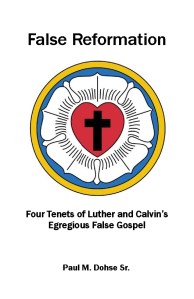
Something is changing. I don’t know how much this ministry has to do with it, but those who know something isn’t right, but can’t articulate it, are beginning to. The wolverine is being tied down and examined, and when that happens it’s not pretty. In one scathing review of me personally and the newly published False Reformation, a Reformed pastor stated the following:
My concern is not for those who have theological understanding; they will be able to see through Paul’s erroneous reasoning right away. My concern is for those who have so little biblical and theological instruction as to be able to discern the errors in Mr. Dohse’s arguments.
Get the picture fellow Average Joe Christians? Reading Paul Dohse’s ideas is something that shouldn’t be done at home by the ignorant totally depraved masses. In fact, in the book, I quote Southern Seminary president Al Mohler:
The main means by which God saves his people from ignorance is the preaching and teaching of the word of God. That’s why a conference like this is so important. It’s not just because we think of the pastorate as a profession set alongside other professions so that we can gather together for a little professional encouragement to go out and be a little better at what we do.
No, we’re here because we believe that those who teach and preach the word of God are God-appointed agents to save God’s people from ignorance [1]. (p.8).
And trust me, the good ole’ boys over at SBC Voices get that message loud and clear. I lay the vast majority of SBC problems at the feet of the Reformation. Because the Reformation was predicated on anti-new birth, Reformed Light propagated wimpy sanctification (including inept theological instruction for parishioners) and an overemphasis on getting people saved rather than making disciples. Sanctification was devalued. It wasn’t deemed important. My wife Susan addressed this at last year’s conference, and her words should be well noted. The following is a conversation she had with her Christian father shortly after a funeral they attended:
“Mrs. Coleman said, At least, he was saved. Can a person be a little bit saved and still go to heaven?” I asked. “Honey, there are all kinds of opinions on whether Lovell was saved. And God has final say in the matter, not the preacher.” I have heard that phrase many times at funerals or when speaking of someone who died. “Well, at least he was saved.” So Lovell lived like the devil, but at least he had his fire insurance policy, made effective because he walked the aisle, said the sinner’s prayer, and was baptized in the Big Sandy River. But I will have to agree with my dad. Only God really knows if Lovell was genuinely saved or not and resting in the bosom of Abraham. At my funeral, I hope more will be said about me than “at least, she was saved.”
And….
I encourage you pastors, teachers, and parents to obey Scripture and teach the dreaded D word: doctrine. Deuteronomy 6:6-9, “The Lord spoke to Moses and to us, and you must commit yourself wholeheartedly to these commands that I am giving you today. Repeat them again and again to your children. Talk about them when you are at home and when you are away on a journey, when you are lying down, and when you are getting up again. Tie them to your hands as a reminder. Wear them on your forehead. Write them on the doorpost of your house and on your gates. It is vital to know and to teach doctrine as we all follow the great commission. Go and make disciples.
The latest resurgence of authentic Calvinism in the SBC is going to finish the job; Calvinism Light says, “sanctification is not important.” Authentic Calvinism says, “What the heck are you talking about??? There isn’t any such thing as sanctification at all!” Six months after Luther’s 95 Thesis launched the Reformation, he put doctrinal feet on the Reformation with his Heidelberg Disputation. It is a complete dressing down of any idea that the Christian has worth in the eyes of God. It defines love itself as something that ONLY seeks what has NO value to the seeker. Luther considered the idea that Christians could please God in sanctification—anathema. By feeding on God’s love (salvation) alone and thereby affirming our worthlessness, we pave a safe road to eternal life.
Look, authentic Calvinism in the form of the latest resurgence, New Calvinism, will do what it always does—it will die a social death. But not before it will leave the SBC in ruins. Reformation Light and its wimpy sanctification has the SBC on its deathbed. Now authentic Reformation doctrine is presiding over the SBC in the form of Dr. Kevorkian. We will go from weak sanctification to no sanctification while, in their own words, “feeding on justification” for what they deceptively call “progressive sanctification.” The two ideas presented in this paragraph can clearly be seen from a link that I was sent by a PPT friend just yesterday. The blog author is a New Calvinist heavyweight, and the candid information on his blog speaks to what I am saying here specifically. The name of the blog is, “Gospel Shaped Living: exploring the completeness of Christ for us.” In other words, we don’t change, the shape of our life does (or the realm), and Christ, via our faith alone, obeys “for us” in sanctification. That’s the only thing that can make our sanctification, “complete.”
But as I was informed yesterday by the Calvinist bubbas over at Voices, you can’t draw any conclusions from a title; ie, Calvin really wasn’t saying that justification is progressive when he entitled 3.14 “The Beginning of Justification. In What Sense Progressive.” And no, I didn’t forget a question mark in that title. I was also informed by another Reformed guru yesterday that when Calvin stated that Christ’s death has a perpetual efficacy for the church (Isnt: 3.14.11)—that Calvin didn’t mean “perpetual” in a perpetual way, per se. Good grief. But here is something interesting from the post that was sent to me from the aforementioned blog:
Let me be clear. I am grateful for the working of God to renew Gospel focus across so many denominations and churches. It was just not so 30 years ago. The Gospel was the entry message for the Christian life, and after that, it was all law. I preached that way for the first ten years of ministry, until God sent a messenger to correct me. Now it seems every day a new book is published applying the Gospel to another area of life!
Well, where did it go prior to “30 years ago”? Actually, the conception of the resurgence was in 1970 officially, compliments of the Seventh-Day Adventist Awakening Movement that in fact rediscovered the true Reformation gospel of EVERYTHING sola fide. A fact many in the Convention are not overly excited to discuss.
Also, note his outright admission that salvation as an “entry” only was a problem prior to the rediscovery, and if salvation is only a “entry”, everything after that is “law.” Obviously, salvation must continue in order for everything not to be about law. This also speaks to the Reformed idea that law continues to be the standard for justification after salvation, and salvation by faith alone must therefore continue in order for that not to be the case. This is a huge problem. And also note that it is the same gospel that saved us that is applied to “another area of life” rather than a many-faceted biblical wisdom of learn and do discipleship. Note that’s “law.” So, is applying the same gospel that saved us to every area of life complicated? Of course it is—that’s why you need them. Also note that “books” are being written that reveal more ways of doing this “30 years” later!
The New Calvinist construct that was derived from authentic Reformed doctrine is dualism. It is knowledge of God’s holiness as set against our sinfulness. It is the good old fashioned knowledge of good and evil introduced in the garden. If Christians grow in sanctification—the Reformation metaphysical construct falls. That’s why it’s efficacious to Reformed theology that you are a dead man walking. That is why it is important that everything is done by Christ for us. That’s why it is important to always search the heart for revealed sin that supposedly makes God bigger and us smaller. But with all false doctrines—they implode—they cave-in on themselves. This is because we are wired to eventually act on what we believe; logic will eventually act on its presuppositions. Hence, the author states the following in the same post:
What I read on one side of this debate is pretty much advocating an endless monitoring of the state of my heart. Am I resting in Christ’s work for me? Am I feeding on my justification?
This seems to be a new legalism, an internal one. It is getting the functional Gospel right in my heart. I dare not do anything until I do so.
“Oh my, I obeyed, but I did so with a trace of self-righteousness. I need to make sure that does not happen again!”
“Dear me, I sought to please God but there was some self-sufficiency in that obedience, and I must repent and try to get it right next time.”
This paralyzes people. I think it is contrary to the apostolic method.
Paul reminds people of the objective truth of the Gospel. Then he calls them to act upon it. He does not call them to endlessly work on making sure they are getting the function of the Gospel correct before they do anything.
Putting the last two ideas together, I can begin the day with words like these: “I believe my righteousness is in Christ and his work, and his work alone. Nothing can change that. God is at work in me too, to make me like his Son.” Then I go into the day. Perhaps I remind myself of these things along the way. But I live based on objective affirmation of faith, not the quality of my resting in Christ.
Basically, meditate on the gospel, and whatever Christ might decide to do is “objective confirmation.” Anything that is within us is subjective. That is why this doctrine is often referred to as the objective gospel completely outside of us. But at any rate, people are always going to do something based on what they believe, and in this case, as the author notes, the endeavor to become more and more aware of how wicked we are becomes a new legalism in, and of itself. This is the futility of false doctrine—it usually becomes what it so vehemently opposes. Though the author’s solution is just more Reformed cognitive dissonance, he touches on what I saw yesterday at Voices. On steroids.
The post I addressed is a short one:
“Take care, brothers, lest there be in any of you an evil, unbelieving heart, leading you to fall away from the living God” (Heb. 3:12).
Search your heart oh friend
Hear this stanza
Repent of your hidden sin
Bring to Justice the Adam Lanza within
The loudest statement made by Adam Lanza on December 14, 2012 was, “Jesus is not Lord!” Although he did not verbalize this statement, he emphatically affirmed it by murdering his mother at her home and 26 other people (6 adults and 20 young children) at Sandy Hook Elementary School in Newtown, Connecticut. Then he further rebelled against his Creator and Sustainer by taking his own life.
Search your heart oh friend
Hear this stanza
Repent of your hidden sin
Bring to Justice the Adam Lanza within
This rebellion against the rule and reign of Christ is taking place all around us as men, women, and children unashamedly sin against their Creator. The question is whether or not you and I have the same rebellious heart (although we may express our rebellion differently), that led Adam Lanza to commit this horrid act of rebellion against God and His Word.
Search your heart oh friend
Hear this stanza
Repent of your hidden sin
Bring to Justice the Adam Lanza within
The sad reality is that every time you and I sin, we rebel against the Lordship of Christ. The answer for such rebellion is that we must continually repent and affirm the gospel, pursuing holiness with all our might while pleading the blood of the King of kings and Lord of lords alone! In other words, we must continually bring the Adam Lanza within to Justice (God) by trusting in Christ, forever reminding ourselves that our sins have been judged in Christ. Therefore, although we are guilty of emphatically proclaiming “Jesus is not Lord,” on the cross God treated Christ as if He was the rebel so that the rebellious could go free! How will you respond? Will you bring to Justice the Adam Lanza within?
Search your heart oh friend
Hear this stanza
Repent of your hidden sin. . .
The obvious suggestion of this post would find agreement with authentic Reformed mentality—even totally depraved Christians still have a propensity to murder children in cold blood for no apparent reason. There is no difference between our sin and the sin of the unregenerate. This makes God look bigger, and us smaller. This is Reformed epistemology. Notice that we are to continually search for inner sins that we need to, “Bring to Justice.” This is perpetual justification. Obviously. The New Calvinists in the SBC teach this, but deny it when confronted—even in the face of the obvious. When confronted, they defied reality itself without even blushing:
What you propagate here is a New Calvinist progressive justification.
I’m advocating progressive sanctification, not progressive justification.
You say plainly that progressive sanctification is by the blood of Christ. So, are [you] not saying that the justifying blood is the source of our sanctification?
The justifying and sanctifying blood of Christ is the source of our sanctification. The Holy Spirit gradually conforms us to Christ.
Are you saying that the finished work of Christ is not the source of our sanctification?
YES JARED, that’s exactly what I am saying. How is a finished work the source of what’s progressive? This was Paul’s specific beef with the Galatians. Justification is not the source of sanctification–the two are separate. This was Dr. Jay E. Adams’ specific argument against the contemporary father of New Calvinism, Dr. John Miller (Sonship Theology) in his book, “Biblical Sonship: a Biblical Evaluation.”
Paul, I’m not saying that justification is the source of sanctification. You’re saying I’m saying this regardless what I say. Offer your position from Scripture. Tell us what the source is for sanctification.
The “blood” represents Christ’s death on the cross for our justification. We were justified by it. You said that we are both justified and sanctified by His blood: “Paul, It is by the blood of Christ that we are justified and sanctified.” How can you now say that–that’s not what you are saying? But to answer your question: the new birth now powers our progressive sanctification, NOT THE OTHER.
Paul, the blood represents Christ’s death on the cross for our justification AND sanctification. We live by faith in the Son of God (Gal. 2:20). We are ever dependent on His finished work. The list of Scripture can go on and on. I’m saying that the work of Christ is the source for both our justification and sanctification, not that our justification is the source of our sanctification.
Paul, my point is that the source is the same not that justification and sanctification are the same. We are progressively sanctified by pursuing holiness while possessing faith in Christ.
Once again, no one is saying that we are sanctified by our justification. We live by faith in the Son of God. We do not look within for our sanctification, we look to Christ alone….So, tell us what you believe is the source of our sanctification if not the work of Christ.
NOT His finished work on the cross, of course, He works in our sanctification through the Holy Spirit, but that DOES NOT = “preaching the cross to ourselves everyday” because we still need to be justified by it.
Paul, I don’t think you can separate the Holy Spirit’s work in our hearts from the work of Christ. No one I’ve seen is arguing that we must continually be justified. You’re building up and tearing down a strawman.
….you say in the post that Christian sin must be continually brought to justice by the blood. That’s not progressive justification? It also makes the law the present affirmation of our just standing when the Scriptures plainly say that we are justified apart from the law. Here is what you wrote: “In other words, we must continually bring the Adam Lanza within to Justice (God) by trusting in Christ…How will you respond? Will you bring to Justice the Adam Lanza within?” I mean, are you saying that you were not using “justice” in a justifying way? Please explain.
Paul, I meant it exactly as Heb. 3:12 describes. We must continually trust in Christ alone for our salvation, making our calling and election sure as we live by faith in the Son of God. We are justified by His blood at the moment we first believe, and if we have been justified, we will continue believing. We must indeed confess ourselves sins while enjoying His forgiveness, not for justification but sanctification. We bring our sins to Justice (God) forever acknowledging our sins have been judged in Christ. Once again, we live by faith in the Son of God. The same blood that justifies us also sanctifies us.
I’ve asked you repeatedly to explain your position. You do not believe Christ’s work is the source of our sanctification, so what is?
The new birth is the source of our sanctification, not the blood which you use to replace, “justification.” Your New Calvinist position is a continual offering of the works of Christ in sanctification by faith alone. Southern Baptists have never believed in sanctification by faith alone because the law is still a standard for our justification in sanctification.
Key is your statement: “We must continually trust in Christ alone for our salvation, making our calling and election sure as we live by faith in the Son of God.” That’s not how the Scriptures say we make our calling and election sure (SPEAKING OF ASSURANCE). It states that we are to ADD to our faith for that purpose–it’s not by faith in the works of Christ ALONE that we gain assurance.
It’s not keeping our own salvation by faith alone. Our faith is already KEPT. It’s leaving the foot of the cross and aggressively pursuing the fruits of righteousness.
[As an addendum, note: “We must continually trust in Christ alone for our salvation, making our calling and election sure as we live by faith in the Son of God.” We “must” and “continually”” live by faith.” As I argue often, there is NO must to keeping anything for our salvation—not even faith which we cannot lose once God has granted it to us as a gift].
Paul, so what does the Apostle Paul mean when he says, “I have been crucified with Christ. It is no longer I who live, but Christ who lives in me. And the life I now live in the flesh I live by faith in the Son of God, who loved me and gave himself for me” (Gal. 2:20)? All I’m advocating is that Christians live by faith in the Son of God. We pursue holiness, putting on the new man, while constantly possessing faith in the Son of God.
We are not sanctified by our works. Also, you can claim that Southern Baptists have “never” believed what I’m advocating, but I would argue that the majority believe like I do.
We gain assurance by looking at the Holy Spirit’s fruit in our lives. This truth CANNOT be separated from living by faith in the Son of God. You cannot separate the Spirit’s work from the Son’s work. Christ’s work is the basis of both our justification and our sanctification. We pursue holiness while possessing consistent faith in Christ. We cannot separate the two. You seem to be separating the two.
1. What did Paul mean in Galatians 2:20? A word for justification appears 6 times between verses 15 and 21. 3:1-3 makes it clear that the context is works salvation by attempting to earn justification through a work that is finished. Verse 3 means literally, “are you reaching your end (glorification) by effort.” This coincides with Romans 8:29, 30. Paul’s argument is that they are trying to work towards a goal that is already finished. When we were unsaved, we were in the flesh and under the law–now we are dead to the law and the life we live in the flesh is sustained by Christ because the flesh involves law. Our justified state is by faith alone, and we are dead to the law. But you make this apply to sanctification as well. “Sanctification” is a biblical word and appears nowhere in this text, but “justification” does no less than 6 times. The crux of Paul’s point is verse 21: “I do not nullify the grace of God, for if justification were through the law, then Christ died for no purpose.”
So then, if sanctification is in these verses, then we cannot make an effort to keep the law in sanctification. We are also dead to the law in sanctification in the same way we are in justification. Therefore, we are dead in sanctification in the same way we are in justification, and Christ must keep the law for us in sanctification. And granted–that is the New Calvinist doctrine.
2. “We are not sanctified by our works.” Yes we are. Paul said that God’s will was our sanctification, and then described it as “abstaining” from…. Our enabled efforts in sanctification by all means does sanctify us (a setting apart from the world), and our end judgment will be for rewards, not to judge “the ground of our justification.”
3. “Christ’s work is the basis of both our justification and our sanctification. We pursue holiness while possessing consistent faith in Christ. We cannot separate the two. You seem to be separating the two.”
Yes, absolutely, I am separating the two. As can be seen by your above statement, if the two are fused together, I must maintain my justification in the same way that I was saved. This makes faith a work for the purpose of keeping our salvation. This is why JC Ryle stated the following: “But the plain truth is, that men will persist in confounding two things that differ–that is, justification and sanctification….What God has divided let us not mingle and confuse.”
How many times do I have to say that no one is infusing justification and sanctification together. Ya’ll are reading your own presuppositions into these men and my article.
How can you say you don’t fuse the two together when you posited Galatians 2:20 to make your point about faith alone for sanctification? Though the text doesn’t speak of sanctification, you say that “the life I now live” speaks to sanctification while the context of the passage is clearly justification. How can this be Jared? Jared, you said that OUR sins needed to be sought out and justified by Christ in the present through the blood. That’s what you You said. Words mean things.
Paul, where did I say that our sins must be sought out and justified? I didn’t you say it; you won’t find it. I said that our sins must be brought to Justice (God), not justified. There’s a difference. Once again, you need to take the time to actually understand what people are arguing before you throw around words like “heretic.”
You may consider the obtuse contradictions following by the author of the post at Voices:
“The justifying and sanctifying blood of Christ is the source of our sanctification.” ≠ “Paul, I’m not saying that justification is the source of sanctification.”
“No one I’ve seen is arguing that we must continually be justified. You’re building up and tearing down a strawman.” ≠ “In other words, we must continually bring the Adam Lanza within to Justice (God) by trusting in Christ…How will you respond? Will you bring to Justice the Adam Lanza within?”
“We cannot separate the two. You seem to be separating the two.” ≠ “How many times do I have to say that no one is infusing justification and sanctification together. Ya’ll are reading your own presuppositions into these men and my article.”
“Paul, where did I say that our sins must be sought out and justified? I didn’t you say it; you won’t find it. I said that our sins must be brought to Justice (God), not justified. There’s a difference.” ≠
Repent of your hidden sin
Bring to Justice the Adam Lanza within
I have said it before and I will say it again: corresponding with these yo-yos is a total waste of time. I do it for educational and ministry purposes, but no resolution or unity will ever be accomplished by trying to reason with these people. Personally, I don’t even take them seriously anymore. God’s people need to come out from among them at all cost. That’s where all of this is going anyway.
Again, the movement will die a social death as it has five times prior to today after Calvin’s Geneva theocracy. The rise and fall of those movements will be documented in the second volume of The Truth About New Calvinism. But concerning the carnage that will be left behind before the next decline into insignificance; a pity. The goal of this ministry is to educate God’s people in hopes of accomplishing the following to whatever degree we can in our little corner of the universe: hastening its inevitable death, and preventing its return.
paul

John MacArthur: The Bad, Good, and Ugly
The Bad
Without a doubt, one of the greatest disappointments in my life is John MacArthur’s departure to the dark side of progressive justification leading to a doublespeak and ambiguity that never characterized his teaching in the past. In an article entitled, “Justification by Faith,” he first states that “if sanctification is included in justification….that makes justification progressive….” Then he goes on to state in the same article that the two can never be “separated.” MacArthur now functions in the Reformed world that creates its own reality; we can never separate things that shouldn’t be included. I find this nonsense coming from a man that has been granted awesome opportunity in sharing the gospel intolerable.
Furthermore, associations with hardcore Reformed mystics and the granting of credibility thereof further disturbs. He recently published a pricy theological book with hardcore Reformed mystic Joel Beeke entitled, Justification by Faith Alone: Affirming the Doctrine by Which the Church and the Individual Stands or Falls. This book boldly proclaims that the individual and even the church stands or falls on the gospel of progressive justification. It’s outrageous and despicable.
The Good
But yet, before a recent sermon, MacArthur made a statement in regard to the recent Newtown massacre. He noted that Christians should have answers in the midst of such events. This is a tremendous breath of fresh air as opposed to the usual whiffle dust that Christians offer in such situations. His statement offered powerful points in regard to a Christian worldview on this matter, and offered hope for the victims. He also noted the substantive outreach to the victims in that area by former GCC associates. It was truly a sweet visitation to the MacArthur that I used to know. Yes, a few perspectives made me a little queasy, but I think this 5 minute statement is one that every Christian should ponder, and it can be listened to here: http://www.gty.org/Blog/B1212172#.UNE5ab1IMlY.twitter
The Ugly
Yet, the fact remains that this ministry continues to deal with its share of the havoc being wreaked on the church daily by the false gospel of progressive justification. It is unclear whether MacArthur thinks the doctrine is a valuable supplement, or whether he has totally bought into the whole package. Furthermore, his counseling ministry headed by Dr. John Street offers blanket credibility to NANC and CCEF. Street is the president of NANC. Both of these ministries together constitute 90% of our present-day active biblical counseling. But yet, the counseling of both is grounded in the gospel of progressive justification. This is counseling that denies the idea that people can really change. It is a ghastly misrepresentation of criminal proportions in the name of Christ.
No doubt, remnants of what he formally taught are still present. He has written books that I would still recommend: “Saved Without a Doubt,” and “How to Meet the Enemy.”
BUT, I would only recommend these writings specifically, and would add extreme caution when reading or listening to anything Mac. Time is valuable. A pity that teachers who can be listened to without launching an investigation on every sentence they utter are becoming fewer and fewer. But it is what it is, and predicted by the apostles.
paul
Clearcreek’s Russ Kennedy and Southwood’s Jean Larroux III: The Divine Right of Philosopher Kings
 Though in the title, Jean Larroux, pastor of the gutted Southwood Presbyterian Church (the subject of several articles here at PPT), has little to do with the crux of the issue to be discussed here. This post is in response to some requests by Southwood members to divulge information I have concerning alleged indiscretions unbecoming of a pastor. I obtained the information through an email by a person who identified _____-self. The information has been vetted and is credible for several reasons. I have not re-contacted the sender of the email, but could probably obtain even more confirmation points if deemed necessary. Where I am going with this will require the laying of some groundwork. Clearcreek Chapel in Springboro, Ohio will supply some additional and helpful examples.
“Cult” is a word that is thrown around quite a bit in Christian circles, but in reality, for good reason. The essence of a cult is CONTROL. Cultwatch.com posits this definition of a cult:
The modern definition of a mind control cult is any group which employs mind control and deceptive recruiting techniques. In other words cults trick people into joining and coerce them into staying.
Cultism dates back to the cradle of civilization and is part and parcel with a basic concept that forms the philosophical infrastructure of all false religious groups. It begins with the presupposition that the masses are spiritually incompetent, and that preordained individuals are selected by God, the universe, or some other higher power to rule the masses on the behalf of that entity. Determinism is almost always a mainstay in said presupposition.
In the Platonist construct (which replaced mythology in these systems with a more scientific approach), the philosopher kings rule, the soldiers enforce the will of the kings (father [entity] knows best), and the masses are the producers who’s sum and substance of life is for the predetermined good of society as a whole. And the philosopher kings know best how to bring that about. And therefore, they should RULE the masses.
If at all possible, philosopher kings will use the sword and fear to keep the process running smoothly, but mind control, brainwashing, and indoctrination will always be present as the staple modus operandi. Such reduces the need for the sword, but the sword has the final say if necessary. The authority of the philosopher kings to send you to hell for eternity is also a strong incentive to live for the group or the whole, which is the “vision of the good.” So, job one is CONTROL.
This is the staple doctrine of EVERY religion that operates apart from truth, capital T. So, wherever truth is not practiced in religion, there is going to be a strong cultish feel in the mix. From a pure biblical perspective, the word is SECT, or SECTARIAN. These are groups who divide with UNTRUTH. So, a strong, very strong element of the cultish motif is lots of division. While cults maintain an operative core, it is at the expense of relationships and other human infrastructures. AND, the primary focus of the philosopher kings—where most of their energies will always be expended, is in maintaining CONTROL—leading to the cultish aura. Hence, “Hey Paul, we are going to this you fill in the blankchurch and I know this sounds crazy, but I think it’s a cult.” I don’t doubt it a bit. ANY system based on the spiritually enlightened ruling over the incompetent masses WILL have the cultish aura.
With all of that said, what about the moral fitness of the philosopher kings? Well, that depends on the particular gargantuan-faceted variances of this ancient principle, but for the most part, the moral fitness of the philosopher king is irrelevant. And throughout history, those who think otherwise and are vocal about it have become a rare breed. Ever heard of a guy named John the Baptist? Especially in Reformed circles where we are all totally depraved “sinners saved by grace,” and all being captive passengers on the Love Slime Boat, integrity doesn’t have relevance in regard to the spiritual caste system needed to lead the totally depraved safely to heaven. Those who don’t get it are mercilessly slaughtered for the sake of the group and the wellbeing of the whole. In America where John the Baptist types can’t be burned at the stake, hanged, or beheaded; slander, bogus church discipline, character assignation, and false criminal charges attempt to fill the gap in silencing detractors. Furthermore, antinomianism may be the very doctrine of the philosopher king to begin with. This reality is known as the divine right of kings:
The divine right of kings, or divine-right theory of kingship, is a political and religious doctrine of royal and political legitimacy. It asserts that a monarch is subject to no earthly authority, deriving the right to rule directly from the will of God. The king is thus not subject to the will of his people, the aristocracy, or any other estate of the realm, including (in the view of some, especially in Protestant countries) the Church. According to this doctrine, only God can judge an unjust king. The doctrine implies that any attempt to depose the king or to restrict his powers runs contrary to the will of God and may constitute a sacrilegious act (http://en.wikipedia.org/wiki/Divine_right_of_kings).
Therefore, the formula: higher power >+ enlightened proxy rulers >+ totally depraved = spiritual caste system = control = cultism = sectarianism = tyranny.
Let’s talk about the operative core that philosopher kings/pastors/elders are able to keep intact. Many people are inclined towards cult atmospheres. Some people are just there for the social community of it all. They like the people, the parties, the events etc. Many people there may be of the same cultural mindset as well. TRUTH is low priority—they hold to the doctrine of the leaders for the sake of community. A second group to consider are those who are simply adverse to change. Normality and business as usual is very important to them. Things would have to get pretty crazy before change would be considered. There is also a group that will follow whatever is placed in front of them. They simply have no discernment. Some know things aren’t right, but have been brainwashed into thinking that there isn’t anything better out there. Besides, to leave would also be admitting to complicity in unjust things that took place; things that are spawned by sectarianism. Finally, there are those who have totally bought into the doctrine. Dissenters who care enough about the truth to raise concerns are disposed with in one of several aforementioned methods.
But the bottom line is the following: churches that function by a caste system are in continual damage control mode. Everything else is window dressing. Real ministry is not taking place. The elders spend all of their time indoctrinating. Again, CONTROL is job one. Sermons are not focused on Scriptural life-wisdom—the focus is indoctrination for control purposes. There is going to be a constant tension, and one reason for this follows:
The written word of God poses a huge problem for the religious caste systems that have plagued the world from the beginning of time—the spiritual elite ruling the masses on God’s behalf via supposed direct revelation and authority. As church historian John Immel notes: The problem is that God is not standing there beside them and confirming His agreement. Or is He? The superintended life manual of God, and its availability to the masses poses a huge problem for those who wish to rule over men: God is telling us what He is telling them, and the tendency is to think God knows more than they do.
And it is clear that God’s word speaks to the individual. The books of the Old Testament and the letters of the New address the whole congregation of the saints. Yes, there are leaders among God’s people, but they are obviously very accountable. There are no closed board meetings between God and church leaders. Luke wrote two letters, really a book in two parts, for the benefit of one person. Why? “….that you may have certainty concerning the things you have been taught” (Paul Dohse: False Reformation; p. 97, TANC Publishers 2012).
This is where Clearcreek Chapel, the church that incited my journey into these matters, supplies a helpful example. The leadership of that church is in constant damage control mode. Their sermon and teaching modules are continually focused on indoctrination and authority. Even when I was last there (circa 2006), there was a climate of fear. Often, their choice of sermon topics are driven by the latest challenges to their doctrine. Apparently, the last episode was in September of this year, prompting a sermon series entitled, “Biblical Authority at The Chapel”:
And, I want to dispel one false, wicked slander about us and churches like us. We do not believe or teach or require absolute, unquestioning submission to the leadership of this church. Whatever you have been told; whatever bad experience you have had elsewhere, I plead with you to listen this morning to God’s word. So in what I am going to say this morning, I am trying to hover close to the Bible and build a Biblical understanding of authority in God’s Kingdom. Tonight, Pastor Dale will help us think about how we take these precepts, principles and patterns and institute Biblical governance and guidance in the church. [and at the pm service: “A recent criticism has been leveled that we at Clearcreek Chapel engage in some sort of Christian mysticism.”].
No? They insist on “absolute, unquestioning submission” to “biblical authority.” BUT, they are the only ones that can properly interpret it! What’s the difference? As noted in the new publication of False Reformation (pp.110,111), another elder at Clearcreek plainly stated that personal study was only a supplement to efficacious elder preaching, and that the word came from God to the elders, then to the parishioner—back to the word, and then back to God with faith being the result. Clearly, the elders and the word are between the believers and God:
You think, perhaps, that [you] can fill up the other half of the plate with personal study, devotions, or quiet times, or a radio program. Beloved, you cannot. Scripture is relatively quiet on such practices. But on preaching, the case is clear and strong. Neglect preaching and neglect your soul. I know that some are kept from services for legitimate reasons which are out of their control, but I doubt that is the case for most. I beseech you, change your ways for the good of this people and for the good of your own selves. Give the Word its rightful place. As I have often said, there is no better place you could be than here, under the preaching of the Word.
The text here implies that there was an interactive nature between three entities: The preacher, the hearers, and the Word. Note this cycle: Paul, from the Word, delivers words. The Bereans, from Paul’s words, go to the Word. The Word cycles from God, through the preacher, to the people, back to the Word, and this, verse 12 tells us, produced belief in the God of the Word. An important thing to note is that this happened daily – suggesting a regular interaction between preaching, personal study, and the Word.
The Bereans eagerly prepared by paralleling their own Bible reading and study with Paul’s preaching. So a good preparation for the public preaching of the Word is the private consumption of the Word. It will be the seasoning that brings out the flavor – salt on your French fries, if you will.
In the first part of the series, Kennedy makes it clear where the authority to interpret resides:
The New Testament often uses the word translated overseer or bishop. This word was primarily was used in the culture to refer to a governor who was sent by a conquering king to govern a city/state on behalf of the king. The overseer, the governor was to exercise oversight under the law the king had given. He was serving, not on his own behalf, but in the place of and for the good of the king. This is the term used for Elders. We are to govern the church on behalf of our King Jesus using the Scriptures as that which expresses His will and frames His wisdom. We are to govern and guide according to the Word of God.
But by the same token, these elders, and many others like them believe that all Scripture must interpreted in a way to yield a Christocentric (grace) meaning. Again, as noted in False Reformation (p. 100):
At this time, resist the temptation to utilize subsequent passages to validate the meaning or to move out from the immediate context. Remembering that all exegesis must finally be a Christocentric exegesis.
Look for Christ even if He isn’t there directly. It is better to see Christ in a text even if He isn’t, than to miss Him where He is.
Kennedy illustrates this in the same message via the following illustration.

Taken together, it is clearly a mystical approach that sees every verse in the Bible as redemptive, and a task that elders are only qualified to execute. This is spiritual cast that dates back to the beginning of time and always leads to tyranny. The point here is to clarify the divine rights of philosopher kings.
Now let’s address the ill behavior of Jean Larroux, and why it’s not relevant. First, the behavior. Jean Larroux’s outrageous behavior in the name of Christ is well documented. Larroux is the subject of chapter 8 in Cathleen Falsani’s “Sin Boldly.” Right, that’s the title of the book. It’s a treatise on, let’s sin more so grace may abound. According to Falsani, Larroux told her (in a conversation endowed with cursing and cigarette smoking) that the depths of grace can only be understood via the depths of our sinfulness. This is no less than the doctrine of the knowledge of good and evil that adorns the vast majority of tyrannical spiritual caste systems—especially Calvinism. This is the same Christocentric interpretation that the Clearcreek elders constantly refer to. All Scripture must be interpreted via God’s holiness as set against our wickedness. Obviously, if wisdom is the goal, and obedience puts us in a good light as opposed to endeavoring to understand our evil more and more; well, you do the math.
But there is something interesting about the writings of those, like Larroux, that think it better yet to actually practice evil as well to better understand grace; the disturbance of the conscience is clearly seen. However, it is usually seen as a vice to be overcome and related to an inept understanding of grace. On a blog belonging to a pastorate that preceded Southwood, Larroux writes the following:
I am becoming keenly aware of how little I actually believe the Gospel that I have been called to preach. I find it ‘easy’ to preach the truth, yet believing it is harder and harder.
Nevertheless, Larroux is a member of a prestigious club of Presbyterian philosopher kings—he is untouchable, and his sin is irrelevant to the Presbytery, and frankly, to most of the Presbyterian producers. I seriously doubt that many are unaware of the things revealed in the email I received, though heinous.
I receive many emails from hurting people who see this in the church and don’t know what to make of it. When you love the truth, it’s hard to get your mind around it. The email revelation will only build hope that someone will care with the enviable disappointment to follow, and deeper wounding.
Come out from among them. Where will you go? Go anywhere but back there. But wherever you end-up, Christ our brother will be with you, and our Helper will counsel you with powerful words from the Scriptures as you go.
All you lovers of the truth—Christ loves you, and for what it’s worth, I love you.
Forever His, and forever a yokefellow to the lovers of truth.
paul



14 comments