Bible as Story? Have We Lost our Minds?
 Here at the Potter’s House we do family readings. Right now, we are reading through the novel, The Witch of Blackbird Pond by Elizabeth George Speare. The book is what we call a historical novel. These are fictional books that attempt to convey the experience of historical facts. Historical novels attempt to put you into the historical event experientially. So, historical novels aren’t “just facts,” but attempt to enable you to understand how people in said historical event experienced it.
This is done well in Speare’s Blackbird Pond. You feel Kit’s angst as she peruses the Puritan shoreline of America for the first time. She senses the abysmal aura as set against the colorful structures in Barbados. And for anybody who knows Puritan history, Kit’s suspicions that something is culturally array in the new land is truly chilling. You want to say, “Run!” But, of course, it’s just a story. Historical novels “put you in the story.” The counterpart is academic history which focuses on facts and is not concerned with personal experience.
Vestiges of the concept can be found in mythology and Plato’s concept of Genre which Aristotle and others helped him develop. The concept was integrated into biblical hermeneutics circa 180AD. The idea of Bible as historical narrative was eventually dubbed Biblical Theology by Johann Philipp Gabler (circa 1785) and further developed by Geerhardus Vos in the 19th century. It was known as Redemptive Historical Hermeneutics in the Dutch Reformed churches during the 1940’s. In the secular realm the debate rages as to which approach educates more effectively (http://goo.gl/zo7zp).
And here we are today. The propagation of Bible as a history narrative is in Blitzkrieg mode. The Bible is not to be researched grammatically, but is to be approached like a novel; our goal is to enter into the “unfolding drama of God’s redemptive story.” Those are the words that are actually used. With any novel, it is the writer’s burden to draw the reader into the plot; in this case, the Holy Spirit. All that is necessary is to approach the Bible as gospel narrative, and the Holy Spirit will do the rest. In fact, many Reformed teachers assert that the Holy Spirit will not teach unless you are reading your Bible as a gospel narrative:
That which makes the Bible the Bible is the gospel. That which makes the Bible the Word of God is its witness to Christ. When the Spirit bears witness to our hearts of the truth of the Bible, this is an internal witness concerning the truth of the gospel. We need to be apprehended by the Spirit, who lives in the gospel, and then judge all things by that Spirit even the letter of Scripture.
I want you to feel the truth and depth and wonder that awaits your lifelong labor of love in pondering the inexhaustible portraits of Jesus given us by Matthew, Mark, Luke, and John.
Nothing can raise those who are spiritually dead or continually give life to Christ’s flock but the Spirit working through the gospel. When this happens (not just once, but every time we encounter the gospel afresh), the Spirit progressively transforms us into Christ’s image (Paul Dohse: The Truth About New Calvinism pp. 99, 100).
Recently, I made some observations about Wade Burleson’s blog, Istoria Ministries:
“If the Bible is God’s revelation to man, and it is, be sure that he will also reveal how he wants his word to be interpreted. Fact is, the Bible has built-in rules for interpretation throughout. ANY rules of interpretation for a text must be validated by the Bible itself. So, what about Bible as story or narrative? After an exhaustive study on what the Bible would state about this interpretive model, it begs the question: where is it?”
On that note, let’s start with a blog named “Istoria Ministries” by Reformed teacher/pastor Wade Burleson. The subtitle reads as follows:
Istoria is a Greek word that can be translated as both story and history. Istoria Ministries, led by Wade and Rachelle Burleson, helps people experience the life transforming power of Jesus Christ so that their story may become part of His story.
Burleson is right, it is a Greek word, but is it in the Greek New Testament? After hours of research, I cannot find it anywhere. In fact, Hebrew or Greek canon words that project the English idea of history, narrative, or story are either extremely scarce or nonexistent. The closest idea is the word “parable” which is a story that helps define truth. It’s a teaching tool. But in every case where a parable is implemented as a teaching method, the Bible plainly introduces it as such beforehand. It doesn’t appear that parables in the Bible are meant to be stories that explain the story.”
The next day, Burleson changed the subtitle to the blog as follows:
“I went to Jerusalem to become acquainted (Greek: istoria) with Cephas.” Paul’s words in Galatians 1:18.
Only thing is, the word is not “istoria,” it is “historeo.” Istoria seems to be a word that, in fact, can be interpreted as story and history both, but is primarily a Greek word of contemporary origin. Not only that, according to Spiros Zodhiates, historeo appears in the Greek New Testament ONCE; specifically, the verse Burleson cites in his revised subtitle. A Strongs number search with Olive Tree software confirms such as well.
We don’t obey novels. We don’t obey narratives. We don’t obey stories. And the Lord wants us to experience what we learn in the Bible by applying it to our lives (James 1:25). Parables in the Bible are teaching tools that aid us in understanding the primary points—a history parable is not the sole interpretive genre that makes the Bible what it is.
You do not build a life on a rock by reading novels—you do it by putting what the Lord teaches into practice (Matthew 7:24). If Christ wanted us to read “these words of mine” as a story why would He have not plainly said so? If we live by the redemption story, why wouldn’t Christ plainly state that instead of, “every word that comes from the mouth of God?” If it’s a story, why would Christ call it “all that I have commanded”?
Have we lost our minds?
paul
Yawn. I’m a “Pharisee.” Go Figure
This blog has always been a tool for working through the best ways to earnestly contend for the faith once delivered to the saints. For three years this blog has tested theses after theses with an open invitation to be proven wrong on every point by the New Calvinists. And no doubt, adjustments have been made. Though mostly personal attacks and the pointing out of 2-3 grammatical errors in a 2000 word post, acceptance of criticism has been key to where this ministry has come. And it has been a long, hard road. I didn’t just put up a blog and start writing, among many other preparations, I took college courses for the specific purpose of being as effective as I could be.
Some critical emails serve my purpose, and this morning, I received a New Calvinist jewel. It is a wonderful piece of Reformed talking points that exposes their egregious false gospel and the verbiage they attempt to use in the winning of an argument. The email can be addressed in order and point by point. Mighty convenient.
You would have made an excellent Pharisee. Like you, they delighted in law, instead of delighting in Christ. They searched the Scriptures because in them they thought they had eternal life, but Jesus said “they [the Old Testament Scriptures] are they that testify of me, but you do not wish to come to me that you might have life.” Then he makes the bold claim about Moses’ writings, “he wrote of me.”
First, Reformed hacks have fed on the Pharisee lie for a long time. The Pharisees were NOT “legalists” (a word that is not in the Bible), but were rank antinomians (“anomia,” a word that appears throughout the New Testament). They didn’t love the law, they loved their tradition. Christ’s specific indictment against the Pharisees was that they made the law void by integrating it with their traditions (Matthew 151-9, Mark 7:9-13).
Like you, they delighted in law, instead of delighting in Christ.
As we have seen, they DID NOT delight in the law, they delighted in their tradition. But note that although the Scriptures say Christians delight in the law (Romans 7:22), according to the Reformed false gospel, we can’t delight in the law and Christ both. To delight in the law is to delight in the law “instead” of Christ. It’s either the law or Christ—it can’t be both. This should speak for itself, and I have written extensively on the Reformed heresies that this reasoning is founded on. Primarily, Luther believed that reality could only be interpreted through one of two prisms: the cross story (the works of Christ [reality]) or the glory story (anything we do [unreality]). This can also be seen in the first tenet of New Covenant Theology which is the stream of Reformed thought that came out of the Australian Forum via Jon Zens:
New Covenant Theology insists on the priority of Jesus Christ over all things, including history, revelation, and redemption. New Covenant Theology presumes a Christocentricity to the understanding and meaning of all reality.
It’s Gnosticism—pure and simple. Christ is the “vision of the good” and everything else is evil.
They searched the Scriptures because in them they thought they had eternal life, but Jesus said “they [the Old Testament Scriptures] are they that testify of me, but you do not wish to come to me that you might have life.” Then he makes the bold claim about Moses’ writings, “he wrote of me.”
Of course Moses wrote about Christ, but does that mean that everything in the Old Testament is about Christ only and not what he tells us to do? Part and parcel with being saved is a commitment to follow Christ by obeying the law (“follow me”). When we commit to Christ, we are recognizing that He will (after the commitment) make us slaves (douleuo) to His law (Romans 7:25). In what I call the gospel according to Moses in Exodus 21:3-8, he splatters them with blood AFTER their commitment to obey the law. Peter alluded to this event specifically in 1Peter 1:1, 2. Before the foundation of the world, and according to God’s foreknowledge and our setting apart by the Spirit, we were set apart “FOR obedience to Jesus Christ” and for “sprinkling with His blood.”
Let me be clear: we don’t do anything to be saved, but when Christ makes us new creatures, He also enslaves us to His law and enables us to obey it. Though we can’t do anything to be saved, we should know that when Christ answers our plea for salvation—He makes us His slave. We now seek to “follow” Him in obedience and love Him by keeping his commandments. I can’t state this fact better than the apostle Paul:
Romans 8:1 -There is therefore now no condemnation for those who are in Christ Jesus. 2 For the law of the Spirit of life has set you free in Christ Jesus from the law of sin and death. 3 For God has done what the law, weakened by the flesh, could not do. By sending his own Son in the likeness of sinful flesh and for sin, he condemned sin in the flesh, 4 in order that the righteous requirement of the law might be fulfilled in us, who walk not according to the flesh but according to the Spirit. 5 For those who live according to the flesh set their minds on the things of the flesh, but those who live according to the Spirit set their minds on the things of the Spirit. 6 For to set the mind on the flesh is death, but to set the mind on the Spirit is life and peace. 7 For the mind that is set on the flesh is hostile to God, for it does not submit to God’s law; indeed, it cannot. 8 Those who are in the flesh cannot please God.
The Pharisees didn’t search the Scriptures for that purpose. This Calvinist, like all of them, makes the fact that they searched the Scriptures for something other than Jesus synonymous with searching the law for ways to work your way into heaven. Christ didn’t even begin to give them that much credit for being closer to the truth. He stated that they made the law of God “void” altogether. Furthermore, many Jews thought they were saved by virtue of the fact that God had appointed them as caretakers of His word. He could have just as easily been referring to that, but it is clear that Christ’s broader point was the following: while claiming to be experts on the law, they were rejecting Him who is one of the major themes of the Scriptures. The other major themes are the other two members of the Trinity.
A person would have to be spiritually blind to miss the typological relationship between the Old Testament Scriptures and the truth revealed in Christ. You are right to observe “The Bible has built-in rules for interpretation throughout.” Not only did God reveal his truth through Jesus and the Apostles; he also revealed to us through their example how we are to interpret the Scriptures.
You seem to have misunderstood the nature of biblical typology. One of the characteristics of a type is that, unlike allegory, it is based on historical fact. We reject the allegorical method of interpretation, but fully embrace the typological pattern Jesus and the Apostle’s used and taught. If you should try to interpret the Book of Hebrews, for example, apart from typology you would be completely at sea. And what of John’s declaration “Behold the Lamb of God?” and Jesus’ declaration “I am the bread of life.” Typology is not a Greek hermeneutic; it is a biblical hermeneutic.
I don’t misunderstand the Reformed approach to “typology” at all. The following is the 6th tenet of New Covenant Theology:
All of the Old Testament scriptures are inherently prophetic in that the entire Old Testament, the Law, the Psalms, and the Prophets, point forward to and anticipate the WORD Incarnate, Jesus Christ (Hebrews 1:1-2). New Covenant Theology presumes that Jesus Christ, in his person and his saving acts, is the hermeneutic center of the Bible.
Then, John Piper states that our justification is maintained by meditating on those saving acts alone:
In the first image, the believer has no security or confidence that he will make it to heaven. In the second image the believer has security in the wrong place; a kind of automatic eternal security that can get you to heaven another way than by the chain of God’s saving, persevering acts revealed in Scripture.
Hence, we persevere to the end by God’s “saving” “acts” PLURAL as “revealed” in “Scripture.” It’s salvation by seeing all of Scripture as redemptive acts. Typology is needed to do this because a literal interpretation causes many problems with this approach. The whole Bible must be interpreted by “rich typology.” Meditation on the works of Christ alone in the Scriptures enables us to live by faith alone in sanctification as a means of maintaining our just standing. Again, Christ plus mediation on his works alone as found in the Scriptures to keep our salvation intact. We are doing something (meditation), and not doing something (obeying the law in sanctification) to keep our salvation. That’s a problem.
You wrote, “To take away from this construct by making the Bible a narrative rather than objective law is to drive a stake through the essence of the of the gospel.” For you, law is the gospel. You even stated that “Law” and “gospel” are used interchangeably. It is true to state that on occasions the term “law” is used as a synonym for the revealed truth of God, but that is altogether different from stating that law and gospel are used interchangeably. You would have found full agreement with the Pharisees. The reality is that Law and gospel are founded on two distinctively different principles. The principle of law is “the man who does them shall live by them.” The principle of the gospel is “the righteous shall live by faith.” Those principles are mutually exclusive. If it is of works, it is no longer by grace.
This statement reveals how ignorant Calvinists think the average parishioner is. “Gospel” means “good news.” All of God’s word is “good news.” This Calvinist, like all Calvinists, makes the good news of the blood synonymous with all of the good news in the Bible, and then makes it mutually exclusive from the law. The Sermon on the Mount is the “good news of the kingdom,” but Christ’s death, burial, and resurrection is not once mentioned in the sermon. The death, burial, and resurrection is the good news of “first importance” (protos 1Cor. 15:3). The word speaks of the order, or what is before what is next. We are to then add works to the foundation of our faith in sanctification (1Peter 1:5-11).
He continues:
The reality is that Law and gospel are founded on two distinctively different principles.
How can that be? We wouldn’t know anything about the gospel if it wasn’t for the law. Law isn’t just the Ten Commandments, it’s the full counsel of God (Matthew 5: 18). Instead of the law (word of God) informing us on the gospel, he makes the gospel a separate entity “founded” on a different “principle.” But we are either “under law” or “under grace.” And “under grace” DOES NOT EXCLUDE THE LAW, but in fact ENSLAVES US TO THE LAW (Romans 7:25). A Christian is also defined by his/her ability to keep the law as opposed to those who are under it (Romans 8:7,8). Furthermore, one of the primary purposes for which we were saved was so that the righteous requirement of the law could be fulfilled in us (Romans 8:4).
His erroneous Reformed position is further stated:
The principle of law is “the man who does them shall live by them.” The principle of the gospel is “the righteous shall live by faith.” Those principles are mutually exclusive. If it is of works, it is no longer by grace.
This is a clear fusion of justification and sanctification by virtue of the fact that law/works and faith/grace are mutually exclusive. Law is totally separate, rather than having a different relationship to both. Hence, those “under grace” cannot be enslaved to the law which is synonymous with unregeneration. If the law is mutually exclusive—there is no gospel. A saved person is enslaved to the law.
Moreover, his statements lack a context in regard to justification and sanctification because the Reformed see them as the same thing. Hence, “The principle of law is ‘the man who does them shall live by them’”….for justification or sanctification? “The principle of the gospel is ‘the righteous shall live by faith’”….for justification or sanctification? If the Reformed answer honestly, they say, “both” because they see the two as being the same.
I have never encountered an individual who claimed to be a Christian as you do who seemed to delight so much in detracting from Christ. There is no question the Scriptures provide us with moral principles and flesh and blood examples [usually negative examples in the OT Scriptures] of how we should live, but the Scriptures are more than a legalistic manual for life. If you read the Scriptures and miss Christ, you have missed the heart of the biblical message.
You have often stated that we believe “every verse in the Bible is about Jesus.” It is difficult to imagine that anyone could believe 1 Chron. 26:18 “at Parbar westward, four at the causeway, and two at Parbar” for example, could be a reference to Jesus. Your claim, as is usual for you, twists our position. What we do believe is that the Scriptures are not primarily a book about laws, but primarily a book about Christ. Even those passages that report the abysmal failures of prophets, priests, kings, judges, etc. point forward to him who will fulfill these offices perfectly to the glory of God.
I will conclude with the simple truth that these last two paragraphs by him illustrate the Reformed, and very Gnostic Emphasis hermeneutic.
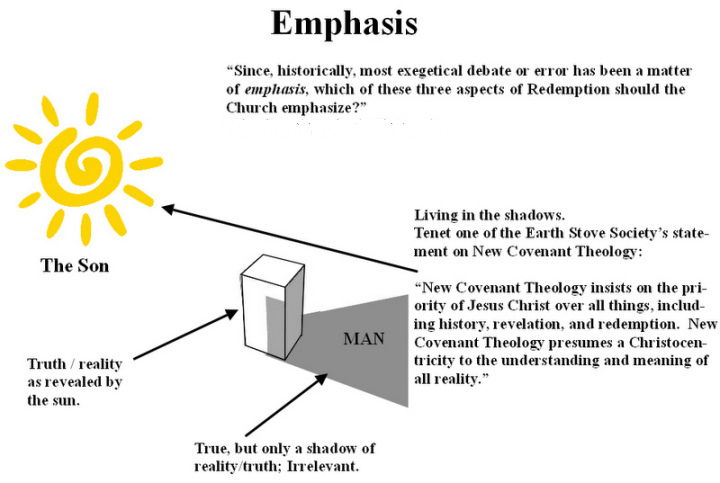
Sure, shadows are true, but to the degree that we focus on the shadows, we detract from the full life-giving powers of the sun Son. Sure, the new birth is true, but to the degree that we focus on a work that is supposedly done within us, we detract from the Son. Hence: “I have never encountered an individual who claimed to be a Christian as you do who seemed to delight so much in detracting from Christ.” Other Reformers warn of “eclipsing Christ” by emphasizing the Father and the Holy Spirit as much as Christ. In Gnostic venues, focus on the material detracts from the “vision of the good.”
Therefore, though I say they believe every verse in the Bible is about Christ to make a point, more accurately, they believe that Scriptures where Christ can’t be seen shouldn’t be “emphasized. ” That would be a problem because Christ stated that man lives by “every word” that comes from the mouth of God (Matthew 4:4). An example of how this incites the Reformed to approach the Bible follows:
Immediate context is vital; however this is a starting point and not an end. From the immediate context begin to think of the wider contextual range (Sentence, Paragraph, book, whole Bible). At this time, resist the temptation to utilize subsequent passages to validate the meaning or to move out from the immediate context. Remembering that all exegesis must finally be a Christocentric exegesis.
Ever wonder why everything is About Jesus in Reformed churches and the Holy Spirit and the Father are seldom mentioned?
That’s why.
paul
The Potter’s House: February 3, 2013; Why Christians ARE Holy and Righteous NOW
In Romans 8:1, we read the following:
There is therefore now no condemnation for those who are in Christ Jesus.
The word, “condemnation” means a guilty verdict. Christians are presently not guilty. Not only are we guiltless, we are a “holy nation” (1Peter 2:9). Paul precedes this statement with the word “therefore” which means for that reason, consequently…. So, we must back up to the previous verses:
Romans 7:25 – I thank God through Jesus Christ our Lord. So then with the mind I myself serve the law of God; but with the flesh the law of sin.
This is the construct of the new creature in Christ. We serve the law of God with our minds, but with our flesh we serve the law of sin. Literally, our minds are slaves to the law of God. “Serve” is the word douleuo which comes from the word doulos meaning slave. One of the few translations that get this right is the NIV:
Thanks be to God, who delivers me through Jesus Christ our Lord! So then, I myself in my mind am a slave to God’s law, but in my sinful nature a slave to the law of sin.
Paul calls this the “law of my mind” in Romans 7:23. “Law of sin” (also Romans 7:23) is the same as “under the law” as opposed to being “under grace.” When we are transformed, we “delight in the law of God IN my Inner being” (Romans 7:22). We are enslaved to the law, delight in the law, and serve the law with our minds in the inner being. BUT, the part of us that died with Christ (Romans 6:1-4) was enslaved to sin in the inner being (Romans 6:6-8) and was raised to new life by Christ’s resurrection (Romans 6:4). So, Christians are to consider ourselves both dead and alive. Do Christians have two natures? Absolutely, a dead one and a living one—one dead to sin and one alive to God in Jesus Christ:
Romans 6:11 – So you also must consider yourselves dead to sin and alive to God in Christ Jesus.
The old mind was enslaved to sin; now our new mind is enslaved to the law of God as evidenced by our delight in it. The “inner man” is renewed. Previously, both our inner man and our members were enslaved to sin, but now our mind is enslaved to the law and we do not have to obey sinful desires:
6:12 – Let not sin therefore reign in your mortal body, to make you obey its passions. 13 Do not present your members to sin as instruments for unrighteousness, but present yourselves to God as those who have been brought from death to life, and your members to God as instruments for righteousness. 14 For sin will have no dominion over you, since you are not under law but under grace.
Romans 6:17-19 elaborates further:
17 But thanks be to God, that you who were once slaves of sin have become obedient from the heart to the standard of teaching to which you were committed, 18 and, having been set free from sin, have become slaves of righteousness. 19 I am speaking in human terms, because of your natural limitations. For just as you once presented your members as slaves to impurity and to lawlessness leading to more lawlessness, so now present your members as slaves to righteousness leading to sanctification.
As Paul states, this is in human terms that we can understand, but it is still a construct that informs our sanctification; in fact, I think it is the apex of sanctification. Understanding this is paramount to spiritual wellbeing and proper functioning in the Christian life. Last week, we discussed how obedience to this construct builds life upon life while disobedience builds death upon death. If we see life being increased in our life, we have confidence that eternal life will be our end; if we see mostly death in our lives, assurance of eternal life is shaken. And remember, this is regardless of circumstances. Circumstance can never take away our ability to obey unto life. Paul states it this way:
Romans 6:19 – For just as you once presented your members as slaves to impurity and to lawlessness leading to more lawlessness, so now present your members as slaves to righteousness leading to sanctification.
This is why we are indeed righteous in the here and now. We are new creatures who desire to love God by obeying His law. We have righteousness within us (1John 2:28,29, 3:10, 5:18)—in the “inner man.” Yes, we sin, but that doesn’t go against the righteousness that has been imputed to us. The penalty has been paid, and it can’t be judged as sin because we are under grace and not under law (Romans 3:21,22), and where there is no law, sin lies dead (Romans 7:8). Besides, the part of us that is guilty of sin is dead and cannot be judged (Romans 7:1-4, 20).
Therefore, there is NOW no condemnation for those who are in Christ Jesus. Paul continues:
Romans 8:2 – For the law of the Spirit of life has set you free in Christ Jesus from the law of sin and death.
We see the difference of relationship between the law of sin (under the law) and the newly introduced “law of the Spirit.” Before salvation, we were enslaved to sin by the law because our mind was hostile towards it. But now that we are in Christ, because we died with Him and are now raised with Him—the “law of the Spirit” (the word of the Spirit; ie., the Bible) SET US FREE from sin and death. This isn’t the only time that the word of God is referred to as setting us free:
James 1:22 – But be doers of the word, and not hearers only, deceiving yourselves. 23 For if anyone is a hearer of the word and not a doer, he is like a man who looks intently at his natural face in a mirror. 24 For he looks at himself and goes away and at once forgets what he was like. 25 But the one who looks into the perfect law, the law of liberty, and perseveres, being no hearer who forgets but a doer who acts, he will be blessed in his doing.
Let’s also take this opportunity to reiterate that when we are speaking of “law” we are speaking of the “word” or the full counsel of God. Notice that James refers to the “word” as “law” in this particular text. To the unbeliever it brings forth bondage and death—to the believer in Christ it brings forth freedom and life. We also learned in the beginning of our study that “gospel” is also the full of counsel of God.
Romans 8:3 – For God has done what the law, weakened by the flesh, could not do. By sending his own Son in the likeness of sinful flesh and for sin, he condemned sin in the flesh, 4 in order that the righteous requirement of the law might be fulfilled in us, who walk not according to the flesh but according to the Spirit.
The law cannot do anything with unbelievers because their minds are hostile to it. The flesh propagates death in response to the law, so God sent Christ to put the fleshly, hostile mind to death. He bore our sins, and died so that we could die with Him. Paul then states the purpose for this:
in order that the righteous requirement of the law might be fulfilled in us, who walk not according to the flesh but according to the Spirit.
This is a shocking statement by Paul: a primary purpose of redemption is for fulfilling the righteous requirement of the law in us. Obviously then, we have been enabled to do so. This also lends understanding to what Christ stated in the Sermon on the Mount:
Matthew 5:17 – “Do not think that I have come to abolish the Law or the Prophets; I have not come to abolish them but to fulfill them. 18 For truly, I say to you, until heaven and earth pass away, not an iota, not a dot, will pass from the Law until all is accomplished. 19 Therefore whoever relaxes one of the least of these commandments and teaches others to do the same will be called least in the kingdom of heaven, but whoever does them and teaches them will be called great in the kingdom of heaven. 20 For I tell you, unless your righteousness exceeds that of the scribes and Pharisees, you will never enter the kingdom of heaven.
It becomes apparent that Christ was referring to the fulfillment of righteousness in us. The particular Greek word used for “fulfill” can mean “replete.” Verse 19 follows with “Therefore.” The relationship between what precedes “Therefore” and what follows is the idea that those who relax the law are not participating in the fulfillment of it. Those who don’t practice righteousness have not died to the law (Romans 7:4). Therefore, the law provokes them to sin; so they will not enter the kingdom of heaven. Furthermore, Christ could not have come to fulfill the law for us instead of in us because as we have noted, law, word, and gospel all pertain to the full counsel of God and the New Testament had not been written yet. Hence, the idea that He came to fulfill the law in our place so His obedience could be imputed to our sanctification is not plausible—there was no completed law to fulfill at that point, and additional revelation had been added—especially the book of Revelation.
Hence, Paul states the following:
8:5 – For those who live according to the flesh set their minds on the things of the flesh, but those who live according to the Spirit set their minds on the things of the Spirit. 6 For to set the mind on the flesh is death, but to set the mind on the Spirit is life and peace. 7 For the mind that is set on the flesh is hostile to God, for it does not submit to God’s law; indeed, it cannot. 8 Those who are in the flesh cannot please God.
Said another way: those who are under the law are subject to the law of sin, and their minds are in bondage to sin leading to death upon death and final death. Those who are under grace delight in the law of God (the law of their mind) in the inner man and their minds are in bondage to righteousness leading to life, peace, and eternal life. Note that the unregenerate are unable to submit to God’s law, and unable to please God, but the saved are obviously able to do both. This is why Paul said that we make it our goal in life to please Him (2Corinthians 5:9). We can also conclude that the law is the “standard of teaching” for pleasing God.
Paul continues:
Romans 8:9 – You, however, are not in the flesh but in the Spirit, if in fact the Spirit of God dwells in you. Anyone who does not have the Spirit of Christ does not belong to him. 10 But if Christ is in you, although the body is dead because of sin, the Spirit is life because of righteousness. 11 If the Spirit of him who raised Jesus from the dead dwells in you, he who raised Christ Jesus from the dead will also give life to your mortal bodies through his Spirit who dwells in you.
This somewhat answers the question of how our mortal bodies can still have life though dead while the inner man is a new creature. Paul states that the Spirit gives our mortal bodies life for the sake of the inner man fulfilling righteousness. I believe in regard to justification, our mortal bodies are dead and maintained by Christ. Our inner man in no way contributes to the finished work of justification, and the old us is dead. Our inner man only contributes to the sanctified life. I believe this is Paul’s point in Galatians 2:20; a verse that is often applied to sanctification:
I have been crucified with Christ. It is no longer I who live, but Christ who lives in me. And the life I now live in the flesh I live by faith in the Son of God, who loved me and gave himself for me.
This does not mean that we don’t live in sanctification. Obviously, from what we just learned in Romans 8, that’s not the case at all. Moreover, preceding verses and verse 21 following make it clear that the context is justification. But in regard to being justified, we had to die with Christ and stay dead. It’s our death with Christ that justified us. We were not raised to fulfill the law for justification because that is a finished work—we were raised to fulfill the law in sanctification, and thereby destroy the deeds of the devil as well:
1John 3:4 – Everyone who makes a practice of sinning also practices lawlessness; sin is lawlessness. 5 You know that he appeared in order to take away sins, and in him there is no sin. 6 No one who abides in him keeps on sinning; no one who keeps on sinning has either seen him or known him. 7 Little children, let no one deceive you. Whoever practices righteousness is righteous, as he is righteous. 8 Whoever makes a practice of sinning is of the devil, for the devil has been sinning from the beginning. The reason the Son of God appeared was to destroy the works of the devil. 9 No one born of God makes a practice of sinning, for God’s seed abides in him, and he cannot keep on sinning because he has been born of God. 10 By this it is evident who are the children of God, and who are the children of the devil: whoever does not practice righteousness is not of God, nor is the one who does not love his brother.
We have learned yet another valuable principle to implement in our presentations of the gospel: to ask God for salvation is to also recognize that he will transform our hearts to be slaves to his law. Anyone who does not want to be a slave to righteousness will not receive the Spirit. This does not mean that we will obey perfectly because the law of sin still wages war against the law of our minds. But the fact remains that we have the seed of God within us and are therefore righteous and able to please God with our life.




6 comments