To the Whiny Crybaby Calvinist Heretics: This is For You
 I have been barraged lately with emails and comments by Calvinists whining and moaning that I have not quoted one respectable Calvinist to prove that Calvinism is the false gospel of progressive justification. What is progressive justification? Well, it is what Calvinists call, “progressive sanctification.” They believe justification has a beginning, and then progresses to “final justification.” Basically, by faith alone in our Christian life, the perfect obedience of Christ who came to fulfill the law is imputed to our Christian life, and this progresses justification (or maintains it) till the end. This is what Calvinists deceptively refer to as “progressive sanctification.” Christ’s obedience to the cross effected the beginning of justification (“passive obedience”), but Christ’s perfect obedience to the law or “active obedience” is an efficacious part of the atonement if anyone is to be saved, and of course, the belief in it as well.
Greshem Machen, the founder of Westminster Seminary, obviously a Calvinist heavyweight, was a big advocate of the “active obedience” of Christ:
J. Gresham Machen, the courageous Presbyterian churchman who sought to preserve the Gospel message in the warring Presbyterian Church (USA), who went on to found Westminster Theological Seminary and the Orthodox Presbyterian Church (OPC), wrote the previous quote in a telegram on Jan. 1, 1937 to Prof. John Murray, a friend and colleague. This is the last thing Dr. Machen ever penned, and he went to be with the Lord a few hours later. Not only does this quote summarize the life and faith of a man who followed the Lord faithfully until the end, but it also presents a clear look at the absolute centrality of Christ’s obedience during His life for those of us who call upon His name in faith–”No hope without it” (David Bibee: CHRIST-CENTERED, NOT (MERELY) CROSS-CENTERED: PART 2 Online source: http://thebereanway.wordpress.com/2011/09/27/christ-centered-cross-centered-pt-2/#).
Machen, a Calvinist, thoroughly understood that this was Calvin’s position.
Now someone asks, How has Christ abolished sin, banished the separation between us and God, and acquired righteousness to render God favorable and kindly toward us? To this we can in general reply that he has achieved this for us by the whole course of his obedience. This is proved by Paul’s testimony: “As by one man’s disobedience many were made sinners, so by one man’s obedience we are made righteous” [Romans 5:19]. In another passage, to be sure, Paul extends the basis of the pardon that frees us from the curse of the law to the whole life of Christ: “But when the fullness of time came, God sent forth his Son, born of woman, subject to the law, to redeem those who were under the law” [Galatians 4:4-5]. Thus in his very baptism, also, he asserted that he fulfilled a part of righteousness in obediently carrying out his Father’s commandment [Matthew 3:15]. In short, from the time when he took on the form of a servant, he began to pay the price of liberation in order to redeem us.
Yet to define the way of salvation more exactly, Scripture ascribes this as peculiar and proper to Christ’s death. He declares that “he gave his life to redeem many” [Matthew 20:28]. Paul teaches that “Christ died for our sins” [Romans 4:25]. John the Baptist proclaimed that he came “to take away the sins of the world,” for he was “the Lamb of God” [John 1:29]. In another passage Paul teaches that “we are freely justified through the redemption which is in Christ, because he was put forward as a reconciler in his blood” [Romans 3:24-25]. Likewise: “We are …justified by his blood …and reconciled …through his death.” [Romans 5:9-10.] Again: “For our sake he who knew no sin was made sin, so that in him we might become the righteousness of God.” [2 Corinthians 5:21] I shall not pursue all the testimonies, for the list would be endless, and many of them will be referred to in their order. For this reason the so-called “Apostles’ Creed” passes at once in the best order from the birth of Christ to his death and resurrection, wherein the whole of perfect salvation consists. Yet the remainder of the obedience that he manifested in his life is not excluded. Paul embraces it all from beginning to end: “He emptied himself, taking the form of a servant …and was obedient to the Father unto death, even death on a cross – Calvin’s Institutes 2.16.5
Calvin, knowing that references to Christ’s obedience to the Father always refer to the one act of submitting to the cross, makes the specific references to His death justifying us a thumbnail that supposedly encompasses his life and death. Let’s say that this only refers to positional justification; that’s still a problem because the Bible states that we were justified apart from the law. If Christ obeyed the law perfectly for our justification, that’s not a manifestation of righteousness apart from the law (ROM 3:21). Moreover, if Christ’s life fulfilled the law, why does the Bible say we were justified by His death? Why is the clear emphasis on the one act rather than His whole life?
But the primary concern here is that sanctification completes justification (denying that it is a finished work), and Christ’s perfect active obedience is imputed to our sanctification by FAITH ALONE as part of the salvation process. That’s progressive justification. It’s also faith alone in sanctification in order to keep ourselves saved because “the same gospel that saves us also sanctifies us.” And: “We must preach the gospel to ourselves every day.” Calvinist heavyweights in our day see it that way. But is that what Calvin believed? You be the judge:
Why, then, are we justified by faith? Because by faith we apprehend the righteousness of Christ, which alone reconciles us to God. This faith, however, you cannot apprehend without at the same time apprehending sanctification; for Christ “is made unto us wisdom, and righteousness, and sanctification, and redemption,” (1 Cor. 1:30). Christ, therefore, justifies no man without also sanctifying him. These blessings are conjoined by a perpetual and inseparable tie. Those whom he enlightens by his wisdom he redeems; whom he redeems he justifies; whom he justifies he sanctifies. But as the question relates only to justification and sanctification, to them let us confine ourselves. Though we distinguish between them, they are both inseparably comprehended in Christ. Would ye then obtain justification in Christ? You must previously possess Christ. But you cannot possess him without being made a partaker of his sanctification: for Christ cannot be divided. Since the Lord, therefore, does not grant us the enjoyment of these blessings without bestowing himself, he bestows both at once but never the one without the other. Thus it appears how true it is that we are justified not without, and yet not by works, since in the participation of Christ, by which we are justified, is contained not less sanctification than justification (CI 3.16.1).
The above reference is referred to as “duplex gratia” or Calvin’s view that grace was extended equally to justification and sanctification. Few Christians would quarrel with the idea that sanctification comes with justification, but the contention arises against the idea that sanctification is powered by perpetual justification: “These blessings are conjoined by a perpetual and inseparable tie.” This states the fusion of justification and sanctification together, and makes them both continuous or “perpetual.” Elsewhere, Calvin stated,
Our justification is his work; from him is power, sanctification, truth, grace, and every good thought, since it is from the Spirit alone that all good gifts proceed (CI 1.13.14) [sanctification is powered by justification].
So, if we are sanctified by justification progressively, sanctification is also monergistic—hence:
If our sanctification consists in the mortification of our own will, the analogy between the external sign and the thing signified is most appropriate. We must rest entirely, in order that God may work in us; we must resign our own will, yield up our heart, and abandon all the lusts of the flesh. In short, we must desist from all the acts of our own mind, that God working in us, we may rest in him, as the Apostle also teaches (Heb. 3:13; 4:3, 9) – CI 2.8.29
And this is how the Calvinist heavyweights of our day interpret all of this. For example, Michael Horton:
Where we land on these issues is perhaps the most significant factor in how we approach our own faith and practice and communicate it to the world. If not only the unregenerate but the regenerate are always dependent at every moment on the free grace of God disclosed in the gospel, then nothing can raise those who are spiritually dead or continually give life to Christ’s flock but the Spirit working through the gospel. When this happens (not just once, but every time we encounter the gospel afresh), the Spirit progressively transforms us into Christ’s image. Start with Christ (that is, the gospel) and you get sanctification in the bargain; begin with Christ and move on to something else, and you lose both (Christless Christianity: p. 62).
Graeme Goldsworthy and co. articulated it this way:
The Present, Continuous Nature of Justification. For all its strength, Reformed theology tends to relegate justification by faith to an initiatory action in the soteriological process. This is because it contends that the subjective (personal) justification of the believing sinner is a once-and-for-all, nonrepeatable act. Hence the relationship between justification and sanctification is seen as justification succeeded by sanctification (Present Truth Magazine: vol. 16; art.13).
And like this:
The Holy Spirit gives the sinner faith to accept the righteousness of Jesus. Standing now before the law which says, “I demand a life of perfect conformity to the commandments,” the believing sinner cries in triumph, “Mine are Christ’s living, doing, and speaking, His suffering and dying; mine as much as if I had lived, done, spoken, and suffered, and died as He did . . . ” (Luther). The law is well pleased with Jesus’ doing and dying, which the sinner brings in the hand of faith. Justice is fully satisfied, and God can truly say: “This man has fulfilled the law. He is justified”…. We say again, Only those are justified who bring to God a life of perfect obedience to the law of God. This is what faith does—it brings to God the obedience of Jesus Christ. By faith the law is fulfilled and the sinner is justified. (Present Truth Magazine: law and Gospel vol. 7 art. 2 pt. 2).
And then for good measure:
Moreover, the message of free reconciliation with God is not promulgated for one or two days, but is declared to be perpetual in the Church (2 Cor. 5:18, 19). Hence believers have not even to the end of life any other righteousness than that which is there described. Christ ever remains a Mediator to reconcile the Father to us, and there is a perpetual efficacy in his death—viz. ablution, satisfaction, expiation; in short, perfect obedience (CI 3.14.11).
So there you go crybabies.
paul
Why it is a Total Waste of Time Talking to Calvinists
Paul,
I saw that you challenged John Lofton to an online debate. I know that challenge was not made to me, but I would be happy to accept the challenge. Let the games begin.
Answer:
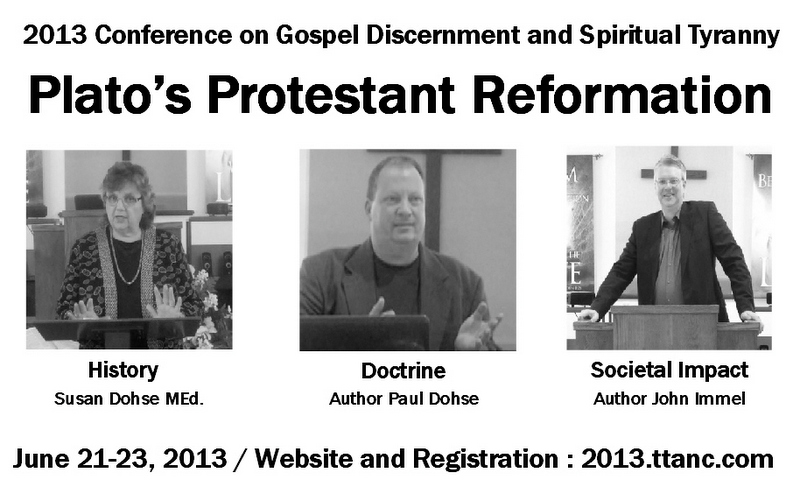
Ya, sounds good big guy. I have a conference coming up and will need time to prepare afterward. Pick a day in August. Bring it.
paul
Answer:
Great. I think we need to decide on a specific topic, a forum, a mutually acceptable moderator and a set of guidelines to govern the debate. Will the moderator pose questions, will we pose questions to each other, or will we take questions from spectators? All of this needs to be decided well in advance.
After all of that is agreed to, a date for August 8 is set, and then this from the challenger:
The following are the rules apart from which I will not debate:
1. The Scriptures are solely authoritative.
2. Each participant must be able to state his opponent’s position to his satisfaction before being able to comment on it.
3. Every assertion must be supported by direct quotations, in context, that indicate the veracity of the assertion. (For example, you may not assert that Calvinists believe that matter is inherently evil, or that justification is progressive unless you can quote a Calvinist who explicitly states such a belief. A title from Calvin’s institutes will not be sufficient to establish that he taught what is stated in the title).
4. Each participant must define the terms he is using according to some accepted standard.
5. Though not a rule, the debate needs to center as much as possible on presuppositions, not on conclusions, since faulty conclusions are based on faulty presuppositions.
Response from Paul:
NO. Let each state his own position to his own satisfaction as well as one’s perception of the other side and let the people decide. And NO, the logical conclusions from stated positions will not be excluded. If Calvin said a cat walked across the street, I will not be excluded from saying that the cat was on the other side of the street just because Calvin didn’t specifically say, “The cat that walked across the street was then on the other side of the street.”
Furthermore, I will not be excluded from my firm belief that words mean things and that conclusions cannot be drawn from titles. If you want to say that a title of a treatise doesn’t reflect the theses of the treatise, state it accordingly and we will let the people decide.
Likewise, be sure of it, I will clearly state that we are debating from two different realities: grammatical verses redemptive. I will call you out on the fact that “The Scriptures are solely authoritative” equals ALL reality being interpreted through a redemptive prism. I will then cite the first tenet of New Covenant Theology according to the Earth Stove Society to back that up. If that’s a bad citation—state your case accordingly. If you reject that, state your case and we will let the people decide.
Moreover, let the people decide in regard to citations and their weight for the case. You don’t decide that and neither do I.
Answer from challenger:
Forget it then. I refuse to debate with anyone who makes up his own interpretations and definitions as he goes along. I can’t defend a position neither I nor any Calvinist believes. If you can’t show we believe a doctrine from clear contextual quotations, then you have lost the debate already. The truth is, you are an arrogant, theologically ignorant and inept fool who refuses to acknowledge what another person states as his belief. Your response has only confirmed what I stated earlier–you are too stupid to understand truth. I refuse to answer a fool according to his folly.
Just so you know, grammatical-historical and redemptive-historical methods are not mutually exclusive. Still, that has nothing to do with the topic we were to have debated.
Answer from Paul:
Whimp.
Answer from Challenger:
Call me a whimp if you like, but you are the one who refuses to provide quotes. I don’t really care what someone who calls himself a Calvinists has written. People in all camps say and write stupid things. If you want to say “a Calvinist named __________________has written__________” that is one thing. To then state that Calvinists believe___________ is another thing altogether. If you are going to make such a statement, you need to show that this has historically been the Calvinists’ position. Prodigious generalities are never good. In any case, you need to actually quote the person. Let the reader decide whether the person is saying what you allege. You must stop simply assigning to people doctrines they don’t believe. You need to learn something about scholarship. Frankly, you are simply not worth my time.
Answer from Paul:
Same old – same old Calvinistic evil despotic communication: because “all of the elders do not agree on that point” you guys have deniability whenever you want it. Calvinism is a joke. The church needs a massive exodus out the Geneva city of spiritual whores.



2 comments