Why the American Church is All Show and No Go: A Picture

Is the cross the power source for the Christian life?
If the Loch Ness monster does exist, it exists underneath the serene Loch Ness Lake in Scotland. In the same way, the revival of German pride took place during the unprecedented economic and social transformation effected by the National Socialist party during the 30’s, but underneath the joy and serenity, there was a monster that would eventually plunge the world into holocaust. Some in Germany saw the real substance in the symbolism, and were lucky enough to get out before it was too late.
Today, we have a Neo-Calvinist revival going on. Churches everywhere come alive on Sunday morning with hip praise bands leading the crowds with raised hands praising the cross. Churches boasting memberships of 20,000 strong have become commonplace.
But what is the substance in the froth? The focus is on the multimedia fireworks—the focus is on the production. What is really going on beyond the media blitz and the propaganda?
First, the focus is on a gathering of souls who are not newly converted, but are being drawn from other churches. Smaller churches that are closing are doing so in record numbers. Praisemart is putting the small independents out of business. The Neo-Calvinist resurgence is not GOing (Matthew 28:19) they are merely calling people to the show.
Secondly, the resurgence is drawing from the first gospel wave that started with the likes of Billy Graham. Getting people saved was the emphasis while aggressive discipleship was unskilled. Now comes the Neo-Calvinists saying that your life is powerless because the church has misidentified the source of power for the Christian life; the source is not the new birth—it’s the cross. Verily, the true gospel of the Reformation has been lost and now found, come all. Unfortunately, they are right; the Reformation gospel did deny the new birth and claimed that the Christian life flows from the cross.
The present-day “revival” of everything Jesus and the cross is not anything new. It is the authentic Protestant belief that any efforts in sanctification (the Christian life) are tantamount to works salvation. This is because salvation is by faith alone, and by faith alone in the Christian life, the perfect works of Jesus are imputed to our Christian life and thus the law continues to be fulfilled in our stead. I have written extensively in regard to the grave problems with this gospel. For one, it is not justification APART from the law. The issue is not who keeps the law—the issue is the law being the standard for justification.
Hence, passive endeavors such as “worship” and “praise” are not works, but are exercises that show our dependence on the works of Christ alone in sanctification. The law is perpetually fulfilled via the praise and worship party complete with the hip praise band and raised hands unto heaven. If we only EXPERIENCE the Spirit, it counts for the righteousness that continues to satisfy the law. That’s really, really bad theology.
And it even goes further than that as Susan Dohse will articulate in our upcoming conference. The Bible is not a book of instruction for the Christian life, but rather contains types of a preordained gospel narrative. Basically, as you live your life by faith alone, you identify with reality in regard to what the Bible says about reality through the prism of the cross. For instance, the Puritans thought they were living out a preordained narrative typified by Israel conquering the land promised to them by God. The Bible as “divine drama” and “gospel narrative” saturates the present-day church culture. The new Gospel Transformation Bible and the widely acclaimed BibleMesh study program are based on this interpretive construct.
It is a Gnostic form of Sabbath sanctification; viz, all of our works flow from setting aside Sunday for “worship” and meditation. This sanctifies everything we do as a non-work. We aren’t really doing anything; we are only experiencing the preordained gospel narrative. We are experiencing the “works prepared for us to walk in before the foundation of the world.” When it gets right down to it, interpreting the Bible literally is tantamount to works salvation in this interpretive construct.
Throughout church history this approach to sanctification has wreaked havoc on the church. Its appeal is the separation of oneself from experiencing the full brunt of tragedy and personal responsibility. Life is stress free if we aren’t responsible for fixing anything. This theology primarily identifies with the upper crust of society as the poor do not usually have the convenience of functioning by such ideas. It has a lot to do with meditation and the bantering about of mystical ideas which doesn’t do much for putting food on the table. One thing often comes to mind when observing the present-day multimedia focus on contemporary “worship”: MONEY, and lots of it. The contemporary church partakes in many events that the laity grunts can’t attend like cruise ship Bible study trips etc. Pastors’ conferences that are all the rage in our day are far from the financial feasibility of lay pastors and the laity in general, not to mention the financial unfeasibility of being certified in a seminary regardless of your spiritual gifts. Yet, for the most part, it is the working class laity grunts that finance the whole kit and caboodle. It is Plato’s Republic by default.
This is the exact scene in Israel when Christ began His earthly ministry. It was a culture saturated with this kind of Western mysticism. In our day, it is a return to the exact same Gnosticism that wreaked havoc on the early church via the Nicolaitans. Christ’s practical application of the Scriptures was culture shock at that time, as it was in 1970 when Dr. Jay Adams published, Competent to Counsel. As Adams spoke in churches across America to promote his counseling construct, Christians were astounded by the idea that “they could do something.” In that same year, the present-day Neo-Calvinist resurgence began with its Gnostic Sabbath sanctification. Therefore, two contrary movements were gaining ground side by side and eventually locked horns in circa 2000. The history and doctrinal significance of this can be read here: False Reformation ch 3 The crux of the debate was the following: What is the source of our power for the Christian life, the new birth and the Scriptures, or the cross? Is it meditating on Jesus and His works, or obeying what Jesus said? Do we love Christ in our kingdom living by learning and doing, or do we only “experience what Christ has supplied for us”?
Gospel contemplationism is a show that we watch—it is about what Jesus did, not doing what Jesus commanded us: “Go therefore and make learners….” It is all show and no go. In the fever of a pseudo revival and the serenity of calm waters, a monster lurks underneath.
paul

The God Who Seeks Us

“Supralapsarianism and infralapsarianism are not good news. It will make evangelism anemic, and will defile what little evangelism takes place.”
We have all heard it many times: no one seeks after God. Salvation isn’t like God throwing us a life preserver; we are floating in the water dead—we can’t even grab the life preserver. We have no choice in the matter in regard to an ability to choose God for salvation. If left to ourselves, we will always choose death. So yes, man can choose, but unless God intervenes he will always choose eternal death. He only has an ability to not choose God, God must choose him first. The verse most often cited is:
Romans 3:10 – As it is written, There is none righteous no not one. 11 There is none that understandeth: there is none that seeketh God. 12 They have all gone out of the way: they have been made altogether unprofitable: there is none that doeth good, no not one. 13 Their throat is an open sepulcher: they have used their tongues to deceit: the poison of asps is under their lips. 14 Whose mouth is full of cursing and bitterness. 15 Their feet are swift to shed blood. 16 Destruction and calamity are in their ways: 17 And the way of peace they have not known. 18 The fear of God is not before their eyes (Geneva Bible 1599). Psalms 13:1-3, 5:10, 139:4, 9:28, 35:2, Isaiah 59:7,8 (LXX Brenton). Psalms 14:1-3, 53:1-3, 5:9, 140:3, 10:7, 36:1, Proverbs 1:16, Isaiah 59:7,8 (Masoretic AV).
As the apostles did many times in their writings, Old Testament quotations in the New were a combination of many different verses to make one point. But should this text be interpreted as a specific rule, or does it characterize the enemies of God? Does the subject of these references, the “fool” understand absolutely nothing about God? Is he completely devoid of any good work? Does the fool NEVER fear God etc., or is this a characterization rather than a hard fast rule? Since other Scriptures contradict the rule, for example, there are many instances of unbelievers fearing God in the Bible; we must conclude that this description characterizes the unbeliever, but is not a definitive description. It is like saying, “You never _______.” We aren’t saying that they never do this, that, or the other, it is a manner of speaking that regards a life pattern.
Granted, man does not initiate a relationship with God. We see this in the fall of man. Adam and Eve hid from God after they sinned, and it was God who searched for them in the garden. After Cain slew Able, it was God who confronted Cain to elicit repentance.
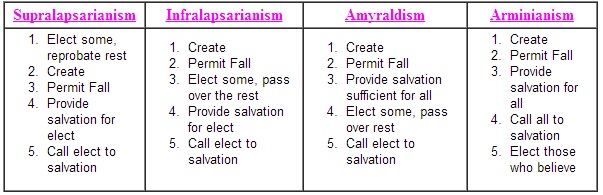
Did God create man as a despised thing in order to bring Himself glory? Did God predetermine the fall of man in order to contrast evil with His good? Does His wrath demonstrate His righteousness? Does His wrath accentuate His grace? Protestantism can be divided into two camps in this regard: supralapsarianism and infralapsarianism. The following chart (other source) demonstrates the difference between the two views.

As you can see, supralapsarianism holds to the position that God preordained the fall of man. Infralapsarianism holds to the idea that it was God’s intent to create man, but not His intent that man fall. In other words, God didn’t create man for the express purpose of his fall. Both hold to the idea that God preselected some for eternal life and others for eternal destruction. Calvin was a superlapsarian.
The human mind, when it hears this doctrine, cannot restrain its petulance, but boils and rages as if aroused by the sound of a trumpet. Many professing a desire to defend the Deity from an invidious charge admit the doctrine of election, but deny that any one is reprobated (Bernard. in Die Ascensionis, Serm. 2). This they do ignorantly and childishly since there could be no election without its opposite reprobation. God is said to set apart those whom he adopts for salvation. It were most absurd to say, that he admits others fortuitously, or that they by their industry acquire what election alone confers on a few. Those, therefore, whom God passes by he reprobates, and that for no other cause but because he is pleased to exclude them from the inheritance which he predestines to his children. Nor is it possible to tolerate the petulance of men, in refusing to be restrained by the word of God, in regard to his incomprehensible counsel, which even angels adore. We have already been told that hardening is not less under the immediate hand of God than mercy. Paul does not, after the example of those whom I have mentioned, labour anxiously to defend God, by calling in the aid of falsehood; he only reminds us that it is unlawful for the creature to quarrel with its Creator (Institutes 3.23.1).
Hence, evangelism is a “savor of death, and a savor of life,” and God is glorified by both. Evangelism isn’t for the purpose of “saving” the lost; it is for the purpose of putting a response to the gospel on display for the glory of God.
There is a universal call, by which God through the external preaching of the word invites all men alike, even those for whom he designs the call to be a savour of death, and the ground of a severer condemnation (Institutes 3.24.8).
He arranges all things by his sovereign counsel, in such a way that individuals are born, who are doomed from the womb to certain death, and are to glorify him by their destruction (3.23.6).
Calvin also held to the idea that Adam and Eve were fallen before the fall:
Even If man had remained in his integrity, still his condition was too base for him to attain to God. How much less could he have raised himself so far, after having been plunged by his ruin into death and hell, after staining himself with so many defilements nay, even stinking in his corruption and all overwhelmed with misery? (Institutes 2.12.1).
This is in stark contradiction to Genesis 1:28-31;
28 And God blessed them. And God said to them, “Be fruitful and multiply and fill the earth and subdue it, and have dominion over the fish of the sea and over the birds of the heavens and over every living thing that moves on the earth.” 29 And God said, “Behold, I have given you every plant yielding seed that is on the face of all the earth, and every tree with seed in its fruit. You shall have them for food. 30 And to every beast of the earth and to every bird of the heavens and to everything that creeps on the earth, everything that has the breath of life, I have given every green plant for food.” And it was so. 31 And God saw everything that he had made, and behold, it was very good. And there was evening and there was morning, the sixth day.
If Eve was “very good,” we must assume free will at that point.* Eve had a choice to trust and obey God who had glorious plans for mankind without the fall (Genesis 1:28). Evil entered into the world through the angelic rebellion led by Satan (Eze 28:11-19, Isa 14:12-14, Rev 12:3,4), and apparently, though speculative, this is a backdrop that effected the way God decided to interact with Adam and Eve. He installed two trees in the garden amidst many other trees, and the one tree that they were forbidden to eat of was the tree of the knowledge of good and evil. They were allowed to eat of the tree of life, but not the other tree of the knowledge of good and evil. God didn’t keep it from them that evil existed, He just didn’t want them to experience it (Gen 2:2-8, 15,16).
It is interesting to note that God intervened to prevent Adam and Eve from eating of the tree of life which would have resulted in them living forever, so He banned them from the garden (Gen 3:22-24). Therefore, we must conclude that to some extent the world and man operates separately from the will of God and God therefore intervenes in the affairs of men, in time, to bring about His desired outcome. We see the same in Genesis 11:1-9—God confused the languages to prevent an undesired outcome. As an aside, let me mention that Gen 11:6 does not bode well for the idea of total inability:
And the Lord said, “Behold, they are one people, and they have all one language, and this is only the beginning of what they will do. And nothing that they propose to do will now be impossible for them.
This study focuses on the fact that God intervenes in the affairs of men by seeking them and calling them to repentance. Does He do this according to a predetermined outcome, or does He know what’s going to happen, and how men will react to specific circumstances? Is God’s intervention merely for the sport of self-glorification in life and death, or does God exhaust every effort to call man to Himself, and when it gets right down to it (in the final analysis), does every person have an ability to choose, the fact that God knows the future notwithstanding?
The latter is for forthcoming study, but we will now look at how God seeks to be reconciled to man.
John 1:12 – But to all who did receive him, who believed in his name, he gave the right to become children of God, 13 who were born, not of blood nor of the will of the flesh nor of the will of man, but of God.
In the garden, Adam and Eve hid from God, they did not seek Him, He sought them out. Neither was it their will to come up with a means of reconciliation according to God’s righteousness. God announced that on the spot after He confronted them:
Genesis 3:15 – and I will put enmity between thee and the woman, and between thy seed and her seed: he shall bruise thy head, and thou shalt bruise his heel (ASV).
Man doesn’t seek God, and he certainly did not come up with the plan of salvation, but does that mean he has no choice when he is cornered by God with the solution for his sin? It seems to me that many verses concerning God’s seeking and His means of reconciliation are interpreted as inability to choose.
We have discussed before how man is created with an intuitive knowledge of God and His righteousness and deliberately suppresses that truth in unrighteousness. Mankind descended from Adam and Eve who talked with God face to face. Creation also testifies about God. Man has been endowed with an ability to know God. Supralapsarianism posits the belief that God predetermined to endow mankind with an inability to choose God before the fall, infralapsarianism posits the belief that inability came after the fall. Their concern is the idea that God is the creator of evil. But in their assessment that God chooses some and not others for salvation, are those not chosen being tempted to greater evil by God in accordance with James 1:13? In other words, is God temping some to greater condemnation with the “good news”? Well, if God is glorified by the savor of death, it would seem so.
There are many ways that God seeks us, but let us name one as evangelism with the “good news” which would seem to be good news to some, but very bad news to others who are endowed with more condemnation every time they hear the gospel. I have even heard some pastors use this savor unto life/death as an incentive for evangelizing. What is the PURPOSE of the good news, to save only, or further condemn as well? (Perhaps John 3:17 answers that question).
Consider that the offer of reconciliation to all men is a legitimate offer. Christ secured salvation for all men—Christ died for all men—this is irrefutable:
2Peter 2:1 – But false prophets also arose among the people, just as there will be false teachers among you, who will secretly bring in destructive heresies, even denying the Master who bought them, bringing upon themselves swift destruction.
Being “bought with a price” is salvific language in the New Testament (1Cor 6:20). Also, we are warned to not “neglect” salvation in Hebrews 2:3. How can we neglect something that is not truly ours for the taking?
God seeks us out with a legitimate offer of salvation. We are also told that we can understand the offer, and even experience the goodness of the offer, and yet reject it (Heb 6:4-6). Final judgment is horrific and eternal because they have rejected the Christ who died for them.
Secondly, God seeks us by sending the Holy Spirit after Christ’s ascension to convict the world of sin:
John 16:6 – But because I have said these things to you, sorrow has filled your heart. 7 Nevertheless, I tell you the truth: it is to your advantage that I go away, for if I do not go away, the Helper will not come to you. But if I go, I will send him to you. 8 And when he comes, he will convict the world concerning sin and righteousness and judgment: 9 concerning sin, because they do not believe in me; 10 concerning righteousness, because I go to the Father, and you will see me no longer; 11 concerning judgment, because the ruler of this world is judged.
Thirdly, as we have discussed in previous parts, it is not God’s desire that any person perish. This is further demonstrated by the fact that God did not create hell for man, but the devil and his angels (Matthew 25:41). In contrast, the prepared place for mankind is God’s mansion (John 14:2,3). I think this is telling; the Bible NEVER states that God created hell for mankind. In light of supralapsarianism and infralapsarianism, this doesn’t add up.**
As we move forward in promoting home fellowships, it is important to me that our incentive for evangelism is valid. Our incentive should be that God died for the sins of every person. Our incentive should be that it is His desire that all men be saved. It should be a call to not neglect such a great salvation. It should be a call not to go to a hell that was not prepared for them.
Supralapsarianism and infralapsarianism are not good news. It will make evangelism anemic, and will defile what little evangelism takes place.
Notes
*Keep in mind the “holy” angels as well. Those who followed Satan in the rebellion must have done so by choice. Inherent in their created being was an ability and freedom to choose.
**A good study is the “book of life.” It would appear that all people born into the world are originally written in the book of life which includes the righteous. It would also appear that they are only “blotted out” when they ultimately reject God’s way of reconciliation.
Other views (other source):
“< Tweet, Tweet

A person who does not completely disavow Calvinism and all of its tenets cannot help the spiritually abused.



1 comment