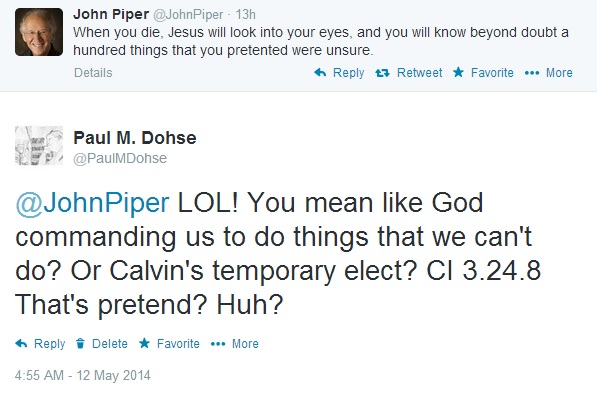
“< Tweet, Tweet

@JohnPiper Doctors who create the disease of confusion will always be needed.
Predestination and the New Birth

A question necessarily arises in the consideration of predestination and the Christian life; if salvation is predetermined, what about the question of an enabled believer? Enablement is the crux in regard to predestination because of the issue of choice. It is really a question of whether or not man is able to choose. If this wasn’t the real issue, it could be easily said that the means of salvation was predetermined by God, but man is able to choose God’s means which are obviously beyond the scope of man’s capabilities.
So, the interpretive question is: is everything predetermined by God, or just some things? Are the means of salvation predetermined with man being able to choose the means, or is man unable to choose? And as we discussed last week, everyone wants the outcome of human history to be predetermine—everyone wants a happy ending where good triumphs, to be guaranteed, or predetermined, but who will, and will not be saved; not so much.
Why? It makes hope and purpose ambiguous. If our choice was predetermined, can we know for certain that our choice is not just our own big idea and a result of being self-deceived? Probably not. Yet, the Bible states that we can know for certain that we are saved. If there is really no cause and effect due to our choices, purpose also comes into question. Of course, the predeterminists would say that there is only one purpose: God’s glory; we were created for God’s glory alone by the gift of life or our destruction. We looked at quotations by John Calvin on this last week. In regard to hope, one must place all of his hope in the hope that God chose him or her and hope for the best. Yes, there is hope, but it is an uncertain hope.
Is EVERYTHING predestined, or some things left to choice and the cause/effect thereof? We know that the outcome of all world history is predetermined according to God’s desire. We see that as a very good thing. We must also consider that God knows what’s going to happen. Even if man has a choice, God knows what that choice is, and apparently works all things to the end that He has predetermined. The consideration here seems to be time versus eternity. Could it be that man has free will in time, but not eternity? Remember, our working hypothesis is that “free will” really boils down to the ability issue; viz, the ability to choose. Granted, no man could have elected the means of salvation, and no man seeks after God in the ways of Adam and Eve who were ashamed and hid from God, but once God seeks out man via the means stated in our previous lessons, is man able to choose? Is man able to be persuaded?
If this is the case, God does not predestine some to hell and others to heaven—they go there by their own hand. Mankind is able to choose, and therefore responsible for his own actions. This also makes judgment about our own choices versus God judging us for things that are totally out of our control. Instead of being judged for merely who we are so that God is glorified by our damnation, we are rather judged and held accountable for actions resulting from our own choices. It is interesting to note that there are degrees of punishment as well. That means man is given a type of merit for some choices unless God has predetermined the choices and the degree of punishment for every individual as well. This seems problematic because the Bible states that God is not a respecter of persons and does not show favoritism.
Another thing that might be considered as predetermined is spiritual gifts granted to each believer. So, the following chart may be helpful:

At first, “choice” being the only concept not predetermined may raise suspicion, but not if this is broken down according to what we are commanded by God to do. We are never commanded to come up with our own means of being reconciled to God; unbelievers are never commanded to obey the Bible, but are rather commanded to repent and believe the gospel; we are never commanded to be reborn, etc. But many, many , many times in the Bible we are commanded to choose, and believers are commanded to obey the Bible as a way to please God and love Him. Can ability and free will then be determined by what is commanded? Can it be assumed that we have ability to choose when we are commanded to do it? May we assume that God does not command us to do what we are not able to do?
Deuteronomy 30:11 – “For this commandment that I command you today is not too hard for you, neither is it far off. 12 It is not in heaven, that you should say, ‘Who will ascend to heaven for us and bring it to us, that we may hear it and do it?’ 13 Neither is it beyond the sea, that you should say, ‘Who will go over the sea for us and bring it to us, that we may hear it and do it?’ 14 But the word is very near you. It is in your mouth and in your heart, so that you can do it.
15 “See, I have set before you today life and good, death and evil. 16 If you obey the commandments of the Lord your God that I command you today, by loving the Lord your God, by walking in his ways, and by keeping his commandments and his statutes and his rules, then you shall live and multiply, and the Lord your God will bless you in the land that you are entering to take possession of it. 17 But if your heart turns away, and you will not hear, but are drawn away to worship other gods and serve them, 18 I declare to you today, that you shall surely perish. You shall not live long in the land that you are going over the Jordan to enter and possess. 19 I call heaven and earth to witness against you today, that I have set before you life and death, blessing and curse. Therefore choose life, that you and your offspring may live, 20 loving the Lord your God, obeying his voice and holding fast to him, for he is your life and length of days, that you may dwell in the land that the Lord swore to your fathers, to Abraham, to Isaac, and to Jacob, to give them.”
The question of predetermination might boil down to this one question: does God command us to do things that He knows we can’t do to prove or make a point, or may we take Scripture at face value and assume that what we are commanded to do necessarily indicates ability and free will? For certain, some things are predetermined, and likewise, we are not commanded to dominate world affairs in order to usher in the kingdom. But can free will be determined by what is commanded? Traditionally, the Reformed, starting with St Augustine, have asserted that God commands us to do things that he knows we cannot do to prove a point:
Lord command what you will and grant what you command!
~ Augustine
This is saying that we are unable to obey, obedience must be granted to us. This seems to contradict Moses, and for that matter, all other Bible authors. If the long and the short of it is that obedience must be granted to us, it seems that a Bible author would have simply said so. Granted, in one particular text Paul states the following:
2Timothy 2:24 – And the Lord’s servant must not be quarrelsome but kind to everyone, able to teach, patiently enduring evil, 25 correcting his opponents with gentleness. God may perhaps grant them repentance leading to a knowledge of the truth, 26 and they may come to their senses and escape from the snare of the devil, after being captured by him to do his will.
So, from this one text, do we conclude that we are unable to obey and all obedience must be completely granted to us? I don’t think so. This text pertains to someone who has been “captured” in a “snare” and is in need of intervention by God. If all obedience is predetermined due to inability, this invariably leads to a relaxing of the law, a specific mentality that Christ warned against:
Matthew 5:17 – “Do not think that I have come to abolish the Law or the Prophets; I have not come to abolish them but to fulfill them. 18 For truly, I say to you, until heaven and earth pass away, not an iota, not a dot, will pass from the Law until all is accomplished. 19 Therefore whoever relaxes one of the least of these commandments and teaches others to do the same will be called least in the kingdom of heaven, but whoever does them and teaches them will be called great in the kingdom of heaven. 20 For I tell you, unless your righteousness exceeds that of the scribes and Pharisees, you will never enter the kingdom of heaven.
I submit to you that a mentality verbalizing the idea that if any obedience takes place at all—it will be granted by God is a relaxing of the law, and in Augustine’s case, teaching others to do just that; in essence…
Hey God, command whatever trips your trigger, but it ain’t gunna happen unless you pull it off.
This brings us to a question that we need to examine in our journey: let’s say that everything about salvation is predetermined and is a gift. We are completely unable to choose—only those who God illumines will believe, and God passes over others leaving them to certain destruction. Does the new birth change that? Does the new birth enable? Well, traditionally, Reformed thought has been about a plenary determinism. This is a huge elephant in the room that isn’t considered, leading to confusion and inaction.
The point here is to examine the doctrinal formula used by traditional Protestants to forward a plenary determinism in both salvation and the Christian life. It calls for a faith alone for salvation, and also a faith alone in the Christian life. Salvation and the Christian life are tied together into one progressive manifestation of the Spirit’s work; our only role is faith alone.
This is accomplished by narrative metaphysics. In other words, reality is a narrative, a story, completely written and predetermined by God. There are many terms for this, one is the divine drama. In essence, the gospel becomes a call to “enter into God’s redemptive story.” I can tell you that right now this idea is the foundation for easily 80% of Sunday school curriculum in the church at large.
Ultimately, if we believe that we have a role in the cause and effect of life, we are writing our own narrative apart from God. This is works salvation. In entering into God’s narrative, we only experience what God has supplied in the narrative—it’s not really us performing any works. In the narrative, we experience good works and evil works all predetermined by God. The experience is subjective, only the gospel narrative itself is objective. All reality is interpreted through the narrative, and all life events should be interpreted by the redemptive narrative. This is also known as the subjective power of an objective gospel ; the objective gospel, and the centrality of the objective gospel outside of. It is most commonly known a Redemptive Historical hermeneutics.
In the prescribed way of reading our Bible in regard to this construct, it is known as the imperative command is grounded in the indicative event. Or, the indicative/imperative interpretive construct. It posits the idea that the Bible is framed in two-fold successions from beginning to end: throughout the Bible, you have a description of God’s redeeming work followed by the manifestation thereof in the form of imperatives, or commands. This two-fold construct embodies the divine drama of reality.
What is the appeal? Obviously, it enables us to completely separate ourselves from the reality of life and any responsibility for our actions. Everything is completely outside of our control, so why care? “Eat and drink, for tomorrow we die.” “What will be will be.” This is a divine drama where everything is predestined, not the least of which are those who are predestined to lead us in the divine drama.
The problem is not in your set, though it is the twilight zone, Christians must come to grips with the fact that this stuff is the foundation of Western religious thought. We must examine it, and go backwards to more accurate biblical truth. For sure, throughout church history, not everyone gets it and you have the antinomian controversies among the Puritans as a result. This misunderstanding between grammatical reality (Moses) and redemptive reality was at the core of the Anne Hutchinson controversy. She was persecuted by Puritan Calvinists who really didn’t understand their own heritage of Reformed spirituality. Some who came over the pond had drifted into a more grammatical interpretation versus redemptive narrative.
This way of teaching also lends ample ability to deceive. For instance, consider the statement by a popular teacher in our day:
Christianity means change is possible. Deep, fundamental change. It is possible to become tenderhearted when once you were callous and insensitive. It is possible to stop being dominated by bitterness and anger. It is possible to become a loving person no matter what your background has been.
The Bible assumes that God is the decisive factor in making us what we should be. With wonderful bluntness the Bible says, “Put away malice and be tenderhearted.” It does not say, “If you can…” Or: “If your parents were tender-hearted to you…” Or: “If you weren’t terribly wronged…” It says, “Be tender-hearted.”
This is wonderfully freeing. It frees us from the terrible fatalism that says change is impossible for me. It frees me from mechanistic views that make my background my destiny.
If I were in prison and Jesus walked into my cell and said, “Leave this place tonight,” I might be stunned, but if I trusted his goodness and power, I would feel a rush of hope that freedom is possible.
If it is night and the storm is raging and the waves are breaking high over the pier, and the Lord comes to me and says, “Set sail tomorrow morning,” there is a burst of hope in the dark. He is God. He knows what he is doing. His commands are not throw-away words.
His commands always come with freeing, life-changing truth to believe. For example…
This particular teacher knows grade-A-well that the “change” he is talking about is a manifestation of the narrative that we experience and not anything that we ourselves perform as witnessed by his closing statement:
Praying with you (and St. Augustine), “Lord command what you will and grant what you command!”
Pastor John
[John Piper: online source; http://www.desiringgod.org/articles/all-gods-commands-are-possible-with-god]
This is all discussed in more detail with other examples in the following articles:*
https://paulspassingthoughts.com/2012/02/11/new-calvinisms-extreme-makeover-of-scripture/
What is at stake here? What is at stake is how Christians interpret reality. How does the Bible fit into how we interpret the world?
How can we know anything about God till we figure that out?
Notes *:
New Calvinism’s Extreme Makeover of Scripture
This Ministry has focused primarily on the fact that New Calvinism is blatantly unorthodox in salvific matters. Originally, the focus was on what was perceived as merely weakening Christians in their walk with God. Continued investigation reveals that New Calvinism also has the gospel wrong and distorts the very core of salvation: the doctrine of justification. Pastor Joel Taylor, a charter member of the long overdue Coalition Against New Calvinismmakes this point well in the organizations inaugural post at http://tcanc.wordpress.com/
The clear picture that has emerged is a movement that leaves no aspect of orthodoxy turned upside down, including Bibliology. I have stumbled across and recognized their approach to Scripture before, but have had bigger fish to fry in this endeavor. Though the complete picture has not yet emerged, I have been spurred to touch on what I do know because of statements made by Cindy Kunsman in her review of The Truth About New Calvinism.
New Calvinism approaches Scripture as a historical gospel narrative in its totality of purpose. Therefore, whether or not there is error, or whether or not events like creation are literal or not, isn’t the point—what the historical narrative is showing about the gospel is the point. Undoubtedly, this is why John Piper has elders on his staff that are theistic evolutionist—whether or not God literally created the Earth in six days is not the point—what the creation event shows us about the gospel is the point.
How some of them integrate this approach with more orthodox forms of interpretation varies, but this element of interpretation has a profound effect on how they approach the Scriptures and use it to “feed” the sheep. One can ascertain what I am talking about if they listen and read carefully. Michael Horton continually speaks of the “divine drama.” In fact, Horton wrote a book entitled, “Covenant and Eschatology: the Divine Drama.”
And where is this coming from? We get a clue if we visit Vossed World blog authored by New Calvinist and NCT theologian Chad Bresson. He wrote a post bemoaning the use of Old Testament events for instruction purposes and practical application to the life of New Testament believers. Of course, such a concern is in contradiction to 1Corinthians 10:6, 10:11, and 11:1. A reader using the name “Kippy” instigated a follow-up post:
In the comments section of the “Abigail” post, Kippy has asked a good question that is asked pretty consistently of the redemptive-historical hermeneutic. Kippy wants to know if practical application is a “wrong approach” to a text such as 1 Samuel 25, especially in the area of counseling. These are good questions. I’ll answer the application question first and the counseling question last.
Actually, Bresson didn’t directly answer Kippy’s initial question, but smothered it in a 10,000 word post. Yet, his response is telling to some extent. Here is Kippy’s intitial question:
Wow, heavy stuff. I do have a question concerning “practical application”, you seem to diss it in the post (because it takes away from the central purpose?). I am presently counseling a depressed person and I’m using Phil 4:4-9. The passage seems to promises wonderful things for those who replace worry with right prayer and erroneous thoughts with true thoughts. Namely, that Christ will guard our hearts and minds. Is this approach an improper use of the Scriptures?—being practical application?
Thanks for your hard work.
Kippy
Though Bresson never directly answers the question, New Calvinist Paul David Tripp does in How People Change, page 27. He states that changing the way we think to biblical thinking is insufficient, and “omits the person and work of Christ as Savior.” Why? Because it does not first see how a particular situation in our life fits into the historical gospel motif presented in Scripture. When we see our redemptive life story IN the biblical narrative, transformation takes place. Bresson’s post further elaborates on this point:
Few have spoken more clearly to the entire subject of “application” than brothers Charles, James, and William Dennison (the “Dennisons 3″). Dr. William Dennison writes, “Good Biblical preaching draws the congregation into the event…As Paul preaches to the Corinthians, his presentation of the saving event of God’s activity in Christ’s work precedes his interpretation of that work to the people. Event precedes interpretation, while interpretation draws the congregation into the event.” (Reformed Spirituality, ed. Joseph Pipa, pp. 148-150)
And….
Why is this? This is true because the application (how we live out the imperatives of the text) is generated by a historical event, the Christ event, or more specifically the cross and resurrection. As Dennison says, “In the Biblical text, morality is grounded in history, or more precisely, the moral life of the believer is grounded in the redemptive-historical work of God in Christ’s death and resurrection.”
And….
As Dennison points out, this has huge implications in terms of how we think about “practical application”. He says, “God engages His people as participants in the event of His activity; He places them in union with the event. Or, to put it another way, God draws His people into His redemptive-historical work as a participant in the event, not as a spectator of the event (One must not view the indicative-imperative grammatical construction in abstraction from its theological and revelational-historical content. The content is what gives the construction its rich supernatural relevance and meaning).”
And….
How does the fact that the listeners are participants impact how we think about application? Dennison quotes his late brother Charles when he says, “The Biblical model is simply this: “’Good preaching does not apply the text to you, but good preaching applies you to the text.’ To put it another way, ‘The preacher does not take the word and apply it to you, but the preacher takes you and applies you to the word.’”
Then Bresson concludes on this point:
So, it’s not that anyone is dissing application. There is certainly application in the text, including the passage that prompted the question, 1 Samuel 25. The question isn’t whether there is application, but what kind of application. And the kind of application found in the text tends to be quite different than the kind of application that is popular today. The application found in the text revolves around an event and is itself an application tied to history. That kind of application has a direct bearing on the 24/7/365 of our “mundane” lives.
As Dennison notes, “The Biblical theologian sees application as that which truly comes from the text because he draws the believer into the redemptive-historical and eschatological drama of the Biblical text. The struggles you face in the Christian life are the same struggles that the church recorded in the Biblical text faced. You live between the two comings of God, just as the people of God in the Biblical text live between the two comings of God. Their history is your history. As their redemption and application was grounded in the promises and the accomplished work of Christ, so your redemption and application is grounded in the promises and accomplished work of Christ. You are living in the same life pattern that the church lived in the Biblical text, and thus, the Bible is God’s document of application.”
Kippy then poses the following statement in the comments section of the follow-up post:
It seems that our primary concern is focus on the glory of Christ and the knowledge of him. This will produce the imperatives naturally. Also, history is still moving toward the return of Christ, by putting ourselves INTO the text, we recognize that we are the ongoing redemptive work of Christ that didn’t end with the Scriptures. The Scriptures enable us to be part of that history. We are not making our own redemptive history, it is making us. We are between the beginning and the end, but all we need to identify with Christ is bound in the Scriptures.
To that, Bresson answered:
Kippy,
It looks like you’re understanding what I’ve said (a minor miracle, I know). I’ll get to your other questions shortly.
Bresson latter added:
If you’re interested in how we fit into the redemptive-historical drama 🙂, a couple of books that have interesting thoughts in this regard are Vanhoozer’s “Drama of Doctrine” and Horton’s “Covenant and Eschatology: The Divine Drama”.
I don’t agree with everything they have to say, but I did find what they had to say about “participation”, “drama”, and Christ’s Incarnation to be thought-provoking. There are thoughts there compatible with what we’ve said here.
(Wednesday, August 06, 2008
Abigail was “motivated” by a future eschatological hope that God would accomplish his purposes in a throne for David
Thursday, August 14, 2008
The application: We, like Abigail, rest in our Avenger).
Hence, this approach makes the Bible a perfect tool for Gospel Contemplationism. In the aforementioned book written by Tripp, four primary applications are given as aids in seeing our own gospel story in the historical gospel meta narrative: Heat; Thorns; Cross; Fruit. Tripp asserts that the sum of the Bible is composed by these four prisms that enable us to place our life story in God’s story as a way of transformation (p.96). On pages 102-105, Tripp attempts to show that the apostle Paul used Scripture in this way for transformation in his own life. On page 94, Tripp states, “This big picture model is the story of every believer. God invites us to enter into the plot!” Unbelievably, Tripp commits a first degree theological felony by admitting in the book that Jeremiah 17:5-10 is the only proof text that can be found to substantiate this hermeneutic, and his mentor David Powlison eludes to that same apology in the Forward. Despite Powlison’s glowing affirmation in the Forward and noting that the book follows after his own Dynamics of Biblical Change, Powlison disavows the book in private conversations because a testing of the book by CCEF in local churches didn’t reveal the fallout that is now rearing its ugly head. This kind of disingenuous communication has been a hallmark of Powlison’s ministry.
This now brings us to statements made by Cindy Kunsman in her review of The Truth About New Calvinism. In my present research for volume two, I am investigating the influence of neo-orthodoxy on SDA theology. My thesis so far is that SDA contributed the fusion of justification and sanctification in New Calvinist theology, and SDA theologian Robert Brinsmead added the centrality of the objective gospel outside of us. I then lean towards the idea that neo-orthodoxy filled in the blank spots to make it run, including the kind of hermeneutic which is the subject of this post. But hold the fort. Kunsman states the following in the review:
J. G. Vos became very interested in the significance of Christ’s history and participated a movement that encouraged people to find a message of redemption in every Bible passage, relating it to the history of Christ. Goldsworthy, an aberrant Anglican, developed a whole esoteric sounding theology about the “holy history of Christ,” he worked alongside Brinsmead, a Seventh Day Adventist (SDA), and it resulted in most of the errors and controversies we’ve seen among the Reformed in the past decade or two. Most of what Jon Zens teaches came from Brinsmead, and most of what Piper teaches sounds just like Goldsworthy. (See addendum note below.) Piper’s preaching quietism through his “beholding as a way of becoming,” a form of Christian mysticism enjoining passive contemplation and the beatific annihilation of the will…. In some shared disdain for Lutheran theology [Brinsmead and company], they explain how salvation really happens [linked to Present Truth volume 46, art. 2, part 4] in their old publication called “The Present Truth” which was once staggeringly popular at Westminster. (Take note that “the present truth” is a doctrine in SDA church, invented by the Whites [linked to several references regarding early SDA publications by the Whites]. It was also the name of their first SDA publication in the 19th Century.) In a discourse that switches back and forth from Catholic Theology into Protestant statements so many times that I gave me theological whiplash, they explain the process. First, the believer is “caught up in the holy history” of Christ and “replaces his history” with Christ’s. As a result of the change in the person who has been assimilated or has assimilated Jesus and is changed, it is then that God decides to bestow the grace of justification on a man because he’s suddenly become acceptable to God. Sorry, folks. This just became justification by works, and sanctification and justification become the same thing…. This is the more subtle reason why Piper and Keller and Bridges and Tchividjian and others preach the gospel to themselves every day which I personally consider to be different than morning devotions or contrition over sin as a New Creation in Christ. This is why Piper and Mahaney do all of their histrionic weeping over their poor, sinful state, because they are still subject to it, giving it power. New life in Christ for them is dependent on daily infused grace and justification…. Piper’s teachings argue against an inner transformation which bestows a believer with the Spirit’s power and discernment to resist sin.
Kunsman embeds several links that do not show up in my citations here, but I would like to focus on her citation of the Australian Forum’s theological journal, Present Truth vol.46,art.2, pt.4. I have reposted the whole article as an addendum to this post. All of Kunsman’s review can be read here: Kunsman’s review of TANC
Present Truth was the theological journal of the think tank known as the Australian Forum which was founded by Brinsmead, Geoffrey Paxton, and Graeme Goldsworthy. They were later joined by Jon Zens. The issue Kunsman cites is dripping with the present-day New Calvinist motif, including the SCANDALOUS GOSPEL sloganry.
Also, match Bresson’s cited post with Kunsmans citation—the theology/hermeneutic is identical, and accentuated with the same phraseology. This bolsters the conclusion that I have come to time and time again throughout my five years of research on this issue: Present Truth might as well be the theological journal of present-day New Calvinism, and it would be if Robert Brinsmead wasn’t a Seventh-day Adventist gone bad.
Then I would ask you to note Kunsman’s citation of the SDA doctrine that is actually named, “Present Truth.” She also notes that it was the name of SDA’a first publication. In my present preparation for volume two of The Truth About New Calvinism, I am reading The Shaking of Adventism by Geoffrey Paxton, one of the core four of the Australian Forum. He presents SDA as the gatekeepers of Reformation theology, and insinuates that the Australian Forum was the “Shaking” predicted by SDA theologians of days gone by.
So what is the point here for now? One, New Calvinists completely bastardize Scripture. Two, it’s looking more and more like New Calvinism is up to its ears in SDA theology.
paul
ADDENDUM; Present Truth volume 46, article 2, part 4:
The Need for a Correct Biblical Framework
The centrality of justification by faith and its forensic character is the raison d’etre of the Lutheran Reformation. It is under massive attack today. Prominent Lutheran scholars are leading this assault on the Reformation faith. But that is not the only feature of the current crisis among Lutherans. Many of those trying to defend the old faith are not convincing. They appear to be losing ground in the struggle. They are repeating many of the old arguments (such as the meaning of words), but their theological framework is too abstract and rationalistic. This plays into the hands of those who advocate a theology of dynamic experience as an alternative to “dry old orthodoxy.”
The abstract scholastic dogmatics of the old Protestant orthodoxy is not adequate for the present crisis. What is needed is a theology with a truly biblical framework. The apostles preached the gospel of Christ out of the Old Testament background. Yet there has always been a tendency in the church to cut the Christian message loose from its Old Testament roots.
When this happens, the Christian message is placed in either a rationalistic or a mystical framework and is consequently distorted. What is needed is a return to biblical faith, which is not just Christian but Judeo-Christian. Biblical faith is historical, covenantal and eschatological.
The want of a theology which has a historical, covenantal and eschatological framework is the real issue behind the issues in the current justification-by-faith debate.
The Historical Framework
The first thing that must be said about biblical faith is that it is historical faith. “The uniqueness—the ‘scandal’—of biblical faith is revealed in its radically historical character.”1
The Bible has a historical framework. Man is essentially a historical being.
Biblical faith understands human existence and human destiny in irreducibly historical terms. If the question is asked, what is the real reality of man?—what is it the actualization of which constitutes the fullness of his being?—the heathen (turned philosopher) would say nature; the Greek metaphysician and the Oriental mystic would say that which is timeless and eternal to him; but the biblical thinker would say his history. History is the very stuff out of which human being is made: human existence is potential or implicit history; history is explicit or actualized existence. And it is not very different on the corporate level. In attempting to explain to someone who really does not know what it means to be an American, it would be futile to try to contrive some conceptual definition of “American-ness.” Would it not prove more appropriate to tell the story of America and rely upon that story to communicate the fullness of what it means to be an American? “The human person and man’s society,” Reinhold Niebuhr has profoundly observed, “are by nature historical. . . [and] the ultimate truth about life must be mediated historically (emphasis added) . . .
But he who understands the reality of human being in biblical terms will find no difficulty in understanding that the ultimate truth about human life and destiny, about man’s plight and man’s hope alike, is truly and inexpugnably historical, and can be expressed in no other way. (Hence the Bible is composed so largely of stories, recitals, histories.) The structure of faith is a historical structure, because being, living, and acting are, in the biblical conviction, radically historical in character.2
This means that true preaching about the sinner’s justification before God is not an abstract theory of imputed righteousness which sounds too much like salvation by celestial bookkeeping. Nor is it explaining the technique of moral transformation. It is the preaching of something historical. Alan Richardson has expressed this point beautifully:
Biblical faith, however, is not at all concerned with asking in what salvation consists or in recommending techniques, whether mystical or ethical, by which salvation may be attained. It is concerned rather with the proclamation of the fact of salvation, and thus it differs from all “religion” by being kerygmatic in character. The Bible is concerned with the fact that God actually has in concrete historical fact saved his people from destruction.3
The principle is the same in both Testaments. In the Old Testament God’s saving act took place in the Exodus-Sinai event, which becomes the type of God’s great saving act in the death resurrection event. Biblical preaching, however, is not preaching about some dead history which is past and gone. Though the event may have happened years or even centuries ago, it lives on as it is continually rehearsed by Word and sacraments.
For the Old Testament believer the Exodus was a history that was part of his existence. He may have lived long after the Exodus took place. But as the event was rehearsed by holy days, feast days and the story of the fathers, he was caught up in that history. He identified with it in such a way that it became his history. Therefore the Exodus was something which really happened to him as a member of the people for whom the redemption was wrought. When he made his confession of faith, he told the story of the Exodus using the first person, as if he had actually crossed the Red Sea with Moses. “‘My father was a wandering Aramean, and he went down into Egypt. . . and the Lord heard our voice [note the first person pronoun] and saw our misery, toil and oppression. . . . So the Lord brought us out of Egypt’”(see Deut. 26:2-10).
So it is with the New Testament believer. In the gospel and the sacraments, the holy history of Jesus Christ is recited, rehearsed and represented. This is more than a memorial of a past event which is dead and gone. In the proclamation of the event in the power of the Spirit, the past is rendered present (Rom. 1:16, 17). The believer is caught up in this holy history—he identifies with it, participates in it, is baptized or incorporated into it. Just as the Old Testament believer embraced the Exodus as his own personal history, so the New Testament believer embraces the holy history of Christ as his own personal history. And like the Old Testament believer, he makes his confession of faith by speaking of this history in the first person. “I have been crucified with Christ” (Gal. 2:20). “Our old self was crucified with Him” (Rom. 6:6). Or as Luther said, “Christ died. I too. He rose from the dead. I too. “Let us now consider what light this historical faith throws on some of the disputes about justification:
1. Since the believing sinner is justified by the holy history of Christ and by that alone, justification must be forensic.
2. Justification is central in Christian teaching since it is wholly concerned with what is central—namely, the holy history of Christ. On the other hand, the presentation of an abstract theory of justification not vitally grounded in Christology will not be regarded as central.
3. If God justifies on the basis of this new history of Christ which is pleasing to Him, then forensic justification is no legal fiction. It is not a matter of God waving a wand over the sinner, declaring him righteous when he possesses no righteousness at all. The believer possesses righteousness good enough and big enough to stand before the tribunal of God. He is identified with the holy history of Christ. It has become his own history. This is no make-believe. This history is real. The believer stands with a good record. It justifies him before God.
Proponents of forensic justification have sometimes given occasion for the Reformation faith to be impugned because they have separated justification from history so that the imputation of righteousness sounds almost like an abstraction. This has happened because soteriology has not been seen in its vital relationship to Christology.
Osiander said that forensic justification makes God appear to be a liar because He calls a man righteous when he is not righteous at all. Osiander was not wrong when he said that God must make the sinner righteous before He can declare him righteous. But the believing sinner has already been made righteous in Christ (2 Cor. 5:21). Why should not the righteous Judge justify the man who stands before Him with the holy history of Christ?
Furthermore, when Christ identified Himself with our history, was He not cursed for our sake? (Gal. 3:12,13). Surely we are not going to say that His condemnation was based on what He was in Himself! So why should not God justify those who are identified with Christ’s history? This justification is no more “analytical” than Christ’s condemnation was analytical. The substitutionary atonement of Christ and justification by a forensic righteousness are merely two sides to one great truth.
Let us also look at Newman’s argument in the light of historical faith. He used the analogy of creation to prove that God makes what He declares (“‘Let there be light,’ and there was light”). By doing this, Newman made God’s creative act depend on justification. But God’s new creation took place in His redemptive act in the holy history of Christ. The faith which justifies does not bring the new creation into existence; it confesses its existence. The conception, birth, sinless life and resurrection of Jesus from the dead were the recapitulation of Genesis 1 and the fulfillment of those Old Testament prophecies which spoke of God making all things new. The justification of the sinner springs from this creative act of God and not the other way around, as Newman and the proponents of “effective” justification contend.
Furthermore, is it correct to take the analogy of creation (“‘Let there be light,’ and there was light”) and apply it to the matter of justification? Justification is an indicative verdict, not an imperative command, so the creation analogy is inappropriate. A better analogy would be God’s verdict, “This is My beloved Son, in whom I am well pleased.” This declaration was not made in order to make Christ pleasing to God but because He was pleasing to God. So it is with the believer. He is declared righteous before God’s judgment seat because He has been made righteous in the holy history of Jesus Christ.
4. One of the most serious criticisms raised against forensic justification is that it leaves the sinner without moral renewal and therefore has antinomian tendencies. A doctrine of justification presented in the rationalistic framework which has characterized too much of the old Protestant orthodoxy cannot adequately meet this charge. It may correctly say that justification is distinguished from regeneration but is never separate. However, the critics are always suspicious that the link between justification and the new birth is too artificial—as if ethical renewal had to be attached to justification like an afterthought. Certainly the endless discussions on the ordo salutis in seventeenth-century Protestant scholasticism were too abstract and artificial.
However, when justification is preached in the framework of history, it appears in vital and inseparable relationship to the new birth. We have seen how the sinner is justified by participating in the holy history of Christ. The same inclusion into Christ’s history also means that the sinner is born again.
A person does not become born again by rummaging around in his psyche. The new birth is not preoccupation with one’s spiritual navel. Man is a historical being. I am the story of my life. My history determines who I am and what my destiny shall be. The only way I can become a new man is to have a new history.
In His discourse on the new birth, Jesus directed Nicodemus’ attention to the first Exodus under Moses (John 3:14). Nicodemus knew very well that it was the Exodus event which gave birth to the nation of Israel. But the prophets had also spoken of a new exodus under a new Moses at the end of the age. In this new redemptive act God would make all things new. There would be a new covenant with a new Israel. Nicodemus was not altogether ignorant of these things. The book of John presents Jesus as that new Moses of the new exodus. The imagery of the Exodus appears everywhere in the Gospel of John. Jesus tells Nicodemus—this representative of Israel—that his identification with the history of old Israel will not entitle him to enter the kingdom of the new age now being inaugurated. He must now look to the Son of Man and identify himself with the Son of Man’s new redemptive history (John 3:14, 15). Just as the first Exodus gave birth to the nation of Israel, so the new exodus at Calvary would give birth to the new Israel.
What we identify with historically has the most profound effect on our lives. For instance, in order to become an American in the deepest sense, I would need to know the story of the birth of this great nation and then to identify myself with that history so that it became part of my existence. I would thereby become caught up in the spirit of America. Its history would then govern the way I think and act. So it is when the Spirit of Christ comes to me clothed in the gospel of Christ. The Spirit incorporates me into the holy history of Christ. This brings about a change which is far more profound than a change of earthly citizenship and political philosophy. It means that my whole life has a new center. The holy history of Jesus Christ determines my entire existence—the way I think about everything as well as the way I act. “I live by faith in the Son of God, who loved me and gave Himself for me” (Gal. 2:20).
Incorporation into Christ’s new history will therefore give me both a new standing (Justification) and a new state (new birth). My new history changes God’s estimate of me and my estimate of God. Thus, the justification which is grounded in history is inseparable from the new birth, which is grounded in the same history. There is really no point to the artificial ordo salutis of Protestant scholasticism. If we say that justification comes first, it is not a temporal order but only a theological order. How I stand in God’s sight must always be given first consideration.
Moreover, the new birth is the sinner’s apprehension of forensic justification. To look away to a righteousness found wholly in Another and in what Another has done, to stake one’s all upon the history of Another, is the negation of human pride and self-centeredness. To exercise saving faith is surely an essential element of the new birth. Thus, John simply says, “Everyone who believes that Jesus is the Christ is born of God” (1 John 5:1). True to the Hebraic rather than the Grecian way of thinking, the Bible describes the new-birth existence more by what it does than by what it is in itself. And true to Hebraic thinking, the biblical content of the new-birth doctrine is historical rather than rationalistic or existential.
Clearcreek Chapel Gone Wild: Jesus Keeps the Clearcreek Covenant for You
My, my; how different Clearcreek Chapel of Springboro, Ohio is since a pack of New Calvinist wolves took it over shortly after the departure of the founding pastor. The victorious pack, led by Chad Bresson, who for some reason has recently left the KoolAid paradise that he built at the chapel with a creepy adoration for his supposed theological prowess, began infiltrating the flock a couple of weeks before Dr. John Street’s departure.
The undomesticated canine delegation he brought with him from a Baptist church in Dayton, Ohio seemed to be frustrated with their inability to devour at that location. Really old sheep produce a mutton that is tough to chew, and invariably leaves a bad aftertaste.
As far as the “friends” I knew back in that day, and their susceptibility to believe Bresson’s outrageous mythology, I never saw it coming.
Apparently, just about any place a thinking person pokes the Chapel these days produces something utterly bizarre. I say this because of what I accidently stumbled onto today. In a recent sermon by Chapel elder Devon Berry, who is a mental healthcare professional (yikes!), he stated that Jesus keeps the Chapel covenant for the “beloved” members. Let me share an excerpt:
Is the Chapel covenant a call to a certain kind of living in the Church? Yes, it is. But beloved, it is a call to much, much, much more than that and it can never be only that. It is a call to the living Christ, our righteousness, our sin-bearer, our life. When you read the Chapel Covenant, reflect on Christ first for it is meant to point us to him – not to ourselves and our own efforts. Then rejoice. He has obeyed for us. He has suffered and died for us. And, he has also enabled us by grace – something we’ve talked around this morning but not mentioned directly.
Let me close by contradicting myself. Earlier I said that you could not keep the Chapel Covenant. I will end by saying that you can keep the Chapel Covenant. Grace, the enabling power given by God because we are at peace with him through the work of the cross, provides all that we need to obey and overcome sin. Hence, the Chapel Covenant is a call to live in the reality of who we are as believers. There is no better place you could live, no more joyful place you could abide, no more beautiful place you could dwell than in the life-transforming reality of the gospel. Believer, be who you are for Christ has given you all that you need.
Clearly, Berry is putting the Chapel covenant on par with the Scriptures. He states that it is more than a standard; it is a “call to the living Christ.” And, the ability to keep the covenant requires the enabling grace of Christ? This is beyond creepy. Moreover, if 2+2=4, Berry makes living by the Chapel covenant via the grace of Christ synonymous with dwelling in the “life-transforming reality of the gospel.” And according to Berry, there is not a place in the world where they could have more joy.
Sorry I am missing all the fun.
paul
The PPT Puritan Archives
Colonial Puritanism was Commonly Known as “Platonic Christianity”
Calvinism’s Parasitic Deception: How the Puritans Hijacked the Great Awakening
Reformed Caste System: The Puritans Saw Violation of Caste as Equal to Violation of the 5th Commandment
A Day to Remember Those Lovable Puritans: International Religious Freedom Day
Inseparable: The Reformation’s Principles of Persecution and its Gospel; Part One
Destroying Eve-il is a Reformed Family Tradition: Today Danvers, Tomorrow the Gallows
Thanksgiving Day: Democrats, Pilgrims, Islam, and Republicans, the Gospel of Freedom, and Why That Gospel is Important to Every Soul
Calvinism and Urine Technology
https://paulspassingthoughts.com/2013/02/01/calvinism-and-urine-technology/
Those lovable Puritans: The Time Boston Banned Christmas
https://paulspassingthoughts.com/2013/12/12/those-lovable-puritans-the-time-boston-banned-christmas/
Calvinism and New Calvinism: When the Black Lamb of the Family is the Patriarch
John Piper, Wilberforce New Calvinist Jive, and Social Justice
New Calvinism’s Loveless Christianity
https://paulspassingthoughts.com/2013/10/04/new-calvinisms-loveless-christianity/
PPT’s Fourth of July Post: Why Mark Dever Hates America and Old People
“< Tweet, Tweet
@AnchoredCon =’s hypocrisy on steroids: repentance is only for the spiritual peasants; ie blackmail and not reporting child abuse. Pathetic



2 comments