Why Calvinists Need to be Saved
You can click on screen shots to enlarge, and then use back arrow to return to post.









Why Church Can’t Help People
 My daughter sends me some articles from time to time written by Reformed academics who have completely taken over the institutional church in this country. What’s left of the church doesn’t possess any discernment and feeds off the who’s who of Christian academia. Historically, there have been about five Reformed resurgences like the one we are presently experiencing that always die out, and the reason they die out is very simple: it’s a false gospel. This post addresses the article because it is indicative of why Protestantism is a false gospel, and since authentic Protestantism presently dominates the American institutional church, there is no help to be found in it. To the contrary, it will rob hurting people of any hope they had left because many believe church is Christianity. Church is not Christianity.
Protestantism was founded on the false gospel of progressive justification. That false gospel produced a tradition of worship practices that survived a purist Protestant doctrine, but invariably paved the way for a return to the original article. In other words, Protestants come to a better understanding of the gospel, but continue to practice the traditions that came from the original article, which feeds the weakness of the original back into the church. So, Protestant Light gets blamed for the mundane, and the solution is to “return to our original roots that we have strayed from.” The original article dies out, but again, the traditions that came from the original continue; i.e., solemn observance of the Lord’s Table, alter calls (Absolution Light), “gospel” everything, ungifted pastors who buy their pastorate from institutional seminaries, heretics vaunted as spiritual heroes, the perpetual regurgitation of Reformed orthodoxy as truth, weak sanctification, avoidance of the difficult issues of life, canned worship services, an institution focus, canned gospel presentations, a program for everything, endless committees, little emphasis on individual gifts, the making of saved people and not disciples, doctrinal illiteracy of shameful proportions, etc., etc., etc.
In said article from The Gospel Coalition blog, the author proffers a solution for helping Christians who struggle with homosexuality. It is fairly easy to see that his solutions flow from the original Protestant gospel of progressive justification. Salvation has a beginning, a progression, and a “final justification.” Since salvation progresses, what they deceptively call “progressive sanctification,” we must supposedly progress in our salvation in the same way we were saved, by faith alone.
Hence, “desires” like homosexuality are completely out of our control. God may eradicate the desire, and then again, He may not because sanctification is of faith alone just like our salvation. To say that we have a role in change is the same as saying we have a role in our salvation according to the Reformed viewpoint. Remember, according to Reformed thought, the Christian life is a continuation of our original salvation; as we often hear, “Salvation is of grace from beginning to end.” This makes the Christian life part of the salvation process. However, salvation is not a process; it is a onetime event—the Christian life is completely separate.
Therefore, the author’s solution is a community that embraces a “theology of unfillment.”
This is the normative Christian experience— to live with incompletion, unfulfillment, and an awareness that the gospel’s imperatives will challenge and frustrate our natural impulses in many ways.
If we’re going to summon people to sexual chastity, we should be welcoming one another into a community in which we are all wrestling with unsatisfied desires that will only fully and finally be met in Christ. Such a community will help create a plausibility structure in which our same-sex attracted friends living with daily unfulfillment see that they are not the only ones.
Of course, this contradicts the biblical promise that God will give us the desires of our heart if we put Him first. But moreover, it follows the Reformed tradition of denying the new birth. The gospel is not a mere mental assent to the facts of the gospel, it is following Christ in death and resurrection. The old self dies, and is resurrected as a new creature, “behold, all things are new.” The new Christian will have new desires. Sometimes, the old desires will die off quickly and will be replaced with new desires, while in other cases the old ways will linger.
But, the Bible is clear, if remaining sin provokes us with desires that oppose the Spirit, we are not enslaved to those desires even though it may feel like it. The born again Christian is able to say “no” to those desires. Also, saying no to errant desires will rob the same desires of “provisions.” Obedience to sinful desires will enslave us to those desires, and for the Christian, that is totally unnecessary. In contrast, our inclinations as Christians will be enslavement to righteousness:
Romans 6:16 – Do you not know that if you present yourselves to anyone as obedient slaves, you are slaves of the one whom you obey, either of sin, which leads to death, or of obedience, which leads to righteousness? 17 But thanks be to God, that you who were once slaves of sin have become obedient from the heart to the standard of teaching to which you were committed, 18 and, having been set free from sin, have become slaves of righteousness. 19 I am speaking in human terms, because of your natural limitations. For just as you once presented your members as slaves to impurity and to lawlessness leading to more lawlessness, so now present your members as slaves to righteousness leading to sanctification.
This is true because…
Romans 6:1 – What shall we say then? Are we to continue in sin that grace may abound? 2 By no means! How can we who died to sin still live in it? 3 Do you not know that all of us who have been baptized into Christ Jesus were baptized into his death? 4 We were buried therefore with him by baptism into death, in order that, just as Christ was raised from the dead by the glory of the Father, we too might walk in newness of life.
5 For if we have been united with him in a death like his, we shall certainly be united with him in a resurrection like his. 6 We know that our old self was crucified with him in order that the body of sin might be brought to nothing, so that we would no longer be enslaved to sin. 7 For one who has died has been set free from sin. 8 Now if we have died with Christ, we believe that we will also live with him. 9 We know that Christ, being raised from the dead, will never die again; death no longer has dominion over him. 10 For the death he died he died to sin, once for all, but the life he lives he lives to God. 11 So you also must consider yourselves dead to sin and alive to God in Christ Jesus.
12 Let not sin therefore reign in your mortal body, to make you obey its passions.
If a professing Christian has conflicting desires, or a desire to overcome passions that are contrary to God’s will according to the Bible, that is a very good sign, and he/she can do it—it’s a promise from God. This is why the institutional church cannot help people; it denies the new birth and disregards the Bible’s role in sanctification.
paul
Freewriting Notes for “Against Church”: The Problem with Church; Salvation Does NOT Sanctify
 What’s wrong with church? Every honest longtime confessing evangelical will testify to the same experience; we have all been longing and searching for that elusive “revival.” Where is the power of Christ’s resurrection that the apostle Paul wrote of? Evangelicals spend their whole lives looking for the newest program that will usher in revival after the last one failed. Some programs offer a hope of revival, but soon burn out like a comet.
“Revivals” come and go. Church history is full of them. Christian scholars study them in order to “rediscover” the secret to escaping this mundane repetition we call church. We show up at a certain time, we are told when to stand, when to sing, when to sit down, when to raise our hand, what to think, when to put our money in the plate, when to leave, and when to come back. Our children cynically refer to the mandatory routine as “doing church.” Every now and then we recognize that we bring our Bibles with us to church, but really don’t need them, and wonder why; an unasked question that our children stopped asking themselves long ago. In most cases, Bibles are unopened during the week and church lost and found boxes are full of unclaimed Bibles. Precious few are excited about witnessing, and the vast majority of evangelicals have never led another person to the Lord.
Let’s be honest: church is boring except when it is controversial. We are so desperate for some spiritual excitement that we have our own Christian versions of Entertainment Tonight and The National Enquirer, and frankly, the church excels at supplying fodder for such. Sadly, the unchurched that have not yet been duped by the pitch, “We are different at Community Different Church, come visit and see for yourself” are now few and far between. The so-called New Calvinist revival of our day is really just a redistribution of sheep from smaller institutions to bigger institutions that offer more bells and whistles.
In all of this, no one asks if church might be the problem with church. While confessing, “The church is not a building; it’s the people,” emphasis on the institutional aspects of church dwarf any consideration of individuals. Committees abound for the sake of the institution while individuals are “left in the hands of God and His unfailing mercies.” If the church needs a coat of paint, you can bet a work day will be scheduled to get it done. But when a life needs renovation, Christians are utterly powerless to do anything about it. Pastors routinely farm-out serious life problems to the “experts.” The Bible is adequate for run of the mill problems, but the experts are needed for the “deeper” problems of life; besides, “at least they are saved.” Because He lives, you can face tomorrow because you are going to heaven anyway. Little of Christianity is about offering present hope and is mere fire insurance. When our children see this, they assume at least two things: God doesn’t have answers, and if He really created us, why not?
Could it be that the whole problem is profoundly simple? Could it be that the church is trying to live out the power of Christ’s resurrection through His death? And if so, why is that the problem?
It is the problem because Christ’s death is a onetime past event that is finished while the power of His resurrection is present continuance by virtue of the fact that it is power. Christ never needed a death or resurrection; He did that for us because we needed it, and many still do. Christ’s death and resurrection is a gift to us—the “good news.” One is a finished work, but the other is alive, and where there is life, growth is assumed. Life is not powered from death, life is powered from life.
The purpose of Christ’s death was to get rid of the old us, and for the new us to experience the power of His resurrection. Do we accomplish that through His death, or His resurrection? Did the old us really die, and is the new us really a completely new person endowed with the life and power of Christ’s resurrection? If that’s the case, why is the experience of Christ’s resurrection so elusive?
The problem follows: a literal resurrection of the individual empowers the individual and not the institution. The American church is comprised of splendid buildings full of broken people. In fact, at a conference in Columbus, Ohio Calvinist DA Carson stated that Christians are “broken people.” Well, look around, the mega-church buildings are not broken—far from it as they invoke awe in those who look upon them. More and more evangelical pastors are proudly coming out of the ecclesiastical closet and “resigning from the job of trying to fix people” because they can’t be fixed. Recently, Calvinist James MacDonald triumphantly proclaimed such while overseeing a multimillion dollar institutional church campus network. However, far be it from the church to resign from fixing the church building or in any way hinder the operation of the institution.
There is only one reason why the visible facilities of the church deserve so much honor, and by no means excluding things like four million dollar aquariums in the foyers: salvation by institution. However, the biblical emphasis is on the individual as a vital part of the body of Christ, and the temples being the very bodies of the believers:
1 Corinthians 3:6 – I planted, Apollos watered, but God gave the growth. 7 So neither he who plants nor he who waters is anything, but only God who gives the growth. 8 He who plants and he who waters are one, and each will receive his wages according to his labor. 9 For we are God’s fellow workers. You are God’s field, God’s building.
10 According to the grace of God given to me, like a skilled master builder I laid a foundation, and someone else is building upon it. Let each one take care how he builds upon it. 11 For no one can lay a foundation other than that which is laid, which is Jesus Christ. 12 Now if anyone builds on the foundation with gold, silver, precious stones, wood, hay, straw— 13 each one’s work will become manifest, for the Day will disclose it, because it will be revealed by fire, and the fire will test what sort of work each one has done. 14 If the work that anyone has built on the foundation survives, he will receive a reward. 15 If anyone’s work is burned up, he will suffer loss, though he himself will be saved, but only as through fire.
16 Do you not know that you are God’s temple and that God’s Spirit dwells in you? 17 If anyone destroys God’s temple, God will destroy him. For God’s temple is holy, and you are that temple.
1Corinthians 12:12 – For just as the body is one and has many members, and all the members of the body, though many, are one body, so it is with Christ. 13 For in one Spirit we were all baptized into one body—Jews or Greeks, slaves or free—and all were made to drink of one Spirit.
14 For the body does not consist of one member but of many. 15 If the foot should say, “Because I am not a hand, I do not belong to the body,” that would not make it any less a part of the body. 16 And if the ear should say, “Because I am not an eye, I do not belong to the body,” that would not make it any less a part of the body. 17 If the whole body were an eye, where would be the sense of hearing? If the whole body were an ear, where would be the sense of smell? 18 But as it is, God arranged the members in the body, each one of them, as he chose. 19 If all were a single member, where would the body be? 20 As it is, there are many parts, yet one body.
21 The eye cannot say to the hand, “I have no need of you,” nor again the head to the feet, “I have no need of you.” 22 On the contrary, the parts of the body that seem to be weaker are indispensable, 23 and on those parts of the body that we think less honorable we bestow the greater honor, and our unpresentable parts are treated with greater modesty, 24 which our more presentable parts do not require. But God has so composed the body, giving greater honor to the part that lacked it, 25 that there may be no division in the body, but that the members may have the same care for one another. 26 If one member suffers, all suffer together; if one member is honored, all rejoice together.
This is why it is critical that God’s people disciple each other in private homes and not institutions; invariably the focus becomes the institution and not the individual member. The institution becomes the temple to the exclusion of the temples. Not only is it not God’s intention that His people meet corporately in a large central location, but it never was the model until it was introduced in the 4th century. Synagogues operated in private homes and were separate from temple worship and priests. Synagogues, which later became the home fellowships of the 1st century Christian assemblies, were operated by the laity. Though priests were treated with honor when they visited, they had no authority in the local synagogues. The only exception was Philo’s Hellenistic influence on Jewish culture which led to institutionalized synagogues. Even the priesthood of the temple was redefined as a holy nation of royal priests, originally in reference to individual believers (1Peter 2:9).
Adding to the misplaced emphasis on church as institution is the idea that God’s kingdom is presently on earth. The good news of the kingdom means that God’s kingdom is presently on earth and seeking to eventually take dominion over all things. Of course, this fuels the concept of institution dramatically. In contrast, believers are “aliens,” “sojourners,” and “ambassadors” here on earth.
1Peter 2:11 – Beloved, I urge you as sojourners and exiles to abstain from the passions of the flesh, which wage war against your soul. 12 Keep your conduct among the Gentiles honorable, so that when they speak against you as evildoers, they may see your good deeds and glorify God on the day of visitation.
2Corinthians 5:20 – Therefore, we are ambassadors for Christ, God making his appeal through us. We implore you on behalf of Christ, be reconciled to God. 21 For our sake he made him to be sin who knew no sin, so that in him we might become the righteousness of God.
Symptoms of salvation by institution can be seen everywhere in contemporary evangelicalism. A minority of truth-loving Christians are often dumbfounded by the mysterious behavior of Christianity at large in the institutional church. Nevertheless, most of this behavior can be explained via salvation by institution. If God appointed a glorious institution to usher people into heaven, we can expect the buildings to reflect God’s glory while the inner rooms are full of wickedness, and if not wickedness, compromise.
How this concept crept into the church historically encompasses the subject of ancient philosophy that will be addressed later; this chapter focuses on the necessary gospel that flowed from the philosophical concept of salvation by institution. Salvation by institution is church, and church therefore needed its own gospel that functions in an institutional construct. This is a gospel that necessarily focuses on the wellbeing of the institution and not the individual. If individuals have all they need to be a temple in and of themselves—they don’t need an institution. That’s a problem for institutions. Therefore, the individual must be stripped of all ability, and must be completely dependent on the institution for…spiritual growth? Hardly. Those stakes are not high enough to sufficiently support the institution; the individual must trust the institution for their very salvation.
Therefore, salvation cannot be a finished work. Salvation must be progressive. If the individual is saved and secure, they have need of little including some sort of institution. If NOTHING can separate us from the love of God (Romans 8:31-39), what do we need an institution for?
Consequently, the institution must be the temple and not the believers, and when believers assemble together, it is in a temple and not the gathering together of a body. The biblical distinctions between body and temple are very deliberate. Christians are to view saved individuals as functioning body parts. The apostle Paul stated clearly that there is no spiritual caste system in a body. Body parts are categorized as visible/nonvisible, but obviously, the nonvisible parts are just as important as the visible parts. In a home fellowship construct, the focus is body parts, in the institutional church the focus is the temple. The New Testament invests in this distinction considerably. Christ doesn’t want centralized worship—He wants a fluid mass of body parts worshiping in spirit and truth. Christianity doesn’t need temples; the individual Christians are temples that are home to the Holy Spirit, and the focus is that the Holy Spirit is at peace in His dwelling.
Why then do many pastors farm-out Christians who have no peace in their temples to “experts”? Because they are seen as a drag on the institutional machine. They are not seen as part of the body, they are seen as a mere recipient of institutional salvation. Likewise, sin is swept under the rug to preserve the institution because it is a conduit from beginning salvation to final salvation, and the gospel of church will serve that purpose and that purpose alone. Threats of any sort to the institution must be neutralized.
The institutional gospel must endorse the institutional church as a conduit to heaven. That necessarily requires that salvation is not finished. If salvation is finished, the institutional church is not needed; therefore, the church must have its own gospel. The institutional church cannot be supported by the low stakes of quality Christian living—the stakes must be higher to support what some call a “vast evangelical industrial complex.” That would be salvation itself—the consequences must be eternal.
The simplest way to differentiate the home fellowship gospel from the church gospel is “law.” In the Bible, “law” is a word that refers to the full counsel of God. It is also referred to as “Scripture,” “holy writ,” “the law and the prophets,” “the gospel,” “the word,” “the law of liberty,” or simply, “the law.” The Bible explains how people are saved, and guides believers according to the issues of life and life more abundantly. Unbelievers will be judged by the Bible if they refuse to be reconciled to God; in that sense the Bible condemns. But believers learn and apply the wisdom of the Bible to their lives leading to a life “built on a rock.”
Matthew 7:24 – “Everyone then who hears these words of mine and does them will be like a wise man who built his house on the rock. 25 And the rain fell, and the floods came, and the winds blew and beat on that house, but it did not fall, because it had been founded on the rock. 26 And everyone who hears these words of mine and does not do them will be like a foolish man who built his house on the sand. 27 And the rain fell, and the floods came, and the winds blew and beat against that house, and it fell, and great was the fall of it.”
Wise obedience to God’s law also leads to a blessed life:
James 1:25 – But the one who looks into the perfect law, the law of liberty, and perseveres, being no hearer who forgets but a doer who acts, he will be blessed in his doing.
Likewise, doing the word leads to peace:
Philippians 4: 8 – Finally, brothers, whatever is true, whatever is honorable, whatever is just, whatever is pure, whatever is lovely, whatever is commendable, if there is any excellence, if there is anything worthy of praise, think about these things. 9 What you have learned and received and heard and seen in me—practice these things, and the God of peace will be with you.
To the unbeliever, the law is death, but to the believer the law is life. This has never changed from the time Moses exhorted the Israelites to choose between life and death until now. In regard to salvation, the unbeliever must have the law’s ability to condemn cancelled which leads to a new life in the Spirit guided by God’s law. When someone is saved, they pass from death to life; that is, from the law’s condemnation to life in the law. The law’s ability to condemn is cancelled. Now, the same law gives life—it’s the full counsel of God for life and godliness (2Peter 1:3).
This takes place when a candidate for salvation realizes that salvation is not a mere mental ascent to the facts of the gospel, it is a decision to follow Christ in death and resurrection. The person desires to die with Christ for the purpose of eradicating the old self that was under the condemnation of the law, and wishes to be resurrected with Christ as a new creature who loves His law. The new creature should not see obedience as a requirement for anything, but rather a privilege to love God and others. He/she has chosen life over death. Obedience is not a requirement of any sort, it is the way of wisdom and life.
If the Christian is permanently sealed by the Holy Spirit until the day of redemption, is able to understand the full counsel of God independently (and that counsel is the final word on truth), cannot be condemned by the law, and cannot be separated from the love of God by anyone or anything, then the institutional church is not efficacious for eternal life. Nothing is needed to finalize salvation; and in regard to living a life that glorifies God, an organization is not needed, only the body of Christ is needed. The key is mutual edification—not institutional authority.
As God’s supposed overseer of salvation, the church proffers a gospel that restricts the law to a single dimension of condemnation. In other words, the law can only condemn, and cannot liberate, bless, or sanctify. “Sanctification” is the setting apart of one’s life for holy purposes. “Justification” is the impartation of God’s righteousness to the believer through the quickening of the Holy Spirit. This is the new birth in which a person is born anew by the seed of God (1John 3:8-10). The new birth makes the believer righteous. This is because they are born of God, and their desires are turned towards fulfilling the law which once condemned them. Prior to salvation there is no love for God’s law, but now…
Psalm 119:97 – Oh how I love your law! It is my meditation all the day. 98 Your commandment makes me wiser than my enemies, for it is ever with me. 99 I have more understanding than all my teachers, for your testimonies are my meditation. 100 I understand more than the aged, for I keep your precepts. 101 I hold back my feet from every evil way, in order to keep your word. 102 I do not turn aside from your rules, for you have taught me. 103 How sweet are your words to my taste, sweeter than honey to my mouth! 104 Through your precepts I get understanding; therefore I hate every false way. Nun 105 Your word is a lamp to my feet and a light to my path. 106 I have sworn an oath and confirmed it, to keep your righteous rules.
Also prior to salvation, all the law could do was condemn—this is the apostle Paul’s “under law” versus “under grace” distinction between the saved and the unsaved.
In regard to the institutional church in our Western culture, this book primarily addresses the Reformation which was founded as an institutional model from its conception, and needed a gospel suited for such.
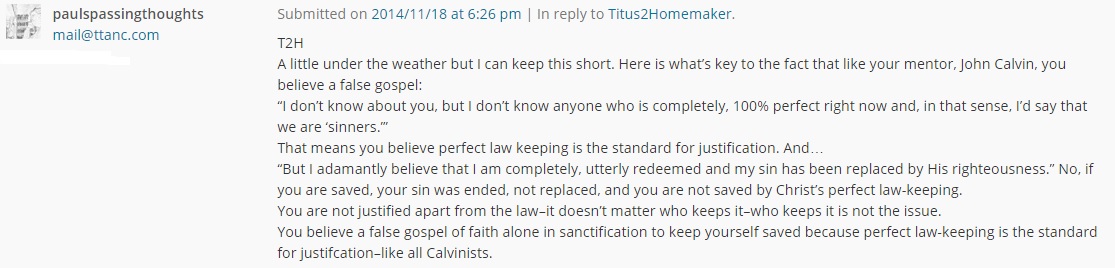
The Reformation gospel makes no distinction between the law’s role for the unsaved and saved; in both cases, the law can only condemn. The most basic problem arising out of this is the law becomes the standard for justification when in fact God makes believers righteous “apart from the law” (Romans 3:21). There is NO law in justification. Christ went to the cross to end the law for justification (Romans 10:4). Those under grace nevertheless now love God’s law. What the Reformers did in essence said…
“You love the law, fine and dandy, but a perfect keeping of the law must be maintained in order for you to be justified and remain justified, so any attempt to keep the law as a Christian is the same as trying to keep the law in order to justify yourself.”
This premise of the Reformation gospel, the crux of it, is well articulated by the late Reformed think tank, the Australian Forum:
After a man hears the conditions of acceptance with God and eternal life, and is made sensible of his inability to meet those conditions, the Word of God comes to him in the gospel. He hears that Christ stood in his place and kept the law of God for him. By dying on the cross, Christ satisfied all the law’s demands. The Holy Spirit gives the sinner faith to accept the righteousness of Jesus. Standing now before the law which says, “I demand a life of perfect conformity to the commandments,” the believing sinner cries in triumph, “Mine are Christ’s living, doing, and speaking, His suffering and dying; mine as much as if I had lived, done, spoken, and suffered, and died as He did . . . ” (Luther). The law is well pleased with Jesus’ doing and dying, which the sinner brings in the hand of faith. Justice is fully satisfied, and God can truly say: “This man has fulfilled the law. He is justified.”
We say again, only those are justified who bring to God a life of perfect obedience to the law of God. This is what faith does—it brings to God the obedience of Jesus Christ. By faith the law is fulfilled and the sinner is justified.
On the other hand, the law is dishonored by the man who presumes to bring to it his own life of obedience. The fact that he thinks the law will be satisfied with his “rotten stubble and straw” (Luther) shows what a low estimate he has of the holiness of God and what a high estimate he has of his own righteousness. Only in Jesus Christ is there an obedience with which the law is well pleased. Because faith brings only what Jesus has done, it is the highest honor that can be paid to the law (Rom. 3:31). [The Forum’s theological journal, Present Truth: “Law and Gospel,” Volume 7, Article 2, Part 2; also see the Calvin Institutes 3.14.9-11].
This is what makes the Reformation gospel patently false. The law is not Justification’s standard. If there is any standard at all, it is a love for the law, not a perfect keeping of it. Christ ended the law for justification, and the law is now the standard of love for sanctification. The Christian’s motives for obedience are pure because he/she knows the law has NO bearing on their justified state. The only motive for obedience is love, but the law is now the standard for what love is in sanctification.
The crux for the Reformed gospel now becomes how one obtains a perfect keeping of the law apart from any obedience of the “believer.” This is a system where perfect obedience must be continually imputed to the believer in order to satisfy the law. It boils down to a system where perfect obedience satisfies the law through faith alone in whatever that system is. In the Reformed construct, that necessarily requires that Jesus not only died for our sins, but also lived a life of perfect obedience to the law while He was ministering on earth. This is called “double imputation.” Our sins were imputed to Christ, and then He died to pay the penalty thereof, and His perfect obedience to the law is also imputed to us so that the law, being the standard of justification, is satisfied.
This is not a new approach; this whole idea of justification’s standard being a perfect keeping of the law. The apostle Paul argued against this universal anti-gospel in his letter to the Galatians in the following way:
Galatians 3:15 To give a human example, brothers: even with a man-made covenant, no one annuls it or adds to it once it has been ratified. 16 Now the promises were made to Abraham and to his offspring. It does not say, “And to offsprings,” referring to many, but referring to one, “And to your offspring,” who is Christ. 17 This is what I mean: the law, which came 430 years afterward, does not annul a covenant previously ratified by God, so as to make the promise void. 18 For if the inheritance comes by the law, it no longer comes by promise; but God gave it to Abraham by a promise.
19 Why then the law? It was added because of transgressions, until the offspring should come to whom the promise had been made, and it was put in place through angels by an intermediary. 20 Now an intermediary implies more than one, but God is one.
21 Is the law then contrary to the promises of God? Certainly not! For if a law had been given that could give life, then righteousness would indeed be by the law. 22 But the Scripture imprisoned everything under sin, so that the promise by faith in Jesus Christ might be given to those who believe.
23 Now before faith came, we were held captive under the law, imprisoned until the coming faith would be revealed. 24 So then, the law was our guardian until Christ came, in order that we might be justified by faith. 25 But now that faith has come, we are no longer under a guardian, 26 for in Christ Jesus you are all sons of God, through faith. 27 For as many of you as were baptized into Christ have put on Christ. 28 There is neither Jew nor Greek, there is neither slave nor free, there is no male and female, for you are all one in Christ Jesus. 29 And if you are Christ’s, then you are Abraham’s offspring, heirs according to promise.
What is Paul saying? He is speaking from the perspective of offspring and the offspring that gives eternal life according to “the promise.” Salvation is based on the covenant God made with Abraham based on promise alone. The promise involved ONE offspring, NOT more than one. If law is a standard for justification, it is in fact an additional offspring—that’s Paul’s point exactly.
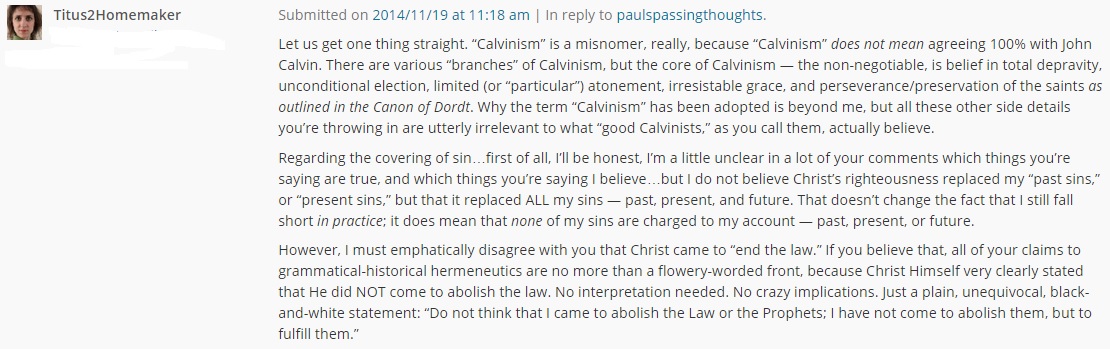
This is where the concept of covenant comes in. To say that all sin was imputed to Christ is not exactly right. Actually, all sin is imputed to the Old Covenant law, and then Christ came to end the law and all of the sin imputed to it. Sin is defined by breaking the law (1John 3:4). All sin is imputed to the Old Covenant law until faith comes. That’s why Christ came to end the law for righteousness. In regard to justification, the law and all of our sins imputed to it are cast away as far as the east is from the west. That’s the function of the New Covenant in this age: it ends sin while the Old Covenant only covered sin. That’s why the New Covenant is a “better” covenant; it doesn’t just cover sin, it ends sin. The coming of the Old Covenant did not replace the Abrahamic covenant because it was ratified according to the promise of the one seed 430 years prior. The Old Covenant was a “guardian” or protector until Christ came to end the law.
Hence, to say that the law is the standard for righteousness is to also say that it was part of the promise and is an additional seed that can give life—no, only Christ can give life. Who keeps the law is irrelevant, it cannot give life in regard to justification—there is only ONE SEED. Christ didn’t come to keep the Old Testament law for us—He came to end the law for us. The New Covenant is not a covering of sin—it is an ending of sin.
On this wise, the Old Covenant still has a function presently; unbelievers are still under it. Every sin they commit is against that law and imputed to it. When they believe on Christ, that law, the “law of sin and death” is ended along with all sins they ever committed. One reason for this ending is because they die with Christ, and are no longer under that covenant:
Romans 7:1 – Or do you not know, brothers—for I am speaking to those who know the law—that the law is binding on a person only as long as he lives? 2 For a married woman is bound by law to her husband while he lives, but if her husband dies she is released from the law of marriage. 3 Accordingly, she will be called an adulteress if she lives with another man while her husband is alive. But if her husband dies, she is free from that law, and if she marries another man she is not an adulteress.
4 Likewise, my brothers, you also have died to the law through the body of Christ, so that you may belong to another, to him who has been raised from the dead, in order that we may bear fruit for God. 5 For while we were living in the flesh, our sinful passions, aroused by the law, were at work in our members to bear fruit for death. 6 But now we are released from the law, having died to that which held us captive, so that we serve in the new way of the Spirit and not in the old way of the written code.
Indeed, the Old Covenant law was “served,” but now the law that kept our sins “captive” is ended by Christ, and we “serve” in the new way of the Spirit, BUT that does not mean that there is not a written law that we “UPHOLD” (Romans 3:31). This same law which includes both covenants is now the sword of the Spirit and our guide for loving God and others. We not only died with Christ to end our sins, but we were resurrected with Him in order to uphold the law for the sake of love. Our NEW desire is to love God and others through obedience to the law. It was the same, as we have seen in Psalms 119 for those under the Old covenant, but at that time their sins were only covered by the law and not ended. This makes the New covenant “better.”
We are saved (justified) by faith alone, but in sanctification, our faith WORKS through love:
Galatians 5:2 – Look: I, Paul, say to you that if you accept circumcision, Christ will be of no advantage to you. 3 I testify again to every man who accepts circumcision that he is obligated to keep the whole law. 4 You are severed from Christ, you who would be justified by the law; you have fallen away from grace. 5 For through the Spirit, by faith, we ourselves eagerly wait for the hope of righteousness. 6 For in Christ Jesus neither circumcision nor uncircumcision counts for anything, but only faith working through love [“If you love me, keep my commandments”].
And what about future sin after salvation?
Romans 4:15 – For the law brings wrath, but where there is no law there is no transgression.
Romans 7:8…Apart from the law, sin lies dead.
However, the universal anti-gospel of the ages retains the law as a covering and the very standard of justification. It makes the law a co-heir with Christ. This necessary separation of law from the believer because he/she cannot keep it perfectly circumvents any ability to love God and others (“If you love me, keep my commandments”), separates law from sanctification, and is the very definition of antinomianism. In the Bible, antinomianism is stated as the antithesis of love (Psalm 119:70, Matthew 24:11, John 14:15).
Consequently, the vast majority of denominations that came out of the Protestant Reformation came up with their own systems that impute a satisfaction of the law to the “believer” who must appropriate this satisfaction by faith alone in whatever that system may be. However, most systems followed the basic principles of the most notable Reformers, Martin Luther and John Calvin. Also, it stands to reason that these systems are encompassed within the authority of an institution because of the complexity of such systems, but also the simplicity as well. Because a perfect keeping of the law must be satisfied in order to justify, and no one can keep the law perfectly, there must be a way for the “believer” to have a perfect keeping of the law credited to their account. When figuring that out from Scripture, it seems complex, but institutions endowed with God’s authority are supposedly vested with the responsibility to make the application simple for the great unwashed masses via orthodoxy. Said another way; ritual, or the “traditions of men.” Note once again Galatians 5:2ff., the Judaizes proffered the ritual of circumcision as a fulfillment of the law for justification. Paul said no; ritual cannot replace a fulfillment of the law for justification unless you keep the whole law perfectly. The law must be ended.
In the final analysis, most religions and denominations that comprise them, bridge a particular standard of righteousness with a ritual system based on a mediation authority between the common people and God. This is always a temple focused institution. God’s system has no standard for righteousness, but only a standard that defines love. When it gets right down to it, what standard could ever adequately define God’s righteousness? The apostle John stated that the world was not big enough to hold a book that would record the good works Christ did while He ministered on earth; so, we are to believe that Christ fulfilled all righteousness in our stead by obeying the Old Testament perfectly? In addition to this problematic question, the New Testament had not yet been written, and many prophecies in both the Old and New testaments are not yet fulfilled.
These substitute systems that errantly seek to satisfy a law by proxy offer the masses a simplistic ritual or tradition that shows their faith in whatever system that credits perfection to their account. This is always done via an institution. The institution is supposedly the God-ordained authority to usher the masses into an eternal utopia of some sort. People then pick the institution of their choice generally assuming that their good intentions and willingness to humbly submit to an authority will get them into heaven.
In the Protestant construct, that is defined as present and future sins removing us from grace which requires perpetual atonement. This is achieved by continually returning to the same gospel that saved us. “We must preach the gospel to ourselves every day” is even a well-traveled mantra among the Neo-Calvinists of our day. This perpetual return to the same gospel that saved us is only sanctioned in the institutional church overseen by Reformed elders:
Moreover, the message of free reconciliation with God is not promulgated for one or two days, but is declared to be perpetual in the Church (2 Cor. 5:18, 19). Hence believers have not even to the end of life any other righteousness than that which is there described. Christ ever remains a Mediator to reconcile the Father to us, and there is a perpetual efficacy in his death—viz. ablution, satisfaction, expiation; in short, perfect obedience, by which all our iniquities are covered (The Calvin Institutes: 3.14.11).
Nor by remission of sins does the Lord only once for all elect and admit us into the Church, but by the same means he preserves and defends us in it. For what would it avail us to receive a pardon of which we were afterwards to have no use? That the mercy of the Lord would be vain and delusive if only granted once, all the godly can bear witness; for there is none who is not conscious, during his whole life, of many infirmities which stand in need of divine mercy. And truly it is not without cause that the Lord promises this gift specially to his own household, nor in vain that he orders the same message of reconciliation to be daily delivered to them (The Calvin Institutes: 4.1.21).
To impart this blessing to us, the keys have been given to the Church (Mt. 16:19; 18:18). For when Christ gave the command to the apostles, and conferred the power of forgiving sins, he not merely intended that they should loose the sins of those who should be converted from impiety to the faith of Christ; but, moreover, that they should perpetually perform this office among believers (The Calvin Institutes: 4.1.22).
Secondly, This benefit is so peculiar to the Church, that we cannot enjoy it unless we continue in the communion of the Church. Thirdly, It is dispensed to us by the ministers and pastors of the Church, either in the preaching of the Gospel or the administration of the Sacraments, and herein is especially manifested the power of the keys, which the Lord has bestowed on the company of the faithful. Accordingly, let each of us consider it to be his duty to seek forgiveness of sins only where the Lord has placed it. Of the public reconciliation which relates to discipline, we shall speak at the proper place (Ibid).
…by new sins we continually separate ourselves, as far as we can, from the grace of God… Thus it is, that all the saints have need of the daily forgiveness of sins; for this alone keeps us in the family of God” (John Calvin: Commentaries on the Catholic Epistles; The Calvin Translation Society 1855. Editor: John Owen, p. 165 ¶4).
This is why Christ primarily limited His apologetic concerns to the traditions of men and antinomianism. Almost without exception, the traditions of men, bolstered by intimidating authoritative institutions, make the lives of “Christians” a segue from beginning salvation to final salvation. The institution is trusted to manage the Christian’s life in a way that they will be able to “stand in the final judgment.” Invariably, almost all religious institutions focus on preparing people for some kind of final judgment.
But Christ came to set people free from judgment, and into freedom to love. The Bible was written to individuals. The Bible always addresses particular individuals or an assembly/group. The Bible never addresses an hierarchy; NEVER. The Bible is written to Spirit-filled individuals called to fulfill their individual and unique callings. The emphasis is not making sure you get to heaven via a preordained institution. That concept circumvents love because the focus is making sure you can “stand in judgment” according to what the institution says will accomplish that.
Salvation doesn’t grow. Sanctification is not the “growing part” of salvation. Salvation is a conception of life that is a onetime event that creates a new creature. The creature grows, but not the conception. The conception is completed. The baby has been born. A baby cannot bring themselves into the world, but in due time they can take the gift of life and participate in it. Their birth is a finished work that makes growing in life possible, but in no way perpetually contributes to it. Likewise, salvation does not sanctify.
Keeping people under the law keeps them saved by keeping them from any attempt to love because that would be works salvation. Christians need to grow in an environment where the individual calling to love and good works is the emphasis, not salvation by faith in an institution. Even in cases where the latter is professed, the fruit of tradition that came from the roots of the Protestant tree is the actual function. Therefore, function mimics slavery to the law while proclaiming freedom. No, true freedom from the law is the only salvation that will yield abundant love in sanctification.
Salvation Does NOT Sanctify.
paul
Romans 13:14B; Part 2, “Overcoming Sin and Living Righteously, a Righteous Life of Real and Lasting Change”

In part one we looked at condemnation and how it empowers sin. Christ went to the cross and ended the law’s condemnation. Fear of death is primarily driven by condemnation and the fear of judgment. One of the most important parts of a Christian’s identity is to know that we are no longer under condemnation.
However, in our day there is a return to authentic Reformed soteriology that actually posits fear of condemnation as the primary motivator in sanctification. In Reformed soteriology, sanctification is seen as a conduit to final justification. In order to remain in the conduit that gives us our best chance to “stand in the judgment,” we must relive our original salvation by faith alone in sanctification. How is that accomplished? By reliving the same gospel that saved us over and over again. This is done through what the Reformers called mortification and vivification. Mortification is something we can do, vivification is only a future glory experience. When you see a Charismatic-like Reformed worship service, what John Piper calls exultation worship, they believe they are experiencing the joy of “future glory.” Really, this is probably the New Calvinist claim to fame: they put feet on the vivification part of mortification and vivification through a more contemporary form of worship. Hence, the “Reformed Charismatic” movement shouldn’t surprise us.
The “mortification of the flesh” part of this doctrine is a return to the fear of judgment, the same fear of judgment that originally saved us. Said John Calvin:
By mortification they mean, grief of soul and terror, produced by a conviction of sin and a sense of the divine judgment [sec.3]… it seems to me, that repentance may be not inappropriately defined thus: A real conversion of our life unto God, proceeding from sincere and serious fear of God; and consisting in the mortification of our flesh and the old man, and the quickening of the Spirit. In this sense are to be understood all those addresses in which the prophets first, and the apostles afterwards, exhorted the people of their time to repentance. The great object for which they labored was, to fill them with confusion for their sins and dread of the divine judgment, that they might fall down and humble themselves before him whom they had offended, and, with true repentance, retake themselves to the right path [sec.5]… The second part of our definition is, that repentance proceeds from a sincere fear of God. Before the mind of the sinner can be inclined to repentance, he must be aroused by the thought of divine judgment; but when once the thought that God will one day ascend his tribunal to take an account of all words and actions has taken possession of his mind, it will not allow him to rest, or have one moment’s peace, but will perpetually urge him to adopt a different plan of life, that he may be able to stand securely at that judgment-seat. Hence the Scripture, when exhorting to repentance, often introduces the subject of judgment, as in Jeremiah, “Lest my fury come forth like fire, and burn that none can quench it, because of the evil of your doings,” (Jer. 4:4)… The stern threatening which God employs are extorted from him by our depraved dispositions [sec.7] [from the CI 3.3.3-7].
Susan and I sat in a Pentecostal service and listened to the pastor say in no uncertain terms that one is not really saved till they experience the “second blessing” usually manifested by speaking in tongues. Services from the Charismatic camps are predicated by these second blessing experiences such as speaking in tongues, Holy Spirit laughter, and “dancing in the Lord.” Though Charismatics emphasize mortification far less than the Reformed, it’s the same basic idea. The vast majority of all denominations in our day flowed out of the Reformation and are predicated by progressive justification; viz, keeping ourselves saved by the same gospel that originally saved us.
The result is a proper biblical definition of antinomianism: some sort of doctrine that separates the law from sanctification. The “Christian” remains under condemnation, and must prepare to “stand in the judgment” by other means apart from loving God and others through obedience to the law. But there is no future judgment for Christians to stand in that has to do with justification. Antinomianism, when it boils right down to it, is the fusion of justification and sanctification together. In any doctrinal construct where sanctification is the progression of justification—that’s antinomianism because the law must be separated from sanctification lest it be justification by works. This is probably the key to ecumenicalism because the primary religion of the last days, according to the Bible, will be antinomianism.
To the contrary, why is it critical that Christians know they are no longer under the condemnation of the law?
1John 4:18 – There is no fear in love, but perfect love casts out fear. For fear has to do with punishment, and whoever fears has not been perfected in love.
The word translated “perfect” in the English is τέλειος (teleios), and is translated “mature” in many other passages of the New Testament. The word means “maturity,” or possessing everything one needs to be mature. Mature love is the idea here, not a “perfect” love.
So, what do we need to understand if we are to be mature in love, overcoming sin, and living righteously? We need to understand that there is no condemnation for us and no need to fear judgment, and we need to understand how sin works against us.
We need to understand that sin is a stand-alone element. It was sin that was found in Satan at some point in time (Ezekiel 28:15). Sin, whatever it is exactly, wages war against righteousness. The location of sin is in the body, and it uses desire to tempt individuals against righteousness. So, the four elements to understand are sin, righteousness, body, and desire. Sin is the problem; its enemy is righteousness; its location is the body, and it uses desire to tempt people to wage war against righteousness.
Let’s begin by looking at how these four elements operate in an unbeliever. Every person born into the world has the works of God’s law written on their hearts. Also within every person born into the world is a conscience that uses this law to either accuse or excuse behavior. So, every person born into the world has an intuitive law and judge within as part of their being. In the final judgment of condemnation at the end of the ages, those who have never been exposed to God’s written law will be judged and condemned because they violated their consciences on many occasions. As a cosmic principle, where there is no law there is no sin, so all babies go to heaven because they do not have a developed conscience. This would also apply to mental disabilities where a conscience is not present.
The Bible also states that repeated rebellion against one’s conscience can sear it like a hot iron. A refusal to obey conscience can reduce a person’s ability to feel guilt.
1Timothy 4:1 – Now the Spirit expressly says that in later times some will depart from the faith by devoting themselves to deceitful spirits and teachings of demons, 2 through the insincerity of liars whose consciences are seared, 3 who forbid marriage and require abstinence from foods that God created to be received with thanksgiving by those who believe and know the truth. 4 For everything created by God is good, and nothing is to be rejected if it is received with thanksgiving, 5 for it is made holy by the word of God and prayer.
Sear: g2743. from a derivative of 2545; to brand (“cauterize”), i. e. (by implication) to render unsensitive (figuratively):— sear with a hot iron.
Those who lack a conscience or moral compass are referred to as sociopaths in our culture. Sin uses desire to tempt, so a person with a seared conscience will most likely follow every desire that sin uses to wage war against righteousness. Police are sometimes stunned that murderers confess to their crime and state the following motive: “I wanted to know what it felt like to kill someone.” So, the murder was committed to satisfy the murderer’s curiosity.
Civil and criminal law restrains evil when fear of punishment outweighs the desire to commit a certain act. If a person thinks they can outwit law enforcement they will be inclined to obey the desire that sin is tempting them with. They don’t see the desire as evil; they have a stronger desire to avoid punishment. Nevertheless, the desire can be strong enough that any kind of logic or self-preservation is abandoned.
Sinful desires can take on all sorts of forms. The question is whether or not we will obey the desire just because it is a desire. Sin is opposed to any kind of law and is empowered by condemnation. Sin is an entity that seeks to bring death through the condemnation of conscience and bad desires. It is a complex death system. Those who are under law are constantly bearing fruits for death although they are able to do good works. In fact, their consciences will reward them with good feelings when they do good, but they are still under condemnation and sin’s constant harassment.
In regard to the believer, sin still resides in the body, but it has been stripped of its power due to Christ dying on the cross for our sins. Sin is empowered by its ability to condemn. I can’t say that I completely understand this, but nevertheless, it is what the Bible states:
1Corinthians 15:56 – The sting of death is sin, and the power of sin is the law. 57 But thanks be to God, who gives us the victory through our Lord Jesus Christ.
Sin brings about some sort of temporary death, physical death, and ultimately eternal death. Sin is in the sowing and reaping business, and the sowing of sin is often interpreted as “getting away with it” because there has not yet been a reaping. But the point here is that sin is empowered by the condemnation of law. When Christ died on the cross to end the law, it stripped sin of its power. Hence, when a Christian is confronted with a sinful desire, they are not only able to say no to that desire, but do so for the proper motives; i.e., love for God and others.
James 1:13 – Let no one say when he is tempted, “I am being tempted by God,” for God cannot be tempted with evil, and he himself tempts no one. 14 But each person is tempted when he is lured and enticed by his own desire. 15 Then desire when it has conceived gives birth to sin, and sin when it is fully grown brings forth death.
Romans 6:1 – What shall we say then? Are we to continue in sin that grace may abound? 2 By no means! How can we who died to sin still live in it? 3 Do you not know that all of us who have been baptized into Christ Jesus were baptized into his death? 4 We were buried therefore with him by baptism into death, in order that, just as Christ was raised from the dead by the glory of the Father, we too might walk in newness of life.
5 For if we have been united with him in a death like his, we shall certainly be united with him in a resurrection like his. 6 We know that our old self was crucified with him in order that the body of sin might be brought to nothing, so that we would no longer be enslaved to sin. 7 For one who has died has been set free from sin. 8 Now if we have died with Christ, we believe that we will also live with him. 9 We know that Christ, being raised from the dead, will never die again; death no longer has dominion over him. 10 For the death he died he died to sin, once for all, but the life he lives he lives to God. 11 So you also must consider yourselves dead to sin and alive to God in Christ Jesus.
12 Let not sin therefore reign in your mortal body, to make you obey its passions. 13 Do not present your members to sin as instruments for unrighteousness, but present yourselves to God as those who have been brought from death to life, and your members to God as instruments for righteousness. 14 For sin will have no dominion over you, since you are not under law but under grace.
15 What then? Are we to sin because we are not under law but under grace? By no means! 16 Do you not know that if you present yourselves to anyone as obedient slaves, you are slaves of the one whom you obey, either of sin, which leads to death, or of obedience, which leads to righteousness? 17 But thanks be to God, that you who were once slaves of sin have become obedient from the heart to the standard of teaching to which you were committed, 18 and, having been set free from sin, have become slaves of righteousness. 19 I am speaking in human terms, because of your natural limitations. For just as you once presented your members as slaves to impurity and to lawlessness leading to more lawlessness, so now present your members as slaves to righteousness leading to sanctification.
20 For when you were slaves of sin, you were free in regard to righteousness. 21 But what fruit were you getting at that time from the things of which you are now ashamed? For the end of those things is death. 22 But now that you have been set free from sin and have become slaves of God, the fruit you get leads to sanctification and its end, eternal life. 23 For the wages of sin is death, but the free gift of God is eternal life in Christ Jesus our Lord.
Sin resides in the body, but even though the body is weak, it is neutral. When the Bible authors speak of the “body of sin,” “desires of the flesh,” etc., they are speaking of when the body is being used by the individual to do the bidding of sin. In the case of an unbeliever, they are under law and sin can provoke them to yield their members up for unrighteousness to the point of slavery while the power of sin has been broken within the believer and they have a choice:
Romans 12:1 – I appeal to you therefore, brothers, by the mercies of God, to present your bodies as a living sacrifice, holy and acceptable to God, which is your spiritual worship. 2 Do not be conformed to this world, but be transformed by the renewal of your mind, that by testing you may discern what is the will of God, what is good and acceptable and perfect.
Therefore, let me comment on this passage:
Galatians 5:16 – But I say, walk by the Spirit, and you will not gratify the desires of the flesh. 17 For the desires of the flesh are against the Spirit, and the desires of the Spirit are against the flesh, for these are opposed to each other, to keep you from doing the things you want to do. 18 But if you are led by the Spirit, you are not under the law. 19 Now the works of the flesh are evident: sexual immorality, impurity, sensuality, 20 idolatry, sorcery, enmity, strife, jealousy, fits of anger, rivalries, dissensions, divisions, 21 envy, drunkenness, orgies, and things like these. I warn you, as I warned you before, that those who do such things will not inherit the kingdom of God. 22 But the fruit of the Spirit is love, joy, peace, patience, kindness, goodness, faithfulness, 23 gentleness, self-control; against such things there is no law. 24 And those who belong to Christ Jesus have crucified the flesh with its passions and desires.
25 If we live by the Spirit, let us also keep in step with the Spirit. 26 Let us not become conceited, provoking one another, envying one another.
The “desires of the flesh” are really sinful desires spoken of in context of yielding up our members in service to sinful desires. At least for the believer, our bodies are the temple of the Holy Spirit:
1Corinthians 3:16 – Do you not know that you are God’s temple and that God’s Spirit dwells in you? 17 If anyone destroys God’s temple, God will destroy him. For God’s temple is holy, and you are that temple.
So, even among Christians, if they “Let…sin…reign in [their] mortal bod[ies], it can lead to fruits unto death, or destruction. Not eternally, but present miseries of all sort.
Through learning God’s full counsel and applying it to one’s life, Christians can learn to say no to sinful desires and live according to the desires of the Spirit. The unregenerate do not possess the desires of the Spirit because they are not born of God. There is not a war between sin and the desires of the Spirit raging within the unbeliever, only a battle between the conscience and sin, and the motives for saying yes to the conscience involve motives other than those of a kingdom citizen. The battle is a single dimension. However, here is where the importance of evangelism comes in: the Holy Spirit convicts the world of unrighteousness, and the word of God is the sword of the Spirit. Evangelism adds another dimension in regard to showing people their need for a savior.
For the Christian, they have the testimony of conscience and the Holy Spirit. The New Testament has much to say about utilizing conscience in our fight against sin. The apostle Paul instructed us to keep a clear conscience before God. This also has much to do with assurance of salvation. Even though we know intellectually that the law has been ended by Christ and we are never condemned, sin nevertheless invokes feelings of condemnation and shakes our confidence.
In the final analysis, sanctification is the growing art of knowing how to control our bodies:
1Thessalonians 4:3 – For this is the will of God, your sanctification: that you abstain from sexual immorality; 4 that each one of you know how to control his own body in holiness and honor, 5 not in the passion of lust like the Gentiles who do not know God; 6 that no one transgress and wrong his brother in this matter, because the Lord is an avenger in all these things, as we told you beforehand and solemnly warned you. 7 For God has not called us for impurity, but in holiness. 8 Therefore whoever disregards this, disregards not man but God, who gives his Holy Spirit to you.

Justification is NOT a Declaration of Righteousness; The Christian is Made Personally Righteous
 It begs the question: has the institutional church ever taught us anything at all that is true? Here we go again; have we all not heard all of our Christian lives that justification is “a legal pardon/declaration in which the Christian is declared righteous”? It is usually explained like this:
“When we believe in Jesus, it is just like we never sinned.”
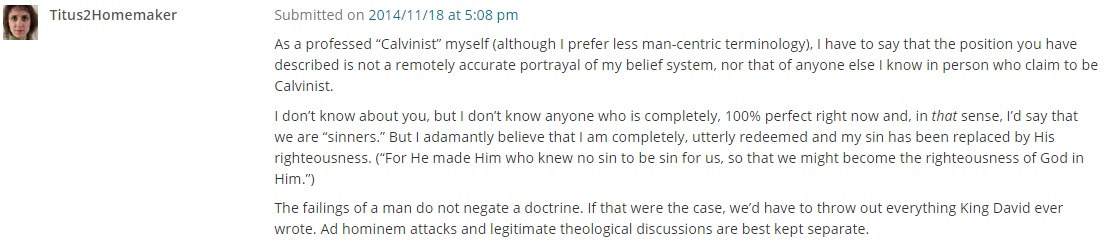
Excuse me, but if you are presently a Christian, it is NOT “just like you never sinned,” you in fact have never sinned, nor will you ever sin in the future.
Huh?
We are talking about JUSTIFICATION, right? Two things happen when we are justified, or… “saved.” The law is ended/cancelled for us when we believe because Christ nailed the law and all of its condemnation to the cross. And, where there is no law, there is no sin. We are not talking about sin as God’s children that grieves the Holy Spirit who seals us until the day of redemption, we are talking about sin that would condemn us eternally.
This is where the logical jump from the ending of the law to justification is defined as a mere legal pardon. The Bible gives tacit recognition to that, kind of, but the primary definition of justification in the Bible is being made personally righteous through the new birth. God’s children are justified because they are made personally righteous. We are not just declared righteous, we are righteous. The nomenclature “duck” does not make a duck a duck, his duckness makes him a duck. Likewise, Christians are justified because they are in fact righteous.
Christians do not bear sin that is covered by God’s righteousness (often erroneously dubbed, “the righteousness of Christ”), our sin is ENDED, and God’s righteousness is infused into us via the new birth—we are literally born of God. Granted, sin still dwells in our mortal bodies, but it cannot condemn us because Christ ended the law on the cross. God now deals with us as children, because we really ARE his children and have his seed (DNA) within us. We may be chastised by God from time to time, but NOT condemned.
Christianity is not a mere mental ascent to the facts of the gospel; it is a literal following of Christ in death and resurrection. You are not “asking Jesus into your heart,” you are accepting God’s invitation to die with Christ and be resurrected with Him. The old you that was under the law literally dies, and you are born again as a literal child of God. Regardless of the fact that you are in a mortal body, you are God’s child and have His seed (σπέρμα sperma; seed of offspring) within you. The issue of the flesh’s weakness is resolved at redemption, but has nothing to do with your present righteousness.
This is why the Christian walk is so important; it testifies to the new birth. Be sure of this: truisms like, “We are all just sinners saved by grace” reveal a fundamental lack of understanding in regard to the gospel. Justification is not a covering, it is an ending of sin/condemnation and the walk of the new creature. I will close with this passage to make my final point:
1John 3:1 – See what kind of love the Father has given to us, that we should be called children of God; and so we are. The reason why the world does not know us is that it did not know him. 2 Beloved, we are God’s children now, and what we will be has not yet appeared; but we know that when he appears we shall be like him, because we shall see him as he is. 3 And everyone who thus hopes in him purifies himself as he is pure.
4 Everyone who makes a practice of sinning also practices lawlessness; sin is lawlessness. 5 You know that he appeared in order to take away sins, and in him there is no sin. 6 No one who abides in him keeps on sinning; no one who keeps on sinning has either seen him or known him. 7 Little children, let no one deceive you. Whoever practices righteousness is righteous, as he is righteous. 8 Whoever makes a practice of sinning is of the devil, for the devil has been sinning from the beginning. The reason the Son of God appeared was to destroy the works of the devil. 9 No one born of God makes a practice of sinning, for God’s seed abides in him, and he cannot keep on sinning because he has been born of God. 10 By this it is evident who are the children of God, and who are the children of the devil: whoever does not practice righteousness is not of God, nor is the one who does not love his brother.



4 comments