Paul's Passing Thoughts

Romans 13:14B; Part 2, “Overcoming Sin and Living Righteously, a Righteous Life of Real and Lasting Change”

Posted in Uncategorized by Paul M. Dohse Sr. on November 16, 2014

HF Potters House (2)

In part one we looked at condemnation and how it empowers sin. Christ went to the cross and ended the law’s condemnation. Fear of death is primarily driven by condemnation and the fear of judgment. One of the most important parts of a Christian’s identity is to know that we are no longer under condemnation.

However, in our day there is a return to authentic Reformed soteriology that actually posits fear of condemnation as the primary motivator in sanctification. In Reformed soteriology, sanctification is seen as a conduit to final justification. In order to remain in the conduit that gives us our best chance to “stand in the judgment,” we must relive our original salvation by faith alone in sanctification. How is that accomplished? By reliving the same gospel that saved us over and over again. This is done through what the Reformers called mortification and vivification. Mortification is something we can do, vivification is only a future glory experience. When you see a Charismatic-like Reformed worship service, what John Piper calls exultation worship, they believe they are experiencing the joy of “future glory.” Really, this is probably the New Calvinist claim to fame: they put feet on the vivification part of mortification and vivification through a more contemporary form of worship. Hence, the “Reformed Charismatic” movement shouldn’t surprise us.

The “mortification of the flesh” part of this doctrine is a return to the fear of judgment, the same fear of judgment that originally saved us. Said John Calvin:

By mortification they mean, grief of soul and terror, produced by a conviction of sin and a sense of the divine judgment [sec.3]… it seems to me, that repentance may be not inappropriately defined thus: A real conversion of our life unto God, proceeding from sincere and serious fear of God; and consisting in the mortification of our flesh and the old man, and the quickening of the Spirit. In this sense are to be understood all those addresses in which the prophets first, and the apostles afterwards, exhorted the people of their time to repentance. The great object for which they labored was, to fill them with confusion for their sins and dread of the divine judgment, that they might fall down and humble themselves before him whom they had offended, and, with true repentance, retake themselves to the right path [sec.5]… The second part of our definition is, that repentance proceeds from a sincere fear of God. Before the mind of the sinner can be inclined to repentance, he must be aroused by the thought of divine judgment; but when once the thought that God will one day ascend his tribunal to take an account of all words and actions has taken possession of his mind, it will not allow him to rest, or have one moment’s peace, but will perpetually urge him to adopt a different plan of life, that he may be able to stand securely at that judgment-seat. Hence the Scripture, when exhorting to repentance, often introduces the subject of judgment, as in Jeremiah, “Lest my fury come forth like fire, and burn that none can quench it, because of the evil of your doings,” (Jer. 4:4)… The stern threatening which God employs are extorted from him by our depraved dispositions [sec.7] [from the CI 3.3.3-7].

Susan and I sat in a Pentecostal service and listened to the pastor say in no uncertain terms that one is not really saved till they experience the “second blessing” usually manifested by speaking in tongues. Services from the Charismatic camps are predicated by these second blessing experiences such as speaking in tongues, Holy Spirit laughter, and “dancing in the Lord.” Though Charismatics emphasize mortification far less than the Reformed, it’s the same basic idea. The vast majority of all denominations in our day flowed out of the Reformation and are predicated by progressive justification; viz, keeping ourselves saved by the same gospel that originally saved us.

The result is a proper biblical definition of antinomianism: some sort of doctrine that separates the law from sanctification. The “Christian” remains under condemnation, and must prepare to “stand in the judgment” by other means apart from loving God and others through obedience to the law. But there is no future judgment for Christians to stand in that has to do with justification. Antinomianism, when it boils right down to it, is the fusion of justification and sanctification together. In any doctrinal construct where sanctification is the progression of justification—that’s antinomianism because the law must be separated from sanctification lest it be justification by works. This is probably the key to ecumenicalism because the primary religion of the last days, according to the Bible, will be antinomianism.

To the contrary, why is it critical that Christians know they are no longer under the condemnation of the law?

1John 4:18 – There is no fear in love, but perfect love casts out fear. For fear has to do with punishment, and whoever fears has not been perfected in love.

The word translated “perfect” in the English is τέλειος (teleios), and is translated “mature” in many other passages of the New Testament. The word means “maturity,” or possessing everything one needs to be mature. Mature love is the idea here, not a “perfect” love.

So, what do we need to understand if we are to be mature in love, overcoming sin, and living righteously? We need to understand that there is no condemnation for us and no need to fear judgment, and we need to understand how sin works against us.

We need to understand that sin is a stand-alone element. It was sin that was found in Satan at some point in time (Ezekiel 28:15). Sin, whatever it is exactly, wages war against righteousness. The location of sin is in the body, and it uses desire to tempt individuals against righteousness. So, the four elements to understand are sin, righteousness, body, and desire. Sin is the problem; its enemy is righteousness; its location is the body, and it uses desire to tempt people to wage war against righteousness.

Let’s begin by looking at how these four elements operate in an unbeliever. Every person born into the world has the works of God’s law written on their hearts. Also within every person born into the world is a conscience that uses this law to either accuse or excuse behavior. So, every person born into the world has an intuitive law and judge within as part of their being. In the final judgment of condemnation at the end of the ages, those who have never been exposed to God’s written law will be judged and condemned because they violated their consciences on many occasions. As a cosmic principle, where there is no law there is no sin, so all babies go to heaven because they do not have a developed conscience. This would also apply to mental disabilities where a conscience is not present.

The Bible also states that repeated rebellion against one’s conscience can sear it like a hot iron. A refusal to obey conscience can reduce a person’s ability to feel guilt.

1Timothy 4:1 – Now the Spirit expressly says that in later times some will depart from the faith by devoting themselves to deceitful spirits and teachings of demons, 2 through the insincerity of liars whose consciences are seared, 3 who forbid marriage and require abstinence from foods that God created to be received with thanksgiving by those who believe and know the truth. 4 For everything created by God is good, and nothing is to be rejected if it is received with thanksgiving, 5 for it is made holy by the word of God and prayer.

Sear: g2743. from a derivative of 2545; to brand (“cauterize”), i. e. (by implication) to render unsensitive (figuratively):— sear with a hot iron.

Those who lack a conscience or moral compass are referred to as sociopaths in our culture. Sin uses desire to tempt, so a person with a seared conscience will most likely follow every desire that sin uses to wage war against righteousness. Police are sometimes stunned that murderers confess to their crime and state the following motive: “I wanted to know what it felt like to kill someone.” So, the murder was committed to satisfy the murderer’s curiosity.

Civil and criminal law restrains evil when fear of punishment outweighs the desire to commit a certain act. If a person thinks they can outwit law enforcement they will be inclined to obey the desire that sin is tempting them with. They don’t see the desire as evil; they have a stronger desire to avoid punishment. Nevertheless, the desire can be strong enough that any kind of logic or self-preservation is abandoned.

Sinful desires can take on all sorts of forms. The question is whether or not we will obey the desire just because it is a desire. Sin is opposed to any kind of law and is empowered by condemnation. Sin is an entity that seeks to bring death through the condemnation of conscience and bad desires. It is a complex death system. Those who are under law are constantly bearing fruits for death although they are able to do good works. In fact, their consciences will reward them with good feelings when they do good, but they are still under condemnation and sin’s constant harassment.

In regard to the believer, sin still resides in the body, but it has been stripped of its power due to Christ dying on the cross for our sins. Sin is empowered by its ability to condemn. I can’t say that I completely understand this, but nevertheless, it is what the Bible states:

1Corinthians 15:56 – The sting of death is sin, and the power of sin is the law. 57 But thanks be to God, who gives us the victory through our Lord Jesus Christ.

Sin brings about some sort of temporary death, physical death, and ultimately eternal death. Sin is in the sowing and reaping business, and the sowing of sin is often interpreted as “getting away with it” because there has not yet been a reaping. But the point here is that sin is empowered by the condemnation of law. When Christ died on the cross to end the law, it stripped sin of its power. Hence, when a Christian is confronted with a sinful desire, they are not only able to say no to that desire, but do so for the proper motives; i.e., love for God and others.

James 1:13 – Let no one say when he is tempted, “I am being tempted by God,” for God cannot be tempted with evil, and he himself tempts no one. 14 But each person is tempted when he is lured and enticed by his own desire. 15 Then desire when it has conceived gives birth to sin, and sin when it is fully grown brings forth death.

Romans 6:1 – What shall we say then? Are we to continue in sin that grace may abound? 2 By no means! How can we who died to sin still live in it? 3 Do you not know that all of us who have been baptized into Christ Jesus were baptized into his death? 4 We were buried therefore with him by baptism into death, in order that, just as Christ was raised from the dead by the glory of the Father, we too might walk in newness of life.

5 For if we have been united with him in a death like his, we shall certainly be united with him in a resurrection like his. 6 We know that our old self was crucified with him in order that the body of sin might be brought to nothing, so that we would no longer be enslaved to sin. 7 For one who has died has been set free from sin. 8 Now if we have died with Christ, we believe that we will also live with him. 9 We know that Christ, being raised from the dead, will never die again; death no longer has dominion over him. 10 For the death he died he died to sin, once for all, but the life he lives he lives to God. 11 So you also must consider yourselves dead to sin and alive to God in Christ Jesus.

12 Let not sin therefore reign in your mortal body, to make you obey its passions. 13 Do not present your members to sin as instruments for unrighteousness, but present yourselves to God as those who have been brought from death to life, and your members to God as instruments for righteousness. 14 For sin will have no dominion over you, since you are not under law but under grace.

15 What then? Are we to sin because we are not under law but under grace? By no means! 16 Do you not know that if you present yourselves to anyone as obedient slaves, you are slaves of the one whom you obey, either of sin, which leads to death, or of obedience, which leads to righteousness? 17 But thanks be to God, that you who were once slaves of sin have become obedient from the heart to the standard of teaching to which you were committed, 18 and, having been set free from sin, have become slaves of righteousness. 19 I am speaking in human terms, because of your natural limitations. For just as you once presented your members as slaves to impurity and to lawlessness leading to more lawlessness, so now present your members as slaves to righteousness leading to sanctification.

20 For when you were slaves of sin, you were free in regard to righteousness. 21 But what fruit were you getting at that time from the things of which you are now ashamed? For the end of those things is death. 22 But now that you have been set free from sin and have become slaves of God, the fruit you get leads to sanctification and its end, eternal life. 23 For the wages of sin is death, but the free gift of God is eternal life in Christ Jesus our Lord.

Sin resides in the body, but even though the body is weak, it is neutral. When the Bible authors speak of the “body of sin,” “desires of the flesh,” etc., they are speaking of when the body is being used by the individual to do the bidding of sin. In the case of an unbeliever, they are under law and sin can provoke them to yield their members up for unrighteousness to the point of slavery while the power of sin has been broken within the believer and they have a choice:

Romans 12:1 – I appeal to you therefore, brothers, by the mercies of God, to present your bodies as a living sacrifice, holy and acceptable to God, which is your spiritual worship. 2 Do not be conformed to this world, but be transformed by the renewal of your mind, that by testing you may discern what is the will of God, what is good and acceptable and perfect.

Therefore, let me comment on this passage:

Galatians 5:16 – But I say, walk by the Spirit, and you will not gratify the desires of the flesh. 17 For the desires of the flesh are against the Spirit, and the desires of the Spirit are against the flesh, for these are opposed to each other, to keep you from doing the things you want to do. 18 But if you are led by the Spirit, you are not under the law. 19 Now the works of the flesh are evident: sexual immorality, impurity, sensuality, 20 idolatry, sorcery, enmity, strife, jealousy, fits of anger, rivalries, dissensions, divisions, 21 envy, drunkenness, orgies, and things like these. I warn you, as I warned you before, that those who do such things will not inherit the kingdom of God. 22 But the fruit of the Spirit is love, joy, peace, patience, kindness, goodness, faithfulness, 23 gentleness, self-control; against such things there is no law. 24 And those who belong to Christ Jesus have crucified the flesh with its passions and desires.

25 If we live by the Spirit, let us also keep in step with the Spirit. 26 Let us not become conceited, provoking one another, envying one another.

The “desires of the flesh” are really sinful desires spoken of in context of yielding up our members in service to sinful desires. At least for the believer, our bodies are the temple of the Holy Spirit:

1Corinthians 3:16 – Do you not know that you are God’s temple and that God’s Spirit dwells in you? 17 If anyone destroys God’s temple, God will destroy him. For God’s temple is holy, and you are that temple.

So, even among Christians, if they “Let…sin…reign in [their] mortal bod[ies], it can lead to fruits unto death, or destruction. Not eternally, but present miseries of all sort.

Through learning God’s full counsel and applying it to one’s life, Christians can learn to say no to sinful desires and live according to the desires of the Spirit. The unregenerate do not possess the desires of the Spirit because they are not born of God. There is not a war between sin and the desires of the Spirit raging within the unbeliever, only a battle between the conscience and sin, and the motives for saying yes to the conscience involve motives other than those of a kingdom citizen. The battle is a single dimension. However, here is where the importance of evangelism comes in: the Holy Spirit convicts the world of unrighteousness, and the word of God is the sword of the Spirit. Evangelism adds another dimension in regard to showing people their need for a savior.

For the Christian, they have the testimony of conscience and the Holy Spirit. The New Testament has much to say about utilizing conscience in our fight against sin. The apostle Paul instructed us to keep a clear conscience before God. This also has much to do with assurance of salvation. Even though we know intellectually that the law has been ended by Christ and we are never condemned, sin nevertheless invokes feelings of condemnation and shakes our confidence.

In the final analysis, sanctification is the growing art of knowing how to control our bodies:

1Thessalonians 4:3 – For this is the will of God, your sanctification: that you abstain from sexual immorality; 4 that each one of you know how to control his own body in holiness and honor, 5 not in the passion of lust like the Gentiles who do not know God; 6 that no one transgress and wrong his brother in this matter, because the Lord is an avenger in all these things, as we told you beforehand and solemnly warned you. 7 For God has not called us for impurity, but in holiness. 8 Therefore whoever disregards this, disregards not man but God, who gives his Holy Spirit to you.

Potter H. 1

Justification is NOT a Declaration of Righteousness; The Christian is Made Personally Righteous

Posted in Uncategorized by Paul M. Dohse Sr. on November 15, 2014

PPT HandleIt begs the question: has the institutional church ever taught us anything at all that is true? Here we go again; have we all not heard all of our Christian lives that justification is “a legal pardon/declaration in which the Christian is declared righteous”? It is usually explained like this:

“When we believe in Jesus, it is just like we never sinned.”

Excuse me, but if you are presently a Christian, it is NOT “just like you never sinned,” you in fact have never sinned, nor will you ever sin in the future.

Huh?

We are talking about JUSTIFICATION, right? Two things happen when we are justified, or… “saved.” The law is ended/cancelled for us when we believe because Christ nailed the law and all of its condemnation to the cross. And, where there is no law, there is no sin. We are not talking about sin as God’s children that grieves the Holy Spirit who seals us until the day of redemption, we are talking about sin that would condemn us eternally.

This is where the logical jump from the ending of the law to justification is defined as a mere legal pardon. The Bible gives tacit recognition to that, kind of, but the primary definition of justification in the Bible is being made personally righteous through the new birth. God’s children are justified because they are made personally righteous. We are not just declared righteous, we are righteous. The nomenclature “duck” does not make a duck a duck, his duckness makes him a duck. Likewise, Christians are justified because they are in fact righteous.

Christians do not bear sin that is covered by God’s righteousness (often erroneously dubbed, “the righteousness of Christ”), our sin is ENDED, and God’s righteousness is infused into us via the new birth—we are literally born of God. Granted, sin still dwells in our mortal bodies, but it cannot condemn us because Christ ended the law on the cross. God now deals with us as children, because we really ARE his children and have his seed (DNA) within us. We may be chastised by God from time to time, but NOT condemned.

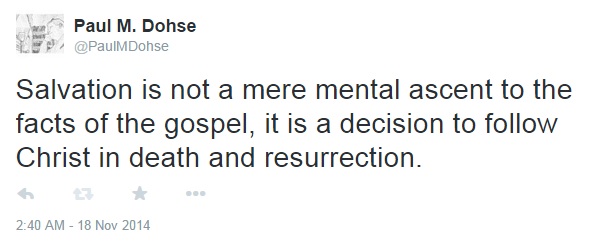
Christianity is not a mere mental ascent to the facts of the gospel; it is a literal following of Christ in death and resurrection. You are not “asking Jesus into your heart,” you are accepting God’s invitation to die with Christ and be resurrected with Him. The old you that was under the law literally dies, and you are born again as a literal child of God. Regardless of the fact that you are in a mortal body, you are God’s child and have His seed (σπέρμα sperma; seed of offspring) within you. The issue of the flesh’s weakness is resolved at redemption, but has nothing to do with your present righteousness.

This is why the Christian walk is so important; it testifies to the new birth. Be sure of this: truisms like, “We are all just sinners saved by grace” reveal a fundamental lack of understanding in regard to the gospel. Justification is not a covering, it is an ending of sin/condemnation and the walk of the new creature. I will close with this passage to make my final point:

1John 3:1 – See what kind of love the Father has given to us, that we should be called children of God; and so we are. The reason why the world does not know us is that it did not know him. 2 Beloved, we are God’s children now, and what we will be has not yet appeared; but we know that when he appears we shall be like him, because we shall see him as he is. 3 And everyone who thus hopes in him purifies himself as he is pure.

4 Everyone who makes a practice of sinning also practices lawlessness; sin is lawlessness. 5 You know that he appeared in order to take away sins, and in him there is no sin. 6 No one who abides in him keeps on sinning; no one who keeps on sinning has either seen him or known him. 7 Little children, let no one deceive you. Whoever practices righteousness is righteous, as he is righteous. 8 Whoever makes a practice of sinning is of the devil, for the devil has been sinning from the beginning. The reason the Son of God appeared was to destroy the works of the devil. 9 No one born of God makes a practice of sinning, for God’s seed abides in him, and he cannot keep on sinning because he has been born of God. 10 By this it is evident who are the children of God, and who are the children of the devil: whoever does not practice righteousness is not of God, nor is the one who does not love his brother.

Reflection on the “Chameleon” Post

Posted in Uncategorized by Paul M. Dohse Sr. on November 13, 2014

10398469_1057314164900_7208696_nAges ago, as a blogger rookie, this was one of my first posts. I wrote mostly about symptoms back then, and would like to add an addendum to the end that answers the “why?” question in regard to what I have perceived for years in the institutional church…

[Begin transcript]

Wikipedia has this definition of the Chameleon Lizard: “All chameleon species are able to change their skin colors. Different chameleon species are able to change different colors which can include pink, blue, red, orange, green, black, brown, yellow and turquoise. Recent research indicates that they do not typically change their color for reasons of camouflage, but instead use color changes as a method of communication, including making themselves more attractive to potential mates.”

Over the years, I have observed the “Chameleon Christian,” and like the lizard, they seem to be the most common form of Christian species these days, as Wikipedia later states concerning the Chameleon. Also like the lizard, they change colors to communicate favorably and appear attractive. To be more specific, they follow whatever teaching happens to be in front of them at the time. This is a phenomenon that has always been hard for me to comprehend, but no less true. You put John MacAuthor in their church one day, they will follow him. Put Joel Osteen in there the next day, they will follow him and adapt accordingly. Compare this to what Scripture says about the Christians at Berea: “Now these were more noble-minded than those in Thessalonica, for they received the word with great eagerness, examining the Scriptures daily {to see} whether these things were so.”

The Bereans wouldn’t even give the Apostle Paul a pass on what he taught. So what are you? Are you a Chameleon Christian, or a Berean?

[End transcript]

I see now that the reason for this is simple; it matters little about the truth within the institutional church, salvation comes by being faithful to the institution itself. In many cases,  new leadership will posit doctrine that turns what prior leaders took 20 years to establish completely upside down. Nevertheless, people will remain faithful to that particular church without a whimper. Why?

Because it’s the institution that saves, not the truth taught within the institution.

paul

Prep For Gnostic Watch Weekly: Friday 11/14/2014

Posted in Uncategorized by Paul M. Dohse Sr. on November 13, 2014

Mark Driscoll Did NOT Resign Because He Abused Parishioners

Posted in Uncategorized by Paul M. Dohse Sr. on November 12, 2014
Mark Driscoll

Mark Driscoll

Sigh. Does anybody have any idea how many “Lessons Learned from Mark Driscoll’s Resignation” posts have been written? How do you write a post on that when the fundamental premise is dead wrong?

Mark Driscoll did not have to step down because he abused people. That was the excuse to get rid of him, but not the reason. We will probably never know what he really did to turn the other institutional church power brokers against him, but it had absolutely NOTHING to do with abusing people.

Abuse in the institutional church is rampant and completely condoned. James MacDonald, a friend of Driscoll’s, is guilty of the EXACT same behavior, actually worse; so, why is he still around? Because he plays well with the power brokers—that’s why. I am incredulous that anyone would believe that he was forced out of ministry for mistreating parishioners. That’s a laugher.

Let’s take Clearcreek Chapel of Springboro, Ohio for instance. The elder board there has a long history of abuse. Former members have fled the state of Ohio to get as far away from that church as possible, literally east coast and west coast, while others have sought psychiatric care after tangling with said elder board. This is an elder board that has a very long list of unresolved conflict with many, many Christians including myself.

Nevertheless, they have the full endorsement of the Reformed counseling community along with their own training center for counselors endorsed by the Association of Certified Biblical Counselors. The director of John MacArthur’s counseling program at Master’s Seminary, Dr. John Street, will be speaking there in January 2015. And of course, few need to be brought up to speed on the continued endorsement of CJ Mahaney despite overt criminal behavior.

In regard to Driscoll, the institutional church power brokers took the opportunity to appear principled, but in reality Driscoll crossed some sort of inner circle code of conduct. Sometimes we can know the real reason, but in Driscoll’s case it is doubtful.

Rob Bell is a case where we can know. The inner circle kicked him to the curb for writing the book Love Wins. In the book, Bell proffered universal salvation. Ouch. You can do many, many naughty things as a New Calvinist celebrity, but you may never, never, never remove the fear factor from being a Protestant. Bell messed with the control/fear factor—that’s a no, no. That’s messing with the mutton bigtime.

However, Francis Chan did the same thing in a book he wrote that was supposedly an answer to Bell’s book, and got away with it though he was much more ambiguous about it.  How? Chan has way more star power than Bell had, and only implied that we can’t know for certain what God means by the term “hell,” but it’s probably a bummer. At any rate, Chan’s book was far from a literal, grammatical statement on hell.

It’s all about politics and the power brokers of what many well respected Christian journalists call the “evangelical industrial complex” (or google “John Calvin’s Geneva Theocracy”). We live in America where the institutional church is not backed by the government; the only thing that the institutional church has to fall back on is salvation by institution, and that has been sold masterfully to God’s people and was a staple of the Reformation. The Protestant institutional church is clearly a corporate man-following popery.

No? With the demise of Driscoll, the Mars Hill empire with multiple campuses nationwide completely collapsed overnight. It’s completely gone. The ministry stood on the feet of the corporate pope and nothing else. This is exactly why James MacDonald is able to extort outrageous salary increases from his own campus empire. If he goes, the whole enchilada goes and everyone knows it. That’s also why MacDonald was able to excommunicate one of the campuses because the elders of that particular campus dared question him. Think about it, he declared every member of that campus unbelieving and condemned just because their elders had questions. MacDonald has also expressed the desire to have the authority to execute parishioners who disagree with him. Again, Driscoll could not even begin to hold a candle to MacDonald’s despotism.

There is one other possibility: Driscoll might have done something really stupid that will come out later, and the rats are jumping ship, but again, we will probably never know the real reason.

Perhaps everyone wants to believe that Driscoll was thrown under the bus because the first pope of New Calvinism, John Piper and the other power brokers really care about the spiritually abused, but it’s not reality by any stretch of the imagination.

paul