Paul's Passing Thoughts

“In The Name Of….” What Does it Mean?

Posted in Uncategorized by Paul M. Dohse Sr. on March 9, 2016

https://paulspassingthoughts.com/Christians throw around a lot of terms without knowing what they are really saying. “In the name of…,” fill in the blank, is no exception. The most common inference of the term used by Christians is the idea that what we do is in the name of Jesus because that sanctifies our good works which really are not our own. Everything we do must be “in the name of Jesus” to affirm that it is not really us doing the good work. When we pray, our prayer must be “in the name of Jesus” so that God will acknowledge it. Like everything else we do, if the work is not sanctified by Jesus’ substitutionary obedience, it will be deemed “filthy rags” by God. That includes your love for God and others. If it is really you doing the loving, it is not in Jesus’ name.

What does the term really mean? Primarily, it has family implications. This is a universal concept. Who you are reflects on your family. As a believer, you no longer function as a representative of your family name on earth, but rather your family name in heaven. Granted, definitive evidence for this in the Bible is somewhat lacking because it is such a given norm, but the idea is there, and gives sense to a plethora of scriptures.

John 1:11 – He came to his own, and his own people did not receive him.12 But to all who did receive him, who believed in his name, he gave the right to become children of God, 13 who were born, not of blood nor of the will of the flesh nor of the will of man, but of God.

This is literal. “You must be born again.” You are a literal child of God because you believed in the name of Jesus who is the “Son of God” and the “Son of man.” Salvation is a family affair in the most literal sense. The gospel goes far beyond restoring man to the garden standard, the gospel invites all of mankind to be part of God’s literal family. Christ came to make new birth into the family of God possible.

Ephesians 3:14 – For this cause I bow my knees unto the Father of our Lord Jesus Christ, 15 of whom the whole family in the heavens and on earth is named, (YLT).

The family name also includes kingdom royalty. Christ is the firstborn and the prince of God’s kingdom, so that figures in as well. To name the name of Christ is to say that you are part of His family and also have sonship with the Father.

“For both he that sanctifieth and they that are sanctified are all of one: for which cause he is not ashamed to call them brethren,” (Heb 2:11 ASV).

By the way, the sanctification spoken of here is definitive sanctification (to set apart) which is part of God’s elected plan of justification and does NOT mean that we have no part in progressive sanctification which is TOTALLY separate from justification. The four parts of the gospel are, definitive sanctification, justification, progressive sanctification, and redemption. These aspects are totally separate and serve different functions. The first two are a finished work, the third is progressive, and the fourth is future. Before the foundation of the earth, the Spirit set the elect (a classified group) apart for God’s righteousness (justification), and the progressive setting apart (colaboring with the Trinity in “putting off and putting on”) takes place during the believer’s life. The salvation of the body is future, and is NOT the salvation of the soul which is already a completed work through the new birth. A believer cannot be unborn, nor is one born progressively—birth is a onetime event. Churchianity makes all these aspects a process of progressive salvation found only in the institutional church as propagated by John Calvin in chapter 14 of book three in that Calvin institutes.

This is why we read the following in Matthew chapter 7:

21 “Not everyone who says to me, ‘Lord, Lord,’ will enter the kingdom of heaven, but the one who does the will of my Father who is in heaven.22 On that day many will say to me, ‘Lord, Lord, did we not prophesy in your name, and cast out demons in your name, and do many mighty works in your name?’ 23 And then will I declare to them, ‘I never knew you; depart from me, you workers of lawlessness.’

When these people make their case at the judgment, whether they know it or not, they are laying claim to being part of God’s literal family while their lives would have brought shame upon the family name. Christ replies that He never knew them intimately; in other words, He never knew them as family. However, more than likely, in the name of Jesus probably has a skewed meaning in their minds. While living a life of lawlessness (Greek: “anomia” or antinomianism), in the name of Jesus was some sort of religious formula dependent on the traditions of men and not biblical truth.

In contrast, “But God’s firm foundation stands, bearing this seal: ‘The Lord knows those who are his,’ and, ‘Let everyone who names the name of the Lord depart from iniquity.’”

God knows His own children and those who bear the name of His Son depart from iniquity because they understand the family to which they belong.

paul

Tagged with:

Control

Posted in Uncategorized by Paul M. Dohse Sr. on March 8, 2016

//platform.twitter.com/widgets.js

Total Depravity

Posted in Uncategorized by Paul M. Dohse Sr. on March 8, 2016

//platform.twitter.com/widgets.js

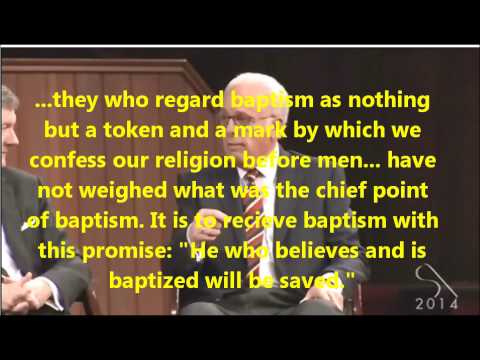
John MacArthur was for Baptismal Regeneration before he was against it

Posted in Uncategorized by Paul M. Dohse Sr. on March 7, 2016

God Predetermines Hope, Not the Fate of Individuals; Genesis 11:1-9

Posted in Uncategorized by Paul M. Dohse Sr. on March 7, 2016

ppt-jpeg4The primary problem with Bible interpretation is the simplicity of its truth. The Bible itself notes that diligent study is needed by every believer, but the Bible’s call to study assumes that individual understanding is the outcome (2Pet 3:16, 2Tim 3:15).

The whole seer thing and hierarchy of understanding are a scam that started in the garden with Eve’s conversation with the serpent and has dominated the world ever since. Obviously, the serpent presented himself as an additional mediator to aid in her understanding. This is what makes America so unique in human history: its tacit nod towards individualism has made it the greatest nation ever, and even at its worst, the greatest defender of freedom and a formidable foe of tyranny’s blood-lust.

And, determinism has always been a major pillar of the caste worldview; it is the premise for caste authority, and it saturates the psyche of humanity. In a stunning rewriting of historical truth, contemporary evangelicals like John MacArthur Jr. claim determinism is a ultra-unique Protestant distinctive. According to them, the nature of mankind continually clamors to be free of authority and is helplessly self-willed. Therefore, especially among the New Calvinist leadership, Americanism, and individualism, in particular, are disdained.

However, Protestantism is just another spiritual caste system like the ones that have dominated human history from the beginning. Again, the Protestant claim of uniqueness is an absurd rewriting of history. From the beginning, mankind has been plagued with fear and condemnation leading to the pursuit of pseudo-comfort in other men. Mankind has always struggled with trusting in the one Mediator alone and instead seeks counsel from the so-called experts, or sub-mediators, aka, the traditions of men. The Bible continually exhorts people to not put their trust in princes and the wisdom of men. The traditions of men, always a dumbed-down version of the law of love or, at least, the relaxing of it is the means to fulfill the righteousness of God via spiritual caste. Read the book of Galatians, that’s what Paul was addressing. While Protestants claim to be the antithesis of the Judaizers, they are in fact a prototype.

Freewill is a major pillar of God’s created state of being, and for the most part, God only predetermines an overall outcome of His choosing. Therefore, when necessary to obtain His desired outcome, He intervenes and overrides the freewill of men when necessary. We see this throughout the Scriptures, and Genesis 11:1-9 is no exception. In this passage, how can the contrast between individualism and collectivism be denied? Protestants claim that a one-world religion would be bad unless it’s Protestantism. This should make us very uncomfortable because it is also the claim of all other religions; in other words, Protestantism is just another party among many seeking control of the world…, but of course, for the “collective good and God’s glory.” Buyer beware. Please note that many of the major Protestant confessions were written for, and addressed to, world leaders. There is a reason for that.

Determinism is so entrenched in Western culture that reading the Bible for what it really says, and plainly so, is a daunting mental exercise in overcoming presuppositions. The Protestant Platonist philosopher kings have totally redefined almost every Bible word and completely co-opted the terminology. When we read the word, “elect” in the Bible, we read it as synonymous with individual choosing, rather that what it is: a classification. God predetermined the hope of salvation for all men, that’s election. The means and purpose of salvation were elected, not individuals. This is the only construct that unifies the Bible…period. Without this construct, the Bible is thrown into total confusion.

Let’s look at an example. In Romans 8:30, Paul states that whomever God calls, He justifies and glorifies. But in Matthew 22:14, we find that many are called, but few are chosen. Huh? If you look at this from individual election or choosing, it is an outright contradiction. John Calvin dealt with this contradiction by teaching that there is a class of temporarily elected who suffer a greater condemnation for God’s glory. That’s a fact that many Calvinists conveniently leave out of the conversation.

In contrast, this is understood via the major context of Romans: the mystery of the gospel. What’s that? Oh my, this is soooo simple. Ephesians 3:6 ESV starts with, “This mystery is….” Any questions? It’s a definitive definition of the mystery of the gospel:

…that the Gentiles are fellow heirs, members of the same body, and partakers of the promise in Christ Jesus through the gospel.

In other words, Paul was telling the Gentiles at Rome that if God called the Gentiles into the commonwealth of Israel (Eph chapter 2), that it was a legitimate invitation with no strings attached. The call to the Jews and Gentiles was, and is, without favoritism or respecting of some people over others. The calling is without regret by God on any wise regarding the Gentiles—they are not a lower class of elect. Paul uses the letter to the Romans to articulate the Jew/Gentile relationship to justification in painstaking detail. The calling regards a call to full and complete adoption into the family of God as equal heirs. All who are called are justified and glorified the same way.

Now Matthew 22 makes perfect sense. God invites Jew and Gentile both into the commonwealth of Israel, but only those who accept the invitation are the elect. Many, meaning both Jew and Gentile are called, but only those who accept the invitation to the wedding feast become the elect. In other words, they accept the invitation to become part of God’s elected plan of salvation and therefore are of the elect. Jesus was also making the point that being a Jew did not guarantee your salvation as was often taught by the Pharisees. They got the point and didn’t like it much. Read Ephesians 2, Romans 8, and Matthew 22 together and the clarity of this is stunning. Then start reading your Bible with this context in mind, and it becomes clearer and clearer. The common English rendering of “many called, few chosen,” should rather read, “many called, but few elect ones.” In other words, many are called, but few Jews will accept the invitation. This didn’t go over well at all.

God predetermines outcome; that is, hope and salvation for mankind and invites them accordingly. They either accept or reject the invitation via their own freewill. God, or His gospel, is not boxed in by man’s definition of Him; that is, God is supposedly limited by His intrinsic sovereignty. Though God applies His sovereignty, He is not defined by it; the love of His gospel is what defines Him…“God is love.”

paul