Why Hillary Will Win and the Future of Capitalism, Part 3
“State welfare’s wage of death is always determined by the degree of the public’s lost dignity and self-confidence…State funded self-actuation is a temporary deception and the Pied Piper of tyranny.”
In parts one and two we looked at what drives people according to their basic needs and the relationship of such to politics. The thesis is deliberately simplistic: even though most Americans do not realize it or ponder it, they will seek to have their basic needs met through methods that either trust government or self. It all boils down to the basic ability of mankind in general and the individual in particular. This is the ability/inability of man question.
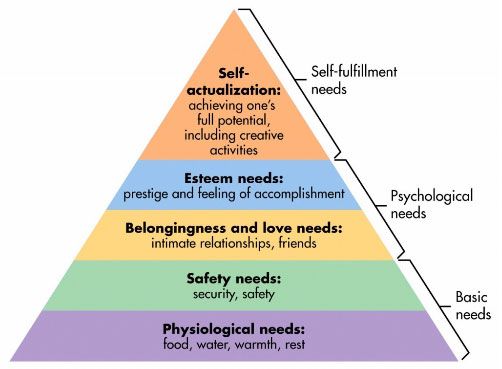
Socialism depends on the state to rule over the affairs of men and the sole purpose of one’s existence is to support the state. Capitalism, uniquely American, depends on the individual resulting in the self-actualization of man. In capitalism, the government’s sole purpose is to facilitate man’s freedom to obtain the upper strata of Maslow’s Hierarchy of Needs. It is a government BY the people and FOR the people. These are the economic applications for questions concerning the true wellbeing of man.
We looked at how this plays out in some contemporary examples. ISIS has no chance of ever bringing America down through terror, so socialists are not going to invest large sums of state money to protect individuals or satisfy justice. Protecting against terror puts emphasis on individual lives and not the state. Hence, the relaxed attitude towards border security etc. Little is more obvious; Democrats are willing to sacrifice a small percentage of people to increase their voting block because their goal is to save America from itself. Said another way, like all of the socialists before them they seek to save mankind from itself. One’s self-actualization is defined by contribution to the group overseen by the state.
“Justice” is a process that defends the sanctity of life. It punishes all acts that disrespect life. This is why justice will always be lacking where individual life is devalued except for its contribution to the state. Therefore, acts against the state will bring swift judgment while crimes against individuals will be all but relegated to the basement closet. Is this not what we see constantly in socialist countries and in America under the Obama administration?
To many in America, socialism seems “stupid” because few understand the logic that drives it. At any rate, Donald Trump is a voice for those who are frustrated by what seems to be illogical, but socialism is NOT illogical, it possesses a logic that drives it. And, the logic addresses the ability/inability of man question.
Is there enough frustration to elect Trump? I doubt it, at least not yet. But that would be quite amazing given the centuries of re-education by socialists since the American Revolution. Regardless of socialists being in total control of education and the media from the beginning, a little less than half of the American people still get it and possess the spirit of Americanism.* In my mind there is only one way this is possible: mankind is wired for freedom and freewill. America is a result of men finally discovering that God creates truth within man that is “self-evident.” God created man with certain laws written on his heart and administered by the human conscience. This is what the framers of the American Constitution hit upon.
Ironically, the Puritans who transported European socialism to the new land are seen as the principle proponents of Americanism and nothing could be further from the truth. The American Revolution was all but a direct pushback against Puritanism. However, America has always been a hybrid of European presuppositions concerning mankind and true Americanism predicated on man’s God-given abilities.
Until America, and from the beginning, religion and state tyranny have always been codependent colaborers in warfare against man’s freedom and his ability. Instead of man being free to choose the God of his conscience, the state has always claimed to own truth according to the religion it’s married to. This mode of operation has dominated world history since the day God closed the Garden of Eden. This is the cardinal principle of Americanism’s separation of church and state. NO, in fact, a devout Christian as President of the United States would NOT necessarily be a good thing. This world kingdom functions best when it is free because that is how God created man. Americanism has proven that this is our best life now until Christ establishes the kingdom of heaven on earth and rules from David’s throne in Jerusalem. Less econocide,** genocide, and democide, and more justice that upholds life is a good thing until the best comes to bear.
If socialism tips the balances of American power completely in its favor, those deceived by the present allowance of pseudo self-actualization will be awakened to a crude reality—they will no longer have their cake and the ability to eat it also. As socialism weaves its deceptive web, it will allow its unwitting advocates to be taken care of in exchange for dignity while playing in the backyard sandbox of freedom. They will awaken to the sandbox being taken away and replaced with all self-actuation being defined by the complete eradication of self for the state’s purposes. This is the age-old tyranny that has always defined world history.The pleasures and freedoms they experience while on the state’s dole will rudely disappear. State funded self-actuation is a temporary deception and the Pied Piper of tyranny.***
Accordingly, as the American institutional church moves back to its Puritan roots via the New Calvinist movement, the confused evangelical capitalists of our day will continue to dwindle. Consequently, you will see a marked increase of anti-Americanism and lack of justice in the church. The rhetoric you will hear is the bemoaning of America-worship versus Jesus-worship, and “man worship versus God worship” proven by a penchant for justice, etc., etc., etc. In fact, this kind of rhetoric is now commonplace in American pulpits.
So, overall, how will the war between capitalism and socialism play out in the future? This will be the subject of our fourth and final part.
paul
*State welfare’s wage of death is always determined by the degree of the public’s lost dignity and self-confidence.
**The economy is no less a weapon against the people than weapons of warfare that take life. Historically, socialism has always used famine to execute suspected capitalists.
***The founders of Americanism deemed Maslow’s lower strata of food and water irrelevant without the freedom to pursue self-actualization.
Why Ligon Duncan is a Heretic in 8 Minutes
 Video post by @PaulMDohse.
Why Hillary Will Win and the Future of Capitalism, Part 2
The standard philosophical theory for the caregiver industry is Maslow’s Hierarchy of Needs (Hartman’s Nursing Assistant Care: The Basics, pp. 58, 59). Care targets are designed around this theory. In actuality, no pun intended, the elements of Maslow’s theory are evident in the milieu of caregiving. Regardless of the severity of disability, residents will seek to do things they enjoy; they will seek personal relationships, and will seek to have purpose and accomplishment. Even ones who cannot communicate and have use of one arm will use that one arm to help you dress them. As they are accustomed to the routine they feel upon their bodies and often cannot see, they will wait for their moment and spring into action to do their part. These are extremely meaningful moments for the caregiver and the top two hierarchies immediately come to mind, and maybe the need to love and be loved as well.
I have to give Democrats credit where credit is due; they seem to understand the significance of Maslow’s theory and how to utilize it to obtain their goals. We all know that national defense is often a hot topic during many presidential elections. Why? Because one of the basic human needs is safety and security.
Republicans usually tout security and peace through strength while Democrats seem to take a naïve and disarmed approach towards aggressive evil in the world. Why? Because aggressive countries share the same basic presuppositions regarding mankind that the Democrats possess; man must be ruled over by government for the common good. In their minds, there is only one thing worse than a bad statist; a good rugged individualist. They will side with the bad statist in a heartbeat. If Al Gore would have been President during 911 rather than George Bush, there would have been no retaliation of any significance. Expenditure of resources to protect a measured number of individuals does not benefit the state nor does it serve justice because the only real sin is against the state, not individuals.
This is why socialist countries like France respond passively to terror attacks. And regarding what benefits state commerce and not individuals we hear in the aftermath of a terror attack that people should go on with life normally because to do otherwise is to “give into fear.” Statist will then define “courage” as those who go on with life as if nothing happened without any precautions. This is because individuals are expendable and moralism is defined by one’s willingness to sacrifice for the state.
So, how do the Democrats get around the need for security? They shift the fear of annihilation from enemies abroad to trigger happy Republicans within. Is this card, the same one played against Barry Goldwater in the 60s not the same exact card being played against Trump in our day? Sure it is. Forget about ISIS, we all may die because Trump can’t wait to launch nukes against Russia and China over a Tweet. It worked against Goldwater, and it will work against Trump.
Presently, this will work because Americans still enjoy individual actualization and have the convenience of lazy thinking resulting in the idea that financial security comes from the government. Presently, more than 47% of all American households receive some sort of government benefits. Republicans are perceived as a threat to that security, and even more so Donald Trump being a hardcore get-it-done business man. This whole idea of “making America great again” will effectively send at least 47% of all Americans running for the Hillary lever—their food and water intake depends on it. “Making America great again” translates into rugged individualism that has no safety net. This is palatable for the time being because the dirty little secret follows: the Democratic ruling elite are not telling their followers what they really believe; the totality of self-actualization is defined by one’s contribution to the state.
Here is the good news that is really amazing: a little less than half of the American people still get it. Without a doubt, that is because of alternative media and the Information Age that we presently live in. But…it will not be enough to elect Trump.
How is this likely to play out in the future? We will look at that question in Part 3.
paul
Why Hillary Will Win and the Future of Capitalism, Part 1
Why in the world would the American people elect a known criminal for president of the United States? As you know, here at TANC Ministries, we are big on reminding people that the accusation of “stupidity” is an analytical shortcut; people ALWAYS do what they do for some reason driven by logic.
In this case, the logic is probably driven by Maslow’s Hierarchy of Needs. Anyone who has followed our ministry for a while knows that I am a proponent of this theory because its truths are evident for those who pay attention to what they experience in life; especially for those in the caregiver industry.
Colonial Americans were unique to human history because their logic was driven by the top of Maslow’s pyramid. Of course, their philosophy founded on Enlightenment ideas resulted in this emphasis. One’s basic logic, and in this case, presuppositions about mankind will determine the emphasis people put on basic human needs. For the Colonials, “Give me liberty or give me death” clearly reverses the order of Maslow’s pyramid.
By the way, the lynchpin, or windsock, is always FEAR which the Colonials lacked because mere human existence for the sake of existence was unacceptable to them. In this case, existence for the sake of the state in exchange for food and water was completely unacceptable to them. One element of this is high taxation.
Be sure of this: the only reason the Democratic political party exists is due to lack of education about these things. It’s a kind of “The only thing we need to know is Jesus died for our sins” mentality. It results in the whole consideration being twiddled down to who we trust to get our needed food and water: the individual, or the state. Is the state’s purpose to free the individual to pursue the top of Maslow’s pyramid or is the top of the pyramid purely defined by one’s contribution to the state’s ability to rule over the affairs of men?
The lie told by the Democratic Party while they slowly dismember Americanism is that trusting the state for food and water will not cost people the top of the pyramid still experienced by Americans. But it will, and it always has. Until America came along self-actuation was only found in one’s contribution to the state to rule over the great unwashed, and invariably, this is always found desperately wanting.
This November, a majority will trust Hillary for their food and water because right now Americans are getting their cake and eating it as well. Even hardworking Americans, via lack of truthful education, see the state as their safety net in case they fail which is likely because after all, we are all totally depraved. Even Billy Graham says so.
Therefore, yes, Hillary has her flaws, but at least she supposedly understands that we all need food and water. But what about Donald Trump? He’s despicable and immature? Well, sure he is, but more than that he represents pick yourself up by the bootstraps and do your job or you’re fired! And if I get fired, how will I eat? If I fail, Hillary will understand and make sure I still have my needs fulfilled by the nanny state. But under Trump, if I fail, he thinks I deserve to starve. It’s cold-blooded survival of the fittest.
Hence, Hillary’s ethics are completely irrelevant. Let me repeat that: this is why Hillary’s ethics are TOTALLY irrelevant. She understands that we are weak and may need help with food and water one day. But that is the lie of the ages. Sooner or later, self-actualization is totally defined by one’s contribution to the state for purposes of saving humanity from itself. Eventually, it becomes an existence totally defined by the state in exchange for food and water. History bears out the results of this miserable existence time and time again.
The antithesis is liberty. In the next part we will further examine this theory and then move on to the likely future of liberty economics: Capitalism.
paul
The Reformed False Gospel of “As If”
 Gospel Sanctification is the original false gospel of the Reformation that presently dominates the institutional church. Basically, it is the gospel of New Calvinism. It is often expressed by the t…



1 comment