How to Un-Confuse Religious Questions: Know That It’s Philosophy
 Why is religion so confusing? Because in most cases it’s not religion. People can’t make heads or tails out of religion in general because they don’t understand that most religions flow from world philosophy. And really, politics as well. If schools taught solid world philosophy there wouldn’t be a Democratic Party and religion would be easily understood.
I was reminded of this as I received a question by email yesterday concerning the religious doctrine of antinomianism. This is a religious doctrine that rejects the law of God in Christian living. Well, most Christians don’t even have a good working knowledge of what “law” is from a biblical perspective to begin with. At any rate, I will answer the antinomian question after I am done ranting.
Going to church is like going to a psychologist. Lots of people go to psychologists for “help,” but now ask them what school of thought their psychologist comes from…nothing but crickets. There are 200 to choose from by the way, and like religion, it comes from philosophy as well. In both cases, faith in expertism negates any concern for whatever ideology is driving the counsel. It’s about authority and not truth.
TTANC Ministries gets its share of grief from evangelicals because of our association with John Immel; well, they can get over it, because if you don’t understand world philosophy you are totally out of school in your discussion of religion in general and theology in particular. Sorry.
Most religious scholars are the scum of the earth because they know their religious commentary is orthodoxy. Of course, most Christians think orthodoxy is a stated clarification of a religion’s truth. Nope, and you can add that piece of trash onto the ignorance heap. Orthodoxy is mythology’s “noble lie.” It is a bedtime storybook for serfs. For example, if the great knowers want to teach the serfs about self-confidence, they write a catechism titled, “The Little Blue Engine That Could.”
Go to church if you will, believe that you are getting the “meat of the word” if you will, but it is really The Little Blue Engine That Could orthodoxy. The demeaning presupposition you agree to is that the pastor is feeding you milk that your poor little juvenile soul can digest. Be like me; when I lost my first family because they didn’t respect me as one that knows anything, I took responsibility for being stupid and letting others think for me. I suggest you do the same; it doesn’t mean you have to be stupid for the rest of your life. Stop being intellectually lazy and grow up. And for crying out loud, stop paying an institution 10% of your income to relegate your life to total destruction or mediocracy at best.
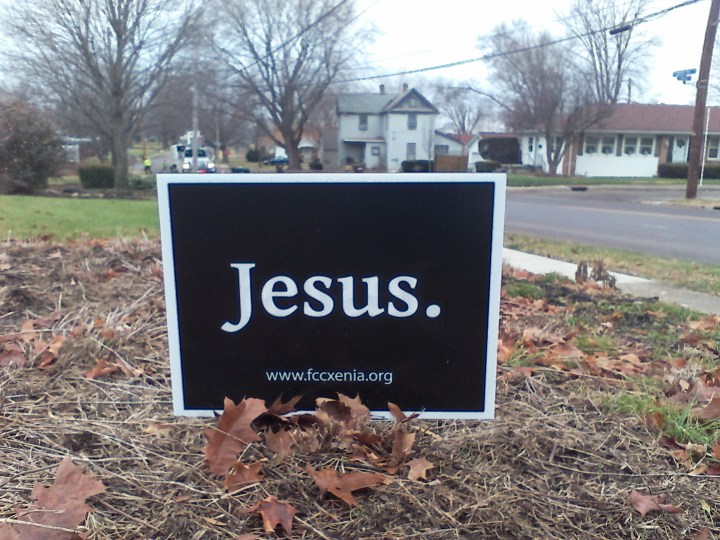
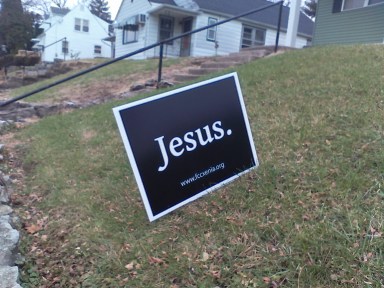
Let’s take the yard sign we have seen around Xenia lately. It is the article marque up top. I went out and took a picture of a couple of them this morning for this article. Jesus. What is that saying?
With soft gentle voice: “Well Paul, it is saying that our faith is childlike and simply focuses on ‘Jesus’ (pronounce like this: “geeeeeee-ja [strong emphasis on the “ja”] uuuus). Ya man, Jesus PERIOD! Ahhhmeeen (Strong emphasis on the “ah”)”.
Begin tough love here: ‘no silly, you who delights in proclaiming yourself a simpleton, this one word with a period is a statement concerning a vast body of philosophical thought.’ But let’s pause here for a moment to interject a nugget. The Bible actually explains why churchians like these spiritual bumper stickers so much; it’s a form of idle worship. You see, you can really make this sign say anything about Jesus that you want it to say because it is a one-word prism. This is how idles operate. A prime example is another local one. A church in nearby Monroe, Ohio has a 60-foot statue of Jesus adjacent to the I-75 corridor. Many people have been interviewed in regard to what the statue means to them. It shouldn’t surprise you that the statue has a different meaning for every person they interviewed. This is how idols work; so, that is in play as well.
What does all of this have to do with antinomianism? Like all other religious debates, you can present a biblical argument, but the philosophical premise of the biblical argument is rarely discussed and this is why religious debate is a gargantuan quagmire that rarely leads to any substantive resolution.
So first, let’s explain the sign, and then how the sign relates to the religious perspective on antinomianism. The sign actually represents a world philosophy with a religious label. This is the foundational philosophical premise of Protestantism in particular. It is an interpretation of reality or state of being, not the Bible. This is a worldview of reality dressed in biblical garb. Here it is:
Christocentrality.
Definition: all of reality is interpreted through the person of Christ and His works. How does that work? It works through the philosophy of metaphysical narrative. What’s that? It is the belief that reality is only experienced because reality is a predetermined narrative written by some higher power. So, though it feels like you are doing life, you are not doing life, you are only experiencing what has been predetermined in the script. You are an actor in a “divine drama.” In the specific case of Protestantism, REALITY is a metaphysical narrative about God’s salvation in Christ. EVERYONE has been written into the script and the life they have lived or will live is predetermined by the metaphysical script. Again, it is experienced like we are doing life through freewill choices, but we are really ONLY EXPERIENCING the prewritten story.
This is what is really behind all of the freewill/sovereignty of God debates among evangelicals that never resolve anything because people don’t really understand the philosophy behind it. The contemporary, more or less, nomenclature for this Protestant doctrine is, the centrality of the objective gospel outside of us which is said to be “experienced subjectively.”
Look, if you pay attention you will begin to see it everywhere. Just google, “divine drama” for starters and look at Bible study programs like The Gospel Project and Bible Mesh. They are all based on interpreting reality from a redemptive prism. The historical-redemptive hermeneutic is also based on this worldview.
What does this have to do with antinomianism? It enables Protestant scholars to claim an allegiance to God’s law on the one hand, while in their reality God’s law is just part of God’s prewritten gospel narrative. The narrative glorifies God when His wrath is poured out on the law-breakers who were written into the script by Him, and he is also glorified by those who love the law according to His metaphysical script.
But, they are antinomian from this viewpoint because the dirty little secret follows: any decision to follow God’s law is predetermined by God’s prewritten gospel narrative; i.e., reality. This is why Martin Luther suggested that a true Christian should be indifferent to whether or not they keep God’s law because it is really God keeping it to begin with:
He, however, who has emptied himself through suffering no longer does works but knows that God works and does all things in him. For this reason, whether God does works or not, it is all the same to him. He neither boasts if he does good works, nor is he disturbed if God does not do good works through him. He knows that it is sufficient if he suffers and is brought low by the cross in order to be annihilated all the more (The Heidelberg Disputation: thesis 24).
So, why go to church or even try to be saved? According to them, this is “working out your salvation with trembling and fear.” Stay faithful to church and this buys you assurance of salvation because you are persevering; but while persevering you can claim that it is God doing it and not you. This is why the whole I didn’t do it, God did it is so prevalent among Christians. It is doubtful they understand the ideology behind their mere experience of doing things they are supposedly not doing, but orthodoxy leads to a functioning apart from intellectual understanding.
This is nothing new. Jesus’ specific beef with the Pharisees is that they “relaxed” the law; i.e., they were deficient in acts of love according to the law (Matthew 5:19 ESV, 23:23, Galatians 5:6). This is because they were inundated with these same types of philosophical ideas.
What is antinomianism? It is the relaxing of the law’s use for love in Christian living without any fear of condemnation. Antinomian philosophies and the theological doctrines driven by them usually teach a condemnation of law while claiming an endearment for it. This makes love a fearful works salvation.
That’s antinomianism in a nutshell.
paul
Circumcision and Double Imputation
Introduction: this is a journey and an invitation for iron to sharpen iron. What makes this study different, and perhaps unique, is its utilization of a historical-grammatical method of interpretation completely separate from any commentaries or orthodoxy. This is an individual Bible study that invites collective input from all Spirit filled believers. We want to tweek this, and debate it if necessary. I believe these are new waters so I am stopping short of being dogmatic at this point. However, it is my hope that we can come to dogmatic conclusions after discussion.
At any rate, I think it is evident that Christians en masse, 2000 years later, are totally confused about how the covenants fit together into one unified gospel. That will only change through the rejection of orthodoxy and the collective study of God’s family.
Above is a video of RC Sproul explaining Protestant double imputation. This makes righteousness a mere legal declaration while leaving a “believer’s” state of being unchanged. In fact, the idea that justification is a “legal declaration” is heard often in Protestant circles of all stripes.
This brings us to the necessity of defining “faith.” In Protestantism, “faith” is an inner ability to perceive reality differently while remaining “totally depraved.” Faith can only perceive, but cannot act in a way pleasing to God. This also defines the Protestant new birth; the so-called believer’s ability to perceive is the only thing that is changed. Supposedly, a believer is saved because they know what they can’t do; they can’t please God with any good work and this is “faith.” It is a faith in “Christ’s works alone and not anything we do.” Faith is what continually drives one back to the cross in order to atone for the yet totally depraved “saint” who is “living by faith alone” or “living by the gospel.”
All in all, it is Martin Luther’s simul justus et peccator. The saint is both sinner and saint, but the “saint” part is only a legal declaration. As a state of being, we remain sinners (totally depraved).
Ironically, while this doctrine cannot make church attendees any different than the world, the church continually sells itself as society’s moral compass. However, what really goes on in the church is becoming more and more prevalent. This is not a peculiar people set apart for God’s purposes. Obviously, this is not a doctrine that can or will bring about change for the better.
Biblically, faith is new creaturehood; it is a righteous state of being. One who has faith has been transformed into a new being. It is very important, doctrinally, that we recognize that Old Covenant believers were born again and not Protestant! No true believer has ever had their sin atoned for or ended without a transformation of the heart. Otherwise, this would necessarily require re-salvation for “present sin.” Forgiveness alone does not make a person righteous. Only a change of heart makes a person righteous. Forgiveness of sin only, necessarily requires re-salvation and a salvation process; progressive justification if you will because that’s what it is. Only twofold salvation can bring about ONCE SAVED ALWAYS SAVED. Please note:
ANY salvation that is not a finished work IN THE BELIEVER necessarily requires a works system and some sort of cooperation on the part of the so-called believer.
The Protestant cuteness of, “It’s a finished work by Jesus [that needs to be continually reapplied]” does not cut it either. This is a finished work outside of the believer, but not a finished work inside of the believer regarding the new birth. In fact, this is exactly what Protestant scholars claim: “The centrality of the objective gospel outside of us.” NO! The gospel is an inside job!
So then, what does this issue have to do with circumcision? Much. This is an opportunity to define faith, belief, circumcision, new birth, the baptism of the Spirt, justification, sanctification, and their relationships to the Old and New covenants.
First, Old Testament believers had transformed hearts and I think we can refer to the transformation as the new birth, but let’s first establish that they had a transformed state of being.
Also, belief is somewhat different than faith. One who has faith has been transformed. Belief occurs as a result of being persuaded by the facts of the gospel, but faith is belief that is joined with transformation. Someone who has faith is born again. The order seems to be belief, repentance, life. Mind you, this is not an Ordo salutis that includes one’s life in the midst of a justification process, but elements that occur at one point in time. One who has faith is spiritually alive and their faith works accordingly. Old Testament believers had a living faith. James wrote that Abraham had a living faith; this has new birth written all over it.
Let’s look at this a little closer:
Acts 26:24 – And as he was saying these things in his defense, Festus said with a loud voice, “Paul, you are out of your mind; your great learning is driving you out of your mind.” 25 But Paul said, “I am not out of my mind, most excellent Festus, but I am speaking true and rational words. 26 For the king knows about these things, and to him I speak boldly. For I am persuaded that none of these things has escaped his notice, for this has not been done in a corner. 27 King Agrippa, do you believe the prophets? I know that you believe.” 28 And Agrippa said to Paul, “In a short time would you persuade me to be a Christian?” 29 And Paul said, “Whether short or long, I would to God that not only you but also all who hear me this day might become such as I am—except for these chains.”
Paul strongly suspected that Agrippa believed the word of God. Notice also that Paul himself endorsed the use of reason in proclaiming the gospel. What was missing in a possible transformation?
Acts 11:18 – When they heard these things they fell silent. And they glorified God, saying, “Then to the Gentiles also God has granted repentance that leads to life.”
A person is persuaded according to the facts of the gospel, desires to act upon the facts (repentance) leading to faith. One who has faith has been born again. The terms (belief and faith) may be used interchangeably in the Bible depending on context, but they are not exactly the same. You may throw in this passage as well:
Hebrews 11:6 – And without faith it is impossible to please him, for whoever would draw near to God must believe that he exists and that he rewards those who seek him.
Biblical terms are important here: having faith; being washed; being justified; being righteous, and being holy are synonymous with heart transformation or the new birth. Another term for new birth is the circumcision of the heart. In the New Covenant, the new birth is joined with the baptism of the Spirit, but they are not the same thing; among other things, the baptism of the Spirit joins Jew and Gentile into one body. The baptism of the Spirit is the “mystery of the gospel” that was not formally revealed:
Ephesians 3:3 – how the mystery was made known to me by revelation, as I have written briefly. 4 When you read this, you can perceive my insight into the mystery of Christ, 5 which was not made known to the sons of men in other generations as it has now been revealed to his holy apostles and prophets by the Spirit. 6 This mystery is that the Gentiles are fellow heirs, members of the same body, and partakers of the promise in Christ Jesus through the gospel.
Ephesian 2:11 – Therefore remember that at one time you Gentiles in the flesh, called “the uncircumcision” by what is called the circumcision, which is made in the flesh by hands— 12 remember that you were at that time separated from Christ, alienated from the commonwealth of Israel and strangers to the covenants of promise, having no hope and without God in the world. 13 But now in Christ Jesus you who once were far off have been brought near by the blood of Christ. 14 For he himself is our peace, who has made us both one and has broken down in his flesh the dividing wall of hostility 15 by abolishing the law of commandments expressed in ordinances, that he might create in himself one new man in place of the two, so making peace, 16 and might reconcile us both to God in one body through the cross, thereby killing the hostility. 17 And he came and preached peace to you who were far off and peace to those who were near. 18 For through him we both have access in one Spirit to the Father. 19 So then you are no longer strangers and aliens, but you are fellow citizens with the saints and members of the household of God, 20 built on the foundation of the apostles and prophets, Christ Jesus himself being the cornerstone, 21 in whom the whole structure, being joined together, grows into a holy temple in the Lord. 22 In him you also are being built together into a dwelling place for God by the Spirit.
I must agree with RC Sproul on one point; the mere taking away of sin alone does not make one righteous. Righteousness is the absence of sin, but that fact alone does not make one righteous. Sin must be taken care of and there must also be a transformation of the heart.
Salvation makes one holy through a twofold process: forgiveness of sin and transformation. This has been true since the very beginning of salvation. Said Christ about saints of old:
Matthew 23:35 – so that on you may come all the righteous blood shed on earth, from the blood of righteous Abel to the blood of Zechariah the son of Barachiah, whom you murdered between the sanctuary and the altar.
Notice that their blood was righteous. There couldn’t be a more definitive statement regarding their righteous state of being. They are called righteous, and their blood is also called righteous; they were righteous, and they had living faith. We must start with this premise; their sin was not only atoned for, but they had transformed hearts. In Old Testament terms, they had circumcised hearts:
Romans 4:11 – He received the sign of circumcision as a seal of the righteousness that he had by faith while he was still uncircumcised. The purpose was to make him the father of all who believe without being circumcised, so that righteousness would be counted to them as well,
Note that Abraham “had” righteousness by “faith” which is a living faith according to James. Much is made of the wording that righteousness was “counted” or “reckoned” to Abraham as something merely accredited to his account legally. But this Greek word is better thought of as a “judgment” or “conclusion.” Abraham was judged righteous by God because he was righteous. Another use of this word entails what one thinks objectively. So, God thought Abraham to be righteous because he was righteous. In addition:
Hebrews 11:17 – By faith Abraham, when he was tested, offered up Isaac, and he who had received the promises was in the act of offering up his only son, 18 of whom it was said, “Through Isaac shall your offspring be named.” 19 He considered that God was able even to raise him from the dead, from which, figuratively speaking, he did receive him back.
Here, “considered” is the same word. Abraham wasn’t giving God credit for something He couldn’t do or could do in the future or at any given time, Abraham knew grad-A-well that God could have raised Isaac from the grave if he wanted to. It was a statement of fact.
Even if an accounting term could be reckoned on this wise, it was credited to Abraham’s account in the present tense. It wasn’t a loan or a promissory note (that would be pure assumption); even by the dictates of the accounting argument, it was something credited to Abraham’s account at the time; ie., he owned it because it was a credit. You get the picture.
Furthermore, and this is where I more than likely need an adjustment in my former theology, where did we ever get it that the new birth is the same thing as the baptism of the Holy Spirit? Speaking for myself, while I claim to be a grammarian, I am making a birth and a baptism the same thing.
I am beginning to think that the new birth has always been part and parcel with salvation from the very beginning, and the baptism of the Spirit is the fulfillment of promises that came with salvation. Said another way, while salvation is a once and for all time act that takes place in the believer, salvation is escalated to higher echelons over time (historically). Does this also pertain to the “elementary” doctrines of Christ that are to be left behind for the fuller realization of God’s kingdom in the present? (Hebrews 6:1 for example).
While the new birth has always been a salvation reality, have we come from being “friends of God” to actual kingdom citizens through the Spirit baptism? Have the Old Testament priests been replaced with every member of Christ’s body being a priest? Has the temple of God been replaced by our bodies? Have the Old Testament sacrifices been replaced with our acts of love offered to God? If this is a true biblical reality presently in contrast to the Old Testament, what made it true? Is it the baptism of the Spirit that made it true? Did all of those things/changes happen through a biblical memo only?
Granted, we must keep in mind, with this transition the new birth and the Spirit baptism happen at the same time; but, before the coming of Christ they were separate. Now, they happen at the same time but are different in that one is the new birth and the other is the culmination of eschatological promises. In this combination, sin is no longer covered, but ended. Old Testament believers had already died and awaited resurrection with Christ while the baptism of the Spirit supplies a death and resurrection under the New Covenant. This could also have implications in regard to the rapture. What paved the way for New Covenant believers to possibly cheat death? Because we already died and have been resurrected?
As mentioned in a prior post, God’s word is a “seed” that brings about new birth:
1Peter 1:23 – since you have been born again, not of perishable seed but of imperishable, through the living and abiding word of God;
1Corinthians, chapter 13, even goes into detail regarding how the word of God is received and takes root in the heart. The Bible leaves nothing to unanswered questions concerning all of the dynamics of the gospel. Whether by God speaking directly, or by prophets, or by the reading of His word, it is the word of God that brings about new birth.
In the Old Testament, circumcision is a signet of the new birth. Females were connected to circumcision by rituals performed after childbirth (Leviticus, chapter 12). Even though that is not Old Covenant terminology seen in English translations, Christ chided Nicodemus for not being familiar with the new birth and spoke of its necessity for salvation in the present tense (before the cross). With the shift to the New Covenant, we see a transition to water baptism which represented the new relationship between God and His people.
This included the new birth and added the promises foretold in the Old Testament.
Let the discussion begin.
paul





3 comments