Am I the Only One Asking These Questions About the Texas Church Massacre?
 Folks, despite the nonsense we hear coming out of the institutional church in general and Baptist churches in particular, sin is not one moral equivalent, there are greater and lesser sins, and there are greater and lesser sinners, and sorry, if I don’t go to church because I think it is filled with hypocrites there will NOT be one more hypocrite if I decide to go.
And furthermore, churchians themselves, like politicians, deny these truisms by their own actions. This nonsense is just talking points.
Rape is a pretty bad sin, yet, we hear accounts of church leadership challenging the victims to “own their own sin” that contributed to the situation, and a refusal to forgive by the victims is supposedly tantamount to rejecting the gospel because that’s not “forgiving the way we were forgiven” and after all, “we are all just sinners saved by grace.”
Pedophilia is a pretty bad sin, yet, churchians bemoan outside involvement by secular authorities as “interference in church affairs,” and “God’s church being judged by the world” (two examples are the Tom Chantry and SGM cases). In fact, former churchians have been excommunicated for reporting incidents to the police.
Now enter the Sutherland Springs mass murder and consider; where is all of the usual rhetoric? Most prevalent is the absence of all the usual “forgiveness” jive. Am I missing a statement by one of the members that “we have already forgiven him”?
This horrific incident clearly exposes church-speak and the false gospel it flows from for what it is; a pile of toxic waste.
While the church puts victims who come forward under the hot light of scrutiny, the church is given a pass due to the, yes, gravity of this particular sin. No doubt, the shooter was utterly evil, but did this church foolishly do something that poked the hornet’s nest? And indeed, this question may be deemed inappropriate because there are degrees of sin and moral equivalency is a Protestant farce.
Within a week of the shooting, the shooter and his second wife were together and having public and private positive fellowship with this church. The day of the shooting, the shooter’s wife and kids were not present at church, and apparently, not in town either. The pastor was, as we finally find out, in Oklahoma City, but for what purpose we know not. The pastor’s wife was in some other state, and which state or for what purpose is unknown. I was a Baptist for 30+ years, and I can tell you this would be highly unusual. In addition, in contrast to the Vegas shooting that followed the norm of reporting heavily about the wife, this guy’s wife isn’t even on the radar screen.
In accordance with my past experience as a Baptist pastor and counseling, there are dots present that if connected would form a typical pattern I saw in how churches handle certain domestic issues, and the pattern is very incendiary. Plainly stated, churches have a tendency to deal with crazy people in a reckless way.
Is that what happened in this case? We may never know, because unlike the pass parishioners don’t get when they are victims of church violence, per the usual, church leaders tend to get a pass; especially when they are the victims of one of those greater sins.
paul
Is Church Dangerous?
Well, pastors say it is. Evangelical superstar John Piper describes church as a place where you learn to love others to a degree where you joyfully lose your own life. In other words, the only way to have joy is self-sacrifice, and to the degree that you love yourself, you are unable to love others. So, not only is self-eradication efficacious for loving others and experiencing happiness, it is our “duty.” Piper’s pretense seems to advertise a positive duty to be happy, but in reality, it is a masochistic happiness which by the way is authentic Protestant orthodoxy.[1]
Biblically, a call to self-death, for the most part, refers to the one-time baptism of the Spirit where we die with Christ and are no longer under the law of sin and death’s condemnation. Then, in the same baptism, we are raised with Christ as new creatures who love the Spirit’s second use of the law: instruction for loving God and others. Taking up one’s cross refers to Christ’s call to be “born again,” not a life of self-eradication.
This call to joyful self-death as a definition of love is definitely a church thing, and another good example is this video [2].
So, yes, church is dangerous, but it’s a happy danger. Do you feel it yet?
And historically, church has been pretty dangerous if you think for yourself or disagree with leadership. But that wasn’t always necessary in order to end up dead at church. In the midst of heretics being routinely burned on a stake, women who made it a point to behave and mind their own business were often accused of being witches and drowned alive accordingly. Neither the Catholic Church nor Protestantism has ever apologized for their atrocities or even acknowledged them. Instead, the emphasis has always been the false narrative giving the Reformation credit for pulling mankind out of the Dark Ages. The exact opposite is reality.
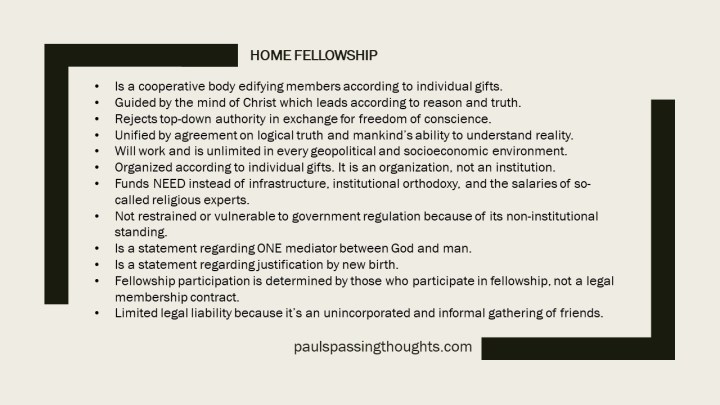
Church, obviously, poses a risk to children in the form of sexual abuse and its propensity for supplying cover for pedophiles. This, in case you have been on another planet for a while, is common knowledge. Even more disturbing is the concerted effort by many churches and denominations to coverup child sexual abuse.[3]
Another risk factor is the church’s resistance towards involving secular law enforcement agencies in criminal activities that take place in church. In fact, many church leaders have stated on record that such are “family issues” and no concern for secular authorities. Other Church leaders claim that secular authorities have “no right to judge the church.”
Church leaders are, to a great extent, immoral and untrustworthy on many fronts. A myriad of examples could be cited, but one glaring example is pastor Tom Chantry, a well-known and respected Reformed theologian with an impressive Protestant pedigree presently awaiting trial for child rape (multiple counts). New church leadership scandals hardly fall short of being weekly affairs with the lesser-knowns not receiving press.[4]
As if this isn’t enough, now we can add active shooters to the list, and there are three things that make this not only possible, but likely. Public access (as with all institutions), participation in volatile domestic situations, and participation in volatile political debate.
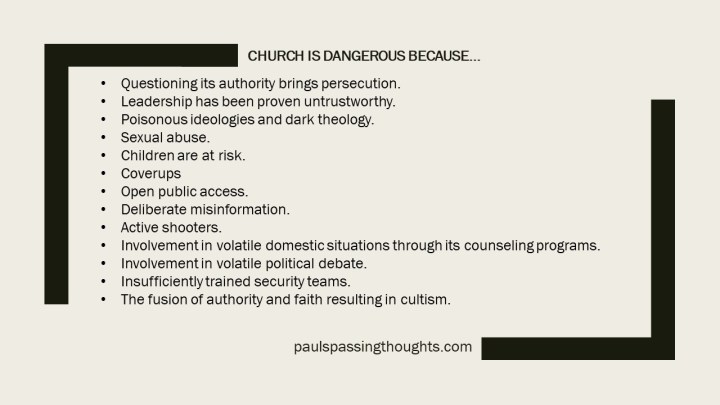
I am going to close this post with something that I don’t do enough; I am going to offer a solution. The fact is, the assembling of God’s people together for edification wasn’t institutionalized until the 4th century. Aside from a plethora of practical considerations, the way “church” was done during its 1st century advent was totally different than what we see today. Even though this ministry has written extensively on the differences, I would like to summarize here.
Home fellowship is a totally different approach that not only emphasizes individual gifts, but is organized in such a way that results in thriving individual ministry naturally. This is because it’s an organized cooperative body instead of a top-down authoritative institution. Because meetings take place in private homes, there is no open access to anything the cat may drag in. In addition, our kingdom is future and presently in heaven, and therefore our focus is the gospel and not the necessary participation in politics that goes hand in glove with dominion theology. When your goal, like everyone else’s, is to be in control for the supposed betterment of man’s existence, you are just another political party or ideological group in the whole batch of humanity. Church made itself that when it became an institution in the 4th century.
The common assertion that home fellowships are in danger of cultism is a total misnomer. Cultism occurs when you fuse authority with faith. That’s the formula that produces cults, not a cooperative body operating under the freedom of conscience. While the institutional church constantly bemoans the dangers of “cults” and “lone rangers” that are not under its authority and supposed infinite wisdom, what goes on in the institutional church is the true epitome of cultism.
It’s ironic, no? While Protestant orthodoxy calls for the sacrifice of self and exalts those who take their families into dangerous mission fields, churches will now be packing heat during “worship services.” In a way it’s almost amusing to think that praise and worship bands who have perfected the aura of meekness and teary-eyed exaltation with arms lifted high will probably be packing heat in the small of their backs.
Times are changing alright, and with that change is the exposure of the institutional church as a fundamentally bad idea. Already, we have seen that it will not work in communist countries that require state approval to assemble, and in regions that are financially destitute. And as the institutional church continues to contribute to culture’s demise while claiming to be its moral compass, its inability to be fluid in any cultural situation will be further exposed.
In contrast, an organized cooperative body functioning on agreement in accordance with personal conscience and in a family format, finds itself able to conduct gospel business and love in any situation.
paul
[1] https://www.desiringgod.org/books/the-dangerous-duty-of-delight
[2] https://www.youtube.com/watch?v=uSv4vBcFyvo
[3] https://bangladeshmksspeak.wordpress.com/
[4] https://paulspassingthoughts.com/2015/09/01/this-weeks-sinner-saved-by-grace-sinning-and-in-the-news-rc-sproul-jr/

 Paul's Passing Thoughts
5 comments