Sigh. What Does It Mean That Jesus Came to Fulfill The Law?
 I do not believe that Scripture contradicts itself. And by the way, the whole “paradox” thing is VERY dangerous territory. Paradox does not abrogate reason. When God beckons us to “reason together,” reason means…”reason.”
Protestantism and Catholicism share many things in common, but one of the primary aspects is the abrogation of individual one-on-one reasoning with God. Do you even know what “orthodoxy” is? The very concept denies the validity of one-on-one reasoning with a personal God. When the church constantly pontificates about a “personal” relationship with God, what it is really talking about is complete submission to the institutional church and complete surrender of personal conscience in exchange for orthodoxy.
Due to this tradition, Protestantism gets away with being predicated on the most simplistic theological error of the ages. And one of its deceptive modes of operation is to use mantras and truisms that represent the extreme opposite of what orthodoxy actually states, the use of terms that allow assumption on certain points until people are fully indoctrinated, and making others the supposed nemesis of the gospel who in fact better represent Protestantism itself.
The biggest laugher is Protestantism’s demonizing of the dreaded “Pharisees” who were supposedly the sultans of “legalism” when Protestantism is an exact representation of the Pharisees. And by the way, as another example of Protestantism’s plenary redefining of reality, there is no such thing as “legalism” being gospel enemy number one. You will search the Scriptures in vain to find such a concept, as well as the word “legalism” being in the Bible to begin with.
Even when Protestants venture into personal Bible reading, they are dong so through the prism of orthodoxy which has redefined every scriptural word and term. The Bible is both very complex in order to substantiate its inerrancy, and simple to entice as many people as possibly into salvation. The depths of Scripture are for discipleship and long-term assurance, not the call of salvation. The offer of the gift is deliberately simple to be inclusive.
Hence, the Bible is NOT easy to understand and requires diligent study by everyone. It is like building structures. When you come upon something that you clearly understand, you set it aside as part of a foundation that further understanding is built upon. We may also use a picture puzzle for another example. As we fit the easier border pieces together, it leads to seeing where the more difficult inside pieces fit. In all of this, BIBLICAL definitions of all words and terms are critical. The definition of words determines your view of truth and reality as well. Those who define words define reality. So, trust me, it would behoove you to let God define the words.
In regard to some of the aforementioned points, what does Protestantism do? It constantly beats the drum of “justification by faith alone.” More recently, it is “justification by faith.” Curiously, “alone” and “apart from the law” are left out while allowing parishioners to assume “justification by faith alone apart from the law” is what is intended. Parishioners are allowed to assume that justification by faith is a onetime event that justifies the believer once and for all time. That’s NOT orthodoxy which propagates a progressive justification. This is not arguable; Protestant orthodoxy is clear on this point in all of its creeds and confessions. To one of the primary points of this post, few parishioners, if any, have read these documents for themselves.
According to Protestantism, justification is not by faith alone nor is it apart from the law. This is probably why the more recent buzz-term is “justification by faith.” According to Protestant orthodoxy, justification is defined by perfect law-keeping. Though the Bible merely states APART from the law…period, orthodoxy states that this means apart from any law-keeping by the so-called believer. One is justified by believing in Jesus’ perfect law-keeping. Shockingly, some renowned Protestant scholars have even stated that Jesus gained his personal righteousness through perfect law-keeping. Of course, this is outright blasphemy in broad daylight.
But, what does the gospel specifically state that we are to believe in? We are to believe in the death, burial, and resurrection of Christ because that is the establishment of the new birth which baptizes us into God’s literal family. Protestantism, being a law-based justification while proclaiming to be the extreme antithesis of such, claims that God resurrected Christ as proof that he kept the law perfectly. Good luck finding that in the Bible; yet, it is a common assertion among Protestants.
In addition, according to Protestantism, Jesus’ perfect law-keeping continues to be a substitution for our law-keeping in sanctification lest we have a “righteousness of our own.” So, our sin was imputed to Christ, and he was a substitution for the punishment we deserved, but in addition, he kept the law perfectly so his perfect law-keeping can be imputed to our sanctification. This is the well-known Protestant doctrine of “double imputation” or in other words a DOUBLE SUBSTITUTION. Clearly, any righteous work that we would do can ONLY contribute to a justified status according to orthodoxy, so all of those works must be perfect. In more other words, justification of the so-called believer is not a finished issue, nor is the so-called believer MADE righteous, but he/she is ONLY “declared” righteous as long as said believer believes that they themselves can do no good work.
How does this doctrine supposedly pan-out in real life application and experience? It’s a Gnostic application which will not be addressed in this post, but I will give a thumbnail. Martin Luther did most of the heavy lifting on this subject using Augustinian Neo-Platonism which later became Gnosticism. It goes something like this: life experience, or how we experience life, is subjective. What does that mean? It means we experience life as if we are initiating all of our actions and actually doing the action. But, not so. When something we “do” is righteous, viz, nothing as all of our works are “filthy rags,” and we are presently saved because we believe exactly that, we are only experiencing the act as if we are doing it but it is really Jesus doing it “through us”…”by faith.” Come now, let’s be honest, we hear this all of the time: “I didn’t do it, Jesus did it!” “It was the Holy Spirit, not me!” Or this one: “Sanctification is NOT done BY us, it is done TO us.”
While mainline Protestants ridicule Pentecostals and Charismatics for ecstatic experiences including speaking in tongues, it is merely a more objective version of the same idea regarding subjective reality; God is the only one that does good, and all righteousness is outside of the believer known as Martin Luther’s “alien righteousness.” In Pentecostalism et al, ecstatic experiences are supposedly a result of God acting overtly instead of subjectively as a way to substantiate that he is doing all righteousness through us. It is merely a more overt demonstration of the exact same idea.
But here is the huuuuuuuge problem with the whole enchilada; you cannot separate LOVE from righteousness. In essence, according to Protestant orthodoxy, the so-called believer does NO love, Jesus does ALL of the love through us while we are essentially loveless. Been to church lately? Does it seem a little loveless? Well, it should, that’s orthodoxy.
Meanwhile, the true gospel of justification by new birth apart from the law changes our relationship to the law. I have written on this extensively, but suffice to say for this post that in this gospel the believer is MADE righteous and not merely declared righteous resulting in the abilty to actually perform acts of love. We are actually righteous as a state of being because we are literally reborn by the Spirit. We are not merely “declared righteous,” we are righteous. And by the way, in regard to the idea that “justification is a legal declaration,” how is a legal declaration “apart from the law”? Is orthodoxy really predicated on such an egregiously elementary error? YES.
The new birth changes the believer’s relationship to the law, and this truth has been so far removed from church that parishioners have extreme difficulty wrapping their minds around it. First, believers have been removed from any kind of judgment by the law that can eternally condemn. That aspect of the law is gone, or ended. In that respect, Jesus, as stated in several places in the Bible, came to END the law and REMOVE our sin.
The new birth is the standard for righteousness resulting in a love for the law and its instruction regarding love, while Protestantism makes perfect law-keeping the standard for righteousness. Hence, Jesus must keep it for us to maintain justification. True Christians fall short of loving and may be chastised accordingly, but do not need a substitution for love in sanctification because they are no longer under condemnation. Instead of salvation being an ongoing atonement for sin to prevent condemnation because we are still under law, we are “chastised as sons” when we fail to love.
And, the true imputation is the imputation of ALL sin to the law, and then Jesus came to end the law and subsequently end sin as well. Jesus ended the law of sin and death on the cross, and justified us with his resurrection unto the law of the Spirit of life. Therefore, there is “NOW NO condemnation” for true believers, and consequently, no substitution for love is needed in our sanctification.
If you must say that Christians still sin, that’s fine, but we cannot receive any death wages from our failure to love. We may receive less life wages and deprive ourselves of “full reward,” but we are no longer under the condemnation of the law. The double imputation or double atonement of Protestantism necessarily equals UNDER LAW or such atonement would be unnecessary.
So, what was Jesus saying in Matthew 5 when he said that he came to “fulfill the law”? The fervent running to this verse upon hearing the above challenge has exasperated me to no end. Add to that: Jesus also stated that he didn’t come to abolish the law.
Every Protestant out there will interpret it this way: Jesus didn’t come to abolish the law of sin and death [actually, he did], but came to fulfill its “righteous demands” so that Jesus’ fulfillment thereof can be imputed to sanctification [NOT]. This clearly contradicts the plain sense of Scripture in many places and leads to abject confusion in understanding the rest of Scripture.
There are many, many, plausible alternatives to orthodox claims regarding this passage; we will discuss a few. Jesus’ introduction to Matthew 5 through 7, commonly known as the Sermon on the Mount, in context, is a point by point rebuttal of rabbinical tradition which, in fact, voided the law with its traditions (Mark 7:13, Matthew 15:6). Almost immediately following, Jesus launches into a contrast between the true spirit of the law and rabbinical tradition. Jesus is saying that he didn’t come to toe the business-as-usual rabbinical line and thereby void the law, but rather came to uphold its true meaning.
In regard to the fulfillment of Scripture, the word “fulfill” is used about 90 times in the New Testament, and in the vast majority of times refers to Christ’s fulfillment of Old Testament prophecy.
By the way, at the very least, this is partly what Jesus was referring to while it is obvious that all Old Testament prophecies are not yet fulfilled. Another huge problem here is that Jesus states that he came to fulfill the “law” and “the prophets.” Primarily, some total fulfillment of the moral law is not the point nor some sort of other fulfilling due to the prophesy issue already stated. To say that “Jesus meant a total fulfillment of the moral law and a partial fulfillment of prophecy” is a really big stretch.
Besides, early in his ministry, God speaks from heaven and proclaims that he is “well pleased” with Christ at John’s baptism which negates the idea that Christ yet needed to obey the law perfectly to obtain salvific righteousness. Moreover, however you want to interpret it, Christ told John the baptist that all righteousness was fulfilled by his baptism. More than likely, this is a symbolic statement regarding righteousness by the baptism of the Spirit who happened to show up for this event as well.
New birth is justification; not perfect law-keeping. Regardless of who keeps it, the law of sin and death cannot give life (Galatians 3).
paul
Tales of Family Come True Just in Time
We will call her “Betty.” Every morning I enter into her reality; the day will be on her terms accordingly. Usually, with a smile and glimmering eyes, she will tell fantastic tales about her family, and their plans for the day. As the day progresses, reality gives way to disappointment; no family members are arriving to take her to some colossal family gathering. Such sadness runs in the background, but like most days, there will be no time for the aide to ponder on it.
As if being a nurse aide is not challenging enough, most aides are from the so-called millennial generation. For the most part, they are arrogant, entitled, heartless, disingenuous, and just plain mean. And for whatever reason, they display little respect for previous generations. And on this particular day, these savages were on the warpath for whatever reasons their agenda-driven minds were conjuring up to afflict others who don’t meet their standards, viz, everyone but their usual enablers.
And on this particular day, their nasty petulance was sucking the life out of everything in the facility and making it a miserable experience. This is where we will talk about the importance of focus and how the stinking thinking of others can cause us to lose it. We do what we do for particular reasons that result in self satisfaction, a feeling of accomplishment, and purpose. Consequently, OTHERS will be the primary joy thieves.
So, it was one of those days; I allowed others to drag me into their miserable, joyless existence. I lost my focus. I forgot why I was there, and replaced the real purpose with a purpose to merely survive the day.
Then it happened, just like that. A couple, probably in their 40’s, and conveying a very strong presence, came walking down the hallway and approached me. “Excuse me, could you tell us how to find Betty?” “Betty?” I asked. “What do you want with her?” They answered, “Well, we are her family, and we are here to see her.”
‘Oh!, I see, um, yes, she said something about going to a family party, are you here to take her to the party?’
“No, we are not able to go to the party, but we are here to visit her, others will be along shortly to take her to the family party.”
‘So, there is really a party?’
“Yes, there is really a party.”
Yet full of doubt and unmeasured joy, I led them to Betty. When she saw them, I could swear her joy set the universe on fire; at least my universe. And when the other family members came to take her to the party, and I saw it with my own eyes, I believed. Her joyful demeanor while being pushed along in her wheelchair will be forever burned in mind.
And then I remembered the purpose. It overwhelmed my soul like a powerful flood. This is why I am here. This is my reward. In an instant, the monsters who stole my purpose were revealed for what they are; insignificant stray dogs barking at the moon.
Betty’s tales of love and purpose, come true, not only reinvigorated me that day, actually, yesterday, but I wonder if I will ever lose focus again.
And if you will excuse me, I must leave for work…
Betty’s tales of yesterday await me.
paul
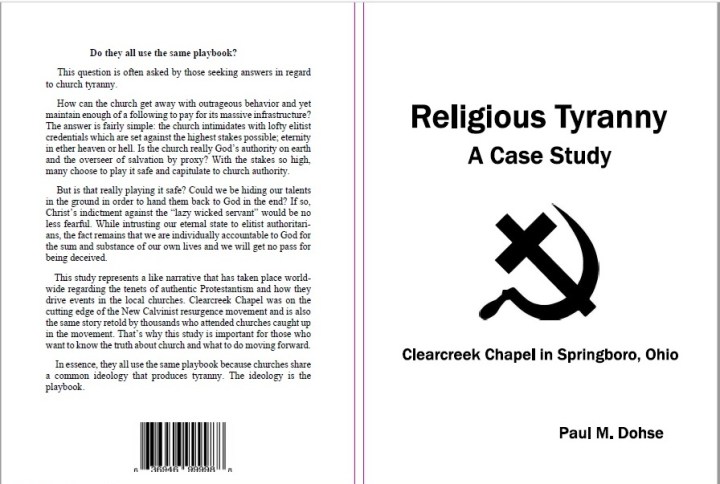
Religious Tyranny: A Case Study; Clearcreek Chapel
Amazon listing. OR, send $15.00 per copy to TANC Publishing, PO Box 583 Xenia, Ohio 45385. Shipping included if ordered directly from TANC.
CHAPTERS
Introduction
Chapter One: The Chapel’s Unique Place in Church History
Chapter Two: The Insurgency
Chapter Three: The Calvinist Civil War Named “Sonship”
Chapter Four: The Arrival of “Ravenous Wolves”
Chapter Five: The Transition Team
Chapter Six: Elders Behaving Badly
Chapter Seven: Those Who Protect Them, and Why
Chapter Eight: The Protestant Gospel of Authority
Chapter Nine: The True Gospel; “You Must Be Born Again”
Chapter Ten: Clearcreek Chapel’s Super-Charged Tyranny Via
New Covenant Theology
Chapter Eleven: Family, Not Institution; Body, Not Authority
Conclusion: The Way Home
Evil’s Job One; Uncertainty About Who God is and His Works
Everyone knows there’s a God, that’s not the biggest question; the biggest question is, “who is He?” Who God is and His purposes determine whether or not humanity and life itself is to be pitied. Who is this that has created us and brought us into the world?
What was God’s purpose in creation, and what is our purpose? Is God a sovereign God who created man to proclaim certain things about himself, and created man so man would know these things? Are some people destined for eternal despair according to God’s will? And if so, why would He do that? Who is God, and how should we experience life because of who He is? The Character of God defines existence.
As I have stated before and will continue to state, Christians are a long way from knowing the answers to these questions and will never know them until the collective laity seeks truth for itself. While the religions of the world vie for the biggest slice of humanity’s pie, their massive writings over the course of history offer no clear answers to these questions; in essence, the most important questions facing mankind.
What kind of God do most people want? I will answer this from my own present perspective on life. Perhaps many share the same desires framed in the same way. I want a God who loves me, and will teach me how to be happy. I want a God who offers hope, and a happy ending to life’s story. I, in fact, believe this to be true about God.
In contrast to my desires, it is not perplexing to me that many religions offer a theology of hopelessness and zero-sum life because ultimately, in every case, faithfulness to their institutions guarantee a free ticket to eternal utopia. Outside the institution is the uncertainty of what God has predetermined, and a dark worldview. One only needs to add institutional platitudes to their lives, and all will be well in the end. Degree of assurance is equal to the degree of religious authoritative intimidation that any given institution can muster. The glory of men waxing eloquent about the terror of God in splendid surroundings is our comfort and assurance. Their art for condemning us causes us to revere them all the more because of what their authority is saving us from. Supposedly. The only thing elitism wants us to be sure of is salvation by religious institution.
This post will suggest some starting points for understanding who God is, but much more work needs to be done through a collective effort of individuals who hold themselves accountable to their own consciences.
The account of creation starts with God’s following emphasis: His creation is good or “very good.” Evil is not introduced until the serpent approaches Eve. Evil was otherworldly, until the serpent introduces the knowledge of it. Of course, this is conjecture at this point, but at least one logical conclusion might be that the digestion of the forbidden fruit brought about a physiological change that enabled God’s creative beings to experience this evil resulting in seeing nakedness as shameful. Clearly, even in this day, well after the fact, what we digest can bring about a physiological change, and in some cases, what we think as well. For purposes of this post we will stop there as that’s a whole other body of philosophical thought by itself.
Then there is the whole theology of nakedness. Again, something created by God is deemed shameful or bad. God said to Adam, “Who told you that you were naked?” I believe the Bible is full of untapped truths that could empower our lives for God’s glory, but remain untapped because of institutional religion. It’s knowledge that would set God’s people free from the tyranny of religious charlatans.
Why did God make an additional tree available in the garden to begin with? Adam was allowed to eat from any tree including the tree of life. Two tees where distinct and placed in the middle (?) of the garden. Curiously, Adam and Eve were banned from the garden after the deception to prevent them from eating from the tree of life and living forever in their present state. This is strange indeed, but it is safe to assume that overall, this gives, “You are what you eat” profound meaning.
A couple of safe points follow: God intervened to prevent Adam and Eve from living forever. If they ate from the tree of life after eating from the tree of knowledge (good and evil), God was going to accept their eternal state. This is why He intervened. Secondly, freewill was an important aspect, or was foundational to their relationship with God. This tree of life shows up at the end in the book of Revelation with more details about it. Trust me, the trees are a vast study that would lead to the answering of many profound questions about reality and life.
The book of Genesis, I believe, establishes God’s mode of operation on some very important points. I believe freewill is one of God’s metaphysical pillars of reality, and probably the bases of true love. Love is not love without an ability to choose. Is God loved only by those He predetermines to love Him? If this is true, mankind has no abilty to really love, and God’s created beings are unable to love God from an individual heart.
“Each one must give as he has decided in his heart, not reluctantly or under compulsion, for God loves a cheerful giver.”
Therefore, we can begin to establish some key points for this post. First, man operates in a freewill reality, but God intervenes to guarantee an ending of the story that He desires. Secondly, freewill is foundation to true love between more than one person.
Thirdly, what God originally created as good remains good. The curse is weakness, not total depravity. Therefore, “redemption” is the saving from weakness (curse).
“We know that the whole creation has been groaning as in the pains of childbirth right up to the present time. Not only so, but we ourselves, who have the firstfruits of the Spirit, groan inwardly as we wait eagerly for our adoption to sonship, the redemption of our bodies. For in this hope we were saved. But hope that is seen is no hope at all. Who hopes for what they already have? But if we hope for what we do not yet have, we wait for it patiently. In the same way, the Spirit helps us in our weakness. We do not know what we ought to pray for, but the Spirit himself intercedes for us through wordless groans. And he who searches our hearts knows the mind of the Spirit, because the Spirit intercedes for God’s people in accordance with the will of God.”
“For everything God created is good, and nothing is to be rejected if it is received with thanksgiving,”
Because what God originally created is good and remains good, He redeems it. We reject the idea that something God created is subject to a complete fall resulting in utter worthlessness.
This leads into the fifth point: life, though expressed in weakness in many different ways, has infinite value. Our response to various forms of weakness shows what we believe about the value of life whether it is a past life, present life, or future life. A corpse, though separated from the spirit, is not only still part of God’s creation, but representative of a person’s life. Hence, all will be resurrected. Historically, especially among God’s people, funerals dignify life, and posthumous activity reveals our real hearts concerning how much we value life. This does not even escape people of the baser sort. The Bible is replete with information about how God’s people eulogize the past lives of others.
Another mode of operation by God involves His response to evil. Rather than the predetermination of evil, like love, evil comes from the heart and according to freewill. God responds by bringing good or something better from the evil act. The best example is the garden deception. Adam and Eve were created beings, but after the deception, God used the reconciliation process to make mankind His very family.
Yet, though God brings good out of every tragic act for those who love Him, and perhaps those who don’t as well, we find in Revelation that these interventions by God are “bittersweet.” In this age, we learn to be happy in God while overcoming the sting of the curse. However, the “new heavens and new earth” will vanquish everything that causes tears and the memories thereof.
Salvation of the soul is a finished work and one cannot be unborn. The doctrine of new birth empowers the individual as a child of God and is the tyrant’s worst nightmare. We are each high priests offering living sacrifices to God in our own temples (our bodies), and permanently indwelled by the same Holy Spirit that any other professing believer has. Don’t miss this: one of the fundamental disagreements Christ had with the religious leaders of that day was the subject of new birth.
Then came the Festival of Dedication at Jerusalem. It was winter, and Jesus was in the temple courts walking in Solomon’s Colonnade. The Jews who were there gathered around him, saying, “How long will you keep us in suspense? If you are the Messiah, tell us plainly.”
Jesus answered, “I did tell you, but you do not believe. The works I do in my Father’s name testify about me, but you do not believe because you are not my sheep. My sheep listen to my voice; I know them, and they follow me. I give them eternal life, and they shall never perish; no one will snatch them out of my hand.My Father, who has given them to me, is greater than all ; no one can snatch them out of my Father’s hand. I and the Father are one.”
Again his Jewish opponents picked up stones to stone him, but Jesus said to them, “I have shown you many good works from the Father. For which of these do you stone me?”
“We are not stoning you for any good work,” they replied, “but for blasphemy, because you, a mere man, claim to be God.”
Jesus answered them, “Is it not written in your Law, ‘I have said you are “gods” ’? If he called them ‘gods,’ to whom the word of God came—and Scripture cannot be set aside— what about the one whom the Father set apart as his very own and sent into the world? Why then do you accuse me of blasphemy because I said, ‘I am God’s Son’? Do not believe me unless I do the works of my Father. But if I do them, even though you do not believe me, believe the works, that you may know and understand that the Father is in me, and I in the Father.”Again they tried to seize him, but he escaped their grasp.
God has taken his place in the divine council; in the midst of the gods he holds judgment:
“How long will you judge unjustly and show partiality to the wicked? Selah Give justice to the weak and the fatherless; maintain the right of the afflicted and the destitute. Rescue the weak and the needy; deliver them from the hand of the wicked.” They have neither knowledge nor understanding, they walk about in darkness; all the foundations of the earth are shaken. I said, “You are gods, sons of the Most High, all of you; nevertheless, like men you shall die, and fall like any prince.” Arise, O God, judge the earth; for you shall inherit all the nations!
In what sense are believers “gods”? We are literally born of God the Father and are the sons of God with Christ being “the Son” who brings “many sons to glory.” This is all family lingo.
While salvation is a plenary finished work, redemption of the material world is a process. Christ came to end sin, the Millennial Kingdom will end disease, and the last enemy to be defeated will be death at the new heavens and new earth.
Uncertainty about who God is, uncertainty about our eternal destiny, uncertainty about who we are, and uncertainty about God’s relationship to evil enslaves us to men consumed with control-lust. Control over others is one of sin’s metaphysical pillars (Genesis 4:6,7). Christianity is a laity affair, and these are the ones God will use to free His people from this present dark age.
This is completely evident if you examine who the Scriptures have been addressed to throughout the ages, and who Christ ministered to during His time here. If He came back today with any resemblance of His first coming, He would completely ignore the who’s who of religious elitism and appeal to the commoners of world.
This somehow completely escapes us: He wouldn’t check in with the Pope, He wouldn’t check in with Albert Mohler, He wouldn’t check in with John Piper, or anyone else who brings God’s character and works into question. Yes, a theology that is constantly asking,
“Has God really said?”
paul
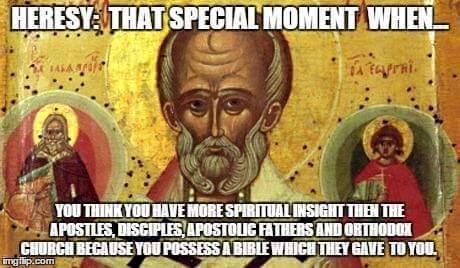
Your Pastor’s Meme
Andy stumbled upon this meme some time ago and thought it was “scary.” My response is more toward finding humor in the stupidity of it. Yet, when it gets right down to it, this is the mentality of most church pastors or elders. When you raise a theological issue with them, you can see the resentment on their faces. I suppose something else makes this meme special coming from these elitist control freaks; the misuse of the word, “then.”



3 comments