The gods of Orthodoxy, and Murderous Leaders Who Don’t Cuss
 I used to feel extreme pity while viewing history pictures of women, children, and old people waiting in some kind of precipice to be summarily executed. But I now realize that not paying attention, and in general, lazy thinking got them there. Of course, the children are not responsible, but as a generation raised by two other generations of lazy thinkers, inevitably, a generation in the chain is eventually going to pay the piper.
History only has two gods; the god of slavery and the God of freedom. The god of slavery has many sub-gods, or “subordinate” gods representing a core orthodoxy. Sure, orthodoxy has many different flavors, but it is all ice cream, and the ice cream is caste authority over the great unwashed.
What is this present world and its history? A bunch of different kingdoms vying to rule the world to save humanity from itself. This is why wars happen. All wars are driven by the basic presupposition of man’s total depravity. As true Christians, we recognize that our kingdom is not presently on earth; we are “sojourners,” “aliens,” and “ambassadors” from another country. If our kingdom was presently on earth, and our king ruling, it would be well obvious.
This can be demonstrated by some articles sent my way this week. Though I am in a season where I have little time to write, this one by Roger E. Olsen inspired me to rearrange my priorities for the day, and while I am at it, I will toss in one by Matt Walsh and some honorable mentions from Susan’s Face Book page to boot.
But first, a word on the functionality of our kingdom. We are of a royal family that functions on grace, or “under grace” reality. Yes, there is most definitely an objective truth which we love, but it is also assumed that all family members are honestly pursuing an understanding of what that truth is. And, we are seeking to align personal conscience with that truth. In other words, we are compelled by love, and not authority. It’s obedient love to the mind of Christ as we progressively understand it, not an obedience under compulsion that may or may not violate our conscience. All loving obedience to our King and Father are freewill offerings, or it isn’t love. This is all hinged on an assumption that we can know the “mind of Christ” which is the treasure of all knowledge and reality. This is also how we function in all of our other relationships as well. Our love is not under compulsion, but rather freewill offerings.
Is there a better example than the so-called “tithe”? Under the old covenant, the tabernacle and priests had to be supported, but there were also freewill offerings. Now that our own bodies are the temple of God, and we are no longer “under law,” we only need to use our members to offer “living” sacrifices to God that are of love and not under compulsion. God loves a cheerful giver. Tithing is under law, not grace. And whatever we do and wherever we are, we are worshiping because our bodies are the temple and we are the priests of that temple, NOT some institutional building built for the purpose of “worship.”
We begin with Roger Olsen who proffers the following in said article: orthodoxy should never be rejected as a result of the personal testimonies of its proponents. He concedes that the founders of Protestantism had horrible personal testimonies, but what are we to do? Should we reject orthodoxy altogether because of the shortcomings of our spiritual heroes? This is asked in rhetorical fashion; after all, what would we do without orthodoxy, right? Orthodoxy, otherwise referred to as “subordinate truth” (wink, wink), must be protected at all cost while the fallout is often unfortunate collateral damage. After all, the Reformers where “men of their time.” Of course, the things going on at the time had nothing to do with the prevailing ideologies…perish the thought! You can liken this to the same mentality of “subordinate shepherds” who have been preordained by the Chief Shepherd to, as Al Mohler stated it, “save God’s people from ignorance.” Yes, they concede, they don’t have the same authority as Christ, but it just so happens that Christ never stops by to check in, so, you do the math.
Is Olsen a sly Platonist manipulator or just a shallow thinker? Perhaps both, but what is the fundamental slight of hand that he uses to enamor the blogosphere with this article? Answer: moral equivalency. Do you see it? Sin is sin. He even concedes that Reformed orthodoxy was used by the Nazis to condone the slaughter of innocent millions, because, you know, no one is innocent to begin with after all. Watch what he does: beer drinking, cussing, womanizing, and mass murder are all the same thing…sin.
Hardly.
Secondly, and this is key, which sins are the direct result of an ideology? We may also boil all of this down to presuppositions about humanity; able, or unable? Free, or necessarily enslaved for its own good and ultimate survival? Wars and mass murder are always the direct result of the latter.
Please note the history of the church, Catholic and Protestant: it is a story of endless wars and bloodshed stopped only by the American Revolution which was predicated on the freedom of mankind and its emphasis on individual rights. The founding fathers of Americanism had some sin issues, but their ideas were contrary to humanity’s inability and consequent enslavement.
This is where we can enter Matt Walsh’s article into the point being made here. Don’t you know, the primary purpose of church is for receiving judgement for your assumed many sins, and receiving ongoing forgiveness? Yes, the nearly sole purpose of church is to bring yourself under judgment for purposes of ongoing “repentance.” Curiously, he calls out Protestant and Catholic churches alike for this shortcoming and subsequent ruining of society accordingly.
And I couldn’t agree more; yep, our ministry has been saying this for years—that’s church in a nutshell. The church is God’s supposed authority on earth where wicked mankind comes for ongoing salvation via “repentance.” “Christians,” yet condemned and still under law, must be compelled to love God and others. Note the clear logical conclusion in his article that salvation is only found in church to begin with, and churches that condemn for a hearty return to the same gospel that saved us. Due to this presupposition concerning humanity, reality is seen through the prism of sin and condemnation, and not love.
If you really understand this issue, you understand that Enlightenment ideas are closer to being under grace than church ideology which is under law. But whether secular issues of individualism versus collectivism (socialism/communism) or religious issues concerning law and grace, most are woefully ignorant.
Now we can enter Susan’s rant to me earlier this week about Face Book postings whining about the moral shortcomings of Donald Trump. Of course, mostly from church folk who want to be led by a good-old-fashioned-church-going Protestant…or Catholic. Yes sir, these are the ones that can keep us out of wars and stuff because, you know, historically, Protestants and Catholics are really good about keeping the peace until someone disagrees with them. They, like Islam, are all religions of peace because there is unity after all detractors are slaughtered, and the rest willingly surrender their conscience and God-given ability to reason. Are these really ideologies effected by the times? No, that is why Catholics and Protestants were slaughtering each other over in Ireland as late as the 1970s. Terrorism is always defined by some orthodoxy. Like Baskin-Robbins, there are 31 flavors, but it is all ice cream.
Forced to get along with each other because of American jurisprudence, the likes of Matt Walsh have discovered the gospel of authority; salvation is for those who humble themselves and stay under the condemnation of the law because we are all sinners in need of ongoing salvation. Catholics and Protestants alike, as well noted by Walsh, are still under condemnation and have this in common. Besides, the Reformation was simply a disagreement about who could better condemn. And, anyone who dared think for themselves were pursued by both which had no upside because both were proficient at torturing detractors.
One comment, as far as I could tell, concerned a complaint that Trump is a cussing President. I think this is the one that grated on Susan the most. Oh, for the days when John Calvin ruled Geneva and was never heard cussing, but was beheading rebellious children and executing accused witches. Oh, for the days when Jimmy Carter the Southern Baptist was President and knew that you couldn’t trust mankind to possess money.
As ambassadors on assignment from another kingdom, we prefer to work here with as little bloodshed, poverty, and run of the mill tyranny as possible. We are “called to peace” and “happiness,” not a perpetual crucifixion as suggested by Walsh. That means understanding that actions are driven by ideology and presuppositions concerning mankind.
Therefore, we prefer leaders who understand freedom whether they cuss or not. Sure, it may be an extra dip of ice cream if they don’t, but those who stone women buried from the neck down are not endeared to us because they don’t cuss.
paul
Justification by New Birth Full Seminar
Introduction
What is the Law?
What is the New Birth and How Does it Justify Us?
Are We to Continue in Sin That Grace May Abound?
What is “The Promise”?
Sanctification, Atonement, and Redemption are Not Salvation
The True Believer’s Calling
The Difficult Verses
Home Fellowship is a Gospel Statement
Justification by New Birth Seminar Afternoon Sessions
Christianity’s Complete Disregard for the Plain Sense of Scripture is Nauseating
Christianity is a mindless horde of man-followers and little else. Truth, viz, orthodoxy, comes from men who buy their credentials and license to rule over the salvation of others. Only orthodoxy is learned at seminary and passed on from generation to generation. Truth is communicated through pithy truisms, mantras, and contemporary music using singers who sound like they are being tortured while they sing.
This is why I have so few friends on Face Book. Even with the few that I have, memes and comments that blatantly contradict Scripture flow like the bowl movements of a newborn. For some strange reason, I am compelled to comment on particular ones that happen to catch my attention.
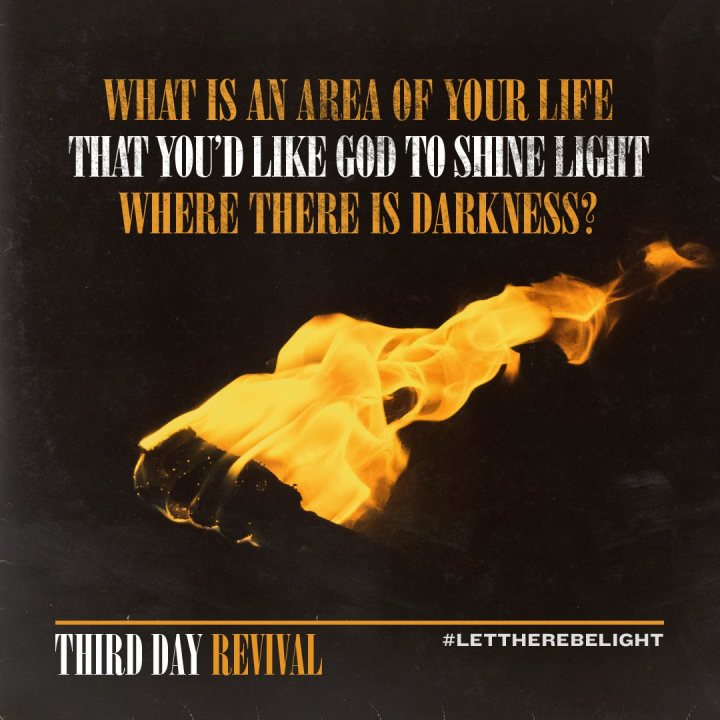
Don’t you know, people who are gifted musically are also spiritual authorities. Hence, the attached meme by the “Christian” moaners Third Day. Like I have said before though I am a pragmatic soul, there is a strange power behind true love because Susan and I ended up married regardless of our incessant fussing over this issue while we were dating. As one who was churched for over 50 years, she was incredulous that I saw nothing positive about church, and constantly pointed out the biblical error in the lyrics of her favorite songs. Once, she deliberately sought to antagonize me by suggesting that Toby Mac knew more about the gospel than I did which invoked hysterical laughter, and it kinda went downhill from there real fast. Of course, we are past all of that now and still friends on Face Book.
Sigh. Do Christians still have parts of their lives that are “in darkness”? Say, is there an area of your life in darkness that you would like the Lord to shine a light on? Where to start with this BS (boloney sausage)? First of all, if it is in darkness, how would you even know that it needs light? Well, I guess it depends on what exactly the meme means by darkness to begin with which is ambiguous like all other things church. However, I suppose we can be reminded that God’s elect only know one thing; that we can’t know. Nevertheless, we have areas that we know are darkness, and know that our only hope is for God to shine light on it, so, ya know, that we will then know it is light, or something like that.
This is why I always enjoy watching evangelicals witness to unbelievers. You can just see what they are thinking by the looks on their faces while these people are talking: “What the hell?”
I could go on and on, but I expend most of that energy ranting to Susan in the car even when she doesn’t turn on the radio. Suffice to say that the Bible presents light and darkness as two totally separate states of being. And, if a believer is walking “like” they are still in darkness, the Bible gives specific instruction on what to do about it which doesn’t include begging the Lord to do something about it and waiting to see if He wants to or not.
Here is an opportunity to look at yet another word or two that Christians are in total confusion about. But let’s not be confused about this: Christians are confused in regard to EVERY metaphysical word and concept in the Bible or elsewhere. For example, you will hear them throw around words like “grace” and “law” more often than they go to the bathroom; now ask them to define those words and behold the deer-in-the-headlights look, or the regurgitation of what someone else told them.
But we are talking about the words, darkness and light. A popular use of these terms among Christians is to prove from the first chapter of Genesis that every verse in the Bible is about Jesus. And, they believe that because they heard it at church. And here is what they heard: Paul stated in 2Corinthians 4:6 that God brought light from darkness which refers to Christ and the gospel. Only problem is that Paul wasn’t citing Genesis, he was citing Isaiah, and so it goes.
To whom shall we go to find truth? Christian musicians represent a plethora of different denominations. Which one of those denominations will be proved correct at the “final tribunal”? And if Christians don’t even know what any given Bible word means, why would we presume that they know what the true gospel is?
paul



1 comment