TANC Will Announce New Program For Pastors So They Can Tell the Truth and Keep Their Jobs

BOXCAST Live Link Sunday 3/11/18 @10:30 am
Blog Talk Radio Live Link Sunday 3/11/18 @ 10:30 am
The protracted conversation about church on social media continued this morning and has inspired me to start a new program for church pastors. We will continue our study in Galatians next Sunday at 10:30 am.
Wow, where to even start here? But, your comment is most valuable to further my points because it’s the typical argument we hear. First, let’s talk about the elephant in the room. Was the Protestant Reformation about perpetually returning to the cross for re-salvation/re-justification? Well, the who’s who of present day evangelicalism say, “yes,” and they are absolutely correct about it. EVERYTHING was about justification/salvation. The whole point of going to church was to see one’s sin afresh as a primer to return to the cross.
Catholics outlawed Bible possession, Protestants merely turned it into a progressive salvation tool only. This led to very weak sanctification in the church which was mended to a point by Dr. Jay Adams who is the father of the biblical counseling movement. However, the Neo-Protestant “gospel recovery movement” began the very same year of Adams’ movement. The Neo-Protestant movement actually bemoaned the church’s attempt to even live by biblical generalities and called it “moralism.” Now, one of the biggest enemies of Reformation progressive justification is a literal understanding of the Bible; that’s a huge problem. So, the Reformation hermeneutic is the whole idea that the Bible is a metaphysical narrative about God’s redemptive plan in Christ, and not to be taken literally; this is the historical-redemptive hermeneutic. As Paul David Tripp has said, “Every verse in the Bible must be seen in its ‘gospel context,'” and we all know who the experts on that are don’t we? According to the heir apparent to MacArthur’s throne, Rick Holland, “good grammar makes bad theology.” So, take note of what I have been accused of in this stream: the use of semantics. Yes sir, I am using the “words mean things hermeneutic” otherwise known as historical-grammatical interpretation.
Now, the next typical defense for the church lie, after ignoring the elephant in the room, is that other stripes of church, particularly the Baptists, are not in the Reformed tradition. That’s just not reality at all. Here is your argument posted in this stream: “While Baptists were not part of the protestant reformation, they are often lumped in the category of protestants. If one accepts that categorization, then the position of the largest protestant organization in America refutes your argument. ‘All true believers endure to the end. Those whom God has accepted in Christ, and sanctified by His Spirit, will never fall away from the state of grace, but shall persevere to the end. Believers may fall into sin through neglect and temptation, whereby they grieve the Spirit, impair their graces and comforts, and bring reproach on the cause of Christ and temporal judgments on themselves; yet they shall be kept by the power of God through faith unto salvation.’ (The Baptist Faith and Message, Article 5 – God’s Purpose of Grace).”
Um, excuse me, but that is practically a copy and paste directly from the Calvin Institutes, and has to do with Calvin’s third class of elect; ie., those who persevere. In fact, the London Baptist Confession is barely anything less than the Westminster Confession said another way. One of the biggest arguments of the New Calvinist/ Neo-Protestant movements was that Baptists, especially Southern Baptists, are expressly and historically Reformed…and that is absolutely true. As one scholar notes, ” the 1689 London Baptist Confession of Faith is based on the 1646 Westminster Confession of Faith, the 1689 is often assumed to be nothing more than baptized version of the 1646.” Charles Spurgeon, the Baptist “Prince of Preachers,” stated the following: “Calvinism is not merely a nickname, it is the gospel.” So, while denying that Baptists believe that any local church can take away salvation, citing the perseverance of the saints, it is not understood that is but one class of Calvin’s elect which includes the non-elect, and the temporarily illumined.
Also note that like the Reformed, you attest that the saints are kept by the power of God. Right, IF they are of the perseverance class of elect which no one can know until the final judgment in which the true children of God are “made manifest.” So, if the church excommunicates you, that means you were never of the perseverance class. Two half dozen is same as a dozen.
Now we will address this whole supposed dichotomy between Catholicism and Protestantism. The Reformation was about reforming the Catholic Church, not leaving it. Calvin and Luther NEVER left the Catholic Church. And shockingly, and in broad daylight, BOTH claim St. Augustine as the foundation of their doctrines and gospels. I mean, Protestants are not even ambiguous about it. BOTH claim Augustine as their Doctor of Grace.
And finally, in defense of the church lie, you go directly to the Neo-Calvinist standby. Yes sir, I only see things this way because I have been hurt by a church. So lame. No, in contrast, a false gospel’s bad fruit finally pushes people to get to the bottom of what is really going on.
Nevertheless, your post has inspired me. We will announce on our Sunday program today a way for pastors to keep their jobs and still tell the truth leading to revival.
The Fall of John MacArthur Jr.

Excerpt from a protracted social media discussion:
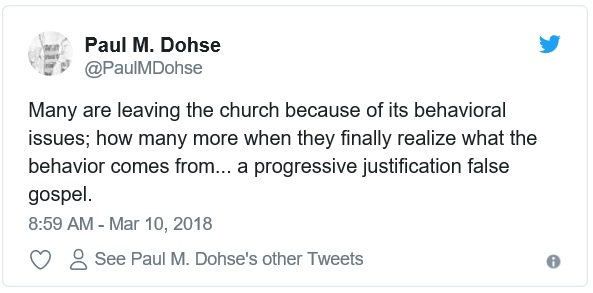
What was rediscovered is true Protestantism; one must continually return to the cross for re-salvation or re-justification. The same gospel that saved you also sanctifies you because sanctification is the progression of salvation. This is the Neo-Protestant / Neo Calvinist / New Calvinism movement in a nutshell; it is a “gospel recovery” movement. Their words, not mine. Hence, in case you have never heard it, “We must preach the gospel to ourselves every day.”
John MacArthur et al have bought into it hook, line, and sinker because they have been shown by Michael Horton and others that this is, in fact, the basis of the Protestant Reformation. MacArthur wasn’t willing to side with the plain sense of Scripture against 500 years of tradition. His closest associate, Phil Johnson, is now clearly stating that salvation is a “process” that can only be effected within formal church membership. That’s Protestantism 101.
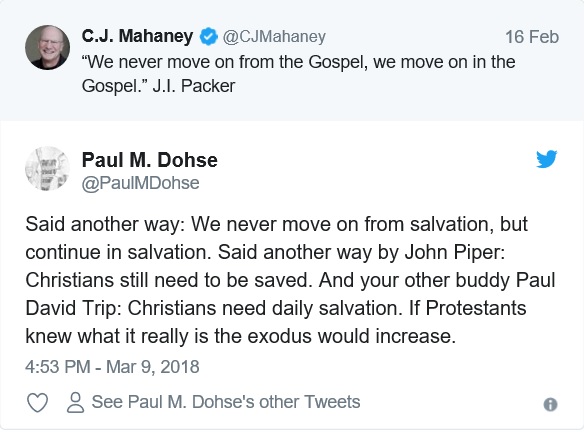
John Piper has stated that “Christians still need salvation.” Matt Chandler states that Christians are “wicked sinners who still need the gospel.” He asks, “On Sunday when the gospel is preached, is it preached to Christians or non-Christians who are present?” To this question he presents, he answers it himself…”YES!” This whole thing we have heard for years when we ask why the gospel is preached so much at church, viz, “Because there might be unbelievers present,” is disingenuous at best and outright deception at worst. The gospel is preached at church because Protestantism holds to the idea that Christians still need ongoing salvation found only in submission to the institutional church. While confused Protestants don’t believe that intellectually, they function that way because of the traditional dynamics of church. Hence, effective sanctification is watered down to the degree that the church functions according to progressive justification.
This is at the heart of all we are seeing in the contemporary church. At some point, I believe Christianity at large will have to deal with this reality because the church will not be able to slowly indoctrinate enough people to support its massive industrial complex. Will Protestantism merge with Catholicism in order to survive? That’s my best guess.
Both believe in a spiritual caste gospel; it’s merely a matter of agreeing to disagree on the minor details. Those who are out to save the organized church because their livelihood depends on it will end up finding another means of income anyway or else capitulate to increased ecumenicalism and overall doctrinal chaos.

 Paul's Passing Thoughts
leave a comment