Script: How Authority Destroys Marriages

Two part audio and video forthcoming. This script is not a transcription and does not match the program word for word.
How Authority Destroys Marriages: Authority, Division, Death; Freedom, Oneness, Life
As a former pastor in the institutional church I heard it often: “He’s a control freak.” Personally, I couldn’t relate to that. Sure, I perceived that people had issues with control and constantly suspicious of their spouses, but I just chalked it up to some sort of paranoia.
In our reality, authority is assumed to be not only a good thing, but efficacious to world order. Well, there has always been plenty of authority in the world, but very little order. Nevertheless, it is assumed that an authority is needed on every level of life.
This year’s TANC conference is focused on the kingdom of God. When the church thinks of God’s kingdom; authority is assumed, but is that really the case? Is God’s kingdom really authority based? And how does our view of authority effect every level of life?
And if not authority, what should we use instead?
“Control freak” did not compute, while acknowledging the term, I moved on. Much later in my Christian life while reading the Bible, a particular passage caused me to stop and ponder:
Then the Lord said to Cain, “Why are you angry? Why is your face downcast? If you do what is right, will you not be accepted? But if you do not do what is right, sin is crouching at your door; it desires to have you, but you must rule over it” (NIV).
Sin is primarily driven by a central “desire,” to control. Its means of control is wrongdoing. Sin lies in wait for someone to do wrong and uses the opportunity to gain control over them. Sin is an entity described in the Bible as a slave master. And, the essence of Sin’s being resides in every human being; in their “members,” and in their mind.
Hence, humanity also shares Sin’s desire to control others, and to what degree is going to be unique to individual factors. Sin uses condemnation to destroy self-worth and self-esteem which makes the individual willing to relinquish freedom. The goal is to fill the individual with fear and to strip one of all self-confidence.
Notice in this passage that God instructs Cain about what Sin is up to and instructs him to turn the tables on Sin. Instead of allowing Sin to control him, he must instead control Sin. This means taking away Sin’s provisions for control by doing good and not evil.
This dynamic effects reality on every level; from the political to the most common of personal relationships. It is a matter of understanding what authority is and its proper role in life. How authority works in regard to kingdoms is key to understanding how authority works in personal relationships and marriage.
Know this: the kingdom of God does not presently reside on earth and does not presently utilize authority. The contrary belief is at the heart of failed Christian marriages.
It is a historically conspicuous that caste, or caste systems have always been the cultural norm worldwide. Let’s look at the definition.
“Caste is a form of social stratification characterized by endogamy, hereditary transmission of a lifestyle which often includes an occupation, status in a hierarchy, customary social interaction, and exclusion. Although caste systems exist in various regions, its paradigmatic ethnographic example is the division of Indian society into rigid social groups, with roots in India’s ancient history and persisting until today.”
This is the ruling of one group of people by another for the collective good of mankind, if not the survival of it. First, why would any given group of people want to rule over another? We have discussed that already—Sin. Now, what the elitists need is a just cause to rule over the lesser and now we introduce the total depravity of mankind or “total inability.”
Please note that, in essence, the serpent approached Eve in the garden with a proposal for a caste system. Obviously, he presented himself as someone who knew more about God than she did. Before that, Adam and Eve communicated with God face to face with no mediation and the assumption that all required knowledge was present. The serpent introduced himself as a necessary mediator for purposes of more information. This is the first caste system proposed: God, the serpent as a mediator between God and man, and Adam and Eve at the bottom.
Once condemnation entered into reality causing Adam and Eve to hide from God, Sin uses this same condemnation to present the following case: “See how unworthy you are? See what a sinner you are? It’s obvious that you are totally unable. Therefore, you need someone to not only rule over you, but to mediate between you and God.” Now, how do we know who these ruling elitists are? It’s called, “preordination” or “predeterminism” or “predestination.” A person’s status in life is predetermined by God in order to determine and validate the person’s credentials as an elitist ruler. If you graduate from seminary with a degree in theology, this means you were preordained by God to “save His people from ignorance” (Dr. Albert Mohler). In India, the criteria is what family you were born into which like everything else is predetermined by God.
So, let’s review. Since mankind is totally depraved, he needs elitist rulers to guide the great unwashed lest mankind destroy itself, and these elitist rulers are predetermined and appointed by God. They also act as mediators between man and God; ie., co-regents that are granted God’s authority to rule over the great unwashed by proxy. In many cases, speaking to the religious aspect, these mediators also have the authority to forgive sin on God’s behalf and God will always honor the edict based on the authority He has granted to them. Also note: because mankind is “arrogant,” “proud,” ect., people have a propensity to think well of themselves and an ability to understand reality. Therefore, it is necessary to incessantly remind the great unwashed of their total inability. This is how condemnation empowers sin: it destroys self-esteem, self-worth, and confidence in personal ability. It instills fear of condemnation and seeks solace in false mediators.
It is now imperative that we recognize that this hierarchy of caste has multiple levels, actually a massive amount of stratification across formal and informal lines. This is the absolute crux of prejudice. While a so-called Christians will often deem themselves a “wicked sinner,” do they not still consider themselves in a better state of life than the unsaved? Caste creates discord, division, and prejudice in every corner of life. The uncool are bullied at school, the disabled are shunned. People condemn others for any and every difference: color, weight, appearance, income, politics, gender; the list is endless. I should be able to control you because you are inferior to me. Furthermore, some classes of people are under a level of condemnation that judges them as a danger to the survival of other races or social class if there is inbreeding. This results in marriage laws forbidding marriage between a variety of difference and is the core source of genocide. History is also chock-full of accounts where too much self-esteem leading to the rejection of government as god leads to mass execution.
We now have the basis of defining authority: because the commoners cannot know truth; truth is whatever the elitists say it is. And, unity is defined by agreement on whatever the authority states as truth, and individual conscience is irrelevant. Because mankind is totally depraved, conscience is not relevant to the individual or the collective whole. Agreement with one authority equals unity whether it is truth or not.
This is not what the Bible states about individual conscience. The Bible warns against violating personal conscience because…
“All who sin apart from the law will also perish apart from the law, and all who sin under the law will be judged by the law. For it is not those who hear the law who are righteous in God’s sight, but it is those who obey the law who will be declared righteous. (Indeed, when Gentiles, who do not have the law, do by nature things required by the law, they are a law for themselves, even though they do not have the law. They show that the requirements of the law are written on their hearts, their consciences also bearing witness, and their thoughts sometimes accusing them and at other times even defending them.) This will take place on the day when God judges people’s secrets through Jesus Christ, as my gospel declares” (NIV).
“holding on to faith and a good conscience, which some have rejected and so have suffered shipwreck with regard to the faith” (NIV).
“The goal of this command is love, which comes from a pure heart and a good conscience and a sincere faith” (NIV).
“Now this is our boast: Our conscience testifies that we have conducted ourselves in the world, and especially in our relations with you, with integrity and godly sincerity. We have done so, relying not on worldly wisdom but on God’s grace” (NIV).
“and this water symbolizes baptism that now saves you also—not the removal of dirt from the body but the pledge of a clear conscience toward God. It saves you by the resurrection of Jesus Christ,” (NIV).
“Rather, we have renounced secret and shameful ways; we do not use deception, nor do we distort the word of God. On the contrary, by setting forth the truth plainly we commend ourselves to everyone’s conscience in the sight of God” (NIV).
“But not everyone possesses this knowledge. Some people are still so accustomed to idols that when they eat sacrificial food they think of it as having been sacrificed to a god, and since their conscience is weak, it is defiled” (NIV).
” Because of this, I always try to maintain a clear conscience before God and all people” (NIV).
“holding on to faith and a good conscience, which some have rejected and so have suffered shipwreck with regard to the faith” (NIV).
These are but a few biblical passages that emphasis the centrality of personal conscience for being led in truth. Here is the thing about authority: it claims priority over one’s conscience. That’s a huge problem. No authority can rightfully compel any person to violate the works of the law written on their heart by God. In addition, Paul, in his letter to the Romans, stated that such is not of faith and therefore sin.
Authority vanquishes the need for reason, because the totally depraved are unable to reason, and the need for leadership, because skillful persuasion using truth is a moot point with those unable to reason to begin with, and beside this, mandates make persuasion unnecessary. Why take time to persuade anyone when they have to do want you want just because you said so?
But didn’t Christ utilize His authority in ministry? No. Obviously, He spent most of His time persuading through teaching.
And sent messengers before his face: and they went, and entered into a village of the Samaritans, to make ready for him. And they did not receive him, because his face was as though he would go to Jerusalem. And when his disciples James and John saw this, they said, Lord, wilt thou that we command fire to come down from heaven, and consume them, even as Elias did? But he turned, and rebuked them, and said, Ye know not what manner of spirit ye are of. For the Son of man is not come to destroy men’s lives, but to save them. And they went to another village. (KJV).
While he was still speaking, Judas, one of the Twelve, arrived. With him was a large crowd armed with swords and clubs, sent from the chief priests and the elders of the people. Now the betrayer had arranged a signal with them: “The one I kiss is the man; arrest him.” Going at once to Jesus, Judas said, “Greetings, Rabbi!” and kissed him.
Jesus replied, “Do what you came for, friend.”
Then the men stepped forward, seized Jesus and arrested him. With that, one of Jesus’ companions reached for his sword, drew it out and struck the servant of the high priest, cutting off his ear.
“Put your sword back in its place,” Jesus said to him, “for all who draw the sword will die by the sword. Do you think I cannot call on my Father, and he will at once put at my disposal more than twelve legions of angels? But how then would the Scriptures be fulfilled that say it must happen in this way?”
In that hour Jesus said to the crowd, “Am I leading a rebellion, that you have come out with swords and clubs to capture me? Every day I sat in the temple courts teaching, and you did not arrest me. But this has all taken place that the writings of the prophets might be fulfilled.” Then all the disciples deserted him and fled (NIV).
Church, while it speaks much of its authority, cannot demonstrate that it has any because it doesn’t. Before the American Revolution, the church state practiced a self-proclaimed authority by torturing naysayers. After the separation of faith and force, the church emphasized its supposed authority over salvation. So, do what we say or we will send you to hell, and by the way, wars and earthquakes and tornados and floods and disease are judgements from God because the world disallows church to rule over everything with the authority God gave us. In reality, the Bible says that ALL authority was given to Christ leading Him to issue a mandate to preach the gospel and make disciples; if it was a mandate to rule over the world and everything in it with top-down authority, He forgot to mention it.
Instead, we, that is, the assembly of Christ or the called-out assembly, are referred to as “ambassadors” and “sojourners” and “aliens” in a foreign land. In other words, God’s kingdom is not presently here. When it is, that will be extremely evident, and we call that the “millennial kingdom” era.
The church has NO authority.
In the world’s endeavor to rule over others through caste systems of all kinds, reality is saturated with divisions upon divisions. While claiming authority prevents chaos, it actually creates chaos. Look at our world; from politics, to employment, to family, to the school yard, and common friendships, there is division in every element of life. The world has always been dominated by a conquest ethic and a desire to control anybody different. Different equals inferior.
Of course, the primary example of this is slavery. But whether slavery or countries ruled by socialism, fascism, or communism, there is one result: low production and a low standard of living. Why is this? Because people are not self-invested. Their labor only benefits the state. There is no satisfaction in one’s labor because they have no choice in following their own interests. They are not allowed any fruits that flow from their own interests but are only allowed to trade time dictated by the state for a survival wage. This also crushes innovation, and is the reason that countries like China have to steal intellectual property from other countries.
Marriage is just another stratum of life where all of these dynamics operate. In the same way countries and companies and many other life categories suffer destruction by these dynamics, so does marriage. In the same way that authority destroys everything good through its conquest ethic, so it goes in a marriage as well.
Before we look at how this effects marriage, is all authority bad? No. Let’s address government authority. I want to do this by going to Romans 13:
Let everyone be subject to the governing authorities, for there is no authority except that which God has established. The authorities that exist have been established by God. 2 Consequently, whoever rebels against the authority is rebelling against what God has instituted, and those who do so will bring judgment on themselves. 3 For rulers hold no terror for those who do right, but for those who do wrong. Do you want to be free from fear of the one in authority? Then do what is right and you will be commended. 4 For the one in authority is God’s servant for your good. But if you do wrong, be afraid, for rulers do not bear the sword for no reason. They are God’s servants, agents of wrath to bring punishment on the wrongdoer. 5 Therefore, it is necessary to submit to the authorities, not only because of possible punishment but also as a matter of conscience.
First, does this mean we are obligated to submit to every government no matter what? No, a government ordained by God rewards good and punishes evil. This is the mark that distinguishes a government ordained by God. Obviously, God did not expect submission to the Nazis during WWII. The Nazis rewarded evil and punished good. Paul states the criteria of ministry that governments are to perform. I believe governments are primarily pragmatic in their function. Remember, there is a law of God written on the heart of everyone born into the world. I believe this is a self-evident good known by all people and adjudicated by the conscience.
Regarding marriage, we have this umbrella chart popular among parishioners that illustrates a marriage caste system propagated by the church. This results in three kinds of marriages; those that fail, those that are miserable (at least for the wife), and those anchored by Gnostic indifference.
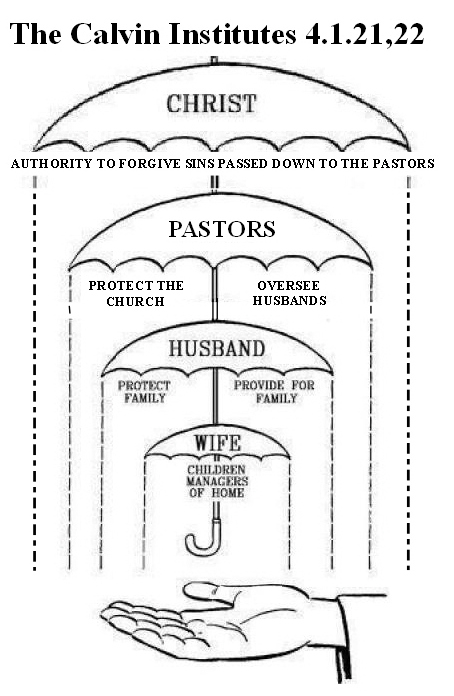
The enviable failure of church marriages flows from gender prejudice that is part of church orthodoxy. It’s the same Protestant caste paradigm that flows from the “fall of man.” Eve sinned first and caused Adam to sin. Women are to blame for sin entering into the world. Therefore, women have an inherent evil desire to lead men into sin. Hence, women are weak and inclined to sin, and must be ruled over for their own good. Women are to be in subjection to their husbands. Why do so many men, especially pastors, get a pass on adultery and even rape? Well, the poor souls were simply duped by an evil woman. She was the devil’s agent in causing a “man of gawd” to stumble. If you ever wondered where victim blaming comes from in the church, you should now consider yourself informed (See Susan Dohse sessions on gender orthodoxy according to the church fathers; TANC 2017).
Full stop. The ability to love one’s wife God’s way is completely incompatible with this belief. Trust, respect, and oneness are virtually impossible. It’s more like a relationship between a prison guard and an inmate. The wife is little more than a servant preordained for the singular purpose of validating the husband. I realize that church couples can put a good face on this orthodoxy, but the metaphysical math doesn’t add up.
First of all, if the husband has authority over the wife, leadership is completely unnecessary. Any ability or effort to persuade is replaced with the wife obeying whatever the husband commands. Secondly, as with all who need to be ruled over, personal investment in self for a sense of accomplishment is limited. The wife’s sole purpose is enabling the husband. And unfortunately, the wife’s gifts are never fully developed, actually, not even close.
We must remember that gender contention is a huge part of church history and orthodoxy. In the 1st century, women were neck and neck with men in the gender wars. Of the 12 primary gods constituting the Roman pagan-state, 6 were women. In fact, Diana was the primary god. The church sought to turn the tide with a vengeance. When women attempted to regain influence through witchcraft, the church unleashed a wholesale slaughter that wiped out the entire population of women in many villages throughout Europe. Furthermore, accusing a woman of witchcraft meant that she was guilty until proven innocent, and the accusation was therefore used to dispose of other women for various reasons.
Hatred of women has always been church orthodoxy as demonstrated by the vaunted spiritual heroes of church regardless of what the church fathers said of them (women) and including those of the Protestant Reformation. If Martin Luther spoke of women the way he did, and he did, any recognition of him or anything he believed is unwarranted and inexcusable. Regardless of the front put on at church and its sugarcoated enslavery of women, association with a church consents to the anti-women orthodoxy of the church for which it has never repented.
In this kingdom dominated by control lust, condemnation, and subsequent divisions of all sorts with everything but the kitchen sink trying to gain conquest over everything else, gender orthodoxy just adds to the confused morass we call church. I understand there is a Bible verse stating that women should remain silent in the church, but since that doesn’t make any sense at all, what is really going on in that passage? We don’t know for certain, but the feminist movement in the church is just another conflict that reflects culture because the church doesn’t really offer anything different than the conquest paradigm. It’s just another caste system dressed up in Bible verses.
So, what then? Should women be allowed to lead men in home fellowships? I don’t know. Certainly, women are instructed by the Bible to lead other women. Any home fellowship could skirt the whole issue by dividing in separate study groups after the fellowship meal. However, there is such a severe famine regarding the ability to articulate the true gospel of justification by new birth as opposed to the false gospel of justification by faith that I say if any women displays a gift to do such let her preach. Home fellowships have flexibility on this and many other issues. Frankly, if some woman wants to wow me with her ability to articulate the gospel of justification by new birth praise be to God. Where are all the men in all of this? Following the philosopher kings like dumb oxen led to the slaughter. It’s pathetic. If women have to stand up and fill the void let it be.
But if not a caste system, what then? Pretty much the same passages that church uses to propagate its caste system.
Ephesians 5:1 – Follow God’s example, therefore, as dearly loved children 2 and walk in the way of love, just as Christ loved us and gave himself up for us as a fragrant offering and sacrifice to God. 3 But among you there must not be even a hint of sexual immorality, or of any kind of impurity, or of greed, because these are improper for God’s holy people. 4 Nor should there be obscenity, foolish talk or coarse joking, which are out of place, but rather thanksgiving. 5 For of this you can be sure: No immoral, impure or greedy person—such a person is an idolater—has any inheritance in the kingdom of Christ and of God. 6 Let no one deceive you with empty words, for because of such things God’s wrath comes on those who are disobedient. 7 Therefore do not be partners with them.
8 For you were once darkness, but now you are light in the Lord. Live as children of light 9 (for the fruit of the light consists in all goodness, righteousness and truth) 10 and find out what pleases the Lord. 11 Have nothing to do with the fruitless deeds of darkness, but rather expose them. 12 It is shameful even to mention what the disobedient do in secret. 13 But everything exposed by the light becomes visible—and everything that is illuminated becomes a light. 14 This is why it is said: “Wake up, sleeper, rise from the dead, and Christ will shine on you.”
15 Be very careful, then, how you live—not as unwise but as wise, 16 making the most of every opportunity, because the days are evil. 17 Therefore do not be foolish, but understand what the Lord’s will is. 18 Do not get drunk on wine, which leads to debauchery. Instead, be filled with the Spirit, 19 speaking to one another with psalms, hymns, and songs from the Spirit. Sing and make music from your heart to the Lord, 20 always giving thanks to God the Father for everything, in the name of our Lord Jesus Christ.
21 Submit to one another out of reverence for Christ [emphasis added].
22 Wives, submit yourselves to your own husbands as you do to the Lord. 23 For the husband is the head of the wife as Christ is the head of the church, his body, of which he is the Savior. 24 Now as the church submits to Christ, so also wives should submit to their husbands in everything.
25 Husbands, love your wives, just as Christ loved the church and gave himself up for her 26 to make her holy, cleansing her by the washing with water through the word, 27 and to present her to himself as a radiant church, without stain or wrinkle or any other blemish, but holy and blameless. 28 In this same way [emphasis added], husbands ought to love their wives as their own bodies. He who loves his wife loves himself. 29 After all, no one ever hated their own body, but they feed and care for their body, just as Christ does the church— 30 for we are members of his body. 31 “For this reason a man will leave his father and mother and be united to his wife, and the two will become one flesh.” 32 This is a profound mystery—but I am talking about Christ and the church. 33 However, each one of you also must love his wife as he loves himself, and the wife must respect her husband (NIV).
First of all, like Matthew 18, where are the elders? They are conspicuously absent. Listen, NO man has authority in your home. Secondly, notice the collective submission of verse 21. Thirdly, what does it mean that the man is the “head” of the wife? Does that mean “head” as in “boss.” No, the illustration used is a human body. So, when you read the commentaries regarding the meaning of this word in Ephesians 5, a case is made for authority, but when you examine how the word is used in every other New Testament verse of the Bible it’s a head of a human body EVERY time. Look, you don’t have to be a Greek scholar to properly understand the Bible. All you need is a good working use of study tools. Most often, Greek is used to make a verse say whatever orthodoxy hounds want it to say.
Now listen. Here is my thumb. Last week, I drilled a hole in it. As a member of my body, I have NO authority over my thumb. I cannot command my thumb to heal. As with most all bodily functions, they are what we call, “involuntary.” Different cells that make up different body members and organs are a body within a body and literally have a complex mind of their own. My head, viz, my mind, has NO authority over my body.
HOWEVER, I can edify my body and submit to its needs in order for all the cells to better perform their function. Get it? That’s the illustration here. It’s body, not authority. You can’t tell your body to do squat. You can desire your body to do something, but if that particular member is unhealthy, no amount of bossing is going to make it do what it doesn’t want to do or can’t do.
You must submit to the needs of your body in order to have a healthy overall function. That’s knowledge of your body, and edification of your body members. That’s good choices and knowledge that edifies. This is what the Bible is talking about when men are instructed to live with their wives according to knowledge. Here, in Ephesians, we find that ill behavior towards our body is ill behavior towards yourself. Your wife should annoy you by not properly edifying herself, not a lack of edifying you. Your body health is directly related to your wife’s wellbeing as you are one body. It cannot be denied that the husband is to take leadership in this endeavor and the wife needs to respect his efforts in doing so. Elders do not live with your wife; they don’t know squat about you wife. In every case where marriage counseling is needed, the husband has been asleep at the switch. Premarital counseling and all other marriage counseling should be limited to an understanding of Ephesians 5, then the husband needs to get off his sorry lazy rump and edify his wife in the same way he edifies his own body. This, as opposed to letting spiritual morons with 4 or 5 useless titles after name do the thinking for them. Together, the husband and wife are the walk of the new man that does the kingdom’s bidding.
While we are on the subject of the body, the new birth makes us a member of Christ’s body. The visible reality is fellowship.
1John 1:1 – That which was from the beginning, which we have heard, which we have seen with our eyes, which we have looked at and our hands have touched—this we proclaim concerning the Word of life. 2 The life appeared; we have seen it and testify to it, and we proclaim to you the eternal life, which was with the Father and has appeared to us. 3 We proclaim to you what we have seen and heard, so that you also may have fellowship with us. And our fellowship is with the Father and with his Son, Jesus Christ. 4 We write this to make our joy complete (NIV).
When we fellowship with the body of Christ, it’s because we fellowship with the Father and the Son through the act of fellowship itself, not by signing a contract with a church that gives them legal authority to publically humiliate us if we debunk their authority. More and more, so-called church discipline which is not in the Bible to begin with and is clearly part of the authority motif, is being practiced in situations where authority is being challenged while leadership turns a blind eye to decadent living among the members. Abused women are hostage as much of their lives have been invested in church culture rather than themselves. The abuse will not be addressed by the church because she is of Eve, the evil temptress who brought sin into the world and is the devil’s advocate for leading “gawdly men” into sin. Church orthodoxy allows for the yellow magical salvation bus going to heaven; it’s a nasty beat up bus with all kinds of treachery going on inside, but supposedly, it’s the only bus going to heaven. This is why the church will be defended at all cost and its authority is directly related to victim blaming.
Bottom line: church membership is tantamount to endorsing spiritual tyranny, a false mandate of authority belonging only to the Lord, a history of bloody slaughter against detractors that the church has never repented of, and documented hatred of woman who should have “dung rubbed in their faces to make them ugly” (Luther) and only good for bearing children (Luther and the church fathers). This, according to Martin Luther who is shamelessly heralded by the contemporary church as well as many other merciless despots.
The contrast is leadership, not authority, body, not caste, family, not an institution, and fellowship, not a legal membership contract.
Be sure of this; a spearhead of this ministry is supplying a way out for women under the bondage of church authority and its “means of grace.” It is a way out for those who have come to realize that they are no longer under law, viz, “God hates divorce” isn’t a license to be treated like a slave and held hostage by the kingdom of darkness that is under law.
In our kingdom, wives are sisters in God’s family, fellow heirs of God’s kingdom, and part of a holy nation of priests. We are a kingdom where “There is neither Jew nor Gentile, neither slave nor free, nor is there male and female, for you are all one in Christ Jesus.”
Come out from among them and be free, for freedom Christ died. Trade the law of sin and death for the law of love. Be free to aggressively love by the law with no fear of condemnation.
Galatians Interlude: How Authority Destroys Marriages

“Know this: the kingdom of God does not presently reside on earth and does not presently utilize authority. The contrary belief is at the heart of failed Christian marriages.”
Blog Talk Radio Live Link: Authority, Division, Death; Freedom, Oneness, Life
As a former pastor in the institutional church I heard it often: “He’s a control freak.” Personally, I couldn’t relate to that. Sure, I perceived that people had issues with control and constantly suspicious of their spouses, but I just chalked it up to some sort of paranoia.
In our reality, authority is assumed to be not only a good thing, but efficacious to world order. Well, there has always been plenty of authority in the world, but very little order. Nevertheless, it is assumed that an authority is needed on every level of life.
This year’s TANC conference is focused on the kingdom of God. When the church thinks of God’s kingdom; authority is assumed, but is that really the case? Is God’s kingdom really authority based? And how does our view of authority effect every level of life?
And if not authority, what should we use instead?
Sunday, 5/20/2018 @ 10am
FYI to Cripplegate and the Clueless Church: My Worship is Well Informed
 My time is very limited right now, and hence, I have little time to write. Accordingly, I had no idea I would be writing a post today, but being offended can result in the rearranging of priorities.
At 62 years old, I suppose I get annoyed as much as anyone, but I rarely get offended, especially by stuff that is church related. Like many other life venues, you learn that church is going to be church, and church is, what it is, and it’s what church does; it condemns, it debates perpetually, it confuses, it covers up, it controls, excels in fear mongering, and epitomizes perpetual trending drama.
However, of late, churchians do something that offends me; they ridicule my worship which is based on years of independent study. In addition, their ridicule is based on ignorance that knows no limits. Moreover, it’s stuff they hear from others and void of any independent thought. Usually, my worship is attacked by those who pay 50 to 80 grand to learn how to think other people’s thoughts. And because they bought their creditability, I’m wrong and they are right. There is something about misinformed ignorance, that is, ignorance that is ignorance and also misinformed to boot that is offensive to me. Think of it as a devil that is wrong about devil stuff. No one respects someone uncommendable when they are wrong about their wrongness because you can’t respect that. Likewise, when Jehovah Witnesses come to my door and I have to inform them of what their doctrine really teaches, I find it disappointing, and if they diss my beliefs, it’s offensive because they don’t even understand their own false gospel. First they teach a false gospel, and on top of that misunderstand what their own gospel actually teaches. This makes debate very difficult; you have to teach them about what they think they believe to even have a beginning point for the debate. Such is the case with the instigative post that was brought to my attention in a PPT comment.
First, they, and exemplified by said post as well, don’t even know what worship is. They will tell you; “corporate worship” only happens at church. As heard often, Church is where we “enter to worship and leave to serve”…by coming back “every time the doors are open.” They don’t even understand what “service” is either. At the very least, church orthodoxy, as exemplified in the London Baptist Confession and elsewhere, sets aside Sunday as the Sabbath Day from which all service flows from gospel contemplationism. While most churchians concede a vague worship that happens in everyday life, none will concede it valid unless sanctified by church membership and faithfulness to its demands.
The polar opposite is true. All of life is worship, and we gather together to encourage one another to worship in all of life the rest of the week. This is why gathering together for fellowship is VERY important. Actually, the overall laxness towards fellowship among church exiters is annoying. Nevertheless, where does church get this all wrong? Well, first remember that if worship has validity outside of the church, what is the church needed for? If there is any valid worship apart from the church, you can worship without the church, and that’s a huge problem for church.
Secondly, and simply stated, church is the Old Covenant plus Jesus. If you will, works plus Jesus. You deny that Mr. or Mrs. churchian? We have a radio program here at PPT; you are welcome to come on air and prove me wrong. But first, I will have to inform you about what your religion specifically states about justification and sanctification, because you either don’t know, or you are a pastor who does, but can’t talk about the “scandalous gospel” that most Christians are not ready for. Let me first demonstrate that you are a professing Protestant, but don’t know what Protestantism is (see, this is what is so offensive to me; being lectured by people with misinformed dogma…gag). If I ask you if Jesus died for all of your past, present, and future sins, you, as a professing Protestant, are going to say, “yes.” But that’s NOT Protestantism. If I ask you about eternal security, or once saved always saved, you will say, “Yes, that’s a tenet of Protestantism.” Not so. If I ask you if Jesus lived AND died for our salvation, you will say, “yes.” Now on this wise, you are correct, that is the Protestant doctrine of double imputation which is works salvation x 2. However, per the usual, you cannot define any of the Protestant formal doctrines that produce the statements you toss around. Therefore, you are more than welcome to take me up on my offer, but know that your cluelessness regarding what you think you believe will be made public.
Unfortunately, people will hold tightly to what they have wrongly invested in for a number of years. I understand that, but you shouldn’t lecture someone who was willing to admit they were clueless and started over on the right path.
Churchians don’t know what worship is, or service, and in addition, they don’t even know what church is. Church is not the body of Christ, and it is not the bride of Christ. Per the usual, Protestants struggle to be wrong about something in one particular way; they are usually wrong about something in two or more ways. Keep in mind, the word used for God’s people in the Bible was a generic word for a “called out assembly.” It was used for any gathering of people assembled together for a particular purpose or issue. The church changed the word to, well, “church” in the English translations of the Bible. The word has no Jewish or Greek etymology, and has to do with things that “belong to a lord.” Long story short, the usage of the word is used in English translations to invoke the idea of authoritative temple worship. There is NO rightful translation premise whatsoever for replacing “assembly” with “church.”
The actual, as stated in the article, “New Testament kind of church” met in private homes almost exclusively because that represents the reality of what it is to be a member of God’s kingdom. To suggest real worship can only take place in a, for all practical purposes, temple, is to deny that our bodies are now the temple. Yes indeed, sanctification is defined by using our members to make living sacrifices to God. If you are a born again Christian, worship should be taking place wherever your body is located. To make the church efficacious for valid worship is a blatant denial of the new birth. The claim that formal membership is needed in a local church to validate worship should be our first clue that something is terribly wrong. And by the way, if I ask you (a churchian) to define the new birth, trust me, what you think it is—is not Protestantism. The Protestant Reformation was ignited over the Catholic Church being half right about the new birth which was unacceptable to Protestant Augustinian followers who rejected the new birth in totality. Yes, because of Thomas Aquinas, the Catholic Church became half right about something and that sparked the Protestant Reformation. But, both were on the same page about compelling people to submit to orthodoxy through the slow death of burning, burying, drowning, and cooking. The only good that came out of the world’s intolerance for this one-two punch of tyranny is Americanism. EVERY virtue that can be claimed by Protestantism is out of political necessity resulting from the birth of Americanism. Any person who believes Protestantism and Americanism are rationally consistent is simply confused about a plethora of issues.
I don’t want the present point to be missed; tyranny must be nourished by the belief that the great unwashed masses are totally unable. That’s Communism, Socialism, and church. That’s the tyranny trinity.
Let us now look at said article a little closer. The author, Eric Davis, has a Master’s Degree in thinking other people’s thoughts. These are the thoughts of those, passed down through history, who get a pass for unspeakable atrocities because they were “men of their time.” In some respect that is true because during their time America wasn’t around to restrain their evil. So, he wrote an article for Cripplegate titled, “Gnat-straining, Camel-gorging.” The introduction to the article is based on something else that Protestants (what he called the religious leaders of the time) are wrong about, viz, the Pharisees. Sigh. I have written about this extensively and won’t belabor the point here, but it has to do with something else that Protestants are wrong about, the definition of antinomianism. OUR definition of antinomianism, that is, proponents of justification by new birth, NOT “justification by faith” follows: antinomianism is against using the law for love in sanctification apart from any condemnation. According to justification by faith (really justification by faith ALONE in both justification and sanctification because justification is progressive according to the church gospel), the law is the standard for justification because the new birth is not defined as something that changes the “believer’s” relationship to the law; the so-called believer is still under the law and its “righteous demands” for perfect law-keeping to remain justified. Therefore, we must go to the church to obtain the “means of grace” (read “means of salvation”) so Jesus’ perfect law-keeping will continue to be imputed to our Christian life to keep us saved. Anyone who denies this is an antinomian which is supposedly the denial of law as a standard for justification. The point is in danger of being missed based on its simplicity; if righteousness is based on perfect law-keeping, that’s righteous by the law, and according to the apostle Paul, NO person, not even Christ…especially Christ, is justified by the law. The Protestant definition of the new birth does not change a person’s relationship to the law according to Roman’s 8:2. This isn’t rocket science; this keeps people under the law which is the biblical definition of a lost person. And hence, let’s think about this; does this gospel not circumvent free and aggressive love in sanctification because no one is a perfect law-keeper? Sure it does. The focus is pleasing everything church so that Jesus’ perfect law-keeping will continue to be imputed to our Christian life to keep us saved.
So, it all goes something like this at church: “The Pharisees were really, really, really good at keeping the law, but lo!, they were unable to keep it perfectly.” So, any attempt to keep the law in order to please God is “moralism” or “a righteousness of our own.” This is what the Pharisees were supposedly guilty of. According to church, this is not antinomianism, but “moralism.” Church defines antinomianism as “libertinism” or the rejection of the law altogether for any purpose whatsoever, or the rejection of the law for justification. In reality, the Pharisees were the epitome of antinomianism. They replaced fulfilling the law through love with fulfilling the law through a handful of religious traditions. This is EXACTLY what the church is guilty of. Since perfect law-keeping is the standard and we can’t keep the law perfectly, being faithful to a handful of traditions at church; ie., the “means of grace,” the law is fulfilled by Jesus in our place. Jesus lived for our sanctification and died for our justification because sanctification is really the progression of justification according to church orthodoxy.
Church is Phariseeism par excellent.
This is the way the article frames all of this: the religious leaders of the time majored on the minor and minored on the major, they strained gnats and swallowed camels. They were really good at the particular and finite elements of the law, but they failed to pay attention to what’s supposedly “major.” This is just another variation of the aforementioned. The author then proceeds to explain what the major stuff really is.
1. Tolerating glaring personal ungodliness.
Generally speaking, this was the sin of the Pharisees which solicits Jesus’ word picture. They assumed to live for God as God’s people, yet tolerated blatant personal sin. Biblical godliness is not multiple-choice. It’s not “pick a few commands you like, do those, and don’t worry about the stuff you don’t like.” Doing the Christian life while tolerating glaring areas of ungodliness in our lives is the idea. This is gnat-straining and camel-eating, par excellence.
What is missing here is how churchians are expected to untolerate glaring sins in their life. By changing their behavior? Hardly, that would be “behaviorism” or “moralism.” Now we observe the redefinition of “repentance” according to churchism. All sin is an opportunity to go to church and return to the same gospel that saved us, the present sin being proof that we need to do such, and of course, the only way we can effectively return to the same gospel that originally saved us in order to keep ourselves saved is faithfulness to church. The devil is in the details; he doesn’t say that we untolerate glaring sin through actual change to a lifestyle of love, but rather a…according to the likes of Paul David Tripp, “lifestyle of repentance.” Viz, a “revisiting the gospel afresh” (Dr. Michael Horton) or “preaching the gospel to ourselves every day” (sound familiar?).
2. Nitpicking the way in which someone confronts us.
It sometimes happens like this: we need a little nudge to get out of a spiritual rut in our lives. A brother or sister loves us enough to come alongside of us to give the needed nudge. But, the way that they go about it might be a few points short of perfection. Perhaps they picked a time when we were tired or had a long day. Perhaps there wasn’t much time to talk. The circumstances were not ideal for us. So, instead of humbly embracing the substance of the loving correction, we seek for an escape hatch. We bark about the method of confrontation. We blameshift; pull out the red herring. We accuse them of not coming at the perfect time or perfect way instead of having humble gratitude and receptivity. It’s gnat-straining and camel-gorging.
Ah, and as a former beloved employee used to reply when I asked him where to find something and he saw it, “Dare it go.” You see, one reason we go to church is to be “accountable.” It’s all about fodder for returning to the cross. Going to church is about sin, sin, and more sin wherever we can find it and being defined by anything that falls short of perfect law-keeping. He even states this as a sorry excuse for not humbly accepting the Protestant definition of love: pointing out sin. You can’t love someone by obeying the law’s standard of love, that would be moralism, but you can love someone by pointing out their faults so they can go back to the cross with the proper offering. According to church, good works are never acceptable at the foot of the cross, only a sin offering. Ironically, this is polar opposite of the Bible’s stated purpose for gathering together, to “encourage each other unto to good works” while Protestantism rejects with prejudice any claim that any person can do a good work whether lost or saved. Any denial of this would argue against a mountain of Protestant orthodoxy penned by Martin Luther and John Calvin to name a few.
3. Living like an angel in public, but a devil in private.
This is the guy who puts forth much sweat to get himself or his family to church stuff and is able to cannive [sic] a general opinion of friendliness from others who know him at a distance. But, a peak into his private home life and it’s another thing. He is unrepentantly proud. He can’t be corrected. It’s his way or the highway. He is an angel at church, but a devil at home. He can’t handle if his wife or children or roommates confront his sin. It’s a humility-less atmosphere by his doing. Gnat-straining and camel-gorging.
Dare it go; see #2. This one serves to verify my point.
4. Division over inconsequential matters.
Take the example of a church administrator making minor adjustments in the church life. For example, a small change to the time of a church gathering, building paint, decor, or similar. Then it happens: an individual reacts in an uproar. Emails, not calls, filled with caps and exclamation points. In all the years of church matters; Sunday preaching, discipleship groups, and leadership training, not once did this upset individual respond with such energy to the ordinary means of grace. But, make a change to something to something minor and it’s gnat-straining and camel-guzzling.
Did you catch it? Complaining about the “ordinary means of grace.” Viz, honestly restated, “ordinary means of salvation.” You know, stuff that you go to church for. Again, Dare it go. Oh, and by the way, let’s not forget about the other end of the spectrum; people who complain about church cover-ups. This isn’t “trusting the judgement of the elders who are close to the situation.” Sooooo, ya know, it only looks like child rape, but who are you to judge because you need to be a shepherded lamb with a big body and little feet which means you can’t even get yourself up if you fall over. But hey, why not? The church gospel is a cover-up for sin to begin with and not an ending of sin. Cover-ups necessarily go hand in glove with a gospel that’s a cover-up to begin with.
5. Hammering unbelievers in our lives for living like unbelievers.
Chances are, most Christians live among non-yet believers. Consider a professing Christian who goes to church and reads their Bible. They can articulate doctrine and recite more books read than most Christians. But, then a neighbor parks a bit on their grass, or the neighbor’s dog makes a mess on their lawn, or the neighbor’s kids pick a few of their flowers. Consequently, the professing Christian complains angrily at their unbelieving neighbor for destroying some grass, and never asks forgiveness. Even worse than some foliage, it’s the relationship that was destroyed. Gnat-straining and camel-guzzling.
Actually, that’s only a sin if the neighbor is one who is first God’s elect, and is also chosen to persevere. And church leaders don’t like members to alienate anyone in their lives because they could be future church members which means more power and more money. However, remember, once they are a member, there is no wrong way in confronting them. Getting hammered is part of the church covenant.
6. Pounding the body of Christ on peripheral, social issues.
Certain socio-cultural issues need addressing from the pulpit. But what can happen is that the local church and pulpit ministry become dominated by socio-cultural issues over and above consecutive, surrendered expository preaching. To discuss and apply socio-cultural issues at times is good. But, when they dominate the time and resources of New Testament ministry, there’s a chance we have veered from the disciple-making mission. Since socio-cultural causes are not the central mission of the local church, we risk gnat-straining and camel-gorging when we disdain other believers who do not devote attention and resources to such issues in the way that we do.
At this point, I could address the church’s neo-Protestant anti-Americanism for aforementioned reasons, but that’s another post.
7. Prioritizing the “Christian life” to the neglect of enthusiastic New Testament body life.
Imagine a professing Christian who reads their Bible and prays every day at home. They have people over often, listen to a lot of Christian radio, and read the Bible to their kids. But there is something crucial missing. It’s them four and no more. They refuse to humbly plug in to a New Testament kind of a church. In doing so, they refuse to transparently commit to Jesus’ Bride. Consequently, they fail to be involved in the body of Christ, despite the prioritizing of Christian things. Gnat-straining and camel-gulping.
This one is what primarily incited this post. This is just wrong backward and forward, upside down and downside up. I have already addressed this point at the beginning of this post, but will elaborate on a few more points. The church is not the bride of Christ; new Jerusalem is the bride of Christ and we are the “guests of the bride groom.” What a laugher that some belonging to church predicated on Augustinian hyper allegory will argue, “How can a city be someone’s bride?” Really? And for all the reasons stated previously, the body of Christ is not church. Listen Bubba, just because I won’t sign a legal contract with a lot of control freaks doesn’t mean I am hiding my sin. But please note, he mentioned prayer; so, also conclude that any prayer outside the church expressing regret for failing to love does not count because it is not church-authenticated. It’s almost like a belief in church absolution, because that’s exactly what it is based on documented church orthodoxy. Yes, deny it if you will, but black and white church orthodoxy points to a granted authority to forgive sins via the church elders. Think about that one for awhile; people who believe they have authority to forgive sins on earth are telling us church membership is synonymous with being part of Christ’s body. Believe them at your own peril.
8. Lots of external and social emphasis, but little heart substance.
This is the idea of an externally and socially-focused Christian living. Some professing Christians live in a state of near perpetual angst at everything external and social issue. Perhaps we often find ourselves in heated debates about cultural, political, and social issues; shaking the fist of our hearts at people. Imagine if we were only angry about social issues, but neglected to take time to sit before God. What does it say about us if we spend more time posting fist-shaking political rhetoric on social media than quietly sitting before God to confess sin of our own heart? He never gets transparent with other believers in their church. Instead, he sort of exists in angst at everything besides his own sinful angst. Gnat-straining and camel-gobbling.
Again, note the obsession with sin, and the primary purpose of church: to be confronted by every other member, the elders, the sermon, yourself during the “Lord’s Table,” by the music, etc., etc., etc. And for sure, the more humble you are the easier it is to control you. What about a contrary emphasis of love? According to church, that’s “behaviorism.”
9. Little love, lots of scurrying.
This is an easy one to fall into. It’s the individual who likes spreadsheets, bullet points, and flowcharts. They love creating dragon-like to-do lists, and valiantly slaying them. They attend church functions regularly and are disciplined. However, while they slay their to-do list, they’re also slaying friendships. They lack love for people. Kindness has been sacrificed in the name of productivity. Gnat-straining and camel-swallowing.
Says the church that demands you be there “every time the doors are open.” As a former churchian/family man/primary breadwinner, I can tell you every time in a week there was any free time for our family we were packing up the kids and heading for church.
10. Much external Christian activity, little prioritizing of corporate worship.
This is the individual who involves themselves in a whirlwind of activities. They love being known as the active, well-rounded family. There is no way they are going to be known as the weird religious family who doesn’t do anything fun. It’s a tornadic existence of sports, club teams, related travelling, PTA, volunteering, altruistic causes, and without ceasing. The end of one whirlwind season means the beginning of another. In the meantime, they find themselves just not able to prioritize corporate worship. It’s a funny thing. They would never plan to miss church. It’s just that they always plan something else. God’s main thing gets crowded out for their main thing. Add to that, dad often finds himself grumbling that worship gatherings always occur at inconvenient times. Gnat-straining and camel-gorging.
Again, notice that worship, though not stated here specifically but strongly implied, only takes place at church. And, having fun isn’t worship. I beg to differ. And also note that it is ok to be a whirlwind at church, especially a financial whirlwind, but not outside of the church. If you flip the dichotomy between the so-called secular and church realm illustrated, it’s an example of gnat-straining and camel-swallowing in and of itself.
11. Neglecting to prioritize use of our spiritual gifts while prioritizing every other aspect of the Christian life.
This individual knows that each Christian has a composite of Spirit-given gifts. They’re convinced. But, the many serving opportunities in the church never work out for them. It’s never the right time. It’s never the right place or temperature or weather for me. Times conflict. We’re tired. Mundane local church life gets boring. I don’t get recognized enough. I lose motivation. People don’t praise me. In the meantime, I valiantly carve out huge chunks of time for the things I want. Gnat-swallowing and camel-gulping.
You could think of more examples. Too often, I have found myself straining gnats while simultaneously cramming camels down my gullet. Thankfully, God did not leave sinners like me to myself. Motivated by his own glory, he gave his most valuable possession—his own Son. Jesus stepped out of heaven, became a man, lived the only impeccable life, then went to the cross to endure the righteous wrath of God for gnat-straining, camel-gorging people like me. He rose from the grave, that all who surrender in faith to him are saved.
Right, like the church emphasizes individual gifts. When did that start happening? What is clearly emphasized? Showing up and supporting church leaders/infrastructure. Why would there be anything else when the crux of orthodoxy is considered? The primary purpose of church temple worship is to revisit the same gospel that saved us in order to receive absolution for present ongoing sin. It is the marketing of ongoing salvation and yes, inevitably, it becomes boring. Church besmirches the idea that justification is a finished work in our lives resulting in a living progression of sanctification. If we do not leave the “elementary principles” spoken of in Hebrews and move on in sanctification, and all of Christian life is based on the elementary, the substitutes bemoaned in this article should be expected.
But, we now come to the payday of the article in the second paragraph of #11. You see, as in every other issue, the solution must be, the gawsssful (the G strongly emphasized). This paragraph is chock-full of the church’s false gospel of progressive justification. “Sinner(s)” is the specific biblical nomenclature for being unregenerate. That’s because church denies the new birth. Again, if we are literally born again into the kingdom of God and one of His literal children indwelt by the Spirit who will “lead you in all truth,” what do we need the religious experts for? Of course we are still sinners with an unfinished salvation lest there be no need for them as well. Ironically, if the church would stop selling salvation and start selling discipleship instead, it would probably be bigger than ever. The fear follows: sanctification as a primary motivation won’t bring in enough money. They think fear is a bigger sale than happiness.
Next we have the primary tool for control: the total inability and total worthlessness of mankind. Man is not worth loving; so, God’s motivation was His “own glory.” This, in blatant contradiction of what the Bible clearly states: God was motivated by His love for mankind which would imply some sort of worth, but the more people are worth, especially in their own minds, the harder they are to control. As discussed earlier concerning the false doctrine of double imputation, Christ lived an “impeccable life” of perfect law-keeping AND died for all of our ongoing sins like gnat-straining and camel-swallowing. In essence, He supposedly lived a perfect law-keeping life so that law-keeping can be imputed to our present lives in order to keep us saved every time we return to the cross with our ongoing sins revealed by our own morbid introspection, fellow sin-sniffers at church, and of course, the “gawdly men” who have authority over us by proxy. And finally, this ongoing surrendering which can only be done at church, keeps us saved. The ambiguity of his tenses in that sentence, as always, is deliberate.
A favorite cliché among church tyrants is, “It’s the Galatian problem again.” In reality, they are the Galatian problem to a “T.” The false teachers at Galatia were propagating a Jesus plus the law gospel which fulfilled love through a handful of traditions: circumcision, diets, and the recognition of days. In the exact same way, church propagates Jesus plus the law with love being fulfilled through the “means of grace” which is Church membership, the Lord’s Table, sitting under “gospel preaching,” tithing, etc.., etc.
I don’t mind being lectured too much by Catholics and Muslims because most understand what they really believe, but I find particularly offensive to be lectured by those who don’t even understand the tenets of their own religion. This makes Protestantism the most pathetic among all of the false religions.
So take a hike, my worship and faith are well informed. Invest your time in the clueless who have handed their consciences over to you, but will answer for it alone when they stand in the judgement.
paul

 Paul's Passing Thoughts
1 comment