
John Allen Chau and the Absurdity of the Protestant Religion
 John Allen Chau had a fervent well-intentioned zeal for God, but unfortunately, according to Protestant cognitive dissonance. More than likely, Chau is in heaven because motives do count with God. He is a good example of how people who love God often trade too much trust in Protestant academia for God-given logic. Praise God he is in heaven, and has probably met my theological mentor, the apostle Paul who might have said to him, “Dude, what were you thinking?” If Paul did ask him that, I have an answer: unfortunately, he was thinking Protestant thoughts.
Theory: people who often love God deeply, but sense that something is missing with church, will often put everything at risk to prove to themselves that they are the real deal. Primarily, what haunts every Protestant who has an individual thought left in their bodies follows: the church’s single perspective on the law. Protestantism, clearly, has a single perspective on the law as the standard for justification; this, in and of itself, makes Protestantism a false gospel and assurance impossible.
If perfect law-keeping is the standard for being justified (saved), how can we know what our true motives are in any work we do that is perceived as a “good work.” The Reformers would answer this way: our motives are irrelevant; NO human being lost or saved can do any work that fulfills the righteous demands of the law. NO Protestant scholar has any qualms whatsoever in stating that Christians are under the “righteous demands of the law.” Only problem is, that’s “under law,” no? Um, refer to your Bible in regard to the ramifications thereof.
Here is how we, as true born-again believers know that our motives are pure in our acts of love: because we are NOT under the righteous demands of the law, because there is no law, because the us that was under the law died with Christ, and because we are resurrected with Christ, our relationship to the law is different. Since we know that any obedience to the law that we WERE under is gone along with the old us, obedience to the law cannot gain any righteousness or favor with God. It’s impossible since that law is abolished. Side note: when Jesus said He did not come to abolish the law, but fulfill the law, we must ask; how did He fulfilled the law? Answer: with the ultimate act of love. According to Romans 8, how does He presently fulfill the law? Right, through US. Those under grace fulfill the law with love because its demands for righteousness and subsequent condemnation is vanquished; the “written code being nailed to the cross.” Jesus was referring to the total abolishing of the law in any form; He didn’t come to do that, but rather to fulfill its intended purpose.
Since we know this about the law, we know that the only motive left for us in obedience is loving God and others. Earning justification through obedience is impossible because that version of the law is gone along with the old us. This is where assurance is found: there is no law to judge us according to righteousness and subsequent condemnation; we are only judged according to love which is a family matter (Hebrews 12). Yes, God’s seed in us, infused grace, if you will, is what makes us righteous resulting in a willing spirit though the weakness of our mortality will cause us to fall short of love at times.
“Oh, so that means we can just live any way we want to.” That is a typical under law mindset response. Not only does the new birth change our hearts and attitudes about law, which means we would have no desire to use under grace as a cloak for unrighteousness, there are family and practical consequences for doing so (not regarding the law).
This cannot be denied: a single perspective on law cannot free anyone from the fear of condemnation and subsequent doubt concerning one’s standing with God. Those who are zealous for God will often seek some other way to obtain assurance. In letters written prior to his death, Chau, the honest young man that he was, stated that he feared death. The Bible states that perfect love (mature love, or love that fulfills the law which would be perfection for all practical theological purposes) drives out fear while fear has to do with judgment. The question we don’t know the answer to follows: how much of his fear was a practical fear versus fear that comes from an under law mindset resulting in doubt? Again, my theory is that many like Chau will overcome their misguided fears from an under law mindset with misguided efforts to prove who they really are.
In contrast, those who have a proper understanding of the new birth know who we are: we are literal children of God who are free to pursue love aggressively with no fear of condemnation. We are also free to interpret the Bible for ourselves and find the following: we, and we alone, as individuals are culpable before God, and though teachers are a help, they are not mediators in the final analysis of how our lives end.
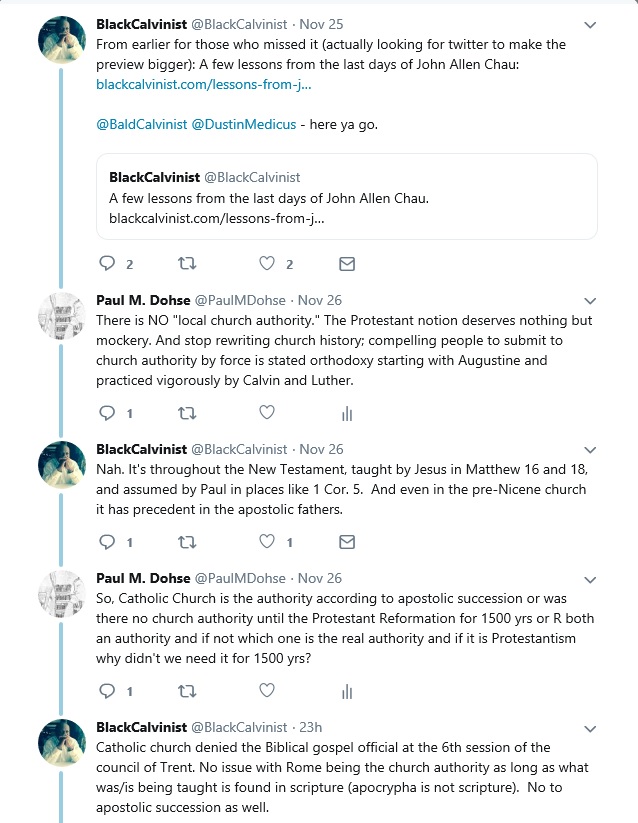
And per the usual, Protestants are apt in capitalizing on the efforts of goodhearted people to find a way out of a single perspective on the law from an emotional standpoint. The newest Protestant craze trending in the venue of missions is an altruistic approach to oversees missions. A good example of this is To All Tribes missionary society that was previously headed up by nut-job David Sitton. He was sent packing a couple of years ago for undisclosed reasons. While with TAT, he used to perform an initiation of sorts with its missionaries that involved a ceremony in an isolated area while he preached beside an open casket. The ceremony was an agreement that if the missionaries died in an isolated area fraught with various and sundry dangers, that no attempt would be made to recover their bodies.
Curiously, we find this same request by Chau in one of his letters prior to his endeavor to convert the Sentinelese people. Sitton published a highly acclaimed book among evangelicals titled, “Reckless Abandon.” Right, some sort of reckless abandon is needed to prove that your devotion to God is the real deal because the only thing you have to offer to God is an effort under law which according to Protestant orthodoxy is precarious to begin with. You can kinda obey God, but then again you can’t. You sorta obey God, but it’s really Jesus doing it…everything is kinda, you know, sorta, or in theological terms, a “paradox.” As Chau was paddling to the island to create a huge mess for many to cleanup afterwards, how could he know for sure that he was doing it for God’s glory or his own? He couldn’t, to know such is impossible under a single perspective on the law. Paul tells us in Romans 12 to outdo each other in love. Unfortunately, the institutional nature of church often encourages people to outdo each other in folklore; for God’s glory of course.
Being free to love with no fear of condemnation according to God-given reason is much better, and easier.
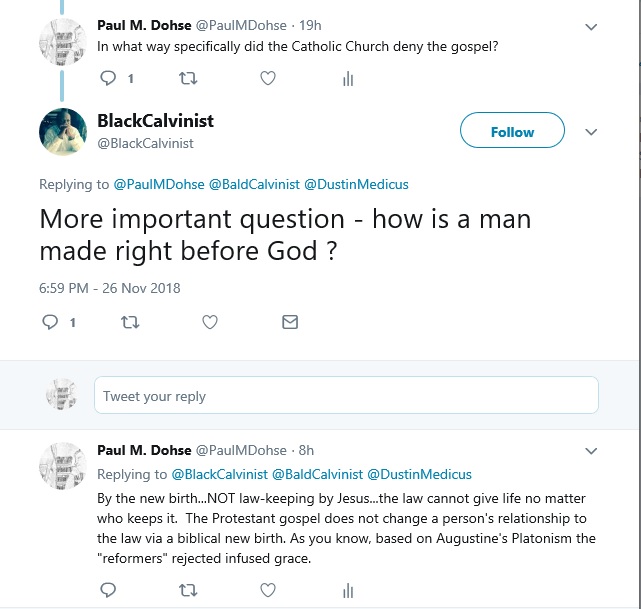
Moreover, what Chau was trying to do makes no sense according to church orthodoxy to begin with, other than the orthodoxy of “reckless abandon.” The Sentinelese people speak an unknown language. Communicating anything to them would be virtually impossible. Secondly, Protestantism is NOT a one-off, one-time, new birth, once saved always saved gospel. Protestantism is a progressive justification that requires church membership to remain saved through the “ordinary means of grace.” Since perfect law-keeping is justification’s standard, and no one can keep the law perfectly, and we therefore still sin against the law, Jesus’ ongoing double substitution must be re-applied for “present sin” which can only be applied through church membership. If you are a Protestant, I dare you to argue the point for I will merely read Luther and Calvin to you in order to immediately end the argument. So, what did Chau think was going to come of his endeavor even if it was successful? Church planting on North Sentinel? A formation of church authority through elders? What? Dude, what were you thinking?
Unfortunately, the thoughts of other Protestant men you trusted. And all along, you had more love for God than they will ever know. But this I am sure of: the day will come when such men will preach the true gospel of Justification by New Birth, NOT the false, irrational gospel of Justification by Faith.
paul
PS, Dear Father, thank you for the opportunity to write two articles about this awesome young man, and I look forward to meeting Him in our kingdom. Father, please, send many like him to preach the gospel of Justification by New Birth. And thank you for setting us free from the law of sin and death through our brother Jesus to serve under the Spirit’s law of love. We serve love, not fear. And our work is love, not a works righteousness that supposedly fulfills the law by substitution.
Amen.
Did John Chau Give His Life For a False Gospel?


You have probably heard about the young American adventurist and Christian missionary, John Chau, who was recently killed by natives on an isolated island near the coast of India. His first attempt to contact them for the purpose of sharing the gospel was met with a flurry of arrows which caused his retreat. Unfortunately, he made a second effort that did not turn out well.
His situation is indicative of problems I have had with church missionary endeavors for years even while I was devoted to church. As a former church pastor, I was always anti-foreign missions for a plethora of practical reasons.
First of all, as a former church pastor, it was evident that the American church didn’t have its own act together, so why would we be arrogant enough to think the rest of the world needs our brand of Christianity?
Secondly, the motives of most missionaries from my perspective was suspect at best. Most presented their mission construct from a personal interest or a lifelong dream to live in a particular region of the world.
Thirdly, vast amounts of money was spent for preparation before the mission ever started.
Fourthly, families had no break from ministry at all and no life apart from ministry. The missionary families barely knew each other. When they did get a furlough, the time was spent dragging their families all over the country to raise or keep support. Missionary children, consequently, and from my perspective, where just plain weird and maladjusted.
Fifthly, actual conversions on the missionary field were far and few in-between.
Sixthly, missionary endeavors were/are according to an institutional construct. Hence, missionary endeavors are limited to regions where the socioeconomics can support institutions, viz, “self-supporting churches,” complete with public buildings, and of course, an ability to support the missionary organization that supported the church planting effort to begin with.
Seventh, many of the missionary plans of action involved breaking foreign laws, which is problematic to begin with, but the way around that was to send the missionary over to the country under the false pretense of a special visa. I was never comfortable with that. But what made it ok? Well, but of course, church authority and the whole, “God’s law is higher than man’s law” and “We must obey God rather than man,” blah, blah, blah. On the one hand, God is all powerful and sovereign, and predetermines who is lost and saved, but on the other hand, we have to break foreign laws because though God is the author of all kinds of other evils in the world, certainly He is totally unwilling to accept laws that ban American missionaries. In elders meetings, I would actually say, “Wait a minute here, we are Calvinists. Is this not God’s way of shutting the gospel door on that country? Whatever happened to, ‘God will have mercy on whomever He will have mercy, et., etc., etc.'”
By the way, Indian law strictly forbids outsiders from visiting the island where Chau was killed, and those he paid to take him there are being prosecuted for being complicit in his murder. His endeavor was a horrible decision and a misadventure that will now have a negative effect on the lives of those who helped him. Which brings me to…
Eighth, in all of this missionary foolishness, missionaries are deemed to be a higher spiritual class among Christians and are often declared spiritual heroes for their foolishness. Stupidity is the gift of faith, and lawbreaking is fearing God more than man.
Ninth, as one who dealt with many, many missionaries, I can tell you, that for the most part, they are basically lazy and think they are spiritual elites that are above being among the working class.
Tenth, Protestant missionaries take the gospel of Justification by Faith with them which is a false gospel to begin with. That’s the only reason one needs to reject church missions to begin with.
This hits on an issue that is very close to home with me. My daughter who was a missionary to remote parts of Kenya for years is presently divorcing her missionary husband for reasons I will not get into here. Per the usual, and as illustrated by a pastor’s conference I went to in Kentucky, none of the pastors of their sending churches had a clue as to what the gospel is. This is the literal horror I lived with for years: the possibility that my daughter and grandchildren would be slaughtered in some third-world banana republic for a false gospel.
On one missionary trip to Kenya with another pastor, my son-in-law held a pastor’s conference where they taught the pastors over there how to do baptisms and the Lord’s Table. Yep, that would be the church’s “means of ordinary grace [read, salvation].” In other words, my family’s lives were being put at risk over progressive justification. Not good times. As I have shared in the past, I am not much of a prayer warrior. If I can fix something and get it done with the gifts the Lord has given me, I have a strong tendency to thank God for the gifts and not wait around to get something done. That was an exception, I did a lot of praying about that situation.
Don’t get me wrong, lots of Protestants are confused enough about Protestantism’s rejection of a literal new birth via Justification by Faith to be saved. While professing Justification by Faith according to pithy truisms, they function more according to an intuitive belief in Justification by New Birth. I trust this was the case with Chau as he seemed to be a free independent spirit though obviously cursed with deadly church ideas.
At any rate, I am sure we all agree that before we put our lives on the line, it should be for a true gospel that we thoroughly understand with our own minds. Once that is the case, missionary work is pretty simple. You go to the country as a legal citizen, you get a job, and you live among the people in a way that glorifies God. If they are drawn to your life and testimony, you break bread, pray, and share the apostle’s doctrine in someone’s home. Basically, you are making another family of God in another part of the world, not an authoritative institution that is an additional mediator other than Christ. You can point to Him alone, not some name brand.
paul
A Discussion About Church Discipline
It is well documented that church discipline no longer addresses congregants behaving badly but instead parishioners questioning the “authority” of a church’s leadership while decadent behavior among the congregants and leaders alike is ignored.
~ Andy
This realization was the straw that broke this camel’s back. 8 years out of the institution now – HalleluYah!
Absolutely. And here was another shocker for me: church discipline is not for public misbehaviors of the baser sort, but rather for ANYTHING that the elders deem, “sin.” The other shocker: church discipline, according to church orthodoxy, is a declaration by the elders concerning one’s salvific status that heaven will bind. You are not only declared an unbeliever, YOU ARE AN UNBELIEVER while under church discipline. Yet another shocker: church membership equals church discipline on different levels. A member in “good standing” is under “instructive discipline” as in “raise up your children in the way they should go.” If a member doesn’t follow the “instructive discipline” they fall under “corrective discipline” and ultimately, if necessary, “redemptive discipline.” Any kind of counseling is considered corrective discipline, so, many, when they seek pastoral counseling, are unwittingly bumping themselves up to the next level. Furthermore, the information gathered in counseling is often used for the redemptive discipline (excommunication). In regard to those who are living in open sin, but not questioning church authority over their salvation, well, we are all just sinners saved by grace anyway, right?
It took me a while to understand all of that even after we left the institution. I knew what I knew but couldn’t quite piece all of it together to make a lucid assertion. You and Andy actually helped me to do that very thing and I am grateful for it.
And we are still learning how it all fits together, and early on you suspect certain conclusions, but you hold off from drawing conclusions because of the absurdity of it. It’s awful tempting to write off Churchians as stupid nitwits but then I must remember that I fell for it for 30 years though I will give myself a little credit; I knew all along that something wasn’t right…something was off, but could never put my finger on it.
EXACTLY!!!
Nevertheless, do a survey of Churchians and you will find that 98% of them think church discipline is for those flaunting sin of the baser sort in public. There isn’t a cult in the world that can even hold a candle for Protestantism. At least Catholics are in the open about their church authority.
As you always point out, most in the institution do not know what the “leaders” actually mean. The same words and phrases are used by “clergy” but they are not saying what the “laity” thinks they are. I experienced this very early on in my church going. I did not understand why we weren’t living and acting (as a congregation) as if we were born again new creations. We kept hearing we are merely saved sinners; saved, being saved, and will be saved. I knew nothing of progressive justification back then, I just knew that what was being taught didn’t seem to reconcile with Holt Writ, but the “powers that be” were saying salvation so we must be speaking the same language? 2 denominations and 20 years and we finally left the institution for exactly what Andy posted in his OP.
Yes, we didn’t know why, but the what becomes enough to know something is seriously defective…we will figure out the why from a safe distance.

 Paul's Passing Thoughts
8 comments