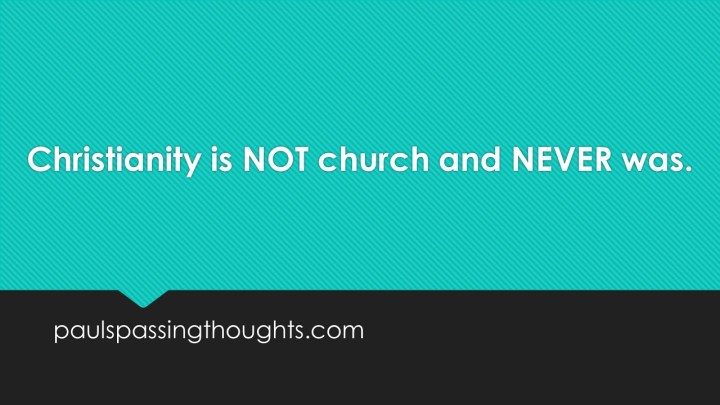
Julie Roys is the Classic Example of a Confused Churchian
 Julie Roys, like many others, is out to save the church from the evils of TGC and T4G etc. However, TGC and T4G are the church. A recent article by Roys reflects the overall confusion and cognitive dissonance of those trying to save the church. They should try to save American Christianity instead.
Roys is the classic example of a confused Churchian. Church orthodoxy shares the exact same presuppositions about mankind as Socialism. Both are predicated on the total inability of man and man’s need to be ruled over by those with superior knowledge. Roys will write an article like this, and then go to church this Sunday and listen to a sermon about her total depravity. Of course, the verbiage will probably be tempered with words like “sinner” etc. Orthodoxy makes the issue about the great unwashed and their lack of knowledge concerning the spiritual while socialists make the issue about the material; so what? In both cases, it’s about the total inability of the individual. Roys represents the hybrid between Americanism and orthodoxy that took place after the American Revolution but is presently on life support. All of the outcry about TGC, T4G, etc. flows from a lack of understanding that the church is returning to its original authentic orthodoxy at breakneck speed.
Something great could emerge from the ashes if Churchians would simply admit that they bought into the traditions of men rather than a grammatical understanding of the Bible. Clearly, the Churchian understanding of the Bible comes from what parishioners are told at church, not what they have read and understood for themselves. Obviously, few want to humble themselves and admit they bought into what they were told all of their lives. For me, it wasn’t hard because 6 months after becoming a Christian and joining a church I knew something was fundamentally wrong with church but I could never figure it out. I stayed committed to church, even as a pastor, because it was the only Christian venue that seemed viable, but I always prayed that God would show me the truth someday, and that prayer was answered.
Per the usual on church stuff, the answer is too simple to grasp and is hiding in plain sight. Church is a lie and a false gospel. The ekklesia was never an institution and was never meant to be an institution. Where Christians should go from here is fairly simple: it’s the difference between family and institution. While Roys points out the laziness, hypocrisy, theft, and overall decadence of socialist leaders, her blindness to the same mentality among America’s spiritual leaders is stunning. In her mind, like many others, this mentality among church leaders is all about a few bad apples. Really? I was a pastor once in the institutional church and I will tell you that pastors are among the laziest people I have ever met in my life. Leaders of the TGC and T4G live lives of splendor and their reported incomes should give people pause in regard to commonsense. While the laity, and nothing but the laity makes everything they do possible, parishioners are given little or no say about anything and are brought up on church discipline if they dare question the “authority” of church leaders.
Furthermore, leaders demand a higher and higher temple tax (“tithes and offerings” wink, wink) and berate parishioners if they don’t pony up. Ironically, failure to cough up what the church leaders say they need is blamed on “materialism” and “worshipping the American dream rather than Christ.” Like so many Churchians, Roys is confused; church is not Christianity. Because of the tradition that Churchians have been indoctrinated with, they actually find such a statement shocking and absurd. That’s why the church will eventually look like the description we see in the book of Revelation: Socialism and tyranny on steroids.
paul
Related links:
Death: God’s Archenemy
Life has taught me some things about death. When I lost my grandmother some years ago, I found that I was unable to accept it. So, I pondered the situation and came to a conclusion: it is ok not to accept death in general or the death of someone close to you; because God doesn’t accept death either. Death is not OK with God; he hates it, and according to the Bible, it is the “last enemy that will be defeated.” When someone close to you dies, a piece of you goes with them; you will now have to find your new normal. You are now less than you were; you must re-calibrate, that’s just the way it is. Death is always a metaphysical subtraction from life.
Death is not a part of life; that’s a bunch of baloney.
There are not worse things in life than death; that’s a bunch of baloney also.
I have seen people in conditions that are so bad that you couldn’t even begin to imagine what it would be like; yet, they hang on to life anyway. Why? According to their testimonies, they are afraid to die. I know people who have a very limited life but want to make the best of what they have, and my career is all about helping them to do that. As long as they are in the fight, I am in it with them.
People hang on to life in hope that they will find some peace about death. They hope they will find definitive answers about death that will enable them to travel through that gate. In our culture that’s difficult because of propaganda spread by those who sell salvation. In geographies where people live from hand to mouth, you can always count on the following: popes, pastors, and self proclaimed apostles are living in splendor. Salvation is big business. What will a peasant pay to save their soul? Everything, including their last penny for one meal.
One of the biggest selling points of religion follows: the church is a sanctuary city from an angry God who wants to punish you in hell for every sin you ever committed. Our view of God and our perception of him is almost helplessly distorted. Christ is presented as a second God of grace that saves us from a God of wrath. This is behind the Christo-centric theology of the church which presents itself as the “under-shepherd” of Christ. The church sells the idea that individual reason and logic cannot understand reality; hence, what we read in our Bibles contradicts what we hear in church, and the result is total confusion about who God is.
Fear of death is compounded because of confusion about God. Fear is the church’s primary selling point. John Calvin and Martin Luther said so.
Hebrews Chapter 2:
Now when it says “all things,” it means nothing is left out. But we have not yet seen all things put under their authority [that is, angels]. 9What we do see is Jesus, who for a little while was given a position “a little lower than the angels”; and because he suffered death for us [“pas” means “all” viz, he suffered death for all], he is now “crowned with glory and honor.” Yes, by God’s grace [love], Jesus tasted death for everyone. 10God, for whom and through whom everything was made, chose to bring many children into glory. And it was only right that he should make Jesus, through his suffering, a perfect leader, fit to bring them into their salvation.
11So now Jesus and the ones he makes holy have the same Father. That is why Jesus is not ashamed to call them his brothers and sisters. 12For he said to God,
“I will proclaim your name to my brothers and sisters.
I will praise you among your assembled people.”
13He also said,
“I will put my trust in him,”
that is, “I and the children God has given me.”
14Because God’s children are human beings—made of flesh and blood—the Son also became flesh and blood. For only as a human being could he die, and only by dying could he break the power of the devil, who had [past tense] the power of death. 15Only in this way could he set free all who have lived their lives as slaves to the fear of dying.
16We also know that the Son did not come to help angels; he came to help the descendants of Abraham. 17Therefore, it was necessary for him to be made in every respect like us, his brothers and sisters, so that he could be our merciful and faithful High Priest before God. Then he could offer a sacrifice [ONE] that would take away [not cover, or temporarily take away] the sins of the people. 18Since he himself has gone through suffering and testing, he is able to help us when we are being tested.
NLT [My comments in brackets].
In the Bible; sin, fear, and death are synonymous. If one is still under sin, they are still in slavery to the fear of death. Note, in this passage, that the only thing that frees us from the slavery of fear is Christ’s death…period. Christ’s death makes it possible for us to be God’s literal children, and Christ’s brothers and sisters. We become literal family members of God. Christ went before us to free us from the fear of death.
Note what is missing here: Christ’s imputation of perfect law-keeping. If that is necessary, we are necessarily still under the slavery of fear and death. Perfect law-keeping, no matter who keeps it, is not what frees us from death’s slavery, only kinship does.
Without fear of death, religion has no product to sell, and there are other things that are very bad for business as well: the idea that God wants to save everyone; the idea that people are able to choose God to be free from the slavery of fear, the doctrine of the Rapture, and the idea that God hates death and gave his only Son to vanquish it from reality forever.
The stakes of life are highest in regard to the death issue, and reason’s logical conclusions regarding death and God are the only things that will assure us, and…
…that’s bad for business as well.
paul
Is Church a Cult? The Answer Goes Beyond the Fury Question: Part 14

Subject: Some more questions
What is a cult to you? How do you feel about Harry Potter, DND, Pokemon and harmless stuff like that? What other sects and cults have you looked into? How does one find truth?
Also, I have been reading Religious Tyranny case study. I find it interesting I’m definitely going to check out some of your books. When you publish the Furry stuff will it just be the blog or will it include more information? Will paperback be available or just digital?
Answer:
Very good questions that I will continue to share with our readers. A cult is any person or movement that combines authority with religion. When any religion states that they have been granted authority by God…that’s a cult. Cults came into being after the American Revolution. Why? Because prior to the American Revolution, we had church states. Church states are not cults. Yes, church states combine authority and religion, but it is an overt authority through state force. When the American Revolution put an end to the church state, the church had to use manipulation to control people and the kingdom of cults was born.
So, first, cults claim authority from God, and secondly, must use manipulation and deception to control people. And yes, as you have alluded to in prior emails, this makes the doctrine of hell suspect. Don’t get me wrong, I presently believe in the doctrine of hell, but because of the fear and control factor of it, I will be revisiting this doctrine. In fact, I am thinking about making it the subject of our yearly conference in 2020. At the very least, I believe we look at the doctrine of hell in the wrong way. Christ and the apostles didn’t emphasize it that much; actually, very little. Why? I consider myself a Pauline theologian, but I can only recall Paul writing about hell once. Considering the gravity of the doctrine, why is that?
So, a cult is the claim of authority from God and the use of deception and manipulation to control. Therefore, church is a cult. Between the first and third centuries, Christianity was a sect. Sects are both good and bad. A sect is a cooperative group unified by agreement on central ideas or beliefs and apart from mainstream tradition. This does not exclude agreed upon organization as well. When the most influential apostles died circa 66 AD, the huge debate of apostolic succession began. This was the idea that Christianity needed to be ruled over via a central hierarchy. At that time, a struggle began between the pagan-state and the apostolic successionists which became church (the institutionalization of Christianity). Religion had always been in bed with the state in the form of paganism. With the advent of church, a struggle ensued between the pagans and the church for Rome’s favor and the enforcement of orthodoxy by the state. That’s why the church set up shop in Rome because it was the epicenter of Roman power and influence. Yes, this is the beginning of the Catholic Church. In circa 350 AD, the church won against the pagans and the church state was born. The church state thrived until the American Revolution accordingly. So, the church first hijacked Christianity, became a church state, and is now a cult.
An In-depth look at the above can be found here:
https://www.academia.edu/17123936/From_Christ_s_Assembly_to_the_Institutional_Church_Part_1
And here:
https://www.academia.edu/17124061/From_Christ_s_Assembly_to_the_Institutional_Church_Part_2
One might ask why there is such an evident desire among people to control others. This is why I believe the Bible; it is the only work that gives answers to these kinds of questions. According to the Bible, control-lust is the essence of sin. A desire to control others drives sin. The Bible also states that sin uses condemnation to control others. So, those who are convinced that they are unworthy are going to let you control them, no? All you must do is convince them that they are “sinners” or “totally depraved”…no? But this also includes criticism by others. Sure, there is “constructive criticism,” but in most cases criticism is all about gaining control of others in some way. Primarily, Christ went to the cross to end condemnation and the subsequent enslavement to sin.
The Furry Fandom is therefore a sect and not a cult like church. However, the Fandom’s way of eliminating condemnation is to make everything acceptable, and the Bible states the following about that: it’s not love of self, God, or others. Due to the way we are created by God, all wellbeing comes from earned self-esteem, or a truthful evaluation of self. The Fandom skips all of that and becomes another being of their own making. Rather than being yourself and partaking in person-building, another identity is assumed using whatever building codes you feel like using. The one thing all Fursuiters readily admit follows: it’s escapism, but they frame it as some sort of virtuous escapism.
Another notation: according to the Bible, if one is not born again, sin is able to use the law to create desires that are against the law. The term “law” includes the Bible, the conscience, and the laws of nature. To answer your question on how truth is known, the Bible states that truth is intuitive, but sin creates desires within that refute that truth deliberately. Hence, what is plainly natural becomes a desire for unnatural things. The Bible addresses this in Romans chapters one and two.
Our research involves the above which includes many sects and cults. Our main focus is contemporary church trends like the New Calvinist movement. I wrote “The Truth About New Calvinism” in 2011. However, we have done a lot of research on world philosophy via our associate John Immel. My wife, Susan, another associate of this ministry has done extensive research on the Puritans. I wrote the book, “The Church Lie” with another TANC associate, Andy Young.
The Furry research will be in book form (perfect bind paperback).
The Furry Fandom Part 13: Inquiring Furries Want to Know
By Paul M. Dohse Editor/Author for TANC Publishing
I want to use this post to keep our readers up to speed: NO, we are nowhere near ending the series which will be turned into a published book. Lulls between parts are due to research which will include psychological studies that I have found. The Fandom has been officially classified as a personality disorder by some Psychologists and also associated with certain types of Bi-Polar disorders. Meanwhile, I received the following redacted inquiry via email by a Furry group. It reveals some more details about where the series is headed.
Received via email:
For the past couple of weeks, we in the group have been reading and going over the post. We find it to be a look into someone that has just discovered what a fandom is. We find it fascinating this is why I keep coming back and trying to get answers.
Our final questions are:
1) What is a contra reality? We think we got it but it is a weird term.
2) Is furry the first time you have ever encountered an internet community?
3) Why do you focus so heavily on the negatives and act like that is a general representation?
4) What are your opinions on other fan communities?
5) I have been asked to bring this up… Bronies
6) What makes furry different than any other online community?
7) Are you personally part of any subculture or fandom?
For us, things like subcultures, fandom, avatars, fake names, alternate identities are common online. Truthfully your post seems to be geared towards older people than younger people. It confused everyone under 35. Our chat wants to finish up the puzzle before we move on. Thank you for your time it has been fun and enlightening -Dub Mutt
PS. Would you happen to know of any good book on church history, the bible or Christianity?
Response:
- It’s an anti-reality. It deliberately rejects God’s order of things. It rejects natural revelation and poses a reality in contrast to God’s creation.
- Hardly. Our organization has researched several sects and cults over the years that are internet based.
- Because that’s how Fandom describes itself. We have only begun to research the group, but one upcoming post will address the Burned Fur Manifesto. This group was formed as far back as 2005 because, “Anthropomorphics fandom is being overrun by sexually dysfunctional, socially stunted and creatively bankrupt hacks and pervs” Note the word, “overrun” as far back as 2005.
- We research sects and cults that are driven by an ideology. Most “fan” organizations can rightly be considered mere hobbies. We make our case extensively in the posts thus far as to why Fandom is not a hobby.
- There are KEY differences between the two groups which is going to make a good post. The contrast serves to expose Furry Fandom for what it really is.
- See #5.
- NO
PS. Yes, a book I published with Andy Young titled: “The Church Lie and the Biblical Alternative.” Go to tanc.online and either purchase it or read it online for free.

 Paul's Passing Thoughts
leave a comment