The Church Lie: The 11 Theses Review #4
As I see what is trending in Churchland of late, I find myself interrupting my busy schedule to write an article or post a video because it oftentimes is just too rich to pass up. However, in every case, in the back of my mind, I am saying, “That’s chapter…in the book.” The book is meant to be very comprehensive, and what we missed will be included in the next addition. Therefore, I will be conducting a reading with commentary of our new book. Hope you can join me.
The Church lie 11 Theses Channel
The Church Lie: The 11 Theses Review #3
As I see what is trending in Churchland of late, I find myself interrupting my busy schedule to write an article or post a video because it oftentimes is just too rich to pass up. However, in every case, in the back of my mind, I am saying, “That’s chapter…in the book.” The book is meant to be very comprehensive, and what we missed will be included in the next addition. Therefore, I will be conducting a reading with commentary of our new book. Hope you can join me.
The Church Lie 11 Theses Channel
The History of Western Philosophy and Its Societal Impact on the Church – Part 1
The following is part one of an eight-part series.
~ Edited by Andy Young
| Click here for part two Click here for part three Click here for part four |
Click here for part five Click here for part six Click here for part seven Click here for part eight |
 We have actually talked many times before about the challenges before us. I understand our obsession. The scope of this issue is vast. It seems a little conspiratorial and a little overwhelming to put it in those terms. When we start talking about Plato and him being a pagan and what John Calvin preached, it starts to come off as if we’re trying to find the boogie man in bad places.
While our challenge is lofty, it is much more personal, because our challenge deals with what happens in the pews. You show up at church, you hear doctrine, you get some people that shake your hand and look longingly into your eyes and say, “you belong.” That is hard to resist. Most people go to church because their kids have a place to stay, or they like the music, and they genuinely like the people. But that’s not where it ends. It is personal because at some point you may have ended up on the wrong side of the pastors. Something happens, it doesn’t matter what, but originally you have been told that you are part of this grand party, and then you find yourself under scrutiny, and suddenly the marketing and packaging is all wrong. You thought you were right to object or to challenge or to just be you, and one day that just was no longer so.
The problem that you have is that you look at your Bible and show supporting references for your objection, but you are told that’s not what that really says, and it really doesn’t matter because you should be submitting to some authority. Suddenly, you look around and life is now insane. All those people that hugged you and said “ye, verily, we are glad you are with us,” have now turned on you in less than a minute. All those friends you had, where’d they go? They have no interest in what you have to say. And the crazy part is the more you try to justify or to explain your position, the worse it gets. Without fail they accuse you of being “defensive”, and of course only “defensive” people are sinners. If you were really humble you wouldn’t dare walk down this line of self-defense.
You look around and you are bewildered. After you wade through the thousand and one emotions that have come out of you in ways that you could not have begun to fathom, you stand back incredulous and wonder, what the heck just happened? “God’s church is not supposed to be this way,” we tell ourselves. And yet here we are, dead square in the middle of a conflict that is almost unintelligible.
Of course these types of experiences within Christianity have been going on for generations. But in our modern age of blogs and the internet, we now have the ability to start comparing notes. Individuals are suddenly able to tell their story about what happened to them, and somebody else will read that and affirm those experiences with their own. As the solidarity among hurt and abused individuals grew, one day we stopped and said, wait a minute, there is a systemic problem here.
This is where we sit within Christianity today. We know we have a conflict, but we haven’t been able to identify the problem. The explanations run the gamut from:
“Doctrines of men” – Well, all doctrines are doctrines of men. God does not come down here, stand up in the public square and start talking. It’s all doctrines of men. Everybody is standing around all the time talking about the content of what they think and proclaiming that in general to the masses. What they really mean is it’s not authentic. If it were true doctrine we wouldn’t have a problem.
“God is testing you” – This one is fabulous. Basically what you are saying is the manifestation of reality is God’s intent. So why then are you seeking to solve the problem? This is how God means it to be.
“All churches have problems” – This a neo reformed classic. They like to pretend that people fussing over the color of the carpet is somehow the same thing as a child being molested and the pastor covering it up and refusing to let the parents go to the authorities. As if there is a moral equivalency.
“We’re all just sinners” – The tried and true “get out of jail free” card. We can’t really fuss and moan about the fact that somebody’s done bad things.
“It’s a failure of ‘polity’” – If you had the right government structure then these bad things wouldn’t happen because we’d have checks and balances, and of course Christians have come to believe that the nature of checks and balances is really designed to restrain our sinful appetites and desires, and so that’s what would make a better government structure that would prevent these bad things from happening, never once realizing that all governments are always in service to a series of values. And so it doesn’t matter the structure you put in place, at the end of the day, if you have the same values, you will continue to govern towards those values.
“If we just had the right people” – Which is ironic considering we assume the problem is the doctrines of men. By definition, if we’re just looking for the right person, what we’re really saying is there is an idealized person out there who somehow magically gets it all right and finally gets to come down from Mt. Sinai and tell us the truth. Well, that’s nutty, because that never works.
The one thing we never challenge is the doctrine itself. There is something wrong with that picture.
Some of you have experienced this tumult. You started looking for answers, and you’ve heard all of these points belabored in endless cycles – if we loved more, if we prayed more, if we prayed louder, if we prayed quieter. Finally you heard somebody say, “No, it’s not any of that. It is the doctrine.” You heard a man named Paul Dohse say, “No, it’s the doctrine.” You heard a guy by the name of John Immel say, “No, it’s the doctrine.” That’s the problem.
And it’s not just a problem. It is EVIL!
That one is a big one for a lot of people, because they want to sustain some kind of moral equivalency between doctrines, as if to say, well, it’s got some good ideas, but, you know, there are some things here that are good, and these guys aren’t all bad from top to bottom. And so we want to parse it out. We don’t want to take a position on the content of what they teach. The doctrine is evil. It is fundamentally and substantively hostile to human existence.
But this leads people to a serious problem. If it is the doctrine, if Calvinism is error, [gasp!] how can that be so? It’s orthodoxy. This is what the church has believed for 500 years, or at least the Protestant church. We would like to pretend that we’re different from the Catholics, but hey, how can you debate orthodoxy? Reformed theology is sacred. John Calvin and Martin Luther, are you kidding? They are at the base of God’s left hand, right beside Peter, James, and the other guys. How can you possibly begin to challenge who these guys are? The reformation, my goodness, if it hadn’t been for those guys we’d all still be Catholics. And those dastardly Catholics, my goodness, they’re just corrupt, and the Pope is of the devil.
Anybody ever heard that before?
Then you have to ask yourself, if that is the problem, if the Reformation is not what we’ve all been told that it is, and the people at the top of the intellectual food chain are not who we’ve been told they are, then we have to ask the really hard question; why has this happened?
Here is my challenge to you. Take a look in the mirror. You are the reason this happens. It isn’t any more complicated than that. Now you might say to me, but isn’t that what everybody else has told me? Everybody else told me that I was a sinner and that I was the reason there was this conflict. Yes, but this isn’t for the same reason.
To understand what really happened we need to start at the beginning. But before we can start that the beginning, people must take responsibility for the content of their own mind. I will bet money that very few people have ever heard a preacher say that before. A preacher might tell you to “think”, but maybe not so much. Here’s the thing. Paul and Susan Dohse and I can detail for you the list of doctrinal failures. We can detail all of the root issues and all of the spiritual manipulations. I have been thinking about these issues for almost twenty years of my life, so I have the ability to do this. But until you personally are committed to the content of your own mind, your own life, and your own purpose, nothing I say here will matter.
Here is why.
 At the end of the day, if you’re not willing to take responsibility for the content of your own mind, your worldview exempts you from everything that comes after that. You have capitulated. You have tossed up your hands and said, oh well, it’s not that big of a deal. At some point you’ll let your brain go tilt, you’ll shrug at the complexity of the world, and toss up your hands in surrender, and insist that Jesus’ message is just simple. All this “brainy” stuff is just added torture for your peaceful soul.
This sounds like a “churchy” answer. You will console yourself for a while, evading the reality that you are letting other men fill the blanks of your own mind. Eventually you will find someone else that will take up the cause of organizing your life yet once again. And not too long after that you will be confronted with the very same spiritual tyranny, the very same social conflicts, the very same church dynamic.
But maybe this time it’s worse. And maybe this time, the spiritual/church tyranny is actually joined with political power. Somehow the guy in front of the pulpit managed to get himself elected to office. And now, not only does he have a body of doctrine, but he has guns.
In Christianity we have failed to understand that government is force. Polity is force. When people start talking government, when people start talking about passing laws, what they are really saying that what they are entitled to do is force you, to compel you, to bring violence against you to bring a desired outcome. And then tyranny will have been joined with political power. And liberty will be dying under its assault.
What will you do then?
The options are very limited because you have already abandoned self-directed thinking. The only thing left will be a wail and a tumult of gnashing of teeth that men are just sinners and who can save us? You will toss up your hands in despair, retreat into some church where the intellectual barricades rule over the doors and you can fortify against the evil.
This all sounds very grim. That course of non-action is a dead end, and it has only one outcome. And that outcome is, you deserve what you get.
You are the reason tyranny happens, from top to bottom, throughout history. Not because you are a wretched old sinner who fails to submit to authority. The reason your interpersonal church relational problems happen is because you refuse to reason, because you refuse to be an independent mind, because you refuse to be an individual.
Now, how many people does that statement make nervous?
How many of you cringe at the notion that you should be more individualistic? How many of you think that having “ego” is deviant sin? How many of you equate being individualistic with “selfish”. How many of you equate selfishness with the greatest expression of moral failing?
 What if I told you that your reaction to self and “selfishness” and individuality and ego is by design? What if I told you that despots and tyrants throughout history the world over have specifically set out to persuade all of humanity that the problem is always the individual, and the only solution to the problem is sacrifice?
Disturbing thought, right?
So now we get to think. I need to bring you up to speed on some basic thoughts that most people have never heard before.
The Gospel According to John Immel, chapter 3:1-3
- All people act logically from their assumptions.
- It does not matter how inconsistent the ideas or insane the rationale. They will act until that logic is fulfilled.
- Therefore, when you see masses of people taking the same destructive actions, if you find the assumptions, you will find the cause.
Here is the underlying logic.
Verse 1 – Assumption + logic = action.
Verse 2 – Faulty logic, erroneous rationalizations, are still ideas that flow from one to the next, until they get to an outcome. That’s important. Just because something is “rational” doesn’t mean it’s not wrong.
Verse 3 – Mass action + destructive outcomes = common premise.
I want you to see the specific relationship between actions and ideas. I submit that man, as a rational, cognitive being, is specifically designed to operate from this standard. What makes man utterly unique in the world is his ability to cognitively and rationally approach the world. He is the only creature that does not automatically by nature adapt to an environment. The exact opposite is true. Man must adapt his environment to himself, and the only way he does that is by reason.
Once you understand that the nature of man’s existence requires him to integrate ideas, then it becomes amazingly simple to understand that the integration of ideas is what he is always after. He’s always trying to figure out how to take his ideas and put them together.
Unfortunately, most people have a big basket in their head, and they toss in this idea and that idea, and they shake it all up, and from time to time they will pull an idea out of this basket and decide, this is a good idea, and then they will act on it. It gets a little dangerous when they start pulling out two or three ideas. It doesn’t matter if they are mutually exclusive, they will try to force them together. They then look at the world, and it still makes no sense to them. Never once has it occurred to them to go back and check their premise; what is your assumption?
This study is called philosophy. Of course when I say “philosophy” in the context of Christians they immediately think of Paul’s major condemnation of “vain philosophies”, and they start to tune out because they think they have an intellectual “get out of thinking free” card.
Disciplines of Philosophy
– Metaphysics
– Epistemology
– Ethics
– Politics
These four studies drive all of human existence. The nature of existence is called metaphysics. How we know what we know is called epistemology. How we value what we know is called ethics. And how we interact with people is called politics.
Each of these disciplines of philosophy is a function of the previous one, forming a progression of thought. What you assume about man’s existence will ultimately impact what you believe man can know. What you believe man can know will ultimately impact how you think he should ethically act. How you think man should ethically act will ultimately form your government structure.
We can debate endlessly about the issues that create the problems within the church or fixing those problems with the right government structure, but government structure is always in service to ideas. This is the reason why. Politics is at the end of a philosophical progression of thought that begins with a metaphysical assumption.
Philosophy is the broad study of how man integrates his ideas. It is how we know what we know. It is where ideas come from, their objective value, and how those ideas impact our human interaction. With this in mind, you can grasp the implication of what I’m saying in the Gospel According to John Immel:
The Gospel According to John Immel, chapter 3:1-3
- All people act logically from their assumptions.
- It does not matter how inconsistent the ideas or insane the rationale. They will act until that logic is fulfilled.
- Therefore, when you see masses of people taking the same destructive actions, if you find the assumptions, you will find the cause.
This is why when you go to church you end up in the exact same spot. You find masses of people taking the same action. If you find their assumption, the roots of their ideas, you will find the cause of their actions.
So my goal last year at the 2012 TANC Conference was to introduce the systemic nature of human thought; to illustrate how this system dynamic impacts human action. Without this mindset it is almost impossible to understand what is happening. To be sure, without this intellectual tool, no specific doctrinal discussion will matter. It won’t matter how much we dissect sanctification, justification, and the centrality of the cross. It won’t matter how many scriptures we stack up in service to our pet doctrines. It won’t matter how much we rail against misplaced church government.
Ladies and gentlemen, that has been done over and over, council after council, synod after synod, internecine fight after internecine fight. And yet the church is a slow-motion train wreck of tyranny and counter-revolution. If you make even a cursory study of the evolution of Christianity from the mid-second century to about 1200 it is a laundry list of bloodshed and tyranny and counter-revolution.
To put this into “church speak”, church history is an endless cycle between legalism and revival. Revival in this instance is nothing more than the return of life, to revive what is actually dying, and the body politic continues to die because it keeps cycling through these same tyrannical ideas. But we have never broken out of the cycle because we have never understood the method underlying the madness.
“All men can see the tactics whereby I conquer, but what they cannot see is the strategy out of which victory has evolved.” ~ Sun Tzu, The Art of War
The tyrants and the mystic despots of the ages have been winning because we have never once challenged their assumptions. In the 21st century we are once again rolling through a philosophical cycle that has repeated itself over and over in history. This cycle is of course why Christians are living through ever-increasing manifestations of abuse.
People are confronted with the same tyranny that our forefathers set out to resist. As of now, the only real response has been to toss up our hands and look mystified at the stars. We know we are impotent. We remain impotent, caught in the cycle of doctrinal fight, church splits, and human tragedy. All we can do is wail about human depravity and mumble feebly about needing more faith. Pray harder. Sacrifice more.
Blah, blah, blah.
I tell you the truth, the answer to why this is happening is as easy to diagnose as the common cold. But the first thing we must do is dare to take responsibility for the content of our own minds. Mystic despots have ruled the world with portents of disaster for anyone with the ambition to live life beyond the substantive, beyond the mediocre.
Here’s where you come in. Autocrats rely on being able to compel outcomes because no one opposes their ideas. Tyrants only succeed when men refuse to think.
In then next session we are going to learn how tyrants have been so successful at waging war against liberty. Put on your thinking caps. We’re about to jump into the deep end of the pool.
~ John
| Click here for part two Click here for part three Click here for part four |
Click here for part five Click here for part six Click here for part seven Click here for part eight |
Houston, We Have A Problem…
This article was prompted by a reader’s comment on a recently published article here at PPT. The comment follows:
“I was always taught that per 1 John 1:9 all Christians are to confess their sins to God on a regular basis. How does that fit in with your studies? If we are no longer able to sin because we aren’t under the Law then how does that passage make sense? You have alluded to the fact that we believers still don’t love perfectly and still do things that are forbidden under the Law. Do we still need to confess our sins regularly to maintain a right relationship with God?”
This is an excellent question and one that bears addressing. The reader brings up a valid point. I have often addressed this question in the past with other people in various forms of social media with varying degrees of success; success being determined by how much that person clung to church orthodoxy being the authority that determined his version of truth for reality. But I don’t think I have ever addressed the question in an actual blog post.
First, I think we have to acknowledge that if we take 1 John 1:9 alone without any supporting context we have an immediate problem because we have a glaring contradiction with 1 John 3:9:
“If we confess our sins, he is faithful and just to forgive us our sins, and to cleanse us from all unrighteousness.” ~ 1 John 1:9
“Whosoever is born of God doth not commit sin; for his seed remaineth in him: and he cannot sin, because he is born of God.” ~ 1 John 3:9
Contradictions (paradox,”mystery”) occur whenever we have incompatible assumptions. The way church orthodoxy handles this contradiction is to re-interpret 1:John 3:9 and insert the word “practice” which is not the word used in the manuscript.
“No one born of God makes a practice of sinning, for God’s seed abides in him, and he cannot keep on sinning because he has been born of God.” ~ 1 John 3:9 (ESV)
Notice that because of the church’s orthodox assumption of righteousness by perfect law-keeping, the ESV interpretation holds out the possibility for believers to keep sinning and thus the need for continual forgiveness of present sin as referenced in 1 John 1:9. I have written a comprehensive article on this subject here.
But the proper way to handle contradictions such as this one is to evaluate our assumptions and determine which one is false. Whenever we are evaluating passages of scripture there are a few things we need to take into consideration:
- The immediate context of the passage
- The overall historical context during which time the passage was written
- To whom it was written
- Grammatical structure.
While John is writing to believers, he is addressing a larger issue, specifically, a sect of gnosticism that had made its way into the assemblies by some false teachers. This particular brand of gnosticism divided man into spirit and flesh and that any time man “sinned” he only did so in his flesh, but his spirit was unaffected. 1 John 1:9 is only part of a larger argument John is making to refute this idea. Paul addressed this historical context in this series of articles beginning here.
Click to view larger image
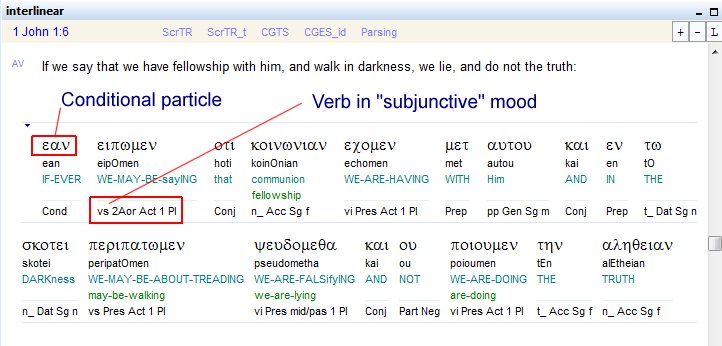
The apostle John is actually presenting a series of rhetorical arguments against this brand of gnosticsm. A close inspection of the grammatical structure of verses 6 through 10 reveal the hypothetical nature of his arguments. At right, here is a screen shot from my interlinear Bible software.
Notice that in the Greek, verse 6 begins with the conditional word “εαν” and the accompanying verb in the “subjunctive mood.” You don’t need to know the technical details of all this, but what is important to know is that this structure is called a 3rd Class Condition. In Greek, 3rd class conditions are used to present rhetorical or hypothetical arguments.
Click to view larger
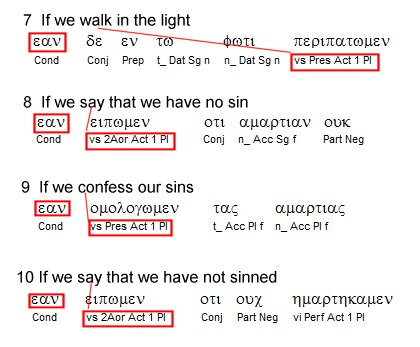
If you look at the grammatical structure of verses 6 through 10 you will see they all begin with this same structure for a 3rd class condition.
So in this case, verses 6 through 10 deal with true biblical JUSTIFICATION set against the gnostic idea of justification. John is not saying that this is something that believers need to do all the time. He is not stating that this is the present state of believers. In other words, “we” is not a reference to believers but rather “we” in a general, non-specific sense. He is showing why the gnostic idea of justification is false, and he is doing so in a very methodical, logical argument using these five rhetorical statements.
Understood in this context, this passage no longer contradicts 1 John 3:9. Having presented the need for justification and how it compares to gnostic doctrine, John goes on to make the case that believers are justified because they have been born again. John understood that because the new creature is God’s offspring, righteousness is not a matter of sinning or not (ie. Law). Righteousness is a state of being by virtue of the fact that they are born of God! Sin has to do with condemnation. Believers don’t “sin” because they are no longer under the law’s condemnation. Where there is no law there is no sin.
~ Andy
Church Historian, John Immel: Morality, Mysticism, Savagery and Salvation.
The following is in response to the Ben Shapiro/John MacArthur interview video that TANC Ministries reviewed on December 16, 2018
There is so much in this interview that requires an in-depth treatment. I’ve had a half dozen articles dancing around my head over the last few weeks, each of them threatening to eat a hole in my brain, so finally I decided to start writing them in no particular order. This isn’t the first part, but it is a part of my ongoing criticism of Ben Shapiro’s interview with John Macarthur December 2nd, 2018.
At around the 9 minute 30 second mark is the following exchange.
Ben’s questions: (summarized) Has it been a mistake to see the president as a moral figure whose job it is to build/uphold societal moral fabric? Are you saying that it is our job in communities to build the social fabric and let the president shape policy?
Johnny Mac: “Yeah, and look, you can’t blame him for the complete destruction of the family. He had nothing to do with that. That’s why the fabric’s coming apart.”
It would have been vogue and cowardly to lump the whole of America’s moral failings on Donald Trump. Indeed Judeo/Christian twitchyness over sexual practice makes him an easy whipping boy. But of the few good things John MacArthur said in this interview, the refusal to dump western culture’s moral decline on President Trump is correct.
Of course Ben Shapiro is morally twitchy as revealed by his litmus test of sexual propriety–e.g. don’t have sex with porn stars.
Whatever one thinks of having sex with porn stars, and marrying more than one wife, and locker room talk on an Access Hollywood video, the root of Ben’s moral superiority is as nonsensical as saying Jews can’t be podcasters in the 21st century because the Pythagoreans in the 7th century BC forbade people to eat beans. It is nonsensical precisely because the question of WHOSE moral standard men are obligated to follow is imbedded in the whims of the gods.
Barack Obama didn’t screw around with porn stars, had only one wife, and there are no Access Hollywood videos with him saying how he would like to grab a woman between the legs. Does that make him a paragon of virtue and “qualified” to stem American moral decline? Or the better question, does President Obama’s obvious muslim leanings mean that advancing Islamic morality was EXACTLY what he was supposed to do? I mean, if the President’s job is to build/uphold social fabric then the mystical source of that social fabric is irrelevant right?
Yeah huh? How does that Islamic “moral” expectation work out for an Orthodox Jew?
Ben, maybe you should go ask Linda Sarsour what she thinks of that moral standard or . . . just study some history. Even a casual review of European history details what happens to Jews under that mystical moral framework.
And speaking of history and mystical moral frameworks, Johnny Mac trots down the path in an effort prove his thesis on the causes of America’s moral decline.
Johnny Mac:
You know when you think about how God looks at this or any Society, the default position of humanity is brutally corrupt.
I mean, you read The Bloodlands, so between Soviet Russia and Germany between the late 1930s and 45 and 13 million people are killed, none in a military uniform, none in a war. 13 million people were massacred by Russians and Germans in those brief years. That is a testimony to what will happen to people when evil is not restrained.
I assume the book that Johnny Mac mentions is The Bloodlands: Europe Between Hitler and Stalin written by Timothy Snyder, detailing the slaughter in Poland, Ukraine, Belarus, Russia and the Baltic states.
The real number of people killed during those years is probably lost because after WWII the “winners” of the war delivered 2/3rds of the world’s population to a brutally corrupt socialist dictatorship. The Soviet Union rewrote history and therefore the death count with impunity. But 13 million is sufficiently large for us to know that what happened there was really, really, bad. However, I want you to understand the actual number (13 Million +/-) is not specifically important. In this instance Johnny Mac is using lots and lots of murder as the proof of human “brutal corruption.” But Johnny Mac gives the exact same judgment as the explanation for one guy in a car driving through a protest in Charlottesville NC, August 20, 2017. And the number there was well below 13 million.
https://www.youtube.com/watch?v=gm3U39lnPO0
See, 13 million and a half dozen are on the same moral par because John Macarthur is trying to use an object lesson to validate his foundational metaphysical assumption: Man is brutally corrupt. Or as he said in the video above. . .
“The human heart is desperately wicked,” he began. “And the human heart is hostile, towards God and self-centered, and proud, and selfish and angry. What Charlottesville simply demonstrates is that fallen humanity is corrupt. All I see in that is the justification of anger.”
Johnny Mac’s overt logic = This (specific) bad thing happened because Man (generally) is morally depraved: selfish, self-seeking, and doesn’t like God very much.
The problem is that his “proof” of human depravity is a narrow generalization that begs the premise: Lots of murder = brutal corruption = human depravity = lots of murder = brutal corruption. Or said another way: his explanation is nonsensical, and it is time for someone to call BS.
I understand why people struggle to challenge the presumption. In western culture the doctrine of Pervasive Depravity has been burned into our minds as a metaphysical given. So most people are quick to scrub through their soul looking for “moral failing” and then extrapolate that internal “evil” as proof of Johnny Mac’s doctrine. It is as if our individual stray moral infractions mean we are a hair’s breadth away from slaughtering the population of Rhode Island.
Beyond the fact that thinking about stealing a pack of gum is at no point the slippery slope to genocide, anyone exercising an ounce of independent thinking would rightly ask: “If human depravity (generally) is the cause of mass slaughter, then how come mass slaughter isn’t the norm in western culture?”
If Johnny Mac is right then Charlottesville should have looked like Death Race 2000. For that matter, every city, every burg, every village, where two human beings reside should be a cauldron of violence. And The Bloodlands would be everywhere, all the time, with (God’s appointed) dictators stacking up the bodies like cordwood.
Right?
But let’s dig deeper into our own psychies to test the pervasive depravity metaphysic.
Do you recoil at the thought of mass destruction?
Yes?
Riddle me this: How come?
If you are pervasively depraved, in accord with the historic doctrine, to which many of you still claim “spiritual” solidarity, how then are you opposed to someone running people over with a car?
By definition you should (at best) be morally . . . blank . . . and (worst??) morally affirming, asking how you can help exterminate . . . whomever.
If depravity is the causality of man’s “brutal corruption” why does mass slaughter like The Bloodlands affect you?
I know, genocide is horrific to think about, but it is a very very big abstraction that most people have no ability to gasp, so let’s bring this closer to home.
Why is Ben morally indignant about Donald Trump’s sex life? Again, if we are morally depraved (assuming sex is morally corrupt and sex with porn stars an even greater aberration on the corruption) shouldn’t we all be having sex with porn stars?
If you are not, then why do you have a moral reaction to someone else acting in accord with their existence?
And this is the point: How can you, dear reader, as a depraved soul, render any moral reaction?
If you are depraved, why would you want to render any moral evaluation?
The correct, logically consistent answer is: you wouldn’t because you couldn’t.
You wouldn’t know how to aspire to be moral any more than a fish knows how to aspire to be dry.
And don’t buy into Johnny Mac’s absurd answer for moral virtue: e.g. because you have a belief system based on authority your conscience is restraining (your) evil.
Here is a summary of Johnny Mac’s logic. God has designed evil to be restrained in three ways: Conscience, Family, and Government. You can hear his full rambling explanation near the 10:20 mark but his loose logic says that:
- Everyone has a conscience, a “skylight” that condemns them for doing bad things . . . sort of. (You can do bad things to the conscience and end up flying planes into the world trade center).
- Families and more precisely fathers us their “authority” to restrain bad action.
- God uses government to keep humanity from doing bad things.
And herein is the glaring flaw throughout the “conscience as restrainer of evil” explanation. If Man’s metaphysical reality is: “brutal corruption” and ” . . .the human heart is hostile, towards God and self-centered, and proud, and selfish and angry,” Man can’t also have a good part that keeps him from evil because he doesn’t know anything else. Man cannot originate, follow, or otherwise identify GOOD because he can never know GOOD. This means that man can’t retroactively “corrupt a good conscience” by rejecting to the “correct” moral framework. Man never knew the correct moral framework.
So the premise collapses on its own vacancy and it doesn’t matter what fathers or governments do. Neither of them can restrain what they are existentially inclined to emulate. Johnny Mac’s point 2 and 3 are little more than chaff floating over the root error.
Notice that the title “father” does not magically consecrate morality to a moral reprobate. The most compelling object lesson here is that the Catholic church calls their priests father and they can’t seem to stop molesting alter boys.
And as for the restraining power of government . . . Oh dear God. Government isn’t the restrainer of evil, it is the undisputed, pound-for-pound, super heavyweight, world champion perpetrator of evil. If there is any historical lesson, it is that Government must be restrained at all cost.
A history lesson should not be necessary, but if Ben Shapiro’s sharp mind can be dazzled into rational mush by Johnny Mac’s Bloodlands explanation, it must be needed.
National Socialist Germany’s theological hero was Martin Luther, so to say the prevailing denomination was Lutheran is a study in the obvious. But for those readers who resist connecting the dots, that means the prevailing doctrine was Reformed Theology. That means Germany was in solidarity with the Westminster Confession. That means Orthodox Christianity dominated the public square. That means if there was ever a nation whose individual and collective conscience should have had an iron clad “skylight” it was Germany during the 1930’s and 40’s. I dealt with the theological and social forces of National Socialist Germany in my 2016 TANC lectures so I won’t detail them here, but the inescapable, irrefutable reality was the people killing “none in a military uniform none in a war” were the rank and file, good evangelical Christians doing exactly what they thought God wanted them to do.
“But John, the Soviet Union was an atheistic state. Doesn’t that validate the premise?”
Not even close. Marx might have called religion the opiate of the masses in protest to mindless obedience to an all knowing god, but his solution was to flip religious devotion to mindless obedience to an all knowing State. At the root, Christianity and Marxism hold the same fundamental presumption: men are cogs in collectivist wheel to be told what to do, and when to do it from an all powerful external force. Reason must not apply.
Furthermore, for all of the government enforced atheism in the Soviet Socialists Republic, never forget that the Bolshevik revolution was against Czarist Russia which was a centuries long Christian theocracy: a government consecrated by the Eastern Orthodox Church. The catalyst for the “atheistic” revolution was Czarist theocratic tyranny that had perpetrated generations of atrocity as good Christian rulers.
The reality available to anyone with a critical thinking bone in their body is that The Bloodlands slaughter took place dead square in the middle of peoples steeped in generations of “Judeo/Christian” values. They were the recipients of the “revelation” sent to establish God’s ordained government to “restrain” evil, yet they were the greatest perpetrators of evil.
Johnny Mac’s metaphysical and historical synthesis is total BS and indicative of a profound intellectual bankruptcy . . . which is the real root of American moral decay.
Johnny Mac and Ben Shapiro are correct that western culture hangs in the balance, but the causality of its decline is NOT because America has abandon Judeo/Christian values.
Morality does not, cannot, come from mysticism, and our salvation from savagery does not, cannot, come from faith. The real causality of America’s moral decline is because its “intellectual leaders” are leading the charge away from what set it apart: Reason.
~ John

 Paul's Passing Thoughts
leave a comment