
The Desire for and Qualifications of an Overseer – Part 1
Originally published on October 2, 2014
 As I began to put my thoughts down on “paper” (I don’t actually use paper, I jot everything down in a Word document and then fill in the blanks) it soon became apparent that the nature of this topic would be too unwieldy to limit to a single article. Therefore I have decided to address this topic in two parts.
I was inspired to write this article after viewing Paul and Susan’s latest edition of Gnostic Watch Weekly (9/26/2014). At the end of the video, Susan made reference to the qualification of an elder found in 1 Timothy 3, and used that in contrast to the alleged qualifications that reformed bloggers feel one should have in order to be qualified to post a comment on their blogs. I wanted to expand on each one of those qualifications of an elder in detail. But before I do that, I think it is necessary to first make sure we have an understanding of what an elder is. And before we do that, we first need to discuss the definition of an “overseer”.
What is an “Overseer”?
The word translated as “bishop” in the King James comes from the Greek verb επισκεπτομαι (ep-ee-skep-toh-my). It is made up of the words “epi”, meaning “over”, and “skopos”, meaning to peer about or referring to a watch or sentry or lookout. Taken together, we get the idea of “over-seer”. The word “supervisor” has the same meaning: “super”, meaning over, and “visor”, having to do with vision, seeing, or watching. So an overseer is basically a supervisor. Interestingly enough, a supervisor is a secular role and not specifically a religious one. So Paul is referring to a role that is not inherently a religious one but has a counterpart in the secular world.
How is this different from an “elder”?
While “overseer” has more to do with the role itself, the term “elder” refers more to the individual filling the role. The word “elder” is the Greek word πρεσβυτερος (pres-byoo-ter-os). It comes from the word “presbus” meaning “elderly”. In the Jewish religious/political system, the Sanhedrin was made up of elected representatives of the people called “elders” or πρεσβυτερος. Typically, these representatives were elderly men who were well respected and honored by the people.
The Jewish “synagogue” teaching model was also usually supervised by an “elder”. So with the advent of the New Testament assemblies, followers of Christ (who at the beginning were all converted Jews) simply continued to follow the synagogue model. And each fellowship selected an elder (πρεσβυτερος) to supervise/oversee (επισκεπτομαι) them.
When we come to 1 Timothy 3, Paul is addressing the qualification for the role of overseer, thus the use of the word επισκεπτομαι rather than the πρεσβυτερος. Although, granted, the significance is minor, and in general the words could be used interchangeably to refer to the same thing.
However, there is a significant difference between the forms of the word “overseer”. Please notice the difference between the words in verse 1 and verse 2:
Verse 1 επισκοπη (ep-ee-skope-ay) – noun: oversight; supervision
Verse 2 επισκοπος (ep-ee-skope-os) – noun: overseer; supervisor
Notice, that the words come from the same root, but the words are different! Even though they are both nouns, the first refers to the function, the second refers to the role. Why is this important? Let me explain.
Disclaimer: I am about to say something extremely controversial. Now consider yourself warned.
I believe that Paul is NOT addressing the issue of someone who desires TO BE an overseer. GASP! “How can you say that?” you might ask. Because of the way this reads in the Greek. While the King James renders this verse this way:
“If a man desire the office of a bishop”
This is how it appears in the Greek:
ει τις επισκοπης οργεται
if any (of) oversight is craving
This is where the difference in the words used is important. It does not say, “if anyone desires to be an overseer.” Literally it reads, “if any is desiring of oversight”. The question we must ask then is to whom or what does the indefinite pronoun “any” refer? Remember the context of 1 Timothy. Paul has gone ahead to Macedonia and has left Timothy behind in Ephesus to act as his proxy. The purpose of the letter to Timothy is to advise him on how to handle certain issues within the various assemblies there. So the “any” in verse 1 of chapter 3 must be referring to the assemblies. Paul is saying, if any of the assemblies desire oversight, they desire a good thing.
Two things should become immediately apparent here. First, that there were some assemblies that did not have an overseer. And second, the implication here would be that an overseer is optional. That’s huge! And that flies in the face of 500 years of orthodoxy. But when you consider the context and the grammatical structure of the text, it fits together perfectly. Paul is telling Timothy, if there are any assemblies that want oversight, that’s a good thing. He then proceeds to instruct Timothy on what the job requirements are for an overseer.
This is very similar to what happened in Acts chapter 6 when the Hellenistic Jews were being left out of the daily distribution to the needy, and the ethnic Jews were getting preferential treatment. The assemblies came to the apostles to solve this problem. But instead, the apostles instructed them to look to themselves for the solution. They gave them a set of criteria for deacons and told them to find men who meet these criteria and have them manage it. The apostles could have very easily said, “Ok, we appoint so and so, and such and such, and they have the authority.” But instead, they believed that those in the assemblies had the ability to select their own deacons. Likewise in this instance, Paul did not instruct Timothy to appoint specific men to the positions of overseer. He left it up to the assemblies to select their own if they so desired.
So, having then examined the relationship of elders and overseers, in part two we will study in detail each of the qualifications of an overseer. You can think of this as a job description. If you were seeking a candidate to fill a role, think about what kind of attributes you would want. What are the attributes that make for a good overseer for a home fellowship?
Andy
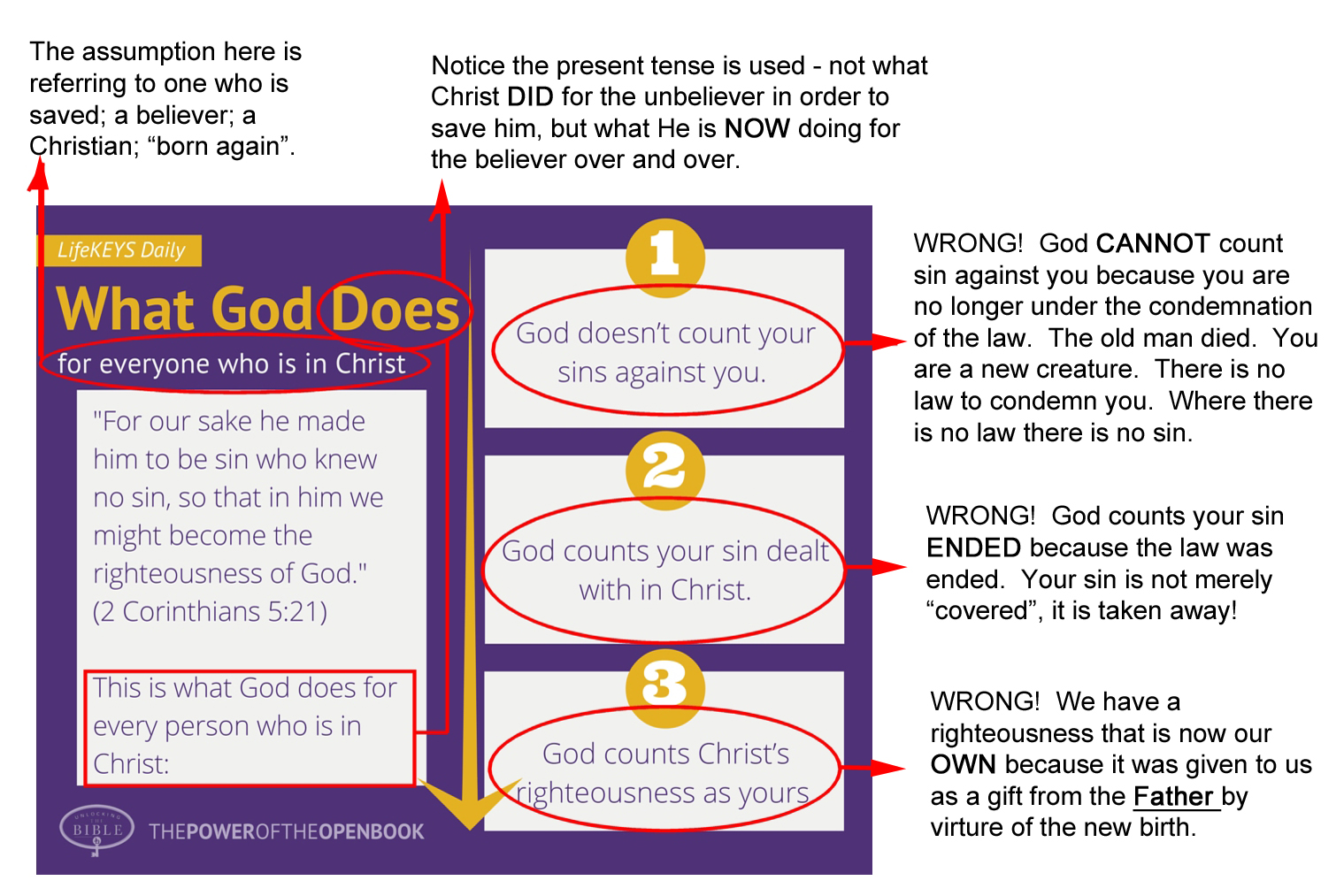
What God Does in Protestant Progressive Justification
Originally published May 31, 2015
There was a meme in my Facebook news feed that caught my eye this morning. I felt compelled to make some corrections to it. If you still don’t believe that Protestantism teaches progressive justification, think again.
Andy
Redemptive-Historical Hermeneutic – A Classic Example
Originally published March 4, 2015
I came across an “interesting” blog article the other day. It appeared in my Facebook newsfeed because someone on my friend list commented on it when one of his friends shared it. Of course, since I am not friends with the one who originally shared it, I was unable to add my comment, thus the inspiration for this article today.
The title of the blog article in questions is, “If we sin, do we lose our salvation?” That mere fact that such a question is still posed in Christianity is indicative of just how biblically illiterate most Christians are. The fact that authors such as this one still address this question in the manner that he does is even more disturbing.
Before even addressing the issue of whether one can lose one’s salvation, the author begins his article by citing Jesus’ example of the two house builders found in Luke chapter 6. Let’s take a look at this passage ourselves before we move on.
47Whosoever cometh to me, and heareth my sayings, and doeth them, I will shew you to whom he is like: 48He is like a man which built an house, and digged deep, and laid the foundation on a rock: and when the flood arose, the stream beat vehemently upon that house, and could not shake it: for it was founded upon a rock. 49But he that heareth, and doeth not, is like a man that without a foundation built an house upon the earth; against which the stream did beat vehemently, and immediately it fell; and the ruin of that house was great.
Luke 6:47-49
Clearly, Jesus is using a metaphor, but to properly understand the metaphor we must ask ourselves, what is the context of this passage? It should be apparent that the context is a contrast between two kinds of individuals. One kind is an individual who hears AND does. The second kind is an individual who hears only. The parallel passage in Matthew 7 goes even further in marking this contrast.
24Therefore whosoever heareth these sayings of mine, and doeth them, I will liken him unto a wise man, which built his house upon a rock: 25And the rain descended, and the floods came, and the winds blew, and beat upon that house; and it fell not: for it was founded upon a rock. 26And every one that heareth these sayings of mine, and doeth them not, shall be likened unto a foolish man, which built his house upon the sand: 27And the rain descended, and the floods came, and the winds blew, and beat upon that house; and it fell: and great was the fall of it.
Matthew 7:24-27
The individual who hears AND does is considered wise. The one who hears only is considered foolish. Herein is the point of this whole passage: the emphasis on hearing AND doing, which is considered to be wise. But please notice what the blog author chooses as his focus:
“Building a house is very similar to one’s experience as either a Christian believer or an unsaved nonbeliever. That is why Jesus drew a comparison between the two (Luke 6:47-49). If you start out with a good foundation that is level and built on solid ground, you can confidently add on walls and flooring and a roof and every other component that makes up a house, and be certain that, because the foundation is sound, the house will be sound. But if you lay a poor foundation that is uneven and shaky, the rest of the house will follow and all the components that are built on that poor foundation will be compromised. To have a soundly constructed house, you must have a good foundation; to have a rock-solid Christian faith, you must build it on foundational truth.”
This is one of the most intellectually incompetent and dishonest uses of the two builders that I have ever seen! This example from scripture has nothing to do with “foundations”. It has everything to do with wisdom and sanctification. The author completely ignores the part about wisdom in both hearing and doing and instead engages in what I call “spiritualizing the analogy”, making it about justification instead. He has interpreted this passage in the so-called “proper gospel context”. This is what happens when you interpret scripture using a redemptive-historical hermeneutic. Spiritualizing the analogy makes a false application of a metaphor that was never intended. It is a logical fallacy. Let’s examine what I mean by this.
If I am given the logical premises that A=B and B=C, I can logically conclude that A=C. This is the logic of the example of the two house builders.
A = B Hearing and doing = a wise man
B = C A wise man = building on a rock (a good foundation)
therefore
A = C Hearing and doing = building on a rock (will make one strong; i.e. aggressive sanctification)
The same holds true for the foolish man.
A = B Hearing only = a foolish man
B = C A foolish man = building on sand (a poor foundation)
therefore
A = C Hearing only = building on sand (will make one weak; i.e. little or no sanctification)
A metaphor makes no sense in and of itself. It has no relevance outside of the initial truth that it represents. If Jesus had only said, “Make sure you build on a rock foundation and not a foundation of sand,” that would have made no sense whatsoever. But Jesus clearly stated that hearing and doing is wise, and He further emphasized that point by using the analogy of building on a rock. Notice also that a correct logical progression in thought results in the proper application of the conclusions. One can reasonably conclude that this not a salvation passage but rather a sanctification passage for believers.
That is the proper meaning and intention of this passage. Contrast that with what the author did in the article. He took the metaphor all by itself and made it say whatever he wanted it to say in order to make his case. And what is his case?
“If you believe that Jesus Christ died on the Cross to pay for your sins, and turn to God in repentance of your sins, then you will be saved… This does not mean that after this occurs, you will never sin again, or even that you will not commit the same sin repeatedly. It means that your heart has been changed toward sin so that you can now see it for what it is… Fortunately, for Paul and for you and for me, that question has a definitively glorious answer: ‘Thanks be to God, who delivers me through Jesus Christ our Lord!’”
Plain and simple, this is progressive justification. Notice it is an ongoing deliverance, not a onetime deliverance. So, then the question remains, what do we have to do to keep the deliverance going? Well, we repent, and that saves us, BUT we still sin. So what? Well, the “so what” is that we need perpetual saving by Jesus. This is what Paul David Tripp and Tim Keller and John Piper call a “daily rescue.” This is Luther’s theology of the cross, a perpetual mortification and vivification.
This is the very reason why the emphasis on the hearing AND doing is ignored. For us “to do” would be works, at least in this construct, if this were a passage on justification and not sanctification. We must live by “faith alone” and not build on the wrong “foundation.” We can only “experience” what it is to have the right foundation, because for us to try and work and build is building on the wrong foundation which is the reformed definition of the “unsaved”. But justification is a finished work. There is nothing we can do to add to it. Because it is finished, we can aggressively “do” the things we “hear” taught to us in the Word. Time and time again, the scriptures equate for us doing good with life and doing evil with death. Good = life = wise. Evil = death = foolish. When it comes right down to it, this really isn’t that hard to figure out.
Andy

 Paul's Passing Thoughts
2 comments