Protestants: Willing Participants in a Truman Show Reality.
Originally published July 12, 2016
 Truman Burbank lived a seemingly normal life. He was just your regular, ordinary kind of guy. Everybody liked Truman. He had a pretty wife, a nice house, a good job. He had everything anybody could ask for. His life was perfect. Or so it seemed.
Of course, Truman Burbank isn’t a real person. He is the titular fictional character in the 1998 film The Truman Show. Those of you who are familiar with the film well know that while Truman’s story is fictional, the reality of his world in that fiction was fiction as well; a fiction engineered specifically for him. The problem was, Truman did not realize that his reality was fake. Unfortunately, just like Truman Burbank, 99% of Protestants don’t realize that their reality as they know it is just as fake, yet they willingly accept it. Truman Burbank offers a perfect philosophical metaphor, so I am using him to illustrate my point.
At the time we meet him in the movie, Truman is approximately 30 years old. From the time he was born, his entire existence has been in the world of Seahaven, FL. It is the only reality he has ever known. And up until now he has never questioned the truth of his reality. What he does not know is that this world is a carefully crafted façade, and every other person in his reality is nothing more than an actor playing a role. Their sole purpose is to make Truman believe that everything he sees around him and everything that happens to him is real. And as he goes about his daily life, hundreds of tiny hidden cameras capture his every move and broadcast his life to the world 24 hours a day. You could say that Truman was the first reality TV star.
How is it that a person can live his entire existence and not realize that his reality is fake? Because Truman’s reality consists of a very deceptive hermaneutic. Everything that happens in his life is carefully interpreted for him so that his understanding of reality remains consistent with what he observes. On this scale you can be sure that this is a very complicated feat to pull off for thirty years.
Such a task can only be maintained for so long, and eventually, unexpected “glitches” begin to occur. For example, one day a strange object falls from the sky and smashes on the ground just feet from where Truman is standing. It happens to be a stage light that is labeled, “SIRIUS (9 Canis Major)”. On another day, while listening to the radio in his car, his radio suddenly begins broadcasting the director’s instructions to the cast, and Truman realizes that the voice on the radio is describing every turn he makes in his car. Yet another time, Truman enters an elevator only to realize when the door opens that no elevator is there but instead he sees a group of stage hands on break around a snack table.
Obviously, such events would be out of the ordinary in Truman’s reality. Here is a conflict between what Truman thinks to be true about his world and what he observes, and he has no idea how to reconcile these contradictions. At this point a mediator is needed to reinterpret what Truman has observed to reconcile the contradiction and convince him that nothing is wrong, everything is as it should be. No, that wasn’t a stage light that fell from the sky, it was a part that fell off an airplane flying overhead. No, you didn’t really hear a guy on the radio announcing your every move. Our station accidentally picked up police frequencies, ha ha, sorry it sometimes happens. Oh did you hear? There was a freak elevator accident in the building next to yours, and a woman was critically injured- no you didn’t really see a stage crew taking their break where an elevator should have been.
The producers went to great lengths to discourage Truman from leaving Seahaven, because as a boy, Truman had a longing for exploring. They posted subtle messages around town with outrageous warnings about the dangers of travel. Sometimes, drastic intervention was required. They even created a scenario one day where Truman was out on a boat with his father, and a sudden storm swept his father overboard, never to be found again. Of course, it was all an act, but to Truman it was very real, and it made quite an impression on him as a small boy. So much so that Truman developed an acute fear of the water and never thought twice about leaving Seahaven by boat, or even crossing a body of water. But as things progress, Truman’s suspicion grows. He begins to ask serious questions of those around him, who continue to simply play along with their roles in a vain attempt to deflect his suspicions.
But despite all these obstacles, Truman was determined to find answers to his questions. He discovered that he could make unusual things happen anytime he was unpredictable. Those involved with the show could not react fast enough to his spontaneity, and this would give them away, only furthering his resolve. Truman knew something was not right about his world, but he did not know why. He could not explain it, but he was no longer willing to accept the explanations given to him by those around him.
We could summarize the salient points about Truman’s reality this way:
- Truman’s understanding of the world was based on a false assumption.
- From time to time Truman would encounter contradictions in his reality that he could not reconcile.
- Truman needed mediators in his life to interpret reality for him.
In much the same way, the way that Protestants understand reality is based on a false assumption. Doctrines such as total depravity (total inability), determinism and God’s sovereignty, election, and many others present man with a view of reality where man is evil and therefore cannot know truth. Believers go to church week after week so that they can be told not just what to think but also HOW to think about not just what the Bible says but also how the world itself works.
Invariably there will come a time when a believer will encounter a contradiction. It may be that he comes across passages of scripture in his Bible that seem to contradict each other. It may be that he encounters something in life that runs counter to what he was taught from the pulpit. Something that he cannot explain, like how can man have a free will if God is sovereign? “Well, you know God’s ways are higher than man’s ways, so we just have to accept that there are some things we just can’t understand and accept as true because God says so.”
Most often, contradictions are handled from a matter of interpretation. This is where the mediator steps in and reinterprets scripture for the believer in its proper “gospel context”. You see, because man is unable to know truth, he needs the authority of a mediator to explain it to him. This is the role of pastors, elders, deacons, bishops, et al.
For Truman Burbank, his mediators were not just a select few in positions of authority. It was the entire cast of characters from the crew behind the scenes, to the actress who played his wife, to the guy who sold him his daily paper at the newsstand. Every person in Truman’s life was a willing participant, regardless of how much they were aware of their overall impact in shaping his life. Extras in the cast, for example, would dutifully play their part all while being totally ignorant of the ultimate level of control the producers sought to wield over Truman’s life.
Truman himself was a willing participant in this ruse. One could argue that he was simply an innocent victim in the whole matter, but consider how much he was willing to overlook in his life for such a long time just so that he could go on living the only life he ever knew. That fact was a major point in the film, when a former cast member called the show and told the show’s creator just how wrong she thought it was the way they were using Truman for their own ends. The creator’s response was profound and powerful. He said that if Truman REALLY wanted to discover the truth, he would find a way, and that whenever that happens, there would be nothing they could do to stop him. The point being of course was that the mere fact that Truman lived this life for so long was a statement to the reality that he really didn’t want to know the truth.
How much can the same be said of Protestants? To what extent are Protestants willing participants in their own “Truman Show” existence? How much are we willing to overlook just so that we can be comfortable in our lives? How much abuse and evil are we going to tolerate just so that we can have some sense of security in where we think our salvation lies? Do we blame the cast of mediators who create this charade for us? Their role is obvious, and they play their parts well, wittingly or unwittingly. But the laity are playing a role as well. They shoulder just as much of the blame as those under whose self-appointed authority they have placed themselves. And they will dutifully pay their tithes and offerings each week, and they will warm their spot on the pew every time the church doors are open, and they will sing when told to sing, and they will stand when told to stand, and they will pray when told to pray, and they will outsource their minds to someone standing before them who will tell them what to think about life. And they will never ask a hard question, even when a stage light falls from the sky.
But there is hope! Because if Protestants really want to know the truth, they will find it. If they really want to find a way out of the nightmare that is the institutional church, they will discover it. And when they are determined to do so, there isn’t a thing the church can do about it!
Andy
Spiritual Identity Crisis
Why do people who call themselves “Christians” and who claim they are “saved” still talk in terms as if they are still unsaved?
~ Andy

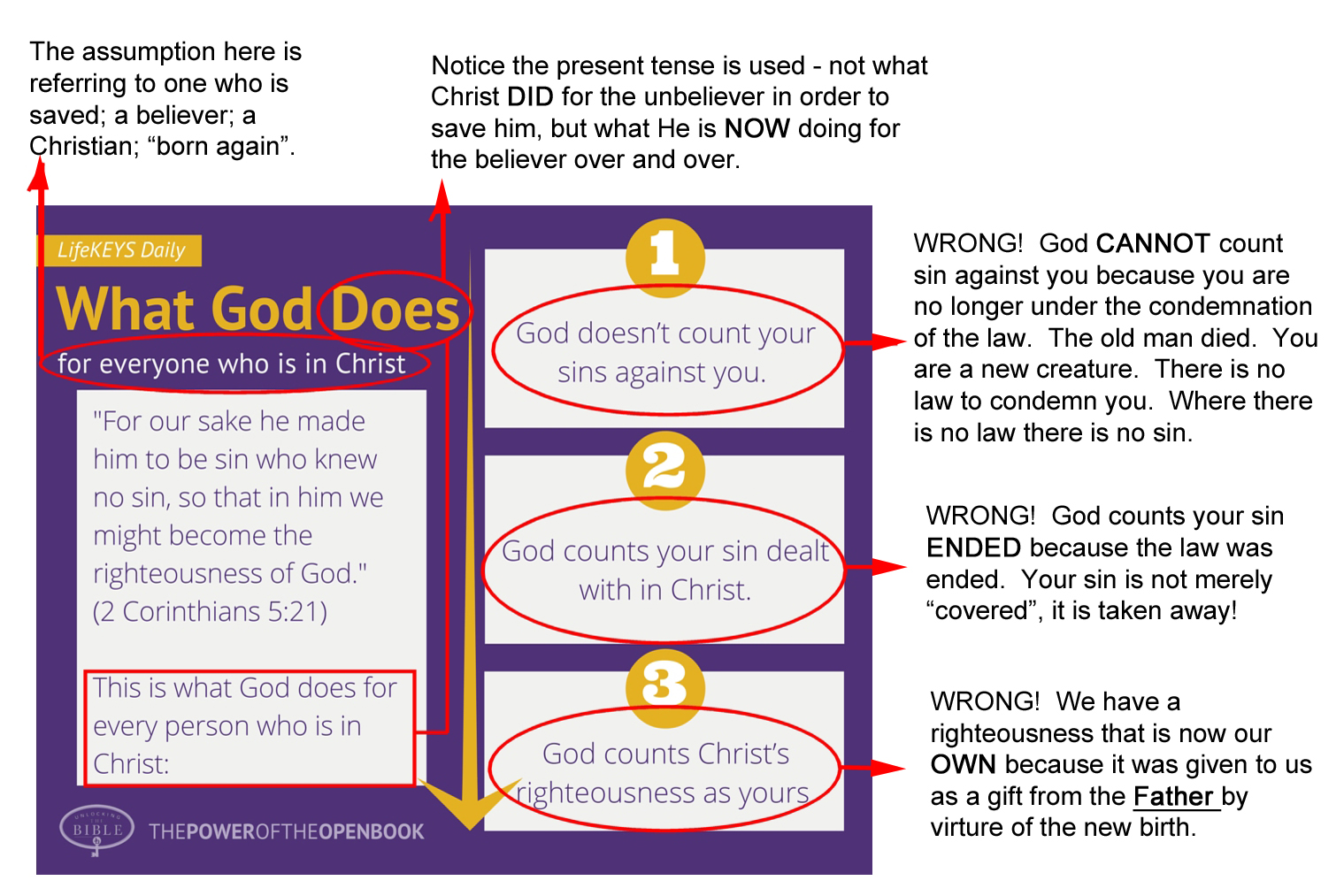
What God Does in Protestant Progressive Justification
Originally published May 31, 2015
There was a meme in my Facebook news feed that caught my eye this morning. I felt compelled to make some corrections to it. If you still don’t believe that Protestantism teaches progressive justification, think again.
Andy
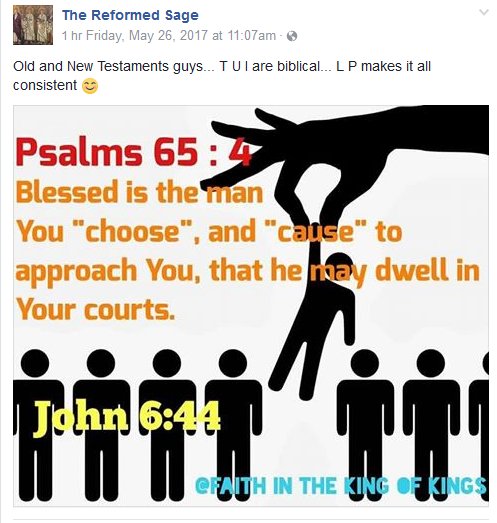
Proper Exegesis: What is the Object of God’s “Choosing”
“Blessed is the man whom thou choosest, and causest to approach unto thee, that he may dwell in thy courts: we shall be satisfied with the goodness of thy house, even of thy holy temple. ”
The translators of this verse made the assumption that the object is man or the individual. God chose man. But if you look closely at the verse, there are many words in italics. This means the words do not appear in the manuscript. Try reading that verse without the italicized words. What if the object is not man but God Himself? What if God chose to dwell with man?
“And I heard a great voice out of heaven saying, Behold, the tabernacle of God is with men, and he will dwell with them, and they shall be his people, and God himself shall be with them, and be their God.” ~ Revelation 21:3
~ Andy
The Lamb’s Wife, Part 1 by Andy Young
 Originally published November 17, 2014
A few weeks ago my family sat down together and watched Fiddler on the Roof. It is a rather long movie for young children to sit through (there were several “potty breaks”), but the little ones enjoyed the songs, and the older ones gained an appreciation for the historical context. One scene in particular depicts a traditional Jewish wedding. Please take a moment and watch the brief clip below:
Traditionally, Jewish weddings were arranged between the fathers of the proposed couple. Keep in mind, there are many details here that I am leaving out because I am trying to be brief. After the parents have come to an agreement to the marriage, the couple is considered “espoused”. This is a formal legal contract into which the couple has entered, and for all intents and purposes, the couple is considered “married” even though the marriage has not yet been consummated. This espousal period can last for up to a year. During this time, the man returns home to make preparations for his bride, and the bride-to-be prepares herself for becoming a wife. Her fidelity to her bridegroom is on display during this period as well.
On the actual wedding day, the bridegroom leads a procession of his friends through the streets of the village to go and meet the bride. This usually occurs between sunset and midnight. There is much pomp and celebration that occurs along the way, and as the procession continues, people exit their homes, bringing a torch or lamp along with them to help light the way, and so the “wedding party” grows larger and larger as more and more “guests” join in celebration with the bridegroom. The bridegroom then receives his bride, and the two, along with the entire party of friends and guests return to the bridegroom’s house where the wedding ceremony occurs with a grand feast and celebration following.
One of the major tenets of Protestant/Reformed/Catholic orthodoxy is that the “church” is the “bride of Christ”. This doctrine can be traced as far back as Augustine. But while originally a Catholic doctrine, evangelicals and fundamentalists still cling to this teaching to this day. You cannot go into any institutional church of any denomination where you won’t hear this taught or not find it in its “statement of faith”. However, what they fail to conveniently mention is that the phrase “bride of Christ” is found nowhere in the Bible. Let me repeat that – the phrase “bride of Christ” is found NOWHERE in the Bible!
This brings me to the point of this article: the doctrine of the “church” being the “bride of Christ” is a FALSE doctrine. Why is that? Because the Bible tells us who the Bride is specifically, and it is not the church! A plain grammatical interpretation of Revelation 21 reveals exactly who the Bride is.
Revelation 21:2, 9-10
“And I John saw the holy city, new Jerusalem, coming down from God out of heaven, prepared as a bride adorned for her husband…And there came unto me one of the seven angels which had the seven vials full of the seven last plagues, and talked with me, saying, ‘Come hither, I will shew thee the bride, the Lamb’s wife.’ And he carried me away in the spirit to a great and high mountain, and shewed me that great city, the holy Jerusalem, descending out of heaven from God…”
Here in plain terms, the Bride is clearly and explicitly shown to be the New Jerusalem. The angel says, “I will show you the Bride”, and he shows John, not a body of people, but the New Jerusalem. The remaining verses of chapter 21 go on to give in great detail a description of what this city looks like. Notice that nothing is said about the inhabitants of the city. The focus of the chapter is the actual city itself. Not only does the angel tell John that this city is the Bride, but in case there was any doubt, he reinforces that fact by stating plainly that this city is the “Lamb’s wife”. So while the Bible never uses the expression, “bride of Christ”, it does use the terms “the Bride, the Lamb’s wife”. But that title is clearly given to the New Jerusalem and not the “church”.
Moreover, even the nation of Israel is not referred to as the “bride”. So if the “church” is not the “bride”, and Israel is not the “bride”, there where exactly does the church and Israel fit in to all of this? Again, scripture tells us plainly. Elements of the Jewish wedding tradition are clearly visualized when Jesus described the “Kingdom of Heaven” in the parable of the wedding feast (Matthew 22), and the parable of the ten virgins (Matthew 25). Let’s begin with the parable of the wedding feast in Matthew 22.
Matthew 22:1-10
“And Jesus answered and spake unto them again by parables, and said, ‘The kingdom of heaven is like unto a certain king, which made a marriage for his son, and sent forth his servants to call them that were bidden to the wedding: and they would not come. Again, he sent forth other servants, saying, Tell them which are bidden, Behold, I have prepared my dinner: my oxen and my fatlings are killed, and all things are ready: come unto the marriage. But they made light of it, and went their ways, one to his farm, another to his merchandise: and the remnant took his servants, and entreated them spitefully, and slew them. But when the king heard thereof, he was wroth: and he sent forth his armies, and destroyed those murderers, and burned up their city. Then saith he to his servants, The wedding is ready, but they which were bidden were not worthy. Go ye therefore into the highways, and as many as ye shall find, bid to the marriage. So those servants went out into the highways, and gathered together all as many as they found, both bad and good: and the wedding was furnished with guests.’ ”
It should be fairly obvious that, as Jesus points out right at the beginning, this parable is used to describe a particular aspect of the Kingdom. In this parable, He is using the metaphor of the traditional Jewish wedding, with the wedding feast being the focus. Of course, this would have been a familiar metaphor to His audience since they were all Jews.
The theme of this parable revolves around two particular groups of people. The first group is made of those who already had invitations to participate in the wedding feast. These were the King’s special invited guests. They received their invitations first. One would think that since these people have been given such a special invitation from the King that they would not hesitate to respond. But notice what happens. On the day of the feast, none of them show up. They reject the gracious invitation. They view it with an attitude of indifference and make all kinds of excuses why they cannot attend. Some even killed the servants who were sent to them to tell them that everything was ready for them to attend the feast.
This first group is a description of national Israel. This is the very nation whose God was Jehovah, but who rejected every prophet that God sent unto them to bring them unto Himself. Stephen accused them in Acts 7:52 when he said, “Which of the prophets have not your fathers persecuted? and they have slain them which shewed before of the coming of the Just One; of whom ye have been now the betrayers and murderers?” accusing them of killing Jesus, their Messiah. And for this God judged them with the destruction of Jerusalem in 70 AD. And in His wrath, God will pour out His judgment upon national Israel during the period of the Great Tribulation.
But there is a second group mentioned in this parable. Since the King made all these preparations, it was his desire to have the feast furnished with guests. So he instructed his servants to go out and issue an invitation to anyone, as many as they could find. This second group represents the nations of the world, or the Gentiles, those whom God would redeem by the blood of the Lamb out of “every kindred, and tongue, and people, and nation.” (Revelation 5:9, 14:6) I think it is important to note that this second group would also include repentant individuals from the first group, or converted Jews.
Nevertheless, the point to take from all of this is that neither of the two groups in this parable are the bride. They are guests, and this is important. What we have is a body of individuals that make up the “church”, or using the correct Biblical term, the εκκλησια (“ekklaysia”), the “called out” (invited) assembly that makes up the Body of Christ. In this parable they are not the bride, but they are clearly the guests at the wedding.
Take a look at the second parable in Matthew 25.
Matthew 25:1-13
“Then shall the kingdom of heaven be likened unto ten virgins, which took their lamps, and went forth to meet the bridegroom. And five of them were wise, and five were foolish. They that were foolish took their lamps, and took no oil with them: But the wise took oil in their vessels with their lamps. While the bridegroom tarried, they all slumbered and slept. And at midnight there was a cry made, Behold, the bridegroom cometh; go ye out to meet him. Then all those virgins arose, and trimmed their lamps. And the foolish said unto the wise, Give us of your oil; for our lamps are gone out. But the wise answered, saying, Not so; lest there be not enough for us and you: but go ye rather to them that sell, and buy for yourselves. And while they went to buy, the bridegroom came; and they that were ready went in with him to the marriage: and the door was shut. Afterward came also the other virgins, saying, Lord, Lord, open to us. But he answered and said, Verily I say unto you, I know you not. Watch therefore, for ye know neither the day nor the hour wherein the Son of man cometh.”
Now the point to make here with this parable is not to determine who the foolish virgins represent and who the wise virgins represent. The point is to show that all of these “virgins” represent those who would go out to join the procession of the wedding party as the bridegroom goes to meet his bride and return with her to his father’s house for the wedding feast. Refer to the video clip at the beginning of this article and you will notice all of the people who accompany the groom on his way to pick up his bride. As the procession goes through the streets of the village, more and more people come out of their houses carrying a candle or “lamp” and join the procession. Notice that this happens at “midnight” or more literally, sunset, as portrayed in the video clip. The young girls in the parable are not going to the wedding to marry the bridegroom. The bridegroom already has a bride. The young girls are simply guests at the wedding.
This is not the first instance that scripture posits this notion of wedding guests. Matthew 9:15, Mark 2:19, and Luke 5:34 use the term “children of the bridechamber”, referring to Jesus’ disciples – those who were called by Christ to follow Him. That would include not only the twelve, but all those who would be saved by faith in Christ, the “ekklaysia”. In John 3:29, John the Baptist referred to himself and any others “which standeth and heareth Him as a “friend of the bridegroom”.
So in terms of the picture of a traditional Jewish wedding, all believers, members of the Body of Christ, are referred to as “guests” and “friends of the bridegroom”, but they are NOT the bride. They go out joyfully with the Bridegroom as He goes to receive His Bride. But clearly from a scriptural standpoint, the wedding guests cannot be the Bride.
Now there are questions that remain. For example, how can Christ “marry” a city? And if the “church” is not the Bride, then what about all those New Testament passages that seem to refer to the “church” in “spousal” terms? These are all valid questions, and I will seek to address them in part 2.
Andy

 Paul's Passing Thoughts
1 comment