Calvin’s False Gospel: On the Wrong Side of the Law; Galatians 3:15-25
 “If Christ had to keep the law perfectly, or if you will, fulfill it, the inheritance no longer depends on The Promise, but God in His grace gave it to Abraham through The Promise.”
“In a manner of speaking, Moses’ law was useless until Christ died. It was a will that promised an inheritance, but without the death of its testator, there is no inheritance; namely, eternal life. So why would Christ have to fulfill the law through obedience? His death alone resulted in the inheritance. Obedience to a will does not fulfil it, only death fulfills it. A will is a promise fulfilled by death only.”
The reason Calvinism is a false gospel is simple and glaring; Calvin was on the wrong side of the law. In fact, Calvin constructed the exact soteriology that the apostle Paul continually railed against. Simply stated, Paul sought to separate law from justification while Calvin sought to fuse law with justification.
Calvin condoned this by making Christ’s perfect obedience to the law part of the “atonement.” This is another caveat we will be discussing: Calvin also misused the word “atonement” and seems to have had a fundamental misunderstanding about what it is. As good Protestants we think of atonement as being central to the cross, and indeed it is VERY important, but not central. I will explain this further along—how Calvin’s understanding of atonement makes the L in TULIP an oxymoron.
Calvin made perfect law-keeping justification’s standard; Paul said, NO! law has nothing to do with being justified whatsoever! Calvin said Christ fulfilled the law for us, and His perfect obedience was imputed to us along with His personal righteousness. Hence, we are righteous positionally, and also righteous factually. Therefore, the “atonement” is a “covering”—no matter what the Christian does, when the father of wrath looks at us, He only sees Christ’s “doing and dying” and not anything we do. This is part and parcel with Martin Luther’s alien righteousness construct as well. It seems logical until you start reading the Bible. But this makes the concept of “covering” very important to the Reformation.
Also, this construct leads to various and sundry formulas for sanctification in which we conduct ourselves in a way that continually reapplies the “doing and dying” of Christ to our lives as opposed to “anything that we do”…and a lot of confusion following. And unfortunately, the elder’s soft whispering in our ear that says, “just trust us” as well. That’s not a good idea.
Let us now examine Galatians 3:15-25 to make these points:
15 Brothers and sisters, let me take an example from everyday life. Just as no one can set aside or add to a human covenant that has been duly established, so it is in this case (NIV).
Really, the crux of Christianity is the covenant God made with Abraham. EVERYTHING goes back to that. God’s complete plan for the ages is bound up in “The Promise.” That is another name, really the formal one, for the Abrahamic Covenant: “The Promise.” One must understand that Reformed theology and Calvinism in particular, is a complete deconstruction of biblical truth and the gospel. Reformed theology holds to the idea that The Promise was conditional. The idea, especially among renowned Southern Baptists, that common ground can be found with Calvinism is the epitome of biblical illiteracy, and this is just one point among many: Paul makes it clear in verse 15 that The Promise cannot be changed or annulled. Furthermore, it does not depend on anything that man does as demonstrated by the fact that God put Abraham in a deep sleep during the ceremony that consummated this covenant.
16 The promises were spoken to Abraham and to his seed. Scripture does not say “and to seeds,” meaning many people, but “and to your seed,” meaning one person, who is Christ (NIV).
Verse 16 is very helpful in understanding something basic about all biblical covenants, here referred to by Paul as “promises.” In the Bible, “promise” is an idiom for “covenant.” The two words are used interchangeably. All of the “promises,” plural, are built upon the one “promise,” singular. All of the covenants build one big historical picture, much of it future, but all based on the one Promise. It is interesting to note that Paul identifies the formally unregenerate Gentiles of his day as alienated from the Promises (plural) of Israel (Eph 2:12).
Verse 16 also makes a distinction in Abraham’s national descendants and spiritual descendants. Abraham is the father of Israel, but not all descendants of Israel are of the “seed of the woman” which is Abraham’s spiritual seed. But be sure of this: that does not negate the promises to national Israel (see Jer 31:31ff.) and those who are of “faith” within national Israel. The point of verse 16 is that belief in Christ denotes the only seed that can give life by “faith” alone apart from anything else. That’s why Paul continues in this way:
17 What I mean is this: The law, introduced 430 years later, does not set aside the covenant previously established by God and thus do away with the promise (Ibid).
The Promise is by faith alone and is the only seed that can give life. The law, which came 430 years later, does not CHANGE anything in regard to The Promise. ALL life is in faith alone, or the seed of faith. One must simply believe. Faith gives life completely separate from the law. Let us expedite the point with verse 21:
… For if a law had been given that could impart life, then righteousness would certainly have come by the law (Id).
You may argue that law can further define righteousness after the fact, but it cannot give life. The law is completely separate from justification/righteousness. The fulfillment of the law by anybody, including Christ, does not impart life—only faith imparts life. A keeping of the law for “atonement” changes the promise:
18 For if the inheritance depends on the law, then it no longer depends on the promise; but God in his grace gave it to Abraham through a promise (Id).
If Christ had to keep the law perfectly, or if you will, fulfill it, the inheritance no longer depends on The Promise, but God in His grace gave it to Abraham through The Promise. So, why the law? Paul will tell us:
19 Why, then, was the law given at all? It was added because of transgressions until the Seed to whom the promise referred had come. The law was given through angels and entrusted to a mediator. 20 A mediator, however, implies more than one party; but God is one (Id).
Moses was the mediator of the covenant of the law given at Mt. Sinai, and the angels enforced its inauguration. This was the unimaginable apocalyptic scene that guaranteed lack of interference from the forces of darkness. In the book of Revelation, we have a description of how angels will be used of God to once again enforce this covenant. Even though the law was added, this was not the addition of another seed of faith; ie., Moses, but there is only one seed that signifies The Promise and the only seed that can give life. Moses’ covenant cannot give life.
So why the law? Now we can talk about, “atonement,” well, sort of. The law was a covering of sorts by way of a will. Under the Old Covenant, if you believed God, you were in the will and guaranteed the inheritance. Remember what Paul said in verse 18?
For if the inheritance depends on the law…
The Old Testament law was a will that protected believers until Christ came and died for our sins. In that sense, they were “covered” until Christ came. Christ is the mediator of a “better” covenant because Moses’ covenant only protected believers from the consequences of sin until Christ came. Moses was the mediator of the will, but Christ is the testator:
22 But Scripture has locked up everything under the control of sin, so that what was promised, being given through faith in Jesus Christ, might be given to those who believe [Note what we have discussed in prior essays: “Scripture” and “law” are synonyms].
23 Before the coming of this faith, we were held in custody under the law, locked up until the faith that was to come would be revealed. 24 So the law was our guardian until Christ came that we might be justified by faith. 25 Now that this faith has come, we are no longer under a guardian.
Hebrews 9:15 – For this reason Christ is the mediator of a new covenant, that those who are called may receive the promised eternal inheritance—now that he has died as a ransom to set them free from the sins committed under the first covenant.
16 – In the case of a will, it is necessary to prove the death of the one who made it, 17 because a will is in force only when somebody has died; it never takes effect while the one who made it is living. 18 This is why even the first covenant was not put into effect without blood. 19 When Moses had proclaimed every command of the law to all the people, he took the blood of calves, together with water, scarlet wool and branches of hyssop, and sprinkled the scroll and all the people. 20 He said, “This is the blood of the covenant, which God has commanded you to keep.” 21 In the same way, he sprinkled with the blood both the tabernacle and everything used in its ceremonies. 22 In fact, the law requires that nearly everything be cleansed with blood, and without the shedding of blood there is no forgiveness (Id).
In a manner of speaking, Moses’ law was useless until Christ died. It was a will that promised an inheritance, but without the death of its testator, there is no inheritance; namely, eternal life. So why would Christ have to fulfill the law through obedience? His death alone resulted in the inheritance. Obedience to a will does not fulfil it, only death fulfills it. A will is a promise fulfilled by death only.
Moreover, in regard to justification, it would seem that the point of the Old Testament law was the temporary imputation of sin, and not the need for a righteous fulfillment. The law imputes NO righteousness, but in regard to justification was a “covenant of death” (2Cor 2:12, 3:6,7). More than likely, the idea is a will of death because it required a death, and can only bring death to those who attempt to be justified by it. Therefore, Christ was the “end of the law for righteousness.” If the definition of “sin” is lawlessness (and it is, see 1John), Christ didn’t merely cover sin—He ended it.
This brings us to “atonement” and the whole “covering” idea. First of all, it is likely that Christ was not crucified on the Day of Atonement because that day has exclusive Jewish cogitations for the future. It’s Jewish eschatology. It is the day when the sins of Israel are cleansed and they are restored as a nation:

(Online source: http://www.hebrew4christians.com/Holidays/Fall_Holidays/Yom_Kippur/YomKippur.pdf )
Secondly, atonement doesn’t allude primarily to “covering,” but rather an exchange:
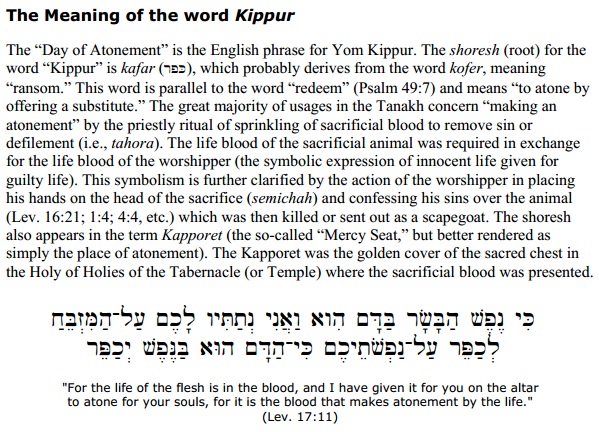
(Ibid).
Therefore, the idea of a “limited atonement” makes no sense at all. First of all, the limitation would only pertain to Israel. Secondly, in regard to Calvin’s overall soteriology, “covering” is only a plausible rendering of atonement; covering versus exchange must be weighed in the balance. In Calvinism, a covering over of our wickedness by the righteousness of Christ is feasible, but what about an exchange of death for life, and sin for righteousness? In the end, what is the passing from death to life? (1Jn 3:14). If we are only covered and not changed, that must be interpreted as mere realm transformation that is only experienced, or the allegory of choice that fits a preferred presupposition.
It’s ironic, even camps that reject the Calvinist label buy into the Calvinist idea of atonement. More buy into the idea that Christ had to keep the law for us. Even more buy into the idea that we are merely covered and not changed: “We are all just sinners saved by grace.” “When God looks at us, He only sees Christ.” We have all said these things.
This is a fundamental misinterpretation of the law’s relationship to grace. And that must change; we mustn’t be on the wrong side of the law.
paul

 Paul's Passing Thoughts
1. Christians ARE righteous. 2. The law has no role in salvation. 3. Christians pursue the law in sanctification out of love without fear that justification can be revoked.
LikeLike
I am not questioning that believers are personally righteous. That is just a matter of reality. What I am asking about David’s views is whether he is saying that righteousness forms the basis of our acceptance with God. Additionally, I want to know if there is any standard by which to measure it and is there a level to which that righteousness must rise before it will be acceptable to God.
LikeLike
Jon,
We will see how he answers if he does. Calvin believed the standard was perfection and a perfect keeping of the law must continue to secure the “just standing” of believers. Hence, Christ’s one sacrifice put an end to the OT sacrifices, but the blood “atonement” as a covering must continue to cover the sins of believers. As we “preach the gospel to ourselves every day” the blood is continually applied to the sins committed by Christians. The Reformed think tank that launched Neo-Calvinism stated it this way:
” After a man hears the conditions of acceptance with God and eternal life, and is made sensible of his inability to meet those conditions, the Word of God comes to him in the gospel. He hears that Christ stood in his place and kept the law of God for him. By dying on the cross, Christ satisfied all the law’s demands. The Holy Spirit gives the sinner faith to accept the righteousness of Jesus. Standing now before the law which says, “I demand a life of perfect conformity to the commandments,” the believing sinner cries in triumph, “Mine are Christ’s living, doing, and speaking, His suffering and dying; mine as much as if I had lived, done, spoken, and suffered, and died as He did . . . ” (Luther). The law is well pleased with Jesus’ doing and dying, which the sinner brings in the hand of faith. Justice is fully satisfied, and God can truly say: “This man has fulfilled the law. He is justified.”
We say again, only those are justified who bring to God a life of perfect obedience to the law of God. This is what faith does—it brings to God the obedience of Jesus Christ. By faith the law is fulfilled and the sinner is justified.
On the other hand, the law is dishonored by the man who presumes to bring to it his own life of obedience. The fact that he thinks the law will be satisfied with his “rotten stubble and straw” (Luther) shows what a low estimate he has of the holiness of God and what a high estimate he has of his own righteousness. Only in Jesus Christ is there an obedience with which the law is well pleased. Because faith brings only what Jesus has done, it is the highest honor that can be paid to the law (Rom. 3:31).”
LikeLike
Argo,
With all due respect, I am not interested in discussing your ideas. I want to discuss what the Scriptures mean.
LikeLike
“I’m the last person who wants to force anyone to discuss my ideas. But what you are saying is that my ideas are not scriptural. That is a massively arrogant presumption, and shows that you do not believe that scripture needs to be interpreted; because if you did, you would acknowledge my right to interpret it and engage those things with which you disagree, like a serious student of the bible. This makes your desire to ” discuss what it means” both irrational and rank hypocrisy. ”
You beat me to it.
LikeLike
“2. What does Romans 8:7-8 [“For the mind that is set on the flesh is hostile to God, for it does not submit to God’s law; indeed, it cannot. Those who are in the flesh cannot please God.”]teach about the inability of those who are in the flesh to subject themselves to God’s law?”
Who is speaking?
Who is the audience?
What is the occasion/venue?
I am not big on proof texting. The clue is the “mind set on the flesh”. Does that mind have a choice? I do not think they are unable but unwilling.
LikeLike
“Even those who proclaim their autonomy and freedom from moral constraints the most vociferously still suffer from guilt for having violated universally accepted norms.”
I do have a problem with this. Universally accepted norms? How would that work in say, Saudia Arabia, where they can stone a woman who was raped? How well did it work in Ancient Egypt where the Israelites were in bondage to slavery? How well did accepted norms work with slavery in the South?
I submit to you that group think and authoritarianism CAN become the accepted norm for many. (It is happening today in the US as we careen toward socialism)
A universally accepted norm can be the collective is more important than any individual within the collective. And that is happening all over the place as the US gives up its principles of Life, Liberty…
Argo uses the example of clinical narcissism which is becoming epidemic. As is sociopathy where suffering guilt is unheard of.
Accepted norms change. And one can see this quite clearly in the history of the church and how “orthodoxy” changed over time. Example: A state church was a universally accepted norm for quite a long time. And a “state church” is evil incarnate. A universally accepted norm was once infant baptism or a third baptism if one dared practice believers baptism.
LikeLike
There is nothing presumptuous about it. It is easy to tell that you, Argo, place your perceived logic above the plain statements of Scripture. And you, Lydia are quite right, a sinner’s inability results from his unwillingness, but it is inability nonetheless.
LikeLike
Lydia,
Re: your comment about universally accepted norms.
You are right. Different societies have perverted these norms almost beyond recognition. Paul wrote concerning the impure, “even their mind and conscience is defiled.” They often “call good evil and evil good.”
This is why Paul wrote, “they do things contained in the law.” He did not say,” they understand and do God’s will completely.” If that were the case, there would be no contrast between them and the Jews who ” know his will, having been instructed out of the law.”
Even the believer who is guided by the Holy Spirit needs the objective standard of Scripture to keep him from using his liberty as a springboard to satisfy the flesh.
LikeLike
David,
“In that verse, 2 Cor 5:21, as I would translate it, it says that Jesus became a sin-offering for us so that we could become righteous before God. Certainly by our sins being washed away in his blood we become righteous before having stacked up a list or checking off a quota of righteous works.”
If you would, I would like you to answer my question about the sinner’s guilt being symbolically transferred to the sacrifice in the OT sin offering. Additionally, if a criminal pays for his crime through capital punishment, does that declare him righteous or just punished and dead?
LikeLike
“Even the believer who is guided by the Holy Spirit needs the objective standard of Scripture to keep him from using his liberty as a springboard to satisfy the flesh.”
This sounds very much like scripture being elevated above the Holy Spirit. Scripture is profitable for many things, but Jesus said he would send a Helper, the Holy Spirit.
Should we assume that every believer is going to elevate his liberty in Christ to satisfy his flesh?
LikeLike