The Reality of Reformed Theology
 “Reformed theology, or if you will, Calvinism, is not a theological debate; it is a philosophical debate concerning the question of how we interpret reality itself.”
The philosopher Friedrich Wilhelm Nietzsche, a proponent of ideas that I find disturbing, once stated the following: “In Christianity neither morality nor religion come into contact with reality at any point.” Perhaps he confused Christianity with the Reformation.
The fact that I agree with Nietzsche on this point is completely beside the point; the Reformers themselves stated exactly what Nietzsche said. To say that Luther stated in his Heidelberg Disputation that mankind in general, and Christians in particular are unable to understand reality or morality is beyond fair. Obviously, no belief touches anything it doesn’t believe in.
You don’t have to be a rocket scientist to figure any of this out, you only need to listen carefully: “The centrality of the objective gospel outside of us.” “The subjective power of an objective gospel.” “The Objective gospel.” “The objective gospel experienced subjectively.” These are all contemporary restatements of Luther’s Heidelberg Disputation. This is only complicated to those who have lost the art of asking themselves questions and knowing that words mean things.
When God created the earth and reality, he also created the epistemology to go along with it. He created light and said, that’s light. The word, “light” interprets what light is. Therefore, when someone talks about light, we understand what they are talking about. God even colabored with man to develop much of the epistemology by asking him to name the animals.
Then the serpent came along and in essence said to Eve, “Yea, has God really said, ‘That’s a cow’? Eve, you can’t draw conclusions through mere words, you need to go beyond that and see the knowledge of good and evil.” Likewise, Reformed teachers like Paul David Tripp teach that the literal meaning of words cannot interpret a “gospel context.” The likes of Rick Holland state that good grammar makes bad theology. Grab your metaphysical wallet and hold on to it tightly lest your philosophical pockets get picked.
The “objective gospel” (for instance, see objective gospel .org) is Luther’s cross story, and the subjectivity of it (how we experience the gospel) is Luther’s glory story.
Objective: (of a person or their judgment) not influenced by personal feelings or opinions in considering and representing facts.
Subjective: based on or influenced by personal feelings, tastes, or opinions.
One of the major tenants of the Heidelberg Disputation and Reformed theology in general is the idea that it is impossible for mankind in general and Christians in particular to approach ANY truth WITHOUT presuppositions; ie., subjectivism. Also, only the gospel is objective. ALL reality must be interpreted through redemption. Hence, the first tenet of New Covenant Theology which is a spinoff from Neo-Calvinism:
New Covenant Theology insists on the priority of Jesus Christ over all things, including history, revelation, and redemption. New Covenant Theology presumes a Christocentricity to the understanding and meaning of all reality.
Any questions? In case you do, consider this quote by the father of contemporary Reformed hermeneutics, Graeme Goldsworthy:
If the story is true, Jesus Christ is the interpretative key to every fact in the universe and, of course, the Bible is one such fact. He is thus the hermeneutic principle that applies first to the Bible as the ground for understanding, and also to the whole of reality (Graeme Goldsworthy: Gospel-centered Hermeneutics; p.48).
This is why the objective gospel, according to Reformed thought, must remain outside of us and only experienced through faith in it alone. This gospel alone must define who we are. The only thing man can know is that he is evil and God is good, EVERYTHING else is conformed to his own distorted individualist presuppositions. His life must be guided completely by something outside of him. Everything within is subjective. The idea that man can know anything objectively is Luther’s glory story. It’s all about the glory of man and not God. It’s either everything or nothing at all. If man has any merit or worth at all, he has ravaged God’s image. He must trust completely in the cross story. This is the foundation of the Calvin Institutes stated in 1.1.1. The Institutes are not only based specifically on Luther’s metaphysics, but the premise is eerily similar to the knowledge of good and evil propagated by the serpent.
The staple assertion during the infancy of the present Neo-Calvinist movement was the often heard idea that this new resurgence was needed because Evangelicalism was drowning in a “sea of subjectivism’:
Now, if the Fathers of the early church, so nearly removed in time from Paul, lost touch with the Pauline message, how much more is this true in succeeding generations? The powerful truth of righteousness by faith needs to be restated plainly, and understood clearly, by every new generation.
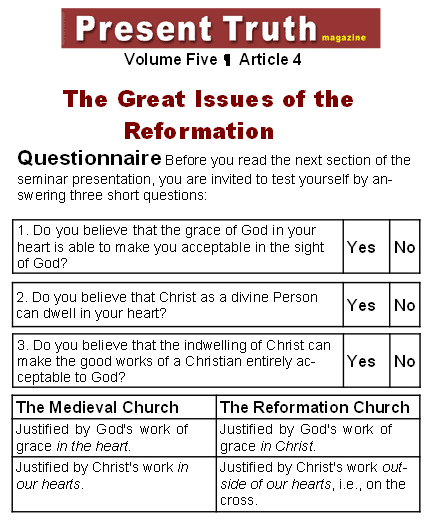
In our time we are awash in a “Sea of Subjectivism,” as one magazine put it over twenty years ago. Let me explain. In 1972 a publication known as Present Truth published the results of a survey with a five-point questionnaire which dealt with the most basic issues between the medieval church and the Reformation. Polling showed 95 per cent of the “Jesus People” were decidedly medieval and anti-Reformation in their doctrinal thinking about the gospel. Among church-going Protestants they found ratings nearly as high (The Highway blog: Article of the Month, Sola Fide: Does It Really Matter?; Dr. John H. Armstrong).
And what was the gist of that survey specifically? An illustration from the cited article follows:
 Reformed theology, or if you will, Calvinism, is not a theological debate; it is a philosophical debate concerning the question of how we interpret reality itself. This is a question of whether or not man can comprehend reality, and the structuring of society accordingly. Throughout history, this debate has always ended up in an arena where life and death are determined. This is not a theological debate this is a debate that determines what kind of world we will be living in. Nietzsche was right in regard to a “Christian” nomenclature of Reformed thought; it holds to the idea that truth and morals are objective and unattainable while in this subjective world.
paul

 Paul's Passing Thoughts
Reblogged this on Clearcreek Chapel Watch.
LikeLike