Piper’s Tweet: Evangelicals Don’t Understand That He is Talking About Our Children Too
 “What’s the attractiveness of this philosophy? Simply, an escape from dealing with real life and responsibility in general.”
There is a lot of discussion among evangelicals (who don’t consider themselves New Calvinists) about John Piper. This is not unusual; we evangelicals love to talk about things we know nothing about. In regard to Piper’s heartless tweet concerning the little children who died in Moore, Oklahoma, evangelicals sit back and ponder why he would attempt to reach out to the lost in this way. What they don’t understand is he’s talking about our children too. All evangelicals can apply the principle of the same tweet to your child dying as a result of you fill in the blank.
Reformed theology is grounded in ancient paganism. It flows from the following basic construct:
1. Metaphysics. The material is evil, only spirit is good.
2. Epistemology. Truth cannot be obtained empirically. It must be obtained through some sort of gateway into the spiritual; usually contemplationism of some sort.
3. Ethics. Determined by the spiritual, and manifested by birthing the spiritual into the material realm.
4. Politics. The enlightened rule over the unenlightened masses on behalf of the spiritual. The masses are in bondage to empirical epistemology.
American evangelicals do not see the line in the sand that should be there. New Calvinism is a return to the same Gnosticism that plagued the first century church and even infiltrated Judaism. It has little patience for those who cling to the material in any way. And that includes children. The ability to dress up Gnosticism in biblical garb and its tsunami-like overtaking of Christianity mirrors what was going on in the first century church to a “T.” In New Calvinism:
1. Metaphysics: The idea that God will renovate heaven and earth with fire and dwell with us eternally in the same basic form that we perceive at this time is an abomination. Hence, Christ will not really dwell on David’s throne literally, Abraham wasn’t really looking for a literal city built by God, etc. It’s all allegory because it’s contradictory to basic Gnostic metaphysics (the idea that God would value a sliver of geography called “Israel” is an absurd notion to the average Gnostic). This is why Christians commonly think the Bride of Christ is the church and that we will dwell in heaven eternally.
2. Epistemology. ALL REALITY is interpreted by contemplating the personhood of Christ. Some call this “gospel contemplationism.” The Bible is a gospel meta-narrative (meta-narrative metaphysics) for contemplation purposes, not grammatical interpretation of reality. This is the basis of the Redemptive Historical hermeneutic.
3. Ethics. Manifested in the “flesh realm” by the imputation of Christ’s perfect life lived on earth, and a natural outflow of gospel contemplationism. New Calvinists call this, “The imperative command is grounded in the indicative event.”
4. Politics. Reformed enlightened elders rule over the unenlightened masses in order to “save them from ignorance” (Al Mohler). Adherence to Reformed elder rule and orthodoxy is one’s best chance to arrive at the final judgment covered by Christ’s obedience. As God’s rulers they also have the authority to declare someone saved or unsaved.
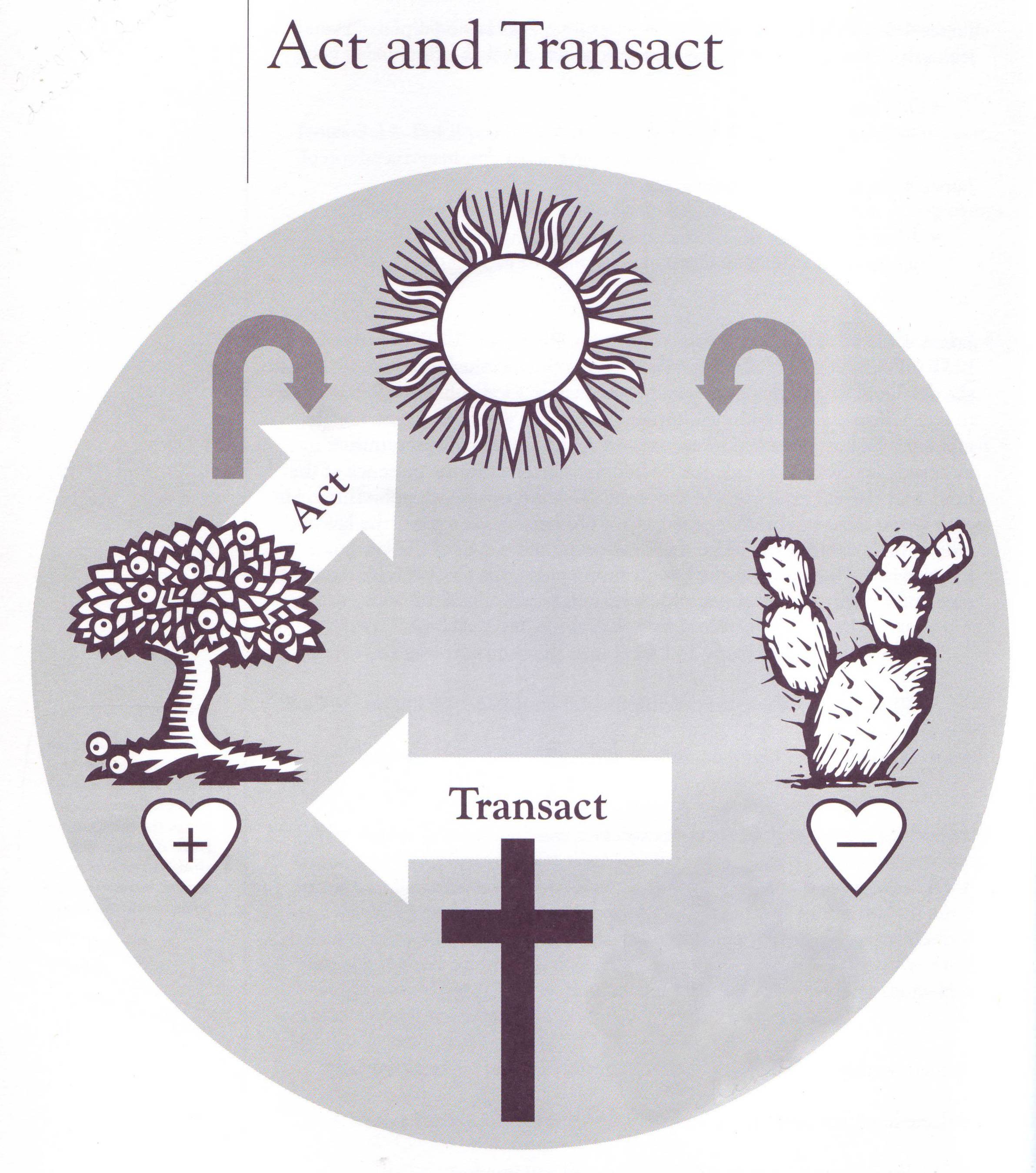
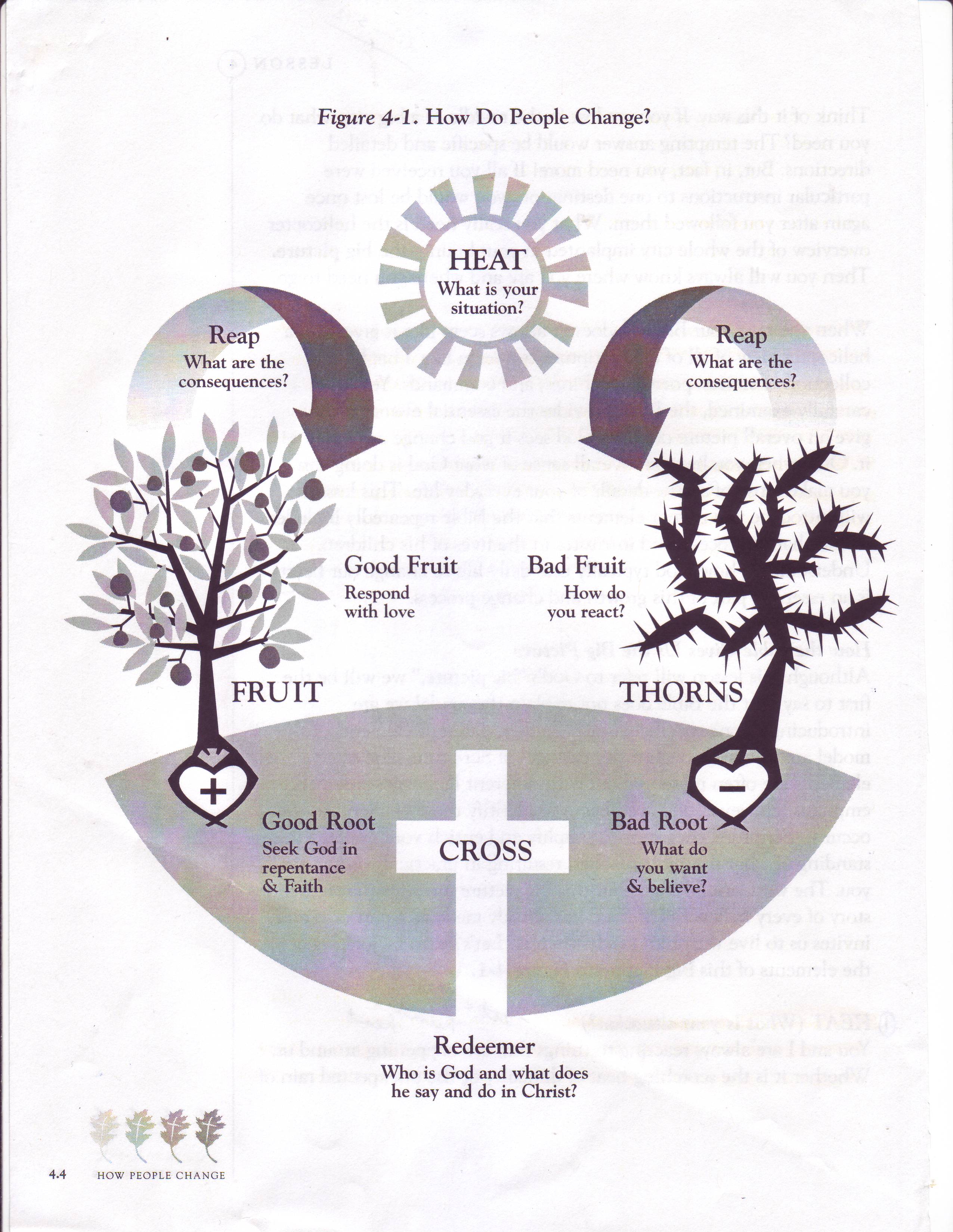
What’s the attractiveness of this philosophy? Simply, an escape from dealing with real life and responsibility in general. Contemplating the gospel and disregarding the material enables us to stand back and observe our lives without emotional attachment. Our only responsibility is to live by faith alone, and by the way, John Piper makes faith absolutely synonymous with joy. This is the premise of his Christian Hedonism philosophy. Therefore, the death of children leads to joy because it shows us the utter worthlessness of this present material world. This is also the thesis of Paul David Tripp’s How People Change: ALL events in life are preordained in order to contribute to gospel contemplationism resulting in spiritual fruit. See the chart below taken from a CCEF workbook based on the same book (click on to enlarge):
And another chart from the actual book:
To Luther, this meant a cycle of deaths and rebirths leading to joy—tragedy enables us to empty ourselves and eradicate connections with the present cares of this material world. Here is how one New Calvinist stated it:
What, then, is the subjective power of this message? Firstly, we find that there is real, objective freedom, the kind that, yes, can be experienced subjectively. We are freed from having to worry about the legitimacy of experiences; our claims of self-improvement are no longer seen as a basis of our witness or faith. In other words, we are freed from ourselves, from the tumultuous ebb and flow of our inner lives and the outward circumstances; anyone in Christ will be saved despite those things. We can observe our own turmoil without identifying with it. We might even find that we have compassion for others who function similarly. These fluctuations, violent as they might be, do not ultimately define us. If anything, they tell us about our need for a savior.
That’s it in a nutshell. And it explains Piper’s heartless tweets down to a gnat’s eyebrow. He has no patience for anyone who entangles themselves in the material world. They are ignorant.
Christians better get a grip on this. This is not mere disagreement on obscure biblical ideas—this is a completely different way of looking at reality that has wreaked havoc on mankind for thousands of years.
paul

 Paul's Passing Thoughts
Barbara says “How sad is it that people have actually dared to believe the Scriptures.”
If only Paul had actually believed the scriptures, we wouldn’t be in this mess. The problem is that Paul misuses a number of Old Testament scriptures, misinterprets them, twists then, in Romans 3 and again in Romans 9. Lets stick with Romans 9 for now.
I will hope that since paulspassingthoughts posted my first comment he will allow me to defend it in one more comment. I honestly didn’t think the last one would pass by the censor.
Firstly, “Jacob I have loved and Esau I hated” is not about salvation or damnation but the inheritance of land. In context its about how that Esau inherited the crappier land; yet he still inherited something! I haven’t inherited any land, so God must hate me more than Esau. But what Paul is doing is twisting this as if it had anything to do with heaven and hell, which it does not.
Secondly, Pharoah’s heart was not hardened by a direct manipulation as if God reached into his heart. His heart was hardened when he asked Moses to pray for a plague to be removed, and as soon as Moses prayed for it, God instantly removed it. Like any criminal who is shown leniency, Pharoah took this as a sign that God didn’t mean business “and Pharaoh’s heart was hardened.” But Paul twists it as if it means God were controlling Pharaoh directly.
Thirdly, the story where God says to Moses “I will show mercy to whom I will show mercy.” Paul adds words to it, namely “and harden whom I will harden” which come plainly from his imagination and not from the OT text! This is the end of Exodus 33 and when God says “I will show mercy to whom I will show mercy” he says this in response to Moses’ request to see God’s glory, and the context clearly means this special mercy of getting to see God’s glory is not for everyone but only some, like Moses obviously. Yet, contrary to how Paul uses this passage in Romans 9, God does not intent to say he dishes out mercy arbitrarily like Calvin’s god, but rather if we continue reading into Exodus 34 we see what RULE God uses in dispensing his mercy: the Lord passes by proclaiming the name of the LORD, ““The Lord, the Lord, a God merciful and gracious, slow to anger, and abounding in mercy and faithfulness, keeping mercy for thousands” which is parallel to Exodus 20:6 “but showing mercy to thousands of those who love me and keep my commandments.” It is not arbitrary, but follows a rule, that mercy is shown to those who love him and keep his commandments. But Paul doesn’t care to read all of Exodus and compare Exodus 33 to Exodus 34 and then again to Exodus 20: like a good Calvinist Gnostic, he just take this verse and that out of context to establish his system.
Fourth, when he speaks of “Hath not the potter power over the clay to make of one lump vessels of honor, and of another vessels of dishonour?” he is not quoting canonical scripture, but is quoting from the book in the Apocrypha called The Wisdom of Solomon. If I recall correctly this is found in Wisdom chapter 15 (I don’t feel like checking the exact chapter right now). In any case the point in Wisdom is just that the human potter makes of the same clay both vessels for clean and unclean use, and then also turns around and makes idols from the same! Paul even twists the Apocrypha. But in the canonical Old Testament there is a better passage in Ezekiel on the potter (and I wont bother to find the exact chapter right now of that one either) where Ezekiel is instructed by God to go the house of the potter where God reveals that if he said he will destroy a nation yet it repents then he will bless it instead and if he said he would bless it but it becomes evil he will destroy it: in other words the potter according to canonical OT scripture responds to the freewill of the clay.
I could go on with more problems of how Paul misuses the OT in Romans 9 and I could move on to Romans 3 as well, but this is enough. Romans is not scripture in the same sense as any other scripture: it is more like the Apocrypha and instead of being made the litmus test of Christianity in the Reformation should have been thrown out of the canon like the Apocrypha was.
LikeLike
Paul,
“Calvinists teach that the righteousness of the law cannot be fulfilled within us because they reject righteousness being united with mortality,” All I am asking for is a quote from a Calvinist who states that. I have read a lot of Calvinists and I have never seen such a statement.
LikeLike
Are you arguing that believers can possess a perfect righteousness internally prior to glorification?
LikeLike
THIS VERY QUESTION BY YOU IS AN INDICTMENT BECAUSE PERFECTION IS NO LONGER A STANDARD FOR THE CHRISTIAN IN REGARD TO JUSTIFICATION–YOUR VERY QUESTION REVEALS THE CALVINISTIC BELIEF THAT PERFECTION IS STILL THE STANDARD FOR OUR JUSTIFICATION IN SANCTIFICATION.
LikeLike
Perhaps you could direct me to one of your posts in which you deny that Paul was a Gnostic. Maybe in all the posts I have read, I have missed the 1000 you are referring to.
LikeLike
No, sorry, you don’t set the agenda for discussion here–it’s my blog. It’s on you to explain to us how we are still totally depraved, as Calvin taught, but our mortal bodies (which comprise of matter) are not inherently evil.
LikeLike
And, I am still waiting for a quote from a Calvinist who states that matter is evil in and of itself and spirit is good.
LikeLike
I decided to check the chapter after all. It is indeed Wisdom 15 that Paul is quoting concerning the potter.
Wisdom 15:7-8 (KJV) “verse 7. For the potter tempering soft earth fashioneth, every vessel with much labour for our service: yea of the same clay he maketh both the vessels that serve for clean uses: and likewise also all such as serve to the contrary: but what is the use of either sort, the potter himself is the iudge. [Me: The author of Wisdom is a silly as Paul on this point, since in reality it is the consumer who decides the use of a vessel. I can buy the more expensive pottery and use it as a chamber pot if I want; and I can use the cheaper one as a drinking vessel for a king, if I want. The consumer really decides, not the potter.]
verse 8. And employing his labours lewdly, he maketh a vaine God of the same clay, euen he which a little before was made of earth himselfe, and within a little while after returneth to the same out of the which he was taken: when his life which was lent him shall be demanded.”
The point is to make fun of idolaters, yet Paul twists it to teach determinism. Any sane Christians would throw Romans out of the canon right along with the so-called Wisdom of Solomon.
LikeLike
By “flesh” Calvin did not understand “matter.” Flesh refers to human nature in its fallenness. In our fallen state, we can do nothing to please God. The issue he was discussing is whether even the regenerate can produce justifying merit. Of course, the answer is no. Though we may through obedience please our Father, we can never produce justifying righteousness,
LikeLike
I understand it is your blog. If you wish to make wreckless statements without verificaition, that is your right. Any good Calvinist understands that the body may be used for good or evil. Paul exhorts believers to use their members [members of the body] as weapons of righteousness. If those members were evil in and of themselves, such an exhortation would be impossible to obey. I can cite numerous Calvinists who take this view of that passage.
LikeLike
ATTENTION. I WILL BE ADDRESSING THIS SUNDAY NIGHT TO MY OWN PEOPLE—I AM DONE ARGUING/WASTING TIME WITH MYSTIC DESPOTS. IT IS NOT MY RESPONSIBILITY NOR MY CALLING TO ATTEMPT TO TEACH THOSE WHO HAVE NOT THE SPIRIT.
LikeLike
I don’t understand that statement “perfection is still the standard for our justification in sanctification.” That is a nonsensical statement. Justification and sanctification are two separate works of God. How could perfection in justification have anything to do with sanctification?
LikeLike
Right–if you don’t understand that the two are separate.
LikeLike
Even those who believe in total depravity [whether in a regenerate or unregenerate state–most Calvinst would not subscribe to the idea that believers continue to be totally depraved in the same sense as are the unregenerate] do not believe the body is evil in and of itself.
I am amazed that you seem to tolerate a person who clearly rejects the divine inspiration of the New Testament Scriptures, yet refuse to answer my honest questions.
LikeLike
Barba,
I post his questions because though I reject his thesis, he frames his questions intelligently. In regard to you: we are all totally depraved, but not in the same way, and it doesn’t mean our bodies are inherently evil. Right. Typical Calvinist double speaking nonsense–you will not be wasting anymore of my time. Post if you will, and get your jollies doing it–but they will not see the light of day here.
LikeLike