What John Piper Really Believes
 “How are we changed by God if nothing happens inside of us?”
“Reformation epistemology must exclude any improvement or grace inside of us; otherwise, by their own definition, reality cannot be known.”
“This brings us to the fact that Reformers, both old and new, seek to create a completely different reality of thought and metaphysics in order to control their followers. They also rewrite church history to match this created reality of their own making.
What John Piper really believes represents the basic principles of the Reformation gospel. The Reformation has always been endowed with those who can sell snow to the Eskimos. The official name of their doctrine sounds so theologically cutting edge: the centrality of the objective gospel outside of us. One thinks: “Right, the gospel should be central, no? And, we were not saved by any kind of knowledge that was within us; of course we were informed by the all-knowing God! Salvation wasn’t something that originated within us!” This is something that the Reformers, past and present, are absolute masters of: drawing people in by using terminology that plays on their assumptions. Hence, “total depravity” is assumed to only apply to the unregenerate. Hence, “justification by faith alone” is assumed to apply to, well, justification alone, when it really applies to both justification and sanctification. Luther and Calvin didn’t see this as disingenuous because they believed the two are the same anyway. Hence, “Scripture alone” assumes applicable knowledge rather than Christocentric contemplationism. But that’s the first one: assumptive terminology; terminology that plays on the assumptions of others.
John Piper has been very careful to stay aloof from the progressive Adventist movement that rediscovered Luther’s “justification by faith alone” gospel and spawned the present-day New Calvinist tsunami. The leader of that movement started a Reformed think tank to systemize the doctrine for contemporary consumption. He was joined by Graeme Goldsworthy who wrote several articles for the think tank’s theological journal in the seventies. But when Goldsworthy was invited to Southern Seminary to lecture, Piper couldn’t help himself; someone who really understood the heart of Reformation theology lecturing at Southern approached orgasmic reality.
TANC Publishing, our own anti-Reformation think tank has known since 2010 what this gospel is, in its least common denominator, but were perplexed concerning the big picture. We understood elements and cause/effect, but in essence, our thoughts were: “How in the world does this work in real life?” We came to believe that said think tank, The Australian Forum, had created an image that captured the big picture of the Reformation gospel, but what in the world could the picture really mean? (Click to enlarge if necessary):

As you can see, anything going on within the believer yields bad results. We called this illustration the “fetus” because we knew it captured the essence of the Reformation gospel, but again, what does it mean in real life? How are we changed by God if nothing happens inside of us? This brings us to the day in 2009 when John Piper couldn’t help himself. He wrote an article on his Desiring God blog that concurred with Goldsworthy on why the Reformation was needed. Supposedly, the Reformation was needed because Rome infused the works of Christ inside of the believer. Because Rome and the Reformers both saw justification as a continuous “chain” from eternity past to “final justification,” any “work” by the believer , whether done by Christ within us, or otherwise, makes us participants in justification. Rome is/was ok with this, the Reformers were not. This author uses almost the whole fourth chapter of The Truth About New Calvinism to document Piper’s commentary on this.
So, regardless of the entire “inside of us” lingo used by Piper et al, they don’t believe there is any grace inside us. Christ doesn’t do work inside of us; if He did, that would “make sanctification the ground of our justification.” Again, because sanctification is the middle links in the chain from eternal justification to so-called final justification. If we are involved in the links at all, we are a part of our own justification and are making “sanctification the ground of our justification.” It all must be a work of God by faith alone. I delve into this matter in detail in Sessions two and three of the 2012 TANC Conference, and in False Reformation published this year.
However, we contend that if salvation is a “chain,” EVERYTHING we do in sanctification is a work. Whether thinking, praying, or meditation, we are still involved in the links. Calvinism makes distinctions between what is a work in sanctification and what isn’t a work in sanctification and thereby classifies passive activities as faith and not works. WORKS ARE WORKS, AND ARE NOT DEFINED BY DEGREE OF PASSIVITY. This is why justification and sanctification must be separate.
Once Calvinism categorizes what is of faith in the Christian life and what is of works, these same conduits are used to live by faith alone which equals all of grace staying COMPLETLEY outside of us. Look back at the illustration—it is what it is. However, their thesis is crippled by the idea that thinking is not a work. Nevertheless, we will begin with Luther and Calvin’s dualist approach to understanding wisdom and use it to reveal how contemporary Calvinists use deliberate deception in propagating this false gospel.
Luther and Calvin believed that all reality was understood by a deeper and deeper understanding of God’s holiness as set against a deeper and deeper understanding of our sinfulness. And this is how people are saved as well: by faith (in whom God is) and repentance (from how evil we are). Neither of these change, the key is a deeper understanding on our part in regard to both. When this continues to happen, the works of Christ are continually imputed to us throughout our Christian life in the same way we were saved; i.e., justification by faith because “sanctification” is really the progression of justification. The works of Christ are imputed to us as we “see” them in the Bible. This is indisputable as illustrated by THEIR OWN chart published by a New Calvinist organization (Click to enlarge if necessary).
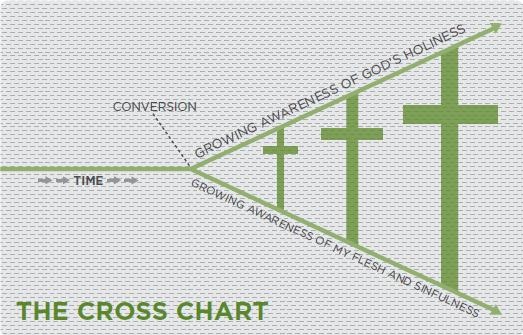
Therefore, New Calvinists communicate within the context of this dualism: the cross story, or your story. It’s either all you, or all God in sanctification. It is either the Cross Chart illustration or a chart that notes some goodness/grace within you. We call this the Either/Or hermeneutic. New Calvinist preaching /teaching well rarely present a metaphysical balance/middle ground/alternative perspective accordingly. The messages will always, in some way, merely contrast total depravity and God’s holiness.
In regard to believing that justification and sanctification are one and the same, we call this the Missing Transition communication technique. In teaching and preaching, New Calvinists continually transition between elements of justification and sanctification without a transition in subject as if they believe the two are one and the same. And that’s exactly what they believe. This has the effect of Christians functioning as if there is no sanctification due to the proverbial out of sight—out of mind consequence. While rejecting the idea of no sanctification when verbalized, that’s how they function because their mental data lacks sanctification wisdom. And be sure of it: this is by design.
New Calvinists also employ terminology that leads followers into assuming that their doctrine is normal. An example is, “heart change.” The heart speaks of that which is inside of us, right? The following New Calvinist illustration, again, THEIR OWN, illustrates that this is deception (Click to enlarge if necessary):

If we can do no work other than seeing our own depravity more and more, how does the heart on the other side of the chart pertain to us? If we change, would that not prevent us from understanding reality because there is less and less of our own depravity to see? Reformation epistemology must exclude any improvement or grace inside of us; otherwise, by their own definition, reality cannot be known. Obviously, “heart” does not pertain to our “heart” per se. It’s assumptive terminology. It plays on the known assumptions of others.
This brings us to the fact that Reformers, both old and new, seek to create a completely different reality of thought and metaphysics in order to control their followers. They also rewrite church history to match this created reality of their own making. Since reality is Christocentric, and all life must be found in the knowledge of the “Sun,” to the degree that we emphasize anything else other than the life-giving rays of the “Sun” (Son), we diminish true life.
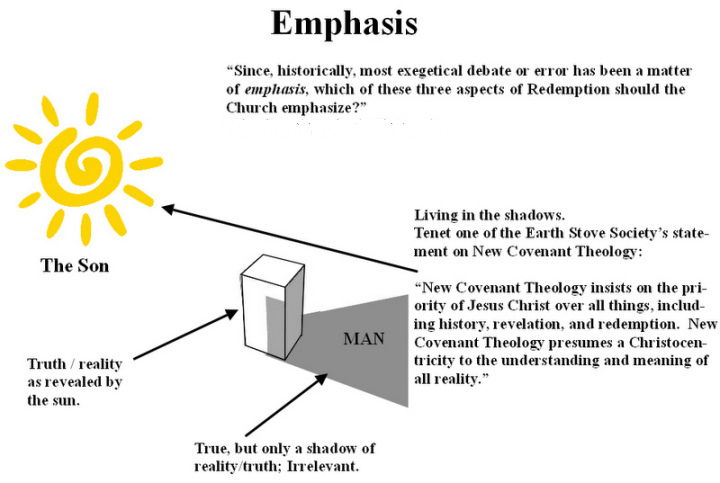
This enables New Calvinists to posit all things true, such as the new birth, “in us” terminology, and the other members of the Trinity while pointing to the whole issue of “emphasis.” Sure, all of those other things apart from Christ are certainly TRUE, but they are forms or shadows of reality (Christ) and to the degree that we focus on them apart from Christ we diminish the life-giving rays. Those things are “good things, but not the best thing.” They are “the fruit, not the root.” “Oh yes, the Holy Spirit’s sanctification is a wonderful truth! But it is a good thing, not the best thing. It is the fruit, not the root.” So, the more you deemphasize the “good thing” for the “best thing,” the better. And obviously, those things are eventually eliminated.
Obviously, the only place left to go from here for New Calvinists is Eastern mysticism. John Piper and other New Calvinists like Tim Keller are not even subtle about their beliefs in such. Neither was the primary forefather of the Reformation, St. Augustine. TANC is presently hard at work unpacking the specific connections between the two and how they function with Reformed theology, especially in regard to realms, manifestations, and spatial birthing. Susan will be bringing an astounding report to the Conference this June. In one of her sessions, she discusses how Augustine thought the Bible was the completion of Platonism.
Let’s conclude with a list of the six communication techniques used by New Calvinists:
1. Assumptive terminology: plays on the known assumptions of others.
2. Either/Or hermeneutic: interprets all wisdom through good and evil.
3. Missing Transition: excludes subject transitions as a way to subtly deny difference.
4. Metaphysical Redefinition of works and non-works.
5. Emphasis: reduces horizontal reality to one life source.
6. Dualism.
paul

 Paul's Passing Thoughts
Reblogged this on Clearcreek Chapel Watch.
LikeLike