The Potter’s House. Sunday, January 13, 2013: Romans 5:6-21; The Gospel, Tenses, and Prepositions
 “Fact is, much Reformed theology posits the idea that we are elected, but then must maintain our election through what we do, or don’t do. You deny that? For crying out loud, simply look at their theology in regard to Israel.”
“Look and do; that’s not how we get salvation, but it’s how we experience salvation.”
“A favorite notion of the Reformed is the idea that ALL people approach the Bible with their own presuppositions and this is unavoidable. Therefore, it is important to choose the right presupposition; i.e., the presupposition that every verse in the Bible is about Jesus. This is pandering protocol to the elder mindset that the masses are mindless and unable to interpret reality objectively.
Pointing out the contrast between what we are finding in Romans through our independent study and our experience of how church has been done in this culture is unavoidable here at the Potter’s House. This ministry is joined at the hip with TANC, which researches Reformed theology and its effects on contemporary Protestantism.
There is a reason we conduct church at home, a reason why we are working through the book of Romans, and a reason why this series is going to be compiled into a commentary on Romans and the gospel (all following visual illustrations can be enlarged by clicking on them).
Susan and I are on a journey. She has been a Christian for 51 years, and I have been a Christian for 30 years. During those years, we worked hard to support the church and donated hard-earned money to those entrusted with what Peter called the “ministry of the word” (Acts 6:4). And what is that ministry? John 21:15 ff.: feed the lambs, tend the sheep, and feed the sheep. From the young to the old, feed them and tend to them.
Susan and I, like many Christians, have put a lot of trust in the theological experts of Western Protestantism over the years to do that job, but what we are finding out in our journey is that we haven’t been told a lot of things, and we don’t like that. And clearly, when the average Christian takes it upon themselves to find out things on their own in order to show themselves approved of God—trouble lingers not far behind. “Unity” now equals, not asking any questions. You must limit your Biblical knowledge of God to whatever the status-qua is of that church or you are a “troublemaker.”
Limiting one’s knowledge of the Scriptures in order to fit in and be accepted is a bad idea, and in the Bible study we attended yesterday at the Church of the Messiah, Susan and I were quite surprised to learn what probably took place at the last supper in regard to what we refer to as “communion.” I did some poking around on the Googleberg press and found one teacher who pieced together what happened at the last supper, as documented in the New Testament, and compared it with how the Jews traditionally celebrate the Passover. But anyway, Susan and I looked at each other with the Who knew? deer-in-the-headlight look.
I’m not the one saying the following; I am paraphrasing from some video’s I was watching on the Googleberg press yesterday. John Piper stated that he is glad that many countries are closed societies because it keeps American Christianity out. He said that; not me. Paul Washer stated that Christian churches overseas tell him to go back to America and request that our missionaries stay home. These guys are saying that; not me. Why is this? My brothers and sisters, it is because the American church is dumbed-down biblically. The Protestant fruit does not fall far from the Catholic tree. This is by design. This follows a basic philosophy that drives doctrine.
People email me about evangelicals giving credence to Catholic teachers. Well, of course they do, and I believe we will see this more and more as Protestants return to the Catholic Church which is also predicated on the spiritual ignorance of the masses. Two different doctrines, but based on the exact same philosophy—that’s why the results are the same. I’m beginning to receive emails now on the most recent sex scandal; get this, at Bob Jones University and another school associated with it.
When is enough going to be enough? After being led by a Christian academia that is matched by none, it’s not getting better—it’s getting worse. Yes, the neo-Calvinism movement is growing, but not with new converts—they are stealing congregants that are completely defenseless against this doctrine due to the fact that they have been dumbed- down by Reformed Light. Authentic Calvinism is the new novelty, but it will dumb-down the American church even more than it is now with present results on steroids.
So what does this have to do with Romans 5:6-21? EVERYTHING! Christians in our day who are dumbed-down by Reformed Light do not know the difference between justification and sanctification. Now they are being led into authentic Calvinism that will teach them that there is no such thing as sanctification at all! I believe many mainline pastors of our day will let New Calvinism into their churches due to the fact that they have not properly trained their parishioners—it’s a matter of if you can’t beat them, join them. They know that if they don’t play along—they will lose their congregation.
Christians in America are asked to remain stateside and wallow in our own filth because we do not even know who we are in Christ. Since the advent of Billy Grahamism, no word has been used more in the church than “gospel.” It has become some kind of generic word that can take the place of any and every verb, noun, adjective, etc. in any sentence. But yet, ignorance concerning the true gospel has never been more prevalent. As one parishioner said to me about trying to ascertain what was going on in their church with their new pastor, “We don’t have the answers to any of the questions, and we aren’t even sure that we even know the right questions to ask.”
Obviously, other countries don’t want our gospel. Why? Because it has no sanctification. They may not know to articulate it in that way—they simply see the results.
Well, Romans five is very much about who we are in Christ, and it doesn’t match with what’s in vogue. The idea is NEWNESS, not “sinners saved by grace.” Throughout Romans five we have strong contrast: who we were verses who we are now. Regardless of any objections, drawing conclusions from tenses in the Bible is part of proper exegesis and recognizing the Bible’s authority. Christ used a Hebrew tense to argue for the resurrection (Matthew 22:23-33). And we will therefore take biblical tenses seriously in our study:
5:1—Therefore, since we have been justified by faith, we have peace with God through our Lord Jesus Christ. 2 Through him we have also obtained access by faith into this grace in which we stand, and we rejoice in hope of the glory of God.
Romans five is full of tenses that aid in describing who we are as Christians. We have been justified by faith. Past tense. Therefore, we have peace with God through Christ. Present tense. We were justified in the past and therefore are presently reconciled to God. We are no longer his enemies. We have obtained access to His grace through that same faith, and in that we rejoice in the hope we have. We stand in this grace, and the certainty of it is the bases of our hope and joy. To the degree that we are uncertain of our standing, we lose hope and joy. Knowing the certainty of our standing in His grace is critical for present hope and joy. Listen carefully to how Kenneth S. Wuest interprets these two verses in his expanded translation of the New Testament:
Having therefore been justified by faith, peace we are having with God through our Lord Jesus Christ, through whom also our entrée we have as a permanent possession into His unmerited favor in which we have been placed permanently, and rejoice upon the basis of hope of the glory of God.
In these verses, we have some interesting words. “Access” is a Greek word that has the idea of being granted permission to enter into an important place such as the company of a dignitary. “Into” is the Greek preposition eis, and denotes moving into something. In this case, “grace” which of course means “unmerited favor.” The preposition “in,” as in “which we stand” (referring to grace) denotes a rest, or no movement unlike eis which means to “move into.” So, by faith, we are given access to grace and we move into it. But once we are in grace, we stand. Look at the illustration below and imagine that the box is grace.
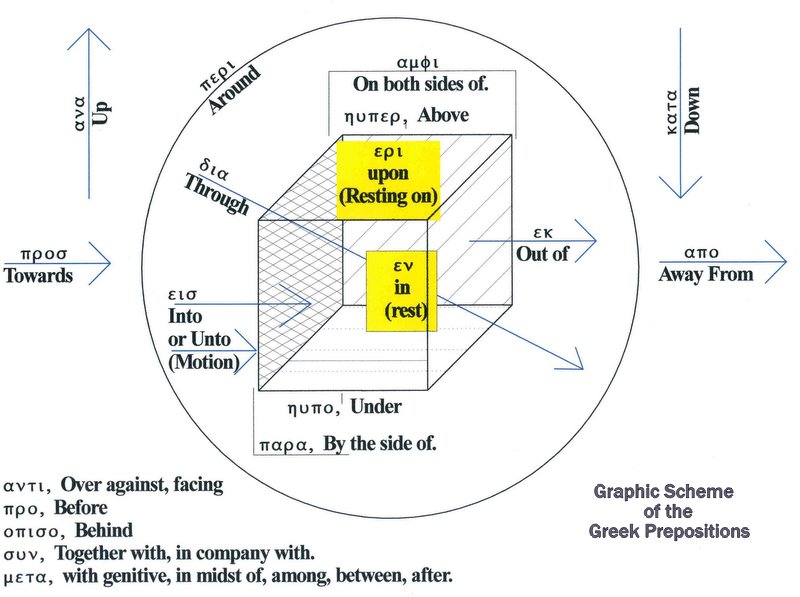 If we stand in unmerited grace, there is no getting out of the box. There is no keeping ourselves there by doing anything because we cannot receive any merit for being there. Said another way, living by faith alone can’t keep us there because then we are receiving merit for maintaining our just standing by faith alone. And certainly, we can’t sin our way out of the box because we are there by grace to begin with. We’re just there, and there is no moving out. You can move in, but there is no moving out. This is why Wuest emphasizes permanence in his expanded translation. What we learn in these first two verses destroys two popular ideas about the gospel in our day: that our justification will not be completely revealed until a last judgment, and the gospel is merely an “announcement.” No, it is a calling to gain access to permanent grace by faith alone. Fact is, much Reformed theology posits the idea that we are elected, but then must maintain our election through what we do, or don’t do. You deny that? For crying out loud, simply look at their theology in regard to Israel.
Last week we discussed verses 3-5, and in this message, I want to look at verses six through eight next. Starting with verses one and two can serve as the first point of this message.
Romans 5:6—For while we were still weak, at the right time Christ died for the ungodly. 7 For one will scarcely die for a righteous person—though perhaps for a good person one would dare even to die— 8 but God shows his love for us in that while we were still sinners, Christ died for us.
We “were” “weak,” past tense, and we “were” “sinners,” past tense. Both of these are in the past tense. We are not “sinners” saved by grace. We are saints saved by grace. Paul continues:
Romans 5:9—Since, therefore, we have now been justified by his blood, much more shall we be saved by him from the wrath of God. 10 For if while we were enemies we were reconciled to God by the death of his Son, much more, now that we are reconciled, shall we be saved by his life.
Paul’s point here is that if Christ died for our sins to reconcile us to God when we were God’s enemies, now that we are reconciled, how much more are we saved from His wrath by Christ’s resurrection life. We died with Christ, and are raised with Him—the apostle delves into this much deeper later on in his letter to the Romans. Don’t miss this; in our day, there is the propagation of the idea that our position changes when we are saved, but not who we are, or said another way, our nature is not changed. Not so. We are saved (from the ills of sin) in more and more abundance by the power of Christ and the power that raised Him from the dead after he died for our sins:
Ephesians 1:15—For this reason, because I have heard of your faith in the Lord Jesus and your love toward all the saints, 16 I do not cease to give thanks for you, remembering you in my prayers, 17 that the God of our Lord Jesus Christ, the Father of glory, may give you the Spirit of wisdom and of revelation in the knowledge of him, 18 having the eyes of your hearts enlightened, that you may know what is the hope to which he has called you, what are the riches of his glorious inheritance in the saints, 19 and what is the immeasurable greatness of his power toward us who believe, according to the working of his great might 20 that he worked in Christ when he raised him from the dead and seated him at his right hand in the heavenly places, 21 far above all rule and authority and power and dominion, and above every name that is named, not only in this age but also in the one to come.
Our position is not only changed, who we are is changed, and we are enabled to appropriate the power that has been granted to us in salvation—to experience it. And let there be no doubt about it: this is primarily experienced by studying the Scriptures and applying that knowledge to our life; in a word, OBEDIENCE. The apostle Paul states elsewhere that we strive to make the experience of salvation our own (Philippians 3:12). His love is perfected in us through keeping His word which results in assurance of salvation (1John 2:5).
In verse twelve, and for the second time in chapter five, Paul starts a new line of thought with the phrase, “More than that.” In verse three, Paul uses the phrase to illustrate that we just don’t stand in grace passively, but that it enables us to look at life in a whole new way; e.g., we rejoice in trials because we understand that it is now a process that enables us to experience the power of our salvation in deeper ways leading to greater hope and assurance. I believe that when we are saved we are infused with an initial exhilaration and assurance, but if we do not proceed in aggressive sanctification in putting on Christ (Ephesians 4:20-24), that zeal will wane. This is what happened to the church at Ephesus, and Christ therefore instructed them to return to the works that they had previously practiced (Revelation 2:4,5).
So, here in verse 11, what is this, “More than that”? Paul returns to one of his initial points concerning having peace with God. We are to rejoice in what seems to be Paul’s primary concern in all of this—we have been reconciled to God the Father. Paul is making this the paramount importance of the salvation subject of this context. Look, every verse in the Bible is not about Christ. Salvation is Trinitarian. We baptize in the name of all three Trinity members. Like all gospel aberrations throughout human history, they come part and parcel with an eclipsing of two Trinity members, and the Reformed tsunami of our day is no exception. Geoffrey Paxton, one of the core four of the Reformed think tank that launched New Calvinism circa 1970, had this to say about the relationship between Christ and the other two members of the Trinity:
Luther and Calvin did not simply stress Christ alone over against the Roman Catholic emphasis on works-righteousness. The Reformers also stressed Christ alone over against all—be they Roman Catholics or Protestants (29) — who would point to the inside of the believer as the place where justifying righteousness dwells. Christ alone means literally Christ alone, and not the believer. And for that matter, it does not even mean any other member of the Trinity! (Geoffrey Paxton: The Shaking of Adventism: p. 41. Baker Book House 1978).
Though this statement seems shocking, it is, in fact, the Reformed mindset in regard to the Trinity. Likewise, in more contemporary fashion, even the highly lauded John MacArthur Jr. stated the following:
Rick Holland understands that truth. This book is an insightful, convicting reminder that no one and nothing other than Christ deserves to be the central theme of the tidings we as Christians proclaim—not only to one another and to the world, but also in the private meditations of our own hearts (John MacArthur: Forward to Uneclipsing The Son; Rick Holland 2011).
The pastor who makes anything or anyone other than Christ the focus of his message is actually hindering the sanctification of the flock. Second Corinthians 3:18 describes in simple terms how God conforms us to the image of His Son: “And we all, with unveiled face, beholding the glory of the Lord, are being transformed into the same image from one degree of glory to another” (emphasis added). We don’t “see” Christ literally and physically, of course (I Peter 1:8). But His glory is on full display in the Word of God, and it is every minister’s duty to make that glory known above all other subjects (Ibid).
Though much could be said here in regard to this statement, suffice to say that prayer is a private meditation to say the least, and we are specifically instructed in Scripture to address our prayers to God the Father. Moreover, concerns about the Father being eclipsed by the Christocentricity of Reformed doctrine has also been expressed by Barry E. Horner on page 192 of Future Israel and the book, The Forgotten Father by Thomas A Smail.
Christ dying for the primary purpose of reconciling us to the Father is a major biblical theme, and the Father also works in our ongoing salvation experience. Though we receive grace in all fullness when we are saved, as we work with God, the Son, and the Holy Spirit to separate ourselves from the world more and more (sanctification) in the way we think and do, more and more of salvation’s power and joy is experienced. The Father is always working (John 5:17).
We now move on to verses 12 and 13:
Romans 5:12—Therefore, just as sin came into the world through one man, and death through sin, and so death spread to all men because all sinned— 13 for sin indeed was in the world before the law was given, but sin is not counted where there is no law.
Go back to our box illustration:
We are using this box to illustrate where we stand in grace; the Greek en, if you will. In that box, there is no law. And where there is no law, let me put it this way: SIN DOESN’T COUNT. When you challenge someone that we are not “sinners” (those who sin as a lifestyle) saved by grace, and they contest your assertion with the rhetorical question, “Did you sin today?” answer with another question: “In regard to grace or law?” They won’t know how to answer because New Calvinists don’t understand the very gospel they claim. We cannot sin in either because we are no longer under the law and there is no sin in grace because there is no law in grace. The sin that we sin in sanctification is not a lifestyle of sin and is a completely different matter. “Sinners saved by grace” is an oxymoron accordingly. In these verses, Paul reiterates his Galatians argument that Abraham was counted righteous 400 plus years before the law was given by Moses.
But before we move on, and still using our visual illustration, let me say something about the blessings of grace. If we stand in grace, are there blessings? And will we experience those blessing by just standing there and doing nothing? Where are the blessings? Go with me to James 1:25:
But the one who looks into the perfect law, the law of liberty, and perseveres, being no hearer who forgets but a doer who acts, he will be blessed in his doing.
Looking “into” is eis, but the blessings are “in” (en) the “doing.” Look and do; that’s not how we get salvation, but it’s how we experience salvation. And if you don’t experience salvation, your salvation is in doubt. And as an aside, the Greek preposition for looking into is where we get the word eisegesis (the process of interpreting a text or portion of text in such a way that it introduces one’s own presuppositions). We get exegesis from ek, which means from, or out of. This is the idea that ALL ideas come from the text and are not skewed by presuppositions or agendas. A favorite notion of the Reformed is the idea that ALL people approach the Bible with their own presuppositions and this is unavoidable. Therefore, it is important to choose the right presupposition; i.e., the presupposition that every verse in the Bible is about Jesus. This is pandering protocol to the elder mindset that the masses are mindless and unable to interpret reality objectively.
Very well; therefore, inform them that your presupposition is exegesis. Also inform them that the Bible teaches its own set of presuppositions that are to be used to interpret other Scriptures. So agree with them, but clarify. And if a Christocentric approach is efficacious it seems to me that this would have been an opportunity for James to plainly say so. But he didn’t.
Another item worthy of mention in the arena of the gospel and prepositions is the following illustration that depicts the Reformed gospel construct:
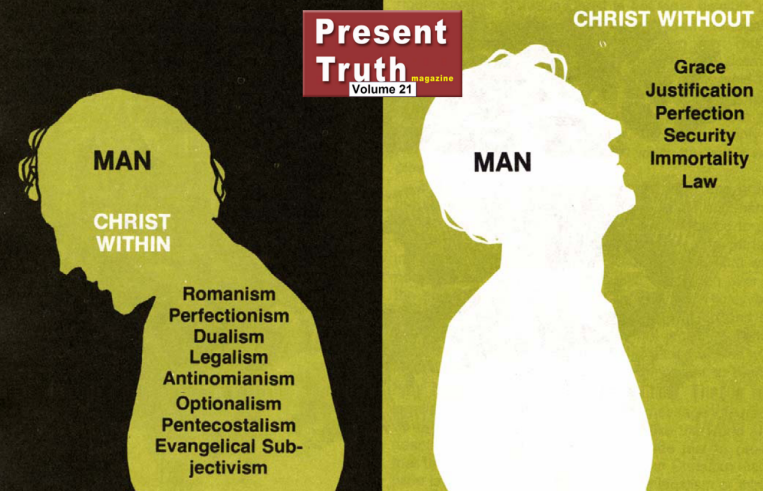
This illustration is known as the often touted, the centrality of the objective gospel outside of us. This propagates the idea, which is very Reformed, that all grace must remain completely outside of the believer or Luther’s alien righteousness. When grace is seen as inside of the believer, this is called “infused grace” and tagged as a false gospel by the Reformed. Any inside considerations are considered subjective and the root of all evil. Furthermore, since the Reformed see justification and sanctification as the same thing, or a “chain” that links justification to glorification—any infusion of grace within us makes us participants in our own justification:
This meant the reversal of the relationship of sanctification to justification. Infused grace, beginning with baptismal regeneration, internalized the Gospel and made sanctification the basis of justification. This is an upside down Gospel (John Piper: Desiring God blog, June 25, 2009 entitled; Goldsworthy on Why the Reformation Was Necessary).
This statement alone, if you think it through carefully, makes the case for the accusation that the Reformed gospel is progressive justification. But if grace cannot be separated from gospel, and we “stand” “en” grace, then it is impossible for us not to be infused with grace. This is our only hope for glory, “Christ en us” (Colossians 1:27). How the Reformed claim that we apply this outside of us gospel to real life is a whole other story that will be the subject of one of my sessions at this year’s TANC conference. Suffice to say for now that mysticism is the only place you can go when this construct is prescribed.
Let’s conclude by reading the apostle’s final point in chapter 5:
Romans 5:14—Yet death reigned from Adam to Moses, even over those whose sinning was not like the transgression of Adam, who was a type of the one who was to come.
15 But the free gift is not like the trespass. For if many died through one man’s trespass, much more have the grace of God and the free gift by the grace of that one man Jesus Christ abounded for many. 16 And the free gift is not like the result of that one man’s sin. For the judgment following one trespass brought condemnation, but the free gift following many trespasses brought justification. 17 For if, because of one man’s trespass, death reigned through that one man, much more will those who receive the abundance of grace and the free gift of righteousness reign in life through the one man Jesus Christ.
18 Therefore, as one trespass led to condemnation for all men, so one act of righteousness leads to justification and life for all men. 19 For as by the one man’s disobedience the many were made sinners, so by the one man’s obedience the many will be made righteous. 20 Now the law came in to increase the trespass, but where sin increased, grace abounded all the more, 21 so that, as sin reigned in death, grace also might reign through righteousness leading to eternal life through Jesus Christ our Lord.
The point that I would like to close with is the fact that we are declared righteous, and made righteous by the one obedient act of Christ on the cross. Paul also stated the following in Philippians 2:8;
And being found in human form, he humbled himself by becoming obedient to the point of death, even death on a cross.
We are not declared righteous because Christ lived a perfect life that was imputed to our sanctification because it finishes justification, another hallmark of Reformed theology. We are made righteous by His death alone. The old us died with Him, and we have been raised in the same power of His resurrection. We are new creatures created for good works (Ephesians 4:23, 2Corinthians 5:17). We were under the law and outside of grace, but now we stand en grace.
What we observe here in Romans five flies in the face of the present-day doctrinal tidal wave overtaking the American church. I would be utterly remiss in not articulating the difference as a way of teaching through antithesis (a method commonly used by Jesus). The Reformed doctrine of our day turns truth completely upside down. It posits a final justification that is yet future; it posits the idea that Christians are not recreated into new creatures; it denies sanctification as separate from justification—making justification progressive; it teaches that the obedience of Christ replaces our obedience in sanctification; it replaces our present goal of pleasing God with a striving for a final justification; it turns study for life application into gospel contemplationism; it replaces exegesis with eisegesis; it replaces assurance through obedience with assurance through contemplationism.
Luther, in his Heidelberg Disputation, the magnum opus of the Reformation, stated that the Christian is indifferent to what works take place in his life because it is Christ doing them anyway. Does that mean that grace abounds more when we sin? Should we be indifferent to good works in our Christian life? We look at the issues of laxness regarding our secure position and its relationship to obedience in chapter six.


 Paul's Passing Thoughts
Reblogged this on Clearcreek Chapel Watch.
LikeLike
Tenses in the greek have more to do with a matter “state” than actual “time”. Nowhere is this more realized than in the present tense. When we “are saved”, present tense, it means that from each moment to moment we currently exist in that state of “saved” or “justified”.
New Calvinists, however, define present tense as a “continuing action”. But what they are doing is confusing present tense with the present participle, so “ye are saved” becomes “ye are being saved”, and “ye are justified” becomes “ye are being justified”. Rather that simply being in a state of current existence, it then becomes a “progressive” continuing action that happens over and over again. You can see how this then supports their theoloogy of having to preach the gospel to ourselves every day.
LikeLike
Andy,
This is a very important discussion. Do you feel that some English translations reflect an ongoing process rather than a fixed position as seen in the Received texts? Are there any actual ESV examples where movement is reflected rather than state?
LikeLike
1 Corinthians 15:2 immediately comes to mind. The context in the first verse the Gospel is in view.
KJV “By which also ye ARE SAVED, if ye keep in memory what I preached unto you, unless ye have believed in vain.”
NIV “By this gospel you ARE SAVED, if you hold firmly to the word I preached to you. Otherwise, you have believed in vain.”
NASB “by which also you ARE SAVED, if you hold fast the word which I preached to you, unless you believed in vain.”
New Living Translation “It is this Good News THAT SAVES you if you continue to believe the message I told you—unless, of course, you believed something that was never true in the first place.”
ESV “and by which you are BEING SAVED, if you hold fast to the word I preached to you–unless you believed in vain.”
In both the Textus Receptus and Wescott-Hort the word for saved is σωζεσθε, present passive indicative. But notice the ESV, by inserting the word “being”, makes the tense a present participle. This is clearly a purposeful mis-translation, and would support the New Calvinist theology that the gospel saves us over and over again.
LikeLike
Andy,
See, this is what I am saying. We would really like to get this sort of thing into the conference. You still thinking it over? It goes without saying that their Bible of choice does this. I know you don’t consider yourself a scholar, but what scholars are calling out the New Calvinists on this? Hey, if the peanut gallery wants better, well, then somebody should have spoken up. Why should we wait for Christian academia to set the agenda? Baloney. If they won’t do it the layman need to.
LikeLike
Andy,
I guess the thing I am wondering about is the fact that the vast, if not all of our translations from from either Rome or the Reformers. Rome speaks for itself, and the Reformation was clearly founded on progressive justification. The Bible that first came to our shores here in America was the Geneva Bible. Yikes! I wonder about this.
LikeLike
And looking again at that NLT rendering, I even qustion the the phrase “that saves”, because that almost makes it sound like it is a continuting process as well. A lot of my New Calvinist friends like to quote from the NLT as well as the ESV.
LikeLike
The Tindale Bible (upon which the KJV was based) caused quite a stir because it directly challenged the authority of Rome. Tindale was burned at the stake because he wanted to use words such as assembly, elder, love, and repent rather than Rome’s ideas of Church, Bishop, charity, and “do pennance”. Words mean things. It is unfortunate that a lot of “Rome” got inserted back in to the KJV despite Tindale’s efforts. Tradition has a lot to do with that. Nevertheless, I trust the KJV’s accuracy the most over ANY modern translation!
LikeLike
Sorry, that should be “Tyndale” in my previous post.
LikeLike
Andy,
Dunno, he was a little too close to Luther for my comfort. Luther totally creeps me out.
LikeLike
Satan’s tactic has always been to attack the Word of God. His lie from the beginning was “Hath God not said…”.
LikeLike
Andy,
Isn’t something the way God just didn’t install a heavenly outpost on Earth with the perfectly preserved word in every language. We are totally right where he wants us: in the midst of the fray.
LikeLike
KJV “By which also ye ARE SAVED, if ye keep in memory what I preached unto you, unless ye have believed in vain.”
NIV “By this gospel you ARE SAVED, if you hold firmly to the word I preached to you. Otherwise, you have believed in vain.”
NASB “by which also you ARE SAVED, if you hold fast the word which I preached to you, unless you believed in vain.”
New Living Translation “It is this Good News THAT SAVES you if you continue to believe the message I told you—unless, of course, you believed something that was never true in the first place.”
ESV “and by which you are BEING SAVED, if you hold fast to the word I preached to you–unless you believed in vain.”
This is blowing my mind. I would love to see many other such obvious examples.
LikeLike
Since you are dealing with Romans right now, Romans 4:20 bears looking at:
Referring to Abraham, “He staggered not at the promise of God through unbelief; but was strong in faith, giving glory to God; ”
The verb “was strong” is the word ενεδυναμωιθη, aorist indicative passive, and it means to empower. The aorist tense is kind of like a “snapshot” view. It is the simplest way of describing something that happened. “[T]he action is started and concluded at the same time, or…the action is focused on a single point in time, or…the action simply occurs without reference to its duration or lasting effect.” (wikipedia) Abraham was strong or empowered. Simple straightforward. The phrase “in faith” is interesting because faith is a dative case noun, meaning is is the agent by which something happened. In this case, faith is the agent by which Abraham was empowered. The last phrase of the verse shows the result, Abraham’s empowerment by faith in God gave glory to God.
Notice how the ESV translates this:
“No distrust made him waver concerning the promise of God, but he grew strong in his faith as he gave glory to God, ”
Here again we do not have a text issue; the text is the same in Wescott-Hort as it is in Textus Receptus. The ESV has twisted the intepretation to make it say something different. Here we are being taught that as Abraham continued to give glory to God the stronger his faith grew. Notice it says “he GREW STRONG”, implying a progression.
For argument’s sake, let’s see how other versions translate this verse just as a comparison:
NIV
“Yet he did not waver through unbelief regarding the promise of God, but WAS STRENGTHENED in his faith and gave glory to God,”
NASB
“yet, with respect to the promise of God, he did not waver in unbelief but GREW STRONG in faith, giving glory to God,”
NLT
“Abraham never wavered in believing God’s promise. In fact, his faith grew stronger, and in this he brought glory to God.”
It is important to note that the whole context of the passage is about Faith being counted for righteousness. It is by faith that we receive the gift of grace, of salvation. We are justified by faith. Paul’s point is that Abraham’s FAITH is what made him righteous before God. His faith empowered him and that gave glory to God. And this happened at a specific point in time. Abraham believed God and is was counted to him for righteousnes. Period. It happened. One time. The ESV would seem to imply that Abraham’s faith grew over time (progression) as he gave glory to God. Sorry that this comment is so long-winded. 😦
LikeLike
Andy,
I think this has relevance in regard to their theology that faith grows as we give glory to God; ie, our faith only grows through gospel contemplationism. I’m not sure that faith grows per se, James seems to say that it is “perfected” through obedience. In other words, faith drives obedience and then obedience reinforces faith which leads to assurance. Calvinists believe that obedience has nothing to do with faith, but that it is the fruit of justification via giving glory to God. The ESV version you have cited here seems to lean the reader in that direction. Also, Calvin and Luther both believed that faith is a lifeless instrument that God uses to work through us. The instruments capacity is increased as we give glory to God. Again, obedience doesn’t contribute to salvation–salvation has been granted in full, but it enables us to experience salvation, and with that experience comes assurance. Calvinism completely circumvents that sanctification process and replaces it with preaching the gospel to ourselves everyday. If Calvinism doesn’t keep people out of the kingdom altogether, it saps them of their witness all together. The BLESSINGS are IN the doing (James 1:25). This is why Luther and many other of the Reformers rejected the book of James. James does severe violence to the Reformed gospel construct.
LikeLike
You said: “faith drives obedience and then obedience reinforces faith”
Again, this is true concerning Abraham and is consistent with the context. Abraham believed God (faith) and it was counted to him for righteousness (justification). This faith led him to obedience such that 40 some odd years later he was obedient to God to the point that he was going to go through with sacrificing that promised heir when God told him to.
LikeLike
….and he didn’t understand why, but the Hebrew writer states that he reasoned that God would resurrect him. At any rate–hardcore trust.
LikeLike