lydiasellerofpurple@yahoo.com said, on November 29, 2012 at 12:54 PM
Paul, this is a perfect example of the “either/or” false dichotomy of Calvinistic thinking. I know seekers who also believe this because this thinking has permeated Christendom since the Reformation: Sinless perfection vs horrible sinner.
. The seekers just use another problematic foundational premise to excuse it away we can call cheap grace: Christ hung on the cross so you could sin in peace!
The John McArthur quote is priceless! Talk about cognitive dissonance.
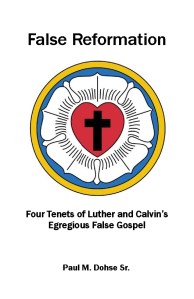
“The willful present-day ignorance of Reformed history and substance is absolutely astounding, but what the church must primarily come to grips with is the fact that the Reformation gospel itself has always been fundamentally false”
It is a rewritten history for those who won’t dig deeper. That is why I never trust one source but read around the subject matter. Reformation history is also political and social history.
What is equallly amazing is that some European documents, letters, etc, were not even available to researchers until after WW2 and the last gasp of state church archives were opened. Those who disagreed with Reformatoin doctrines had their writings burned or where fleeing and were not able to publish. I read not long ago about anabaptist writings still being discovered in Eastern Europe. But the information we have now is enough to discredit the Reformation on fruit alone! If their beliefs drove their behavior, then we should be grateful to the deists that founded America.
paulspassingthoughts said, on November 29, 2012 at 1:56 PM
Lydia,
You won’t to get your mind blown? Download “On Being a Theologian of the Cross” by G.O. Forde. It’s a commentary on Luther’s Heidelberg Disputation. Cristocentric hermeneutics came directly from Luther and it’s pure, unadulterated Platonism. EVERYTHING is interpreted through a dualistic prism.
lydiasellerofpurple@yahoo.com said, on November 29, 2012 at 8:35 PM
Paul, I thought you might enjoy this comment left on Peter’s blog about Augustine and the concept of Original sin/guilt which is excellent:
“reading this post, I went back to Adam’s post at SBC Today and read it. I was at ETS but did not get to sit in on Schreiner’s presentation – some other paper captured my attention at that time slot. So many choices…
I think the discussion of original sin and original guilt opens up a far greater discussion that we Baptists have been heretofore avoiding – that of a consistently Christian anthropology.
I have spent the last 8 months in my own research of the Augustinian views of providence and anthropology – the ones we Baptists have inherited from our theological forebears, more or less. It is with Augustine that the doctrines of real or federal original sin originate, as well as original guilt. I contend that such an anthropology is not fully Christian, but is at its root largely Manichaean, as Augustine imported his Manichaean dualism into his interpretation of the Christian faith (along with numerous Neoplatonist assumptions). He arrived at original sin largely due to a mis-translation of Romans 5:12 (“in whom” all sinned instead of “because”) as well as his attempt to answer the question of why evil was present in God’s good world.
Long story short, Augustine “solved” the philosophical problem of evil using Manichaean categories of (eternal) good and (eternal) evil. God became the good principle while humanity became the evil principle. Thus evil, in the greatest theological category switch ever foisted upon the church, became an eternal principle and the way God views humanity “from all eternity” (thus the root of Augustine’s anachronistic infralapsarianism, unconditional election, and irresistible grace). Even though Scripture clearly acknowledges that sin and evil have both a beginning (everything was originally “very good”) and an end (the last 2 chapters of Revelation), Augustine moves evil to eternity by contending that God sees us as ontologically sinners deserving and needing condemnation. To me, this is a gross theological error for numerous reasons, not the least of which is christological (that is a huge can of worms and too long to write here). Suffice it to say that some of our SB theological minds need to do a lot of constructive work in the area of Christian anthropology. We are assuming Augustine’s legacy without closely examining it. I think Adam’s post might help us start the conversation.”

 Paul's Passing Thoughts
Reblogged this on Clearcreek Chapel Watch.
LikeLike
Paul, this is a perfect example of the “either/or” false dichotomy of Calvinistic thinking. I know seekers who also believe this because this thinking has permeated Christendom since the Reformation: Sinless perfection vs horrible sinner.
. The seekers just use another problematic foundational premise to excuse it away we can call cheap grace: Christ hung on the cross so you could sin in peace!
The John McArthur quote is priceless! Talk about cognitive dissonance.
“The willful present-day ignorance of Reformed history and substance is absolutely astounding, but what the church must primarily come to grips with is the fact that the Reformation gospel itself has always been fundamentally false”
It is a rewritten history for those who won’t dig deeper. That is why I never trust one source but read around the subject matter. Reformation history is also political and social history.
What is equallly amazing is that some European documents, letters, etc, were not even available to researchers until after WW2 and the last gasp of state church archives were opened. Those who disagreed with Reformatoin doctrines had their writings burned or where fleeing and were not able to publish. I read not long ago about anabaptist writings still being discovered in Eastern Europe. But the information we have now is enough to discredit the Reformation on fruit alone! If their beliefs drove their behavior, then we should be grateful to the deists that founded America.
LikeLike
Lydia,
You won’t to get your mind blown? Download “On Being a Theologian of the Cross” by G.O. Forde. It’s a commentary on Luther’s Heidelberg Disputation. Cristocentric hermeneutics came directly from Luther and it’s pure, unadulterated Platonism. EVERYTHING is interpreted through a dualistic prism.
LikeLike
Paul, I thought you might enjoy this comment left on Peter’s blog about Augustine and the concept of Original sin/guilt which is excellent:
“reading this post, I went back to Adam’s post at SBC Today and read it. I was at ETS but did not get to sit in on Schreiner’s presentation – some other paper captured my attention at that time slot. So many choices…
I think the discussion of original sin and original guilt opens up a far greater discussion that we Baptists have been heretofore avoiding – that of a consistently Christian anthropology.
I have spent the last 8 months in my own research of the Augustinian views of providence and anthropology – the ones we Baptists have inherited from our theological forebears, more or less. It is with Augustine that the doctrines of real or federal original sin originate, as well as original guilt. I contend that such an anthropology is not fully Christian, but is at its root largely Manichaean, as Augustine imported his Manichaean dualism into his interpretation of the Christian faith (along with numerous Neoplatonist assumptions). He arrived at original sin largely due to a mis-translation of Romans 5:12 (“in whom” all sinned instead of “because”) as well as his attempt to answer the question of why evil was present in God’s good world.
Long story short, Augustine “solved” the philosophical problem of evil using Manichaean categories of (eternal) good and (eternal) evil. God became the good principle while humanity became the evil principle. Thus evil, in the greatest theological category switch ever foisted upon the church, became an eternal principle and the way God views humanity “from all eternity” (thus the root of Augustine’s anachronistic infralapsarianism, unconditional election, and irresistible grace). Even though Scripture clearly acknowledges that sin and evil have both a beginning (everything was originally “very good”) and an end (the last 2 chapters of Revelation), Augustine moves evil to eternity by contending that God sees us as ontologically sinners deserving and needing condemnation. To me, this is a gross theological error for numerous reasons, not the least of which is christological (that is a huge can of worms and too long to write here). Suffice it to say that some of our SB theological minds need to do a lot of constructive work in the area of Christian anthropology. We are assuming Augustine’s legacy without closely examining it. I think Adam’s post might help us start the conversation.”
.http://peterlumpkins.typepad.com/peter_lumpkins/2012/11/young-truett-mcconnell-scholar-drops-a-bombshell-on-southern-baptist-academia-.html#comment-form
LikeLike