Are You a “Church” Member of a Little Geneva?
 “Diverting the saints away from a many-faceted application of truth to the narrow mystic prism of Redemptive Historical hermeneutics is the focused and intentional blitzkrieg of the Reformed oligarchy. The sole purpose of this hermeneutic is to stifle independent thought and free thinking.”
“One should note with much ado that ‘sin’ is anything that Reformed elders say it is. Parishioners often assume that Reformed elders define sin worthy of church discipline by a literal biblical definition. While such naivety is adorable, it is far from reality.”
“And ‘church autonomy’ was not intended to protect either church or state from each other. With Reformed history fresh in their minds, the framers of the constitution sought to prevent cooperation between the two for the expressed protection and well-being of the people.”
“The First Amendment has an ‘ embedded theology’? Really? I will say this as lovingly as I can: if you sign a membership covenant with any church, you need your head examined—the Reformed claim that church membership equals being saved notwithstanding.”
_____________________________________________________________________________
TANC, our organization that is in the process of being formed for the purpose of educating the church about Reformed theology, ultimately seeks to have Reformed theology, and Calvinism in particular, labeled as a cult. That is what we will be aggressively propagating with all diligence. And your support is appreciated.
Like all cults, Reformed theology seeks to control their subjects. But why? The reason stems from ancient spiritual caste systems in which an enlightened minority leads the masses. Proponents will include people who merely lust for power along with those with the best of intentions. Initially, governments and religious institutions were one and the same, ruling on earth in God’s behalf. Supposedly. Large numbers of people will buy into this because it offers them some sort of comfort /security, and it is also easy: “I belong to the fill in the blank ; therefore, heaven is guaranteed no matter what I believe or do.”
When these cults are old and survive a long time, they begin to be classified as “religions.” When individuals start religious movements (and ironically) with the exact same elements, they are often labeled, “cults.” Some cults that are poorly managed, and make bad decisions regarding their ancient presuppositions concerning mankind crash with a big bang. Jim Jones’ “People’s Temple” is a good example of this. Others like the Reformed tradition die a social death, but continue on with acceptable adjustments while retaining the same nomenclature. But from time to time the authentic article will resurface as new movements that have “rediscovered” the “true gospel.” This is the exclusiveness claim that is indicative of all cults.
This spiritual caste system always results in tyranny. How cult leaders manage the ebb and flow of comfort versus tyranny determines whether or not their particular brand will reach religious status, or even that of “denomination.” BUT, the same philosophical ideas that drive every cult are always present and operating. In the “success” thereof, the subjects believe that they are receiving something from the religious caste system (cultic religions/denominations) that they otherwise could not receive from God directly. That’s key—direct access to God =’s NO CONTROL.
The proof is in the pudding and John Calvin’s rule over Geneva is well documented and nothing less than Cult 101. The recent “Neo-Calvinism” surge in the church is merely an excellent contemporary study of the same exact elements that drove the tyranny in Geneva. It is a Geneva that the New Calvinists lust for. The only difference is the pesky separation of church and state that exists in many democracies such as the USA. So, they improvise.
Many New Calvinist “churches” pursue close relationships with local authorities with intentionality. A saved policeman that buys into the theology is considered to be a prized possession in Reformed churches. Such individuals can be used to intimidate unofficially, and in some cases, in a construct that is unlawful. For instance, if a Reformed church wants to ban an individual from church premises because of what they know while posing no objective threat to the safety of the parishioners, such a ban may have no lawful merit. And to obtain a restraining order is a due process that may expose the “church” to information that they do not want known. Here is where a phone call from a local police officer, or in my case, someone claiming to be a Springboro, Ohio police detective comes in handy. Churches, in most states, cannot ban members from the premises that do not pose a physical threat to parishioners or create a disturbance (for example, see the Wall Street Journal report here: http://goo.gl/zgf4R). In-house security details are also becoming popular in Reformed churches. They are used to intimidate and escort individuals from church premises making use of assumed authority by those who submit to their intimidation.
The following are the primary elements of a cult and ever present in Reformed churches as well:
I. Control mechanisms.
A. Small groups.
B. “Accountability”
C. “Mentors”
D. Unearned fast friendships.
a. Part of a reporting structure.
E. Time control.
a. Lots of events scheduled.
II. Love Bombing
A. Love is from the heart and transcends propositional truth.
III. Exclusiveness
A. The “unadjusted,” “underestimated,” “scandalous” gospel.
IV. Authoritative interpretation of truth.
A. The elders are the final authority on what the Bible teaches.
B. Parishioners have no authority to interpret the Bible for themselves.
C. Spiritual growth must include elder preaching.
D. Thinking for yourself is a dangerous stunt that shouldn’t be tried at home.
V. Authority to proclaim salvation status.
A. If the elders proclaim an individual unregenerate, whatever they bind on earth will be bound in heaven.
Reformed theologians control independent interpretation of the Bible through academic intimidation and the Redemptive Historical hermeneutic. To say that most parishioners of our day have been brainwashed into to thinking that they are not qualified to interpret the Bible on their own is a gargantuan understatement. But on top of this, the Redemptive Historical hermeneutic (uniquely of the Reformed tradition) demands a redemptive application for every verse in the Bible. Exegetical propositional truth has been replaced with gospel contemplation and an art (seeing the gospel in every verse of the Bible) reserved for the spiritually enlightened Reformed elders. The totally depraved herd should only be concerned with Jesus saving them more and more each day and not drawing any objective conclusions from the Bible that might disagree with Reformed ideas. Diverting the saints away from a many-faceted application of truth to the narrow mystic prism of Redemptive Historical hermeneutics is the focused and intentional blitzkrieg of the Reformed oligarchy. The sole purpose of this hermeneutic is to stifle independent thought and free thinking.
Yesterday, a reader sent me a review of a new book published from the monstrous New Calvinist propaganda machine which has all but completely polluted mainstream Christianity. A vast majority of Christians now depend on para-Bible information as the “subordinate” truth to live by. While recognizing its subordination to the Bible, they also recognize that they can’t understand the Bible. God’s anointed must interpret it for us.
The email heading was entitled, “Geneva Coming?” Probably not, but only because this is America. However, it is more than fair to say that Calvin’s Geneva was cultish to say the least, and New Calvinists will do everything they can to improvise within the present restrictions. It’s who they are—they can’t help it—they are driven by the same philosophy that drove Calvin. And that is what the new book is about: how to control people with church discipline without getting sued, or at least winning the court case if you do get sued as a church.
This is a necessary book for New Calvinists because what drives their church discipline is not based on a literal interpretation of the Bible—it’s based on controlling ideas and free thinking. Furthermore, non-New Calvinistic churches do not have the intestinal fortitude to stand up against the rampant bogus church discipline plaguing the church. Hence, out of frustration, many seek justice in the civil courts—especially because some of the issues are criminal in nature and not merely civil. In many cases, victims are held hostage at New Calvinist churches; elders disallow departure from membership because the reasons for leaving are “not biblical.” Departure would then result in excommunication. Calvinists believe they have the authority to declare someone unsaved, and whether right or wrong, God will honor it. Hence, to disobey the elders could cause you to lose your salvation. Furthermore, in Reformed circles, to be a member of a church is synonymous with salvation; as one Reformed elder has stated: “Since the church is the Body of Christ, a person cannot be “in Christ” unless he is in the church.” Therefore, to be excommunicated for any reason is synonymous with NOT being “in Christ.” In many states the threat of excommunication to control or stop a decision to leave a church is technically kidnapping. Ohio is a prime example:
Route: Ohio Revised Code » Title [29] XXIX CRIMES – PROCEDURE » Chapter 2905: KIDNAPPING AND EXTORTION
2905.12 Coercion.
(A) No person, with purpose to coerce another into taking or refraining from action concerning which the other person has a legal freedom of choice, shall do any of the following:
(1) Threaten to commit any offense;
(2) Utter or threaten any calumny against any person;
(3) Expose or threaten to expose any matter tending to subject any person to hatred, contempt, or ridicule, to damage any person’s personal or business repute, or to impair any person’s credit;
(4) Institute or threaten criminal proceedings against any person;
(5) Take, withhold, or threaten to take or withhold official action, or cause or threaten to cause official action to be taken or withheld.
(B) Divisions (A)(4) and (5) of this section shall not be construed to prohibit a prosecutor or court from doing any of the following in good faith and in the interests of justice:
(1) Offering or agreeing to grant, or granting immunity from prosecution pursuant to section 2945.44 of the Revised Code;
(2) In return for a plea of guilty to one or more offenses charged or to one or more other or lesser offenses, or in return for the testimony of the accused in a case to which the accused is not a party, offering or agreeing to dismiss, or dismissing one or more charges pending against an accused, or offering or agreeing to impose, or imposing a certain sentence or modification of sentence;
(3) Imposing a community control sanction on certain conditions, including without limitation requiring the offender to make restitution or redress to the victim of the offense.
(C) It is an affirmative defense to a charge under division (A)(3), (4), or (5) of this section that the actor’s conduct was a reasonable response to the circumstances that occasioned it, and that the actor’s purpose was limited to any of the following:
(1) Compelling another to refrain from misconduct or to desist from further misconduct;
(2) Preventing or redressing a wrong or injustice;
(3) Preventing another from taking action for which the actor reasonably believed the other person to be disqualified;
(4) Compelling another to take action that the actor reasonably believed the other person to be under a duty to take.
(D) Whoever violates this section is guilty of coercion, a misdemeanor of the second degree.
(E) As used in this section:
(1) “Threat” includes a direct threat and a threat by innuendo.
(2) “Community control sanction” has the same meaning as in section 2929.01 of the Revised Code.
Effective Date: 01-01-2004
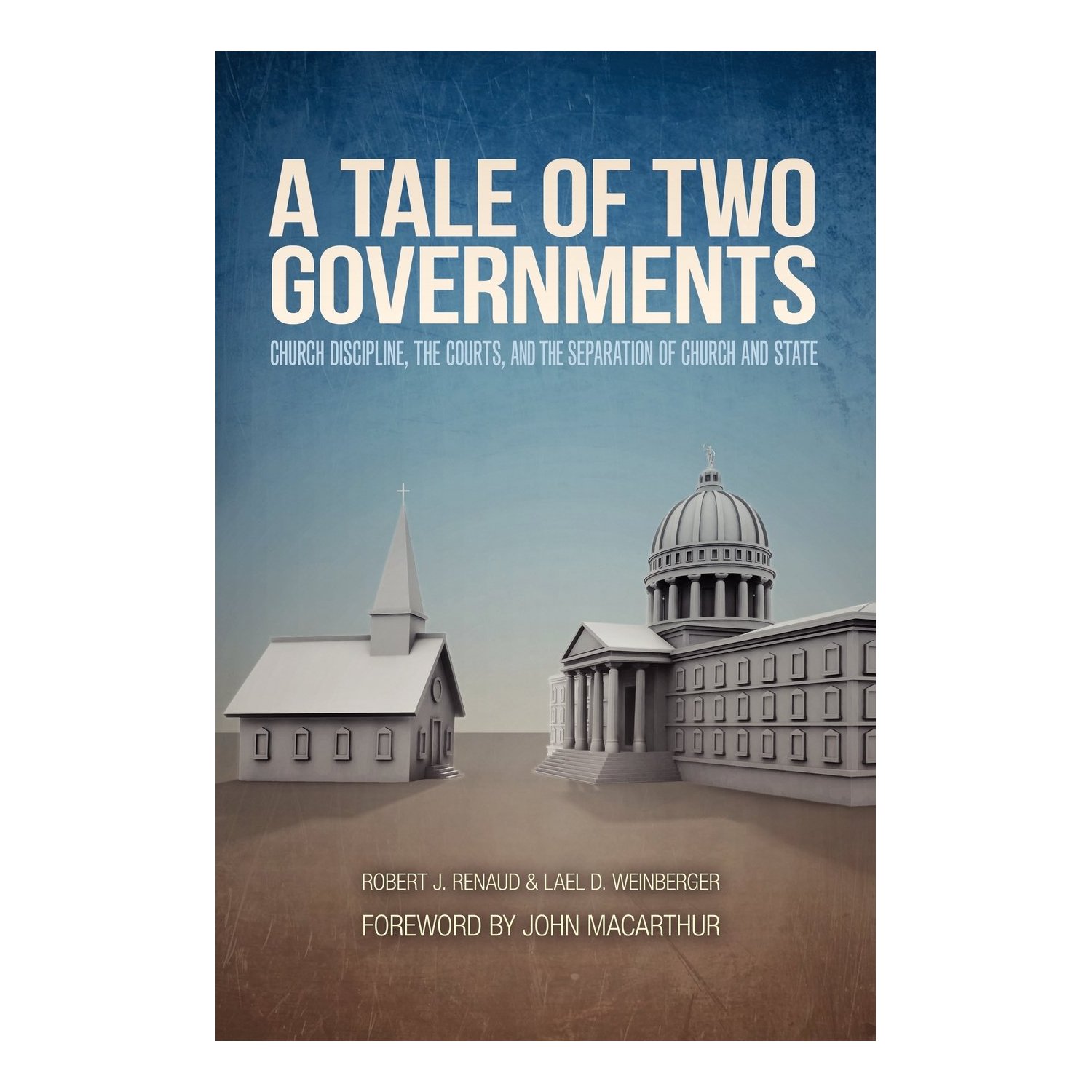
The name of the book that was the subject of the review is, “A Tale of Two Governments” by Robert J. Renaud and Lael D. Weinberger. The review was written by David V. Edling (http://goo.gl/gvPed). Edling is co-author of “Redeeming Church Conflicts”(Baker, 2012) and was the director of church relations at Peacemaker Ministries before his retirement. Peacemaker Ministries was formed to deal with the onslaught of lawsuits resulting from the recent resurgence of authentic Geneva style Calvinism and its tyranny.
The authors and the reviewer bemoan the fact that lawsuits may prevent churches from moving forward with church discipline, and the book apparently offers a clear path to overcoming those fears by implementing protocols that will prevent lawsuits or prevent a negative legal judgment against a church. According to Edling:
While fear of having to interact with the secular courts and fear of man may dampen the zeal to follow the biblical prescription when a church member hardens his or her heart and remains stuck in sin, these authors effectively refute the idea that such excuses hold any validity. The most significant contribution these authors make to life together in the church today is to provide church leaders and members with confidence—confidence that these common fears can be replaced with the knowledge that being biblical is protected by the laws that govern both church and state.
One should note with much ado that “sin” is anything that Reformed elders say it is. Parishioners often assume that Reformed elders define sin worthy of church discipline by a literal biblical definition. While such naivety is adorable, it is far from reality.
Edling continues with the following statement that is chilling to anyone one who knows the real truth about Reformed doctrine and history:
The foundation for their argument is Scripture. They effectively exegete the relevant passages, including an explanation of how Jesus proclaimed he would build his church by giving men “the keys of the kingdom of heaven” (Matt. 16:18-19), that is, the unique authority both to open the kingdom (through the preaching of the gospel) and to regulate its internal administration (through the practice of church discipline, binding and loosing sin). Using a threefold approach of (1) church history (specifically a “high point” review of 2,000 years of church-state relations); (2) a concise review of the common law and American jurisprudence (the development of the current legal doctrine called “church autonomy”); and (3) practical theology (how to keep your church out of court), Renaud and Weinberger deftly weave together their “tale” that leaves the reader with only one conclusion: if we are wise, we need not fear the courts or the reaction of our church members as we fulfill the call of Christ to love his people and build his church as he has directed using church discipline to restore, protect, and keep pure that for which he died.
Did Christ give Reformed elders a “unique” authority to “bind and loose sin” on earth? The apostles claimed no such “unique authority,” but rather constantly referred to the authority of Scripture and the ability of the saints to interpret it for themselves (Acts 17:11). The apostle Paul called on everyday saints to judge what the true gospel is for themselves (Galatians 1:8), and to only follow leaders AS they follow Christ. Furthermore, you can be certain that the authors only cover the “high point[s]” of Reformed history as it is saturated with the blood of those who disagreed with the Reformers. In the same way that people pick their noses in their cars and somehow think others cannot see them, Reformed elders think that the bloody oligarchy of Reformed history cannot be read. And “church autonomy” was not intended to protect either church or state from each other. With Reformed history fresh in their minds, the framers of the constitution sought to prevent cooperation between the two for the expressed protection and well-being of the people.
The reviewer continues with the following statement that can only be said to reveal how ignorant they believe the saints are:
What does it mean for the church to “be wise” from a secular legal perspective in light of the many court cases that have been decided over the years? As these authors summarize, church leaders must be aware of legal principles that will protect the church in its practice of discipline. Failure to stay within these boundaries may leave the church unprotected. The “church autonomy” doctrine is built on the First Amendment’s embedded theology that God established two separate but equal governments, but the First Amendment doesn’t necessarily bar all claims that may touch on religious conduct. To protect the legal distinction church leaders must understand that their jurisdiction to practice discipline depends on following the law. Central to understand is the “implied consent” that exists in a truly voluntary relationship between church and member (typically through formal membership), that an act of discipline must be grounded in a church’s doctrinal commitments that have been clearly articulated and are supported by recognized religious belief and practice, and that the church must have a clearly stated policy for the practice of biblical church discipline (usually set forth in its constitution or bylaws). Further, church leaders must help members understand the limits of confidentiality because church discipline, by definition, requires others knowing of the continuing sin in the life of one who fails to repent and change.
Here is the assertion that the church and the state are two separate “governments” with the church having its own “jurisdiction.” This mentality should send cold chills running up the back of any thinking person while running to reread the membership covenant they signed. The First Amendment has an “ embedded theology”? Really? I will say this as lovingly as I can: if you sign a membership covenant with any church, you need your head examined—the Reformed claim that church membership equals being saved notwithstanding.
In his conclusion, the reviewer states the following:
Consider whether your church may be failing to obey God’s appointed means of soul care through the faithful and consistent practice of redemptive church discipline.
“Redemptive church discipline”? What’s that? The Scriptures never use the term “church discipline” let alone the former. That term should alert you that something may not be exactly right. I address church discipline issues in detail via a free ebook available on this blog: https://paulspassingthoughts.com/wp-content/uploads/2012/04/ebook-church-discipline.pdf and for good measure: https://paulspassingthoughts.com/2012/02/09/new-calvinism-and-hotel-california/
Meanwhile, don’t join a little Geneva. And if you’re in one get out. You’re in a cult. A doctrine/philosophy of control equals cult regardless of the nomenclature.
paul

 Paul's Passing Thoughts
Paul,
If Paul assumed he was saved, why did he write in the very next chapter “Or do you not know that the unrighteous will not inherit the kingdom of God? Do not be deceived: neither the sexually immoral, nor idolaters, nor adulterers, nor men who practice homosexuality,” Here is a man living in unrepentant sexual immorality. Would not one assume Paul would have to regard him as one who would not inherit the kingdom of God?
LikeLike
I agree Paul may have been referring to this man in 2 Cor 1. If that is the case, the evidence would be that Paul now considered him, based on his repentance, a believer. It does not indicate he regarded him a believer when he commanded the church to put him away.
LikeLike
BTW Paul,
This action by the church was not to be undertaken by its own authority. It was to be done in Christ name or with his authority.
LikeLike
In other words, discipline by the church is discipline by Christ.
LikeLike
‘It is, nonetheless, the elders who are to take the leadership in this action:’
Really. How interesting. No elders are ever mentioned in Corinthians except maybe Chloe, who had “people”. (wink). No where does Paul say the “elders” should handle it. You are assuming and reading into it from other Epistles the Corinthians had not read! Paul was writing to the entire church. You are automatically assuming that means elders handle it. You are doing the same thing Noblitts church did with the teaching on Matthew 18 at a pastors conference. Bad form. And one reason more and more are not trusting
Randy, you are going to hate this and totally disagree with it but it is excellent for those who understand the problems with twisting scripture to lord it over:
Click to access straight.pdf
LikeLike
‘This action by the church was not to be undertaken by its own authority. It was to be done in Christ name or with his authoritya’
huh? What is your definition of a “church” or Body of Christ? Lots of charlatans say they are doing things in the Name of Christ. Is this more of the bizarre keys to the kingdom for elders stuff?
LikeLike
I”f issues can be limited to the elders, so much the better.”
Bible interpretation for those who want to lord it over. ADD to the Word to be in authority over people because we have a title conferred by mere men. Matt 18 says nothing about elders or even priests since it was pre church age Jesus teaching.
Sheesh Randy!! You really keep trying to get that “authority over” stuff in there any way you can. You guys are eat up with it.
LikeLike
Here is the bottomline from the discussion. Many churches are not allowing people to simply leave. They are dogging them as to they are accountable and must leave on good terms which means whaatever the elders say are good terms. I am hearing this from many quarters.
A lawyer on another blog give an example of a letter for people to send to a church they are leaving that is into authoritarian practices like many REformed ones are now. This letter is legal and if a church continues to contact the person after receiving the letter by certified mail, they are harassing the person. More and more folks are going to have to do this.
But the main warning we must give folks is to STOP signing membership covenants or agreements. My goodness even Saddleback had them years ago. Do not sign creeds, agreements or anything at any church. Scripture says let your yes be yes and your no, no. These things are almost always allegiance to men who think they own the church body and decide for you your sin. No Holy Spirit needed in these churches, the elders, pastors, apostles or whatever are the Holy Spirit for you.
LikeLike
“Do you really think it is a problem to recognize that people are not really in fellowship with the church if they never attend?”
You don’t see the problem wth that thinking? Many times the “leaders” are charlatans and the folks who do not come are simply not enabling evil anymore. They owe the charlatans no explanation. One reason the “nones” are growing is because many of the 501c3 institutions are cesspools of power politics and greed. It would be a sin to attend. Like SGM and Mars Hill.
Paul is a “none” according to the survey.
LikeLike
Lydia,
“You are assuming and reading into it from other Epistles the Corinthians had not read! Paul was writing to the entire church. You are automatically assuming that means elders handle it. You are doing the same thing Noblitts church did with the teaching on Matthew 18 at a pastors conference. Bad form. And one reason more and more are not trusting.”
You might want to stop telling me what I am assuming since you don’t have a clue what I believe about this issue. “He [or she] who answers a matter before hearing it, it is a shame unto him.” As I recall, you have never actually asked me what I believe about the issue of church polity relative to elder rule. Yet, you freely tell me what I believe about the issue. The problem is you seem to have a problem with any kind of leadership unless it is yours.
When Paul and his companions ordained elders in every church, are we to assume they did not instruct all of them concerning their duties in the same way. As I have stated, this action was to be undertaken by the church, but certainly it was the duty of the elders to take the lead in such matters. Whether you like it of not, someone has to take the lead in the church.
I know you have been associated with Mega churches led by charlatans. I probably detest such organizations at least as much as you do. But that was not what Paul and I were discussing before you horned in. The New Testament Scriptures clearly prescribe disciplinary action in areas where there are those who disobey the Scriptures and remain impenitent, even when the offender is an elder. We can’t just assume that such a practice is wrong because it has been abused.
I am sure there are churches in which the leaders are charlatans. If that is the case, those charlatans are to be rebuked before all so that others may fear. What I am taking about are people who haven’t been in church for years and are still counted as part of the church fellowship. This is the reason the SBC is the largest protestant denomination in the US. There are people on the roll who died years ago.
How do you understand “in Christ’s name, or with Christ’s authority” in 1 Cor 5? I understand it to mean it is to be in accordance with Christ’s Word, the NT Scriptures. Far from giving elders the authority to discipline for any reason, it limits discipline to matters that Jesus himself would forbid.
There is nothing wrong with signing a covenant as long as the covenant is in line with the Scriptures. There have been churches I have refused to join because the covenant tried to bind my conscience where the Word of God did not bind my conscience. To tell people not to align themselves to a church by covenant is like telling couples to forget about marriage and just shack up. If the covenant is biblical to begin with, it can’t be abused. If it says something like, ” ’til death do us part” no matter what, I might be a little suspicious of it.
LikeLike