The New Calvinist Takeover of Southwood Presbyterian Church: Part 15; The Fusion of Justification and Sanctification Can Only Lead to Two Things
 “On the flip side, if sanctification is completely separate in operation, Christians can have an aggressive role in it because it has no bearing on the finished work of justification.”
A lot of New Calvinists have visited the Southwood series with the usual barrage of theological jargon that confuses. This is typical: observers trying to ascertain what the issues are walk away confused; so, time to clarify. This doctrine reminds me of the young old lady optical illusion picture. All of the lines, colors, and forms are exactly the same, but depending how you look at it, it’s radically different.

Hence, the discussion of this doctrine verses orthodoxy with justification and sanctification in the balance is not much different. But what is the big deal? This is, as quoted from The Truth About New Calvinism p. 77:
Third, because the believer’s role is reduced to a point that is not according to Scripture, he/she is deprived of the abundant life in a way God wants us to experience it for His glory and the arousing of curiosity from those who don’t have the hope of the gospel.
Fifth: while reductionist theologies seek to reduce the believer’s role to the least common denominator, supposedly to make much of God and little of man, the elements that attempt to make it seem plausible are often complex and mutating. Therefore, instead of majoring on the application of what is learned from Scripture, believers are constantly clamoring about for some new angle that will give them a “deeper understanding” of the gospel that saved them.
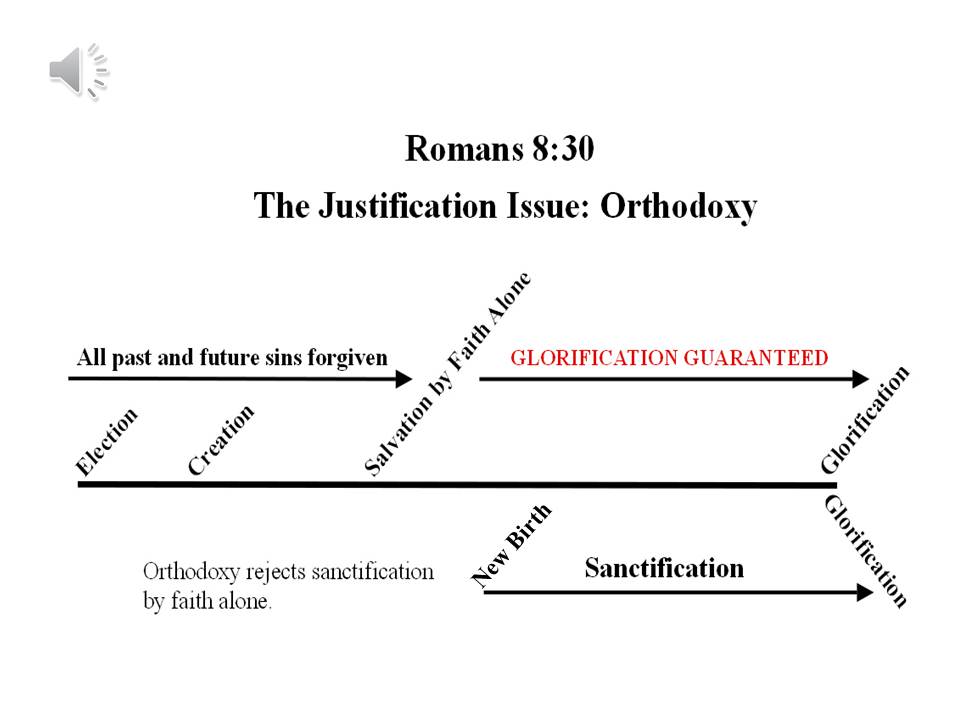
Sanctification IS NOT, as many New Calvinists say, “justification in action” because justification is a finished work. If sanctification is “justification in action,” then justification is not FINISHED, it’s still doing something, which means it’s a progressive work towards glorification, or at the very least a maintaining thereof. That’s works salvation if man does any of it (ie., grace/Christ plus works), and antinomianism if Christ does it all in sanctification. In other words, progressive justification (or what is deceptively called “progressive sanctification” by New Calvinists), or the belief that “sanctification is justification in action,” can only result in two things: works salvation or antinomianism. On the flip side, if sanctification is completely separate in operation, Christians can have an aggressive role in it because it has no bearing on the finished work of justification (click on image to enlarge).
That’s why New Calvinists, in essence, deny the new birth as being an objective recreation that is in us and of us. They believe the new birth is a “formation of Christ” that is displayed through us, but we are still spiritually dead. An actual recreation of our personhood makes it possible to colabor with Christ, and NC don’t like that idea. More on that later, so don’t let it confuse the central issue at this time.
This is the crux of the New Calvinist issue: Brinsmead merely converted Adventist doctrine from works salvation to antinomianism. When Justification is progressive and not a finished work, somebody has to keep the work going, so it’s works salvation. When we do even part of that by keeping the law, that’s Jesus plus works or law-keeping. When Jesus does all of the law-keeping for us (because someone has to keep the process moving forward), we are obviously not obligated to keep the law. In fact, to do so would be to participate in the fruits of justification, which we dare not do (click on image to enlarge).
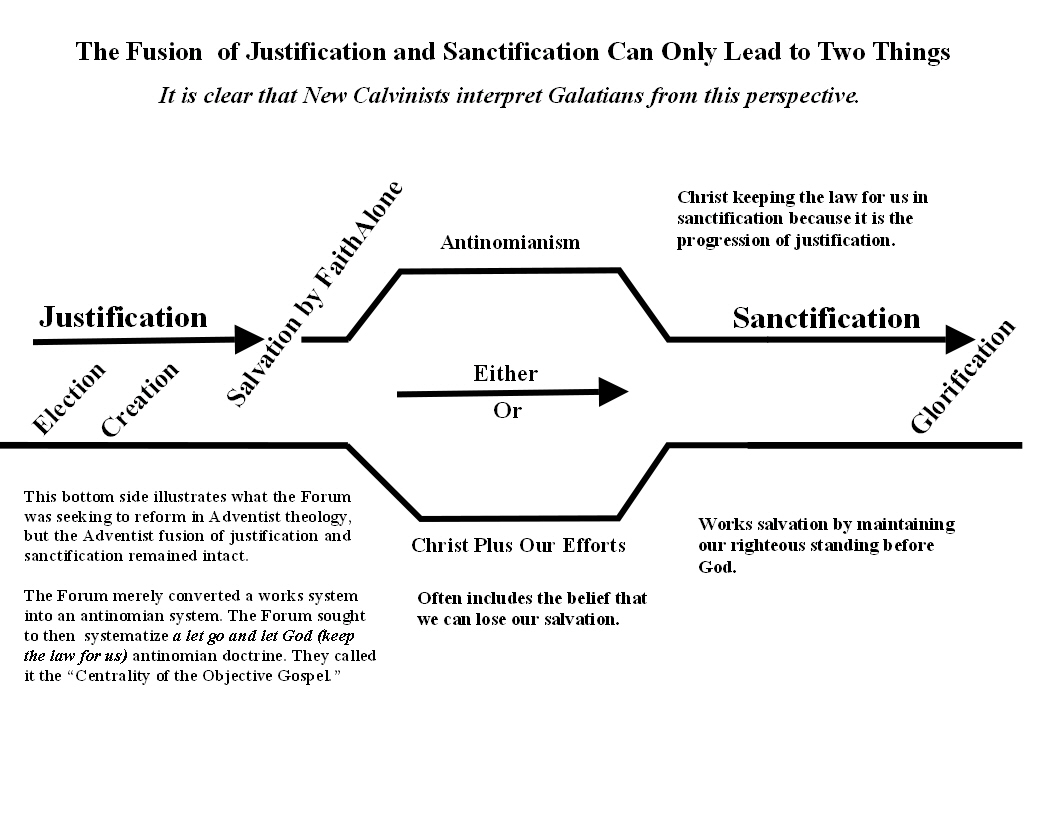
The Forum was seeking to reform Adventist theology, but the Adventist fusion of justification and sanctification remained intact.The Forum merely converted a works system into an antinomian system. The Forum sought to then systematize a let go and let God (keep the law for us) antinomian doctrine. They called it the “Centrality of the Objective Gospel,” and Reformed theologians fell for it, hook, line, and sinker.
In orthodoxy, Christians can aggressively pursue righteousness via the law because we know that it can’t contribute to our justification anyway—it’s IMPOSSIBLE, justification is a finished work. However, can our seeking after righteousness (Matthew 7:24-27) have an effect on how we experience the new birth? Absolutely. One of many aspects of that is seeing God glorified in the eyes of others because of our obedience to the Father. What could feel better? (Matthew 5:16).
paul

 Paul's Passing Thoughts
your romans 8:30 chart confuses me – are you saying that as a result of justification, glorification is guaranteed? and if so, what role does sanctification have in glorification?
LikeLike
Anon,
1. “are you saying that as a result of justification, glorification is guaranteed?” Yes, because both are monergistic. Unless God changes his mind about who He saves, and I think we know the answer to that one.
2. “and if so, what role does sanctification have in glorification?” Role? as in singular? Let me answer in the singular: sanctification is synergistic and glorification, like salvation is monergistic. In regard to the singular consideration of the difference between synergism and monergism, in regard to that one perspective, sanctification would play no role in glorification. We can make decisions and choices in sanctification, but we can’t decide when we are going to be resurrected. However, justification is not fused to glorification by sanctification; it is fused to glorification by God’s election.
3. Not only does Romans 8:30 indicate this by the conspicuous absence of sanctification, but in Galatians 3:3, Paul is saying that by trying to maintain your just standing before God through works or ritual, you are also trying to obtain your own glorification. New Calvinists love to exploit the cursory observation of that verse that seems to say that we are being perfected by justification (a strong present progressive type of the passive indicative English). But Young’s Literal Translation and the footnote in the ESV has it right: the idea is, “or now ending with.” YLT: “so thoughtless are ye! having begun in the Spirit, now in the flesh do ye end?”
LikeLike
eh, ignore the last question – i was confusing eternal arguments with temporal arguments. as i was thinking about mortification and vivification i realized we were on different planets argumentatively speaking.
LikeLike
Anon,
Right, you agree with Michael Horton (and I don’t), ie., page 661 of New Calvinism’s official systematic theology written by Horton, and under “Mortification And Vivification”:
1. Both happen by “participation in Christ.” As usual, our participation is conspicuously missing.
2. Daily salvation.
3. We don’t struggle with SIN, BUT, only our “new identity.”
4. The moral law shows us the right path, but only the gospel has the “arms and legs” to obey.
LikeLike
actually paul, i don’t agree with michael horton and i am not a new calvinist. as you know terms mortification and vivification were used by the “old calvin” himself and in that concept he substantially agrees with martin luther. i’ve already told you that i agree that justification is once and done. instead of presupposing my position it would be helpful to simply answer my question without those suppositions.
my whole point in mentioning 1 Cor 1:30-31 (30 And because of him you are in Christ Jesus, who became to us wisdom from God, righteousness and sanctification and redemption, 31 so that, as it is written, “Let the one who boasts, boast in the Lord.” – ESV, your favorite version) was to point out the very fact of synergism in sanctification. it isn’t participation in Christ, it’s participation because of Christ and through the help of the Holy Spirit. Sanctification is a temporal aspect of our walk, not eternal. Do you agree?
LikeLike
Ya, that part looks good.
LikeLike
and so now we arrive a one of the mysteries, right? on one hand, from an ETERNAL perspective, one who is justified looks forward to glorification regardless of what he does or doesn’t do with regard to the law. on the other hand, from a TEMPORAL perspective, that same one who is justified can experience the consequences of sin in the here and now, and through the process of sanctification and because of the Holy Spirit who dwells in us we strive to suffer those consequences less and less. still sounding good?
LikeLike
Anon,
Yes and no. It sounds good till,”we strive to suffer those consequences less and less.” No, we strive (“make it our goal) to PLEASE Him.” And we are also encouraged that to do so will be bring blessings (James 1:25). Yes, the other is true also, but not primary.
LikeLike
okay, no issue with your restatement at all, i wasn’t crazy about the way i stated it anyway. in reality i was setting up an assertion that unfortunately many equate our striving to please him and/or glorify him as being associated with our ETERNAL relationship rather than our TEMPORAL relationship. I’m really attempting to get past all the jargon myself.
LikeLike
True, there is a relationship, but not in regard to the justification that gets us there, other than the fact that justification makes sanctification possible. It make it possible, but sanctification doesn’t “flow” from it.
LikeLike
Isn’t justification that which saves us from the penalty of sin? Isn’t regeneration that which frees us from the dominion of sin in this present life? Doesn’t our regeneration by the Holy Spirit make sanctification possible? If God only had forgiven us of the penalty of sin and God had not regenerated us (made us a new creation), would any sanctification in this life have been possible?
LikeLike
Randy in Tulsa,
All that’s true. Sanctification is impossible without those considerations. However, those facts do not exclude us from the process.
LikeLike
I have a question, are you Calvinistic as far as salvation goes? You made the statement that salvation is monergistic, I thought that you believed that we had a part in our salvation through our faith, am I wrong?
LikeLike
Anon,
I want to be cautious here because I am revisiting my Calvinistic beliefs. But, yes, I do believe salvation is monergistic. It is by faith alone, but faith is a gift from God. But on the other hand, I believe God’s invitation to follow Christ is a 100% legitimate offer. How can this be? I don’t know, but one thing that amazes me is how the apostles were completely comfortable with this tension. Let’s face it, they evangelized like it depended on them. On the other hand, I find the sovereignty of God to be a powerful truth in the realm of counseling. People need to feel the very hand of God on their situation. He just didn’t “allow” events in their life, He preordained it. His plan for their life is right on schedule, our lives are never reeling out of control. In Revelation, you have to believe that people on Earth will think the world has spun off its axis, but not so, God will be in control of when and how every seal is opened. As far as election, I am leery of Calvinists like John Piper who “delight in how God glorifies Himself” in election. The whole, “look at how spiritual I am because I rejoice in the fact that some are predestined to heaven and some to hell.” I have relatives that are not saved, and the thought that God maybe didn’t choose them is not cause for rejoicing. I am more like Ryle who said that election is a mystery that should make men tremble.
LikeLike
Calvinists believe regeneration is monergestic in that the work of regeneration is initiated by God and accomplished totally by his sovereign grace. Conversion, faith and repentance, and in a sense sanctification, on the other hand, is the believer’s response to God’s work of regeneration. We are enabled to believe and repent. We are extremely involved in that activity. Only God can regenerate us
LikeLike