Do you believe one can say that justification and sanctification are always found together in the same persons without saying that there is a “fusion” between justification and sanctification?
paulspassingthoughts said, on November 20, 2011 at 7:55 PM
Randy,
Justification is not “in” anybody. Justification is a legal declaration by God. His righteousness has been credited to our account in full. It’s totally past tense and a totally done deal. Sanctification does not maintain justification until the judgement.
I understand that justification is not “in” us. My question is whether all who are the justified ones are also being sanctified? And, do you believe a person can answer that question in the affirmative without believing the two are “fused.” I fully understand that sanctification does not maintain justification until the judgement. Since justification is based on Christ’s obedience and not on our obedience, nothing is needed to maintain it apart from his intercessory work as our great high priest.
Can I take from your statement that you do not believe that the works we do in obedience to Christ, even if they are enabled by grace that is imparted to us in regeneration and sanctification as a result of Christ’s work, do not maintain or increase our acceptability before God?
paulspassingthoughts said, on November 20, 2011 at 10:28 PM
Randy,
“My question is whether all who are the justified ones are also being sanctified? And, do you believe a person can answer that question in the affirmative without believing the two are “fused.” YES TO BOTH SENTENCES.
“Since justification is based on Christ’s obedience and not on our obedience, nothing is needed to maintain it apart from his intercessory work as our great high priest.” HOLD YOUR HORSES; JUSTIFICATION IS BASED ON CHRIST’S OBEDIENCE TO THE CROSS, NOT, I REPEAT, NOT HIS ACTIVE OBEDIENCE THROUGHOUT HIS LIFE ON EARTH IN HUMAN FLESH. SECONDLY: “….nothing is needed to maintain it apart from his….” NOTHING, I REPEAT, NOTHING MAINTAINS JUSTIFICATION–IT IS A FINISHED WORK.
“Can I take from your statement that you do not believe that the works we do in obedience to Christ, even if they are enabled by grace that is imparted to us in regeneration and sanctification as a result of Christ’s work, do not maintain or increase our acceptability before God?” NO, ABSOLUTELY NOT, BECAUSE NOTHING IS NEEDED TO MAINTAIN JUSTIFICATION, IT IS A FINISHED WORK.
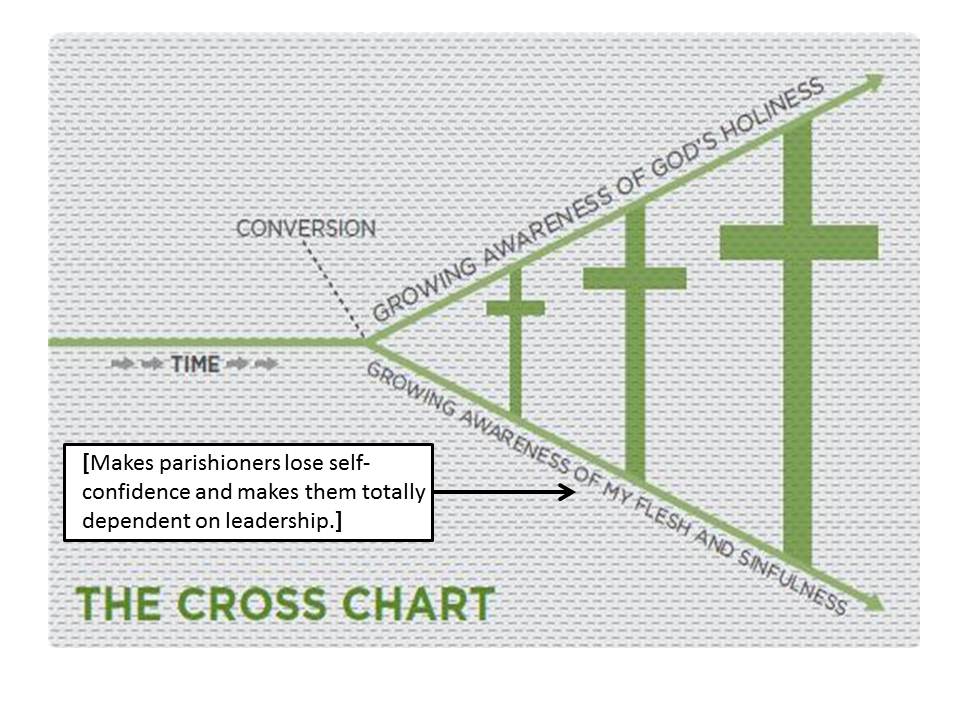
That illustration with the large crosses really does show how a person would be totally dependent on leadership instead of the Holy Spirit. That is an excellent example of what I have seen in the NC. But then, I think that is the whole point!
I could not agree more that the redemptive work of Christ is a finished work, never to be repeated. Additionally, I agree that our justification is a once for all declaration about us, though I would disagree that it is not based on his obedience to the law in our place. That doctrine [Christ active obedience] is not a New Calvinist doctrine. Calvinist have believed that and taught if for centuries.
What has not been finished is his saving activity as our High Priest in making continual intercession for us. The Westminster Shorter Catechism states this well. In answer to the question, “How does Christ fulfill the office of a Priest?” Ans. “Christ fulfills the office of a Priest in his once offering of himself as a sacrifice to satisfy divine justice and reconcile us to God, and in his making continual intercession for us.” [Since, I quoted this from memory, it may not be word for word correct]. The book of Hebrews 7:25 says “Therefore [because he is a priest after the order of Melchezidec who continued to be a priest as long as he lived] he is able to completely save those who come to God by him, seeing he ever lives to make intercession for them.” He continues his saving activity, based on his once for all sacrifice on the cross. Why do we need his intercession if not to freshly apply that once for all sacrifice to our current needs as believers who are not yet made perfect in holiness?
I’m not sure this answer is what you intended. I asked, “Can I take from your statement that you do not believe that the works we do in obedience to Christ, even if they are enabled by grace that is imparted to us in regeneration and sanctification as a result of Christ’s work, do not maintain or increase our acceptability before God?” NO, ABSOLUTELY NOT, BECAUSE NOTHING IS NEEDED TO MAINTAIN JUSTIFICATION, IT IS A FINISHED WORK.
Did you mean to say, Yes, absolutely, I do not believe that?
paulspassingthoughts said, on November 21, 2011 at 11:46 AM
Randy,
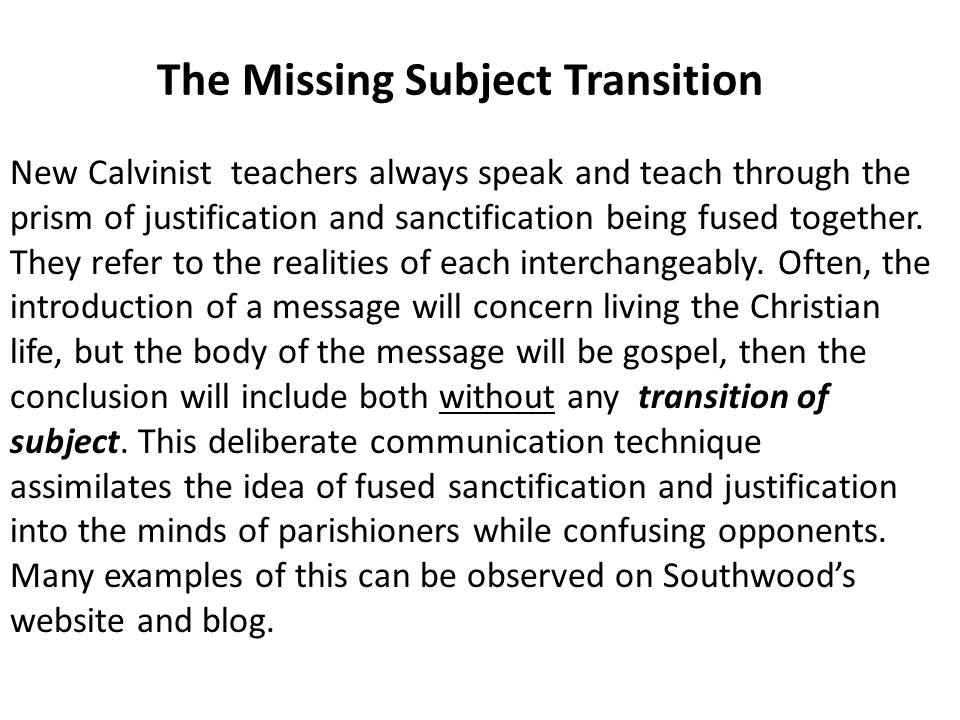
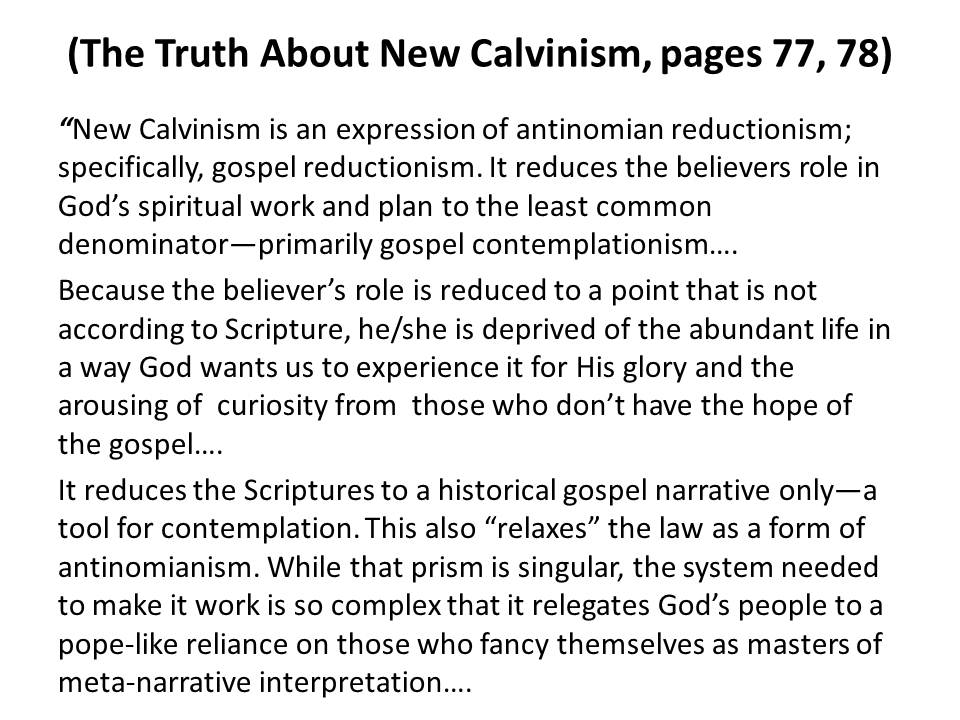
Let me get right to the point: New Calvinists believe that Christ’s obedience to the cross (passive) was for justification, and His obedience to the law (active) was/is for our sanctification; and both were/are part of the atonement. Hence, any effort on our part in sanctification would be the same as working for justification as well. To make any effort in sanctification would be an attempt to usurp Christ’s works for sanctification which completes justification. New Calvinists claim we work hard, but work hard at what? Well, I just read the answer to that question as answered by Southwood’s pastor on their blog; humble repentance is hard work:
“I’m not arguing for NO EFFORT or WORK I am arguing for GREATER EFFORT and MORE DIFFICULT WORK, the work of humbling ourselves, being broken, repentant, prostrate before God, looking past our ‘symptomatic sins’ to their root causes and being faced with such horror over my depravity that I am left with no other options than Jesus.”
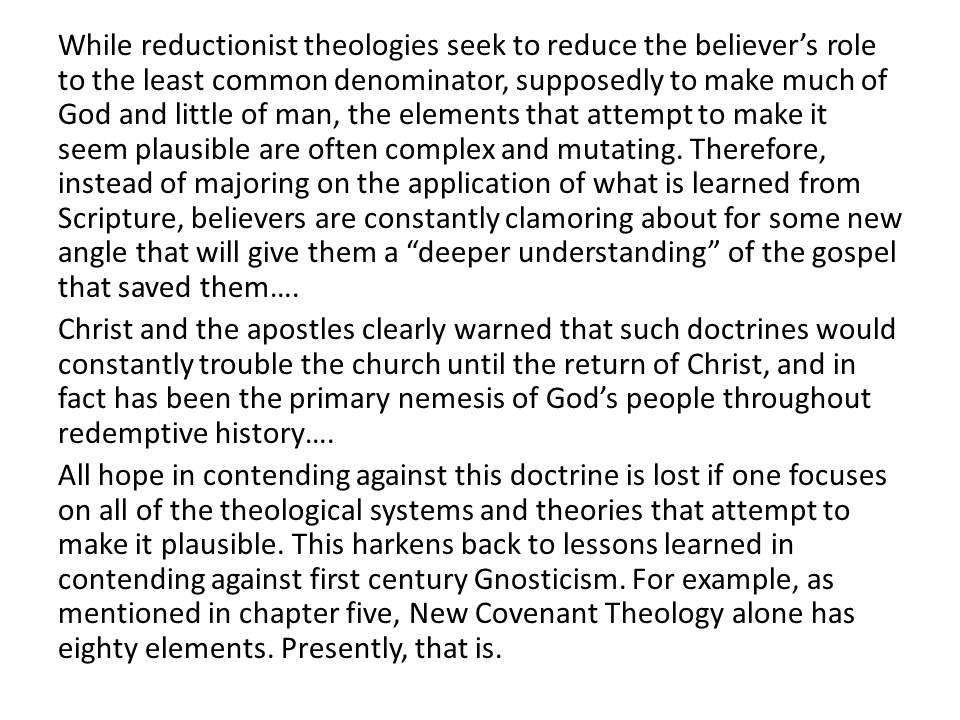
In other words, the New Calvinist working hard at the same things that saved us: faith and repentance alone (or what they call “deep repentance”). Sorry Randy, but orthodox Christianity has never believed in sanctification by faith alone, nor do we believe that Jesus obeys for us. Neither do we believe that all obedience is a mere natural flow that must first come from Gospel Contemplationism.
Give me quotes saying that Christ’s active obedience was principally for our sanctification. The classic Reformed position is and has been that his active obedience was for our justification. It was a human righteousness that the law required; it was that human obedience as the second Adam that he performed.
I agree that sanctification demands effort that goes beyond humbling ourselves, being broken etc. It requires obedience. In reality, repentance is not hard work at all since it doesn’t come from us but from God. The result of that repentance is that we return to Jesus in confession and in faith to receive fresh applications of his redeeming work. He is faithful and just to forgive us, based on his once for all sacrifice.
I am not sure what you were answering in the above post, but it doesn’t seem to speak to what I asked in my latest post.
Paul, how in the world does my growing understanding of my own sinfulness lead to a unhealthy dependence on leadership? Just based on the fact that I know my own wicked heart should make me that much more dependent upon Christ. This should lead to a fleeing from making myself dependent upon leaders.
So I guess my rather simplistic response is 1.) You can’t reject something because it has been used wrongly (according to the accusation against SGM). 2.) Do you deny that there are such things as gospel indicatives and gospel imperatives (which cannot be divorced from the indicatives)?
You can’t deny gospel imperatives and indicatives, no matter how hard you try Paul. For the record we hang on because its in the Bible and please do not condescendingly dismiss my question. As a brother in Christ I deserve a little bit better bro.








 Paul's Passing Thoughts
Paul,
Do you believe one can say that justification and sanctification are always found together in the same persons without saying that there is a “fusion” between justification and sanctification?
LikeLike
Randy,
Justification is not “in” anybody. Justification is a legal declaration by God. His righteousness has been credited to our account in full. It’s totally past tense and a totally done deal. Sanctification does not maintain justification until the judgement.
LikeLike
Paul,
I understand that justification is not “in” us. My question is whether all who are the justified ones are also being sanctified? And, do you believe a person can answer that question in the affirmative without believing the two are “fused.” I fully understand that sanctification does not maintain justification until the judgement. Since justification is based on Christ’s obedience and not on our obedience, nothing is needed to maintain it apart from his intercessory work as our great high priest.
Can I take from your statement that you do not believe that the works we do in obedience to Christ, even if they are enabled by grace that is imparted to us in regeneration and sanctification as a result of Christ’s work, do not maintain or increase our acceptability before God?
Randy
LikeLike
Randy,
“My question is whether all who are the justified ones are also being sanctified? And, do you believe a person can answer that question in the affirmative without believing the two are “fused.” YES TO BOTH SENTENCES.
“Since justification is based on Christ’s obedience and not on our obedience, nothing is needed to maintain it apart from his intercessory work as our great high priest.” HOLD YOUR HORSES; JUSTIFICATION IS BASED ON CHRIST’S OBEDIENCE TO THE CROSS, NOT, I REPEAT, NOT HIS ACTIVE OBEDIENCE THROUGHOUT HIS LIFE ON EARTH IN HUMAN FLESH. SECONDLY: “….nothing is needed to maintain it apart from his….” NOTHING, I REPEAT, NOTHING MAINTAINS JUSTIFICATION–IT IS A FINISHED WORK.
“Can I take from your statement that you do not believe that the works we do in obedience to Christ, even if they are enabled by grace that is imparted to us in regeneration and sanctification as a result of Christ’s work, do not maintain or increase our acceptability before God?” NO, ABSOLUTELY NOT, BECAUSE NOTHING IS NEEDED TO MAINTAIN JUSTIFICATION, IT IS A FINISHED WORK.
LikeLike
That illustration with the large crosses really does show how a person would be totally dependent on leadership instead of the Holy Spirit. That is an excellent example of what I have seen in the NC. But then, I think that is the whole point!
LikeLike
Paul,
I could not agree more that the redemptive work of Christ is a finished work, never to be repeated. Additionally, I agree that our justification is a once for all declaration about us, though I would disagree that it is not based on his obedience to the law in our place. That doctrine [Christ active obedience] is not a New Calvinist doctrine. Calvinist have believed that and taught if for centuries.
What has not been finished is his saving activity as our High Priest in making continual intercession for us. The Westminster Shorter Catechism states this well. In answer to the question, “How does Christ fulfill the office of a Priest?” Ans. “Christ fulfills the office of a Priest in his once offering of himself as a sacrifice to satisfy divine justice and reconcile us to God, and in his making continual intercession for us.” [Since, I quoted this from memory, it may not be word for word correct]. The book of Hebrews 7:25 says “Therefore [because he is a priest after the order of Melchezidec who continued to be a priest as long as he lived] he is able to completely save those who come to God by him, seeing he ever lives to make intercession for them.” He continues his saving activity, based on his once for all sacrifice on the cross. Why do we need his intercession if not to freshly apply that once for all sacrifice to our current needs as believers who are not yet made perfect in holiness?
I’m not sure this answer is what you intended. I asked, “Can I take from your statement that you do not believe that the works we do in obedience to Christ, even if they are enabled by grace that is imparted to us in regeneration and sanctification as a result of Christ’s work, do not maintain or increase our acceptability before God?” NO, ABSOLUTELY NOT, BECAUSE NOTHING IS NEEDED TO MAINTAIN JUSTIFICATION, IT IS A FINISHED WORK.
Did you mean to say, Yes, absolutely, I do not believe that?
Randy
LikeLike
Randy,
Let me get right to the point: New Calvinists believe that Christ’s obedience to the cross (passive) was for justification, and His obedience to the law (active) was/is for our sanctification; and both were/are part of the atonement. Hence, any effort on our part in sanctification would be the same as working for justification as well. To make any effort in sanctification would be an attempt to usurp Christ’s works for sanctification which completes justification. New Calvinists claim we work hard, but work hard at what? Well, I just read the answer to that question as answered by Southwood’s pastor on their blog; humble repentance is hard work:
“I’m not arguing for NO EFFORT or WORK I am arguing for GREATER EFFORT and MORE DIFFICULT WORK, the work of humbling ourselves, being broken, repentant, prostrate before God, looking past our ‘symptomatic sins’ to their root causes and being faced with such horror over my depravity that I am left with no other options than Jesus.”
In other words, the New Calvinist working hard at the same things that saved us: faith and repentance alone (or what they call “deep repentance”). Sorry Randy, but orthodox Christianity has never believed in sanctification by faith alone, nor do we believe that Jesus obeys for us. Neither do we believe that all obedience is a mere natural flow that must first come from Gospel Contemplationism.
LikeLike
Paul,
Give me quotes saying that Christ’s active obedience was principally for our sanctification. The classic Reformed position is and has been that his active obedience was for our justification. It was a human righteousness that the law required; it was that human obedience as the second Adam that he performed.
I agree that sanctification demands effort that goes beyond humbling ourselves, being broken etc. It requires obedience. In reality, repentance is not hard work at all since it doesn’t come from us but from God. The result of that repentance is that we return to Jesus in confession and in faith to receive fresh applications of his redeeming work. He is faithful and just to forgive us, based on his once for all sacrifice.
I am not sure what you were answering in the above post, but it doesn’t seem to speak to what I asked in my latest post.
Randy
LikeLike
Randy,
Had to bit the bullet and pass all of these. I hope I get time to address this one later.
paul
LikeLike
Paul, how in the world does my growing understanding of my own sinfulness lead to a unhealthy dependence on leadership? Just based on the fact that I know my own wicked heart should make me that much more dependent upon Christ. This should lead to a fleeing from making myself dependent upon leaders.
LikeLike
Scott,
Here is how that teaching is being used in New Calvinist Churches: http://church-discipline.blogspot.com/2008/04/sovereign-grace-ministries-use-of.html#links
In fact, the Clearcreek elders tried to use what was clearly demotivational control on me. Furthermore, it’s not the truth. I think this guy makes his case pretty good on that point: http://wp.me/pmd7S-126
LikeLike
So I guess my rather simplistic response is 1.) You can’t reject something because it has been used wrongly (according to the accusation against SGM). 2.) Do you deny that there are such things as gospel indicatives and gospel imperatives (which cannot be divorced from the indicatives)?
LikeLike
Geez, the ind/imp thing? You guys are still hanging on to that one? I will post chapter 12 of the book tomorrow.
LikeLike
You can’t deny gospel imperatives and indicatives, no matter how hard you try Paul. For the record we hang on because its in the Bible and please do not condescendingly dismiss my question. As a brother in Christ I deserve a little bit better bro.
LikeLike
Scott,
since Southwood’s pastor believes it also, I will post chapter 2 of the book to answer your question. Give me about 30 minutes.
LikeLike
Scott,
Ok, I posted chapter 12 to answer your question.
LikeLike