Rick Holland’s “Uneclipsing The Son” Part 4: Mr. Holland Was For Obedience Before He was Against It, And The Sonship / AF Connection
 On pages 46 through 56 (most of chapter 4), Holland makes a case that the book of Job is all about Christ. Of course, New Calvinist believe every verse in the Bible is about Christ so that’s no surprise. Though I believe his exegesis is a stretch to come to that conclusion, these pages are by far the less ghastly so far and have some merit. In addition to making this point, he seems to slightly redefine the word transcendence as primarily the difference between two things, rather than something that is superior or not confined by immanence. I know, this seems like nitpicking, but Holland seems to use his primary definition to make some sort of strict dichotomy between the Son and the Father that effects how we perceive the Trinity, and such dichotomies tend to make me suspicious. Not only that, it’s eerily similar to the “objective” part of COG (the centrality of the objective gospel) which teaches that gospel reality is completely outside of us. This can subtly set up a prism that requires all realities about the Father to be seen through the Son, rendering the Father as true, but insignificant when compared to Christ; and in fact, our biggest problem—with Christ coming to the rescue. Of course, there is some truth to that, but that approach also makes me uncomfortable with what seems like an unbalanced view of the Trinity that can lead to bad places.
Nevertheless, what follows is much easier to expound on. On page 59, Holland reiterates what makes GS what it is: contemplative spirituality. Holland states on page 59: “In other words, we see Christ now, and the more we know Him and the more we study Him, the more we become like the clear image we see of Him. Looking for [emphasis mine. This is supposedly what job one is for Christians when reading their Bible] and seeing and gazing [my emphasis] at the excellencies, the glories of Jesus leads to greater vision, sharper focus, deeper awareness of Jesus and His permanent abiding presence. It elevates the soul to a higher vantage point of worship. We must learn to stare at the Son of God such that we are blinded to all the allurements of the world! All encumbrances aside, all slack hardeness aside, everything aside but…Him.”
Along with this statement being a superb specimen of how GS instructs followers to read the Bible, looking for Jesus only; and specifically, his “excellencies” and “glories,” the statement shows the kinship between GS and Sonship Theology. In a book Jay Adams’ wrote to warn the church about Sonship, he wrote the following:
“The problem with Sonship is that it misidentifies the source of sanctification (or the fruitful life of the children of God) as justification. Justification, though a wonderful fact, a ground of assurance, and something never to forget, cannot produce a holy life through strong motive for it.”
And,
“Certainly, all of us may frequently look back to the time when we became sons and rejoice in the fact, but there is no directive to do so for growth, or even an example of this practice, in the New Testament….The true reminder of the good news about Jesus’ death for our sins is the one that he left for us to observe-the Lord’s supper (‘Do this in remembrance of Me’).”
Holland follows this up on page 60 and 61 with the usual GS slight of hand. On page 60, using John 14:21 as a point of reference, he makes several orthodox statements concerning obedience. He seems to be clearly saying that obedience is the gateway to a deeper love for Christ. He seems to be saying the same thing Christ is clearly saying in that text: obedience to Christ is synonymous with loving Him. In other words, obedience is a loving act (John 3:16).
I used to become perplexed by these sudden bursts of orthodoxy after reading page after page of “truth” seasoned with nuance because God’s people are not yet ready to accept that we have been supposedly living under a false gospel for the past 100 years. I calmly read pages 60-61 while enjoying a nice lunch Susan fixed for me. Two all beef patties smothered in pepper-jack cheese and jalapeños. No buns because I’m on a low-carb diet that is working fabulously (email me at pmd@inbox.com if you want the details). She also brought me a glass of tea sweetened with something other than sugar, but it was really good. Before I finished the last bite, Holland began to explain exactly what he means by “obedience” on page 61. He was for it on page 60, but on page 61, well, you see, what Jesus meant in John 14:21 is love and obedience are the same thing.
But you say: “Paul, that agrees with what you just said was orthodox!” Not exactly. I said that obedience is an act among many that is a demonstration of love. On page 61, Holland makes the point that they are the same thing, but obedience must be defined by love, and now we must ask ourselves what “love” is. Hmmmmm—get you hand on your wallet:
“So what does it mean to love Jesus? Yes, we’ve already seen obedience. That’s a given [I’m sure]. But [just like the “But”Light commercial: “Here we go!”] true Christians are distinguished from unbelievers not only by their obedience, but by their love for Christ. Let this question echo in your soul: Do you love Christ? Is He precious to you, as He was to Peter? Is He the hub of your faith and your life, [and here is the crux:] or have you made Christianity something of a way to live instead of a person to love?”
NOTE, after saying obedience and love are intrinsically connected, he makes a dichotomy that is impossible to distinguish in real life. How can one possibly distinguish Godly obedience from making “Christianity something of a way to live instead of a person to love?” It’s a false dichotomy that forces the reader to decide whether true love is a way of life or a “person to love.” And again, and again, regardless of a calling to live in a new way throughout Holy Writ, Holland does not qualify the statement.
HOWEVER, Holland then defines what this true love is on pages 61-67 after the pesky subject of obedience is relegated to its proper place in the back of the bus. He then breaks down a “biblical” definition of love into three categories: Love And Faith (p.61), Love And Understanding (p.64), and Love And Affections (p.66).
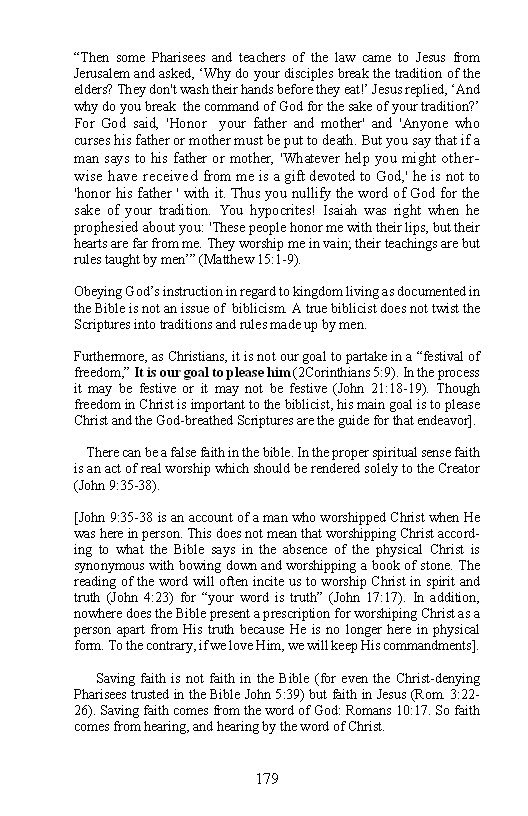
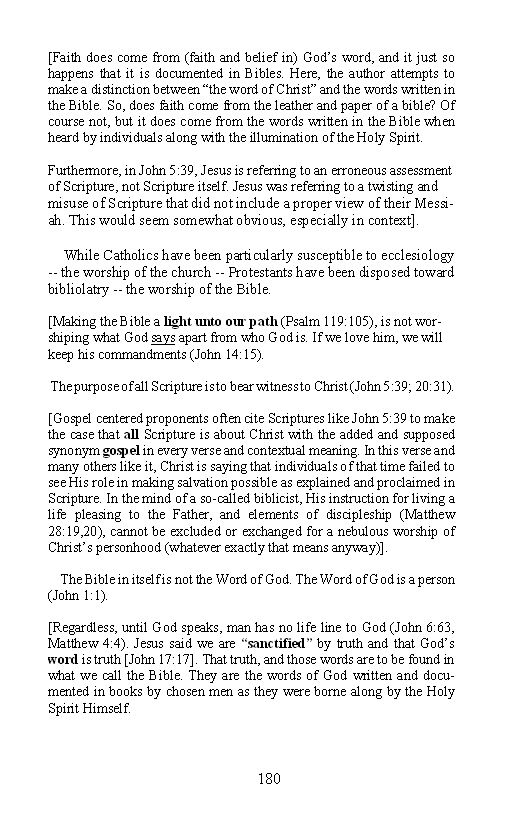
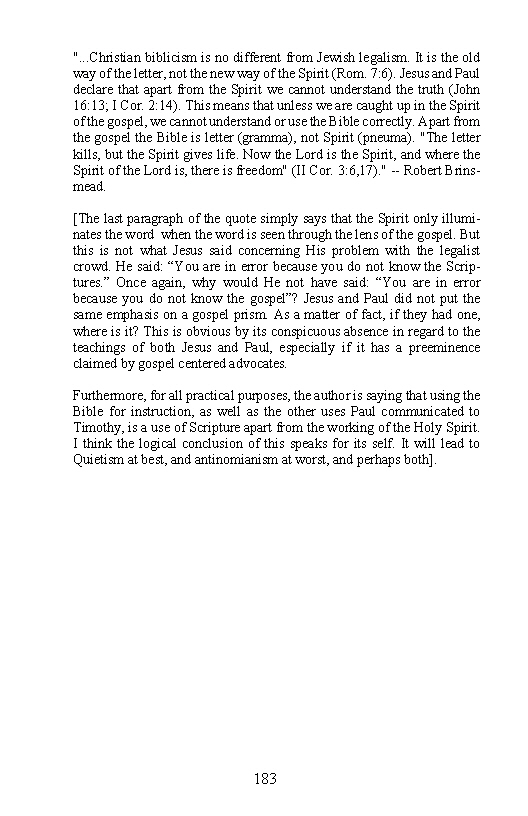
In the first segment, “Love And Faith,” Holland clearly shows this book’s kinship with the Australian Forum. I devote a whole chapter in my book, “Another Gospel” to Robert Brinsmead’s interpretive prism as taught by him and Paxton / Goldsworthy. Following this post, a full copy of that chapter can be viewed. On page 62, Holland describes faith as the “eye of the soul.” He then writes that Scripture is the lens used by faith and the Holy Spirit illuminates Scripture for one purpose and one purpose only: “Suddenly the Bible comes alive and we see Christ’s excellence, His splendor!” Hence, this is the EXACT position of the AF: the Bible’s only purpose is to obtain a deeper knowledge of the gospel, and the Holy Spirit will not illuminate anything else but that. Holland writes on page 63: “There must be a faith that engages with God’s Word on Jesus and estimates it to be the most important information in the world” [which then becomes the interpretive mode of operation].
Therefore, the Bible is for the purpose of plunging the depths of seeing the glory of Christ and nothing else. Any other information in the Bible that seems to be contrary to that thesis is descriptions of what Christ has done and should teach us more about Him instead of being an instruction book for a different “way to live.” All of the commands in the Bible are meant to show us what Christ has done for us already, and to humble us because we can’t keep all of them perfectly anyway. As I heard one pastor say from a pulpit about three months ago: “You can’t keep all of God’s law anyway, so don’t even try.” Pondering the volume of commands should also drive us to the foot of the cross and more dependence on Christ. Supposedly.
Therefore, the only logical conclusion is that obedience is a natural result of “Staring At The Son” (the actual title of chapter 5). But how do we know when we are committing the horrible sin of “obeying Jesus in our own efforts?” Well, because it will FEEL like it—that’s how you supposedly know, and Holland emphasizes that point throughout the rest of chapter 5. Throughout the book, Holland reiterates the same worn-out GS points made by Francis Chan (“When it’s love, it feels like love”), John Piper (“Beholding as a way of becoming” and joy is synonymous with faith), Paul David Trip (Christians are still spiritually dead), and Michael Horton (we only grow spiritually when we “revisit the gospel afresh”). The following is the chapter of my future book where the AF view of interpretation is dealt with—which is the same approach propagated by Holland:





 Paul's Passing Thoughts
This Brinsmead Gospel Centered stuff is at least half a bubble off plumb. “The Bible is not the Word of God, the Word of God is a person,” “Christians enslaved to the Bible,” “not a book of rules,” “saving faith is not faith in the Bible but faith in Christ” is confused thinking. And according to Brinsmead the historic churches are Christian biblicists no different from Jewish legalism!? He’s certainly not part of the catholic (universal) church as we know it. Brinsmead is so focused on Christocentric that he forgets or omits the Trinity. Jesus is the one who informs us that He glorifies the Father. It was the Father who told him what to say and how to say it. Ok, focus on Jesus. But Jesus also said “Why do you call me ‘Lord’ ‘Lord’ and don’t do what I say? I will say to you, ‘I never knew you’.” Was Jesus merely focused on the Father? No, He also said, my will is to do the will of Him who sent me.”
Paul, check that first paragraph of your future book where you wrote: “Those who affirm it should be dismissed as VALID(?) teachers, regardless of their names.” I think it should be INVALID teachers.
Thanks!
Arkansas Bill
LikeLike
Yep, Thanks Bill, a lot of the book is unedited, plus, that introduction is going to be rewritten. The Brinsmead treatise on interpretation is how New Calvinism functions in regard to the Scriptures though they would stop short of using the forthright language Brinsmead uses. The excerpt was posted on a website that promotes NCT. Horton has also stated that the Spirit only illuminates when the Scriptures are seen in gospel context. paul
> —–Original Message—– >
LikeLike