The Heart / Flesh Debate
Heart Versus Flesh
There are hundreds of passages that use the term “heart” to describe the seat of human emotion, intelligence, morality, volition and religious life in general. However, most often, “heart” is used in Scripture as an idiom for the mind.
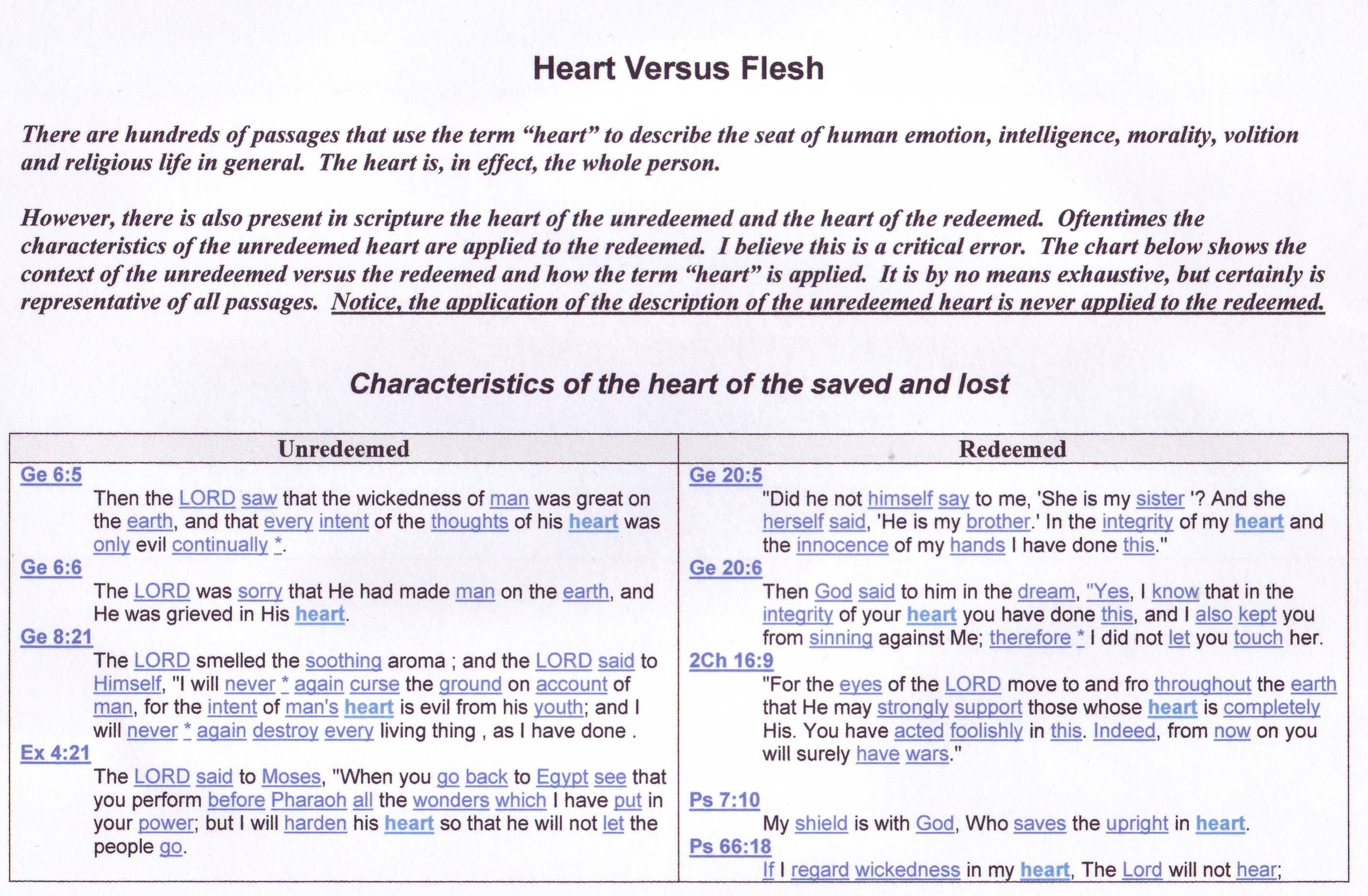
There is also present in scripture the heart of the unredeemed and the heart of the redeemed. Oftentimes the characteristics of the unredeemed heart are applied to the redeemed. I believe this is a critical error. The chart below shows the context of the unredeemed versus the redeemed and how the term “heart” is applied. It is by no means exhaustive, but certainly is representative of all passages. Notice, the application of the description of the unredeemed heart is never applied to the redeemed.
Characteristics of the heart of the saved and lost
|
Unredeemed |
Redeemed |
| Ge 6:5Then the LORD saw that the wickedness of man was great on the earth, and that every intent of the thoughts of his heart was only evil continually *.
Ge 6:6The LORD was sorry that He had made man on the earth, and He was grieved in His heart.Ge 8:21 The LORD smelled the soothing aroma ; and the LORD said to Himself, “I will never * again curse the ground on account of man, for the intent of man’s heart is evil from his youth; and I will never * again destroy every living thing , as I have done . Ex 4:21 The LORD said to Moses, “When you go back to Egypt see that you perform before Pharaoh all the wonders which I have put in your power; but I will harden his heart so that he will not let the people go. De 5:29 ‘Oh * that they had such a heart in them, that they would fear Me and keep all My commandments always *, that it may be well with them and with their sons forever ! De 8:14 then your heart will become proud and you will forget the LORD your God who brought you out from the land of Egypt, out of the house of slavery. 1Sa 7:3 Then Samuel spoke to all the house of Israel, saying, “If you return to the LORD with all your heart, remove the foreign gods and the Ashtaroth from among you and direct your hearts to the LORD and serve Him alone; and He will deliver you from the hand of the Philistines.” 2Ch 12:14 He did evil because he did not set his heart to seek the LORD. 2Ch 25:2 He did right in the sight of the LORD, yet not with a whole heart. 2Ch 26:16 But when he became strong, his heart was so proud that he acted corruptly, and he was unfaithful to the LORD his God, for he entered the temple of the LORD to burn incense on the altar of incense. Ps 73:1 Surely God is good to Israel, To those who are pure in heart ! Ps 78:8 And not be like their fathers, A stubborn and rebellious generation, A generation that did not prepare its heart And whose spirit was not faithful to God. Jer 5:23 ‘But this people has a stubborn and rebellious heart; They have turned aside and departed. Jer 17:9 “The heart is more deceitful than all else And is desperately sick; Who can understand it? Eze 14:4 “Therefore speak to them and tell them, ‘Thus says the Lord GOD, “Any man of the house of Israel who sets up his idols in his heart, puts right before his face the stumbling block of his iniquity, and then comes to the prophet, I the LORD will be brought to give him an answer in the matter in view of the multitude of his idols, Eze 20:16 because they rejected My ordinances, and as for My statutes, they did not walk in them; they even profaned My sabbaths, for their heart continually went after their idols. Mr 7:21 “For from within, out of the heart of men, proceed the evil thoughts, fornications, thefts, murders, adulteries, Lu 6:45 “The good man out of the good treasure of his heart brings forth what is good; and the evil man out of the evil treasure brings forth what is evil; for his mouth speaks from that which fills his heart. Ac 8:21 “You have no part or portion in this matter, for your heart is not right before God. Ro 1:21 For even though they knew God, they did not honor Him as God or give thanks, but they became futile in their speculations, and their foolish heart was darkened. Ro 2:5 But because of your stubbornness and unrepentant heart you are storing up wrath for yourself in the day of wrath and revelation of the righteous judgment of God, Eph 4:18 being darkened in their understanding, excluded from the life of God because of the ignorance that is in them, because of the hardness of their heart;
|
Ge 20:5“Did he not himself say to me, ‘She is my sister ‘? And she herself said, ‘He is my brother.’ In the integrity of my heart and the innocence of my hands I have done this.”Ge 20:6Then God said to him in the dream, “Yes, I know that in the integrity of your heart you have done this, and I also kept you from sinning against Me; therefore * I did not let you touch her.
2Ch 16:9 “For the eyes of the LORD move to and fro throughout the earth that He may strongly support those whose heart is completely His. You have acted foolishly in this. Indeed, from now on you will surely have wars.” Ps 7:10 My shield is with God, Who saves the upright in heart. Ps 66:18 If I regard wickedness in my heart, The Lord will not hear; Ps 73:1 Surely God is good to Israel, To those who are pure in heart ! Ps 86:12 I will give thanks to You, O Lord my God, with all my heart, And will glorify Your name forever. Jer 24:7 ‘I will give them a heart to know Me, for I am the LORD; and they will be My people , and I will be their God, for they will return to Me with their whole heart. Jer 31:33 “But this is the covenant which I will make with the house of Israel after those days,” declares the LORD, “I will put My law within them and on their heart I will write it; and I will be their God, and they shall be My people . Jer 32:39 and I will give them one heart and one way, that they may fear Me always *, for their own good and for the good of their children after them. Eze 11:19 “And I will give them one heart, and put a new spirit within them. And I will take the heart of stone out of their flesh and give them a heart of flesh, Eze 36:26 “Moreover, I will give you a new heart and put a new spirit within you; and I will remove the heart of stone from your flesh and give you a heart of flesh. Mt 5:8 “Blessed are the pure in heart, for they shall see God. Mt 12:34 “You brood of vipers, how can you, being evil, speak what is good ? For the mouth speaks out of that which fills the heart. Mt 15:18 “But the things that proceed out of the mouth come from the heart, and those defile the man. Lu 6:45 “The good man out of the good treasure of his heart brings forth what is good; and the evil man out of the evil treasure brings forth what is evil; for his mouth speaks from that which fills his heart. Ro 2:29 But he is a Jew who is one inwardly; and circumcision is that which is of the heart, by the Spirit, not by the letter; and his praise is not from men, but from God. Ro 6:17 But thanks be to God that though you were slaves of sin, you became obedient from the heart to that form of teaching to which you were committed, Heb 10:22 let us draw near with a sincere heart in full assurance of faith, having our hearts sprinkled clean from an evil conscience and our bodies washed with pure water. 1Pe 1:22 Since you have in obedience to the truth purified your souls for a sincere love of the brethren, fervently love one another from the heart, 1Jo 3:21 Beloved, if our heart does not condemn us, we have confidence before God; Addendum: Romans 6:17 – But thanks be to God, that you who were once slaves of sin have become obedient from the heart to the standard of teaching to which you were committed, Romans 7:25 – Thanks be to God through Jesus Christ our Lord! So then, I myself serve the law of God with my mind, but with my flesh I serve the law of sin. Hebrews 10:22 – let us draw near to God with a sincere heart and with the full assurance that faith brings, having our hearts sprinkled to cleanse us from a guilty conscience and having our bodies washed with pure water. |
As you look at the references above, you’ll easily see that the Bible never applies the ugly characteristics of an unregenerate heart to a redeemed person. Why then, should we? God has renewed the heart of a believer and it is unbiblical to accuse the Body of Christ of having hearts that are unregenerated.
Where then, is the battle? The Bible teaches that the battle against sin is in the flesh, NOT the heart. Notice, please:
Mt 26:41
“Keep watching and praying that you may not enter into temptation; the spirit is willing, but the flesh is weak.”
Jesus is speaking to a redeemed person. He shows them that the danger is in the flesh, not the heart (perhaps synonymous with spirit in this passage).
Ro 7:5
For while we were in the flesh, the sinful passions, which were aroused by the Law, were at work in the members of our body to bear fruit for death.
Paul teaches here that our sinful passions are from the flesh.
Ro 7:18
For I know that nothing good dwells in me, that is, in my flesh; for the willing is present in me, but the doing of the good is not.
A critical passage! We know the Bible teaches that our flesh was not redeemed at salvation and, in fact, awaits the glorification described so clearly in 1 Corinthians 15. Therefore, we have a “redeemed heart” incarcerated in “unredeemed flesh.” This is exactly why we struggle. Notice:
Ro 7:14
For we know that the Law is spiritual, but I am of flesh, sold into bondage to sin.
Ro 7:25
Thanks be to God through Jesus Christ our Lord ! So then, on the one hand I myself with my mind am serving the law of God, but on the other, with my flesh the law of sin.
Ro 8:3
For what the Law could not do, weak as it was through the flesh, God did: sending His own Son in the likeness of sinful flesh and as an offering for sin, He condemned sin in the flesh,
Ro 8:4
so that the requirement of the Law might be fulfilled in us, who do not walk according to the flesh but according to the Spirit.
Ro 8:5
For those who are according to the flesh set their minds on the things of the flesh, but those who are according to the Spirit, the things of the Spirit.
Ro 8:6
For the mind set on the flesh is death, but the mind set on the Spirit is life and peace,
Ro 8:7
because the mind set on the flesh is hostile toward God; for it does not subject itself to the law of God, for it is not even able to do so,
Ro 8:8
and those who are in the flesh cannot * please God.
Ro 8:9
However, you are not in the flesh but in the Spirit, if indeed the Spirit of God dwells in you. But if anyone does not have the Spirit of Christ, he does not belong to Him.
Ro 8:12
So then, brethren, we are under obligation, not to the flesh, to live according to the flesh —
Ro 8:13
for if you are living according to the flesh, you must die; but if by the Spirit you are putting to death the deeds of the body, you will live.
The heart is not mentioned anywhere in this key teaching. Romans 6 through 8 contain the key teaching on our struggle against sin. And, it is clear; the struggle is centered on the flesh, not the heart.
Further evidence of this:
Ro 13:14
But put on the Lord Jesus Christ, and make no provision for the flesh in regard to its lusts.
1Co 3:1
And I, brethren, could not speak to you as to spiritual men, but as to men of flesh, as to infants in Christ.
How do we cleanse ourselves and appear holy before the Lord?
2Co 7:1
Therefore, having these promises, beloved, let us cleanse ourselves from all defilement of flesh and spirit, perfecting holiness in the fear of God.
Ga 5:13
For you were called to freedom, brethren; only do not turn your freedom into an opportunity for the flesh, but through love serve one another.
Ga 5:16
But I say, walk by the Spirit, and you will not carry out the desire of the flesh.
Ga 5:17
For the flesh sets its desire against the Spirit, and the Spirit against the flesh; for these are in opposition to one another, so that you may not do the things that you please.
Ga 5:19
Now the deeds of the flesh are evident, which are: immorality, impurity, sensuality,
Ga 5:24
Now those who belong to Christ Jesus have crucified the flesh with its passions and desires.
Ga 6:8
For the one who sows to his own flesh will from the flesh reap corruption, but the one who sows to the Spirit will from the Spirit reap eternal life.
~ Penned and researched by Brian Jonson, West Chester, Ohio

 Paul's Passing Thoughts
Paul, you say,
“Oftentimes the characteristics of the unredeemed heart are applied to the redeemed. I believe this is a critical error.”
What is critical error is when redeemed people act like they are not redeemed, and fail to act redeemed. Clearly, you must agree that regenerate can act like they are unregenerate? They can sin, right? They can have wrong motives? They can lust and envy and hate?
It is also error to act as if the redeemed do not have the choice to act like the unredeemed. It is further error to suggest that the redeemed can act like the redeemed without changes in their mindset and their actions. Clearly, the old self must be ‘put off’ and the new self ‘put on,’ by changing our specific behaviors through effort. Ephesians 4:22-24; Colossians 3.
In other words, it would be error to suggest that the regenerate cannot fail to change their behaviors of mind and body, just as it would be error to suggest we are unable to change them. Christ’s blood freed us to choose between the two, to offer our members to righteousness or unrighteousness, to be enslaved by either. Romans 6; Galatians 5; Ephesians 4; Colossians 3.
Accordingly, your point is best stated that the GS crowd tend to use their heart-talk to deny that the regenerate have been freed to choose good or evil and do it. If that is your point, I agree.
However, one must be careful not to imply that the regenerate typically succeed in putting off and putting on. Actually, many regenerate people fail to put off and put on, all the time. In some or many areas, they continue to live in bondage to unrighteousness unnecessarily, because they have not taken the steps necessary to stop the bad and start the good. This is why James admonishes us to purify our kardia (heart). He calls us the double-psuche (double-souled). James 4:8. Now, you can argue he was not referring to the regenerate, but you would be wrong. You can argue he was not saying we are still depraved, and I would say you are using that term in an extreme way without explaining it. Again, the regenerate are not still depraved in the sense of being unable to choose good over evil, but they are depraved in the sense of having failed to put off the old anthropos and put on the new anthropos, … at least until they do so. This is why Paul admonishes us in Ephesians and Colossians to get busy doing so.
To suggest the regenerate don’t need to purify their kardia, as James suggests would be false. Likewise, we must purify our nous, dianoia, nous and psuche. If that were not the case, then James wouldn’t tell us to do so. Is the renewing of the nous in Ephesians 4 and Romans 12 something the unregenerate must do and not the regenerate? Of course not. You don’t tell the unregenerate to offer their lives as a living sacrifice and to no longer be conformed to the world but to be transformed by the renewing of their mind. That is a teaching for regenerate believers.
Moreover, I have never seen anyone definitively resolve the question of what the parts of the inner man are and how they function in relation to each other. I’m talking about the nous, dianoia, kardia, psuche, pneuma, suneidesis, ischus, etc. Are they all just one thing? Are they parts of the same thing? Are they distinct? Also, I defy you to find a biblical term for the human faculty called the ‘will’.
That said, why argue about heart vs. mind?
Indeed, the real issue is whether God has enabled the regenerate to obey, to resist sin/temptation/Satan, to flee immorality, to offer our members to righteousness or not, to be transformed by the renewing of our mind, to conform our inner man and our body to that of the new anthropos. The answer is yes, we’ve been freed and enabled, and we must embrace the Spirit of God and seek to do all those things.
But if we do not know we are freed and enabled, or if we do not embrace the Spirit of God and seek to do good, we will continue in bondage to the principles of this life, to worldliness and to Satan, to continue in unrighteousness. In that case, though we be regenerated, we are in fact still enslaved. We are in fact still depraved in our behavior. We are in fact hard in heart. The regenerate are born again into a raised from the dead position, where they have to walk out of the tomb, be helped like Lazarus’ friends to lose the grave clothes, and must do as Jesus commands, which is to walk freely but under His yoke, learning from Him.
Those who want to change the heart or mind only are just as much fools as those who want to change outward behavior only. But to suggest that just because we are regenerate the heart and/or mind are somehow suddenly completely in line with God’s will is nonsense. We need education, repentance and practice to get the mind renewed and aligned with God, and it must be followed through with actions consistent with our repentance. Anything else is vague, nonsensical and futile.
These are the things you should be saying, rather than vaguely complaining all the time that the heart is not the problem. The heart/mind/understanding/spirit/soul/inner man is still a HUGE problem after we are regenerate. If it were not, why do you keep trying to change the minds of regenerate people? If your vague version of sanctification made any sense, people’s minds would be perfectly in line with God’s will already and you would not need to teach us anything. Instead, you could secure our obedience by simply putting shock collars on us, so that if our body tried to go a way other than the direction of our regenerate mind, it could be prodded into line. But that is not at all an accurate description of life after regeneration.
My friend and brother in the Lord, should you keep telling us not to pay any attention to our kardia, as if that term is irrelevant after regeneration? So what if your nemesis likes that word. You gain no traction by vagulely acting like the inner man is no longer the issue. Why do you let them set the agenda, as if there need be a debate between heart and flesh. The debate is whether or not we’ll recognize our freedom to purify our heart, soul, mind and strength that we may love with them in our actions. For, who obeys who has an impure heart, soul, mind and body? And are you trying to tell us the regenerate have those all purified already? … really?
Tad
LikeLike
Tad,
I didn’t write the article / paper–Brian Jonson did. However, I think he would agree with
much of what you are saying. His paper refutes the primary idea that Christians still have
a totally depraved heart. He also refutes the idea that the battleground is *in* the heart
rather than *with* the flesh. The GS crowd refutes a redeemed/unredeemed dichotomy in the inner man because that contradicts GS’s Heart Theology which logically conforms to their view of the gospel.
WHY TALK ABOUT IT? Unfortunately, because the GS crowd is. Ever try to counsel someone who thinks they’re still totally depraved????? Do we fight and see the battlefield as you have described above? Or do we see it as the eradication of so-called “heart idols” that result in Jesus obeying in our place? I think I can speak for Brian–it’s a very difficult area that we wish didn’t need discussion. But nevertheless–it does.
paul
LikeLike
Once we are regenerate at the moment of being born again, we do in fact have many areas where we have to put off the old man and put on the new, with a change of heart. To say it’s really the mind instead of the heart makes no difference. They are, then, idols or fixations of the mind Focus on the nomenclature is a red herring.
Now, what you really differ with these GS guys upon is the means by which practical sanctification is to occur. Once you repent at heart or at mind, you must actually change your outward behavior. The GS’rs are not really interested in people who have repented seeking to change their outward behavior. They want it to be a ‘natural’ overflow of the heart, relying on Jesus’ teaching that our words and acts are an overflow of the heart. Their misunderstanding of the need to willfully act on our repentance is rooted in a gross oversimplification of the overflow of the heart image used by Jesus.
That said, I can’t figure out why you draw a distinction between the GS ‘deep repentance’ and plain old repentance. I have read one of your hero’s books (Jay Adams), and I don’t see him discounting the need to have inner repentance of what we are idolizing or fixated upon in sin. Then, he says we must do acts in keeping with that repentance, to complete the change. This is putting off and putting on. His account seems to be accurate.
Is there really much of a difference between Adams’ repentance on the inner man and that of the GS crowd? Isn’t the difference in what is to happen after that? The GS sage says to then go about your business so you can be surprised by new behavior. Adams says to intentionally do acts in keeping with repentance to reify or solidify one’s change of heart (my paraphrase).
I guess I must perpetually misunderstand you. It seems to me you are always trying to denigrate the repentance in the inner man aspect the GS’r actually shares with Adams. I object to attempts to marginalize the changes that have to happen in the inner man. You can’t do acts in keeping with repentance if you have an ineffective heart or inner repentance.
Finally, if I am all wrong about what you are trying to say in your hundreds of posts, maybe you should take it that you are being too glib with your rhetoric, implying things you don’t really mean. So i say, one teacher to another, maybe you need to rethink your rhetoric about the heart. After all, the kardia is a serious spiritual term in the NT. You better show us how to deal with it, rather than pretending there is nothing we can do to know its contents and deal with them — especially if you are going to make the move of saying its the same as the mind (… we can’t know the contents of our mind and repent of them? … you risk incoherence in your body of posts.) If you have a post I missed that clarifies all this, please advise. otherwise, you might do one.
Tad
Again, it appears to me the substance of your complaint about
LikeLike
“Once we are regenerate at the moment of being born again, we do in fact have many areas where we have to put off the old man and put on the new, with a change of heart. To say it’s really the mind instead of the heart makes no difference. They are, then, idols or fixations of the mind Focus on the nomenclature is a red herring”
No Tad. First, I am not limiting “heart” to the mind only–just saying it is often used that way in Scripture. I agree with Brian’s opening statement, which I thought was pretty clear. Second, Scriptures never use the preposition “of” as in “idols OF the heart” implying that they originate there. The preposition used, especially in Ezekiel 14, is “toward” the heart.
“That said, I can’t figure out why you draw a distinction between the GS ‘deep repentance’ and plain old repentance. I have read one of your hero’s books (Jay Adams), and I don’t see him discounting the need to have inner repentance of what we are idolizing or fixated upon in sin. Then, he says we must do acts in keeping with that repentance, to complete the change. This is putting off and putting on. His account seems to be accurate.”
First Tad, thanks for clarifying the fact that Jay Adams is one of my heroes; damn right he is, and for good reasons. One being: many younger Evangelicals know GS is false doctrine, but they don’t want to upset their whittle tummies by standing up to the BIG names that are propagating this stuff. Some guy in his 80’s has to make-up for their filthy cowardliness. The word of God is His word, or it isn’t. I certainly know where I stand on that! Secondly, my problem with GS repentance is that they make no distinction between repentance for justification and repentance in sanctification. John ch 13 makes it clear that their is a difference. Thirdly, GS teaches that deep repentance paves the way for Jesus to obey for us, and in our place, unlike the orthodox coating that you apply above using the apostle’s “put-off / put-on” dynamic. For crying out loud Tad–Tripp says in HPC, a treatise par excellence on Heart Theology, that even changing our thinking to align with Scripture circumvents “the WORK of Christ as SAVIOR. C’mon Tad, really.
“I guess I must perpetually misunderstand you. It seems to me you are always trying to denigrate the repentance in the inner man aspect the GS’r actually shares with Adams. I object to attempts to marginalize the changes that have to happen in the inner man. You can’t do acts in keeping with repentance if you have an ineffective heart or inner repentance.”
Inner repentance deals with thoughts, motives, and biblical thinking verses worldly thinking. That’s what Adams believes, along with outward repentance that may or may not take place in any particular order in the milieu of life. There is NO, I repeat, NO confusion of semantics here–the Adams / Welch debate concerning the heart / flesh should make that clear. The GS crowd believes that the inner heart can be analyzed in regard to the idols that it supposedly creates. Trust me, Adams doesn’t believe that.
“Finally, if I am all wrong about what you are trying to say in your hundreds of posts, maybe you should take it that you are being too glib with your rhetoric, implying things you don’t really mean. So i say, one teacher to another, maybe you need to rethink your rhetoric about the heart.”
No Tad. As a layman, I will do the best I can with this forum (it’s not a theological journal) while waiting for Evangelicals with more resources than I have to get a backbone. This is a forum and an “information network.” I have learned much from contributors. Secondly, I am up against people who are well paid by the saints and have time to sit in their libraries and dream all of this stuff up. It ain’t easy.
Nevertheless–your contribution is very much appreciated–if you get time, cite actual quotes from my posts. Do I have time to articulate everything the way I would like to? No. Definitely not.
paul
LikeLike
Paul, you spirited debater you – such passionate expressions of emotion. What a prophetic spirit you sport …
Anyhow, you say, “Tripp says in HPC, a treatise par excellence on Heart Theology, that even changing our thinking to align with Scripture circumvents “the WORK of Christ as SAVIOR. C’mon Tad, really.”
It is one thing for a practical theologian to state his doctrine (be it correct or incorrect). It is quite another for him to state how to do what he says we are meant to do. In reality, the goal of what L&T advocate is to get a person to repent of their known sins, and reading Scripture about it is part of the drill for them, isnt it? So, if Scripture is being applied in an effort to evoke repentance, that can’t be bad. Again, the place where the difference matters is that they wouldn’t have a repentant sinner then obey the Scripture and purposely do right in their behavior.
Adams would first allow conviction in the light of Scripture and then have the sinner actually, intentionally go do right in keeping with the Scripture. This is where the GS heresy lies as a practical matter. However, I agree with your repentance to be saved vs. repentance to be sanctified distinction. Actually the GS’r would too. But they would inappropriately apply Repentance to be sanctified, failing to complete it with actions in obedience to the Law, the Word, and the Lord.
“The GS crowd believes that the inner heart can be analyzed in regard to the idols that it supposedly creates. Trust me, Adams doesn’t believe that.”
Paul, this is where there is a semantic problem. Just as i have criticized your glib dismissals of the heart, i criticize your glib dismissals of the heart’s contents. You have said they are unknowable, as only God knows the heart, etc., citing Scripture. Then, you act like idols are not ‘of’ the heart but only ‘toward’ it, as if that explains something, as if that’s a distinction with a practical difference.
The bottom line is that an idol is a graven image. Literally a statuette or statue, made of wood, stone or metal, maybe other physical materials. For a person to worship it, they must, in their heart, believe in what the idol represents, which is the ‘god’ or demon or spirit or what have you which the person wishes to place their hope, trust, faith and love in. That being might be Molech or Baal, or whom or what – ever.
The NT clearly defines idolatry far more abstractly than that, e.g., “consider the members of your earthly body as dead to immorality, impurity, passion, evil desire, and greed, which amounts to idolatry.” Colossians 3:5; “13No temptation has overtaken you but such as is common to man; and God is faithful, who will not allow you to be tempted beyond what you are able, but with the temptation will provide the way of escape also, so that you will be able to endure it. 14Therefore, my beloved, flee from idolatry”. 1 Cor 10.
Based on these sorts of verses, we can conclude that Paul sees idolatry abstractly, as a worship, hope in, faith in, trust in, faith in, anytyhing other than what is of the Spirit, including anything that is an object of temptation, arousing our “immorality, impurity, passion, evil desire, and greed” which are the desires within us, which James would call our “lust”: “… each one is tempted when he is carried away and enticed by his own lust. 15Then when lust has conceived, it gives birth to sin; and when sin is accomplished, it brings forth death.”
The admonitions to not love or befriend the world or anything in it (John), or to not be devoured by our lusts refer to the same idols of the mind or heart or soul which we figuratively treasure and store up in our hearts ala Jesus. (your statement that we or the heart don’t create idols in the heart is very difficult to make sense of. Speak plainly. how can you say we don’t ‘conceive’ a desire for something evil and pursue it from the heart as Jesus and James describe it?) James says:
1What is the source of quarrels and conflicts among you? Is not the source your pleasures that wage war in your members? 2You lust and do not have; so you commit murder. You are envious and cannot obtain; so you fight and quarrel. You do not have because you do not ask. 3You ask and do not receive, because you ask with wrong motives, so that you may spend it on your pleasures. 4You adulteresses, do you not know that friendship with the world is hostility toward God? Therefore whoever wishes to be a friend of the world makes himself an enemy of God. James 4.
The lusts lead to the murder,the envy to the fights and quarrels, etc. The lusts are after our “pleasures”. We don’t ask for them from God, so they are idolatrous, as we are seeking after them via the law at work in the members of the body (rom 7). That law is, from God’s view, lawlessness, i.e., the Flesh, at work. But the flesh (sarx) is not just the human body, which is just as physical and mute as the wood or stone idol. No, sarx, which is usually about the same as soma, is being used as an idiom to represent the law of the flesh, what the NIV folk call the sin nature, in distinction from the spiritual nature. That is, the flesh is what Paul calls the old man, old self, old anthropos, and the spiritual nature is what he calls the new man, self, anthropos, which is the image of christ, who is the image of God.
All that said, my point is that you denigrate the glib use of the term, idol of the heart, without any clarity. I doubt you disagree with my analysis of the term, idolatry. Yet, you act like we have no heart idols after we are born again. Well, whatever you want to call them, that is what they are, the objects of the lusts of the flesh, our unrighteous treasure stored up there. If paul calls the lusting after such things idolatry, why are the objects of our lust, like the treasure of our heart, not suitably referred to as idols of the heart?
That said, I demand that you immediately stop being obsessed with the GS words, and stick to their errors which make the GS theory not just bad doctrine, but nearly useless for practical sanctification.
I demand that you charge them with this error:
“GS will deceive you and keep you ‘useless’ and ‘unfruitful in the true knowledge of our Lord Jesus Christ.’ GS will keep you ‘blind or short-sighted,’ and not allow you to remember your ‘purification from [your] former sins.’ 2 pe 1:8-9.
i.e., it’s time to ‘apply all diligence’ to “put on the new self, which in the likeness of God has been created in righteousness and holiness of the truth. 25Therefore, laying aside falsehood, SPEAK TRUTH EACH ONE of you WITH HIS NEIGHBOR, for we are members of one another. 26BE ANGRY, AND yet DO NOT SIN; do not let the sun go down on your anger, 27and do not give the devil an opportunity. 28He who steals must steal no longer; …”
In other words, you should say, ‘you stupid, tupid, upid, pidly, insipid GS propoonent, you gotta follow up the repentance with the doin. Dig it?’
Say that and i’ll leave you alone forever.
Incidentally, … sorry for demanding. That’s not my place. If we were face to face I’m sure we’d have a great and rewarding conversation without the harsh lack of gentility. But absent skype or the corner diner, what’s wrong with a little bit of endearing rudeness across the miles? Eh?
Tad
LikeLike
Tad,
Here is the crux: Your argument (which sounds like ‘word for word Kellerism’) has viable elements until you make “adulatory” synonymous with idols *IN* the heart or *OF* (which has production implications) the heart. The lust in our heart that is focusing on that object doesn’t make that object *in* our heart, or produced by our heart–and the difference is significant.Very significant. Why?
1. When we are observing an object that is creating lust in our heart, what does the bible say to do? Paraphrasing: “Flee,” “abstain,” “cut off provisions,” “don’t invest in it.” As opposed to __________(fill in the blank with GS theology).
2. If idols are “in” the heart, or “of” the heart, what’s the difference between that and, “you have a demon OF….” OR, “you have an idol OF…”
In fact, Psychoheresy Awareness Ministries constantly launches that exact complaint against CCEF, and Paul Tripp in-particular. Tad, I was in marriage counseling for three years while a CCEF counselor tried to figure out what idols were in my heart. It all starts with the acceptance of an unbiblical preposition. A little erroneous preposition is all that it takes.
The Bible does NOT make the lust of the flesh synonymous with idols in the heart. If I am a business man and I am lusting after “Susan” at the office, I don’t have a “Susan Idol.” You say: “Now your being silly.” Oh really? Why don’t I lust after Betty or Nancy? What is it about Susan that makes me want her instead? Yes, in fact, it begs David Powlison’s X-Ray questions: “What is it about Susan that you want in-particular?”; “Don’t the other women in the office have that?”; “They do? Will then tell me more about Susan.” And on it goes.
paul
LikeLike
I enjoyed the comments above by Tad. He spells out some of the specifics on one page that address the problems. However, I can tell Tad has not been a regular reader of Paul’s Passing Thoughts. Tad’s complaints, seems to me, are all clearly addressed and explained on other blog postings. Unfortunately, everything can’t be explained in one posting. I don’t think Tad’s comments about “vague, nonsensical, and futile” are well justified.
To me, GS/Sonship’s over emphasis (way over the top!) about saints having drepraved hearts, impure hearts, rebellious hearts, desperately sick hearts, and hard hearts clearly MEANS little to no good behavior can be produced. This is understood, WITHOUT SAYING, for most Christians. Thinking like our Lord: what is in a man defiles him; from the heart, the mouth speaks. In the same way, if a guy has a bad leg, without saying, I know he’s not a sprinter. In my experience, I’ve never heard the GS/Sonship people teach about the saints having “pure hearts,” “good hearts,” or “noble hearts” at all. Seems to me GS/Sonship doesn’t give people much hope of maturity and that’s why most focus on Christ alone. True, they have methods, but where are the testimonies about real progress in maturity? I’m not aware of any.
Still, I agree with Paul’s important statement:
“Oftentimes the characteristics of the unredeemed heart are applied to the redeemed. I believe this is a critical error.”
“Critical error,” because it has to do with our Christian Identity. Who are we? God wants us to know we are different than the unredeemed. If Christians think they are grasshoppers (Num 13:33), then they will probably act like grasshoppers. These “heart” verses in Scripture are numerous for a reason. They tell us that God makes the redeemed different, gives us a different identity, a different nature, compared to the world. God knows the heart. Based on that, some belong to Him, and others belong to the world (sons of the devil, sons of God). We’re not God but we look for behavior patterns to govern ourselves and how we relate with others. Examples: 1Cor 5:11 “With such a man (a so called brother, who is sexually immoral, greedy, an idolater, slanderer, drunkard, or swindler) do not even eat.” 1Jn 3:15 “you know that no murderer has eternal life in him.” The Apostle Paul was perplexed about the Galatians, thinking he was still in child birth waiting for them to be born again. Christians are taught to believe in the relationship between the heart and behavior. Sometimes it’s hard to figure, but we must test the spirits to see whether they are from God.
I’ve noticed in many Reformed Confessions of Faith the idea that a God given “new heart” does produce good behavior as surely as a good tree produces good fruit. In the Parable of the Sower, the good soil where the seed (Word) fell stood for a “good and noble heart” and it’s the only one that produced a harvest. It’s comparable to genetics; the powers of predestination are in the seed, God can make it happen. If God is our spiritual Father, we should be able to image Him (sons like Father). It’s all there for our encouragement. GS/Sonship throws cold water on all these mysteries.
Once again, I enjoyed the discussion. Thanks.
Arkansas Bill
LikeLike
Hi, Bill. I am not a proponent of the GS view of things. Rather, I have stuck the tip of my nose into things only to encourage Paul in his arguments against GS to (a) hit the mark without overstating the point beyond what is accurate and to (b) not mischaracterize the true nature of practical sanctification in the process. As to the former, if Paul wants to silence GS, he must use precision, lest he risk losing credibility in his arguments. If he says something I or another reader disagrees with, even though we agree with part of his point, then we won’t trust him on other matters. It’s just that simple. As to the latter point (b), he must use precision, lest he risk adding his own errors about what true practical sanctification is to the errors perpetrated by GS.
But now a general point:
Are blogs like this an effective way to convince anyone of anything? The lack of precision they engender when months of past postings are assumed in what is expressed makes for much confusion among newer or more casual participants. I’ve seen this phenomenon on other blogs. The result is there is a clique of insiders who defend what they consider the central tenants of the site, decrying all who question anything said by any of the sacrosanct contributers, and dismissively telling them to research ancient threads, which, once read, raise as many questions as the instant post to begin with.
That hasn’t happened here yet, but it seems like a near inevitability when serious matters are presented on a blog.
But more to the point about Paul’s missionary journey called his passing thoughts:
This blog appears to be an attempt to bring accurate attention to doctrinal errors of GS and their deleterious affects on the body of Christ. Showing where GS contradicts Scripture is one thing, but then going further to argue it contradicts ‘orthodox’ doctrine on practical sanctification is another. When Paul seeks to show GS precepts and methods violate HIS idea of that orthodoxy, and he sort of assumes what that orthodoxy ought to be, I think he get’s onto thin ice. Once in a while he’ll bring out some evidences of what his idea of the proper orthodoxy oughta be, like this side by side comparison chart which heads up this thread. That’s all well and good, but what does it mean and why? Can you sum it up with a glib phrase or statement?
My observation is simply that having such evidence, coupled with glib statements which are supposed to sarchastically speak volumes of derision on the GS view is (a) not overly persuasive to those who aren’t sure what Paul’s sense of orthodoxy is, and (b) offensive to the reader’s sense of orthodoxy if the glib use of rhetoric seems to the reader to implicitly contradict their own sense of what is orthodox. For this reason, Paul has the responsibility to lay out proper orthodoxy rather than simply decry someone else’s doctrine and methods. The standard he is using to judge GS needs to be shown to be correct, or he gains little traction with all his inuendo.
Paul insists this is not about semantics. I disagree. I think it’s about semantics, syntax, punctuation, style, tone and all the elements that go into communication with the written word. Why? Because how you say it impacts how it is received, which impacts what you are communicating, of course.
In the end, I am trying to distinguish Paul’s writing style from his message only because I’m sort of tired of being torn between agreeing wholeheartedly with him and feeling I don’t trust his sense of orthodoxy on how a person matures in Christ. This is especially so when he chooses to attack certain words used in Scripture, such as heart and idol, and tries to tell us to take them captive and make them obedient to his orthodoxy instead of to Christ’s Word.
In the Gospels we’ve got Jesus talking in terms of the heart and in terms of its treasures, and Paul talking abstractly about idolatry, and it’s obvious the two terms would be interchangeable in the case of unrighteous treasure stored up in the heart. So, why all this about whether the heart creates the idol? This is an attempt to say that BECAUSE GS’rs have used the term, idol, wrongly no one can use it at all now, unless we are very careful to say the idol is not of or in the heart but with the flesh. Ironically, that type of precision creates more ambiguity than it clarifies.
Look, if Paul wants to take a specific counseling method of GS and expose and decry it, that’s fine. But to sweepingly tell us we are in doctrinal error to figuratively say we have stored up idols or treasures in our hearts, or figuratively say we have created an altar to a false god in our heart (e.g., god is their appetite Phil 3:19) is annoying nonsense.
Furthermore, if Paul agrees we must do as James says, and purify our kardia, even if that’s his metaphor for the mind (which I think would be an over-simplification), what would we be purifying it of? lustful thoughts and desires? If so, what causes such lustful thoughts and desires? James says we are carried away and enticed by our own lust, right? So why are we lusting? Would it not make sense we should try to figure out why we keep lusting after Paul’s fiance? If each day we repent of those thoughts, purifying our minds as we mourn and weep and get close to God and He gets close to us as we humble ourselves (James 4:8-10), are we ever getting rid of that which causes us to lust after this woman to begin with? Will we progress? What is Paul’s orthodoxy on that? More than that, what if I disagree about his orthodoxy on that?
Paul or one of his blog minions can say, oh go read thread 394.567. But what if we have a problem right here in Paul’s instant post. He implies I have nothing in a heart that needs purifying, but only in a conscious mind. To me, that very implication appears false. That very implication is either a contradiction of what he might have said in prior postings, or it shows the prior posting won’t resolve my questions. So, should my comments or questions be dismissed?
Here’s the final point.
If I had a blog and a bloke made the statements I make or asked the sorts of questions I ask, I’d answer him straight up with clarity. If I were accused of being glib, vague or incoherent, I’d try to clear it up, rather than pompously tell him he just doesn’t understand or he should have read the other hundred postings or that I the blogger am only an amateur who hopes a pro will take this over soon. If I had already thoroughly answered that question in a prior post, I’d cite it with specificity, and tell the bloke that if he still has questions to ask away.
Why? Because we are the body trying to build up the body as each part does its work. I’m tough on Paul to help sharpen him, just as his posts help sharpen me and all who read. So, I’m asking Paul to make his tent lines taught and quit slacking in all these areas.
Bill, I appreciate your conciliatory tone. God bless you, Paul and his ministry.
Tad
LikeLike
Tad,
The *Total Depravity of the Saints* is a semantics issue??? I am going to have to come to Illinois!!!!
LikeLike
Paul, you fiesty fellow.
You would be much welcomed.
But, of course, why do you pick a term I obviously don’t disagree with to reduce my points to absurdity? ‘total depravity’ is a term of art neither of us invented, and it’s not a biblical term we might be free to ‘intepret’.
See, this is the kind of thing I’m talking about, bro. do you want to slither out from under my criticisms or do you want to communicate?
Tad
LikeLike
Sorry Tad, you will have to forgive me–I am a former low voltage component specialist. We were taught that the value of a circuit is always determined by its weakest point.
paul
> —–Original Message—– >
LikeLike