The Protestant Twisting of 1John, Part 4 – A Clarification: Gospel and Obedience
 Originally published April 20, 2015
Listen to audio or download audio file.
Welcome to Blogtalk Radio False Reformation this is your host Paul M. Dohse Sr. Tonight, part 4 of “The Protestant Twisting of 1John: A Clarification.” If you would like to add to our lesson or ask a question, call (347) 855-8317. Remember to turn your PC volume down to prevent feedback. Per the usual, we will check in with Susan towards the end of the show and listen to her perspective.
If you would like to comment on our subject tonight, you can also email me at paul@ttanc.com. That’s Tom, Tony, Alice, Nancy, cat, paul@ttanc.com. I have my email monitor right here and can add your thoughts to the lesson without need for you to call in.
Initially, I wanted to just address 1John 1:9 in a thorough way to debunk this whole Protestant idea that we keep ourselves saved by returning to the same gospel that saved us. And, the way we reutilize the same gospel that saved us is a continued repentance for “present sin.” It’s this whole idea that Jesus died for our past sins, but we must ask forgiveness for known present sin in order to keep ourselves saved. When we do that, it’s a reapplication of Jesus’ death for present sin. Hence, 1John 1:9.
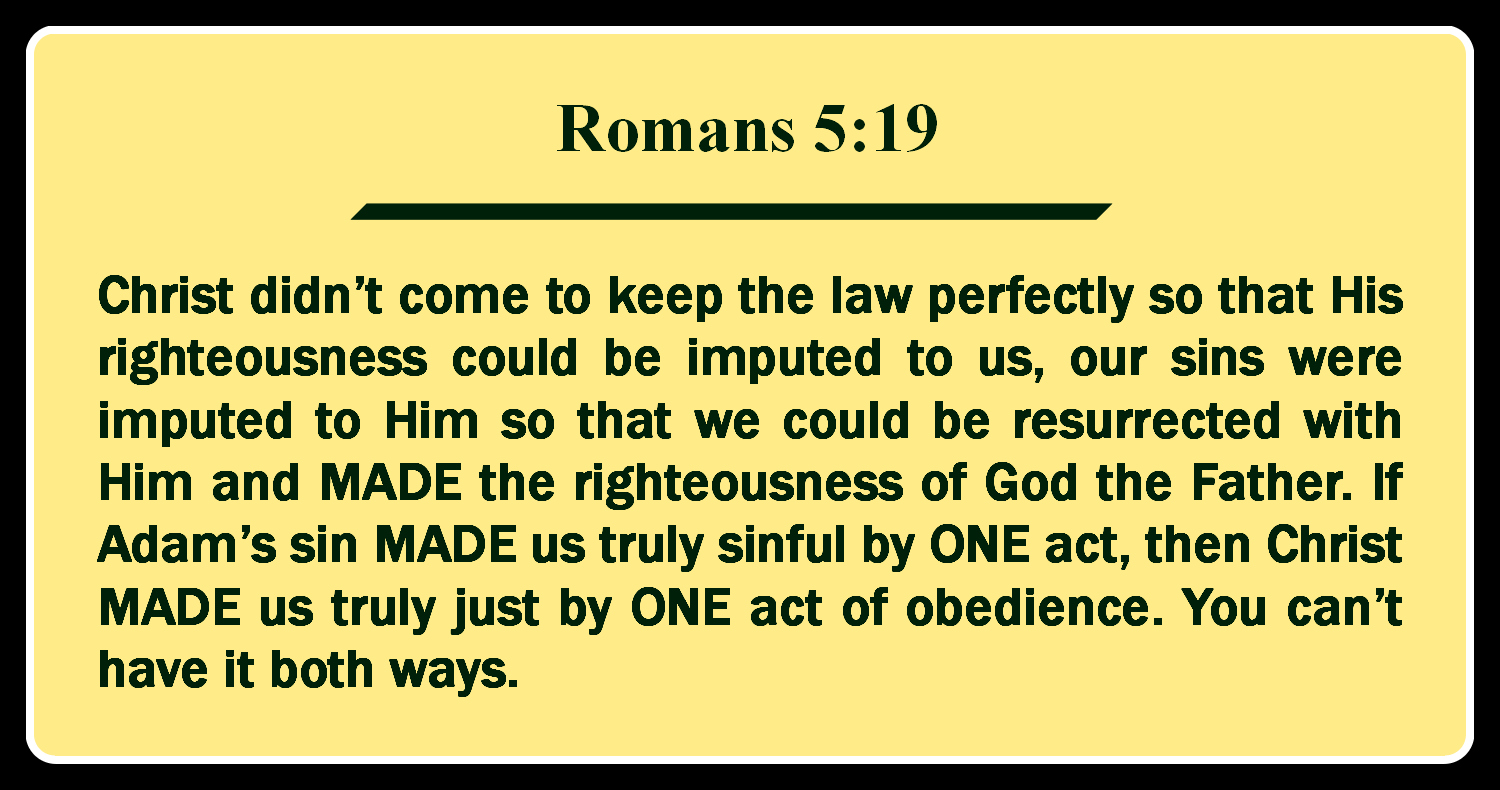
But it doesn’t stop there in Protestant soteriology. They then concern themselves with the question of true righteousness. If our sins are forgiven, that keeps us out of hell, but it doesn’t make us truly righteous. What to do? So here is what they came up with: Jesus came to die for our forgiveness, past and present IF we return to the same gospel that saved us by faith alone, but He also came to keep the law perfectly so that His perfect obedience could be imputed to “Christian” life. The Reformed call this “double imputation.”
And it turns the true biblical gospel completely upside down. First, it makes the law the standard for justification. There is no law in justification, we are justified APART from the law. Why would Christ obey the law for us when justification is apart from the law? Then what is the standard for righteousness? NOT the law, but rather God’s righteousness. What’s that? For one, and primarily, it’s the new birth. For us, the standard of righteousness is being a child of God. Being the offspring of God is what makes us righteous. Kinship, not law.
Secondly, we are not justified by the law, no matter who keeps it—who keeps it is not the point, the law itself is the point, because there is no law that can give life. Only the new birth gives life (Galatians 3:21).
Thirdly, double imputation is obviously a covering for sin with the righteousness of Christ and not an ENDING of sin. Our sins are not “taken away” they are only covered. “Christianity” is about living a life of faith only to maintain a covering for sin. Therefore, we are not the ones really obeying, and therefore, we are not the ones performing love either.
And boy does this notion land us right where we are at in 1John. I have invested so much in the untwisting of 1John 1:9 in this series, that I thought, “I might as well finish the book out and make it our 1John commentary.” And so it is.
This is our theses: the new birth creates us anew into people who love the truth, and therefore practice oblove. That’s a new word that I made up. What is the definition of oblove? It’s the combination of the words “love” and “obedience.” Biblically, you cannot separate these two words, they are synonymous. The law is the Bible, and it is a book of condemnation to the unsaved and a beloved love manual for those born again. This is also why our sins are not covered, they are taken away (1John 3:5). Christ came to take away sin, not cover it.
You know, many go to church and sing the hymns, and many listen to Christian radio and raise their hands in praise while stopped at red lights, but a lot of that good Protestant music is just really bad theology that imperils the soul and stops far short of inciting the curiosity of the unsaved. One example is a beautiful song by Steve Camp titled, “He Covers Me.” But again, the premise of the song is that our sins are covered and not ended.
You know, there is a quiet revolution going on in Christianity. Christian husbands are beginning to stand up and assume their rightful role as spiritual leaders. This necessarily means leaving the institutional church which deliberately seeks to emasculate the men among us. One thing that I hear back is that fathers are beginning to stand silent and not sing traditional songs that are deviations from the truth. Good for them. I even hear back that their children ask, “Daddy, why aren’t you singing?” And they tell them why. Undoubtedly, children and wives will get way more out of these types of examples rather than 365 different versions of the same gospel that saved us.
“Why is it that all we ever hear about in the church is the gospel?” Because we have to keep returning to the same gospel that saved us to keep ourselves saved, and by the way, the only place that this continued atonement is valid is in the institutional church. Sure, Protestants will deny salvation by church membership; they will rather become indignant and state that salvation is only found in the gospel. However, the fact remains that they also believe that authority to preach the gospel is vested in the institutional church.
If our sins are only covered, the focus of the Christian life is to keep ourselves covered, not obedience because now obedience is defined by law-keeping. We have been trained mentally to think of obedience as something demanded by the law. This makes the law a co-life-giver with God. At least in one regard, the idea of one God connects with this idea. There is only one life-giver (Galatians 3:10-21).
I strongly suspect that when the Bible talks about God being one, it in no way includes the context of the Trinity. It’s interesting to note that in context of Galatians 3:10-21, the point is that the law is not a coequal with God—there is only one God.
1John 3:1 – See what kind of love the Father has given to us, that we should be called children of God; and so we are. The reason why the world does not know us is that it did not know him. 2 Beloved, we are God’s children now, and what we will be has not yet appeared; but we know that when he appears we shall be like him, because we shall see him as he is. 3 And everyone who thus hopes in him purifies himself as he is pure.
4 Everyone who makes a practice of sinning also practices lawlessness; sin is lawlessness. 5 You know that he appeared in order to take away sins, and in him there is no sin. 6 No one who abides in him keeps on sinning; no one who keeps on sinning has either seen him or known him. 7 Little children, let no one deceive you. Whoever practices righteousness is righteous, as he is righteous. 8 Whoever makes a practice of sinning is of the devil, for the devil has been sinning from the beginning. The reason the Son of God appeared was to destroy the works of the devil. 9 No one born of God makes a practice of sinning, for God’s seed abides in him, and he cannot keep on sinning because he has been born of God. 10 By this it is evident who are the children of God, and who are the children of the devil: whoever does not practice righteousness is not of God, nor is the one who does not love his brother.
11 For this is the message that you have heard from the beginning, that we should love one another. 12 We should not be like Cain, who was of the evil one and murdered his brother. And why did he murder him? Because his own deeds were evil and his brother’s righteous. 13 Do not be surprised, brothers, that the world hates you. 14 We know that we have passed out of death into life, because we love the brothers. Whoever does not love abides in death. 15 Everyone who hates his brother is a murderer, and you know that no murderer has eternal life abiding in him.
16 By this we know love, that he laid down his life for us, and we ought to lay down our lives for the brothers. 17 But if anyone has the world’s goods and sees his brother in need, yet closes his heart against him, how does God’s love abide in him? 18 Little children, let us not love in word or talk but in deed and in truth.
19 By this we shall know that we are of the truth and reassure our heart before him; 20 for whenever our heart condemns us, God is greater than our heart, and he knows everything. 21 Beloved, if our heart does not condemn us, we have confidence before God; 22 and whatever we ask we receive from him, because we keep his commandments and do what pleases him. 23 And this is his commandment, that we believe in the name of his Son Jesus Christ and love one another, just as he has commanded us. 24 Whoever keeps his commandments abides in God, and God in him. And by this we know that he abides in us, by the Spirit whom he has given us.
The law is not the standard for justification; it is the standard for our love, obedience, and submission. If there is a standard for justification at all, it would simply be defined by the new birth. We are justified by virtue of being in God’s family. The first man was a created being. God did not decide to save man by restoring a covenant of works, or restoring man’s image created in the likeness of God, or to restore paradise lost. He decided to save man by making him His literal family. The gospel isn’t about restoring things; it’s about making all things new. This defines you as pure, albeit in mortality. Nevertheless, being born of God in mortality results in the inevitable morphing into more and more purity:
See what kind of love the Father has given to us, that we should be called children of God; and so we are. The reason why the world does not know us is that it did not know him. 2 Beloved, we are God’s children now, and what we will be has not yet appeared; but we know that when he appears we shall be like him, because we shall see him as he is. 3 And everyone who thus hopes in him purifies himself as he is pure.
Let’s ask an interpretive question here. What did Jesus mean when He told John the Baptist that His baptism by John would fulfill all righteousness? I think it fulfilled all righteousness by representing the literal new birth, or Spirit baptism. Though we still reside in mortal bodies, the decision to be saved is a decision to follow Christ in baptism, or a decision to be born again. That’s the gospel. That’s what the gospel is.
Romans 6:1 – What shall we say then? Are we to continue in sin that grace may abound? 2 By no means! How can we who died to sin still live in it? 3 Do you not know that all of us who have been baptized into Christ Jesus were baptized into his death? 4 We were buried therefore with him by baptism into death, in order that, just as Christ was raised from the dead by the glory of the Father, we too might walk in newness of life.
5 For if we have been united with him in a death like his, we shall certainly be united with him in a resurrection like his. 6 We know that our old self was crucified with him in order that the body of sin might be brought to nothing, so that we would no longer be enslaved to sin. 7 For one who has died has been set free from sin. 8 Now if we have died with Christ, we believe that we will also live with him. 9 We know that Christ, being raised from the dead, will never die again; death no longer has dominion over him. 10 For the death he died he died to sin, once for all, but the life he lives he lives to God. 11 So you also must consider yourselves dead to sin and alive to God in Christ Jesus.
12 Let not sin therefore reign in your mortal body, to make you obey its passions. 13 Do not present your members to sin as instruments for unrighteousness, but present yourselves to God as those who have been brought from death to life, and your members to God as instruments for righteousness. 14 For sin will have no dominion over you, since you are not under law but under grace.
The more you study the apostle John, the more you will see the apostle Paul. Romans 6 is key here. The perfection of the law is not the standard for righteousness, passing from life to death is the standard. Though we still sin, we are dead to sin. Being deemed righteous in our present state is defined by a reversal of slavery leading to a new direction in life. Romans 6 explains, as we shall see, 1John 3. The literal new birth, in essence reverses slavery (Romans 6:20). This also debunks the whole Reformed total depravity song and dance. Before the baptism of the Spirit that comes by believing on Christ, the unregenerate are free to do good, but enslaved to the law of sin and death (Romans 8:2).
Being under the curse of the law is both a forensic statement and a state of being. It is true, while under law, a perfect keeping of the law is demanded. But this is key: when it gets right down to it, unbelievers are indifferent to the Bible or the law of God. And remember, the law and the Bible are the same thing. Man is capable of doing good, and in fact does do good, but because he/she has no love for God’s truth, and in fact are indifferent to it, life decisions lead to many-faceted forms of death, and ultimately, eternal death. Unbelievers that live according to conscience will suffer a lesser punishment in this life and the life to come.
Believers can in fact make life and death decisions, but are inclined towards obeying the law because of the new birth. Clearly, the Bible states that there is a reversal of slavery. The believer is enslaved to righteousness, but unfortunately free to sin. But according to Paul, a believer can stupidly enslave themselves to certain sins by obeying the desire that the sin produces. The believer is no longer enslaved to sin, but can be ignorant of this fact. And keep in mind, Protestantism is predicated on the idea that we are still enslaved to sin as believers which goes part and parcel with still being under the law and law continuing to be the standard for justification.
Listen, here is why the home fellowship movement is going to eventually take off: the alternative is Protestantism which defines the believer according to how the Bible defines an unbeliever. Eventually, people are going to figure out that they have been proudly proclaiming themselves as unregenerate in the name of Christ.
Lastly, this is defined by the fact that believers have the freedom to present their bodies as living sacrifices, or in other words, present their members for holy purposes that please God. The body is not inherently evil because it is part of the material world. Whether saved or unsaved, the body can be used for good purposes. However, in the case of an unbeliever, good behavior doesn’t lead to life more abundantly, it just leads to lesser punishment and a more bearable eternal state. For the unbeliever, good behavior merely leads to less death. For the believer, obedient love leads to more life.
Now with all of this in mind, let’s read further in 1John Chapter 3:
4 Everyone who makes a practice of sinning also practices lawlessness; sin is lawlessness. 5 You know that he appeared in order to take away sins, and in him there is no sin. 6 No one who abides in him keeps on sinning; no one who keeps on sinning has either seen him or known him. 7 Little children, let no one deceive you. Whoever practices righteousness is righteous, as he is righteous. 8 Whoever makes a practice of sinning is of the devil, for the devil has been sinning from the beginning. The reason the Son of God appeared was to destroy the works of the devil. 9 No one born of God makes a practice of sinning, for God’s seed abides in him, and he cannot keep on sinning because he has been born of God. 10 By this it is evident who are the children of God, and who are the children of the devil: whoever does not practice righteousness is not of God, nor is the one who does not love his brother.
John wrote what he wrote in 1John 3 because of what Paul wrote in Romans 6—it’s saying the same thing. Obeying the law isn’t the issue, a “commitment” to obey the law isn’t the issue, the reality of the new birth is the issue.
1Corinthians 15:1- Now I would remind you, brothers, of the gospel I preached to you, which you received, in which you stand, 2 and by which you are being saved, if you hold fast to the word I preached to you—unless you believed in vain.
3For I delivered to you as of first importance what I also received: that Christ died for our sins in accordance with the Scriptures, 4 that he was buried, that he was raised on the third day in accordance with the Scriptures, 5 and that he appeared to Cephas, then to the twelve. 6 Then he appeared to more than five hundred brothers at one time, most of whom are still alive, though some have fallen asleep.
This is, as Paul called it, the gospel of “first importance” or literally “the gospel of first order of importance.” There is way more behind this than a mental ascent to the facts of the gospel. You have to believe that this first happened to Christ in order to believe that it really happened to you spiritually. Repentance is a change of mind in regard to many things concerning your life and the life of Christ.
By the way, there was an evangelical movement for a while that emphasized the new birth. It peaked in the 70’s and was considered to be the most egregious of all false gospels. The Australian Forum, the think tank that gave birth to the present-day return to authentic Reformed soteriology, actually published an article titled, “The False Gospel of the New Birth.”
John continues in chapter 3 to explain one of the characteristics of being born again, love. But let me insert this, and this is VERY important: the characteristics of the new birth are framed in what the Bible refers to as “abiding.” If God’s seed “abides in” us (1John 3:9), other things also abide in us: the fact that we abide in Him also; the truth abides in us; we know the truth; we love the truth; we love fellow Christians; we do not practice sin, but rather practice righteousness as a life direction and pattern; we love God’s law; we submit to need; we obey; we seek to please God; we have a hunger for learning more of God’s word, and many more can be listed.
Let’s read more of John 3 with this in mind:
11 For this is the message that you have heard from the beginning, that we should love one another. 12 We should not be like Cain, who was of the evil one and murdered his brother. And why did he murder him? Because his own deeds were evil and his brother’s righteous. 13 Do not be surprised, brothers, that the world hates you. 14 We know that we have passed out of death into life, because we love the brothers. Whoever does not love abides in death. 15 Everyone who hates his brother is a murderer, and you know that no murderer has eternal life abiding in him.
16 By this we know love, that he laid down his life for us, and we ought to lay down our lives for the brothers. 17 But if anyone has the world’s goods and sees his brother in need, yet closes his heart against him, how does God’s love abide in him? 18 Little children, let us not love in word or talk but in deed and in truth.
See, the order in which John discusses these things is in no wise disconnected. We need to start thinking about “obedience” in reference to love and the new birth. Really, the Christian life is about love. But listen, any love that flows from you starts with a love for truth. Also, please take note of a more biblical definition of love: love is a submission to need—that’s love. When the Scriptures tell women to submit to their husbands, that’s just another way of telling wives to love their husbands. When the Bible tells men to love their wives, it’s simply telling men to submit to their needs. Look at 1John 3:17 again. How does benevolence get parachuted into that body of text out of nowhere? John goes from discussing murder to meeting financial need; it seems like he is all over the map, but not really.
Lastly, working out the new birth with love leads to assurance.
19 By this we shall know that we are of the truth and reassure our heart before him; 20 for whenever our heart condemns us, God is greater than our heart, and he knows everything. 21 Beloved, if our heart does not condemn us, we have confidence before God; 22 and whatever we ask we receive from him, because we keep his commandments and do what pleases him. 23 And this is his commandment, that we believe in the name of his Son Jesus Christ and love one another, just as he has commanded us. 24 Whoever keeps his commandments abides in God, and God in him. And by this we know that he abides in us, by the Spirit whom he has given us.
Assurance of salvation comes through working out our new birth in fear and trembling. Assurance of salvation is grounded in the ending of the law because the old us died with Christ resulting in no condemnation, while our new relationship to the law leads us in love and life. Now listen, even a casual student of the Bible can begin to hang Bible verses all over this framework.
Next week, we will build on this as we go into chapter 4—let’s go to the phones.
TANC 2015 – Paul Dohse, Session 3: What is the Gospel?
We don’t hear much about one of the primary biblical terms used for “gospel.” The gospel is also known throughout Scripture as “the promise.” A promise made by God; think about that. But who is the promise to?
Acts 2:36 – Let all the house of Israel therefore know for certain that God has made him both Lord and Christ, this Jesus whom you crucified.”
37 Now when they heard this they were cut to the heart, and said to Peter and the rest of the apostles, “Brothers, what shall we do?” 38 And Peter said to them, “Repent and be baptized every one of you in the name of Jesus Christ for the forgiveness of your sins, and you will receive the gift of the Holy Spirit. 39 For the promise is for you and for your children and for all who are far off, everyone whom the Lord our God calls to himself.” 40 And with many other words he bore witness and continued to exhort them, saying, “Save yourselves from this crooked generation.” 41 So those who received his word were baptized, and there were added that day about three thousand souls.
This is an extraordinary text. Clearly, the gospel is a promise to all men contingent on believing in the promise, and resulting in the “gift” of the Holy Spirt. This is a fundamental principle of Biblicism: when a particular text is absolutely clear, and barring all assumptions, everything else must align logically with the concepts that are clearly stated.
Hence, the Protestant definitions of “election,” “called,” and “chosen” must be completely reevaluated. The gospel is a promise and a gift offered to all men.
…and you will receive the gift of the Holy Spirit. 39 For the promise is for you and for your children and for all who are far off, everyone whom the Lord our God calls to himself.
And who does the Lord call to himself? Everyone.
Turn to me and be saved, all the ends of the earth! For I am God, and there is no other (Isa 45:22).
And I, when I am lifted up from the earth, will draw all people to myself (Jn 12:32).
Say to them, ‘As surely as I live, declares the Sovereign LORD, I take no pleasure in the death of the wicked, but rather that they turn from their ways and live. Turn! Turn from your evil ways! Why will you die, people of Israel?’(Eze 33:11).
Biblicism does not reject mystery, or paradox, but always approaches the latter with extreme skepticism. Biblicists consider paradox guilty until proven innocent. God is not a God of confusion, but be sure of this: the paradox card is more times than not a license for a mystery that only the spiritual elite understand—those who have the rule over you.
If the promise and the gift are verbally offered to all people, but the offer is not legitimate for all, that makes the use of these words completely illogical. Though the issue of election will not be explored in this series, the basic wrongness of Protestants who propagate so-called “sovereign grace” must call their deterministic gospel into question. Those who have the basic gospel completely wrong cannot be trusted with the rest of the story.
However, the fact that salvation is a promise and a gift will be key to exposing the false gospel of Protestantism in simple terms. The Bible defines the gospel with these specific words for good reason – words mean things.
What is the Gospel?
1Corinthians 15:3 – For I delivered to you as of first importance what I also received: that Christ died for our sins in accordance with the Scriptures, 4 that he was buried, that he was raised on the third day in accordance with the Scriptures, 5 and that he appeared to Cephas, then to the twelve. 6 Then he appeared to more than five hundred brothers at one time, most of whom are still alive, though some have fallen asleep.
These are the facts of the gospel, but in Paul’s statement much more is assumed rightly because of other texts that further define what is being stated here in 1Cor 15:3-6. Obviously, no one is saved by a mere believing of the facts concerning the gospel. As James wrote, the devils believe also and do tremble in regard to their future condemnation. The facts do need to be believed, but what saves is the following of Christ in these facts. In other words, it’s not a mere believing of the facts, but also the belief of what the results of believing are, and a desire to want that for yourself.
You believe the promise, and the gift, and you want the gift for yourself. The gift is the baptism of the Spirit, and believing in the transaction that takes place. It’s believing the promise and “receiving” the gift.
Romans 6:1 – What shall we say then? Are we to continue in sin that grace may abound? 2 By no means! How can we who died to sin still live in it? 3 Do you not know that all of us who have been baptized into Christ Jesus were baptized into his death? 4 We were buried therefore with him by baptism into death, in order that, just as Christ was raised from the dead by the glory of the Father, we too might walk in newness of life.
5 For if we have been united with him in a death like his, we shall certainly be united with him in a resurrection like his. 6 We know that our old self[a] was crucified with him in order that the body of sin might be brought to nothing, so that we would no longer be enslaved to sin. 7 For one who has died has been set free from sin. 8 Now if we have died with Christ, we believe that we will also live with him. 9 We know that Christ, being raised from the dead, will never die again; death no longer has dominion over him. 10 For the death he died he died to sin, once for all, but the life he lives he lives to God. 11 So you also must consider yourselves dead to sin and alive to God in Christ Jesus.
12 Let not sin therefore reign in your mortal body, to make you obey its passions. 13 Do not present your members to sin as instruments for unrighteousness, but present yourselves to God as those who have been brought from death to life, and your members to God as instruments for righteousness. 14 For sin will have no dominion over you, since you are not under law but under grace.
It’s amazing that the unsaved understand this in their own way. It’s just a fact that the unsaved understand the gospel intuitively better than the vast majority of Protestants. Most unsaved people know that salvation involves the loss of who they presently are in exchange for a new life that is in the wind so to speak. This is what Christ was telling Nicodemus as recorded in John 3 and why Nicodemus came to Him under cover of darkness—Christ was a threat to the present life he knew. The fact that Christ told him that he must be born again which would result in a new, and completely unpredictable life correlates with the fact that Nicodemus came to Him under cover of darkness. Nicodemus was afraid of losing his present life, and therefore, Christ addressed the issue forthwith.
“Just believe” and “faith alone” minus the new birth is a Protestant hallmark. It boils down to a mere glorified assent to the facts of the gospel. It is not the losing of present life in order to find the new one. It is not repentance, i.e., a turning from the old life and following Christ in literal death and resurrection. Water baptism is a public confession that you understand this. Now many will protest that we are doing something to be saved other than believe; we are “following” Christ. But it is a decision, not some work of following. The Spirit does the baptizing, not us. We are saved by wanting that for our life and accepting the gift that is offered.
But likewise with any gift, once it is given, the receiver owns it. It is now up to us to work out our own salvation with fear and trembling (Phil 2:12,13). Here, “salvation” refers to redemption (the saving of the body, Rom 7:24, 8:23), not the saving of the soul, and work/fear refers to the new Christian person and life, not our onetime new birth. The Christian life is a process; the new birth is a onetime event. Before we were saved, our fear regarded condemnation. Now our fear regards chastisement and sin that leads to unnecessary deaths (consequences for sin). There is no work FOR salvation, but there is a work IN the Christian life, specifically, a work of love (Gal 5:6).
On the flipside, even though there is not a work FOR salvation (justification), there is a work IN being unsaved that has a specific wage paid by a specific master. We met him in the previous session, the sin master. This is how the Bible frames this: there are two masters who pay two different wages: one pays wages for death, and the other pays wages for life. ALL people in the world are earning one or the other in varying degrees. Either group can do bad or good works (Rom 6:20), but one can only be credited for death, and the other can only be credited for life. These are two different wages paid by two different masters.
These two groups, lost and saved, are under two different laws that determine their wages. The lost who belong to the sin master are “under law” and its condemnation, the law of sin and death. Those under this law can only bear fruits of death. In contrast, those purchased by Christ (“you have been bought with a price” 1Cor 6:20, 7:23) can only bear fruits for life. They are identified as “under grace,” or under the law of the Spirit of life (Rom 6:14, 8:20).
Romans 6:15 – What then? Are we to sin because we are not under law but under grace? By no means! 16 Do you not know that if you present yourselves to anyone as obedient slaves, you are slaves of the one whom you obey, either of sin, which leads to death, or of obedience, which leads to righteousness? 17 But thanks be to God, that you who were once slaves of sin have become obedient from the heart to the standard of teaching to which you were committed, 18 and, having been set free from sin, have become slaves of righteousness. 19 I am speaking in human terms, because of your natural limitations. For just as you once presented your members as slaves to impurity and to lawlessness leading to more lawlessness, so now present your members as slaves to righteousness leading to sanctification.
20 For when you were slaves of sin, you were free in regard to righteousness. 21 But what fruit were you getting at that time from the things of which you are now ashamed? For the end of those things is death. 22 But now that you have been set free from sin and have become slaves of God, the fruit you get leads to sanctification and its end, eternal life. 23 For the wages of sin is death, but the free gift of God is eternal life in Christ Jesus our Lord.
This is why Christ came to end the law (Rom 10:4). The law that He ended is the law of sin and death. EVERYONE born into the world is under the law of sin and death and condemnation. This is how we know Christ died for everyone ever born into the world. He also purchased mankind from the sin master; eternal life is the promise, new birth is the gift (if received by faith) resulting in freedom from condemnation and the fruits of death. The believer now “upholds” the law he/she is free to serve: the law of the Spirit of life also known as the “law of Christ” and the “law of liberty.” Salvation is a free gift, but the Christian life is a work that can earn rewards.
Hebrews 6:10 – For God is not unjust so as to overlook your work and the love that you have shown for his name in serving the saints, as you still do.
God would be unjust to forget you labor of love in sanctification because you are earning rewards, and there is no fear in regard to condemnation because that concerns judgement:
1John 4:18 -There is no fear in love, but perfect [mature] love casts out fear. For fear has to do with punishment, and whoever fears has not been perfected in love. [Because they fear condemnation].
This is what is critical about the new birth, or the baptism of the Spirit. The old man that was under the law of sin and death died with Christ, and is now free to “serve another” through being resurrected with Christ:
Romans 7:1 – Or do you not know, brothers—for I am speaking to those who know the law—that the law is binding on a person only as long as he lives? 2 For a married woman is bound by law to her husband while he lives, but if her husband dies she is released from the law of marriage. 3 Accordingly, she will be called an adulteress if she lives with another man while her husband is alive. But if her husband dies, she is free from that law, and if she marries another man she is not an adulteress.
4 Likewise, my brothers, you also have died to the law through the body of Christ, so that you may belong to another, to him who has been raised from the dead, in order that we may bear fruit for God. 5 For while we were living in the flesh, our sinful passions, aroused by the law, were at work in our members to bear fruit for death. 6 But now we are released from the law, having died to that which held us captive, so that we serve in the new way of the Spirit and not in the old way of the written code.
Here is a good place to speak of God’s calling to mankind. This is a good place to talk about how God pushes man to the brink of salvation—to the gates of the kingdom. God, in His calling of man, does everything but make the decision for him.
First, God creates every human being with the works of God’s law written on their hearts, and a conscience that either excuses or accuses them. Those without the word of God will be judged by this internal law, while the religious will be judged by both (Rom 2:12-16). Until a human being develops a conscience, they are not under any law and therefore without sin (Rom 4:15). Man has intuitive knowledge of God’s gospel (Rom 1:18-21).
Secondly, the Holy Spirit uses the law of sin and death to convict the world of sin, righteousness, and the judgment to come (Jn 16:8).
Thirdly, believers use the law of sin and death to convict the world of sin, righteousness, and the judgment to come.
Fourthly, believers testify about God to the world with their lives (Matt 5:14-16).
Fifthly, Christ has purchased all men with His death on the cross. Their sin debt is prepaid. They have already been purchased from the sin master. They themselves choose to remain under the control of their present master, but their contract has been bought out, they are free to choose Christ as their new master.
Sixthly, even the law that condemns unbelievers holds their sin captive. Even the law of sin and death is a “ministry” (2Cor 3:7-11). The first covenant which is passing away (Heb 8:13) held sin captive in the law of sin and death until Christ came (Gal 3:19-27). Christ ended the law for righteousness to those who believe in Him. Our sins are not merely covered—they are ENDED along with the law of sin and death. ALL sin was held captive in the law of sin and death that the old us was under, but upon believing, that man died and is now under the law of the Spirit of life (Rom 8:2). We are now fee to work through love as guided by the Scriptures (Gal 5:6,7). Our obedient love fulfills the law (Gal 5:14, Rom 8:4, Rom 13:8-10, Matt 22:34-40).
Seventh, God increased the law through the first covenant to drive man towards him (Rom 5:20).
Eighth, God made man a living being, but after the fall he made mankind His very family (Gal 3:29, Heb 2:11).
Ninth, in the end, God will vacate heaven and dwell with His family on earth. God Himself comes DOWN to earth to dwell with man (Rev 21:3).
This is some of the good news of God’s love for mankind.

An Introduction to TANC 2015: Why the Protestant Reformation is a Lie

Protestants don’t know anything. That’s not a derogatory remark, it’s merely a staple of Reformed ideology. It’s who we are supposed to be. Protestantism is predicated on the idea of spiritual caste as an accepted norm. The average Protestant parishioner is not supposed to know anything, and again, this is an accepted norm. In fact, many Protestant laymen who didn’t get the memo will concur; knowing something in the institutional church will usually get you in trouble. If you know something, you lack humbleness, and are trying to undermine… The Pastor.
This should not surprise us at all if we understand our authentic roots and the ideology of our spiritual heroes. Though Martin Luther’s 95 Theses is credited with launching the Reformation, its first and defining doctrinal statement came six months later in the form of the Heidelberg Disputation to the Augustinian Order. In the 22nd thesis of that document, Luther declared knowledge to be a vice that does nothing but puff people up, and like with all lust, it can never be satisfied. Luther’s disdain for reason is well documented, referring to it as…
Reason is the Devil’s greatest whore; by nature and manner of being she is a noxious whore; she is a prostitute, the Devil’s appointed whore; whore eaten by scab and leprosy who ought to be trodden under foot and destroyed, she and her wisdom … Throw dung in her face to make her ugly. She is and she ought to be drowned in baptism… She would deserve, the wretch, to be banished to the filthiest place in the house, to the closets.
Reason is the greatest enemy that faith has; it never comes to the aid of spiritual things, but more frequently than not struggles against the divine Word, treating with contempt all that emanates from God.
Reason must be deluded, blinded, and destroyed. Faith must trample underfoot all reason, sense, and understanding, and whatever it sees must be put out of sight and … know nothing but the word of God.
There is on earth among all dangers no more dangerous thing than a richly endowed and adroit reason… Reason must be deluded, blinded, and destroyed.
Reason should be destroyed in all Christians.
Whoever wants to be a Christian should tear the eyes out of his Reason.
To be a Christian, you must “pluck out the eye of reason.”
In our day, this fruit doesn’t fall far from the tree as reflected in this quote by a pastor sent to our ministry by one of his former parishioners:
Paul told the Corinthian church that “‘knowledge’ puffs up but love builds up” (1Cor 8:1). So, if you love knowledge and look into the word of God to gain mere knowledge and you absolutely love doing it to the exclusion or ignoring of everything else, you may be “puffed up” and indeed not “building up.”…. Puffiness rips and tears. Puffiness pushes people away. Puffiness divides. Perhaps even more critical is the fact that puffiness portrays a small gospel and devastatingly distorts God’s glory.
To the puffy I say, “Stop studying your Bible.” Go on a quest for Jesus. He is the Word! Study Him, not it.
Studying Jesus and not any knowledge regarding Jesus is the most popular rendering of 1Corithians 2:2 in our day: we are supposed to make every effort to know NOTHING but Christ and him crucified. After all, according to another popular truism in our day, “He is a person—not a precept.”
Of course, most Protestants would deny all of this out of hand when confronted, but the roots and foundation of Protestant ideology has at least resulted in a lax view of knowledge while leaving the thinking to Protestant academia. Some well-known evangelicals such as Dr. Jay Adams have stated the obvious: Protestants are biblically illiterate, and have no wisdom in regard to Christian living other than God-given commonsense and even that is at an all-time low.
Christians, who strive for wisdom and spiritual maturity in the institutional church, if they don’t give up, will eventually find themselves in turmoil and at a crossroads. Striding towards commonsense spiritual objectives will continually put them at odds with the Protestant herd. I was certainly no exception. As someone who was always considered knowledgeable wherever I attended church as a Baptist, in reality, I knew nothing. The knowledge that I had accumulated in various seminaries and Bible colleges was all but worthless. Though I read and studied my Bible more than most, I understood little of it. Most of what I read made no sense at all. Nevertheless, I deemed myself knowledgeable relative to the environment, yet in my heart, I knew the Christian life made no sense and I was for the most part confused. In reality, I was good at constructing Protestant sentences with orthodox bumper stickers and pithy truisms.
So, I set out on a journey eight years ago to search for clarity after 23 years of confusion and strife. The part of my journey that really made everything come together began in 2011 when I embarked on a personal study of Paul’s letter to the Romans. I was determined to make this the time—the endeavor that would reveal once and for all what I was searching for: why my God seemed to be a God of confusion. I prayed earnestly at the beginning of the study that I would just let Paul’s words say what they plainly said. If something he wrote was definitive, I would use that as a building block of understanding.
Though I stayed true to the plan, not much happened until Romans 4:15. That’s the day my life came to a full stop.
For the law brings wrath, but where there is no law there is no transgression.
What in the world did Paul mean by that? NO law, NO sin: especially in the context; speaking of Christians. I kept it mind and continued to work through the letter. Then I came to Romans 5:13…
for sin indeed was in the world before the law was given, but sin is not counted where there is no law.
There it was again: no law, no sin. I stopped there in my verse by verse study and read through the rest of the letter and found the following:
Romans 7:6 – But now we are released from the law, having died to that which held us captive, so that we serve in the new way of the Spirit and not in the old way of the written code. 7 What then shall we say? That the law is sin? By no means! Yet if it had not been for the law, I would not have known sin. For I would not have known what it is to covet if the law had not said, “You shall not covet.” 8 But sin, seizing an opportunity through the commandment, produced in me all kinds of covetousness. For apart from the law, sin lies dead.
Apart from the law sin lies dead. There it is again. No law, no sin. Then I read the following as well:
Romans 10:4 – For Christ is the end of the law for righteousness to everyone who believes.
Conclusion: Christ died on the cross to end the law, and where there is no law, there is no sin. That’s how Christ took my sins away: He died on the cross to end the law. The true Christian is free from any judgement or condemnation—we are not under the jurisdiction of the law.
I wasn’t the least bit sure where this left the law in regard to the Christian life, but pondering the simple fact that we are no longer condemned was exhilarating and freeing. The old self that was under the law of sin and death died with Christ; you can’t indict a dead person, they are no longer under the law. And even if you exhumed my body and presented it in court, the judge has no law in which to convict me (Rom 7:1-6). There is NOW no condemnation for those in Christ (Rom 8:1).
Again, I was not sure where this left the law in regard to the believer’s life, but I had my building block; part of the pieces fit together which would lead to more pieces fitting and an increased understanding of the bigger picture.
Then I came to Romans 8:2.
For the law of the Spirit of life has set you free in Christ Jesus from the law of sin and death.
Remember, I had committed to simply letting the words say what they say. As a result, I saw something in this verse that I had never seen before; clearly, Paul wrote of two separate laws…the law of the Spirit, which I had always thought of as the Spirit’s realm of influence, and the law of sin and death.
“Wait a minute here,” I thought to myself. “If the law of sin and death refers to the written law that condemns mankind, and the two laws spoken of here are the same Greek word, and they are, why would one refer to a realm while the other one referred to a written law? Could it be that this is two perspectives on the same law?” I knew that a literal take on this verse would demand that, and then John 17:17 came to mind:
Sanctify them in the truth; your word is truth.
Then another verse came to mind:
And when he comes, he will convict the world concerning sin and righteousness and judgment (Jn 16:8).
That’s when I realized that the law has two different applications/perspectives: one for the lost and one for the saved. But verses were not done coming to mind:
Love does no wrong to others, so love fulfills the requirements of God’s law (Rom 13:10).
For in Christ Jesus neither circumcision nor uncircumcision counts for anything, but only faith working through love (Gal 5:6).
So, the Christian is free to aggressively love God and others through obedience without ANY fear of condemnation:
There is no fear in love, but perfect [mature] love casts out fear. For fear has to do with punishment, and whoever fears has not been perfected [matured, or growing] in love (1Jn 4:18).
Therefore, why the Reformation is a lie is not complicated at all. This SIMPLE fact makes Protestant theology a house of cards: it keeps so-called believers under the law of sin and death; its very definition of a Christian is the Bible’s definition of a lost person…under law (Rom 6:14). Protestantism is predicated on a single perspective on the law that Christians remain under; they remain under condemnation. This condemnation is covered by Christ’s righteousness as the “Christian” lives by faith alone. Living by faith alone works (usually some kind of ritual like “preaching the gospel to ourselves everyday”) imputes the obedience of Christ to our Christian lives as a way to keep ourselves justified. The Reformed call this “double imputation.”
Once one gets past all of the theological Protestant-speak, it boils down to extremely simple theological math: a Christian is NOT free to love—Jesus must love for us lest it be works salvation. And it almost goes without saying that there is a love famine in the institutional church for this very reason. The Protestant is not free to love, but must focus on a convoluted life formula that supposedly imputes the righteousness of Christ to our lives and thereby keeps us saved. Yes, this is the dirty little secret: total depravity doesn’t merely apply to the unregenerate, but also to the “saints.”
Yes, yes, many a Protestant doth protest against this accusation because few Protestants know what Protestantism is. Nevertheless, it is a false gospel that denies the new birth and keeps people under law and not under grace—a grace that frees the individual to aggressively love without fear of condemnation and the mire of unhealthy introspection.
We are saved APART from the law of sin and death…period (Rom 3:21), and it does NOT matter who keeps the law, the law of sin and death itself is the issue. Salvation is accomplished by the ENDING of the law of sin and death—not the fulfilling of it. Christ came to fulfill the law of the Spirit of life (and love) through us (Rom 8:4)…NOT the law of sin and death.
That would make the law of sin and death a co-life-giver with Christ. The law cannot give life unto salvation. If Christ fulfilled the law of sin and death with loving obedience to the Father, that law is a co-life-giver. That is Paul’s entire point in Galatians chapter 3. There is only ONE seed. If we are still under the law, the law is an additional seed that can give life…but there is only ONE!
Hence, Protestantism goes the way of most other false religions; some ritual or tradition fulfills the law of sin and death and separates the individual from the freedom to love without condemnation and according to the law of the Spirit of life. Love is replaced by obeying men and faithfulness to their institutions. The law of love is replaced with the traditions of men and their orthodoxy.
Consequently, we are in a Protestant dark age. In the same way that secular America has awakened to the failure of the elitist political class, Christians must awaken to realize the failure of Protestant academia. The assembly of Christ was a laity movement, and only the laity can return God’s people to the truth of the gospel. This is a repeat of history when God’s elect where continually troubled by the 1st century Gnostic elitists. Paul wrote to them…
For consider your calling, brothers: not many of you were wise according to worldly standards, not many were powerful, not many were of noble birth.
Likewise, the beloved James addressed the problem as well:
Listen, my beloved brothers, has not God chosen those who are poor in the world to be rich in faith and heirs of the kingdom, which he has promised to those who love him? But you have dishonored the poor man. Are not the rich the ones who oppress you, and the ones who drag you into court? Are they not the ones who blaspheme the honorable name by which you were called?
This is our mission at TANK, to aid the priesthood of believers in rediscovering the truth of the gospel and kingdom living robbed from us by 500 years of Protestant orthodoxy. The light has been covered by the Protestant basket long enough, and this is a matter of simple theological math: the new birth is the standard of righteousness, NOT the law of sin and death, and it matters not who keeps it—it CANNOT give life.
So, the speakers at this year’s conference are partaking in this journey in the arena of ideas. This is an issue that addresses every area of life and culture. Other than the gospel of first importance stated here, everything is being examined and revisited. It’s not group think, it’s collective truth made up of individuals seeking the one mind of Christ, not the traditions of men.
Let all be convinced according to their own conscience. Protestant elitists will not stand in our stead regardless of their claims, but each person will give an account for the sum and substance of their own lives. Let us do it with trembling and fear; not any fear of condemnation, but a fear of trading the life of Christ for the death of tyranny.
Because only truth sanctifies,
Paul M. Dohse

 Paul's Passing Thoughts
1 comment