The True Gospel Verses Calvinism: Part 2
“The whole idea that Christians are unable to obey the law in a way that is acceptable to God is an absurd contradiction of a massive body of Scripture. But yet, this is widely accepted in Reformed circles and key to understanding their doctrine.”
“And moreover, according to Reformed theology, the law is still a standard that must be maintained to get justification home to glorification by driving on a road named Sanctification.”
“However, If you will stay your mind on the reality of the above illustration, and dogmatically assert that all Reformed theology in some way relates to this illustration, you will be given insight into the soul of Reformed theology. Do not let the Reformed academics move you away from this reality with rhetoric.”
“So, in Reformed theology, because the law remains a standard for progressive justification, perfect obedience to the law in sanctification must also be imputed to us.”
Let’s begin by revisiting the original question that prompted this two part post:
Paul, please explain in layman’s terms how Calvinism views justification and sanctification. I am trying to understand this. Does this have anything to do with the saint’s persevering?
What most people don’t understand is the fact that Reformed theology is all but a complete demolition of the truth. The election/free will debate is hardly the issue; this theology barely falls short of contradicting every basic theological point of Scripture.
This starts with the fusion of justification and sanctification….
….this fusion is the leaven that leavens the whole lump. Reformed theology thinks that sanctification links justification to glorification. It believes that sanctification is the growing part of salvation. But, salvation doesn’t grow, it’s a finished work. The chart below from a Calvinist organization should make my point (click to enlarge if necessary).
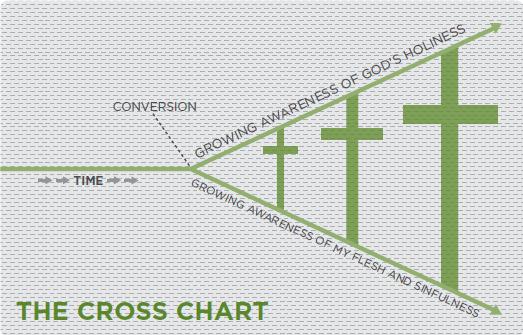
Also note: the believer doesn’t grow, the cross does. In fact, the believer gets worse! Or at least endeavors to increasingly realize how rotten he/she is. But what about the new birth? Reformed theology denies it regardless of the fact that Christ said, “You must be born again.” I can already hear the cat cries, but I will make my case. There isn’t a theology on earth that is more wrong than Reformed theology for many reasons including the denial of the new birth.
First of all, while denying that they fuse justification and sanctification together, the core element of Reformed theology is based on such. If justification and sanctification are fused together, we abide in the milieu that is between the two. That can make sanctification very tricky, unlike my biblical thesis in part one—we don’t abide in that realm that is a finished work. If we reside in a place where justification progresses to glorification, can we mess it up? According to Calvinists, “yes.” More on that later. But again, they clearly recognize this problem and base their core doctrine on it.
So, what doctrine is that? Well, there is only one way to prevent us from short circuiting justification on the way to glorification: cut us out of sanctification all together and make it a 100% work of God. And I agree, if our sanctification is the link between justification and glorification, we would need to be cut out of the equation all together. This is greatly magnified in Reformed theology by the idea that justification must be maintained by the keeping of the law. So, justification begins, but needs to be maintained until it arrives to glorification via the road of sanctification. This can be seen in a personal conversation I had with the well-known Calvinist Voddie Baucham:
paul: “Do you believe in this Gospel Sanctification stuff?”
Baucham: “I’m not sure what you mean.”
paul: “The same gospel that saved us also sanctifies us.”
Baucham: “Yes, absolutely!”
paul: “But Dr. Baucham, justification is a finished work, how can it sanctify us?”
Baucham: Nodding toward the window where we were standing; “That road out there is a finished work, but we still use it.”
Is that true? Are we sanctified by justification? Do we still “use” justification to get to glorification? At least in the Reformed view, the answer to all three of those questions is “yes,” and the perfect maintaining of the law to get justification home to glorification is the key. Justification must be maintained by the perfect keeping of the law, or else the legal declaration that we are justified is, “legal fiction” according to Reformed academics. This is the exact term they use to explain why sanctification must maintain justification by a perfect maintaining of a true legal declaration by perfect law-keeping. And moreover, according to Reformed theology, the law is still a standard that must be maintained to get justification home to glorification by driving on a road named Sanctification. As we discussed in part one, the law has been voided in regard to justification. Paving a road from justification to glorification, and naming it Sanctification, and using the law for the asphalt is a gargantuan theological misstep.
Well, that certainly excludes us! No? But don’t worry, Calvinists have a solution to this problem—it’s the doctrine of The Objective Gospel Outside of Us. The gospel gets justification home to glorification on the road named Sanctification, and we don’t have anything to do with it because the road is maintained by the perfect keeping of the law. How in the world does all of this work? I will explain, stay tuned. But first, let me establish that Calvinists believe that the law must be obeyed perfectly to maintain justification. This can be seen clearly in the writings of John Calvin himself. In context of sanctification, Calvin wrote that any attempt by a Christian to keep the law in sanctification was akin to an effort to keep the law….for justification. So, in Reformed theology, whatever is….for sanctification, IS ALSO….for justification because the two are the same. Calvinists use James 2:10, which is a statement….for justification, and apply it….for sanctification as one example, but they also routinely speak as if justification, and sanctification are the same thing with the same standard for keeping the law. Here is what Calvin said on this wise in his Institutes (Book 3; ch. 14, sec. 9,10):
Let the holy servant of God, I say, select from the whole course of his life the action which he deems most excellent, and let him ponder it in all its parts; he will doubtless find In it something that savors of the rottenness of the flesh, since our alacrity in well-doing is never what it ought to be, but our course is always retarded by much weakness. Although we see that the stains by which the works of the righteous are blemished, are by no means unapparent, still, granting that they are the minutest possible, will they give no offense to the eye of God, before which even the stars are not clean? We thus see, that even saints cannot perform one work which, if judged on its own merits, is not deserving of condemnation.
Even were it possible for us to perform works absolutely pure, yet one sin is sufficient to efface and extinguish all remembrance of former righteousness, as the prophet says (Ezek, 18:24). With this James agrees, “Whosoever shall keep the whole law, and yet offend in one point, is guilty of all” (Jam 2:10).
Notice that there is nothing a Christian does that is considered good or righteous by God. The same is echoed by Calvinists in our day like Tullian Tchividjian (click to enlarge if necessary):

And also notice what the standard for that is: the law….for justification in sanctification. The whole idea that Christians are unable to obey the law in a way that is acceptable to God is an absurd contradiction of a massive body of Scripture. But yet, this is widely accepted in Reformed circles and key to understanding their doctrine. Obviously, the law is still the standard, which is a problem in and of itself if you read part 1. The road named Sanctification that links justification and glorification together is paved with the law, and the asphalt is kept in perfect condition by a perfect keeping of the law. As discussed in part one, the law is not available to progress justification forward. For purposes of progressing justification—the law is void—we are no longer UNDER it….for justification. Therefore, justification can’t progress. It doesn’t get bigger, and it doesn’t grow. But obviously, if we are still on that road, things get tricky.
Therefore, Reformed theology holds to the idea that salvation grows to perfection until glorification, but we must remain OUTSIDE of this process lest the growing process is messed up by our mortal imperfection. This is where the Centrality of the Objective Gospel Outside of Us comes into play. Reformed academics get a covert pass on this because listeners assume they are talking about justification only—BUT THEY ARE NOT—THEY ARE TALKING ABOUT BOTH JUSTIIFICATION AND SANCTIIFCATION. So, we must be cut out of the growing process of salvation because of our imperfection while being able to lay claim to it. But how? Here is how: THE GOSPEL GROWS, BUT WE DON’T. Remember the cross illustration above?
Ok, so, in Reformed theology, justification and sanctification are the same thing. Sanctification is the growing of justification until it reaches glorification, and in the process, justification must not be “legal fiction.” Therefore, sanctification maintains justification by the perfect keeping of the law until the day of glorification . We can lay claim to it, but because of our mortal imperfection, we can’t be part of justification progressing to glorification. So how does this work in Reformed theology? We will get to that, but first, let me further substantiate my claims thus far. Let me begin by quoting Calvin on the idea that justification is progressive. Really, our first clue should be the title of chapter 14 from the Calvin Institutes: “The Beginning of Justification. In What Sense Progressive.” Calvin states the following in that chapter:
Therefore, we must have this blessedness not once only, but must hold it fast during our whole lives. Moreover, the message of free reconciliation with God is not promulgated for one or two days, but is declared to be perpetual in the church (2 Cor 5:18, 19). Hence believers have not even to the end of life any other righteousness that that which is there described. Christ ever remains a Mediator to reconcile the Father to us, and there is a perpetual efficacy in his death, i.e., ablution, satisfaction, expiation; in short, perfect obedience, by which all our iniquities are covered. In the Epistle to the Ephesians, Paul says not that the beginning of salvation is of grace, but “by grace are ye saved,” “not of works, lest any man should boast” (Eph 2:8, 9).
Furthermore, a Reformed think tank that was highly regarded in the early seventies, the Australian Forum, published the following illustration that captures the general idea of the doctrine (click to enlarge):
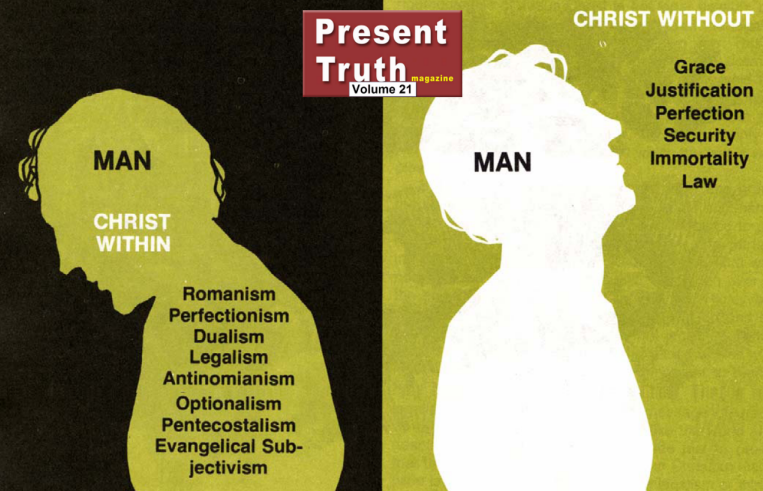
Let me add an additional note:

Obviously, this illustration provokes multiple questions in regard to practical application which will be discussed later (how this supposedly works in sanctification). But the key reality must not leave your mind: Christians cannot really participate in sanctification according to Reformed theology with the exception of one concept, and unfortunately, as we shall see, that one concept can only be works salvation. Not only is our role limited and narrow, the specific role is efficacious to maintaining our own salvation. However, If you will stay your mind on the reality of the above illustration, and dogmatically assert that all Reformed theology in some way relates to this illustration, you will be given insight into the soul of Reformed theology. Do not let the Reformed academics move you away from this reality with rhetoric.
Let’s also illustrate that proponents of Reformed theology fuse justification and sanctification together and speak of the two as being the same thing. In their sermons and teachings, they do this by virtue of the missing transition of subject matter—that being the difference between sanctification and justification. In their messages, they transition between the two without noting any difference as if the two are the same thing—because that is what they believe. Furthermore, this is an excellent communication method for assimilating this idea into the minds of their parishioners victims without them realizing what is happening. Examples of this are strewn about everywhere, but I will cite the following example from The Truth About new Calvinism, page 18:
Regarding the same message in context of who the audience was, in the sermon notes, the top of the page had statements like, “Things Jesus wants us (“us” would presumably be Christians) to know about the law.” The top parts of the notes were also replete with “we” in regard to the law, but the bottom part had statements like: “We live in the Age of Grace; salvation is not of works,” but yet, the whole message clearly regarded the role of the law in the lives of Christians. Therefore, whether unawares or otherwise, the pastor extended the relationship of the law in regard to justification (salvation) into the realm of sanctification (our life as already saved Christians), by virtue of a missing transition in subject matter. Hence, the subject of the law’s relationship to the lost was spoken of as being the same thing as its relationship to those who are saved. Theologians call this a collapsing of sanctification into justification or the synthesizing of the law’s relationship to justification and sanctification. This is most definitely a hallmark of New Calvinist doctrine to keep in mind for later discussion. The communication technique of the missing transition is also a technique used often by New Calvinists.
Next, let’s establish the fact that in Reformed theology, the law must still be the standard for sanctification because sanctification is the growing process of justification; in other words, progressive justification. Again, if law is not the standard for sanctification which is supposedly the progression of justification, then justification (according to Reformed theology) is mere “legal fiction.” Well, justification does not grow, it is based on God’s declaration—not law (as discussed in part one), and there is a reason why sanctification need not be perfect as a kingdom life totally separate from the finished work of justification which will be addressed later. But without further ado, the aforementioned Reformed view can be seen in Calvin’s diatribe in which he thinks it of abundant importance for Christians to know that they cannot obey the law in order to please God:
For since perfection is altogether unattainable by us, so long as we are clothed with flesh, and the Law denounces death and judgment against all who have not yielded a perfect righteousness, there will always be ground to accuse and convict us unless the mercy of God interpose, and ever and anon absolve us the constant remission of sins. Wherefore the statement which we set out is always true. If we are estimated by our own worthiness, in everything that we think or devise, with all our studies and endeavors we deserve death and destruction.
We must strongly insist on these two things: that no believer ever performed one work which, if tested by the strict judgment of God, could escape condemnation (Calvin Institutes: book 3; ch.14, sec. 10,11).
So, though the apostle Paul states that the paramount goal of Christians is to please God (2Cor. 5:10); obviously, Reformed theologians state unequivocally that the law is not the standard for that. Again, it can’t be, because sanctification is growing justification which demands a perfect adherence to the law in order not to be “legal fiction.” Therefore, if not the law, what? This interpretive question is the juggernaut of the subject at hand. The answer: more salvation. According to Reformation theology, our only possible participation in progressive justification is the same thing that justified us to begin with: faith alone. But wait a minute, in Reformed theology, we are not justified per se. Remember the illustration that is the soul of Reformed theology that we cannot be removed from, and the reality thereof. All righteousness , Christ, grace, ect., must remain outside of us. Nothing of grace can be within. So, we have no righteousness that is our own….for sanctification. Like….for justification, it must remain outside of us. In fact, Reformed theologians believe that if grace, Christ, or any kind of valid righteousness is inside of us, that is infusing grace into us while in sanctification. And if we do that, we are making sanctification the ground of our justification. Get it? If sanctification is a road that takes justification to glorification, and it must be paved with perfection, and we are on that road, and grace is infused into us, then we are made part of the progressive justification process. Game over.
We must (according to Reformed theology) walk side by side with justification on the road named Sanctification that takes us to glorification without being a part of the process. Otherwise, our participation is legal fiction because we obviously still sin. An “aberration” that believes that we have righteousness inside of us is called “infused grace” by Reformed academics and is the primary offence to the soul of Reformed theology: The Objective Gospel Outside of Us. Again, reobserve the two-man Christ within/Christ without Reformed illustration that is the soul of this doctrine. All Righteousness must remain outside of us and we must walk the road named Sanctification the same way we were initially permitted to be on the road, by faith only. If we work, or obey the law, we are believing that there is a righteousness inside of us that can participate with progressive justification in arriving at glorification at the end of the road. This is infusing grace into us and making our ability to travel with justification the ground of our justification. At least partially, which is a horseshoe and hand grenade issue in regard to justification anyway. Now, let’s observe the “elder statesman” of New Calvinism reiterating what I have just written. Take note that John Piper’s comments following were in regard to a lecture by Graeme Goldsworthy at Southern Seminary. Goldsworthy was one of the key members of the aforementioned Reformed think tank, the Australian Forum. The following excerpts were taken from The Truth About new Calvinism, pages 41-43:
In the aforementioned article concerning Goldsworthy’s lecture at Southern, Piper agrees that the original Reformation sought to correct the reversal of sanctification and justification:
“This meant the reversal of the relationship of sanctification to justification. Infused grace, beginning with baptismal regeneration, internalized the Gospel and made sanctification the basis of justification. This is an upside down Gospel.”
In case one would think that Piper excludes evangelicals from this concern because of his mention of baptismal regeneration, consider what he said in the same article: “I would add that this ‘upside down’ gospel has not gone away— neither from Catholicism nor from Protestants….”
….Piper concurs with Goldsworthy that “infused grace” is the problem. The like complaint is that the completely outside of us gospel empowers us inwardly, subjects us to subjective distractions from the power of the historic Christ event, and makes the natural result of the gospel our power source (the fruit), instead of the outward power of the gospel, the real root. To infuse grace is to suggest that we are enabled to participate in being justified by our own efforts in bringing about the natural results of the gospel.
Nothing shows this kinship between the Forum and New Calvinism more than a Piper quote from this same article and a visual aid used by Robert Brinsmead to demonstrate how “infused grace” supposedly puts our souls in peril. First Piper’s quote:
“When the ground of justification moves from Christ outside of us to the work of Christ inside of us, the gospel (and the human soul) is imperiled. It is an upside down gospel [emphasis Piper’s—not this author].”
Now observe Brinsmead’s illustration on the next page: [the two-man Christ within/Christ without chart which was published by the Australian Forum].
This necessarily leads to the Reformed denial of the new birth. Obviously, the idea that Christ lives within us and works within us is part and parcel to the new birth—and a big problem for The Objective Gospel Outside of Us. Reformed theologians know that they cannot blatantly deny the new birth and retain credibility, so they have many cute ways of relegating it to insignificance in order to bolster their staple doctrine. I have addressed how they do this in many other articles including chapter 11 of The Truth About New Calvinism, and will not continue to do so here, but will at least note some interesting quotes that speak to my assertion:
It robs Christ of His glory by putting the Spirit’s work in the believer above and therefore against what Christ has done for the believer in His doing and dying.
~ Geoffrey Paxton (Australian Forum)
But to whom are we introducing people to, Christ or to ourselves? Is the “Good News” no longer Christ’s doing and dying, but our own “Spirit-filled” life?
~ Michael Horton
And the new-birth-oriented “Jesus-in-my-heart” gospel of evangelicals has destroyed the Old Testament just as effectively as has nineteenth-century liberalism. (footnoted to Paxton’s article with above quote).
~ Graeme Goldsworthy (Australian Forum)
One would therefore think that this theology would lead to a view that believers are no different from the unregenerate save belief in the gospel only. Practically, Christians remain totally depraved like the unregenerate. And you would be correct about that. Reformed theology holds to the idea that justification initially recons us righteous in Christ, and without Christ in us, and then continues to recon us clothed with Christ’s righteousness (and none of our own in sanctification) as long as we “live by faith” ALONE….for sanctification. Moreover, only the POSITION of a person is changed in salvation, not the character, personhood, or creaturehood. There is no better illustration of this than the following citation from Michael Horton’s Christless Christianity, p.62:
Where we land on these issues is perhaps the most significant factor in how we approach our own faith and practice and communicate it to the world. If not only the unregenerate but the regenerate are always dependent at every moment on the free grace of God disclosed in the gospel, then nothing can raise those who are spiritually dead or continually give life to Christ’s flock but the Spirit working through the gospel. When this happens (not just once, but every time we encounter the gospel afresh), the Spirit progressively transforms us into Christ’s image. Start with Christ (that is, the gospel) and you get sanctification in the bargain; begin with Christ and move on to something else, and you lose both.
The tail end of Horton’s quote brings me to the next point. Notice that Horton states that “we” can “lose,” as in l-o-s-e “both.” Both what? Obviously, justification and sanctification. Which equals = no salvation. “Paul, is he really saying that we can lose our salvation?” Sure he is—IF—we “move on to something else.” Which equals = moving on to something else but faith alone…for sanctification which is the same thing as moving on to something else….for justification. Progressive justification is not the only theological anomaly that Reformed theologians are content with, they must also add sanctification by faith alone. But all of this is necessary in order to stay consistent with their core doctrine: The Centrality of the Objective Gospel Outside of Us. Yes, let them squeal all night long; nevertheless, they teach that you can lose you salvation.
I will illustrate this further by revisiting the idea that Reformed theology fuses justification and sanctification together. Reformed theologians are big on the “Golden Chain of Salvation” concept based on Romans 8:30. We discussed Romans 8:30 in part one along with its ramifications for salvation. The Reformed take on this verse is the idea that sanctification is excluded because it is one and the same with justification. The opposite position was presented in part one to some extent. Note the following quotation by John Piper:
This is probably why in the golden chain of Romans 8:30 the term sanctification is missing: “And those whom he predestined he also called, and those whom he called He also justified, and those whom he justified he also glorified.” When Paul jumps directly from justification to glorification he is not passing over sanctification, because in his mind that process is synonymous with the first phase of glorification and begins at conversion. (God is the Gospel, footnote, p. 93).
Ok, notice that Piper calls justification (“conversion”) “the first phase of glorification.” So, again, we see that justification grows in glory and culminates at complete glorification and sanctification is part of that “process.” Not so. In regard to the fusion of justification and sanctification, what is a “chain”? Reformed theologians clearly refer to the justification “process” as a chain with justification on one end and glorification on the other end, and sanctification in the middle. Moreover, John Piper preached a sermon in which he warns that if we do not participate in the salvation “links” in the proper way, that we put ourselves in great danger—presumably in regard of losing our salvation. The following illustration with a golden chain and Piper’s quotes from the sermon should clearly make my point here (click to enlarge):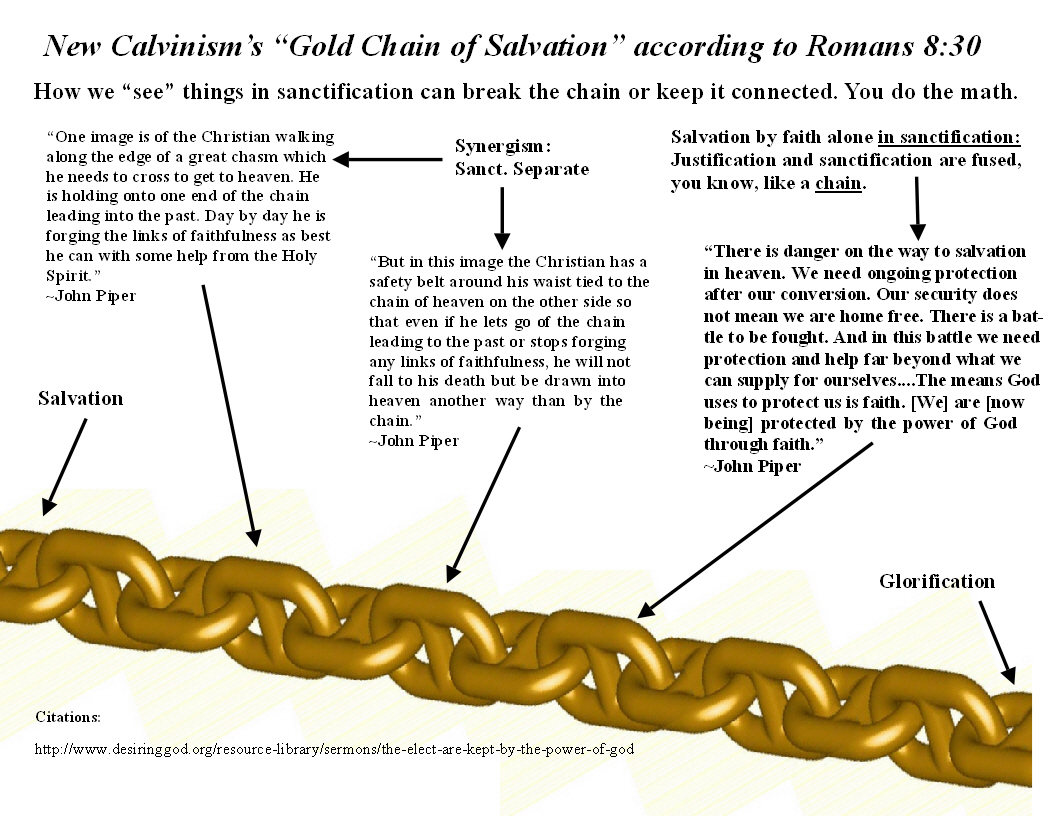
Which brings me to yet another point. If we can lose our salvation, what do we have to do to keep it? Whatever that is, it’s a work to maintain justification. And that is works salvation. In the case of Reformed theology, we have to keep our salvation by sanctification by faith alone. Hence: salvation by Christ + faith alone in sanctification. Think about that. To the Reformed, moving on to anything else but sanctification by faith alone will cause us to lose our salvation. Historically, the relaxing of the law in sanctification has always been deemed antinomianism. Is Reformed theology salvation by antinomianism? Yes, I think it is—the fusion of justification and sanctification can hardly end up anywhere else.
This entails the belief that Christ not only came to die for our sins, but He also came to live a perfect life of obedience to the law so that His perfect obedience in the life he lived on earth could be imputed to us in sanctification. So, in Reformed theology, because the law remains a standard for progressive justification, perfect obedience to the law in sanctification must also be imputed to us. In other words, Jesus obeys for us. How our justification must be maintained in our sanctification (according to Reformed theology) is well articulated by the Australian Forum Reformed think tank (The Truth About new Calvinism: p. 101, 102):
After a man hears the conditions of acceptance with God and eternal life, and is made sensible of his inability to meet those conditions, the Word of God comes to him in the gospel. He hears that Christ stood in his place and kept the law of God for him. By dying on the cross, Christ satisfied all the law’s demands. The Holy Spirit gives the sinner faith to accept the righteousness of Jesus. Standing now before the law which says, “I demand a life of perfect conformity to the commandments,” the believing sinner cries in triumph, “Mine are Christ’s living, doing, and speaking, His suffering and dying; mine as much as if I had lived, done, spoken, and suffered, and died as He did . . . ” (Luther). The law is well pleased with Jesus’ doing and dying, which the sinner brings in the hand of faith. Justice is fully satisfied, and God can truly say: “This man has fulfilled the law. He is justified.”
We say again, only those are justified who bring to God a life of perfect obedience to the law of God. This is what faith does—it brings to God the obedience of Jesus Christ. By faith the law is fulfilled and the sinner is justified.
On the other hand, the law is dishonored by the man who presumes to bring to it his own life of obedience. The fact that he thinks the law will be satisfied with his “rotten stubble and straw” (Luther) shows what a low estimate he has of the holiness of God and what a high estimate he has of his own righteousness. Only in Jesus Christ is there an obedience with which the law is well pleased. Because faith brings only what Jesus has done, it is the highest honor that can be paid to the law (Rom. 3:31).
A more contemporary example from the Journal of Biblical Counseling (David Powlison’s CCEF) can be observed in the following citation:
It is by virtue of Christ’s perfect life, death on the cross and resurrection-plus nothing-that we are justified (made and declared right with God) and sanctified (set apart, kept, and viewed as right with God) and sanctified (set apart, kept, and viewed as right in the Lord’s eyes by virtue of His obedience). Christ is our holiness. Christ is our sanctification.
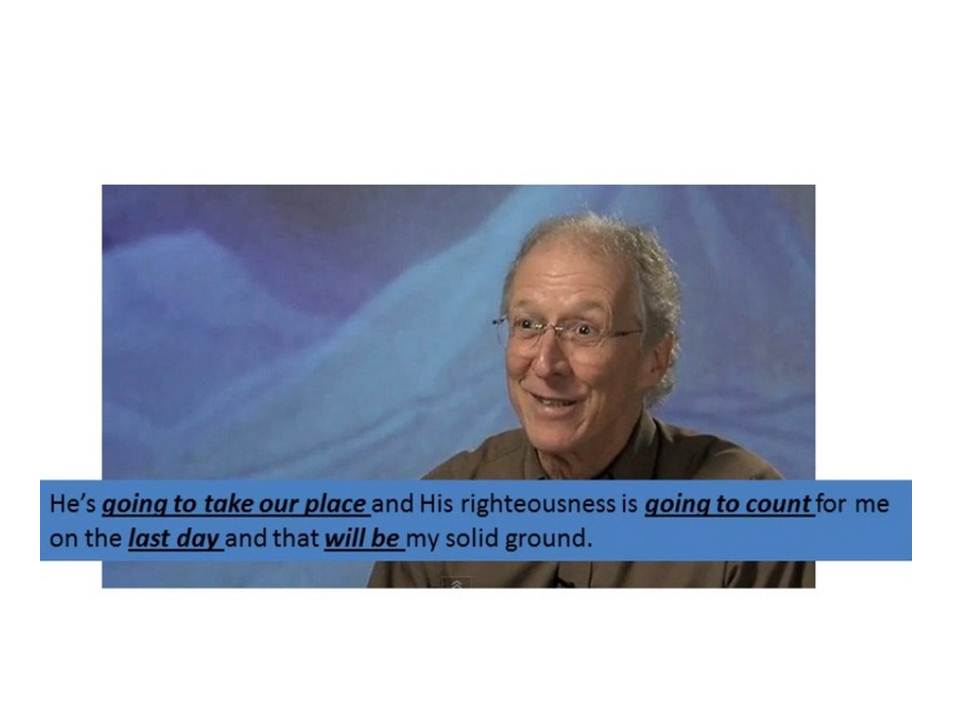
Therefore, our walk with Christ must be a continual reoffering of the works of Christ to maintain our just standing. When we come to the last resurrection, we will be judged accordingly. If we lived sanctification in this way, the righteousness of Christ will be the ground of our justification and we will be glorified. See the following illustration from a John Piper video clip (click to enlarge):
 Christians will stand in no such judgment. And via the new birth, we are new creatures that in fact are righteous. Our lack of imperfection, though displeasing to the Lord, has no bearing….for justification. We are new creatures that deplore the weakness of our mortality, but are indwelt and enabled to obey God through our new life in the Holy Spirit. We are declared righteous, and in fact are righteous. We are not colaboring with our flesh like the world, but we rather colabor with God (1Cor. 3:9, 1Thess. 3:2, 2Cor. 6:1). Therefore, Paul could say, “Now if I do what I do not want, it is no longer I who do it, but sin that dwells within me (Romans 7:20). We will look at the supposed practical application of Reformed theology in part three, and compare it to the truth in light of assurance, spiritual growth, perseverance of the saints, and other sanctification issues.
paul
2012 PPT’s Top Ten Heretics of Our Day

10. Ligon Duncan
Heresy: Sonship Theology
Denomination: Presbyterian

9. Paul Washer
Heresy: Gospel Sanctification
Denomination: Southern Baptist

8. Al Mohler
Heresy: Gospel Sanctification
Denomination: Southern Baptist

7. CJ Mahaney
Heresy: Gospel Sanctification
Denomination: Reformed Charismatic

6. David Powlison
Heresy: Sonship Theology
Denomination: Presbyterian

5. Elyse Fitzpatrick
Heresy: Antinomianism, Gospel Sanctification
Denomination: Reformed Evangelical

4. Michael Horton
Heresy: Progressive Adventism, Antinomianism, Gospel Contemplationism
Denomination: United Reformed

3. John Piper
Heresy: Progressive Adventism, Antinomianism, Gospel Contemplationism
Denomination: Reformed Baptist

2. Tullian Tchividjian
Heresy: Hyper-Antinomianism, Gospel Sanctification, Gospel Contemplationism
Denomination: Presbyterian

1. Tim Keller
Heresy: Contemplative Spirituality, Spiritual Mysticism, Gospel Contemplationism, Sonship Theology
Denomination: Presbyterian
An Open Letter to the President of the National Association of Nouthetic Counselors
“This is the apostle Paul’s disparaged 3-verse system to fix a lack of peace. It is the wonderful hope that obedience to God’s word seizes upon His promises. And that’s why many NANC counselors strip their victims of hope.”
“The cited letter reflects the same things often taught by many board members of NANC and BCC. Because this doctrine combines justification and sanctification, it makes sanctification like a minefield because what we do in sanctification can affect the justification that supposedly powers it. This does not lay a healthy foundation for counseling”
Dr. Street,
The National Association of Nouthetic Counselors website states the following about your organization:
NANC exists to help pastors and those who would be ministers of the Word of God by providing help and encouragement. NANC is first and foremost a certifying organization. The certifying process is rigorous but attainable by even the busiest pastor. The process consists of the completion of an approved training course, the completion of a theological and a practical counseling test, several references, and a minimum of 50 hours of supervised counseling experience.
Furthermore, your organization refers hundreds of “counselors” certified by your organization. The purpose of this letter is to publically confront you in regard to the fact that NANC has board members, Fellows, and hoards of certified counselors who openly promote a blatant false gospel. I will first establish this fact, in case you are not aware of it, and then beseech you to tell me why this acceptable.
Much data could be provided as I have been sent several articles written by NANC Fellows that contain outrageous teachings; and apparently, NANC thinks nothing of sending troubled people to antinomian mystics. But I only need to quote one of your present board members, David Powlison. Powlison performed a lecture at John Piper’s church while Piper was on a sabbatical to eradicate “several species of heart idols” that he saw in his heart. Apparently, they were of the 8-month type because he was able to return to ministry at the pre-appointed time. Powlison stated the following at Piper’s church:
This might be quite a controversy, but I think it’s worth putting in. Adams had a tendency to make the cross be for conversion. And the Holy Spirit was for sanctification. And actually even came out and attacked my mentor, Jack Miller, my pastor that I’ve been speaking of through the day, for saying that Christians should preach the gospel to themselves. I think Jay was wrong on that.
Jack Miller was the father of Sonship Theology, a false gospel that is presently wreaking havoc on Presbyterian churches. It has also been known as Gospel Sanctification and is the primary catalyst for the present-day New Calvinist movement which has turned orthodoxy completely upside down. The doctrine is best explained by a theological journal that was its source:
Unless sanctification is rooted in justification and constantly returns to justification, it cannot escape the poisonous miasma of subjectivism, moralism or Pharisaism…. Since the life of holiness is fueled and fired by justification by faith, sanctification must constantly return to justification. Otherwise, the Christian cannot possibly escape arriving at a new self-righteousness. We cannot reach a point in sanctification where our fellowship with God does not rest completely on forgiveness of sins…. Christian existence is gospel existence. Sanctification is justification in action.
Miller adopted the theology and coined the phrase, “We must preach the gospel to ourselves every day.” “The same gospel that saved us also sanctifies us” is the New Calvinist mantra of our day. I receive many links to articles written by NANC Fellows who clearly hold to this doctrine. In fact, How People Change, written by Timothy Lane and Paul David Tripp (and based on Powlison’s Dynamics of Biblical Change) is a Sonship/Gospel Sanctification treatise. Tripp and Lane are also on the board of the upstart Biblical Counseling Coalition. That board is the who’s who of Sonship/GS/ NC, including hyper-antinomian Elyse Fitzpatrick.
On a church level, here is the fruit of this doctrine:
To the Ruling Elders of Southwood:
On September 4, 2011, our daughter and her family from Atlanta were here and we attended the Sunday worship at Southwood. After the service, our 13 year old granddaughter, who is well grounded in scripture, stated that she was very confused by the message. She had come away hearing that every good thing she does is wrong. Why would she believe that? We have gone back and listened again to that message, entitled “Duh,” and here is what we found:
The message is from Galatians 3:1-6. Paul is chastening the church for falling prey to the persuasion of the Judaizers, exhorting them again that God’s love for them was not by any of their own works but through the miraculous work of Christ and the Holy Spirit. Jean seems to take the written word beyond its intent. He subtly changes ‘God’s love’ to ‘God’s favor.’ He changes legalism to performance. He takes Jewish law and extends it to almost any action one does. Here are some paraphrased quotes from the sermon. “To keep God’s favor, the Galatians were believing they needed Christ and a dash of obedience which looks like those things called Christian disciplines. Christian walk Christianity is from the Devil. Faithfulness is feeling condemned for work you haven’t finished (as contrasted with faith: resting completely in Christ). Faith is a litmus test for teachers and leaders; the difference between faith in Christ alone and faithfulness is like the difference between truth and falsehood, between Heaven and Hell. Faith alone is all we will teach.” (Here Jean says this is what Paul is teaching but he gives no supporting scriptures to support his interpretation.) “Discern as false any book, sermon, or Bible study where you hear a dash of self justifying obedience. Self justifying obedience is from Satan.
Jean’s statements, combined with the tone and inflections in his delivery, imply that he is scornful of Christian disciplines, preachers, Christian writers, the Christian walk, obedience, faithfulness, good works, and an individual’s efforts. This message can lead to the conclusion that everything we do is evil and, by extension, that God and the Holy Spirit can do nothing through us. The message lacks balance and leaves sanctification out of the equation. A new believer under this teaching would be moribund after accepting Christ, hidebound in fear that he can do nothing right. While it is true none of us have all pure motives, it is also true that God commands us to go forward and that the Holy Spirit will be with us. God says we are His instruments for spreading the Truth. We cannot do this if we are strapped by guilt; we can do this if we seek partnership with the Holy Spirit.
From here Jean goes back to Paul saying “…since you were 100% depraved when you were brought into the Kingdom by the Holy spirit and by no works of your own, why are you trying to be perfected by your own human efforts? You are being deceived by the Devil.” I believe Jean is paralleling Paul in this. Jean then goes on to “We are like alcoholics ; we use Bible study, prayers, small groups, etc. as a crutch and the church rewards our ‘addiction’ with its approval. How would you know if you were addicted? Stop everything. If you feel anxiety, then you are afraid of leaving your ‘fix.’” So we ask: what does God have us do? Jean’s answer is “rest totally in Jesus.” So in turn we ask, what does Scripture say about resting totally in Jesus? But we hear no clear answer from the pulpit.
The cited letter reflects the same things often taught by many board members of NANC and BCC. Because this doctrine combines justification and sanctification, it makes sanctification like a minefield because what we do in sanctification can affect the justification that supposedly powers it. This does not lay a healthy foundation for counseling, and as Timothy F. Kauffman recently stated in the Trinity Review, when justification and sanctification are combined, anything we do in sanctification is works salvation—even doing nothing. It’s eerily reminiscent of Christ’s parable concerning the slothful servant. When such a parable is considered and compared to statements by Elyse Fitzpatrick and her spiritual big brother Tullian Tchividjian, it should make the hair stand up on a deceased person.
Moreover, the unfortunate results of counseling that comes from this doctrine can be seen in the following statement by a pastor who oversees a NANC counseling center:
We read this quote from Paul Tripp in last week’s Biblical Theology Study Center. Amazingly, part of the quote was used again the following evening during testimony time from someone not in our class…someone who resonated with the quote in the midst of personal crisis. For those who are involved in biblical counseling, it can be really easy (and tempting) for the Bible to become little more than a 12-verse system designed to fix a life. Tripp reminds us that the Bible isn’t a how-to manual, but a place where we find hope in a Person.
Compare that statement with what the apostle Paul said:
Do not be anxious about anything, but in every situation, by prayer and petition, with thanksgiving, present your requests to God. And the peace of God, which transcends all understanding, will guard your hearts and your minds in Christ Jesus.
Finally, brothers and sisters, whatever is true, whatever is noble, whatever is right, whatever is pure, whatever is lovely, whatever is admirable—if anything is excellent or praiseworthy—think about such things. Whatever you have learned or received or heard from me, or seen in me—put it into practice. And the God of peace will be with you.
This is the apostle Paul’s disparaged 3-verse system to fix a lack of peace. It is the wonderful hope that obedience to God’s word seizes upon His promises. And that’s why many NANC counselors strip their victims of hope. That, and confusing children who love the Lord.
So tell me Dr. Street, why is this acceptable? Why not come out from among them? Besides, the evidence that this doctrine was concocted by a Seventh-Day Adventist who is now an atheist is overwhelming. The truth will come out, and will eventually be accepted as truth. Why stick around and look stupid? Or, you could fix the problem. I beseech you Dr. Street, stop sending troubled people to false teachers. This is something that none of us want on our resume.
Paul Dohse
New Calvinism’s Extreme Makeover of Scripture
 This Ministry has focused primarily on the fact that New Calvinism is blatantly unorthodox in salvific matters. Originally, the focus was on what was perceived as merely weakening Christians in their walk with God. Continued investigation reveals that New Calvinism also has the gospel wrong and distorts the very core of salvation: the doctrine of justification. Pastor Joel Taylor, a charter member of the long overdue Coalition Against New Calvinism makes this point well in the organizations inaugural post at http://tcanc.wordpress.com/
The clear picture that has emerged is a movement that leaves no aspect of orthodoxy turned upside down, including Bibliology. I have stumbled across and recognized their approach to Scripture before, but have had bigger fish to fry in this endeavor. Though the complete picture has not yet emerged, I have been spurred to touch on what I do know because of statements made by Cindy Kunsman in her review of The Truth About New Calvinism.
New Calvinism approaches Scripture as a historical gospel narrative in its totality of purpose. Therefore, whether or not there is error, or whether or not events like creation are literal or not, isn’t the point—what the historical narrative is showing about the gospel is the point. Undoubtedly, this is why John Piper has elders on his staff that are theistic evolutionist—whether or not God literally created the Earth in six days is not the point—what the creation event shows us about the gospel is the point.
How some of them integrate this approach with more orthodox forms of interpretation varies, but this element of interpretation has a profound effect on how they approach the Scriptures and use it to “feed” the sheep. One can ascertain what I am talking about if they listen and read carefully. Michael Horton continually speaks of the “divine drama.” In fact, Horton wrote a book entitled, “Covenant and Eschatology: the Divine Drama.”
And where is this coming from? We get a clue if we visit Vossed World blog authored by New Calvinist and NCT theologian Chad Bresson. He wrote a post bemoaning the use of Old Testament events for instruction purposes and practical application to the life of New Testament believers. Of course, such a concern is in contradiction to 1Corinthians 10:6, 10:11, and 11:1. A reader using the name “Kippy” instigated a follow-up post:
In the comments section of the “Abigail” post, Kippy has asked a good question that is asked pretty consistently of the redemptive-historical hermeneutic. Kippy wants to know if practical application is a “wrong approach” to a text such as 1 Samuel 25, especially in the area of counseling. These are good questions. I’ll answer the application question first and the counseling question last.
Actually, Bresson didn’t directly answer Kippy’s initial question, but smothered it in a 10,000 word post. Yet, his response is telling to some extent. Here is Kippy’s intitial question:
Wow, heavy stuff. I do have a question concerning “practical application”, you seem to diss it in the post (because it takes away from the central purpose?). I am presently counseling a depressed person and I’m using Phil 4:4-9. The passage seems to promises wonderful things for those who replace worry with right prayer and erroneous thoughts with true thoughts. Namely, that Christ will guard our hearts and minds. Is this approach an improper use of the Scriptures?—being practical application?
Thanks for your hard work.
Kippy
Though Bresson never directly answers the question, New Calvinist Paul David Tripp does in How People Change, page 27. He states that changing the way we think to biblical thinking is insufficient, and “omits the person and work of Christ as Savior.” Why? Because it does not first see how a particular situation in our life fits into the historical gospel motif presented in Scripture. When we see our redemptive life story IN the biblical narrative, transformation takes place. Bresson’s post further elaborates on this point:
Few have spoken more clearly to the entire subject of “application” than brothers Charles, James, and William Dennison (the “Dennisons 3”). Dr. William Dennison writes, “Good Biblical preaching draws the congregation into the event…As Paul preaches to the Corinthians, his presentation of the saving event of God’s activity in Christ’s work precedes his interpretation of that work to the people. Event precedes interpretation, while interpretation draws the congregation into the event.” (Reformed Spirituality, ed. Joseph Pipa, pp. 148-150)
And….
Why is this? This is true because the application (how we live out the imperatives of the text) is generated by a historical event, the Christ event, or more specifically the cross and resurrection. As Dennison says, “In the Biblical text, morality is grounded in history, or more precisely, the moral life of the believer is grounded in the redemptive-historical work of God in Christ’s death and resurrection.”
And….
As Dennison points out, this has huge implications in terms of how we think about “practical application”. He says, “God engages His people as participants in the event of His activity; He places them in union with the event. Or, to put it another way, God draws His people into His redemptive-historical work as a participant in the event, not as a spectator of the event (One must not view the indicative-imperative grammatical construction in abstraction from its theological and revelational-historical content. The content is what gives the construction its rich supernatural relevance and meaning).”
And….
How does the fact that the listeners are participants impact how we think about application? Dennison quotes his late brother Charles when he says, “The Biblical model is simply this: “’Good preaching does not apply the text to you, but good preaching applies you to the text.’ To put it another way, ‘The preacher does not take the word and apply it to you, but the preacher takes you and applies you to the word.’”
Then Bresson concludes on this point:
So, it’s not that anyone is dissing application. There is certainly application in the text, including the passage that prompted the question, 1 Samuel 25. The question isn’t whether there is application, but what kind of application. And the kind of application found in the text tends to be quite different than the kind of application that is popular today. The application found in the text revolves around an event and is itself an application tied to history. That kind of application has a direct bearing on the 24/7/365 of our “mundane” lives.
As Dennison notes, “The Biblical theologian sees application as that which truly comes from the text because he draws the believer into the redemptive-historical and eschatological drama of the Biblical text. The struggles you face in the Christian life are the same struggles that the church recorded in the Biblical text faced. You live between the two comings of God, just as the people of God in the Biblical text live between the two comings of God. Their history is your history. As their redemption and application was grounded in the promises and the accomplished work of Christ, so your redemption and application is grounded in the promises and accomplished work of Christ. You are living in the same life pattern that the church lived in the Biblical text, and thus, the Bible is God’s document of application.”
Kippy then poses the following statement in the comments section of the follow-up post:
It seems that our primary concern is focus on the glory of Christ and the knowledge of him. This will produce the imperatives naturally. Also, history is still moving toward the return of Christ, by putting ourselves INTO the text, we recognize that we are the ongoing redemptive work of Christ that didn’t end with the Scriptures. The Scriptures enable us to be part of that history. We are not making our own redemptive history, it is making us. We are between the beginning and the end, but all we need to identify with Christ is bound in the Scriptures.
To that, Bresson answered:
Kippy,
It looks like you’re understanding what I’ve said (a minor miracle, I know). I’ll get to your other questions shortly.
Bresson latter added:
If you’re interested in how we fit into the redemptive-historical drama :-), a couple of books that have interesting thoughts in this regard are Vanhoozer’s “Drama of Doctrine” and Horton’s “Covenant and Eschatology: The Divine Drama”.
I don’t agree with everything they have to say, but I did find what they had to say about “participation”, “drama”, and Christ’s Incarnation to be thought-provoking. There are thoughts there compatible with what we’ve said here.
(Wednesday, August 06, 2008
Abigail was “motivated” by a future eschatological hope that God would accomplish his purposes in a throne for David
Thursday, August 14, 2008
The application: We, like Abigail, rest in our Avenger).
Hence, this approach makes the Bible a perfect tool for Gospel Contemplationism. In the aforementioned book written by Tripp, four primary applications are given as aids in seeing our own gospel story in the historical gospel meta narrative: Heat; Thorns; Cross; Fruit. Tripp asserts that the sum of the Bible is composed by these four prisms that enable us to place our life story in God’s story as a way of transformation (p.96). On pages 102-105, Tripp attempts to show that the apostle Paul used Scripture in this way for transformation in his own life. On page 94, Tripp states, “This big picture model is the story of every believer. God invites us to enter into the plot!” Unbelievably, Tripp commits a first degree theological felony by admitting in the book that Jeremiah 17:5-10 is the only proof text that can be found to substantiate this hermeneutic, and his mentor David Powlison eludes to that same apology in the Forward. Despite Powlison’s glowing affirmation in the Forward and noting that the book follows after his own Dynamics of Biblical Change, Powlison disavows the book in private conversations because a testing of the book by CCEF in local churches didn’t reveal the fallout that is now rearing its ugly head. This kind of disingenuous communication has been a hallmark of Powlison’s ministry.
This now brings us to statements made by Cindy Kunsman in her review of The Truth About New Calvinism. In my present research for volume two, I am investigating the influence of neo-orthodoxy on SDA theology. My thesis so far is that SDA contributed the fusion of justification and sanctification in New Calvinist theology, and SDA theologian Robert Brinsmead added the centrality of the objective gospel outside of us. I then lean towards the idea that neo-orthodoxy filled in the blank spots to make it run, including the kind of hermeneutic which is the subject of this post. But hold the fort. Kunsman states the following in the review:
J. G. Vos became very interested in the significance of Christ’s history and participated a movement that encouraged people to find a message of redemption in every Bible passage, relating it to the history of Christ. Goldsworthy, an aberrant Anglican, developed a whole esoteric sounding theology about the “holy history of Christ,” he worked alongside Brinsmead, a Seventh Day Adventist (SDA), and it resulted in most of the errors and controversies we’ve seen among the Reformed in the past decade or two. Most of what Jon Zens teaches came from Brinsmead, and most of what Piper teaches sounds just like Goldsworthy. (See addendum note below.) Piper’s preaching quietism through his “beholding as a way of becoming,” a form of Christian mysticism enjoining passive contemplation and the beatific annihilation of the will…. In some shared disdain for Lutheran theology [Brinsmead and company], they explain how salvation really happens [linked to Present Truth volume 46, art. 2, part 4] in their old publication called “The Present Truth” which was once staggeringly popular at Westminster. (Take note that “the present truth” is a doctrine in SDA church, invented by the Whites [linked to several references regarding early SDA publications by the Whites]. It was also the name of their first SDA publication in the 19th Century.) In a discourse that switches back and forth from Catholic Theology into Protestant statements so many times that I gave me theological whiplash, they explain the process. First, the believer is “caught up in the holy history” of Christ and “replaces his history” with Christ’s. As a result of the change in the person who has been assimilated or has assimilated Jesus and is changed, it is then that God decides to bestow the grace of justification on a man because he’s suddenly become acceptable to God. Sorry, folks. This just became justification by works, and sanctification and justification become the same thing…. This is the more subtle reason why Piper and Keller and Bridges and Tchividjian and others preach the gospel to themselves every day which I personally consider to be different than morning devotions or contrition over sin as a New Creation in Christ. This is why Piper and Mahaney do all of their histrionic weeping over their poor, sinful state, because they are still subject to it, giving it power. New life in Christ for them is dependent on daily infused grace and justification…. Piper’s teachings argue against an inner transformation which bestows a believer with the Spirit’s power and discernment to resist sin.
Kunsman embeds several links that do not show up in my citations here, but I would like to focus on her citation of the Australian Forum’s theological journal, Present Truth vol.46,art.2, pt.4. I have reposted the whole article as an addendum to this post. All of Kunsman’s review can be read here: Kunsman’s review of TANC
Present Truth was the theological journal of the think tank known as the Australian Forum which was founded by Brinsmead, Geoffrey Paxton, and Graeme Goldsworthy. They were later joined by Jon Zens. The issue Kunsman cites is dripping with the present-day New Calvinist motif, including the SCANDALOUS GOSPEL sloganry.
Also, match Bresson’s cited post with Kunsmans citation—the theology/hermeneutic is identical, and accentuated with the same phraseology. This bolsters the conclusion that I have come to time and time again throughout my five years of research on this issue: Present Truth might as well be the theological journal of present-day New Calvinism, and it would be if Robert Brinsmead wasn’t a Seventh-day Adventist gone bad.
Then I would ask you to note Kunsman’s citation of the SDA doctrine that is actually named, “Present Truth.” She also notes that it was the name of SDA’a first publication. In my present preparation for volume two of The Truth About New Calvinism, I am reading The Shaking of Adventism by Geoffrey Paxton, one of the core four of the Australian Forum. He presents SDA as the gatekeepers of Reformation theology, and insinuates that the Australian Forum was the “Shaking” predicted by SDA theologians of days gone by.
So what is the point here for now? One, New Calvinists completely bastardize Scripture. Two, it’s looking more and more like New Calvinism is up to its ears in SDA theology.
paul
ADDENDUM; Present Truth volume 46, article 2, part 4:
The Need for a Correct Biblical Framework
The centrality of justification by faith and its forensic character is the raison d’etre of the Lutheran Reformation. It is under massive attack today. Prominent Lutheran scholars are leading this assault on the Reformation faith. But that is not the only feature of the current crisis among Lutherans. Many of those trying to defend the old faith are not convincing. They appear to be losing ground in the struggle. They are repeating many of the old arguments (such as the meaning of words), but their theological framework is too abstract and rationalistic. This plays into the hands of those who advocate a theology of dynamic experience as an alternative to “dry old orthodoxy.”
The abstract scholastic dogmatics of the old Protestant orthodoxy is not adequate for the present crisis. What is needed is a theology with a truly biblical framework. The apostles preached the gospel of Christ out of the Old Testament background. Yet there has always been a tendency in the church to cut the Christian message loose from its Old Testament roots.
When this happens, the Christian message is placed in either a rationalistic or a mystical framework and is consequently distorted. What is needed is a return to biblical faith, which is not just Christian but Judeo-Christian. Biblical faith is historical, covenantal and eschatological.
The want of a theology which has a historical, covenantal and eschatological framework is the real issue behind the issues in the current justification-by-faith debate.
The Historical Framework
The first thing that must be said about biblical faith is that it is historical faith. “The uniqueness—the ‘scandal’—of biblical faith is revealed in its radically historical character.”1
The Bible has a historical framework. Man is essentially a historical being.
Biblical faith understands human existence and human destiny in irreducibly historical terms. If the question is asked, what is the real reality of man?—what is it the actualization of which constitutes the fullness of his being?—the heathen (turned philosopher) would say nature; the Greek metaphysician and the Oriental mystic would say that which is timeless and eternal to him; but the biblical thinker would say his history. History is the very stuff out of which human being is made: human existence is potential or implicit history; history is explicit or actualized existence. And it is not very different on the corporate level. In attempting to explain to someone who really does not know what it means to be an American, it would be futile to try to contrive some conceptual definition of “American-ness.” Would it not prove more appropriate to tell the story of America and rely upon that story to communicate the fullness of what it means to be an American? “The human person and man’s society,” Reinhold Niebuhr has profoundly observed, “are by nature historical. . . [and] the ultimate truth about life must be mediated historically (emphasis added) . . .
But he who understands the reality of human being in biblical terms will find no difficulty in understanding that the ultimate truth about human life and destiny, about man’s plight and man’s hope alike, is truly and inexpugnably historical, and can be expressed in no other way. (Hence the Bible is composed so largely of stories, recitals, histories.) The structure of faith is a historical structure, because being, living, and acting are, in the biblical conviction, radically historical in character.2
This means that true preaching about the sinner’s justification before God is not an abstract theory of imputed righteousness which sounds too much like salvation by celestial bookkeeping. Nor is it explaining the technique of moral transformation. It is the preaching of something historical. Alan Richardson has expressed this point beautifully:
Biblical faith, however, is not at all concerned with asking in what salvation consists or in recommending techniques, whether mystical or ethical, by which salvation may be attained. It is concerned rather with the proclamation of the fact of salvation, and thus it differs from all “religion” by being kerygmatic in character. The Bible is concerned with the fact that God actually has in concrete historical fact saved his people from destruction.3
The principle is the same in both Testaments. In the Old Testament God’s saving act took place in the Exodus-Sinai event, which becomes the type of God’s great saving act in the death resurrection event. Biblical preaching, however, is not preaching about some dead history which is past and gone. Though the event may have happened years or even centuries ago, it lives on as it is continually rehearsed by Word and sacraments.
For the Old Testament believer the Exodus was a history that was part of his existence. He may have lived long after the Exodus took place. But as the event was rehearsed by holy days, feast days and the story of the fathers, he was caught up in that history. He identified with it in such a way that it became his history. Therefore the Exodus was something which really happened to him as a member of the people for whom the redemption was wrought. When he made his confession of faith, he told the story of the Exodus using the first person, as if he had actually crossed the Red Sea with Moses. “‘My father was a wandering Aramean, and he went down into Egypt. . . and the Lord heard our voice [note the first person pronoun] and saw our misery, toil and oppression. . . . So the Lord brought us out of Egypt'”(see Deut. 26:2-10).
So it is with the New Testament believer. In the gospel and the sacraments, the holy history of Jesus Christ is recited, rehearsed and represented. This is more than a memorial of a past event which is dead and gone. In the proclamation of the event in the power of the Spirit, the past is rendered present (Rom. 1:16, 17). The believer is caught up in this holy history—he identifies with it, participates in it, is baptized or incorporated into it. Just as the Old Testament believer embraced the Exodus as his own personal history, so the New Testament believer embraces the holy history of Christ as his own personal history. And like the Old Testament believer, he makes his confession of faith by speaking of this history in the first person. “I have been crucified with Christ” (Gal. 2:20). “Our old self was crucified with Him” (Rom. 6:6). Or as Luther said, “Christ died. I too. He rose from the dead. I too. “Let us now consider what light this historical faith throws on some of the disputes about justification:
1. Since the believing sinner is justified by the holy history of Christ and by that alone, justification must be forensic.
2. Justification is central in Christian teaching since it is wholly concerned with what is central—namely, the holy history of Christ. On the other hand, the presentation of an abstract theory of justification not vitally grounded in Christology will not be regarded as central.
3. If God justifies on the basis of this new history of Christ which is pleasing to Him, then forensic justification is no legal fiction. It is not a matter of God waving a wand over the sinner, declaring him righteous when he possesses no righteousness at all. The believer possesses righteousness good enough and big enough to stand before the tribunal of God. He is identified with the holy history of Christ. It has become his own history. This is no make-believe. This history is real. The believer stands with a good record. It justifies him before God.
Proponents of forensic justification have sometimes given occasion for the Reformation faith to be impugned because they have separated justification from history so that the imputation of righteousness sounds almost like an abstraction. This has happened because soteriology has not been seen in its vital relationship to Christology.
Osiander said that forensic justification makes God appear to be a liar because He calls a man righteous when he is not righteous at all. Osiander was not wrong when he said that God must make the sinner righteous before He can declare him righteous. But the believing sinner has already been made righteous in Christ (2 Cor. 5:21). Why should not the righteous Judge justify the man who stands before Him with the holy history of Christ?
Furthermore, when Christ identified Himself with our history, was He not cursed for our sake? (Gal. 3:12,13). Surely we are not going to say that His condemnation was based on what He was in Himself! So why should not God justify those who are identified with Christ’s history? This justification is no more “analytical” than Christ’s condemnation was analytical. The substitutionary atonement of Christ and justification by a forensic righteousness are merely two sides to one great truth.
Let us also look at Newman’s argument in the light of historical faith. He used the analogy of creation to prove that God makes what He declares (“‘Let there be light,’ and there was light”). By doing this, Newman made God’s creative act depend on justification. But God’s new creation took place in His redemptive act in the holy history of Christ. The faith which justifies does not bring the new creation into existence; it confesses its existence. The conception, birth, sinless life and resurrection of Jesus from the dead were the recapitulation of Genesis 1 and the fulfillment of those Old Testament prophecies which spoke of God making all things new. The justification of the sinner springs from this creative act of God and not the other way around, as Newman and the proponents of “effective” justification contend.
Furthermore, is it correct to take the analogy of creation (“‘Let there be light,’ and there was light”) and apply it to the matter of justification? Justification is an indicative verdict, not an imperative command, so the creation analogy is inappropriate. A better analogy would be God’s verdict, “This is My beloved Son, in whom I am well pleased.” This declaration was not made in order to make Christ pleasing to God but because He was pleasing to God. So it is with the believer. He is declared righteous before God’s judgment seat because He has been made righteous in the holy history of Jesus Christ.
4. One of the most serious criticisms raised against forensic justification is that it leaves the sinner without moral renewal and therefore has antinomian tendencies. A doctrine of justification presented in the rationalistic framework which has characterized too much of the old Protestant orthodoxy cannot adequately meet this charge. It may correctly say that justification is distinguished from regeneration but is never separate. However, the critics are always suspicious that the link between justification and the new birth is too artificial—as if ethical renewal had to be attached to justification like an afterthought. Certainly the endless discussions on the ordo salutis in seventeenth-century Protestant scholasticism were too abstract and artificial.
However, when justification is preached in the framework of history, it appears in vital and inseparable relationship to the new birth. We have seen how the sinner is justified by participating in the holy history of Christ. The same inclusion into Christ’s history also means that the sinner is born again.
A person does not become born again by rummaging around in his psyche. The new birth is not preoccupation with one’s spiritual navel. Man is a historical being. I am the story of my life. My history determines who I am and what my destiny shall be. The only way I can become a new man is to have a new history.
In His discourse on the new birth, Jesus directed Nicodemus’ attention to the first Exodus under Moses (John 3:14). Nicodemus knew very well that it was the Exodus event which gave birth to the nation of Israel. But the prophets had also spoken of a new exodus under a new Moses at the end of the age. In this new redemptive act God would make all things new. There would be a new covenant with a new Israel. Nicodemus was not altogether ignorant of these things. The book of John presents Jesus as that new Moses of the new exodus. The imagery of the Exodus appears everywhere in the Gospel of John. Jesus tells Nicodemus—this representative of Israel—that his identification with the history of old Israel will not entitle him to enter the kingdom of the new age now being inaugurated. He must now look to the Son of Man and identify himself with the Son of Man’s new redemptive history (John 3:14, 15). Just as the first Exodus gave birth to the nation of Israel, so the new exodus at Calvary would give birth to the new Israel.
What we identify with historically has the most profound effect on our lives. For instance, in order to become an American in the deepest sense, I would need to know the story of the birth of this great nation and then to identify myself with that history so that it became part of my existence. I would thereby become caught up in the spirit of America. Its history would then govern the way I think and act. So it is when the Spirit of Christ comes to me clothed in the gospel of Christ. The Spirit incorporates me into the holy history of Christ. This brings about a change which is far more profound than a change of earthly citizenship and political philosophy. It means that my whole life has a new center. The holy history of Jesus Christ determines my entire existence—the way I think about everything as well as the way I act. “I live by faith in the Son of God, who loved me and gave Himself for me” (Gal. 2:20).
Incorporation into Christ’s new history will therefore give me both a new standing (Justification) and a new state (new birth). My new history changes God’s estimate of me and my estimate of God. Thus, the justification which is grounded in history is inseparable from the new birth, which is grounded in the same history. There is really no point to the artificial ordo salutis of Protestant scholasticism. If we say that justification comes first, it is not a temporal order but only a theological order. How I stand in God’s sight must always be given first consideration.
Moreover, the new birth is the sinner’s apprehension of forensic justification. To look away to a righteousness found wholly in Another and in what Another has done, to stake one’s all upon the history of Another, is the negation of human pride and self-centeredness. To exercise saving faith is surely an essential element of the new birth. Thus, John simply says, “Everyone who believes that Jesus is the Christ is born of God” (1 John 5:1). True to the Hebraic rather than the Grecian way of thinking, the Bible describes the new-birth existence more by what it does than by what it is in itself. And true to Hebraic thinking, the biblical content of the new-birth doctrine is historical rather than rationalistic or existential.

 Paul's Passing Thoughts
19 comments