Here We Go Again: The New Calvinist Takeover of Southwood Presbyterian Church; Part 1
 “This issue couldn’t be clearer; there are two gospels among us, and New Calvinist David Powlison plainly said so accordingly. He even admitted that the notable Jay Adams doesn’t agree with his gospel. This should incite serious questions among God’s people….Southwood must choose their gospel and stand for it. What else is there?”
It plays out daily in the American church from coast to coast:
Therefore, the pattern is the same: new pastors assume leadership in a church that doesn’t know what New Calvinism is, and the church takes it for granted that their theology is orthodox. Then once in, they replace present leadership with those of like mind, and begin to make vast and rapid changes because they see that church as a bastion of falsehood that has sent many to hell. Then, dissenters are mercilessly mowed down and muzzled, usually via church discipline. In most cases, the dissenters don’t have a full understanding of what they are dealing with, they just know something isn’t right (The Truth About New Calvinism [TTANC] p. 134).
I don’t know any inside details concerning the present controversy at Southwood Presbyterian Church in Huntsville, Alabama. Some or all of the elements cited above from TTANC might be evident, but one thing is clear: a New Calvinist “pastor” recently assumed leadership, and the congregation has realized that he isn’t what he seemed to be. Less than a year after assuming leadership, we read the following on their website:
November 17, 2011
To the members & friends of Southwood Presbyterian Church,
Last evening the Session of Southwood Presbyterian Church met again to consider the matters before the church. After much prayer from both the members of the Session and members of the congregation the Lord provided a decision with no dissension or abstention. The UNANIMOUS motion reads as follows:
“With repentance and conviction over our own personal and corporate sin, particularly for having stirred dissension with a premature motion delivered after Monday night’s meeting, the Session has met and deliberated further on the issues before our church. Having considered the breadth of the situation and our unified desire for the peace and purity of the church, the Session does hereby revise the purpose of the called congregational meeting to begin addressing the myriad of issues brought before us, including Jean F. Larroux, III, but we are not recommending the dissolution of the pastoral relationship with him at this meeting. Furthermore, we are in need of, thankful for and desirous to have further prayer from the congregation in all our deliberations. Submitted by Bob Greenman, Clerk.”
The Session will meet again on Monday evening, November 21st and greatly desires your prayers and support for a continued spirit of unity and peace as we begin to make plans for addressing the myriad of issues before us. The called congregational meeting will be held on Sunday, December 4, 2011, in the sanctuary of Southwood Presbyterian Church commencing at 12:30pm.
God is at work. His Spirit is moving to bring forgiveness and healing. I personally urge you to work toward, pray for and labor after unity, charity and peace. Let your love be known among all men.
Yours and His,
Jean F. Larroux, III
Larroux is the pastor in question. A perusal of their website confirms that he is the epitome of New Calvinism. When the congregation brought him in to assume leadership, did they know what a New Calvinist is? No. Did Larroux know what a New Calvinist is? Yes. Did he know the congregation didn’t know what a New Calvinist is? Yes. Could I be wrong about these assumptions? I doubt it.
What Does Jean F. Larroux, III Represent?
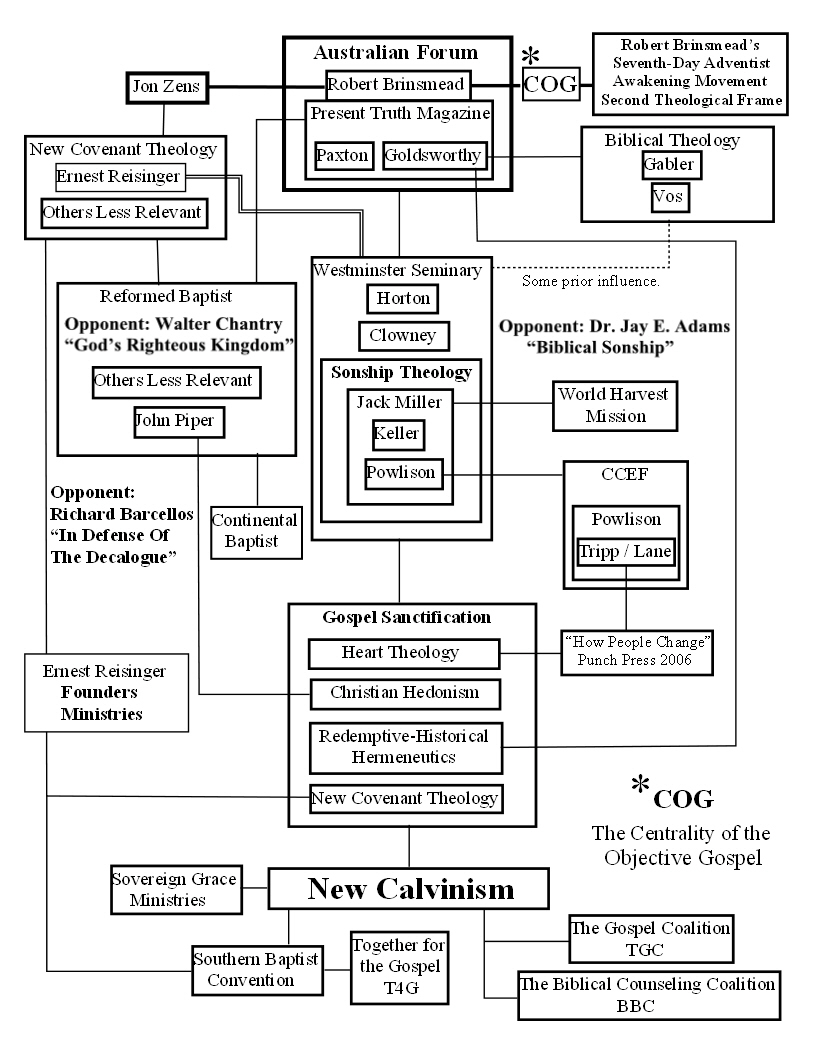
So what’s a New Calvinist? As we shall see, they are legends in their own minds. The movement originated in 1970 when a Seventh-day Adventist named Robert Brinsmead met an Anglican theologian named Geoffrey Paxton in Australia. Brinsmead was attempting to reform Adventism through his studies in Reformed doctrine. Together, they formed a theological think tank named the Australian Forum project. They were later joined by Graeme Goldsworthy who wrote the Goldsworthy Trilogy which is presently the New Calvinist standard for Bible interpretation (TTANC chapters 3 and 4).
The Forum’s magazine became the most widely publicized theological journal among English speaking people (one edition had over one million copies printed), and caught the attention of a Westminster graduate by the name of Jon Zens in the early 70’s. He joined the Forum’s efforts to formulate their central doctrine into a consistent systematic theology. Their primary doctrine that was the hub of everything they taught was called the centrality of the objective gospel (COG). The doctrine fused justification and sanctification together into a progressive justification that replaced sanctification. Zens helped to form a systematic theology that would attempt to make the issues of law and covenants fit with COG doctrine. Today, that doctrine is known as New Covenant Theology (TTANC chapter 5).
The Forum had vast influence at Westminster Seminary during the 70’s and early 80’s. A professor there by the name of Dr. John Miller adapted COG into a doctrine that emphasized more of a counseling model. He dubbed it “Sonship Theology.” His understudies were Tim Keller and David Powlison. Powlison used Sonship/COG to mold his Dynamics of Biblical Change which is the counseling model for Westminster’s CCEF. Two of Powlison’s understudies, Paul David Tripp and Timothy Lane, articulated the doctrine in How People Change, published by Punch Press in 2006. The book fits the Forum’s COG doctrine to a “T.” Donn Arms (M.Div.) of INS recently wrote an unfavorable review of the book and pointed out its disturbing elements.
However, the doctrine experienced a heavy pushback among Presbyterians in 1996-1999, so the Sonship name was dropped and replaced with “Gospel Transformation.” Jay Adams, who wrote a book in contention against the doctrine when it was known as Sonship, thought the doctrine had faded away. Under its stealth era between 2000 and 2008, the movement’s growth exploded. In 2004, a small group of protestants which included Jay Adams dubbed the movement “Gospel Sanctification.” Jay Adams has a GS archives on his blog and has written against it extensively. In 2008, the movement stumbled; it accepted the label “New Calvinism” which was coined by journalist Collin Hansen. New Calvinism is: COG, NCT, GS, and Sonship. It’s all the same doctrine
Visions of Grandeur
As stated in TTANC:
And New Calvinists are no exception, starting with their primary deception that must necessarily lead to arrogance. They believe they are a new Reformation and have the true gospel, and evangelicalism at large has been propagating a false gospel for the past 100 years. This line of thought and the specific differences in the two gospels can be seen in the following statement by New Calvinist Tullian Tchividjian:
“As I’ve said before, I once assumed (along with the vast majority of professing Christians) that the gospel was simply what non-Christians must believe in order to be saved, while afterward we advance to deeper theological waters. But I’ve come to realize that ‘the gospel isn’t the first step in a stairway of truths, but more like the hub in a wheel of truth.’ As Tim Keller explains it, the gospel isn’t simply the ABCs of Christianity, but the A-through-Z. The gospel doesn’t just ignite the Christian life; it’s the fuel that keeps Christians going every day. Once God rescues sinners, his plan isn’t to steer them beyond the gospel, but to move them more deeply into it. After all, the only antidote to sin is the gospel—and since Christians remain sinners even after they’re converted, the gospel must be the medicine a Christian takes every day. Since we never leave off sinning, we can never leave the gospel.”
Notice that Tchividjian refers to the other camp as the “vast majority” of other Christians who don’t believe in New Calvinism’s sanctification by justification gospel. The Major themes of a New Calvinist biannual convention, Together for the Gospel (T4G) have been “the unadjusted gospel” and “the underestimated gospel.” A popular phrase among them in the blogsphere has been the “scandalous gospel.” Regarding the thesis of this book, their gospel makes much of God and little of Man by reducing our role in God’s work to the least common denominator, but they have done that so well, that much is being made of the men who have done such a good job of making much of God. The four men who founded T4G, a Presbyterian, two Southern Baptists, and a Charismatic, have been dubbed the “core four” and have a cult following that approaches creepiness.
This whole Reformation motif was started by the Forum which taught that all doctrines either fall into the objective gospel or subjective experience. Subjective spirituality was supposedly spawned by Rome and resulted in a reversal of justification and sanctification. Therefore, the Reformers rediscovered the objective gospel which ignited the Reformation, and also taught that the job wasn’t done (semper reformanda), and you can imagine who contemporary New Calvinists think that duty has fallen to. This is all covered in chapter four along with documentation concerning the fact that John Piper, one of the “elder statesmen” of the New Calvinist movement agrees with that scenario. This us against them mentality was passed down from the Forum and blossoms in the movement to this very day. They are the children of the Reformers—we are Rome.
And this arrogance translates into a predominant characteristic of New Calvinism: heavy-handed leadership style. As far as New Calvinists are concerned, evangelicals have been leading people into hell for the past 100 years (their estimation of when semper reformanda was lost) and any interference with the “unadjusted gospel” will be dealt with—no holds barred. The weapon of choice is church discipline (pages 130, 131).
The Two Gospels of Our Day
There are two gospels afoot in our day, and those doctrines can be defined by the contention between two notable men:
The crux of the matter can be further ascertained from Powlison’s message at Piper’s church as mentioned before:
“ This might be quite a controversy, but I think it’s worth putting in. Adams had a tendency to make the cross be for conversion. And the Holy Spirit was for sanctification. And actually even came out and attacked my mentor, Jack Miller, my pastor that I’ve been speaking of through the day, for saying that Christians should preach the gospel to themselves. I think Jay was wrong on that.”
At the core of a longstanding contention between Jay Adams and the CCEF clan, and later NANC also because of CCEF influence, was disagreement on the gospel. The distinction cannot be clearer—Adams believes that the gospel is for salvation, and then we move on in making disciples by teaching them to observe the whole counsel of God. Powlison, according to Westminster’s version of the Forum’s centrality of the objective gospel which is Sonship Theology, believes the same gospel that saved us also sanctifies us. Powlison also mentioned the phrase that Miller coined that is the motto of contemporary New Calvinism: We must preach the gospel to ourselves every day (TTANC pages 81, 82).
What’s at Stake?
The truth and many other issues are at stake here, but one of the major concerns is the fact that New Calvinism has a tendency to create cult-like churches:
All this leads to many New Calvinist churches taking on cult-like tendencies. Exclusiveness (new Reformation), an attitude that some higher knowledge is a part of the movement that many are not “ready” for (the scandalous gospel), and a subjective view of Scripture (a gospel narrative, not instruction) is a mixture that will have bad results, and is the perfect formula for a cult-like church (TTANC p. 134).
And endnote 104:
Many New Calvinist churches fit all eight descriptive points published by cultwatch.com: 1. Deception 2. Exclusiveness 3. Intimidation 4. Love Bombing 5. Relationship Control 6. Information Control 7. Reporting Structure 8. Time Control (p. 145).
And Larroux is no exception. The Southwood website and blog is saturated with examples of how New Calvinists control parishioners with their doctrines of deep repentance and the total depravity of the saints. Donn Arms addresses these doctrines in some detail in his book review of How People Change. Frankly, Larroux’s writings on this site are so saturated with this doctrine—I don’t even know where to start. That’s why this post will be a series until their December meeting.
Unlike Coral Ridge, perhaps Southwood parishioners can at least know the details of why they are being ravaged rather than being led to the slaughter like oxen. I can at least do that for them. One can toss a dart onto the Southwood website and nail verbiage by Larroux that is designed to control and manipulate—it’s everywhere, whether putting God’s stamp of approval on everything he does or this: “Would you trust him to determine whether or not you were in sin EVEN IF you didn’t think you were?” Notice that the authority here is what an elder or someone else sees in your life and not Scripture. Sonshippers call this “speaking life into you,” a phrase that I saw being used on the site at least once by Larroux. I also noticed that those who questioned Larroux’s fitness to lead Southwood are the ones who are now repenting. This is typical. I warn the Southwood parishioners, I know of New Calvinist congregations that will barley even buy new cloths without consulting with the elders first.
Southwood Must Choose a Gospel and Contend for It
It is evident, based on what I have read on their blog, that Larroux is controlling the agenda in this situation:
God is at work. His Spirit is moving to bring forgiveness and healing. I personally urge you to work toward, pray for and labor after unity, charity and peace. Let your love be known among all men.
Oh really? Per the usual, New Calvinist “pastors” have a direct line to God’s throne. Southwood better wise-up, this isn’t a time for peace and unity at Southwood, this is a time to earnestly contend for the faith once delivered to the saints. This is like one of the seven letters; if anything, Christ has something against Southwood because they are tolerating false doctrine.
This issue couldn’t be clearer; there are two gospels among us, and New Calvinist David Powlison plainly said so accordingly. He even admitted that the notable Jay Adams doesn’t agree with his gospel. This should incite serious questions among God’s people. Between Jean F. Larroux, III and Jay Adams, I can tell you where I would put my money; that’s a no-brainer. Southwood must choose their gospel and stand for it. What else is there?
paul
The Hostile Takeover of the SBC by “Aggressive Calvinism” Began in 1982
Addendum to Second Edition: The Truth About New Calvinism
Very well, if folks want to refer to the New Calvinists taking over the SBC as “aggressive Calvinism,” that will work; New Calvinists are very aggressive. The events going on in the SBC right now are a mirror image of Coral Ridge, Clearcreek Chapel, NANC, and many, many other examples. Some months prior, a Presbyterian pastor/acquaintance of mine warned a church that called him for references regarding a new pastor for their church; in essence, he told them, “there is a dangerous movement afoot and the proponents are very stealth in regard to what they really believe—be careful.” They didn’t listen. The tragic results are all too common. The present debate over the SBC name change is part of it, and Southern Baptists better win that symbolic battle in order to hold ground. There is hope; the Daviess-McLean Baptist Association recently took a stand against “aggressive Calvinism.” If the SBC survives, it will only be because others follow their example.
More hope: there are lots of folks in the SBC who do not like hyper-Calvinists who also concern real Calvinists. New Calvinism is hyper-Calvinism in both justification (salvation) and sanctification (plenary hyper-Calvinism). So if many Southern Baptists do not like hyper-Calvinism, they should dislike the double hyper-Calvinists even more who are in the process of taking over the convention, and seeking to wipe out the memory of the SBC they secretly despise. Yes, there is hope, but SBC protestants need to better identify the enemy. We need to get rid of the “aggressive [New] Calvinists” first, and then have discussion about the hypers and the standards later. Aggressive Calvinists threaten the very existence of the SBC. We have our problems, and we may even be on life support, but Dr. Kevorkian presiding over our condition is not the answer—neither do I think he should be able to plunder SBC resources before he pulls the plug.
The Difference Between the Old and the New
This is not difficult. One only needs to examine their mantras to know the difference between Old and New Calvinism. “The same gospel that saved you also sanctifies you.” “We must preach the gospel to ourselves every day.” “The gospel isn’t the entry point of Christianity, it is the A-Z of Christianity” [even though Christ referred to the gospel as an entry point to the kingdom, and the apostle Paul referred to the gospel as a “foundation”: 1Corinthians 3:10-15, Romans 15:20]. If we are sanctified by salvation, what does that say about what Aggressive [New] Calvinists believe about sanctification? All Christians, whether Calvinistic or otherwise, believe that salvation is by faith alone and not works. Theologians call this “monergistic.” However, we also believe that sanctification is “synergistic,” meaning that the new birth enables us to co-labor with God in the sanctification process as friends devoted to Him in the truest sense. In other words, our marvelous God has made a way to be reconciled to Him while also enabling us to participate in His work in a truly legitimate way despite our weakness. The Bible specifically refers to us as God’s co-laborers in 1Corinthians 3:9, 1Thessalonians 3:2, and 2 Corinthians 6:1.
But obviously, if we are sanctified by monergism, sanctification must also be monergistic (a work by God alone). And as indicated elsewhere in this book, this is critical because the law (Scripture) is a primary conduit used to participate in God’s work. If we cannot participate in sanctification, neither can we uphold God’s law in sanctification any more than we could in justification. This is the crux of the matter. The real issue is the church’s primary nemesis used by the kingdom of darkness throughout the ages: against every word that proceeds from the mouth of God. This is what theologians call “antinomianism,” and as discussed in chapter one, the Bible predicts that it will be the spirit of the last days. Christ and the apostles framed the last days in context of “anomia” (primarily, 2Thessalonians, chapter 2; Matthew 7:23, 13:41, 24:11,12; 2Corinthians 6:14; Titus 2:14). It’s the same type word, used in all of these cited verses regarding the spirit, fellowship, love, antichrist, and redemption of the last days, as our English word “atypical,” or “against/anti what is normal.” Old Calvinists do not believe in monergistic sanctification which necessarily makes us antinomians. And orthodox evangelicalism has never believed in sanctification by faith alone. The modern-day epitome of Old Calvinism, Dr. Peter Masters, stated the following:
The new Calvinism is not a resurgence but an entirely novel formula which strips the doctrine of its historic practice, and unites it with the world (The Merger of Calvinism with Worldliness from Sword & Trowel 2009, No. 1 by Dr Peter Masters).
And this by Calvinistic Baptist Donn Arms, M.Div.:
Justification is monergistic, sanctification is synergistic. Walking is what I do, not something Christ does for me (Institute for Nouthetic Studies blog: Archives; Gospel Sanctification, May 13, 2011 Gospel Sanctification comments section).
Despite their adamant denials concerning the above, the simplicity of the Aggressive Calvinist mantras will always betray them in regard to their lies. And as discussed elsewhere in this book, all of their massive doctrinal pontification is discussion on how to make an overly passive sanctification work with the blessed truth of our Lord and Savior. Our brother Jude called Him our “absolute ruler” (despotace) and “supreme commander” (kooreeos).
Thirdly, Old Calvinists, unlike the Aggressive Calvinists, do not believe in the fusion of justification and sanctification. Listen to what Old Calvinist Jay Adams (no pun intended) said about “Gospel Sanctification” (the name given to New Calvinism [Aggressive Calvinism] before it was realized they are the same thing):
The crux of the issue has to do with the unbiblical fusion of sanctification with justification. The latter is set forth not as “keeping” God’s commandments, but as bringing about change by concentrating on the cross. As one immerses himself in the cross of Christ, sanctifying growth occurs. The biblical truth is that we are to pursue fruit, which becomes a reality and the Spirit helps us grow in grace (Institute for Nouthetic Studies blog: Archives; Gospel Sanctification, May 9, 2011 by Jay Adams).
The fact that Aggressive Calvinism fuses justification and sanctification together can be seen clearly in their mantra-like anthems such as, “The same gospel that saves you also sanctifies you.” This completely distorts the orthodox view of justification which is a onetime declaration by God that His righteousness has been credited to our account in full. According to their own pithy truisms, justification continues and completes itself. That’s a huge problem. If justification is progressive (what they deceptively call “progressive sanctification”), we cannot be involved, except in whatever our involvement was concerning justification. Hence, “….because the believer’s role is reduced to a point that is not according to Scripture, he/she is deprived of the abundant life in a way God wants us to experience it for His glory and the arousing of curiosity from those who don’t have the hope of the gospel.” And, “….while reductionist theologies seek to reduce the believer’s role to the least common denominator, supposedly to make much of God and little of man, the elements that attempt to make it seem plausible are often complex and mutating. Therefore, instead of majoring on the application of what is learned from Scripture, believers are constantly clamoring about for some new angle that will give them a ‘deeper understanding’ of the gospel that saved them.”(p. 77, The Truth About New Calvinism).
Unless this doctrine is exposed and halted, it will leave the SBC in ruins.
New Covenant Theology Cannot be Separated from New Calvinism
It is important to note that New Calvinism entered into the SBC through Reformed Baptist circles. New Calvinism was conceived by the Australian Forum’s Centrality of the Objective Gospel (COG). The detailed history can be observed in the “History” section of The Truth About New Calvinism. Jon Zens, the father of New Covenant Theology (NCT), worked with the Forum to develop a systematic theology that would make COG plausible. Present Truth magazine was the Forum’s theological journal. Citing from volume 16, article 13, it is obvious that the Forum’s doctrine is exactly the same as present-day New Calvinism:
Unless sanctification is rooted in justification and constantly returns to justification, it cannot escape the poisonous miasma of subjectivism, moralism or Pharisaism…. Since the life of holiness is fueled and fired by justification by faith, sanctification must constantly return to justification. Otherwise, the Christian cannot possibly escape arriving at a new self-righteousness. We cannot reach a point in sanctification where our fellowship with God does not rest completely on forgiveness of sins…. Christian existence is gospel existence. Sanctification is justification in action (emphasis mine).
As noted in The Truth About New Calvinism, Robert Brinsmead, the principle figure of the Forum, was intimately involved with Zens and the development of New Covenant Theology before Zens coined the phrase in 1981 (chapter 5). Zens himself said that Robert Brinsmead wrote articles in the Baptist Reformed Review (BRR) that accomplished the following: “The dynamic N.T. approach to law and gospel was stated forcefully by RDB [Robert D. Brinsmead]….” (Id. pages 56,57). The BRR was the primary lightening rod in the law/gospel debate raging in Reformed Baptist circles at that time, and Robert Brinsmead was a contributing author at the behest of Jon Zens. Zens took the doctrine into Reformed Baptist circles, while the Forum was primarily responsible for spreading the doctrine in Presbyterian territory, especially Westminster Seminary. Also, according to Zens, Present Truth magazine was “….the largest English-speaking theological journal in the world at that time” (Id. p. 53).
Though COG/NCT took on different nuances, COG and NCT share the same basic tenets that make the primary doctrine unique. They share the same unique hermeneutic, the same emphasis on progressive justification, the centrality of the gospel, a historic Christocentricity to the understanding and meaning of all reality, the personification of the law, the indicative/imperative prism, so-called “experiential Calvinism,” a majority view of Supersessionism, and especially unorthodox dichotomies of law and gospel (to name a few). The differences come in regard to how law and gospel relate to each other in order to make the doctrine fit together with “truth” in the best possible way. But they all believe that the same gospel that saves us also sanctifies us. Both infuse justification and sanctification.
The recognition that NCT is integral to New Calvinism is grudging and aloof among proponents. For example, DA Carson vigorously supports NCT by his actions, but when cornered verbally, espouses things that sound like, “I was for it before I was against it.” And, “It depends on what the meaning of the word ‘is’ is.” A good example of this is an article by Jim Gunn entitled, A Critique of New Covenant Theology (online source: http://goo.gl/Pm9E9). The article is an apt specimen of how Carson and Tom Nettles vigorously support NCT, but refuse to acknowledge its validity in plain language. Other New Calvinist leaders openly acknowledge that the two are inseparable. One example is the elders of Clearcreek Chapel in Springboro, OH. They are a highly respected New Calvinist church regularly hosting notable teachers such as Paul David Tripp, Stuart Scott, Dr. Robert D. Jones, and Dr. Lou Priolo. While embracing gospel centrality, they consider it all to be under the auspices of NCT. This can be seen best in a series preached there by Dr. Dale Evans entitled, A Gospel-Centered Hermeneutic: Foundations for a New Covenant Theology. In his introduction, Evans stated:
Over the last several weeks, the pulpit ministry at Clearcreek Chapel has focused on presenting texts and issues related to the concept know[n] as New Covenant Theology. This morning we will look at a text and suggest that this idea under this label is exactly how the apostle Paul read and interpreted Scripture.
As a ministry that vigorously supports all the major tenets of New Calvinism such as Heart Theology, Redemptive Historical Hermeneutics, and Christian Hedonism, one of their pastors on staff, former radio personality Chad Bresson, is sometimes referred to as “the golden boy of central Ohio NCT.” He is also a member of the Earth Stove Society formed to promote NCT. On the other hand, he has a blog dedicated to the “Biblical Theology” of Geerhardus Vos, the father of Chrsitocentric Hermeneutics. He often posts articles by two former key figures of the Australian Forum on that same blog: Robert Brinsmead and Graeme Goldsworthy.
The Plot to Take over the SBC With COG
The plot to take over the SBC with the Forum doctrine was hatched in a hotel room in Euless, Texas on November 13, 1982:
Then, on November 13, 1982, [Ernest] Reisinger, Nettles and Malone met at a Holiday Inn in Euless, Texas, for prayer to seek God’s direction with respect to a Southern Baptist conference ministry. Nettles brought to the meeting several young men who had embraced the doctrines of grace. Among them were Bill and Tom Ascol, Ben Mitchell and evangelist R.F. Gates. Reisinger later called this one of the most meaningful prayer meetings in which he had ever participated. The attendees spent the first half of the day in prayer, reading Psalms and hymns. During the second half of the day, they discussed ideas. They finally settled on the idea of a conference with the doctrines of grace as its foundation. Thus began the Southern Baptist Founders Conference (Founders Ministries blog: The Beginnings of Reformation in The Southern Baptist Convention: The Rise of the Founders Movement).
Reisinger was a former Presbyterian turned Reformed Baptist, then Southern Baptist. He also knew Cornelius Van Til personally. Van Til, a Reformed Presbyterian with an inclination towards mysticism like his close friend Geerhardus Vos, attended Reisinger’s ordination in 1971. As far as the movement begun by Reisinger and others to restore the “doctrines of grace” to the SBC, another Presbyterian by the name of John H. Armstrong was apparently present at its conception and describes the movement as the beginnings of the “neo-Calvinism” movement in a review of Time magazine’s 2009 assessment of the New Calvinism movement:
I have watched this movement for neo-Calvinism from its infancy. I personally attended the first meeting (and several more the years following) of the group that started this effort back in the 1980s. I personally knew the founder who dreamed up the idea of recovering Calvinism in the SBC [Ernie Reisinger] and then spread the “doctrines of grace” very widely. He is now with the Lord [ie., five years prior in 2004]….I was also involved in the various “gospel” recovery groups which were begun, now creating large gatherings of folk who believe they are the people who are preaching and recovering the “biblical gospel” (John H. Armstrong blog: The New Calvinism, Archives; March 31, 2009).
The early eighties is when the combination of the Forum, their theological journal, and the push among Reformed Baptist by Jon Zens (with the help of Robert Brinsmead) began to rapidly expand. And the torch carried forth was the idea that the Forum had recovered the lost doctrines of grace. Armstrong makes that clear:
The sixteenth-century rediscovery of Paul’s objective message of justification by faith [and sanctification also because justification is supposedly progressive] came upon the religious scene of that time with a force and passion that totally altered the course of human history. It ignited the greatest reformation and revival known since Pentecost.
Now, if the Fathers of the early church, so nearly removed in time from Paul, lost touch with the Pauline message, how much more is this true in succeeding generations? The powerful truth of righteousness by faith needs to be restated plainly, and understood clearly, by every new generation.
In our time we are awash in a “Sea of Subjectivism,” as one magazine put it over twenty years ago. Let me explain. In 1972 a publication known as Present Truth published the results of a survey with a five-point questionnaire which dealt with the most basic issues between the medieval church and the Reformation. Polling showed 95 per cent of the “Jesus People” were decidedly medieval and anti-Reformation in their doctrinal thinking about the gospel. Among church-going Protestants they found ratings nearly as high.
Reading Scott Hahn’s testimony in his book, Rome Sweet Home (Ignatius Press, 1993), I discovered the same misunderstanding. Here can be found a complete and total failure to perceive the truths of grace, faith and the righteousness of God. No wonder Hahn left his Presbyterian Church of America ordination behind to become a Roman Catholic. He did not understand the gospel in the first place, as his own words demonstrate.
I do not believe that the importance of the doctrine of justification by faith can be overstated. We are once again in desperate need of recovery. Darkness has descended upon the evangelical world in North America and beyond, much as it had upon the established sixteenth-century church (The Highway blog: Article of the Month, Sola Fide: Does It Really Matter?; Dr. John H. Armstrong).
According to Armstrong: “We are once again in desperate need of recovery. Darkness has descended upon the evangelical world in North America and beyond, much as it had upon the established sixteenth-century church.” Apparently, light came “twenty years” prior to his writing of that post via the Forum’s Present Truth magazine. That was the mindset of the “Reformation” movement in the early eighties that is now New Calvinism. The details of this are expanded in chapter four of The Truth About New Calvinism.
A Proven Method
Reisinger was no stranger to how the formation of conferences could affect the taking over of Christian groups. He witnessed firsthand how this was done by Jon Zens in 1979:
At the fall Banner of Truth Conference in 1979, Ron McKinney spoke with lain Murray, Ernie Reisinger and others about the possibility of having a conference where some aspects of Reformed theology could be discussed and evaluated by men of differing viewpoints (Jon Zens: Law And Ministry In The Church: An Informal Essay On Some Historical Developments (1972-1984).
That conference ended up being the first “1980 Council on Baptist Theology” held in Plano, TX. It was the coming out party for New Covenant Theology, and eventually resulted in the formation of a denomination that split a large group of Reformed Baptists. Two years later, Reisinger would be leading the way for the same kind of “revival.” From the beginning, NCT/COG came forth from the womb with visions of grandeur, splitting churches, deceiving, and wreaking havoc on God’s people. It will continue to do so until it is stopped.
But wasn’t Ernest Reisinger an opponent of NCT and a good friend of Walter Chantry who also opposed NCT? Apparently, Chantry was opposed to certain aspects of Zens’ teachings before it was NCT, especially the antinomian parts. As far as the who’s who of the evangelical world mugging together while differing on theology—what’s new? NCT theology cannot be separated from New Calvinism over one of many disagreements among them concerning how law and gospel relate to each other. Still, they all believe in the fusion of justification and sanctification. Ernest Reisinger stated the following in “Lordship and Regeneration”:
The Lordship teaching puts the order of salvation as follows: 1) Regeneration, 2) Faith (which includes repentance), 3) Justification, 4) Sanctification (distinct from but always joined to justification), and 5) Glorification.
The “always joined” justification and sanctification is the fusion thereof, and the “distinct[ion]” he is talking about is the supposed idea that sanctification is the progressive form of justification. Orthodox evangelicals believe no such thing. Also, his view of the distinctions between law and gospel are endorsed by proponents of Sonship Theology, which will certainly save one research on that wise concerning Reisinger (Gospel Discipling—The Crying Need of the Hour: Stephen E. Smallman; Executive Director, World Harvest Mission, November 1997).
Does Chantry believe in the synthesis of justification and sanctification? It’s not relevant—the primary point concerning Chantry is that he recognized antinomian elements of NCT early in the movement, and also, his role refutes the story among New Calvinists that this doctrine has always been widely accepted among other Reformed leaders. It might be noted that he didn’t launch an attempted takeover of the SBC which makes him less relevant than Reisinger, who also promoted the Founders movement among Southern Baptists by claiming that James Boyce believed in their form of “Calvinism.” Did James Boice believe in the fusion of justification and sanctification? That’s doubtful.
Did the COG Come After the Reisinger, or Before the Ascol?
One of the participants in the “prayer meeting”/takeover plot at the Holiday Inn at Euless was Tom Ascol, heir apparent to Reisinger’s pastorate and Founders Ministries. Ascol is a consummate New Calvinist. On Grace Baptist Church’s website, under “core distinctives,” the following statement appears:
The gospel is not an add-on to our services or merely an entry point to Christianity. The gospel is the message we preach and the means by which we persevere in the faith. We focus on applying the gospel to every area of living, including marriage, family, work, personal sanctification, evangelism, and Christian community.
In 2010, Ascol authored a resolution to the SBC’s annual convention entitled, “SBC Resolution on the Centrality of the Gospel.” In part, it reads:
….and be it further
RESOLVED, That we encourage churches in preaching, teaching, and discipleship to proclaim the gospel to unbelievers, showing them how to find peace with God, and to proclaim the gospel to believers, that through the renewing of our minds we might continually be transformed by the gospel.
Did Ascol embrace New Calvinism after the passing of an orthodox Ernest Reisinger? That’s very doubtful. Ascol said the following on Reisinger’s homepage:
Ernie Reisinger has been a mentor, friend and great encourager to me in the ministry. I thank the Lord for his influence in my life. Tom Ascol Pastor of Grace Baptist Church, Cape Coral, Florida, Executive Director of Founders’ Ministries and Editor of Founders Journal. (The Reformed Reader blog homepage).
Ascol represents what Reisinger believed from the beginning. Ascol learned it from Reisinger. Armstrong places Reisinger at the beginning of the movement, and as an eyewitness, describes it to a “T.” And like all New Calvinists, Reisinger possessed an arrogance that crowned him the supposed savior of the SBC.
The SBC’s Dark Future
Unless the hostile takeover of the SBC is halted, Southern Baptists will be removed from history, its service assets compiled by sacred labor plundered, assemblies divided, and replaced with cult-like congregations. The very essence of this movement and its tenets breed cultish assemblies. The following can be read on page 134 of The Truth About New Calvinism:
All this leads to many New Calvinist churches taking on cult-like tendencies. Exclusiveness (new Reformation), an attitude that some higher knowledge is a part of the movement that many are not “ready” for (the scandalous gospel), and a subjective view of Scripture (a gospel narrative, not instruction) is a mixture that will have bad results, and is the perfect formula for a cult-like church.
The footnote accompanying this quote also reads as follows:
Many New Calvinist churches fit all eight descriptive points published by cultwatch.com: 1. Deception 2. Exclusiveness 3. Intimidation 4. Love Bombing 5. Relationship Control 6. Information Control 7. Reporting Structure 8. Time Control.
One example of this is New Calvinism’s dirty little secret about what they really believe concerning church discipline. They don’t believe in a Matthew 18 process to correct a particular situation—they believe in “redemptive church discipline.” What’s that? It holds to the view that all sin is a result of one’s view of justification. Therefore, what they did is not the issue, their view of justification is the issue. So the discipline is “redemptive.” In other words, it is designed to bring the individual into New Calvinism and out of “evangelicalism” which New Calvinists continually liken to the Roman Catholicism that the “first reformers” contended against. This attitude can be seen in the prior citation by Armstrong. Is this creepy and cultish? Absolutely. Hints of this can be seen in a 2008 resolution to the SBC that (according to my understanding) Ascol contributed to:
RESOLVED, That we urge the churches of the Southern Baptist Convention to repent of the failure among us to live up to our professed commitment to regenerate church membership and any failure to obey Jesus Christ in the practice of lovingly correcting wayward church members (Matthew 18:15-18).
Notice the implication that church discipline regenerates.
Much could be discussed here just on the “deception” point alone, but I will close with one example that exemplifies the character of this movement. In heated back and forth correspondence with New Calvinists regarding the proposed connection between Founders and NCT, one of the contenders emailed Tom Ascol and asked him to verify that both Founders and Reisinger are/were anti-NCT. Ascol replied in the affirmative for them, and I was copied on the email. As evidence, Ascol claimed that Founders Press published the book, “In Defense Of The Decalogue” by Richard Barcellos (which is a devastating treatise against NCT). I found this very perplexing, and checked my copy. Sure enough, it was published by Barcellos himself through Winepress Publishing. Both the contenders and I have emailed Founders for an explanation, and are still waiting.
paul
Take 2: The First and Second Generation of Biblical Counseling
Adams prefers to focus on what we can ascertain with certainty because people’s lives hang in the balance. Powlison prefers to “push the envelope” and test theories of change continually expedited by CCEF’s “research and development department” that he is so proud of. This is necessary for purposes of finding more and more data as to why we should preach the gospel to ourselves and how that reductionist concept supposedly works in real life. Powlison has no qualms whatsoever in testing those theories on people’s lives.
We are not only in the second generation of biblical counseling, but we are also in the second gospel wave. The first gospel wave treated sanctification as unimportant and a distraction from “getting people saved.” The second gospel wave we are in now states that it is not only unimportant, but that it is completely irrelevant because it is really justification to begin with. Adams corrected the problems of the first wave and everyone agrees that it was a reformation and the beginning of the biblical counseling movement, but now the second generation wants to usher in another form of the first gospel wave while persecuting the cure to the former.
After yesterday’s post, I was still troubled in my spirit. I searched my heart, and I still think the issue is discouragement concerning the lax attitude toward truth in our present day. Maybe it’s me. I was haunted all of my adult life because I continually asked myself, “What is truth? Is there any?” I had that conversation with myself most of my life. I observed the seemingly worthless cycle: Born, play, go to school, get a job, get married, have kids, go to ballgames, retire, fish, die. Why?
Then I became a Christian. I found what I was looking for my whole life. Is that one reason that I hold it dear? And then I was never taught the best way to apply that wonderful truth to my life in the first ten years of my Christian life. Is that why the persecution of Jay Adams troubles me so? “Oh come now Paul, persecution? There you go again-exaggerating!” Sorry, calling someone a Pharisee is no trite matter to me. Nor is the suggestion that the counsel that turned my life around is/was bogus. I don’t appreciate that.
Special note to my volunteer editing committee: Sorry, this is therapy. This is the only excerpt from the book that I will be posting before it goes to print if the Lord wills. I will be anxiously awaiting your feedback. I owe you guys some additional manuscripts as well, and let me say that your input has been awesome and has encouraged me much. Layman can have people too! The following manuscript from chapter nine is a work in process and the footnotes are full-size.
Chapter 9: Understanding By Contrast: The Jay Adams Reformation
The thesis of this book is seven-fold. First, New Calvinism is an expression of antinomian reductionism; specifically, gospel reductionism. It reduces the believers role in God’s spiritual work and plan to the least common denominator—primarily gospel contemplationism.
Second, it reduces the gospel to the saving work of Christ only—eclipsing the Father and Holy Spirit.
Third, because the believer’s role is reduced to a point that is not according to Scripture, he/she is deprived of the abundant life in a way God wants us to experience it for His glory and their arousing of curiosity from those who don’t have the hope of the gospel.
Fourth: it reduces the Scriptures to a historical gospel narrative only—a tool for contemplation. While that prism is singular, the system needed to make it work is so complex that it relegates God’s people to a pope-like reliance on those who fancy themselves as masters of mega-narrative interpretation.
Fifth: while reductionist theologies seek to reduce the believer’s role to the least common denominator, supposedly to make much of God and little of man, the elements that attempt to make it seem plausible are often complex and ongoing. Therefore, instead of majoring on the application of what is learned from Scripture, believers are constantly clamoring about for some new angel that will give them a “deeper understanding” of the gospel that saved them.
Sixth: Christ and the apostles clearly warned that such doctrines would constantly trouble the church until the return of Christ, and in fact has been the primary nemesis of God’s people throughout redemptive history.
Seventh: All hope in contending against this doctrine is lost if one focuses on all of the theological systems and theories that attempt to make it plausible. This harkens back to lessons learned in contending against first century Gnosticism. For example, as mentioned in chapter five, New Covenant Theology alone has eighty elements. Presently, that is.
Therefore, the goal is to focus on the doctrines reductionist premise, and compare that with the truth of God’s word. The rest that pleads the doctrine’s case cannot be true if the premise isn’t true—regardless of its orthodox-like garb.
In this history section, some doctrine is being observed to show historical relevance, and that will be the case in this chapter as well. In chapter seven, we observed Sonship Theology’s historical connection to New Calvinism. In this chapter we will glean what there is to learn in a contrasting movement that took place during the rise of New Calvinism. Why did these two movements clash? If the other movement contradicted New Calvinism, and it certainly did, what can be learned about new Calvinism and its doctrine by contrast?
The contrary movement was what we will aptly call the “Doing Reformation.” It started with Dr. Jay Adams. Powlison commented on the movement in the aforementioned message at Piper’s church (chapter 8) and it will be borrowed again:
I think that in the first generation of biblical counseling, which would be initiated by Jay Adams, probably the landmark book, 1970, Competent to Counsel, that’s where the title of my dissertation came, that Adams had certain – Adams certainly articulated those three core commitments about the nature of the scripture, the nature of ministry, the nature of the church. And Adams says certain things that no one in the counseling world was saying, the notion that the Bible spoke and that God engaged all of life, the notion that God is our environment. We live in His world. History plays His themes, that whatever is going on with people always is touching, butting against, conforming to, arguing with God, either suppressing the knowledge of God, or delighting in the knowledge of God. That sense of a God who is sovereign and of a God whose word speaks into human life a great strength.
Adams had, and again, this is one of the distinctives of his system, real strong sense of what – and he took the language, Paul’s language of the putting off and the putting on, putting off with the old man, the old nature, the putting on of the new. And again, credit him in this. Instead of talking in generalities, he actually gave a counseling method, ask questions. Don’t just talk about sin. Find out where this couple that is in intense conflict, where are they struggling, what happens, when is it, what does he say to her, what does she say to him, what are the attitudes, where are the breakdowns happening. So those are – there was the initiation of some kind of counseling process that was put in there that invited a pastor, invited a Christian lay person, a chaplain, whoever, to actually have reason to talk for more than one hour with a person, get to know people, find out where they’re really at. Don’t just give them platitudes. Get to know them. Find out the information, and don’t just tell people, well, you should love your wife. Help a husband wrestle through how do I love – in the power of God, how am I to love this wife, the one I have? ‘Cause I know the way that my wife is loved is different from the way that Jack’s wife is loved, or the way that anyone else’s wife here is loved, and so forth and so on. Children are different, wives are different, husbands are different. And so wrestle through the specifics.
Though Powlison puts his own biased twist on this historical account, some of it is useful. Jay Adams is known as the father of the contemporary biblical counseling movement and rightfully so. In a nutshell, while New Calvinists like to talk about “intelligent repentance,” ie., a complex, deep introspection into the soul to find heart idols for the purpose of reorienting our desires, Adams was all about intelligent obedience.
No thanks to the first gospel wave started by Billy Graham in the fifties, diligent and intelligent application of God’s wisdom in sanctification was eclipsed by the supposed priority of getting people saved. Missing the simplicity of Christ’s mandate to the church, we began making “saved” people and not disciples.61 So obsessed was the church with making saved people, they would not pass on the opportunity to look for them among the saved, ignoring the second part of Christ’s mandate to “go.” Hence, the alter call. The primary goal of Sunday church was not “encouraging each other unto good works,”62 but seeing people walk forward to rededicate or give their lives to Christ. Psychology filled the void, leading to a pushback by Dave Hunt and his book The Seduction of Christianity. Hunt brought attention to the problem but offered no solution or alternative to the idea that Sigmund Freud was smarter than God. However, Adams did. Adams understood Christ’s mandate: make disciples—“teaching them to observe all that I have commanded.”
Powlison is right on this wise: Christians were trying to function on biblical “generalities.” But also, Adams has been known to comment that as he traveled about the country speaking in churches, people were shocked to hear that they could “do something” in the sanctification process; and concerning trouble in life as well in addition to praying about it. Adams devised a biblical counseling method, and as many pastors who ascribed to it will attest, when counselees were asked what they had done about their problem, it was almost always one of three responses: they had prayed about it only; nothing; or something other than biblical. Christianity en masse was ignorant in regard to thinking biblically, and certainly ignorant of right biblical doing if they were doing anything at all other than praying about it. And pray they did because it was the pastor’s replacement for counseling. The extent of counseling was the following advice: “Pray and go to the Psychologist.”
The church seemed tone-deaf to the fact that few people were willing to entrust their souls to a God that didn’t even know how to save their marriages. The Adams reformation changed that in a big way. In training centers across the United States, pastors who had been in the ministry for thirty-years were heard saying, “Where has this teaching been all of my life? Ok, this makes sense; the God who created us should certainly know how to fix us!” Adams brought theology down to real life; hence, many Calvinist were heard saying, “Oh, I get it; God is not only sovereign in salvation—he is sovereign in my life difficulties as well!” The organization that primarily advocated what Adams taught was the National Association of Nouthetic Counselors, or NANC. The astonishing revelation/news that Spirit filled believers could use the God-breathed Scriptures to help people spread fast—especially in the early nineties. The revival was on, but all was not well.
CCEF (chapter 8) and NANC were seen as the two major biblical counseling organizations driving the movement. The organizations also shared board members—and different perspectives on the gospel. According to a source that will remain unnamed, Paul David Tripp complained that Adams was not “vertical enough.” That is a valuable statement because one of the major suppositions of this book is that a proper balance of the vertical (God’s work) and the horizontal (our work) is critical to the Christian life and testimony. Why? Because the primary conduit in consideration is the law. Christ did not even speak of those who openly indulge in sin so that grace can supposedly abound, he spoke of those who merely “relax(es)” the law and teach others to do the same,63 and that regarding the “least” of all His commandments. To say that Sonship Theology has a relaxed attitude towards the law would by a gargantuan understatement. The crux of the matter can be further ascertained from Powlison’s message at Piper’s church as mentioned before:
This might be quite a controversy, but I think it’s worth putting in. Adams had a tendency to make the cross be for conversion. And the Holy Spirit was for sanctification. And actually even came out and attacked my mentor, Jack Miller, my pastor that I’ve been speaking of through the day, for saying that Christians should preach the gospel to themselves. I think Jay was wrong on that. I – it’s one of those places where I read Ephesians. I read Galatians. I read Romans. I read the gospels themselves. I read the Psalms. And the grace of God is just at every turn, and these are written for Christians. I think it’s a place where Jay’s fear of pietism, like his fear of speculation, psychologically actually kept him from tapping into just a rich sense of the vertical dimension. And I think Biblical Counseling as a movement, capital B, capital C, has been on a trajectory where the filling in of some of these neglected parts of the puzzle has led to an approach to counseling that is more mature, more balanced. It’s wiser. It has more continuity with the church historically in its wisest pastoral exemplars.64
At the core of a longstanding contention between Jay Adams and the CCEF clan, and later NANC also because of CCEF influence, was disagreement on the gospel. The distinction cannot be clearer—Adams believes that the gospel is for salvation, and then we move on in making disciples by teaching them to observe the whole counsel of God. Powlison, according to Westminster’s version of the Forum’s centrality of the objective gospel which is Sonship Theology, believes the same gospel that saved us also sanctifies us. Powlison also mentioned the phrase that Miller coined that is the motto of contemporary New Calvinism: We must preach the gospel to ourselves every day. Powlison then shared why he thought Adams missed the boat on the right approach to helping people:
I think there’s been a huge growth in the movement in the understanding of the human heart, which is really a way of saying of the vertical dimension. And I had an interesting conversation with Jay Adams, probably 20 years ago when I said, why don’t you deal with the inner man? Where’s the conscience? Where’s the desires? Where’s the fears? Where’s the hopes? Why don’t you talk about those organizing, motivating patterns?
And his answer was actually quite interesting. He said, “when I started biblical counseling, I read every book I could from psychologists, liberals, liberal mainline pastoral theologians. There weren’t any conservatives to speak of who talked about counseling. And they all seemed so speculative about the area of motivation. I didn’t want to speculate, and so I didn’t want to say what I wasn’t sure was so.
One thing I knew, obviously there’s things going on inside people. What’s going on inside and what comes out are clearly connected cause it’s a whole person, so I focused on what I could see.”
In other words, if Powlison quoted him accurately, Adams didn’t want to try to help people with anything that was speculative. This is antithetical to Powlison’s approach. CCEF’s research and development department devises theories and then experiments with them in local churches. An example of this would be Paul David Tripp’s treatise on Powlison’s Dynamics of Biblical Change, How People Change. The material was tested in several churches to apparently ascertain response. In one church, the material was tested in a Sunday School class and the leader’s guide stated the following in “Acknowledgments”:
We want to offer a special word of appreciation to all the churches around the country that were willing to test this course. Your contribution is invaluable. You have challenged and encouraged us and helped sharpen the curriculum.65
Though the leadership of that church and the elder in particular that taught the class knew a certain ladies husband would disapprove of sanctification by justification, he allowed her into the class while her husband was in the middle of another study elsewhere. He knowingly taught her the material behind her husband’s back. This kind of arrogant mentality is commonplace in the movement—the elder assumed he knew what was best for the man’s wife. Also troubling is the idea that biblical truth must be tested as opposed to the belief that conclusive truth can be drawn from Scripture by proper exegesis. Powlison’s nebulous approach to truth can be seen in further comments he made concerning Adams in the same presentation:
And that notion that the active verbs with respect to God can do multiple duty for us, they not only call us to faith and love and refuge and hope, but they can turn on their heads and they become questions, what am I hoping in, where am I taking refuge, what am I loving that is not God, that that’s actually a hugely significant component, both of self-knowledge and then of repentance as well.
Emphasis on the positive side of the heart is the whole relationship with God. And I do think that’s a way where, in the first generation, it looks pretty behavioral, and the whole vividness of relationship with God.66
Throughout the presentation, Powlison refers to the “first generation” of biblical counseling as opposed to the second generation of which he fathered through his program that is the criteria for counseling training at Westminster seminary: The Dynamics of Biblical Change. What that program is based on couldn’t be clearer: gospel reductionist theology with its dual clarion calls of “We must preach the gospel to ourselves every day” and “The same gospel that saved you also sanctified you.” The basis of this theology can be seen clearly in how counseling is practiced by these two organizations; the primary thrust is to wow the counselee with the glory of the gospel. All change must come through the objective gospel outside of us and everything must be interpreted through that reality. That’s how Paul Tripp can present change of thinking as an outside-of-the-cup procedure—because the believer is initiating the change and all change must come through the observation of the outside gospel first. This is one of the tenets of New Covenant Theology as well as articulated by New Covenant Theology guru Chad Bresson. Point number one of his eighty tenets is the following:
New Covenant Theology insists on the priority of Jesus Christ over all things, including history, revelation, and redemption. New Covenant Theology presumes a Christocentricity to the understanding and meaning of all reality.
It all harkens back to the sevenfold thesis of this book. Sonship theology is based on the Forum’s centrality of the objective gospel outside of us with the goal of reducing the believer’s role to the least common denominator. Powlison, who perhaps has never even heard of the Forum, applied that theological principle to counseling because the concept was passed on to him through John Miller’s Sonship Theology. Miller was infused with the concept because at the time of his tenure, Westminster was saturated with the doctrine (see chapter 6)—even to the point of the Westminster faculty inviting the Forum for a visit to Westminster (regardless of their SDA connections) while holding their noses and serving them pork at the behest of Jay Adams.
This brings us to point five of this book’s thesis:
While reductionist theologies seek to reduce the believer’s role to the least common denominator, supposedly to make much of God and little of man, the elements that attempt to make it seem plausible are often complex and ongoing.
Tripp’s How People Change is the articulation of how this overly vertical doctrine supposedly works in the real life of spiritual growth. Of course, it would seem that proponents argue that it is impossible to be overly vertical. But let there be no doubt: the crux of the contention between first generation biblical counseling and the second generation of the supposed same is a question of balance between the horizontal and the vertical. Adams prefers to focus on what we can ascertain with certainty because people’s lives hang in the balance. Powlison prefers to “push the envelope” and test theories of change continually expedited by CCEF’s “research and development department” that he is so proud of. This is necessary for purposes of finding more and more data as to why we should preach the gospel to ourselves and how that reductionist concept supposedly works in real life. Powlison has no qualms whatsoever in testing those theories on people’s lives.
We are not only in the second generation of biblical counseling, but we are also in the second gospel wave. The first gospel wave treated sanctification as unimportant and a distraction from “getting people saved.” The second gospel wave we are in now states that it is not only unimportant, but that it is completely irrelevant because it is really justification to begin with. Adams corrected the problems of the first wave and everyone agrees that it was a reformation and the beginning of the biblical counseling movement, but now the second generation wants to usher in another form of the first gospel wave while persecuting the cure to the latter.
And the result is not enough gospel for the lost. Too little questioning about the hope that is in us because we are still at the foot of Christ’s cross and not picking up our own and walking forward. Too much gospel in the wrong place.
Let’s Pretend: New Calvinists Care About Truth
Tim Keller’s stature among New Calvinists is second to none, but yet this is common knowledge: http://goo.gl/3kKXQ
Al Mohler and John MacArthur have known the following about CJ Mahaney for Months: http://goo.gl/CsjnF Mark Devers is in charge of damage control, and of course, there is this also:

 Paul's Passing Thoughts
13 comments