The Problem with Contemporary Biblical Counseling: Justification “Runs in the Background”
 “Jay Adams has often pointed out that people are clueless in regard to the fact that there are about 200 different counseling theories in Psychology. Think about that; when people go to a psychologist for help they are no doubt clueless in regard to the perspective that they will be counseled from. Nevertheless, if biblical counseling is about sanctification, and it is, there are at least as many different theories on how justification ‘runs’ with sanctification.”
The fact that our justification is a finished work is critical to the gospel. If justification is not finished, its proper maintenance by faith alone without works becomes a balancing act between works and faith in sanctification. You have an integration of two things where one calls for faith alone and the other calls for a faith that works.
Therefore, when justification and sanctification are fused together, the Christian life will be marked by confusion, fear, introspection, and a paralyzed, stagnant Christian life. Sound familiar? A radical dichotomy between justification and sanctification frees the believer to aggressively love without fear that anything they do in sanctification will affect their justification. There is no fear in our justified position.
A false gospel cannot help people. All in all, the contemporary biblical counseling movement is saturated with the idea that justification is progressive. Point in case; biblical counseling superstar Lou Priolo believes that justification, “runs in the background.” In a guest post written for Jay Adams’ Institute for Nouthetic Studies, Priolo stated the following:
To my way of thinking, the place of the doctrine of justification in the believer’s life is much like the operating system on a computer. I’m a PC guy. My personal computer operates under a Windows operating system. Windows is always up and running, but most of the time, it runs in the background. I don’t see it. I can go for days without looking at it (although I know it is functioning as long as the other programs are operating properly). Occasionally, I have to go to the control panel to troubleshoot a problem, make some minor adjustments, or defrag my hard drive, but I don’t give it another thought because I have faith that it is doing what it is supposed to do. So it is with my justification. It is always up and running. Though I am not always consciously thinking about it, everything I do flows from it.
If one carefully examines this statement by Priolo, many disturbing anti-gospel ideas could be pointed out, and oddly, Jay Adams himself has written against these very ideas. Particularly, the idea that “everything” we do is powered by, or “flows” from justification. This is no whit different from what Tullian Tchividjian, John Piper, or even Joseph Prince believes.
Justification cannot be both finished and “running.” If justification runs in sanctification, what do we have to do to keep it running properly? That’s a huge problem by virtue of the very question itself. If the race we run as Christians, the one Paul talked about, is powered by justification, and we can be disqualified from that race; well, the ramifications in this issue speak for themselves.
No wonder that confusion, chaos, controversy, and a civil war between “first generation” biblical counseling and “second generation” biblical counseling are the order of the day in those circles.
Jay Adams has often pointed out that people are clueless in regard to the fact that there are about 200 different counseling theories in Psychology. Think about that; when people go to a psychologist for help they are no doubt clueless in regard to the perspective that they will be counseled from. Nevertheless, if biblical counseling is about sanctification, and it is, there are at least as many different theories on how justification “runs” with sanctification.
Who will finally stand up and say, “Enough of this madness!”? Who will finally stand up and say one is finished and one is progressive. Come now, are we saying that one runs in a race that is finished? Indeed, I stood dumbfounded when Voddie Buacham’s answer to that question from me was, “yes.” Is this nonsense the very reason that the world does not take us seriously? We are unable to clarify the gospel we proclaim. Call the world totally depraved if you will, but they are not stupid.
paul
Rick Phillips and Reformation 21 on the Law/Gospel Controversy: Liars? Or Just Confused?
Neither. After seven years of researching Neo-Calvinism and its historical roots, the proponents are what we call noble liars. They think they are gifted, educated, and preordained to understand things that the common parishioner is unable to understand, so they lie about “truth” that the pathetic totally depraved zombie sheep are not able to handle. It boils down to what Jack Nicholson said to Tom Cruz in A Few Good Men: “Truth! You can’t handle the truth!”
And that’s the problem with double T (Tullian Tchividjian); he plainly teaches the practical implications of good ole’ fashioned Geneva style Calvinism. TT has his own niche and following in a unique culture and doesn’t need the massive cash flow that feeds the Neo-Calvinist subculture. Really, it’s a massive institutional network that is building a church/state wannabe subculture within American culture. Its mega churches, or “campus” networks are anywhere from a couple to twenty campuses in a given geography. These are mini communities within the communities at large, and most have their own police departments posing as in-house “security.” These departments, often manned by former law enforcement professionals, are used to intimidate people who ask questions. In my own personal experience, a police detective church member of a community police department was called on to intimidate me by phone.

At any rate, T4G, TGC, or the GRN and their state affiliates (you heard that right; the sheer massiveness of this network would indeed be an interesting study) can’t afford to have the likes of TT throwing around verbiage that raises red flags and makes the herd pause in their grazing. He must be neutralized.
So, Rick Phillips and the Gospel Reformation Network have published yet another Reformed catechism to calm the herd and keep‘em grazing. I will address each point by point.
Gospel Reformation Network Affirmations and Denials
Article I – Legalism is a Real Problem
•We affirm that legalism is a dangerous problem that the church must always address.
•We deny that legalism is the primary enemy of the gospel to the exclusion of spiritual bondage, moral rebellion and a love for sin.
Comment: There is no such thing as legalism in the Bible. The word does not appear anywhere in Scripture. Notice what is missing in the above list of concerns, what the Bible emphasizes from front to cover: antinomianism. It’s absent because when it all boils down to a proper understanding of law/gospel—that’s what Calvinism is.
Article II – The Gospel and Total Depravity
•We affirm that unregenerate man, being totally depraved, is unable to obey or please God unto salvation.
•We deny that the believer, being regenerated by the Holy Spirit, remains unable to obey and please God, by grace and in Christ.
Comment: This is a classic and longstanding Calvinist noble lie. Calvinism holds to the total depravity of the saints and they know it. I have documented this extensively in two books and on my blog. Suffice to say that Article II is prefaced with… “by grace and in Christ.” “by ‘grace’” is a replacement word for “justification.” “In Christ” is a replacement for the “vital union” which enables the realm manifestation of Christ’s obedience “through faith [ALONE].” This is all doublespeak; they do not believe anything different from what TT does.
Article III – The Gospel Includes Sanctification
•We affirm that the gospel provides salvation for the whole man, including man’s need for both imputed and imparted righteousness.
•We deny that the gospel provides freedom from the guilt of sin in justification without deliverance from the power of sin in regeneration and liberation from the practice of sin in sanctification.
Comment: They all speak of the Christian life being “the subjective power of the objective gospel.” Obedience is a manifestation of Christ’s righteousness that we EXPERIENCE only—it is done to us and not by us. Luther stated it this way:
He, however, who has emptied himself (cf. Phil. 2:7) through suffering no longer does works but knows that God works and does all things in him. For this reason, whether God does works or not, it is all the same to him. He neither boasts if he does good works, nor is he disturbed if God does not do good works through him (Heidelberg Disputation Thesis 24).
As TJ Jakes has said concerning the Trinity: he has no problem believing in three distinct persons as long as you are talking about “manifestations,” but, “I am not crazy about the word person.”
Article IV – Union with Christ and Sanctification
•We affirm that both justification and sanctification are distinct, necessary, inseparable and simultaneous graces of union with Christ though faith.
•We deny that sanctification flows directly from justification, or that the transformative elements of salvation are mere consequences of the forensic elements.
Comment: Again, this is a longstanding Reformed metaphysical two-step. Justification and sanctification are “distinct” but “inseparable.” They deny that the “transformative” elements are exclusively of the static or “forensic” reality of justification. It’s like saying that the life of a cat doesn’t come from its fur only, but it’s still a cat. Also notice that the two are “simultaneous graces.” This is Calvin’s “double grace” in which he taught that sanctification is a mere amplification of justification; ie, everyday progressive justification.
Also, all of these transformative manifestations happen within the “vital union” which is ONLY maintained by faith alone. In other words, while saying they deny that works flow from forensic justification alone, they are saying that works flow from the vital union which is only maintained through faith alone in forensic justification. It’s deliberate deception.
Article V – Gratitude and Motivation
•We affirm that gratitude for justification is a powerful motivation for growth in holiness.
•We deny that gratitude for justification is the only valid motivation for holiness, making all other motivations illegitimate or legalistic.
Comment: They affirm everything else, but remember, everything else is experienced only through the vital union which is maintained by faith alone in sanctification. This is the clear teachings of New Calvinism’s elder statesman, John Piper.
Article VI-Good Works not Merit
•We affirm that believers are not under the Law as a covenant of works, where the believer is required to merit his or her own righteousness before God.
•We deny that Christ has freed the Christian from the moral Law as the standard of Christian living.
Comment: Uh, what Calvinists believe is that we are still under the law of sin and death, their standard of righteousness, and Jesus’ obedience will be imputed to it in order to maintain our salvation if we live by faith alone in the vital union. When have you ever heard any of these guys say that we directly uphold the law of the Spirit of life through learning and obedience? Right, that’s what I thought.
Article VII – Adoption and Sanctification
•We affirm that through the finished work of Christ believers are adopted by God as sons and now relate to God as their loving heavenly Father.
•We deny that our adoption precludes God’s fatherly displeasure when His children rebel, or that God’s Fatherly love prevents Him from disciplining Christians who stray from the path of righteousness.
Comment: The justifying work of Christ is finished, but they believe that the “finished work” must be perpetually reapplied to the Chrsitian life by faith alone in order to maintain our salvation (Calvin Institutes 3.14.10-11).
Article VIII – Effort and Sanctification
•We affirm that God-glorifying, Christ-centered, Holy Spirit-empowered effort to put off sin and put on righteousness is necessary for Christian growth in grace.
•We deny that all practical effort in sanctification is moralistic, legalistic or that the only effort required for growth is that Christians remember, revisit, and rediscover their justification.
Comment: Note, “only,” “the only effort.” They still agree that revisiting our justification is a part of the sanctification process, if not of primary importance. The fact of the matter is, justification has NO part in sanctification other than the fact it makes sanctification possible and must preceded sanctification. The two are not “inseparable,” in regard to being empowered in our Christian life, they are mutually exclusive. This was Jay Adams’ very contention against Jack Miller’s Sonship theology of which Reformation 21 finds its contemporary historic roots.
Article IX – Faith and Sanctification
•We affirm that growth in the Christian life comes through faith, which believes and acts on the promises of God in the Scriptures.
•We deny that faith is wholly passive in sanctification or separated from good works in the same sense that justification is by faith alone.
Comment: But again, notice his wording very carefully: WE, or US, is excluded as the specific subjects. The Christian “life” grows (ie, realm manifestation), and it is the “faith” that acts, and “faith” is a what? Right, a gift from God that is done to us and not by us. Also notice: “We deny that faith is wholly passive.” Again, notice the continual replacement of personal pronouns for the noun “faith.” I am not parsing words here, in the following chart indorsed heavily by the GRN, what’s growing? US, or the cross? What is our role in the chart?

Article X – Preaching the Imperatives
•We affirm that faithful preaching of the Law for use in the Christian life must always be done in the context of God’s provision through the gospel and the power of the Holy Spirit.
•We deny that preaching the Scripture’s indicatives without the imperatives is a healthy model for Christian ministry because such preaching fails to conform to the pattern seen in Scripture and is dangerous to the life and ministry of the church.
Comment: Mercy. Sigh. They are still propagating the preaching of a mere “pattern” and not specific application performed by us. Even John MacArthur has stated plainly that he does not preach application because that is the Spirit’s job—not ours.
Article XI – Sanctification and Assurance
•We affirm that Christians gain assurance of salvation by cherishing the promise of the gospel and by the fruit of the Spirit’s work in the believer’s life.
•We deny that assurance gained through growth in godliness amounts to a performance-based religion or necessitates an unwholesome spiritual pride.
Comment: This is an easy one. They are saying the same thing TT says: assurance comes from a mere remembering of the gospel and observing the work performed by the Holy Sprit apart from us. TT would agree here 100%
Article XII – Sanctification and Victory
•We affirm that Christians can and should experience victories over sin, however limited and partial, and that these victories bring glory to God and bear testimony to the power of His grace.
•We deny that rejoicing in victories over sin amounts to spiritual pride or performance religion, although Christians may and sometimes do sin in this way.
Comment: This states my case; victory in the Christian life is a what? Right, “experience.” And where does the power come from? Right, “grace.” Any power or ability vested in us by the new birth is excluded.
paul
Lying About Tchividjian: Exhibit B; Jerry Wragg the Rabbit Hunter

“Pastor” Jerry Wragg was called on by John MacArthur Jr. to bring “clarity” to the sanctification issue at the 2014 Shepherds’ Conference held annually at MacArthur’s church. Wragg split the sanctification controversy into three camps within the present-day Neo-Calvinist resurgence: Reformed, T4G, and gospel-centered. While making Tullian Tchividjian the scapegoat for all of the confusion, the fact remains that these groups all believe the same thing. And frankly, like all of them, Wragg knows this. They all know that the Reformation was founded on a Dualism interpretation of reality as opposed to a grammatical interpretation of reality. None of this is about Bible doctrine—it’s about philosophy and they know it.
The contention is really about the communication of what they all believe to the masses. Wragg et al take exception to Tchividjian’s straight forward approach to Reformed metaphysics. Like John Piper has stated openly, God’s people are not ready for the hard truth of the authentic Reformed gospel.
I grew up rabbit hunting with my grandfather. We always hunted them with our favorite rabbit dog, “Jack.” Rabbit dogs are of the beagle breed. When you jump a rabbit, they run away in a big circle and will end the circle where they were originally jumped, but will then go to their hole or another hiding place. If a hunter does not ambush the rabbit while waiting in the general area of the original jumping point, the beagle, or beagles will be left running in circles as they follow the rabbits scent.
 This is why all Reformed teachers are rabbit hunters. The rabbit is orthodoxy, and Reformed followers are a huge pack of beagles. The exception to this analogy is the Reformed hunters never shoot the rabbit—the goal is to keep the doggies running in circles. This hunting technique can be seen clearly in Wragg’s message. And hence, the pastor beagles at the conference will go back to their local churches and run the beagle puppies in the same circles accordingly.
In the message, Wragg makes Tchividjian the central point of contention while propagating the exact same thing that Tchividjian teaches. This is not commendable; even beagles know when the scent is different. To me, thousands of nodding pastors sitting under this academic bunny trail is no different from the saluting masses who listened to Adolf Hitler in the 30’s.
Wragg’s bunny circle was a big one, a whopping 12,000 words. He states the reason for this early in the run:
Hi. Well, I have the unenviable task of dealing with a subject that really could go about five or six different ways. In fact, this could be a whole seminar on law versus gospel or law and gospel relationship. This could be a whole seminar on the sanctification process itself and a host of other things. But since I’ve called it the new antinomianism, obviously, you know that I’m trying to deal, in this session, with this entire discussion of the relationship between justification, sanctification, and particularly as it relates to how we change and some of the terminology that is going around today.
First of all, none of these guys believe we change as people, that’s just a big fat lie and they know it. They believe we experience righteousness and God uses us to manifest righteousness in a realm. Righteousness is done to us while we are unable to do righteousness. Likewise, in regard to salvation, the ability to be persuaded is to act on righteousness instead of righteousness acting upon us. Again, they condone all of the assumptive language concerning the idea of obedience because we are not “ready” for the deep hard truths that they are gifted to accept with all joy concerning the majesty of God. As church historian John Immel aptly points out, these Reformed beliefs have significant kinship to Stoicism and the glorification of fatalism. The definition of bravery is to accept hopelessness and its supposed Theocentrism.
When we consider the great teachings of Scripture, they are not there just to give us information and they are not to teach us what we can do in our own strength. In Musings 34 (http://www.godloveshimself.org/?p=2018) we looked at how believing that the doctrine of justification is true is not the same thing as being justified. The new birth was also mentioned at the end. In the passage above (John 3:3-5) Jesus speaks pointedly and with power in a way that reflects on the issue being mused on here. Jesus did not tell Nicodemus that he must know the truth about the new birth in order to enter the kingdom. Jesus also did not tell Nicodemus that he must believe the truth about the new birth in order to enter the kingdom. Instead of that, Jesus told Nicodemus that he must actually be born again in order to enter the kingdom. There is a huge difference between believing what is true and what is true actually happening to you (God Loves Himself .wordpress .com: Musing 35; February 10, 2014).
And why is the relationship between gospel and law so complicated? It’s not complicated at all; the Bible will either judge those who are under its condemnation, or it will free those who now learn it and obey it as a way to love God and others:
Romans 8:2 – For the law of the Spirit of life has set you free in Christ Jesus from the law of sin and death.
The reason it is complicated is because it is the integration of Scripture with Augustinian Neo-Platonist philosophy. This is conspicuous church history for anyone who will investigate it on their own without a play by play from the rabbit hunters. That play by play is a circle. The beginning of the circle, and the fact that these guys don’t believe anything different is revealed by Wragg early on:
So on one side there is this group of people who are strongly believing that the lion share of their reformed brothers and sisters are drifting into sort of a legalism. They’re drifting away from the freedom of gospel grace. That’s the concern on the part of some, that somehow striving to obey the gospel is going back to the very law from which we’ve been freed in justification. And so they talk about believing in grace and remembering grace, and they major on the indicatives of our union with Christ. And so the warning goes up that they are concerned about the danger of becoming like a Pharisee and performing commands with no heart. The legalism term gets thrown around quite a bit at fellow Christians especially those who might talk about submission or duty to Christ or effort in sanctification. And even there’s a suspicion on the rise of any sermon or ministry that emphasizes obedience to commands rather than this language of the high thoughts of God’s grace.
Stop right there. If I didn’t know any better, and I am not sure that I do, the likes of Jerry Wragg think this is all a cute game in how they talk in code. They seem to be amused at how they can say something plainly and in broad daylight while knowing that the simplicity of the words they use will go right over the heads of those listening. It’s an arrogant show of intellectual superiority enjoyed by the other philosopher kings looking on in amusement. They think the Lord looks on in approval because they are telling the truth on a higher spiritual plane while pontificating the truth to the peasants in understandable mythological narratives. This is the mythological noble lie to keep the masses calm which was dignified by the Sophists, and integrated into Scripture resulting in orthodoxy. It reminds me, to a “T” of the dialogue between Socrates and his understudies.
What am I speaking of? Supposedly, Wragg is speaking against all obedience flowing from gospel contemplationism. He knows, for the most part—that beagle won’t hunt. But note carefully how he frames the issue at hand; viz, obedience in sanctification:
That’s the concern on the part of some, that somehow striving to obey the gospel is going back to the very law from which we’ve been freed in justification.
Please note: “obey the gospel” is a salvation term. It is a term that is exclusive to justification. Wragg is clearly talking about this term in a sanctification context:
Romans 10:16 – But they have not all obeyed the gospel. For Esaias saith, Lord, who hath believed our report?
2 Thessalonians 1:8 – In flaming fire taking vengeance on them that know not God, and that obey not the gospel of our Lord Jesus Christ:
1 Peter 4:17 – For the time is come that judgment must begin at the house of God: and if it first begin at us, what shall the end be of them that obey not the gospel of God?
Wragg uses this exact same term regarding obedience in the Christian life—it’s no different than anything Tchividjian is saying. Wragg continues:
On the other side, there is this group of people that are strongly believing that this teaching either wrongly minimizes an outright – or a role of the law in the Christian’s life or outright ignores it. There is this concern on this other side of the aisle that reformed brothers and sisters are abandoning what it truly means to know and love Christ in the imperatives and are running headlong into full-blown antinomianism. If you think it’s nothing more than an intramural debate, I’ll tell you that so far I’ve been contacted by dozens and dozens of friends and churches who have said their churches are dividing over this.
Here’s how the typical situation goes. At some point, a pastor or a leader or a group of pastors and elders will be rightly teaching and emphasizing the doctrine of justifying grace, and then they begin to give emphatic cautions about terms like duty and striving for holiness. And so their sermon starts to become laced with cross-centered terminology, free grace terminology. They speak of obedience as unrequired or spontaneous and rising only from love and gratitude as legitimate motive. And so that leadership team will make strong contrast between being gospel-centered and obeying rules. And this dichotomy is created. And then that’s when the word “legalism” starts to be generously applied to any emphasis on self-discipline, submission, and keeping commands. People in the congregation are hearing these new emphases, and they become concerned at what seems like a significant shift in the way we live the Christian life, in the way change occurs in the Christian life. And some in the church get together and they confirm their mutual concerns and they approach the leadership but unfortunately doesn’t seem to be a way to bring these reformed gospel loving groups to agree on the problem, what is the core of the problem or to bring some biblical balance.
What balance? You mean talking about being sanctified by justification in a more balanced way? Wragg then launched into a massive treatise regarding the supposed history of antinomianism through the prism of Reformed understanding. This is the Indy 500 of rabbit trails. These guys use a distorted definition of antinomianism to say the same thing in a way that seems more palatable to those who trust orthodoxy. Here is the way Wragg qualified antinomianism in light of the discussion:
Yet, while it’s true that only the power of the gospel can save, here’s how Tullian draws the implications from this story of Zacchaeus and his assumption that Jesus never told him what to do. He goes on to say that the law prescribes good works but only grace can produce them. I agree. The requirements of the law, listen, spring unsummoned from a forgiven heart. By definition, good works can’t be forced or coerced. They are instinctive, reflexive, and spontaneous. Then this, underserved grace creates a new life of unrequired obedience bringing forth more good works than any laying down of the law ever could. So basically, notice the terminology. Jesus never tells him what to do. Requirements of the law spring unsummoned from a forgiven heart. Undeserved grace creates a new life of unrequired obedience. And what the free grace movement is continuing to promote is the idea that the grace of justification generates works without any relationship to the obligations of the law, no relationship to the obligation sense of it at all. The need for holiness is never completely put out, but it’s become kind of this, I like to call it, I told my staff, it’s like a red-headed stepchild to the issue of grace.
The claim is that when believers fully understand grace, then vices, the kind that Hebrews says so easily entangle us, will be exposed for the fraudulent promises they are, and we will enjoy the liberating grace of God, listen, without having to strive, without having to struggle, or without having to obey from a sense of obligation. In other words, obedience, they say, out of duty is always wrong. Now I’m convinced that this conflates, intermingles, and blurs the issue of justification, the freedom we have in justification, it conflates that with progressive sanctification. And the free grace movement often bleeds the believer’s no condemnation status into the progressive sanctification dynamic so that the will is viewed as passive in spiritual growth and only moved upon by the motives of gratitude. That’s how they get there. That’s the tracing of the line. And this, by the way, beloved, was the battle of 17th century antinomianism. Antinomianism has always said that the promises of the gospel are the exclusive motivations for obedience. They’ve always denied that the Bible standards and the Bible’s warnings are a means God uses to motivate his people. They’ve always said that.
Now listen, this 12,000 word drone is designed to wear out the beagles and save the orthodox rabbit, so let me boil it all down for you. If you would like, you can view the transcript here Jerry Wragg in all of its literary marathon glory. Like all of these guys, Wragg is propagating a sanctification by faith alone, but is making the crux of the issue…the way sanctification by justification is experienced. He objects to Tchividjian et al narrowing sanctification to a joyful passivity that flows from gratitude alone; this is his definition of antinomianism. He asserts that even though sanctification is by faith alone, it is experienced “subjectively.”
And I don’t like talking about change that is always about visceral evaluations and experiential terminology. I don’t like that. I like the language of faith. It’s very clear to me, self-emptying and trusting myself to what God says. Is that subjective? Yeah, it affects me. And then I’m called subjectively to live out the truth. I get that. But my power to do so is not grounded in me or in my experience or even my evaluation of it. God has to accept a pretty imperfect duty and delight from Jerry Wragg every day. He has to accept a pretty imperfect version of all of that. And by his grace, I’m under no condemnation, but he empowers me to do that and the greater and more strong my faith, the more my everything will mature, emotions included. So people sometimes will list passages where God commands us to delight in him and love him and rejoice in him. In response to those things, I just say amen. But what seems missing quite often is the language of faith. And so by drifting into the place where you largely define and evaluate your spiritual condition by internal subjective senses, it becomes a bit of a dead end.
This is exactly what Tchividjian teaches. This is the hard work of “self-emptying” or stated another way by others, including Tchividjian, “a lifestyle of repentance.” Wragg seems to be accusing the “other” camp of rejecting any use of the law in sanctification, including its supposed purpose of showing our…as stated by others, “sinfulness as set against God’s holiness.” This isn’t so, but like the others, Wragg states that the subjective results are not grounded in anything we actually do, but…
my power to do so is not grounded in me or in my experience or even my evaluation of it.
Nothing different is being said here. The problem is: how it is being stated by the likes of Tchividjian is giving the beagles a heads up. It is causing the beagles to pause in the chase and say, “Is it just me, or are we running in a circle?” Moreover, John MacArthur has framed the discussion in the exact same way that Wragg contested at MacArthur’s 2014 conference; eg, that obedience is “always sweet, never bitter,” and the idea that Christians obey commands that they are mentally unaware of because the Holy Spirit is the one who applies truth. MacArthur has stated he only preaches the word, and the Holy Spirit applies it to life, comparing biblical instruction, disparagingly, to telling people how to get a parking spot at the mall.
Wragg seemed to be primarily addressing the following perceived problem within the overall beagle and rabbit show: Christians shouldn’t evaluate their spiritual condition by their joy level; they shouldn’t put any credence in that at all—they should merely come empty handed back to Christ by faith alone in the promise alone (as a Christian). You could barely slip a playing card between the two “differences.” This reveals a possible, and sad reality: the primary bone of contention that Wragg was addressing was not the sanctification by faith alone that James attacked in his epistle, but the supposed assertion by the “other” camp that joy is synonymous with the presence of saving faith.
I will close with this excerpt that clearly reveals that there is really no difference in the camps:
So I would suggest that what this sensual, culture-immersed generation needs is not another excuse for their guilt and weakness but a message of real power, real power, the power that God assures us in the very gospel of grace and the power that comes by the means God chose. The Bible never pits indicatives against imperatives. The grace that affected and secured my justification is the same grace that empowers me in the use of God’s intended means, which are the word and prayer and service and praise, et cetera. And the key that unleashes the Spirit’s power in sanctification is through faith. When you entrust yourself to God’s word in the moment of temptation, that’s what starves the flesh. That’s mortification. The Scripture teaches us that Christ’s victory over sin and death in the past assures us of dynamic power over sin in the present, Romans 6:11 and following. And when we’re weak and experiencing defeat, the Bible’s answer has never been hit reset on your justification and stop trying. On the contrary, even an exhausted believer who’s been wrongly trying to perform for God shouldn’t gloss over the sorrows or some fresh-coated justification because they need to get at the roots of unbelief that prevent them from dying to self.
Wragg makes the definition of antinomianism those who rely on feelings only and reject any use of the law, but only hit a justification reset bottom. His answer is to strive in sanctification and feel the pain, but it is a striving to use the law for revealing how evil we are (as Christians), and the trusting of what Christ did in His life of obedience which is imputed to our Christian life: “The Scripture teaches us that Christ’s victory over sin and death in the past assures us of dynamic power over sin in the present.” It’s the same old Reformed double imputation that has always plagued the church for centuries:
The grace that affected and secured my justification is the same grace that empowers me in the use of God’s intended means, which are the word and prayer and service and praise, et cetera. And the key that unleashes the Spirit’s power in sanctification is through faith….[ALONE IN SANCTIFCATION!].
It’s all the same antinomianism that is really a rejecting of the believer’s participation in fulfilling the law of the Spirit of life. Instead of the law of the Spirit of life setting us free from the law of sin and death, the Reformed gospel keeps us under that law so that the Christian life must be lived the same way we were saved: by faith alone. Faith alone in sanctification keeps the law of sin and death satisfied because the works of Christ are perpetually applied to it by faith alone.
That’s what they all believe. And that antinomian dog will not hunt.
paul
Lying About Tchividjian: Exhibit A; John Piper and “Infused Grace”
The Gospel Coalition has parted ways with Tullian Tchividjian because he doesn’t have enough veiled honesty about John Calvin’s antinomianism. Like Calvin, and especially Luther, Tullian doesn’t have any use for the law save its ability to show us how wretched we are, and that is making the herd uneasy. Tchividjian continually puts the Calvinist cartel in a position of calming the herd.
Keep in mind that while Kevin DeYoung is out there calming the herd by talking about sanctification in a justification way, and frankly, telling dog-faced lies, John Piper and the Reformed issue of infused grace lurks in the background. What is it?
Basically, according to the elder statesman of Neo-Calvinism, whom no one will lay a hand on, the primary difference between Rome and Evangelicalism, and the very crux of the Reformation, is the issue of infused grace. Infused grace, what Rome is guilty of according to Calvinists, is the idea that there is goodness in the believer INCLUDING the very works of Christ. So, this view not only has a problem with goodness (infused grace) being inside the believer, this view even has a problem with the idea that Christ works within us! ALL righteousness is outside of the believer. This is Luther’s alien righteousness; sound familiar?
No matter how good Kevin DeYoung sounds in proffering obedientism in sanctification—keep in mind that this is what he really believes. That is why he and the whole lot are a bunch of stinking liars. Again, their problem with Tchividjian is that he is telling like it is about the true Reformed gospel.
“But Paul, how in the world does that supposedly work in real life?” I explain it in “Pictures of Calvinism,” but I will reiterate it here. Yes, yes, I understand that they talk about “Christ in us” and “us in Christ” and the “vital union,” but they by no means mean what they say with those words. ALL of that is…By faith…, and now we must discuss what their definition of faith is. Faith is like an eye that only sees outward, and is able to experience righteousness, but not participate in it. It’s like standing in the rain: you feel the rain, you experience the rain, but you have no control over the rain, the rain is something that is done to you, but you don’t do anything to the rain. If you could do anything to the rain, well, that means you can create righteousness.
Another way this is stated is, “heart change.” That doesn’t mean we actually change. “Heart change” is a changed capacity, or increased capacity to experience “vivification.” Mortification and vivification is a Reformed doctrine that defines sanctification as a perpetual death and rebirth that increases our capacity to experience in part the actual glorification that we will experience when we are resurrected.
Mortification, a deeper and deeper understanding of our need for grace via meditating on our depravity as exposed in the Bible, leads to death, and a subsequent resurrection/rebirth. This is what the Reformed mean by, “living by the gospel.” It is a perpetual death and resurrection, or “living by the cross.” It fuses justification, sanctification, and glorification together into a progressive experience culminated by full glory. Spiritual growth is defined by an increased capacity to experience the joy of our future glory.
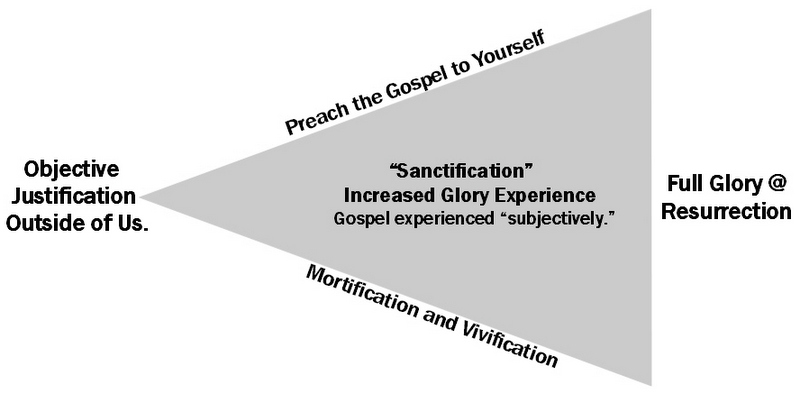
In covering for the mess that Tchividjian makes with his honesty, the Calvinist cartel dances around all of this by redefining ALL of the known terms and adding many.
My case for this is thoroughly documented in Pictures of Calvinism and It’s Not About Election. The ebooks are below.
Progressive Justification: It’s Life Application
Calvinist Liars Attempt to make Tullian Tchividjian a Scapegoat
I have compiled a lot of transcripts for a future post that will address the T4G/TGC damage control crew of Kevin DeYoung, Jerry Wragg, and Mike Fabarez. Oh, and due to this post by Rick Phillips, I will add him to the list.
The Rick Phillips post confirms my position: Tchividjian was given the boot for his views on sanctification, which trust me, are the exact same as the rest of that bunch. Again, their problem with Tchividjian is the fact that he isn’t nuanced enough. All of the jargon about New Calvinists (the contemporary expression of authentic Calvinism) believing in obedience, effort in sanctification, etc., is disingenuous and for the most part outright deception.
Since Phillips wrote some real whoppers in his post, I will use it as a basis for the article which I hope to post by the first of next week. For instance, on the one hand, and per their modus operandi, Phillips claims to endorse obedience, effort, etc., in sanctification by…
the power of grace through faith in Christ.
Got that? “Grace” is code for justification. “Through faith in Christ” is code for faith alone in sanctification. These lying hypocrites believe in sanctification by justification just like Tchividjian does. The blog that Phillips writes for, Reformation 21, also proffers the traditional Reformed view of mortification and vivification which is also exactly what Tchividjian believes. Through “deep repentance,” or a “lifestyle of repentance,” viz, mortification, we EXPERINCE vivification which is the joy of our original salvation. It’s not us doing the actual obedience, we are only experiencing it. The language used is usually, “we are transformed into Christ’s image” etc. It is the mere experience of “spiritual transformation” and “heart change.” If you note the words they use carefully, they don’t actually say that we change.
Though I have a lot on my plate right now, I can’t let this treachery go unchallenged. These guys don’t believe anything different than Tchividjian. Lord willing, I will make the case next week.
paul

 Paul's Passing Thoughts
leave a comment