The Five Lies of the Five Solas: Sola Scriptura

tancpublishing.com
Once again, as in this post, and this post, we find that people assume much about the clarion call of the Protestant Reformation: the five solas. One assumes that scripture alone means that Christianity draws all of its truth for life and godliness from an exegetical study of the Scriptures. Not so.
Scripture, according to the Reformers, cannot aid the “believer” in wisdom for living life. In fact, living life is not really the business of the believer for that would be works salvation—the Christian life must be EXPERIENCED only through the death and life of Christ.
This is the Reformed doctrine of mortification and vivification. The Christian mustn’t seek to learn the Scriptures and apply the principles to their lives; they must rather use the Scriptures to “gaze” upon the “saving works of Christ in all of the Bible.” This “gazing” upon the salvific works of Christ in all the Scriptures then results in a subjective “reflection” of Christ’s glory. Stars are really just huge chunks of rock floating around in space that reflect the sun’s light; in the same way, we are chunks of dead stones that merely reflect Christ’s light (glory) when we fix our sight on Him alone.
Therefore, according to the Reformed camp, the Bible is merely a tool for gospel contemplationism. Its sole purpose is not to learn more of God’s truth and better ways to love God and others, but rather a gospel narrative that enables us to see our own wretchedness more and more as set against the holiness of God. This results in more and more gratitude for the cross which results in Christ’s glory being REFLECTED from our dead, worthless selves.
This is the crux of the Reformed Redemptive Historical hermeneutic. It calls for seeing and interpreting all reality through the suffering of the cross, or the works of Christ seen in the Scriptures. Biblical imperatives are not anything that we are to do, but rather show us what Christ has already done for us.
Scripture alone for seeing Christ alone, so we can live by faith alone.
paul
Today’s Christian Husband and Father: Killing His Family with Awesome Preaching
 Originally posted December 6, 2012
Bob is on his way to Jerry’s house for dinner. Bob is the chairman of their church’s elder board. Jerry is being considered for eldership and Bob will be dining at his house for a pre-interview en lieu of further discussion. Pizza is the cuisine. And apparently, not just on this night—Bob notes that every trashcan in the house is stuffed with pizza boxes. Dishes full of M & Ms also adorn many of the table tops. Bob is taken to the kitchen by Jerry to meet his wife, and Bob perceives no less than twenty-five bags of potato chips staked about in various places. One corner of the kitchen is occupied with a tall stack of Coca-Cola 12packs. Big on taste—small in nutrition.
Precious few will disagree that Bob’s family is headed for serious health problems if they do not change their ways. Yet, Bob is a picture of how the vast majority of Christian husbands oversee the spiritual diets of their families. However, the “Bob” motif falls woefully short of making the point; at least Bob knows what his family is eating for better or worse. Christian husbands of our day don’t even know the difference between Redemptive Historical hermeneutics and Grammatical Historical hermeneutics. In fact, when the subject comes up, a rolling of the eyes follows.
That’s because the preaching/teaching is awesome where they go to church. Uncompromising, and God glorifying. As one pastor exhorted me when inquiring about what hermeneutic he used in his preaching: “Come and see if it tastes good, and if you still want to, we will talk about theology.” But I never doubt it will taste good. Who doesn’t love pizza for dinner, potato chips as a side, Coke to drink, and M&Ms for desert?
Fact is, nearly 90% of preaching/teaching in today’s American church is fundamentally based on Luther’s Heidelberg Disputation. This document is the very heart of the Reformation and the engine that drives the present-day New Calvinist movement. Its premise was based on the idea that all spiritual reality, wisdom, and truth comes from the combination of two perspectives, and only these two: the holiness of God, and the wretchedness of all men whether they are Christians or not. Luther called this perspective the “theology of the cross.” It has come to be known as Gospel-Centered preaching/teaching. It is also the foundation of the Calvin Institutes. Everything in the Calvin Institutes, in some way, points to the glory of God “as set against our sinfulness.”
This has become job one: as described in the Heidelberg Disputation; this way of teaching is the “cross story,” and all other spiritual wisdom is the “glory story.” Hence, the contemporary clarion call of the Reformation derived from Luther’s Disputation is, the centrality of the objective gospel outside of us. Anything at all that has anything to do with us is “subjective,” and part of the “glory story.” Unless it concerns our wretchedness. Therefore, the Disputation ridiculed a negative attitude towards suffering as well for this serves to further reveal our woeful state in life which magnifies the redemptive work of Christ and our utter worthlessness. The whole motif can be visualized by the following Reformed chart:

Yes, you can preach wonderful sermons on those two dimensions. They are both abundantly true. Charles Spurgeon is known as the “prince of preachers.” All of his sermons are based on the “cross story.” All, I repeat “all” of John Piper’s sermons and the (seems like) 600 books he has written are based on nothing but, I repeat, nothing but the “cross story.” Amen, pass the potato chips. In circa 1994, John MacArthur abandoned the “glory story” aspects of his preaching and now focuses on the “cross story.” Amen, pass the M&Ms. And those babies slide down nice with a big swig of Coca-Cola.
“But Paul, what’s so sweet about focusing on our own wickedness?” My dear friend, haven’t you seen any Staples commercials? It’s easy. You totally stink. Nothing is expected of you: “Hey honey! Good news! We don’t change! Our marriage isn’t about a bunch of do’s and don’ts! Our failures make us wiser!” That was easy. In fact, teachers like Michael Horton and John Piper continually espouse the idea that expectations are just, “more bad news.” And regarding leaders? “Alright, time to prepare my message for tomorrow, and all I have to do is look for two things, and two things only in the text: how great God is, and how bad we are.” That was easy. In fact, we find the following on a well-known Reformed blog regarding instruction on how to prepare a Bible lesson:
At this time, resist the temptation to utilize subsequent passages to validate the meaning or to move out from the immediate context. Remembering that all exegesis must finally be a Christocentric exegesis.
Look for Christ even if He isn’t there directly. It is better to see Christ in a text even if He isn’t, than to miss Him where He is.
But as the apostle asked rhetorically, “What saith the Scriptures?” Is there another story other than the “cross story”? Anybody interested in the House on a Rock story?
Matthew 7:24 -“Everyone then who hears these words of mine and does them will be like a wise man who built his house on the rock. 25 And the rain fell, and the floods came, and the winds blew and beat on that house, but it did not fall, because it had been founded on the rock. 26 And everyone who hears these words of mine and does not do them will be like a foolish man who built his house on the sand. 27 And the rain fell, and the floods came, and the winds blew and beat against that house, and it fell, and great was the fall of it.”
Learn and do. That’s how we have a life built on a rock. It is the very definition of a disciple:
Matthew 19 – Go therefore and make disciples of all nations, baptizing them in the name of the Father and of the Son and of the Holy Spirit, 20 teaching them to observe all that I have commanded you. And behold, I am with you always, to the end of the age.”
So, here is my suggestion. When you go to church this Sunday, and other days following that involve sitting under the teachings of your leaders, take a legal pad with you. Draw a line at a downward angle on the bottom labeled, “our sin.” Draw a line at the top with an upward angle, and label it “Christ.” Then draw a line in the middle and label it, “What? Why? And How?” Or, “Not only what Jesus did, but what did He SAY?” Or simply, “Life built on a rock.” If there isn’t a three-dimensional balance—get out of there. You either love your family or you don’t. You will be judged by Christ accordingly.
I was approached by my wife Susan this morning. My son by marriage had approached her asking questions about demonology. Apparently, he had questions concerning some things he had heard about the subject (demonology) in the secular realm. I was astonished; though both of them have been in church for a combined total of 72 years, they didn’t even know the basics regarding this subject. My wife wanted to know the answers to his questions—other than the usual answers: “Jesus” and “gospel.”
And if we don’t know, the world will gladly inform our children accordingly. Knowledge equals authority.
Men, wake up.
paul

Simple Post Title by Rick Phillips Reveals Presbyterian False Gospel
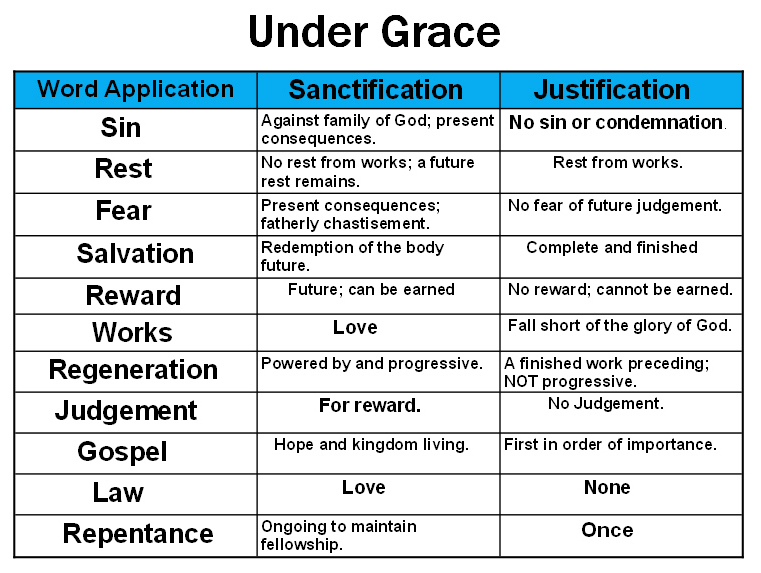
 Call yourself a Presbyterian if you will, but it is a denomination fathered by John Calvin. Call yourself a Calvinist if you must, but he clearly believed that Christians remain under the law and its demand for perfection. Therefore, sanctification must be lived by faith alone for the following efficacious result: the perfect obedience of Christ performed during His life on earth as a man will be “imparted” to our Christian lives to fulfill the law and keep us justified. This is called, double imputation. Christ died on the cross to “impute” righteousness (justification) positionally, and lived a perfect life so that righteousness could also be “imparted” to our sanctification (Christian life).
Presbyterians not well endowed in nuance will often state it this way: “Christ died for our justification and lived for our sanctification.” That’s a false gospel. Why? Because it keeps Christians under the law. It denies that Christ came to end the law. And it posits the idea that there is a law that can give life. And it denies Christians the ability to fulfill the law by love because their focus must be living by the same gospel that saved us so Christ will keep the law satisfied for us. Supposedly, it’s ok to be under the law because Jesus keeps it for us. Jesus didn’t come to fulfill the law of love through us, He came so that we could fulfill the law of condemnation through Him. In the final analysis, that defines Christianity as unregenerate; under law and NOT under grace.
This is simple theological math, and the final equation is keeping ourselves saved by faith alone. Sanctification becomes a complicated affair of defining what is a work in the Christian life and what isn’t a work in the Christian life. We must “live by the same gospel that saved us” in order to keep ourselves saved. We are not free to focus on the law as an instruction book of love, but the focus is not “making the fruit of sanctification the root of our justification.” Justification isn’t a finished work, it is a growing tree that must bear its own fruit. If the fruit comes from us, that’s “making the fruit the root.” That’s “fruit stapling.”
Salvation doesn’t grow. It is finished. I believe the doctrine of election completely eradicates works from justification, makes justification a finished work before the foundation of the world, and creates an infinite dichotomy between justification and sanctification. This does not negate our free will to choose in time, but seals our future glory in the Holy Spirit. God throws our sins as far as the east is from the west. All of our sins were under the law, and Christ ended the law. Where there is no law there is no sin. The law now works through love, not condemnation. A Christian cannot sin against the law of condemnation; what law? As Christians, our sin is not covered—it’s ENDED. We don’t keep ourselves saved by perpetually accessing imputation and impartation by doing certain things “by faith.”
Unlike what Calvin taught, the Christian life is not a rest, we rest in justification, but sanctification is a labor of love. And there remains another rest for God’s people, but that is not now. We don’t continue to rest in justification in order to keep ourselves saved. Doing ANYTHING to keep ourselves saved is a work, even when under the auspices of rest. When you are resting, you are doing something by default. If nothing else, rest is a decision. You are doing something to keep yourself saved. Justification is finished; sanctification is not. Sanctification is progressive; justification is not. Sin is ended; not covered. The law of justification covered, but it was ended on the cross; now the law only works through love.
Stop fearing the law and start loving—there is no fear in love. Calvin clearly taught a Christian Sabbath by faith alone motivated by fear of condemnation. This is not arguable on any level. I painstakingly document these facts in It’s Not About Election. Of course Christians are totally depraved according to Calvin; according to him, we are still under the law. When we are under grace, we obey the law out of no other motive but love, IF we know that justification is finished and we are free to aggressively obey the law for love…
“If you love me, keep my commandments.”
Among many other egregious tenets generated by this false gospel, Calvin insisted that all sins committed by Christians cause them to fall from grace, and there must be a perpetual forgiveness imputed to the “believer,” and the perpetual forgiveness for falling short of the law of condemnation can only be found in the institutional church overseen by preordained Reformed elders. Hence, church membership is primarily about receiving perpetual forgiveness for sins committed under law which demands perfection. This is also why any Presbyterian criticism of Romanism is a mockery of the true gospel. Both propagate the same progressive justification that keeps “Christians” under law. Different means of being able to “stand in the judgment” will not save any of them.
This brings me to a post sent my way written by Rick Phillips titled, “The Gospel Includes Sanctification.” Regardless of all of the whining about Tullian Tchividjian who they use for cover, they believe no whit different on any wise than Tchividjian or any other person propagating works salvation by antinomianism. Who keeps the law or kept the law for us is not the issue—law in justification is the issue, and this can be seen in the simple title of the aforementioned post by Phillips.
Phillips employs the usual nuance that masks the Presbyterian false gospel by replacing words; in this case, “justification” for the more ambiguous, “gospel.” What the title really states is…
Justification Includes Sanctification.
Would Phillips deny this? Would he deny that “gospel” includes the idea of justification? This clearly makes justification a process, and not a finished work. This is the Achilles’ heel of Presbyterianism and Calvinism in particular. If we are in-between a beginning justification and a “final justification,” we are somehow involved in the finishing of justification; there is no way around this. Phillips flavors this progressive justification with the idea that salvation saves the “whole man” with both “imparted” and “imputed” righteousness. “Wholeness” does not occur completely at the new birth, it makes regeneration a progression of justification. Therefore, sanctification is not a result of justification; it is part of the justification process. This makes sanctification a spiritual minefield with a focus away from aggressive, worry-free love, and instead, a fearful concern that we will make “the fruit of sanctification the root of justification.” There is a danger of this because as fellow Presbyterian Lou Priolo notes; like our computers, justification is the program always running in the background.
Go figure, by everyone’s assessment, the confusion concerning sanctification in our day is rampant; yet, in no time ever have we had more highly paid Reformed academics waxing eloquent from coast to coast. It’s not that they are overpaid communicators; it’s a clear case of a gospel that doesn’t add up biblically. That’s where the confusion is coming in—the problem is not in your set.
Unless of course, they are your best shot at being able to “stand in the judgment.” Their father clearly stated that Reformed elders have the “power of the keys,” and whatever they bind or loose on earth will be the same in heaven. Let me interpret that for you: if Rick Phillips or Lou Priolo like you, you’re in.
That’s an equation that adds up perfectly.
paul

 Paul's Passing Thoughts
leave a comment