Connecting the Dots: Tullian Tchividjian and Luther’s Theologian of the Cross
 The Magnum Opus of the Reformation: Martin Luther’s Heidelberg Disputation; Part 5
The Reformed community will hardly shed a tear in regard to the recent demise of Tullian Tchividjian. A consummate theologian of the cross in accordance with Martin Luther’s Heidelberg Disputation, his lack of nuance drove other Reformed leaders to distraction.
Tchividjian is the premier example of the authentic Reformed gospel applied in our day. His life and teachings will be compared to what we have learned thus far from the foundational doctrinal statement of the Reformation.
Join the discussion @ 7pm on Friday, 6/26/2015. Program link:
A Clarification on my Anti-Reformation, Anti-Protestant Stance
 It is true, I have totally written off every Calvinist that has ever lived in regard to having any value for sanctification or justification except for two, one being Dr. Jay Adams. After all, I don’t want to be extreme.
So, what’s my excuse for excusing Adams? He brings something to the table that isn’t Reformed. Sure, he may argue that it is Reformed, but nevertheless the results are the same: people find a measure of real help in a contemporary church where there isn’t any help. In fact, the consensus is in: people are better off after they leave church. This ministry has witnessed several marriages on their way to divorce court until the couple simply stopped going to church. In fact, I dare say their marriages are getting better.
We are in a Protestant Dark Age. A movement is needed where the wisdom of God found in the Scriptures is rediscovered in Western culture. What needs to be rediscovered specifically? It starts with the knowledge that the Bible is written for the able individual. That’s first.
Secondly, the issue of how we interpret reality must be addressed. The Reformers did not interpret reality literally, and that tradition was passed down to all that followed them. In the church today, by and large, the pastorate does not interpret state of being in the same way that congregants do. The Reformers reinterpreted every word and term according to their own worldview. For example, “God’s glory” really means “God’s self-love.” Stated simply, John 3:16 in reverse.
The Reformers devised an ingenious indoctrination system of sliding metaphysics. They redefined every word and term, and allowed the listeners to assume what they meant by each word and term. In the process of using these words and terms in a certain way, listeners are slowly indoctrinated in accordance with the primary goal of the Reformers: a desired functionality albeit foggy understanding.
Let me give some specific examples. Total depravity. From the beginning in Reformed thought, this included believers. So, while assuming total depravity pertains to the unregenerate only, many are eventually indoctrinated into the original Reformed idea that this also includes believers.
Sola scriptura. The assumption is Scripture alone, but the Reformers knew that few would ask the following question: “What exactly did the Reformers believe about the Scriptures?” Sure, Scripture alone, but for what purpose?
Election. The assumption is that this argument focuses on man’s ability to choose God for salvation, but it goes much, much deeper than that and is directly relevant to what the Reformers believed about reality itself. Few know that Calvin believed in three classes of elect: non-elect, temporarily elect, and the final elect, or those who persevere.
The Reformers believed that reality is a narrative written by God in which mankind is written into the script. Reformers such as Jonathan Edwards believed that man has no will per se, but God preordains every thought that precedes every act of man which makes it seem as if man has a will. My wife Susan will be doing three sessions on Jonathan Edwards at this year’s TANC conference. Many will find her research fairly shocking.
Sola fide. The assumption is faith alone for salvation/justification. By far, this is the one that the Reformers get the most mileage out of. Using this assumption, they continually talk about sanctification in a justification way. Eventually, sanctification becomes justification. Eventually, the Christian life becomes perpetual re-justification which is the Reformation gospel in a nutshell.
Protestantism is truly the super-cult of the ages.
And the institutional church finds itself in a huge dilemma. Traditional institutional worship beginning with the Reformation was tailored for perpetual re-justification down to the alter call routine. The Lord’s Table is a solemn ceremony where additional grace is imparted through repentance. In reality, the first century assemblies met for dinner, and the fellowship meal was supposed to remind them of their fellowship with God and His Son. It was all very informal and not for the purpose of imparting additional grace.
The gatherings were an extension of worshipful living specifically designed for private homes and nothing more. The institutional version is an extension of two pillars of Reformed theology: the doctrine of progressive justification, and the politics of church-state. Hence, traditional institutional worship necessarily circumvents the original intent of Christ’s mandate for His assemblies.
With all of that said, Adams supplies a little help that can be found right now in the institutional church, and at least for the time being, we need to seize upon everything we can get. I am not talking about those who think they are helped by adopting a Reformed worldview of zero-sum-life (viz, “second generation” biblical counseling). I am not talking about those who seem to stand strong in the face of adversity because they see all of life as nothing but a divine prewritten narrative for the sole benefit of a divine self-love. No, here is my reasoning in regard to Adams per a comment I posted yesterday:
God used Jay Adams to save my life. How? Jay emphasized the need for biblical counseling using a grammatical approach to the Scriptures. This approach proffered the idea that seizing upon the literal promises of God in the Bible is curative. Of course, this would seem evident. That gives hope; if I follow God’s instruction on this, God will do that.
In the midst of the hell I found myself in, I could begin to please God. Nothing could keep me from doing so except myself, and in God’s timing, and in God’s way, it would be curative as well.
As someone who prided himself as a knowledgeable, objective evangelical, Jay’s teachings exposed the fact that I was really a functioning mystic that used all of the orthodox verbiage. While I disagree with Jay on many things, this is the powerful approach that he brings to the table.
“Christians” have a choice to make in regard to how they will interpret the Scriptures and reality itself: grammatically, or according to Christocentric Gnosticism. I am not talking about pseudo grammatical interpretation used for a purely redemptive outcome, I am talking about authentic exegetical interpretation, not cross-centered eisegesis leading to the antinomianism of “second generation” biblical counseling.
And, Jay is an example to all of us in practicing our gifts faithfully to the end. There is no retiring from a love for the ministry that you are called to whatever it is.
May the Lord give God’s people many more years of his living sacrifice.
Am I willing to give a Calvinists credit where credit is due? Yes, if he brings something to the table that can give life. If we were in a time when the laity has retaken its rightful place in Christ’s mandate supplying ample sanctification wisdom, would I recommend Adams in any regard? I am not sure, my due to him in this particular age notwithstanding. But for the time being, we must scrape up everything we can get until the laity obeys its calling, as long as it is truly worth scraping up.
The Reformation has failed. A resurgence of it commenced in 1970. By 2008, it dominated American evangelicalism and continues to do so today. But, the chickens are coming home to roost. Its leaders are dropping like flies. The damage control is now unmanageable. The institutional church is a train wreck while the Nones and the Dones are laying about everywhere on the landscape. The latest trail blazer of the neo-resurgence to fall at the hands of his own gospel sanctification Reformed doctrine is Tullian Tchividjian. He is one of seven of the most visible leaders of the movement to resign for misconduct in less than two years. Others have been the focus of controversial bully-like conduct in the same time frame, along with numerous Neo-Calvinist mega church pastors who have resigned for sexual misconduct, three in the Orlando, Florida area alone.
The answer is NOT Reformation—the answer is a laity revolution. The laity has been conned into investing huge sacrifice in Reformed academia, and to what end? Who will deny that the laity understands less about Christian living than we ever have? Rather than seeking God’s face on our own, we run to orthodox sand boxes like The Warburg Watch and play with the same regurgitated Reformed talking points. This only serves to help the failed Reformation with its damage control. It only serves to send the message that being confused is acceptable.
But we do not serve a God of confusion. It’s time for the laity to stop worshiping Reformed academia and give honor to the one who sanctifies us with truth—not the traditions of mere men.
paul
The Magnum Opus of the Reformation: Martin Luther’s Heidelberg Disputation; Part 4
 Listen to Show or download audio file.
Welcome truth lovers to Blog Talk radio .com/False Reformation, this is your host Paul M. Dohse Sr. Tonight, part 4 of “The Magnum Opus of the Reformation: Martin Luther’s Heidelberg Disputation.”
Greetings from the Potter’s House and TANC ministries where we are always eager to serve all of your heterodox needs. Our teaching catalog can be found at tancpublishing.com.
If you would like to add to our lesson or ask a question, call (347) 855-8317. Remember to turn your PC volume down to prevent feedback.
Per the usual, we will check in with Susan towards the end of the show and listen to her perspective.
Remember, you may remain anonymous. When I say, “This is your host; you are on the air, what’s your comment or question”—just start talking.
If you would like to comment on our subject tonight, you can also email me at paul@ttanc.com. That’s Tom, Tony, Alice, Nancy, cat, paul@ttanc.com. I have my email monitor right here and can add your thoughts to the lesson without need for you to call in. You can post a question as well.
Ok, so last week we only covered thesis 7, and as discussed, sometimes these Reformed guys are as clear as mud. Where the confusion comes in regards Luther’s position on mortal versus venial sin. Per Susan’s contribution last week, we know that Luther and Calvin never left the Catholic Church, and Susan assessed the Catholic position on mortal and venial sin. With that said, what was Luther’s position?
Look, here is the same advice I gave Susan in regard to her research on Jonathan Edwards: sometimes, there is just no way of knowing what these guys are trying to say, so you have to look for the places that can be defined and draw conclusions accordingly. The way Luther goes about thesis 7 could be debated until the second coming. So what’s he saying definitively? Well, let’s go to thesis 12:
In the sight of God sins are then truly venial when they are feared by men to be mortal.
This becomes sufficiently clear from what has been said. For as much as we accuse ourselves, so much God pardons us, according to the verse, »Confess your misdeed so that you will be justified« (cf. Isa. 43:26), and according to another (Ps. 141:4), »Incline not my heart to any evil, to busy myself with wicked deeds«.
Bingo. That’s pretty clear. For all practical purposes, according to Luther, the deeds of the saved and unsaved alike are all mortal sins. Even if Luther makes room for sins being authentically venial in the subjective Christian life, it makes no difference because mankind cannot do a good deed or any work that would be meritorious before God. In order to be saved, an individual must disavow the possibility of good works and assume every act is a mortal sin.
Susan is in the midst of some very heavy research, and has been sharing some of it with me. At times she will read excerpts from Edwards and there is no way in hades to know what the guy is saying. But, according to the subject, you can draw from what the guy has said in other places and draw your conclusions. And that’s what we are doing here.
While we are on thesis 12, let’s note this:
For as much as we accuse ourselves, so much God pardons us, according to the verse, »Confess your misdeed so that you will be justified« (cf. Isa. 43:26).
Bingo—that’s the Reformation gospel in a nutshell. You are still a wretched unregenerate sinner, and a perpetual return to the same repentance that saved you keeps you justified. The saving death of Christ is continually reapplied to your life along with His imputed obedience as well. This is what Paul David Trip et al call “A lifestyle of repentance” echo, echo, echo, echo.
And by the way, if you have any complaint at all about the way your church is run, this is what you will probably hear: “Who are you to judge? You should be busy accusing yourself rather than others lest you fall from grace.” And I don’t have a problem with that and nether should you. Why? Well at least they know what Protestantism is about. They are just being good Protestants, it is what it is.
And here’s another thing; I claim a liberty for myself that I think is biblical. I refuse to pass judgement on who is going to hell and who isn’t. Not only is hell a terrible place of eternal torment that I would not literally wish on anybody, but I choose to leave that assessment where it belongs; in the hands of God. Do you know why people want me to draw the hell conclusion from my assessment of true gospel versus false gospel? Here’s why: they want to use that to shut down discussion and subsequent discovery. See, when TANC ministries comes up, they want to say, “Ya, Dohse believes that Martin Luther and John Calvin are burning in hell.” See, that shuts down discussion. But if they tell the truth and say, “Dohse believes the Reformation gospel is progressive justification,” well, now that induces curiosity and discovery.
Listen, who am I to be going around saying that this guy is going to hell and that guy is going to hell? That’s not my place, but the bigger point is that such behavior becomes the topic and not the substantive discussion of true gospel versus false gospel. The former utilizes a jump from presuppositions to conclusion so that the substantive is circumvented. Don’t fall for that garbage.
Let’s now proceed to thesis eight:
Thesis 8: By so much more are the works of man mortal sins when they are done without fear and in unadulterated, evil self-security.
The inevitable deduction from the preceding thesis is clear. For where there is no fear there is no humility. Where there is no humility there is pride, and where there is pride there are the wrath and judgment of God, »for God opposes the haughty. Indeed, if pride would cease there would be no sin anywhere.
This thesis supplies a couple of major hallmarks of the Reformation. But I better pause here to head off a danger at the pass. Don’t be tempted to think that this point by point assessment of the FIRST Reformation doctrinal statement is redundant. It’s not. In all of this, I am becoming more and more appreciative of Luther’s genius. Throughout this document, Luther is not only putting forth a foundational doctrinal statement, he is teaching people how to think and what to think about the finer points of life. Luther isn’t saying the same things in a different way, he is redefining the elements of collective thinking that are possible exits out of the foundational premise. At the end of this study, one could put together a counter disputation, and maybe I will.
Here, he defines “pride.” What is that according to Luther, and frankly every Reformer after him? Pride, according to Luther, is the heart of sin: “Indeed, if pride would cease there would be no sin anywhere.” Here we see two major epistemologies or metaphysical hermeneutics of the Reformation: First, the common man cannot only do anything that would find favor with God, the common man cannot know reality. Second, every truth has a counter truth. Said another way, opposites define each other. In Plato’s theory of forms, reality descends from the immutable objective to the mutable and shadowy subjective. Ascent to the objective begins by finding those things that are immutable in the subjective shadow world.

For Plato, that was math among other things, but along this same line of epistemology is dualism, or what’s called “co-eternal binary opposition, a meaning that is preserved in metaphysical and philosophical duality discourse but has been more generalized in other usages to indicate a system which contains two essential parts.” Do you see this in thesis 8? It’s pride and humility. We also refer to this as the either/or hermeneutic. There is no in-between, it’s either/or. There is no taking pride in what you do without being prideful. There is no taking of satisfaction from a job well done; you are either humble or prideful.
And, this is also key, what is humbleness’ key attribute? Right, fear; specifically fear of condemnation…”For where there is no fear there is no humility. Where there is no humility there is pride, and where there is pride there are the wrath and judgment of God.”
Your only chance of getting into heaven in the end is doubts that you will. Luther and Calvin both equated eternal security with damning pride. Tullian Tchividjian once joked that Presbyterians differ from Baptists because Presbyterians don’t call each other “brothers” because no one knows for certain whether that’s the case or not. The joke bought the house down, but as the saying goes, the truth in a joke is what often makes it funny.
Once again, this is also right out of the Calvin Institutes:
Let us, therefore, embrace Christ, who is kindly offered to us, and comes forth to meet us: he will number us among his flock, and keep us within his fold. But anxiety arises as to our future state. For as Paul teaches, that those are called who were previously elected, so our Savior shows that many are called, but few chosen (Mt. 22:14). Nay, even Paul himself dissuades us from security, when he says, “Let him that thinketh he standeth take heed lest he fall,” (1 Cor. 10:12). And again, “Well, because of unbelief they were broken off, and thou standest by faith. Be not high-minded, but fear: for if God spared not the natural branches, take heed lest he also spare not thee,” (Rom. 11:20, 21). In fine, we are sufficiently taught by experience itself, that calling and faith are of little value without perseverance, which, however, is not the gift of all (CI 3.24.6).
As we have discussed before, Calvin’s election construct has three categories: the non-elect, the temporary elect, and those who persevere. No one knows whether they make it or not until they are revealed as such in the final judgement. This is known as “final justification when the sons of God are made manifest.” Apparently, they are made manifest by their “accompanied good works” which were really performed by Jesus and not them. This aversion to eternal security is also demonstrated by the likes of John Piper:
There is danger on the way to salvation in heaven. We need ongoing protection after our conversion. Our security does not mean we are home free. There is a battle to be fought (John Piper: Bethlehem Baptist Church Minneapolis, Minnesota; The Elect Are Kept by the Power of God October 17, 1993).
Of course, the apostle John’s stated purpose for writing the book of 1John directly contradicts this idea. Let’s move on to thesis 9:
Thesis 9: To say that works without Christ are dead, but not mortal, appears to constitute a perilous surrender of the fear of God.
For in this way men become certain and therefore haughty, which is perilous. For in such a way God is constantly deprived of the glory which is due him and which is transferred to other things, since one should strive with all diligence to give him the glory-the sooner the better. For this reason the Bible advises us, »Do not delay being converted to the Lord.« For if that person offends him who withdraws glory from him, how much more does that person offend him who continues to withdraw glory from him and does this boldly! But whoever is not in Christ or who withdraws from him withdraws glory from him, as is well known.
Luther here has a problem with the idea that good works can be performed by the unbelieving or believing and such works do not condemn, but are merely dead works that cannot earn merits for justification. This now brings us to what the Reformers believe is the sole purpose for all existence: God’s glory. Any concession that man can do anything good robs God of glory.
Man can indeed do good works, but in regard to the unsaved, it is true that in the end that only results in less condemnation, but Luther isn’t even willing to conceded that. If people can do good works resulting in less condemnation—that robs God of glory. Furthermore, it removes fear of condemnation from some works which also robs God of glory.
This is why Luther’s disputation is said to be the cross story versus the glory story: any glory not given to God is claimed by man; hence, the glory story, or the story of man. It can’t be a story about God and man, All glory must be granted to God. You are either living in the cross metaphysical narrative or the glory of man metaphysical narrative.
Thesis 10: Indeed, it is very difficult to see how a work can be dead and at the same time not a harmful and mortal sin.
This I prove in the following way: Scripture does not speak of dead things in such a manner, stating that something is not mortal which is nevertheless dead. Indeed, neither does grammar, which says that »dead« is a stronger term than »mortal«. For the grammarians call a mortal work one which kills, a »dead« work not one that has been killed, but one that is not alive. But God despises what is not alive, as is written in Prov. 15:8, »The sacrifice of the wicked is an abomination to the Lord.«
Second, the will must do something with respect to such a dead work, namely, either love or hate it. The will cannot hate a dead work since the will is evil. Consequently the will loves a dead work, and therefore it loves something dead. In that act itself it thus induces an evil work of the will against God whom it should love and honor in this and in every deed.
This thesis makes another argument against the idea that good works can be performed by mankind, but they are dead works in regard to justification. If mankind can perform a good deed, if mankind is competent, if mankind has some sort of ability, then why would that not include the ability to choose? This speaks to the Reformed doctrine of total inability. The Reformed continually claim this doctrine as uniquely Reformed and contrary to all other religions throughout history. This is not true; in fact, the total depravity of mankind coupled with determinism of some sort has been the overwhelming norm from the beginning of time. We delved into this historical fact in our Romans series (lessons 55-64).
What I would like to focus on in this thesis is Luther’s mention of grammar and the “grammarians.” What is a grammarian? A grammarian is someone who studies world linguistics. A grammarian also studies the connections between linguistics and the interpretation of reality. By and large, a grammarian is going to take a literal approach to interpreting reality; ie., things are as they appear. Another way of stating it: reality can be understood empirically. Hence, man can reason and understand reality.
This is going to be my subject at this year’s conference. The Reformers did not hold to a literal interpretation of realty. Obviously, St. Augustine was heavily steeped in allegory. This is what most Christians don’t understand: the Reformation was about the interpretation of reality itself, and how the Bible should be used for that purpose.
The Reformers didn’t reject biblical grammarianism, but made it secondary to the redemptive view of reality, or the idea that all of reality should be interpreted by “the gospel.” If the use of grammar leads to a redemptive outcome, wonderful. If it doesn’t, you use allegory to insure a redemptive outcome. The Reformed therefore often claim to be grammarians which is blatantly disingenuous. And look, the Reformed camp is not the least bit shy about all of this. We can see in this thesis how Luther was willing to use the grammar for the outcome he desired. In essence, he is saying: look, if the simpleton grammarians even think that something dead cannot contribute anything to life, how much more should we believe it as well?
And look, the Reformed camp is not the least bit shy about all of this. In his book, “Uneclipsing The Son,” by John MacArthur confidant and rumored heir apparent Rick Holland, he states that “bad grammar makes good theology” (page 39). The who’s who of American evangelicalism endorsed the book, and John MacArthur wrote the forward. As should be surmised by the title, the book is an in-your-face Gnostic treatise. The whole eclipsing the sun motif is a well-traveled illustration in Neo-Platonist/Gnostic circles. In the forward, MacArthur makes shocking statements that include the following idea: the subordination of God the Father and the Spirit to the Son.
If one does not interpret the Bible as a grammarian, all bets are off. While the Catholics made printing the Bible illegal, the Protestants merely took away individual interpretation and made biblical knowledge “the Gnosis.” Also, here is an aside: why did Christ emphasize the new birth to Nicodemus? The guy was “the” teacher in Israel and had never even heard of the new birth. Why? because Judaism was saturated with Gnostic philosophy and the infusion of divinity into a mortal being was unthinkable. The guy’s very name even reflects the Gnostic politic: nico; victory; demus; people; or, victory over the people. The most prominent Gnostic sect of the day was the Nicolaitans which means “victory over the laity.”
Now, next week, we are going to use theses 11 and 12 as an introduction to thesis 13 and following where Luther gets into the foundational position of free will according to the Reformation. We have heard lots of discussion about freewill for many years; next week, we will define the issue.
The Problem with Contemporary Biblical Counseling: Justification “Runs in the Background”
 Originally published June 13, 2014
“Jay Adams has often pointed out that people are clueless in regard to the fact that there are about 200 different counseling theories in Psychology. Think about that. When people go to a psychologist for help they are no doubt clueless in regard to the perspective that they will be counseled from. Nevertheless, if biblical counseling is about sanctification, and it is, there are at least as many different theories on how justification ‘runs’ with sanctification.”
The fact that our justification is a finished work is critical to the gospel. If justification is not finished, its proper maintenance by faith alone without works becomes a balancing act between works and faith in sanctification. You have an integration of two things where one calls for faith alone and the other calls for a faith that works.
Therefore, when justification and sanctification are fused together, the Christian life will be marked by confusion, fear, introspection, and a paralyzed, stagnant Christian life. Sound familiar? A radical dichotomy between justification and sanctification frees the believer to aggressively love without fear that anything they do in sanctification will affect their justification. There is no fear in our justified position.
A false gospel cannot help people. All in all, the contemporary biblical counseling movement is saturated with the idea that justification is progressive. Point in case; biblical counseling superstar Lou Priolo believes that justification, “runs in the background.” In a guest post written for Jay Adams’ Institute for Nouthetic Studies, Priolo stated the following:
To my way of thinking, the place of the doctrine of justification in the believer’s life is much like the operating system on a computer. I’m a PC guy. My personal computer operates under a Windows operating system. Windows is always up and running, but most of the time, it runs in the background. I don’t see it. I can go for days without looking at it (although I know it is functioning as long as the other programs are operating properly). Occasionally, I have to go to the control panel to troubleshoot a problem, make some minor adjustments, or defrag my hard drive, but I don’t give it another thought because I have faith that it is doing what it is supposed to do. So it is with my justification. It is always up and running. Though I am not always consciously thinking about it, everything I do flows from it.
If one carefully examines this statement by Priolo, many disturbing anti-gospel ideas could be pointed out, and oddly, Jay Adams himself has written against these very ideas. Particularly, the idea that “everything” we do is powered by, or “flows” from justification. This is no whit different from what Tullian Tchividjian, John Piper, or even Joseph Prince believes.
Justification cannot be both finished and “running.” If justification runs in sanctification, what do we have to do to keep it running properly? That’s a huge problem by virtue of the very question itself. If the race we run as Christians, the one Paul talked about, is powered by justification, and we can be disqualified from that race; well, the ramifications in this issue speak for themselves.
No wonder that confusion, chaos, controversy, and a civil war between “first generation” biblical counseling and “second generation” biblical counseling are the order of the day in those circles.
Jay Adams has often pointed out that people are clueless in regard to the fact that there are about 200 different counseling theories in Psychology. Think about that. When people go to a psychologist for help they are no doubt clueless in regard to the perspective that they will be counseled from. Nevertheless, if biblical counseling is about sanctification, and it is, there are at least as many different theories on how justification “runs” with sanctification.
Who will finally stand up and say, “Enough of this madness!”? Who will finally stand up and say one is finished and one is progressive. Come now, are we saying that one runs in a race that is finished? Indeed, I stood dumbfounded when Voddie Buacham’s answer to that question from me was, “yes.” Is this nonsense the very reason that the world does not take us seriously? We are unable to clarify the gospel we proclaim. Call the world totally depraved if you will, but they are not stupid.
paul
Are Calvinists Saved?
Originally published October 6, 2012
The begging of the question has a sound Scriptural argument.
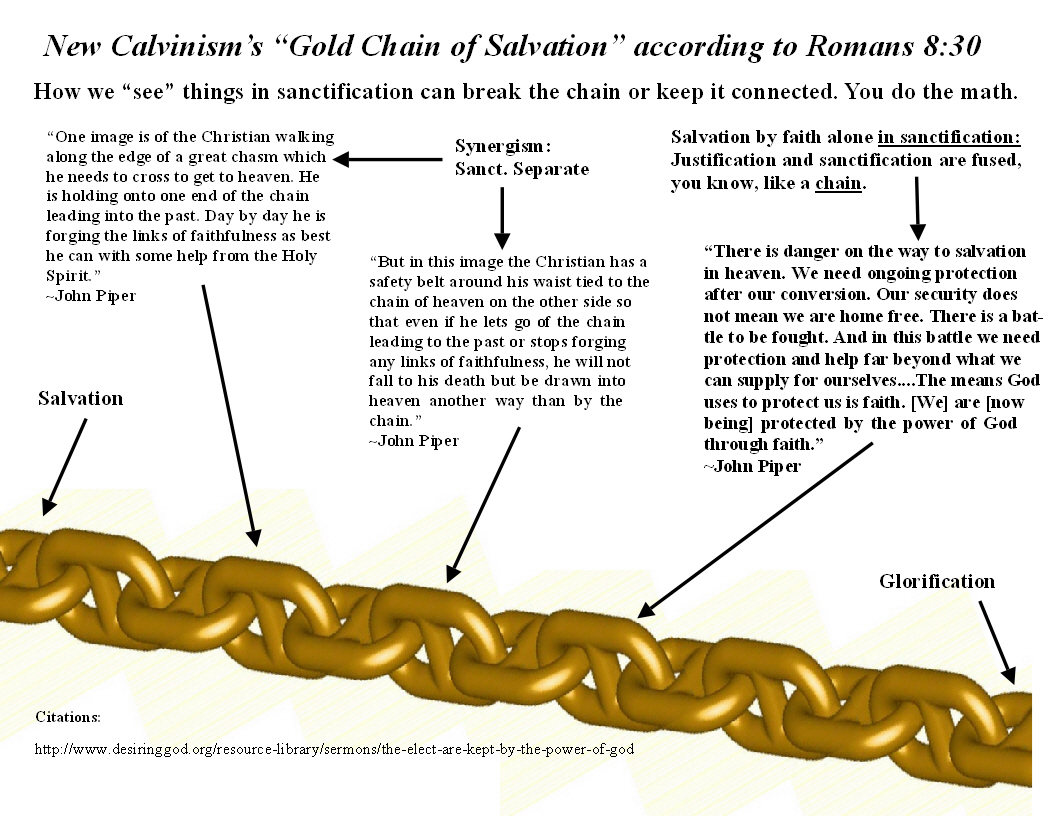
This ministry has made much of the critical importance of separating justification (salvation) and sanctification (growth in holiness, or kingdom living). The Reformed (Calvin/Luther Reformation doctrine/gospel) “never separate, but distinct” doublespeak doesn’t cut it in the arena of truth, and we will see why. “Never separate” =’s false gospel. If you get a little lost in the first part of my argument which gives the lay of the land, don’t worry, when I get into the specific Scriptural argument, it will clear things up and make it all come together for you. It must delight the ghosts of the Reformation that the argument has always been in the arena of freewill verses predestination. It’s the primary thrust of this ministry to change that argument. This isn’t a quibbling about semantics in the mainstream—this is about the truth of the gospel. As New Calvinist Russ Kennedy once thundered from the pulpit in his mousy voice: “Any separation of justification and sanctification is an abomination!” I have often argued from the standpoint of this issue. If sanctification is the middle of the Reformed “golden chain of salvation” then sanctification is part of finishing justification. This means that what happens in sanctification determines whether or not justification is properly finished. What’s a chain? John Piper even preached a message about the eternal importance of our contribution to the “links” in just the right way. In essence, sanctification becomes a spiritual minefield. This is exactly the same thing that the Reformed crowd has always accused Rome of: the fusing together of justification and sanctification. However, as we shall see, they are both guilty of the exact same heresy/false gospel. As we shall see, both teach that sanctification finishes justification. This is a linear gospel (one unified chain from salvation to resurrection (glorification) versus a parallel gospel with salvation on one plane as a finished work before the foundation of the world, and kingdom living that runs parallel with the finished work and reflects the reality of our salvation until glorification. Typical in the linear gospel is the idea that Christ died for all of our past sins, but we must now finish the work (with the Holy Spirit’s help [sanctified works salvation]) until glorification when we are completely transformed into complete holiness. This is the often-heard bemoaning of “Christ PLUS something.” 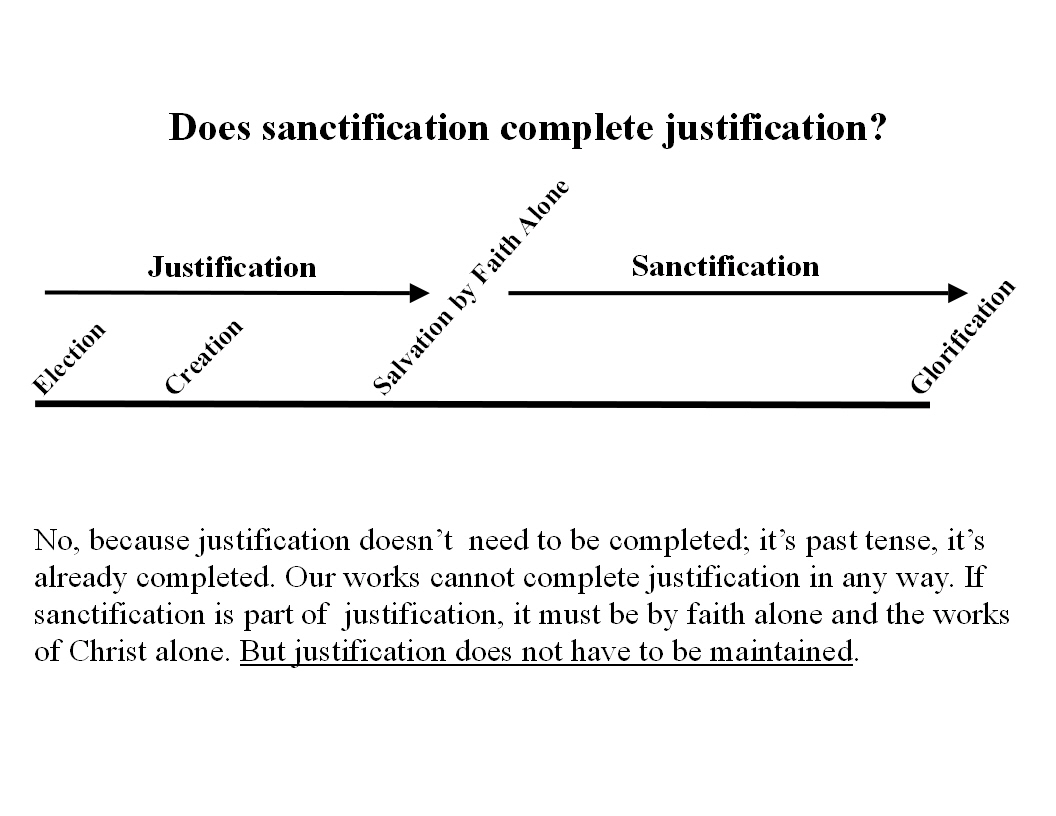 An excellent example is some strains of Freewill Baptists who teach that Christ died for all of our past sins, but with the help of the Holy Spirit, we must confess and repent of every sin we commit until the resurrection, e.g., Christ plus salvation by repentant prayer for sins committed after we are “saved.” My grandparents were saved out of this tradition. When my grandfather asked my grandmother if she thought that God could ever forgive him of all the sins he committed, she answered: “Yes, but you are going to have to pray awful hard!” Praise God that through the ministry of several individuals my grandparents eventually abandoned that gospel for the true one of salvation by faith alone as a finished work. Likewise, Rome teaches that you must let the Catholic Church finish your justification through ritual, e.g., Christ plus Catholic ritual. The Reformation gospel is also Christ plus something else, but the something else is ever-so-subtle. In both cases, sin must be dealt with in sanctification in order for the saint to remain justified until the final judgment. In other words, the righteous standard of justification must be maintained on our behalf. Like all other proponents of a linear gospel, the Reformed crowd contends that anything less than the perfection demanded of the law (“all sin is transgression of the law”) is “legal fiction.” So both Rome and the Reformers agree: justification must be maintained by sanctification, and in the case of the Reformers specifically, they believe that the perfect standard of the law must be maintained until glorification; otherwise, our justification is “legal fiction.” Here is where Reformed subtlety is uncanny: Christ keeps the law for us in sanctification. He maintains the perfect standard. All the fruit of sanctification (obedience/good works) flows from the life He lived on Earth and His death on the cross. Christ plus the works of Christ to finish salvation. “But Paul, what in the world is wrong with that?!” Here is what is wrong with it: works are still required to maintain justification. That is a huge problem, even if it is Christ doing the work. What did the Hebrew writer say about Christ’s work for justification not being complete? And even more subtle is the following Reformed idea: believing that the law is no longer a standard for maintaining justification is antinomianism. Antinomianism =’s legal fiction. Their definition of antinomianism is the removal of the law from justification as the standard for maintaining it. Traditionally, among Biblicists, antinomianism is the removal of the law from sanctification, and herein lays even further steroidal subtlety: the Reformed theologians would refute a removal of the law from sanctification as well, not only because they think justification and sanctification are the same thing, but because its perfect keeping is required to maintain a true declaration of the just that is not “legal fiction.”
  However, the Biblicist believes that the law is a standard for kingdom living and is no longer a standard for justification. Therefore, if we attempt to obey it with the Holy Spirit’s help, and to please/serve the Lord, it can have no bearing on our just state. While the Biblicists think they are therefore joint contenders with the Reformers against antinomianism, such is far from the truth. The Reformed mind believes the Biblicist is either a legalist or an antinomian, or both. The Biblicist is supposedly an antinomian because he/she has removed the law from justification as a just standard, or is a legalist because they think they should strive to keep the law in sanctification. Since sanctification finishes justification’s perfect standard of law keeping, our “own” attempts to keep the law in sanctification is an attempt to finish justification. Hence, what the Biblicist fails to understand is the Reformers belief that Christ must maintain the law for us in sanctification because justification and sanctification are not separate. Anything more or less is supposedly works salvation. On the other hand, because it is vital that Christ obeys the law for us in sanctification, the likes of John Piper and Tullian Tchividjian contend that those who are really preaching the Reformed gospel will indeed be accused of antinomianism. All in all, their position is easy to see if you pay attention. John Piper and many other Calvinists often state that, “Good works are the fruit of justification.” And, “Justification is the root, and sanctification is the fruit.” Well, the average Biblicist then thinks, “Yes, but of course, our salvation makes good works in sanctification possible.” But that’s not what they are saying. If you pay closer attention, they are saying that justification is a tree that produces its own fruit. Justification is the root, and whatever happens in true sanctification is the fruit of the root of the justification tree. Problem is, justification doesn’t grow. Justification is a finished work. What Calvinists refer to as “progressive sanctification” is really the fruit of the root: progressive justification. Another name for this that they throw around is “definitive sanctification.” The word “definitive” refers back to the definite completion of justification.
  Revision: this ministry now rejects the idea that orthodoxy is truth; orthodoxy is the traditions of men. Never in Scripture do we find premise for a body of teaching that explains the teaching. The above illustration is valuable for demonstrating that the fruit of justification is glorification, NOT sanctification. This brings us to the Scriptural argument which begins with a question I asked myself just this morning: “Paul, you are always harping about the crucial importance of the separation of justification and sanctification—a parallel gospel versus a linear one. But where does the Bible say specifically that this is critical?” First, the very definition of a lost person in the Bible is one who is “under the law”:
Romans 3:19 Now we know that whatever the law says it speaks to those who are under the law, so that every mouth may be stopped, and the whole world may be held accountable to God. Romans 6:14 For sin will have no dominion over you, since you are not under law but under grace. Romans 6:15 What then? Are we to sin because we are not under law but under grace? By no means! 1 Corinthians 9:20 To the Jews I became as a Jew, in order to win Jews. To those under the law I became as one under the law (though not being myself under the law) that I might win those under the law. Romans 7:1 Or do you not know, brothers —for I am speaking to those who know the law—that the law is binding on a person only as long as he lives? Romans 7:2 For a married woman is bound by law to her husband while he lives, but if her husband dies she is released from the law of marriage. Romans 7:3 Accordingly, she will be called an adulteress if she lives with another man while her husband is alive. But if her husband dies, she is free from that law, and if she marries another man she is not an adulteress.
The unsaved are “under the law” and will be judged by it in the end. This is the very definition of the unsaved. Calvinists define Christians the same way—we are supposedly still under the law and will be judged by it in the end. That’s why Christ must keep the law for us—because we are still under it. If not this position, why do many in the Reformed tradition hold to the idea that Christ’s perfect obedience is imputed to our sanctification? His death justifies us, and His perfect life sanctifies us. Hence, His death pays the penalty for past sins, and then His perfect life imputed to our sanctification keeps us justified. Why would an imputation to our sanctification be necessary if we are no longer under the law? This is known as the Reformed view of “double imputation” and has been called out as heresy by many respected theologians for this very reason: it implies that Christians are still under the law. In regard to sustaining the law in our stead, why? It has been totally abolished in regard to our just standing:
Romans 3:20 For by works of the law no human being will be justified in his sight, since through the law comes knowledge of sin. Romans 3:21 But now the righteousness of God has been manifested apart from the law, although the Law and the Prophets bear witness to it— Romans 4:15 For the law brings wrath, but where there is no law there is no transgression.
The keeping of the law by anybody DOES NOT do anything to justify mankind:
Romans 3:28 For we hold that one is justified by faith apart from works of the law.
Here is where the separation of justification and sanctification is vital on this first point: we ARE NOT under the law for justification, but rather UPHOLD THE LAW in sanctification. The two must be separate because of the differing relationships to the law:
Romans 3:31 Do we then overthrow the law by this faith? By no means! On the contrary, we uphold the law. Romans 6:15 What then? Are we to sin because we are not under law but under grace? By no means!
Furthermore, if we are still under the law (whether or not Christ obeys it for us to keep us in a just standing), this means we are still under the power of sin. Being under the law and also under its spell to provoke sin in the unregenerate is spoken of as being synonymous in the Bible. Those who are “under the law” are also under the power of sin and enslaved to it:
Romans 7:4 Likewise, my brothers, you also have died to the law through the body of Christ, so that you may belong to another, to him who has been raised from the dead, in order that we may bear fruit for God. Romans 7:5 For while we were living in the flesh, our sinful passions, aroused by the law, were at work in our members to bear fruit for death. Romans 7:6 But now we are released from the law, having died to that which held us captive, so that we serve in the new way of the Spirit and not in the old way of the written code. Romans 7:8 But sin, seizing an opportunity through the commandment, produced in me all kinds of covetousness. For apart from the law, sin lies dead.
If we are still under the law, and will be judged by it, whether or not Christ stands in the judgment for us with His own works, we are still enslaved to sin by virtue of being under the law…. for justification. And Calvinists know this to be true, that’s why they say we are still…. what? Right, even as Christians, “totally depraved.” And, “enemies of God.” Of course, throughout the Bible, Christians are spoken of as being friends of God and no longer His enemies. Our status as enemies of God is stated in the past tense. But the Reformed crew continually state that Christians are vile enemies of God and are enslaved to sin. They realize that this goes hand in hand with being under the law. To the contrary, dying to the law in the death of Christ….for justification—sets us free to be enslaved to the righteousness that is defined by the law. We are dead to the law for justification and alive to obey truth….for sanctification:
Romans 8:2 For the law of the Spirit of life has set you free in Christ Jesus from the law of sin and death. Romans 8:3,4 [emphasis by author] For God has done what the law, weakened by the flesh, could not do. By sending his own Son in the likeness of sinful flesh and for sin, he condemned sin in the flesh,….in order that the righteous requirement of the law might be fulfilled in us, who walk not according to the flesh but according to the Spirit. Romans 8:7 For the mind that is set on the flesh is hostile to God, for it does not submit to God’s law; indeed, it cannot. Romans 9:31 but that Israel who pursued a law that would lead to righteousness did not succeed in reaching that law. John 17:17 Sanctify them in the truth; your word is truth. James 1:25 But the one who looks into the perfect law, the law of liberty, and perseveres, being no hearer who forgets but a doer who acts, he will be blessed in his doing.
So, that is the separation that must be for the true Christian: Justification has no law for which we are judged, and we live by the law of blessings in sanctification. This brings us to another important separation in the two: the judgments. Those under the law and sin will stand in a final judgment which will be according to the law. Again, because Calvinists believe that we are still under the law, albeit that Christ obeyed/obeys it for us, Christians will supposedly stand in the same judgment as the damned who are under the law and enslaved to it. At that time, the children of God, according to Calvinists, will be “made manifest.” But because Christians are not under the law and cannot be judged by it, they will stand in a judgment for rewards and not a judgment that determines a perfect keeping of the law by Christ in our stead. Hence, there will be two different resurrections: one for those under the law and another for those under grace, and two different judgments for the same two groups. One for rewards, and one to determine if those under the law kept it perfectly. The latter judgment doesn’t go well for any standing in it.
Luke 14:12-14 He said also to the man who had invited him, “When you give a dinner or a banquet, do not invite your friends or your brothers or your relatives or rich neighbors, lest they also invite you in return and you be repaid. 13 But when you give a feast, invite the poor, the crippled, the lame, the blind, 14 and you will be blessed, because they cannot repay you. For you will be repaid at the resurrection of the just.” [Notice that this is a resurrection for the “just.” They are already determined to be just before they are resurrected]. 2Corinthians 5:9,10 So whether we are at home or away, we make it our aim to please him. 10 For we must all appear before the judgment seat of Christ, so that each one may receive what is due for what he has done in the body, whether good or evil. 1Corintians 3:11-15 For no one can lay a foundation other than that which is laid, which is Jesus Christ. 12 Now if anyone builds on the foundation with gold, silver, precious stones, wood, hay, straw— 13 each one’s work will become manifest, for the Day will disclose it, because it will be revealed by fire, and the fire will test what sort of work each one has done. 14 If the work that anyone has built on the foundation survives, he will receive a reward. 15 If anyone’s work is burned up, he will suffer loss, though he himself will be saved, but only as through fire. Hebrews 6:10 For God is not unjust so as to overlook your work and the love that you have shown for his name in serving the saints, as you still do. Revelation 20:6 Blessed and holy is the one who shares in the first resurrection! Over such the second death has no power, but they will be priests of God and of Christ, and they will reign with him for a thousand years. Revelation 20:11-15 Then I saw a great white throne and him who was seated on it. From his presence earth and sky fled away, and no place was found for them. 12 And I saw the dead, great and small, standing before the throne, and books were opened. Then another book was opened, which is the book of life. And the dead were judged by what was written in the books, according to what they had done. 13 And the sea gave up the dead who were in it, Death and Hades gave up the dead who were in them, and they were judged, each one of them, according to what they had done. 14 Then Death and Hades were thrown into the lake of fire. This is the second death, the lake of fire. 15 And if anyone’s name was not found written in the book of life, he was thrown into the lake of fire.
Don’t let anyone tell you that eschatology is a “secondary” or “nonessential” consideration. Your eschatology is your gospel. It will state your position regarding whether or not you fuse justification and sanctification together; ie, likening Christians to those under the law.
Yet another vital difference in sanctification and justification is repentance. Repentance for salvation (when you are justified) is different from our repentance in sanctification. Among many in the Reformed tradition where the “same gospel that saved you also sanctifies you,” the repentance is the same. Repentance unto salvation is not a onetime “washing,” but rather a means to continue “in the gospel” through what they call “deep repentance.” Biblicism holds to repentance in sanctification that restores his/her fellowship and communion with God as His children. They would see repentance unto salvation as differing, and only necessary for salvation—a onetime decision to take one’s life in a new direction by following Christ, and believing in his death, burial, and resurrection. Reformed repentance, according to the likes of Paul David Tripp and others is a “daily rescue.” Our original repentance was for rescue, and we need rescue today as much as we needed rescue when we were saved. Again, this indicates their belief that we are still under the curse of the law and need to be continually rescued from it while remaining under the bondage of sin. However, Christ made it clear to Peter (John 13:6-11) that those who have been washed (1Corinthians 6:11, Romans 8:30) do not need another washing. Those who drink of the living water do not thirst again (John 4:13,14). Lastly, though many other separations could be discussed, why saints can be considered just while they still sin at times is of paramount importance. There is no sin in our justification because there is no law, and where there is no law, there is no sin. Though unfortunate, there can be sin in our sanctification because it is totally separate from justification and can’t affect our just standing with God. Basically, all of the aforementioned makes it of necessity to deny the new birth. If we have God’s seed in us, and we do (1John 3:9), that dispels total depravity, and without total depravity, justification and sanctification cannot be fused together. The new birth is a huge problem for Reformed theology. If the old man that was under the law is dead (Romans 7:1ff), and the seed of God is in the saved person, and the sin due to our weakness in the flesh cannot be laid to our account for justification, then our justification is not “legal fiction” because we do not exhibit perfect obedience to the law. This is another grave consideration because Christ said, “You must be born again.” Obviously, despite their denials that they deny the new birth—you can’t be both totally depraved and born again. Reformation doctrine is clearly a false gospel. Its version of justification does not void the law, and denies the new birth while distorting everything in-between. Freewill verses predestination is hardly the issue, the very gospel itself is the issue.
paul

 Paul's Passing Thoughts
15 comments