Tullian Tchividjian is Representative of New Calvinist Anti-Truth
 I posted on an article referred to me yesterday written by Tullian Tchividjian. In the post Tchividjian praises his late father for his passive approach to raising Tullian which was dubbed “grace.” And apparently, as one of the premier heretics of our day, Tchividjian thinks he turned out well, thanks to his father’s grace-like rearing. An excerpt:
Years later he told me that he saw all those checks being cashed [checks that Little T-T stole from his father and forged], but he decided not to say anything about it at the time. It didn’t happen immediately (the fruits of grace are always in the future), but that demonstration of unconditional grace was the beginning of God doing a miraculous work in my heart and life. My dad’s literal “turning of the other cheek” gave me a picture of God’s unconditional love that I couldn’t shake…. Steve Brown once said, “Children will run from law and they’ll run from grace. The ones who run from law rarely come back. But the ones who run from grace always come back. Grace draws its own back home.” I ran from grace. It drew me home.
In yesterday’s post I addressed the fundamental misrepresentation of biblical law and grace in all of this. In this post I would like to address Tchividjian’s all-out assault on the plain sense of Scripture. But remember, Tchividjian is representative of New Calvinism and authentic Reformed doctrine in general. Tchividjian has a very strong grasp on what the Reformers believed and taught. And like T-T (pronounced “tee-tee”), they redefined many biblical concepts and realities in opposition to the common sense hermeneutic. In mysticism, common sense is for the common folk.
This isn’t particularly deep; God condemns the passive parenting T-T praises as commendable and supposedly based on grace versus law. As I addressed yesterday, there is no law in the grace of justification, but there is ample grace in the practice of law in sanctification. The fundamental heresy of Calvinism projects the grace of justification onto sanctification which makes law a part of justification. That’s the crux. Fear of law in sanctification reveals a belief that law is also the standard for justification. So, parents who fear law in parenting deprive their children of grace. If for no other reason, it cannot be denied that love is of grace and to deprive your children of discipline is to also deprive them of love:
Hebrews 12:7 – It is for discipline that you have to endure. God is treating you as sons. For what son is there whom his father does not discipline? 8 If you are left without discipline, in which all have participated, then you are illegitimate children and not sons. 9 Besides this, we have had earthly fathers who disciplined us and we respected them. Shall we not much more be subject to the Father of spirits and live? 10 For they disciplined us for a short time as it seemed best to them, but he disciplines us for our good, that we may share his holiness. 11 For the moment all discipline seems painful rather than pleasant, but later it yields the peaceful fruit of righteousness to those who have been trained by it.
Moreover, one can read of the unspeakable tragedy that fell upon the house of Eli and all of Israel because of his passive parenting of his sons Hophni and Phinehas (starting in 1Samuel 2:12). God also accused Eli of honoring his sons above Him because he would not discipline them.
Again, T-T is representative of the authentic Reformed doctrine sweeping the American church and covertly taking over its institutions. Hindering the needed alternative is Protestant propaganda that the average Christian father is not “qualified” to lead his family and others.
But we must ask ourselves: “We can’t do better than this? Really? We don’t know that Eli’s example is a bad idea? Protestant pastors are on such a higher spiritual plane than we are that the obvious really isn’t true?”
In our day, if you can discern reality—you’re qualified.
paul
Tullian Tchividjian’s Grace Post Reveals His Fundamental Lack of Salvific Knowledge
“If children who have a proper view of salvation run to God, it will be from the condemnation of the law to the blessings of the law in sanctification, not grace apart from the law in both sanctification and justification.”
Tullian Tchivijian doesn’t understand the basics of salvation. This is revealed in a recent post in which he uses his late father’s demonstration of what Tullian calls “grace.” Like all New Calvinists, and for that matter, authentic Calvinists, law and grace are separated into a strict dichotomy. Because sanctification is seen as the horizontal maintenance and completion of vertical justification, the necessary separation of law and grace in justification is also extended to sanctification.
Unfortunately, this reveals an attitude about justification; specifically, that law is a standard for justification that must be maintained in sanctification. Since this is impossible for mortal Christians, law and grace must be kept separate in sanctification as it is in justification. It makes mortality and the new birth mutually exclusive because Christians still clothed in mortality don’t keep the law perfectly. Hence, according to New Calvinism, Christians must be sanctified apart from the law. That’s a huge problem because Christ stated in John 17:17 that God only sanctifies by the truth of His word. Exacerbating the problem is the confusion caused by traditional Protestant dichotomies concerning the Ten Commandments and God’s word. “Law” is a generic term for God’s full counsel contained in the Bible. This is very demonstrable, but I would mention Matthew 5:18 and 1Corithians 14:34. In both cases, more than the Ten Commandments are clearly in view.
The thesis of Tullian’s post is the idea that passive parenting demonstrates grace, while rules in parenting demonstrate law and the idea that children must earn favor with God for salvation. Tullian concludes the post with the idea that children will never return to law, but will always return to grace:
Years later he told me that he saw all those checks being cashed, but he decided not to say anything about it at the time. It didn’t happen immediately (the fruits of grace are always in the future), but that demonstration of unconditional grace was the beginning of God doing a miraculous work in my heart and life. My dad’s literal “turning of the other cheek” gave me a picture of God’s unconditional love that I couldn’t shake….
Steve Brown once said, “Children will run from law and they’ll run from grace. The ones who run from law rarely come back. But the ones who run from grace always come back. Grace draws its own back home.” I ran from grace. It drew me home.
This misrepresents law to our children in two ways. First, it denies children from experiencing the blessings of living life God’s way. This demonstrates the wisdom of God and the fact that He knows what He is talking about. Second, it implies that law and grace are mutually exclusive in justification and sanctification both. Instead of the gospel’s message concerning the different relationships to the law in justification and sanctification, it makes our relationship to the law the same in both. This is a major circumvention of the true gospel. There is no law in justification, and as unbelievers, that which is good (the law) provokes us to sin and threatens to be our judge in the end. But once born again, the law provokes us to righteousness (ROM 6:17-23, 8:3-8). “Grace” is not only unmerited salvation; it is the blessings of sanctification as well. But those blessings primarily come through the law (Matthew 7: 24, 25, James 1:25, Psalm 119). If children who have a proper view of salvation run to God, it will be from the condemnation of the law to the blessings of the law in sanctification, not grace apart from the law in both sanctification and justification.
An unmerited blessing apart from the law in sanctification shows clearly a belief that we did not receive righteousness apart from the law for our justification (ROM 3:21). “Under law” means we are enslaved to sin, provoked to sin by the law, and will be judged by the law. “Under grace” means we are enslaved to righteousness rather than sin, will not be judged by the law, and are provoked to righteousness by the law. Paul stated that his mind served the law (ROM 7:25).
Therefore, we are still under the law according to New Calvinism because law is separated from grace in sanctification. It is still a standard for justification. No relationship to the law has been exchanged from unregenerate to regenerate.
That’s why Calvinism is a false gospel. The saved are still “under the law.”
paul


Tchividjian’s Response: It’s Why They’re Called “Wolves in Sheep’s Clothing”
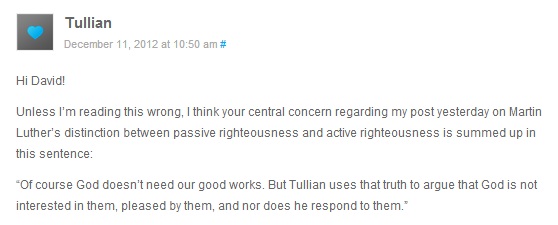
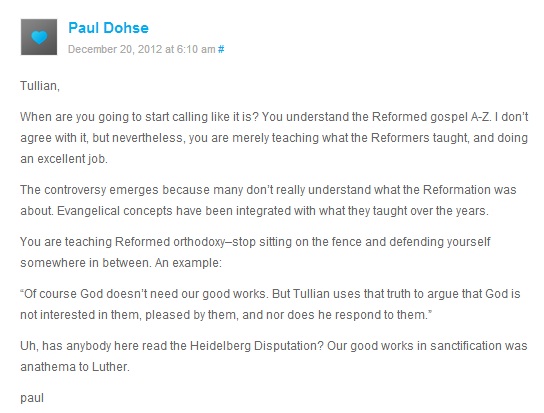
 “Not only that, and don’t miss this, if sanctification ‘feeds on justification,’ and if justification is monergistic, and it most certainly is, then sanctification is also monergistic and not synergistic. So, regardless of Tchividjian’s synergistic-like jargon in regard to sanctification—we should know better.”
Let’s be honest, when the Bible warns us about wolves dressed up like sheep; deep down, we assume it’s a bad costume. But it’s not, and we should assume that we will have to diligently exercise the brain God gave us in order to make sure that “no one deceives you.”
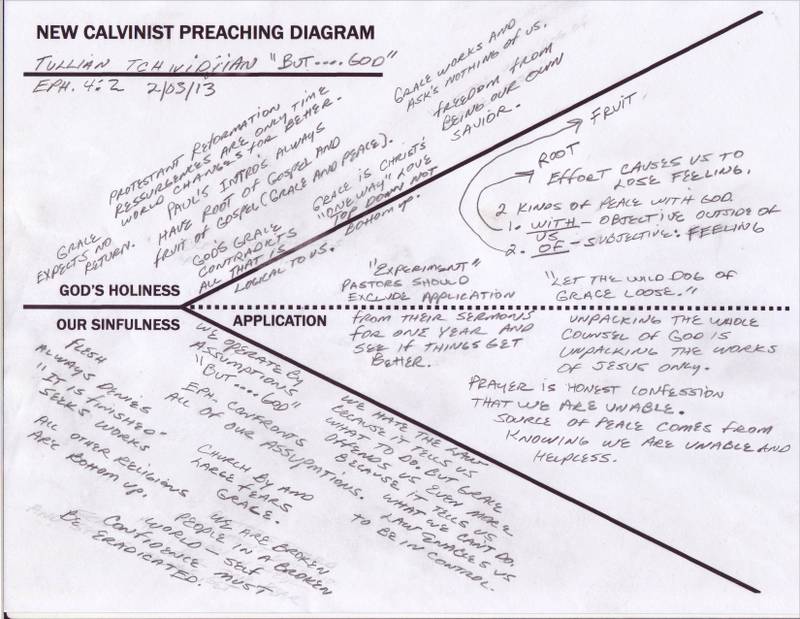
Tullian Tchividjian, hereafter “Mr. T,” is once again answering to fellow Calvinists for his Reformed antinomian ways. Mr. T is a heretic, but he’s spot-on in regard to the Reformed doctrine that he teaches. Unfortunately, rather than calling out men who don’t get what Luther/Calvin really taught, Mr. T continues to hone and adjust his defense of what he teaches in an evangelical way. If he would just say, “Listen guys, I teach authentic Reformed doctrine. You guys call yourselves Calvinists and you don’t even understand his soteriology, so hang it on your beak,” I would come to Coral Ridge and wash his car for free. And as a bonus, I would serenade him with the Christian classic, “Friends.” Yes, let’s get all the Calvinists debating each other with citations from the Institutes and the Heidelberg Disputation. Hint: if you are in that debate; choose sides with Mr.T.
Mr. T’s conclusion to his latest defense makes my first point:
So, I’m all for effort, fighting sin, resisting temptation, mortification, working, activity, putting off, and putting on, as long as we understand that it is not our work for God, but God’s work for us, that has fully and finally set things right between God and sinners. Any talk of sanctification which gives the impression that our efforts secure more of God’s love, itself needs to be mortified. As Scott Clark has said, “We cannot use the doctrine of sanctification to renegotiate our acceptance with God.” We must always remind Christian’s that the good works which necessarily flow from faith are not part of a transaction with God–they are for others. The Reformation was launched by (and contained in) the idea that it’s not doing good works that make us right with God. Rather it’s the one to whom righteousness has been received that will do good works.
There’s so much more that can be said, but I hope this serves to clarify that my understanding of the Christian life is not “let go and let God” but “trust God and get going”–trust that, in Christ, God has settled all accounts between him and you and then “get going” in sacrificial service to your wife, your husband, your children, your friends, your enemies, your co-workers, your city, the world.
AMEN “BROTHER!” But….the devil is in the details—literally. Mr. T writes the following in his introduction:
Pertinent to any discussion regarding justification and sanctification is the question of effort. In my recent back and forth with Rick Phillips on the nature of sin and its ongoing effect on the Christian, some have assumed that when I say there is no part of Christians that are sin free, I’m also endorsing a “why-even-try”, effortless approach to the Christian life–that I’m overlooking or understating the importance of “sanctification.” I suspect that one of the reasons for this is owing to my passion to help people understand the inseparable relationship between justification and sanctification.
Though I understand why—“why-even-try” is between quotation marks, technically, in context, “sanctification” being so indicates a misnomer by the author. In fact, many in the Reformed tradition dismiss progressive sanctification altogether. Dana Stoddard refers to it as “definitive sanctification” which usually refers to the elective setting apart for salvation by the Holy Spirit when we were justified before the foundation of the Earth. As far as I can tell, the Reformation magnum opus, the Heidelberg Disputation, does not contain the word sanctification at all. But perhaps I am missing it somewhere. At any rate, a couple of other details are worth noting in Mr.T’s introduction.
He speaks of “the nature of sin and its ongoing effect on the Christian.” The idea that “when I say there is no part of Christians that are sin free.” Well, that just isn’t so. It’s solid Reformed theology, but it’s not true. 1John 3:9 states, “No one born of God makes a practice of sinning, for God’s seed abides in him, and he cannot keep on sinning because he has been born of God.” The apostle Paul adds to that by saying we delight in God’s law in our “inner being.” Furthermore, Paul stated that the power of sin to enslave us is broken; hence, “it is no longer I who do it, but sin that dwells within me.” To say that no part of the Christian born of God is untainted by sin is just not true.
Mr. T then states that justification and sanctification are “inseparable.” And….
As G. C. Berkouwer said, “The heart of sanctification is the life which feeds on justification.” So, I think it’s fair to say that sanctification is the justified life.
This is sanctification by justification, and suggests that the law still needs to be upheld to maintain our justification. That is not righteousness “apart from the law.” This is the Achilles heel of the Reformation gospel and I have written on this extensively. Not only that, and don’t miss this, if sanctification “feeds on justification,” and if justification is monergistic, and it most certainly is, then sanctification is also monergistic and not synergistic. So, regardless of Tchividjian’s synergism-like jargon in regard to sanctification—we should know better. Everything else is just window dressing. Impressive window dressing, but nothing more than window dressing just the same.
Furthermore, as Dr. Jay Adams aptly notes, this whole business of sanctification feeding on justification “misidentifies the source of sanctification.” Mr. T then begins to make his case with Luther’s concept of passive righteousness and active righteousness. Right. That’s from theses 27 of Luther’s Disputation and is classic Reformed theological gymnastics. The Disputation eradicates the participation of the Christian in sanctification so thoroughly that Luther suggests in theses 5 that people who do good works in public shouldn’t be brought up on criminal charges. I’m not kidding.
Moreover, Mr. T, in supposedly advocating hard work in sanctification, describes that work as a constant fight against our supposed totally depraved narcissism which constantly clamors to earn acceptance with God for justification:
Also, be aware of the fact that our hearts are like a “magnet” that is always drawing the horizontal (non-saving) plane towards the vertical–we are always burdening our love for others (which fulfills the law) with soteriological baggage. In other words, we see our good works as a way to keep things settled with God on the vertical plane instead of servicing our neighbor on the horizontal plane.
In other words, we should never serve anybody for the sole purpose of pleasing God. Pleasing God always means pleasing God for the sake of justification. This, my friends, is just one of many, many problems with fusing justification and sanctification together. The apostle Paul made it clear that pleasing God is the paramount goal of the Christian’s life.
Mr. T even suggests that efforts to keep the law as Christians will just inflame sin. This is true of unbelievers who are “under the law.” The law has a tendency to provoke them to sin. This also agrees with the Reformed idea that Christians are still “under the law” and therefore need the gospel every day:
This is also why it is important to fight sin and resist temptation. Sin and temptation is always self-centered. It is, as Augustine put it, “mankind turned in on himself.” Failing to believe that everything we need we already have in Christ, we engage in “sexual immorality, impurity, sensuality, idolatry, sorcery, enmity, strife, jealousy, fits of anger, rivalries, dissensions, divisions, envy, drunkenness, orgies, and things like these” (Galatians 5:19-21), desperately looking under every worldly rock and behind every worldly tree for something to make us happy, something to save us, something to set us free. The works of the flesh are the fruit of our self-salvation projects…. Real freedom in “the hour of temptation” happens only when the resources of the gospel smash any sense of need to secure for myself anything beyond what Christ has already secured for me. We, therefore, “preach the gospel to ourselves everyday” because we forget it everyday.
And, go figure, the cure is dedication to the….right, local church:
It is for these reasons that it is so important for us to exert effort to pray, read the Bible, sit under the preached Word, and partake of the sacraments. It’s in those places where God confronts our spiritual narcissism by reminding us that things between he and us are forever fixed. It’s at those “rendezvous points” where God reminds us that the debt has been paid, the ledger has been put away, and that everything we need, in Christ we already possess. This vertical declaration forever secures us and therefore sets us free to see the needs around us and work hard horizontally to meet those needs.
When justification and sanctification are fused together, sanctification becomes a tricky minefield that can blow-up our eternal security. This is obvious if you read all of the back and forth between Tchividjian and Kevin DeYoung, and now Phillips. But never fear, if you are faithful to the Reformed philosopher kings, all will be well. Just stay at the foot of the cross while the philosopher kings figure it all out. You will be safe feeding there.
Or will you?
paul

 Paul's Passing Thoughts
2 comments