














Brinsmead’s Second “Awakening” Framework is the Foundation of New Calvinism
 I recently read an article written by Martin L. Carey entitled, “Judged by the Gospel: The Progression of Brinsmead’s Awakening.” Carey was the son of Iris Carey, a staunch follower of Brinsmead during the Awakening movement of which he was the central figure.
According to Carey, this was no small movement within Adventist circles:
“For three decades, the ‘Brinsmead Agitation’ challenged Adventist leadership on several continents. During the years I was growing up, the conflict over his teachings became so intense that showing any agreement with Brinsmead’s heresy could get one expelled—and this I saw firsthand. Many pastors lost their jobs or left the ministry voluntarily because they espoused Brinsmead’s theology. For his followers, even mentioning the name of Brinsmead could put one’s membership at risk. Moreover, much Adventist literature published in the 1970’s was aimed at correcting Brinsmead’s influence.”
Carey does a good job of explaining Adventist doctrine and how Brinsmead interacted with it, but let me give you the short version: In justification, all of a saint’s past sins are forgiven, but then Christians have to work for moral perfection to be completely justified at the judgment. The first theological framework that laid the foundation for Brinsmead’s Awakening movement was borrowed from protestant beliefs; specifically, that we stand in the judgment clothed in Christ’s righteousness, not our own. This is what makes us fit for the judgment. Carey further explains:
“This was the original ‘Awakening Message.’ For many Adventists who had lived in dread of God’s judgment, this was good news. As Brinsmead later described,
‘…it was the most sweet and joyful news that many had ever heard. Neither time nor circumstances…can efface the memory of souls weeping for joy at the simple revelation that Christ is our righteousness in judgment’(Review of Awakening, Pt. 1).
Brinsmead decided to leave Avondale in 1958 to speak independently and to publish. His following soon became a significant movement in Australia. By 1960, they called themselves the ‘Sanctuary Awakening Fellowship.’ Even though the Australian Adventist leadership strenuously opposed the Awakening, the movement spread. Inevitably, on December 19, 1960, the Awakening message came to America, and the General Conference had no idea what was about to hit them.”
This is when Carey’s mother began to follow Brinsmead:
“In 1961, a young mother of three named Iris Carey was among those who heard and ‘wept for joy.’ She lived a few blocks from the Review and Herald building in Tacoma Park, and she began excitedly and widely circulating Brinsmead sermon tapes. Some caught that excitement, others strongly resisted. (Indifference was not a typical Adventist reaction to Brinsmead.) Meanwhile, for the three of us who were kids of Iris Carey, tension with our church and the world was a constant reality. In spite of its polarizing message and charismatic leader, the Awakening movement never tried to be a separate denomination. Indeed, Brinsmead’s purpose was not to destroy Adventism but to restore it to its original judgment day urgency [due to the fact that many knew in their heart that they could not obtain perfection on their own and preferred not to discuss it while playing along with a token recognition of the doctrine]. In the 1960’s, most Awakeners, as we called ourselves, remained members of Adventist churches—that is, as long as they would have us…. Iris was expelled from several churches for giving out Brinsmead literature and for holding unauthorized Bible studies. For her, this persecution confirmed the prophetic status of the Awakening message, and throughout the movement it unified Awakeners into a distinct Adventist subculture.”
Then Carey explains the following:
“The resulting abundance of literature and tapes galvanized our movement’s mission and kept it moving. Additionally, Bob Brinsmead was constantly adjusting his message. Whenever Awakeners would meet they would ask one another, ‘Have you heard the latest?’ We always looked for the next church-shaking new emphasis. Brinsmead had a genius for building elaborate theological structures, getting everyone excited, then tearing them down for a ‘new framework.’ He often said, ‘Like Abraham, Isaac, and Jacob, I keep moving my tent in faith.’ There was no resting for the devoted Awakener following Brinsmead’s mercurial leading.”
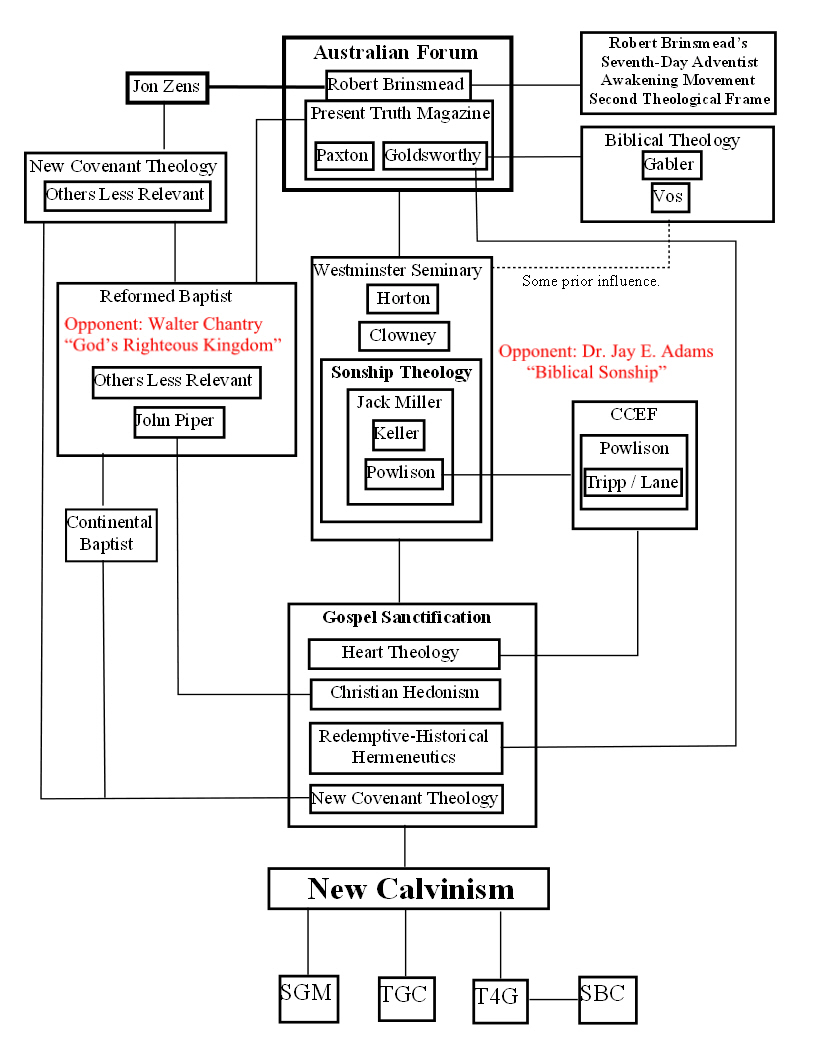
The second theological framework Brinsmead developed before he abandoned the Awakening movement lives on today in the form of New Calvinism. The doctrine was developed when Brinsmead began researching the Reformers:
“In 1971, Brinsmead scheduled a flurry of summer institutes to bring us his latest emphasis. There was more excitement than usual; the latest round of tapes had prepared us for something big. Bob had been studying the Reformation doctrine of justification by faith, comparing it to Roman Catholic doctrines. Reading Luther, he saw [supposedly] that justification is not just a means to the end of perfect sanctification. When we are justified by faith, not only does God impute Christ’s righteousness to us but we also possess Christ Himself—all His righteousness and all His perfection. Eternity flows from that fact. The apostle said,
‘And those whom he predestined he also called, and those whom he called he also justified, and those whom he justified he also glorified’ (Rom. 8:30).
The same ones he justified he also glorified. We began to realize we had inserted extra steps into Paul’s chain of salvation: sanctification and a final atonement brought about by blotting out sins. Those added steps, in fact, were the heart of the Awakening message—but we had ignored the heart of the real gospel: being justified by faith, we ‘rejoice in hope of the glory of God.’ Our righteousness is in heaven, said Brinsmead:
‘The righteousness by which we become just in God’s sight, remain just in His sight and will one day be sealed as forever just in His sight, is an outside righteousness. It is not on earth, but only in heaven…only in Jesus Christ.”
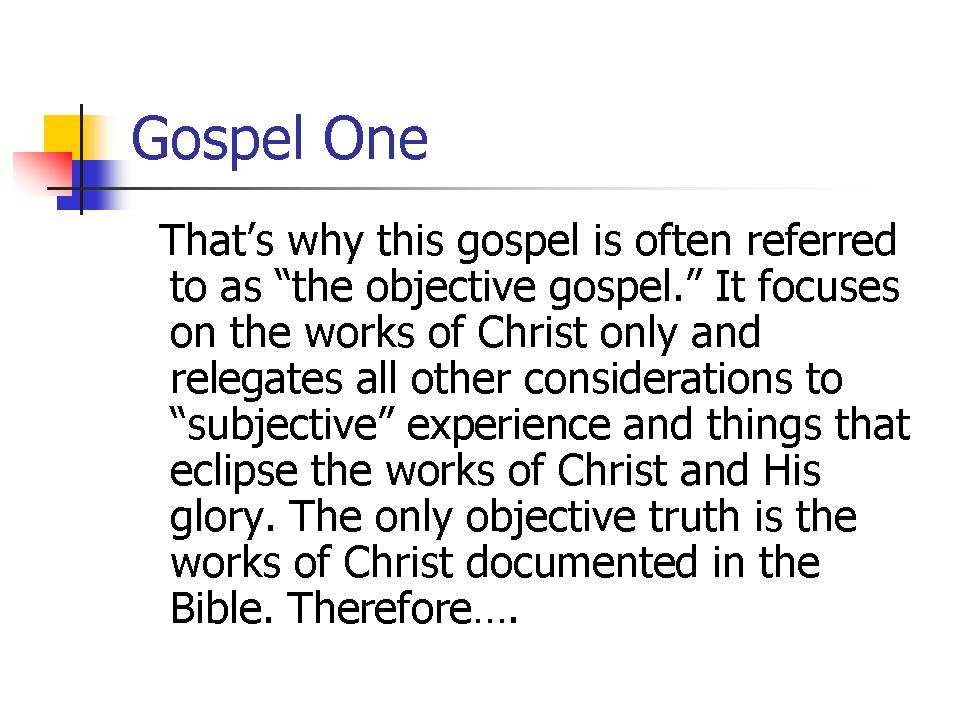
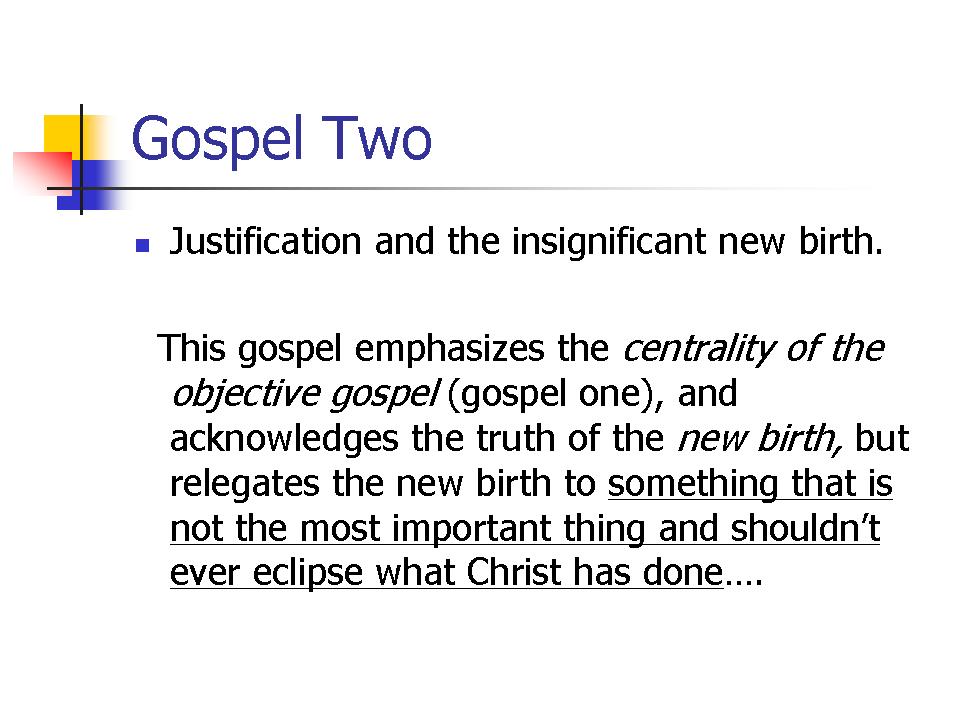
Brinsmead’s theological frame eliminated the extra “step” of sanctification from the gospel. Not only that, the gospel was completely objective and an “outside righteousness. It is not on earth, but only in heaven…only in Jesus Christ.” So, the believer does not (supposedly) experience a righteousness that he possesses through the new birth, in Brinsmead’s second frame, that’s “subjective”:
“True sanctification looks away from self and flows from the finished, objective work of Christ…. For many Christians, the glory of the crucified Christ is not their focus; instead they seek internal experiences that eclipse the cross. The Awakening rightly opposed the subjective, human-centered emphasis found among some groups within Christianity. Wrongly, they reacted with a cerebral, spiritless gospel. Brinsmead strongly opposed the charismatic movement’s emphasis on experiences as a return to the theology of Rome. However, going to another extreme, Present Truth magazine decried ‘the false gospel of the new birth,’ and offered a new birth that was merely a corporate, objective blessing, not an individual experience.”
Though mainline Adventist were at the other extreme, propagating a justification that you had to keep on your own, they rightly complained that Brinsmead’s new frame was a “justification-centered gospel” that “encouraged spiritual laziness.” During that time, the project that was solidifying this doctrine into a “consistent” theological framework was the Australian Forum. Their doctrinal publication was Plain Truth magazine mentioned by Carey. The primary Australian three were Brinsmead, Geoffrey Paxton, and Graeme Goldsworthy. The writings of Graeme Goldsworthy are a mainstay of contemporary New Calvinism, especially the “Goldsworthy Trilogy.” This “justification-centered gospel” can be seen among many New Calvinists like CJ Mahaney who continually claim that the gospel can be defined by five words: “Christ died for our sins.” Like the Australian Forum, New Calvinists believe that all of life flows from objective justification and deny the new birth as a subjective truth that is not relevant to the more important matter of the gospel. This regardless of the fact that Christ said, “You must be born again.” Hence, Sonship Theology, which is based on the centrality of the objective gospel and helped give birth to New Calvinism, propagates a total depravity of the saints. Well known New Calvinists David Powlison and Tim Keller were forefathers of that movement.
That’s pretty much the smoking gun: the hallmark of Brinsmead’s centrality of the objective gospel necessitates the denial of the new birth, and central figures of the New Calvinist movement clearly deny the new birth accordingly; for example, Graeme Goldsworthy and Michael Horton. Goldsworthy said this in an article he wrote in Plain Truth Magazine: “And the new-birth oriented ‘Jesus-in-my-heart’ gospel of evangelicals has destroyed the Old Testament just as effectively as nineteenth-century liberalism” (Obituary for the Old Testament Vol. 41-Article 2). Goldsworthy footnoted this statement by referencing an article by Paxton entitled “The False Gospel of the New Birth” (Present Truth Vol. 7 Article 3 June 1978 ps. 17-22). In that article, Paxton made the following statement: “It robs Christ of His glory by putting the Spirit’s work in the believer above and therefore against what Christ has done for the believer in His doing and dying.”
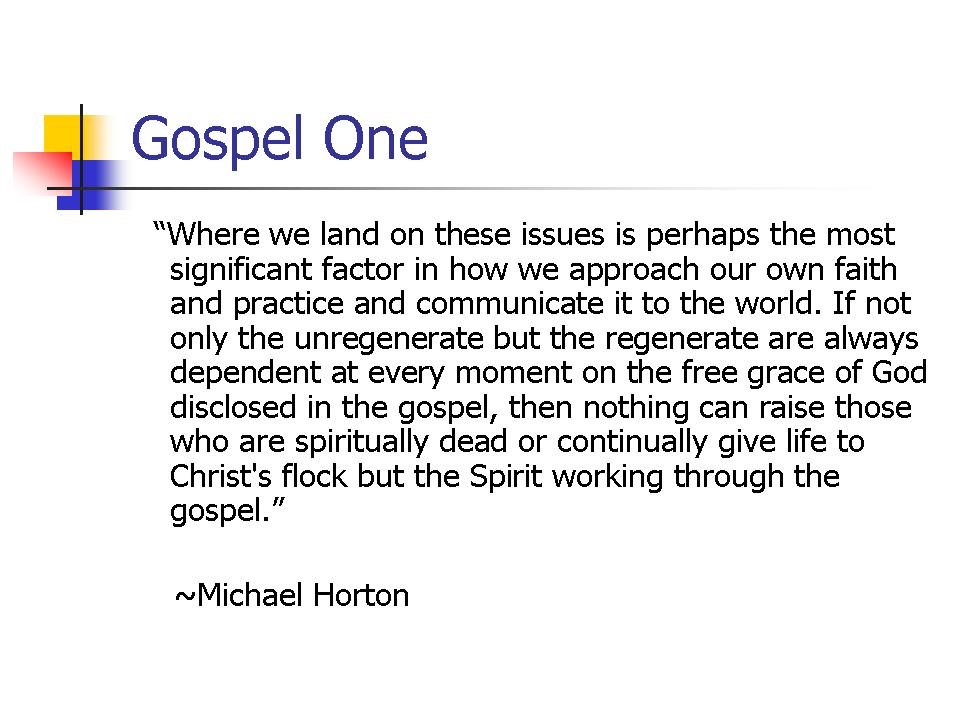
Compare that with what Michael Horton wrote in Receiving Christ (from his out of print book In the Face of God): “Is the ‘Good News’ no longer Christ’s doing and dying, but our own ‘Spirit-filled” life?’”
New Calvinists who do not plainly deny the new birth do so practically by advocating the total depravity of the saints and the idea that Christians are spiritually dead. Paul David Tripp states plainly that Christians are still spiritually dead on pages 64 and 65 of the 2006 printing of “How People Change.” Concerning a video that is a satire on total depravity entitled “John Piper is Bad,” Piper concurred in an interview that the point of the video was theologically true, Christians are still “bad” in regard to our behavior.
paul
John MacArthur: The Evil Empire Only Needs a Little Tweaking
It needs to be stated again, and again: the Emergent Church approaches Scripture the same way that New Calvinism does—as a narrative that devalues propositional truth. One searches the narrative for “pictures of Jesus” for contemplative purposes while the other seeks to emphasize what Jesus has done in the narrative, and endeavors to “enter into the gospel story” by doing what Jesus did. At least the latter has some application to their mysticism as opposed to New Calvinist contemplative spirituality. MacArthur is the pot calling the kettle black.
John MacArthur, apparently equipped with a new motto: “Looking at the face of Jesus one verse at a time,” has some advice for the youth division of the New Calvinist movement (the Young, Restless, Reformed [YRR]). The advice, which is being doled out in a three-part series, is entitled, “Grow up. Settle Down. Keep Reforming.” The whole notion reveals how out-of-touch MacArthur has become—save the fact that the timing of this is good because he knows they have cut ties with him.
First, how can they take such advice when it would mean changing their name? This is a marketing machine, and you don’t mess with name recognition—that’s marketing 101.
Second, “keep reforming”?!! What are they reforming? The movement is wreaking havoc from coast to coast—splitting families, splitting churches, breaking hearts, spreading false doctrine, and leaving the disillusioned strewn across the Christian landscape.
Third, the very coldhearted arrogance of the movement can be seen in what MacArthur states in his article, and in a related article by Tim Challies. MacArthur cites this paragraph in his second article that obviously is fruit from a very bad tree:
Pastors must be innovative, stylish, agents of change. You have got to appeal to young people. They are the only demographic that really matters if the goal is to impact the culture.
And if elderly people in the church prove to be “resisters,” just show them the door. Give them the left foot of fellowship. After all, “There are moments when you’ve got to play hardball.”
But for heaven’s sake don’t dress for hardball. HCo. clothes and hipster hair are essential tools of contextualization. The more casual, the better. Distressed, grunge-patterned T-shirts and ripped jeans are perfect. You would not want anyone to think you take worship as seriously as, say, a wedding or a court appearance. Be cool. Which means (of course) that you mustn’t be perceived as punctilious about matters of doctrine or hermeneutics. But whatever you do, do not fail to pay careful attention to Abercrombie & Fitch.
After some research, I ascertained that this is Mac’s take on an attitude prevalent in the movement—an attitude that he chalks up to the supposed unfortunate influence of the Emergent church movement among the innocent souls of YRR. In his first part, he says this:
“Five years later, the so-called Emergent Church is now in a state of serious disarray and decline. Some have suggested it’s totally dead. Virtually every offshoot of evangelicalism that consciously embraced postmodern values has either fizzled out or openly moved toward liberalism, universalism, and Socinianism. Scores of people who were active in the Emerging movement a decade ago seem to have abandoned Christianity altogether.”
It needs to be stated again, and again: the Emergent Church approaches Scripture the same way that New Calvinism does—as a narrative that devalues propositional truth. One searches the narrative for “pictures of Jesus” for contemplative purposes while the other seeks to emphasize what Jesus has done in the narrative, and endeavors to “enter into the gospel narrative” by doing what Jesus did. At least the latter has some application to their mysticism as opposed to New Calvinist contemplative spirituality. MacArthur is the pot calling the kettle black.
Furthermore, postmodernism isn’t going anywhere, it is being integrated into New Calvinism in the same way that Sonship Theology is. Proof? No problem, just remember what grandma used to say: “Birds of the feather flock together.” Really, I am weary of Mac whining about who the YRR associate with. They associate together for a reason; namely, the antinomian ties that bind.
The arrogance of the movement can be further seen in the Challies post:
“In my travels and in many conversations with people like you [the YRR], I have come to realize that many people discount MacArthur as a man whose time has come and gone. ‘He has finished the New Testament; he fought the theological battles of the 1980’s and 1990’s, but it’s time for him to stop. He doesn’t get it anymore. He’s stuck in the past.’”
Then, Challies, who disagrees with MacArthur, but likes him, and disagrees with the above assessment, but then sort of says that Mac’s criticism of Patrick and Driscoll (who he likes but sometimes disagrees with) confirms what he thinks their kind of wrong about above, and then quickly follows that by mentioning that his mother likes Mac a lot, and….good grief!
If only it were true that MacArthur was “stuck in the past.” Anymore, following him is like being a Cincinnati Bengals fan; you don’t know which team is going to show up—the contemplative spirituality ( Gospel Sanctification /Sonship) Mac, or the expository Mac? If he believes both are applicable, he hasn’t stated that. I suppose that would add a clarity that is out of vogue in our day. In the close to his first part, Mac says the following:
“It is a wonderful thing to come to grips with the doctrines of grace, and it is a liberating realization when we acknowledge the impotence of the human will. But embracing those truths is merely an initial step toward authentic reformation. We still have a lot of reforming to do.”
This statement contradicts the theme / mantra of the movement he has now embraced: “The gospel is not the first step of Christian truth, or the ABC’s, but rather the A-Z….It is not a room in a building, it’s the whole building….it’s a hub that holds together all of the spokes and rim….the same gospel that saves us also sanctifies us….” etc. The first part of the statement is the Sonship Mac: we still have an impotent will and are totally free because now we know we can’t do anything. The second part is the expository Mac: “we” build on the foundation of the first step of understanding. “We,” who have impotent wills, “have a lot of reforming to do.” Say Mac, that wouldn’t be in a list form would it?
Behold our new Mac. Total confusion.
paul
Big Mac Contradictions: From “Saved Without A Doubt” to “Uneclipsing The Son”
“Like the Emergent Church postmodernism that Dr. MacArthur rebukes in ‘The Truth War’ with all fervor, he has become comfortable with contradictions. Like the postmoderns he ridicules, the Bible is not a superintended document concerning what Jesus SAYS, it is a story / narrative about what Jesus looks like. These are indeed confusing days for the American church, and she has lost one that was once a voice of clarification amidst the crosstalk.”
As one who has had profound respect for John MacArthur over the years, his courtship with New Calvinism and their Gospel Sanctification doctrine has been a major disappointment for me. That aside, by far, the most powerful book Mac has ever written is Saved Without A Doubt. It’s probably why the book has been recently reprinted.
But one can only conclude that there is a really big contradiction by Mac regarding what he wrote in SWD and what he penned in the forward to the atrocious Uneclipsing The Son by Rick Holland ; specifically, what gives you assurance of salvation doesn’t also sanctify you.
I have always said that the first chapter of 2Peter presents huge problems for the New Calvinist movement. First, Peter makes it clear that he wrote the epistle during a time when he knew his departure into glory was at hand (verses 12-15). This was the message that Peter thought to be the most important truth for the saints to remember after his departure so that they could “be able at any time to recall these things.” What things? Peter calls those things “qualities” (verse 12) that are to be ADDED to our FAITH (because obviously, faith is the foundation that we build on in contrast to the New Calvinist proposition to continually rebuild the foundation). If Michael Horton’s “revisiting the gospel afresh” is paramount to sanctification, it is unthinkable that this would not be what Peter would want them to be in constant remembrance of.
Secondly, Peter wrote that he and others saw the very majesty of Christ firsthand, but then refers to the Scriptures as a better testimony that was to be used for direction (a light in a dark place [verse 19] or as Psalm 119;105 says, “a light to my path”).
This same chapter also has assurance as a major theme, so I thought it would be very interesting to go back and revisit what MacArthur wrote about the first chapter of 2Peter in SWD. Throughout chapter 7 where he expounds on 2Peter and its relationship to assurance, the contradictions to what he wrote in UTS are numerous, but I will highlight the most glaring contradictions.
1. In his introduction to chapter 7, Mac writes that he took a sabbatical in 1980 (when New Calvinism was still in its infancy and being nurtured by Robert Brinsmead and Jon Zens) to reevaluate his future at Grace Community Church where he had ministered for eleven years. Mac states on page 127: “I remember feeling I had taught my congregation everything I knew. I feared boring them by going over the same old things.” Here, Mac is clearly talking about a variety of biblical truth and disciplines. Surely, he wasn’t referring to deeper knowledge of Christ (and his personhood) as “the same old things” (and additionally, “things” in the plural). He then states that God called him to a ministry of remembrance that reinvigorated him: “What happened? The Lord taught me the importance of being used to remind believers of truth they already know. I sensed a new commitment and perspective in ministry based on my reading of 2Peter 1.” He then states: “I’ve been at my church for more than forty years now. If I have my way, I’ll be around a lot longer than that, reinforcing the truth just as Peter did.”
But in UTS he writes: “After more than four decades of pastoral ministry, I am still constantly amazed at the power of Christ-centered preaching”[as opposed to “truth”]. And, “The pastor who makes anything or anyone other than Christ the focus of his message is actually hindering the sanctification of the flock.” So much for a ministry of “remembrance.” If the remembering is anything other than Christ—it hinders sanctification, and one would have to assume assurance as well.
2. On page 128 of SWD, MacArthur was in good company with those who propose that the Lord’s table is what Christ recommended for remembering Him and his sacrifice for us. In his contention against a form of New Calvinism called Sonship Theology, Jay Adams wrote the following: “Certainly, all of us may frequently look back to the time when we became sons and rejoice in the fact, but there is no directive to do so for growth, or even an example of this practice, in the New Testament….The true reminder of the good news about Jesus’ death for our sins is the one that he left for us to observe-the Lord’s supper (‘Do this in remembrance of Me’).” Likewise, MacArthur recognizes this same reality on page 128: “Remembrance is a vital aspect of Christian ministry. Celebrating Communion at the Lord’s Table is a prime example—its point is that we might forever remember Jesus Christ and His sacrifice on our behalf. It challenges us to overcome the indifference bred by familiarity.” And, “God has endowed the brain with the capacity to reinforce spiritual truth. When you continually feed on the Word of God [verses Christ only?], you will respond in a spiritual manner almost voluntarily.”
In SWD, Mac clearly has a variety of biblical truth in mind, but in UTS, Mac says, “Second Corinthians 3:18 describes in simple terms how God conforms us to the image of His Son: ‘And we all, with unveiled face, beholding the glory of the Lord, are being transformed into the same image from one degree of glory to another’ (emphasis added). We don’t ‘see’ Christ literally and physically, of course (I Peter 1:8). But His glory is on full display [“full display” ?] in the Word of God, and it is every minister’s duty to make that glory known above all other subjects.”
3. By far, the most glaring contradiction is the most important, and is paramount to sanctification that turns out well. In the forward to UTS, Mac makes it clear that spiritual growth comes by gazing on the “face” of Jesus (but what exactly does that mean?! And how do you do that “one verse at a time” which is the motto of his ministry?). But he would then have to say that sanctification that is going well isn’t experienced by assurance because of what he writes in SWD. On page 123 of the new addition and 106 of the first addition, he writes the following: “Perhaps the most obvious reason for lacking assurance is disobedience, because assurance is the reward for obedience.” Not only that, but Mac makes it clear that it is us exerting and striving in the process: “Peter said to expend maximum effort to equip or supply ourselves (GK., epichoregein) with a series of virtues” (p.132 new / p.114 first edition).
However, in UTS, he says the following: “This is the ever-increasing reality of progressive sanctification; it happens not because believers wish it or want it or work for it in their own energy, but because the glory of Christ captures their hearts and minds.” That concept of contemplative spirituality is nowhere to be found in SWD, and is a direct contradiction to “….expend maximum effort to equip or supply OURSELVES with a series of virtues” (emphasis mine).
4. Furthermore, in SWD, Mac clearly contradicts the New Calvinist concept of the imperative command is grounded in the indicative event. When he is talking about the necessity of exerting our own energy or efforts in obedience for assurance, and presumably spiritual growth as well, he rejects the notion that Peter’s imperatives in 2Peter 1 flow from the indicates in some kind of effortless experience: “Now that may come as a surprise after hearing in verses 3-4 about all the good things God has already done for us. You might expect the next statement to be, ‘So let go and let God. Relax and wait for Him to do it all.’ Hardly. Peter said to EXPEND MAXIMUM EFFORT to equip or supply OURSELVES….”(emphasis mine). So, Dr. MacArthur, which is it? NOT by our own efforts, or expending maximum effort to supply ourselves? Regardless, Mac is clearly rejecting a cause and effect relationship between contemplating what God has done in verses 3,4 and what Peter commands in the verses following.
5. Mac further contradicts the theme of Holland’s book (which he enthusiastically endorses) by emphasizing in SWD that salvation is a foundation that we build on. UTS rejects that idea and replaces it with the idea that the gospel is not merely the “ABC’s of Christianity, but the A-Z” as many New Calvinists like to state it. Holland states this on almost every page of UTS, but particularly on page 15. On that page, he also states that being familiar with the gospel is what hinders spiritual growth, and the key is to look deeper into the gospel for the purpose of feeling the same way we did when we were first saved (“Do these words move you as they once did?”). Again, in SWD, Mac agrees with Adams in regard to a primary remedy for that—the Lord’s Table, but also writes: “In your faith, your initial believing in Christ, you need to come lavishly, zealously, diligently alongside what Christ has done and do everything you [amazingly, the emphasis here on “you” is MacArthur’s] can possibly do. That’s what will continue to yield the fruit of assurance in your life.” A close friend of MacArthur’s, RC Sproul, who also for some reason enthusiastically endorses New Calvinism, would agree:
““Sanctification is cooperative. There are two partners involved in the work. I must work and God will work. If ever the extra-biblical maxim, ‘God helps those who help themselves,’ had any truth, it is at this point. We are not called to sit back and let God do all the work. We are called to work, and to work hard. To work something out with fear and trembling is to work with devout and conscientious rigor. It is to work with care, with a profound concern with the end result” (Pleasing God p. 227).
6. As opposed to gazing on the glory of Christ (or his “face” which obviously is not seen in Scripture, nor John Piper’s “pictures of Jesus” that we are supposed to look for) as the primary gateway to spiritual growth as propagated by Mac in UTC, he rather promotes the primary idea in SWD that the gateway of assurance (and one assumes accompanying growth) is obedience and right choices (p.129 first / p.150 new). Again, on those pages, he reiterates that vigorously appropriating what God has supplied is the “balancing” approach, not some kind of effort that flows from the work of God that is not our “own efforts.” In UTS, MacArthur falls into the New Calvinist either/or hermeneutic; it’s either all of us, or all of the Spirit. Jay Adams notes well that such a hermeneutic strips us of a way to genuinely love the Lord according to a biblical prescription.
Additionally, in stark contrast, he describes love and praise of God, joy, contentment, service, gratitude, and fearlessness as flowing from assurance which he says first flows from obedience! (129,130 / 150-152). This completely blows-up the New Calvinist paradigm propagated by Michael Horton: 1. Contemplation on the gospel 2.Gratitude 3. Doxology 4. obedience (#4 flowing from something that is “not in our own efforts” which is what exactly?). Mac makes this absolutely clear on page 147 of the new addition, saying that God knows who he has elected; and, “God is not the issue here; you are.” On page 146 of the new addition and replicated in the first, Mac writes: “Be warned: A failure to diligently pursue spiritual virtue will produce spiritual amnesia. It will dim your vision of your spiritual condition. You may associate some external activity or experience with the moment of you salvation, but you will not feel assured.” This is obviously a gargantuan contrast to what Mac is advocating in UTS.
Like the Emergent Church postmodernism that Dr. MacArthur rebukes in The Truth War with all fervor, he has become comfortable with contradictions. Like the postmoderns he ridicules, the Bible is not a superintended document concerning what Jesus SAYS, it is a story / narrative about what Jesus looks like. These are indeed confusing days for the American church, and she has lost one that was once a voice of clarification amidst the crosstalk.
paul

 Paul's Passing Thoughts

leave a comment