New Calvinists like to say, “What’s that look like?” Well, it kinda looks like Plato.
Read this post: deliteralizing-the-bible-from-plato-to-peterson
The following is what it “looks like”:


Tragedy At Southeastern? What’s The Big Deal? I Thought We Are All Totally Depraved!
 Stuff like this always causes me to have to stop everything I am doing and post. I didn’t know anything of William Birch or his blog before the breaking story this week that he fell into significant sin and has confessed. Apparently, even though I have never heard of him, he was fairly well known in the blogosphere and was a student at Southeastern Theological Seminary. In fact, the sinful act took place on campus, and we are not talking about getting caught smoking in the boy’s restroom.
Of course, Southeastern is stunned and is busily partaking in damage control. Am I here right now? Southeastern is all but totally in the tank for the doctrine of Gospel Sanctification which is the hallmark of, well, “aggressive Calvinism” or New Calvinism, depending from what perspective you are looking at it. Basically, the doctrine teaches that we are (this includes Christians) totally depraved, really don’t change, and either manifest a sin realm or spirit realm depending on how often we use the Scriptures to contemplate the gospel; ie, Gospel Contemplationism. Supposedly, when we contemplate the works of Christ in the Scriptures, his righteousness is imputed to us in the same way it was when we were saved. In salvation, it is a general imputation; as Christians, specific things are imputed to us in the same way when we see them in the Scriptures. Hence, sanctification is still an imputation of righteousness in the same way justification was.
Therefore, the doctrine denies an orthodox view of the new birth, claims that Christians are totally depraved, and also claims that we do not really change, we only manifest one realm/sphere or the other at any given time. A post that is an example of how they see progressive imputation through use of the Scriptures can be observed here: http://wp.me/pmd7S-1lh . An example of how they view the fact that we do not really change as Christians can be read here: http://goo.gl/T1pMg , but the money quote by New Calvinist Terry Rayburn follows:
There are several problems with that essentially Legalistic view of Sanctification, as reflected in the following observations:
1) Our flesh cannot get better. In Romans 7:18 Paul wrote, “For I know that NOTHING good dwells in me, that is, in my flesh…” Your flesh cannot be improved. Flesh is flesh, and spirit is spirit.
2) Our new nature, on the other hand cannot get better, because it has already been made new and perfect through regeneration. We have been given a “new heart” (new nature, or new spirit), and not a defective one, which would be absurd. This new spirit has been made “one spirit with Him” (1 Corinthians 6:17), such that when we “walk according to the Spirit” (i.e., the Holy Spirit), we also walk according to our own new spirit.
3) Those who deal with Sanctification by zeroing in on so-called “Progressive” Sanctification as the main point of Sanctification, are at best in Kindergarten.
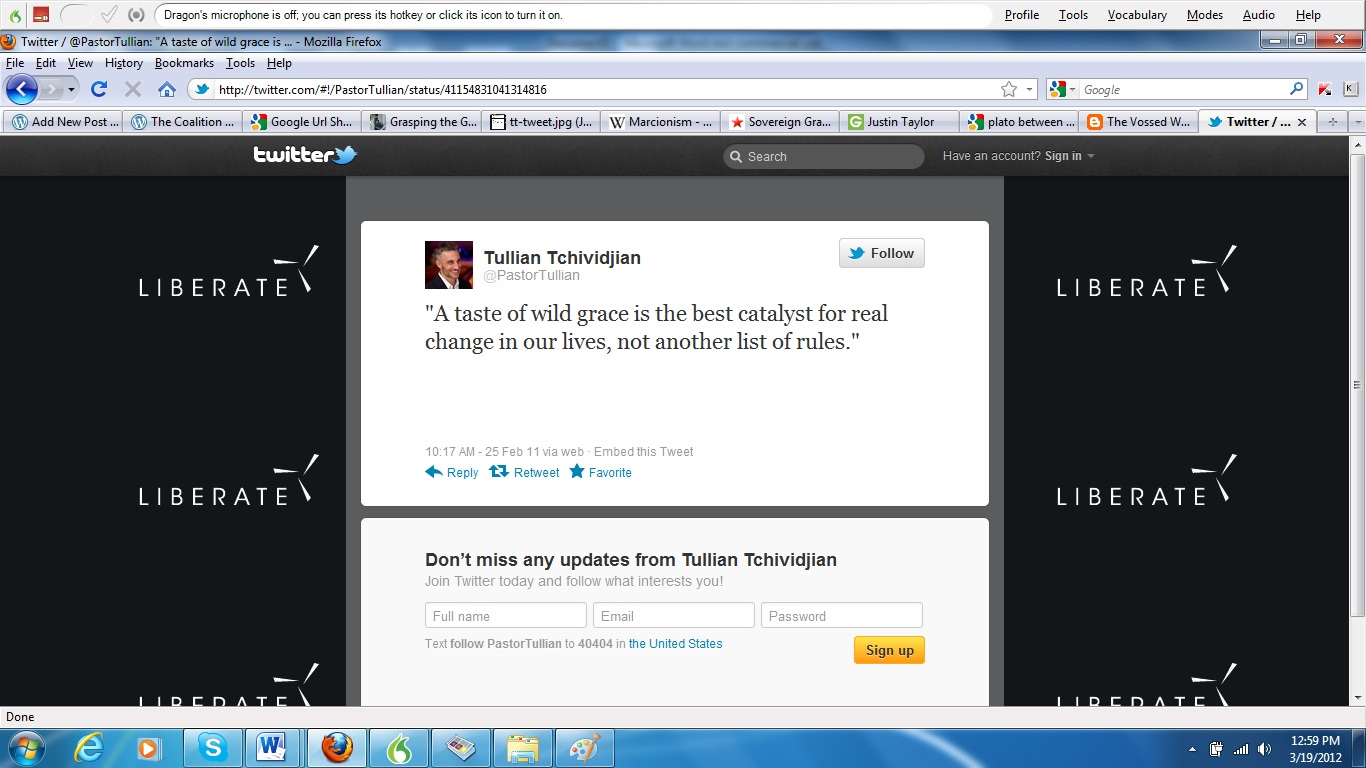
So, Southeastern will come forth in dismay and act completely incredulous that this has happened. Meanwhile, Southeastern’s conference schedule is saturated with propagators of this doctrine, including Tullian Tchividjian. On the one hand, it’s a tragedy. On the other hand, they invite leaders to speak to the students who teach that we are totally depraved and can’t change! Can teaching seminary students such things lead to said behavior? Well, forgive me for thinking so! How ironic that Tchividjian has already spoken there this year, and is scheduled to return in the fall. Consider this commentary on a post he wrote on the total depravity of the saints http://goo.gl/Jiu4I , and the following tweets by Tchividjian:
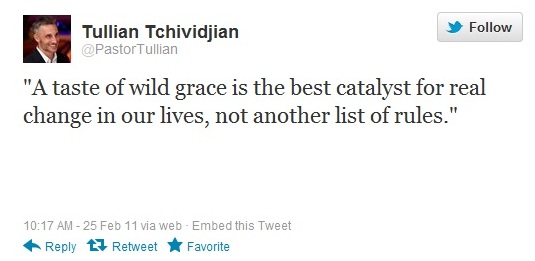
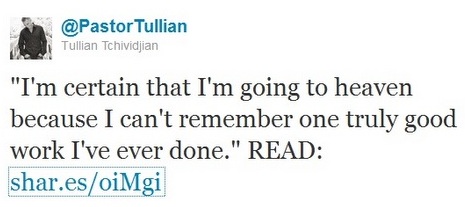
I guess I am the only one scratching my head on all of this, but I also wonder if Southeastern is going to get a “I told you so” from New Calvinist Michael Horton who often warns Christians about trying to “be the gospel” rather than “preaching the gospel.” Like all New Calvinists, Horton teaches that the gospel is “news to be proclaimed” not a list of “do’s and don’ts.” They plainly teach that “law and gospel” are separate. This concept can be found in Horton’s book, “Christless Christianity” on pages 117-119, and also on pages 53-54 of “Family Shepherds” written by Southeastern graduate Voddie Baucham. If the same gospel that saved us also sanctifies us, and the law and gospel are separate; well, you do the math (the law is separated from sanctification). Supposedly, a deeper understanding of the gospel that saved us must always precede obedience which then is a “mere natural flow” without effort because we are really manifesting a spiritual realm that was imputed to us at salvation.
And the present-day New Calvinist movement got this doctrine from Seventh-Day Adventist Robert Brinsmead, who combined Reformed theology with Platonism to come up with the centrality of the objective gospel outside of us. Instead of reality or truth being completely outside of man (Plato), in New Calvinism, the gospel must remain completely outside of us, and nothing of grace may be infused within us. Hence, consider the following quotations by the who’s who of New Calvinism in our day:
When the ground of justification moves from Christ outside of us to the work of Christ inside of us, the gospel (and the human soul) is imperiled. It is an upside down gospel. ~John Piper
Thus, it will inevitably lead not to self-examination that leads us to despair of ourselves and seek Christ alone outside of us, but to a labyrinth of self-absorption. ~ Michael Horton
So what does this objective Gospel look like? Most importantly, it is outside of us.~ Tullian Tchividjian
The blessings of the gospel come to us from outside of us and down to us.~ John Fonville
It robs Christ of His glory by putting the Spirit’s work in the believer above and therefore against what Christ has done for the believer in His doing and dying.~ Geoffrey Paxton (Australian Forum)
But to whom are we introducing people to, Christ or to ourselves? Is the “Good News” no longer Christ’s doing and dying, but our own “Spirit-filled” life?~ Michael Horton
And the new-birth-oriented “Jesus-in-my-heart” gospel of evangelicals has destroyed the Old Testament just as effectively as has nineteenth-century liberalism. (footnoted to Paxton’s article with above quote). ~ Graeme Goldsworthy (Australian Forum)
Of course, the only practical application of Platonism is Gnosticism, and incredibly, some of the most popular New Calvinists of our day have Gnostic themes for their ministries as illustrated by the following two screen shots that clearly illustrate Gnostic dualism.
Then if one googles “Plato Two Worlds,” you get:
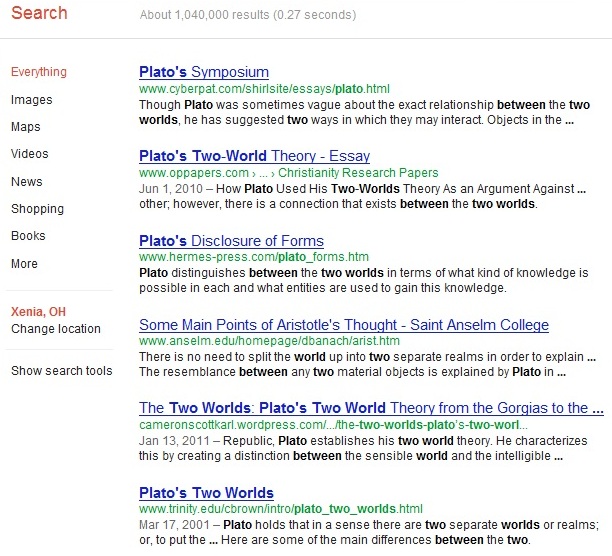
And the similarities between the New Calvinist concept of separating law and gospel is eerily similar to those of the 2nd century Gnostic heretic Marcion. In regard to the gospel being completely outside of us like knowledge of reality (Plato), many New Calvinists now teach that the gospel cannot be fully known: http://5ptsalt.com/2012/02/23/grasping-the-gospel/
Lastly, I heard on the news that this brother that fell is going to enter counseling at Southeastern! Right, that’s all this brother now needs—to be taught that he is totally depraved, that he can’t change, and that the primary cure for his problem is a deeper understanding of the death, burial, and resurrection. After all, as Southeastern hero Paul David Tripp often states: applying biblical instruction to this problem would not be seeing the problem in its “gospel context,” and instruction also denies Christ’s saving work on the cross by replacing Christ’s personhood with “a cognitive concept applied to a new formula for life.”
The brother has it bad right now. Counseling at Southeastern will finish the job. I am reading a lot on the blogosphere about all the friends this guy has. Ha! We will see.
paul
Why Jay Adams Had to be Neutralized by the New Calvinists
Susan and I had a glorious fellowship with another Christian couple this afternoon. They are in a ministry of significant influence and will be unnamed. At some point, the conversation turned to New Calvinism. As Susan and I sat and listened to the husband’s testimony concerning what he valued in John Piper’s teachings, I was filled with an understanding in regard to why Piper’s teachings are so attractive. I might add that I was very impressed with his calm, articulate answer immediately following my comment that I believe Piper to be one of the premier heretics of our day.
What this brother described was the fact that serious Christians were looking for an alternative to the fallout from the first gospel wave in contemporary Christian History: raise your hand, sign a card, don’t drink, smoke, chew, or hang out with girls that do. Christianity had been reduced to living by a list of do’s and don’ts by people who didn’t have any life to show for it. Fair enough. Guilty as charged.
But the fact of the matter is that Jay Adams did offer a viable alternative. It was based on hearing the word of God and applying it to our lives according to the whole counsel of God’s wisdom and not just, “stop doing that.” I saw firsthand how this “first generation” biblical counseling movement changed lives in radical fashion, including my own. And the movement continues to do so today even though the fact of that matter is covered up by a whole lot of New Calvinist noise.
To me the crux of the matter is in this brother’s testimony. New Calvinists have effectively sold the idea that they are offering the only alternative to easy believeism in our day. That’s only true because they got rid of the other alternative through slander and persecution, and they know it. Jay Adams’ “first generation” biblical counseling was a threat to the emerging New Calvinist tsunami. Why? 1) Because it worked and God used it to change lives. 2) It was/is the antithesis of New Calvinism because the latter fuses justification and sanctification while first generation counseling doesn’t. Furthermore, this is what New Calvinist David Powlison said was the fundamental difference between the two while teaching at John Piper’s church:
This might be quite a controversy, but I think it’s worth putting in. Adams had a tendency to make the cross be for conversion. And the Holy Spirit was for sanctification. And actually even came out and attacked my mentor, Jack Miller, my pastor that I’ve been speaking of through the day, for saying that Christians should preach the gospel to themselves. I think Jay was wrong on that.
If we associate justification with “conversion,” and we do, Powlison’s statement can be reworded as follows for clarification:
Adams had a tendency to make the cross be for justification (justification cannot be separated from conversion). And the Holy Spirit was for sanctification.
Second generation counseling/New Calvinism is sanctification by justification, and that was also propagated by his mentor that he mentions. New Calvinists choose their words carefully. Imagine how far the movement would get if they didn’t replace “justification” with “gospel”:
The same finished work of justification that saved you also sanctifies you. Or, we must preach justification to ourselves every day. Or, sanctification is the finished work of justification in action.
I explained to the brother that the other alternative was relentlessly persecuted, and that’s why it would seem that there is only one alternative. He concurred that he perceives criticism of Adams taking place on a continual basis. Why? Because the truth he teaches is the competition. It’s a threat.
This is an approach that I have never used before: 1) Powlison admits a fundamental difference between first generation and second generation counseling; ie, sanctification by the cross (justification) verses sanctification by the Spirit apart from the finished work of justification. 2) An alternative is confirmed. 3) You only have the New Calvinists’ testimony that they are the only alternative. 4) Why not investigate and find out for yourself?
He agreed, and was sent off with a copy of The Truth About New Calvinism. Please pray for the situation. Christianity doesn’t need a second gospel wave. The first wave devalued sanctification by focusing on justification only; the second devalues it as well by making it the same thing as justification. Both are just as deadly, and when the novelty of New Calvinism wears off, the results will be worse.
paul
New Calvinism’s Replacement of the New Birth with Pagan Philosophy
We can rest assured that our Father doesn’t want us to be confused. He gave us a brain and is honored when we use it, but know this: He doesn’t want us to use it to vet every theory running amuck in the world regarding the meaning of life. His word to us is clear: we have His Spirit; we are not to be deceived; test every spirit; and we have all that is needed to be fully equipped for every good work. But according to New Calvinist David Powlison, the church forgets stuff. Therefore, it needs a research and development purpose to rediscover lost truth and apply it. Buyers beware; you only need to follow the money.
As stated in The Truth About new Calvinism, it all boils down to the enemy’s agenda: 1) keep people out of the kingdom 2) deceive kingdom citizens into living spiritually anemic lives 3) which leads to a lack of testimony and thereby facilitates purpose number one. If the kingdom of darkness couldn’t keep you out, it can at least use you to keep others out. And we only need to examine that in context of what worked so well: “Did God really say….” The apostle Paul warned us many times in regard to being led away from the truth by vain philosophies.
New Calvinism is a reductionist theology. Reductionism is two-fold. First, in an attempt to make much of God’s grace and little of man’s efforts, the role of man is reduced as much as possible in theological systems. Secondly, this entails diminishing the primary instrument for man’s participation in God’s work—the law. Therefore, something needs to be done about the new birth because it implies the ability to participate in upholding God’s law in sanctification. New Calvinists have several different ways of denying the new birth; this post is about what they replace it with.
The primary tenet of New Calvinism is the centrality of the objective gospel outside of us as developed by the Australian Forum, a think tank for the Progressive Adventist Movement. One reader commented in regard to part 5 of the New Calvinism for Dummies video series:
One of the things that popped into my mind when you were talking about “objective” and it occurring outside ourselves. It also seems like the NC is inviting the person to stepoutside themselves to be an observer of themselves. Like they are being invited to emotionally remove themselves from who they are, becoming the unemotional observer, which would also lead to some coldheartedness. With the emotions corralled, as such, it just sort of reminds me of Spock on Star Trek.
That’s a good assessment, and speaks to the fact that New Calvinists are very coldhearted and indifferent, also lacking in having a sense of justice about them. That’s one of the bad results of partaking in anti-word philosophies:
….and many false prophets will appear and deceive many people. Because of the increase of anomia, the love of most will grow cold (Matthew 24:11,12).
Their hearts are callous and unfeeling, but I delight in your law (Psalm 119:70).
The centrality of the objective gospel outside of us (COGOUS) is the mainframe that holds all of the various movements within New Calvinism together and gives it a hyper-ecumenical flare. The various groups within New Calvinism all have their own way of making this doctrine work with real life, but the overall goal of the doctrine is the same: gospel contemplationism leading to a passive manifestation of a realm. This is merely a device of the only primary goal of the kingdom of darkness from the beginning of redemptive history; specifically, “Has God really said.” It is meant to divert God’s people from Christ’s simple counsel:
Everyone then who hears these words of mine and does them will be like a wise man who built his house on the rock (Matthew 7:24).
If every verse in the Bible is about what Christ has done and not what he SAYS; ie, “these words of mine,” biblical wisdom for kingdom living is circumvented. Secondly, if our only “do[ing]es” is a passive yielding to a realm, the kind of intentional application of God’s word necessary for a life built on a rock is also circumvented. This will lead to the circumvention of Christ’s goal stated in Matthew chapter five:
14 You are the light of the world. A city set on a hill cannot be hidden. 15 Nor do people light a lamp and put it under a basket, but on a stand, and it gives light to all in the house. 16 In the same way, let your light shine before others, so that they may see your good works and give glory to your Father who is in heaven.
Therefore, the simple biblical approach of learn/hear>>>obey>>>God glorified, must be replaced with a more passive formula. Opponents of the biblical model would say they only want to exclude man’s efforts so God will get all of the glory, resulting in contemplation/meditation>>>_________>>>God’s works manifested, not ours. The blank is filled in by various and sundry techniques which New Calvinists point to. This often confuses the real issue. But getting back to the main point, the new birth must be refuted because it makes the contra formula possible. And because the latter formula is reductionist and narrow, it must be embellished. Hence, Christian Hedonism, Heart Theology, unbiblical forms of prayer, Neuro-Linguistic-Programming, reorientation of desires, etc, etc. This is vital in selling the product because we were created for work (you know, feet, hands, stuff like that), and passive theologies therefore contradict the conscience. So the blank between meditation and work must be filled in with some plausible stuff that sounds good. Please note: I am stating all of this in context of sanctification. COGOUS>>>life application>>>manifestation of works verses new birth>>>learn and apply>>>obedience.
Furthermore, the application must not only supply a feasible life application, but must also appeal to human desire. This brings us back to the astute comment by the aforementioned reader. This whole idea of COGOUS giving one the ability to step outside of themselves and be an observer of their own life. Some would call this Nature/Freedom philosophy; this is the freedom from the laws of nature, and in the case of New Calvinism, God’s written law as well. There is no better way to demonstrate this than by a quote from one of the most popular New Calvinist articles ever written:
What, then, is the subjective power of this message? Firstly, we find that there is real, objective freedom, the kind that, yes, can be experienced subjectively. We are freed from having to worry about the legitimacy of experiences; our claims of self-improvement are no longer seen as a basis of our witness or faith. In other words, we are freed from ourselves, from the tumultuous ebb and flow of our inner lives and the outward circumstances; anyone in Christ will be saved despite those things. We can observe our own turmoil without identifying with it. We might even find that we have compassion for others who function similarly. These fluctuations, violent as they might be, do not ultimately define us. If anything, they tell us about our need for a savior.
Secondly, this freedom gives us permission to confront and confess our pain. We can look our self-defeating and regressive tendencies in the eye for once. We no longer have to pretend to be anything other than what the Gospel tells us we are: hopeless sinners in need of mercy. Honesty and repentance go hand in hand – freedom puts us on our knees, where we belong. A subjective Gospel turns repentance into a frightening affair, evidence that God is far away from us. An objective Gospel provides the assurance that actually produces repentance, forging the pathway to the place where we find forgiveness and redemption. We can finally grasp hold of the truth that it is always better to be sorry than to be safe. The pastoral implications for marriage alone are staggering.
(David Zahl and Jacob Smith: Mockingbird blog, “The Subjective Power Of An Objective Gospel”).
I think this quotation says it all. It is a freedom from obedience to the law (because we are totally depraved sinners that can’t keep it anyway), freedom from consequences, and supplies a mentality that we can use to detach ourselves from the burdens of life. It is Nature Freedom philosophy to the max and could be accompanied by the song, “Don’t Worry Be Happy” by Bobby McFerrin:
Here is a little song I wrote
You might want to sing it note for note
Don’t worry be happy
In every life we have some trouble
When you worry you make it double
Don’t worry, be happy……
Ain’t got no place to lay your head
Somebody came and took your bed
Don’t worry, be happy
The land lord say your rent is late
He may have to litigate
Don’t worry, be happy
Look at me I am happy
Don’t worry, be happy
Here I give you my phone number
When you worry call me
I make you happy
Don’t worry, be happy
Ain’t got no cash, ain’t got no style
Ain’t got not girl to make you smile
But don’t worry be happy
Cause when you worry
Your face will frown
And that will bring everybody down
So don’t worry, be happy (now)…..
There is this little song I wrote
I hope you learn it note for note
Like good little children
Don’t worry, be happy
Listen to what I say
In your life expect some trouble
But when you worry
You make it double
Don’t worry, be happy……
Don’t worry don’t do it, be happy
Put a smile on your face
Don’t bring everybody down like this
Don’t worry, it will soon past
Whatever it is
Don’t worry, be happy
….because everything that matters is outside of you—the cross. Just sit back and let life make the cross bigger; stop trying to be the gospel instead of living the gospel by faith alone. That’s one of the many allurements of New Calvinism, but primarily, it’s a theological framework that allows us to fill in the practical application line in any way we would like to. And we like that.
paul


 Paul's Passing Thoughts

leave a comment