David Powlison’s Gnostic Counseling Paradigm
David Powlison is the major figure representing the counseling wing of Westminster Theological Seminary: the Christian Counseling and Educational Foundation (CCEF). Powlison was mentored by Dr. John Miller who was a professor at Westminster. Miller was the father of Sonship Theology which was his own twist on the rediscovery of the doctrine of perpetual justification (Gospel Sanctification) via the Australian Forum think tank formed in 1970.
Powlison took the concept of progressive justification and used it to develop his Dynamics of Biblical Change project which is the foundation of counseling education at Westminster. Two former students of his, Paul David Tripp, and Timothy Lane, wrote a book entitled “How People Change”(HPC) which is a treatise on the “practical application” of Gospel Sanctification (the doctrine of the present-day New Calvinist movement). The title of the book is a lie; as we shall see, New Calvinists do not really believe that people change.
This is most evident when one reads pages 64 and 65 of HPC. Tripp and Lane describe Christians as “powerless,” “enslaved,” and “dead.” They further elaborate by writing, “When you are dead, you can’t do anything” (p. 64, HPC). How do dead Christians change? Obviously, they don’t. Hence, this is why the vast majority of present-day biblical counseling controlled by the CCEF machine is a farce: the counseling is not about change.
So what’s going on? Basically, it starts with Plato and what was later known as Gnosticism. Some refer to Gnosticism as “Platonism for Dummies,” but the basics are easier to explain through fundamental Platonism. Plato believed man was unable to know reality. The following excerpt is a good explanation of Platonism 101:
Plato, the most creative and influential of Socrates’ disciples, wrote dialogues, in which he frequently used the figure of Socrates to espouse his own (Plato’s) full-fledged philosophy. In “The Republic,” Plato sums up his views in an image of ignorant humanity, trapped in the depths and not even aware of its own limited perspective. The rare individual escapes the limitations of that cave and, through a long, tortuous intellectual journey, discovers a higher realm, a true reality, with a final, almost mystical awareness of Goodness as the origin of everything that exists. Such a person is then the best equipped to govern in society, having a knowledge of what is ultimately most worthwhile in life and not just a knowledge of techniques; but that person will frequently be misunderstood by those ordinary folks back in the cave who haven’t shared in the intellectual insight….the Allegory also attacks people who rely upon or are slaves to their senses (Analysis of The Allegory of the Cave by Plato Online source:123helpme.com/view.asp?id=135077).
Because the common man is enslaved to his own senses and can only comprehend what he can sense from the material world which is merely shadows of reality, Plato devised what we now call a cybernetic loop. This is a process that evaluates the outcomes of experience/circumstances/data for the purposes of making adjustments or reaching goals. Since the common man is not enlightened, the next best thing is to devise a system that gives him guidance from the criteria that he can experience with his senses. The enlightened ones, who should lead and govern the common man, develop these cybernetic loops to help guide mankind in their world of dark shadows. Plato believed in a world ruled by philosopher kings. Below are some illustrations of cybernetic loops:
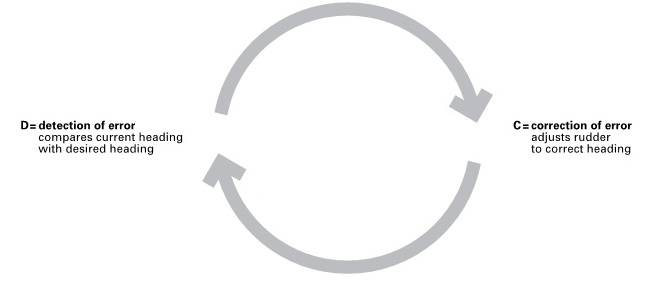
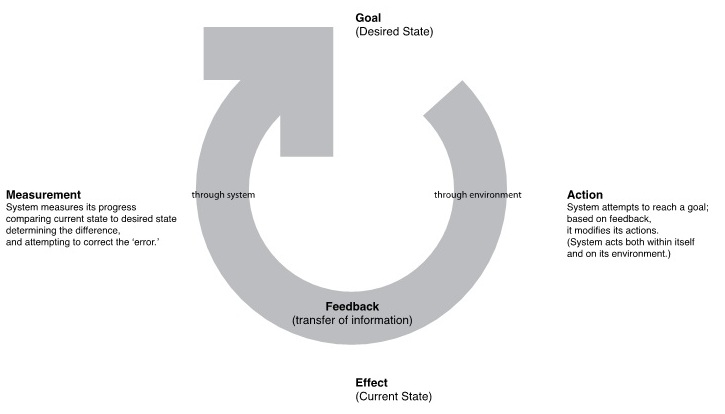
These loops can be complicated and may involve loops that evaluate other loops. Below is another illustration in regard to Plato’s philosophy:
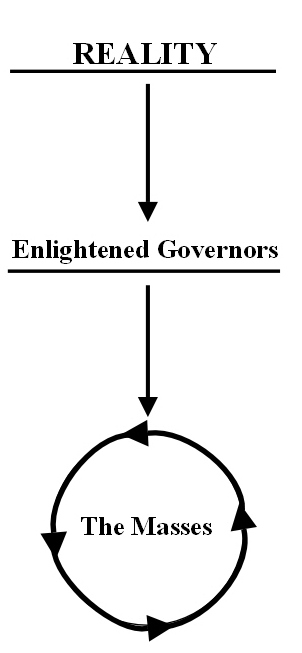
Plato had a vast influence on Augustine who is primarily responsible for the total depravity of the saints tenet found in Reformed theology. This prism had a profound influence in the forming of the gospel of perpetual atonement, or the idea that the effects of Christ’s death on the cross wasn’t a finished work, but was progressive for the purpose of maintaining a righteous standing for the saints. See illustration below:

This is opposed to the gospel that rejects the total depravity of the saints and propagates an enablement through the new birth:

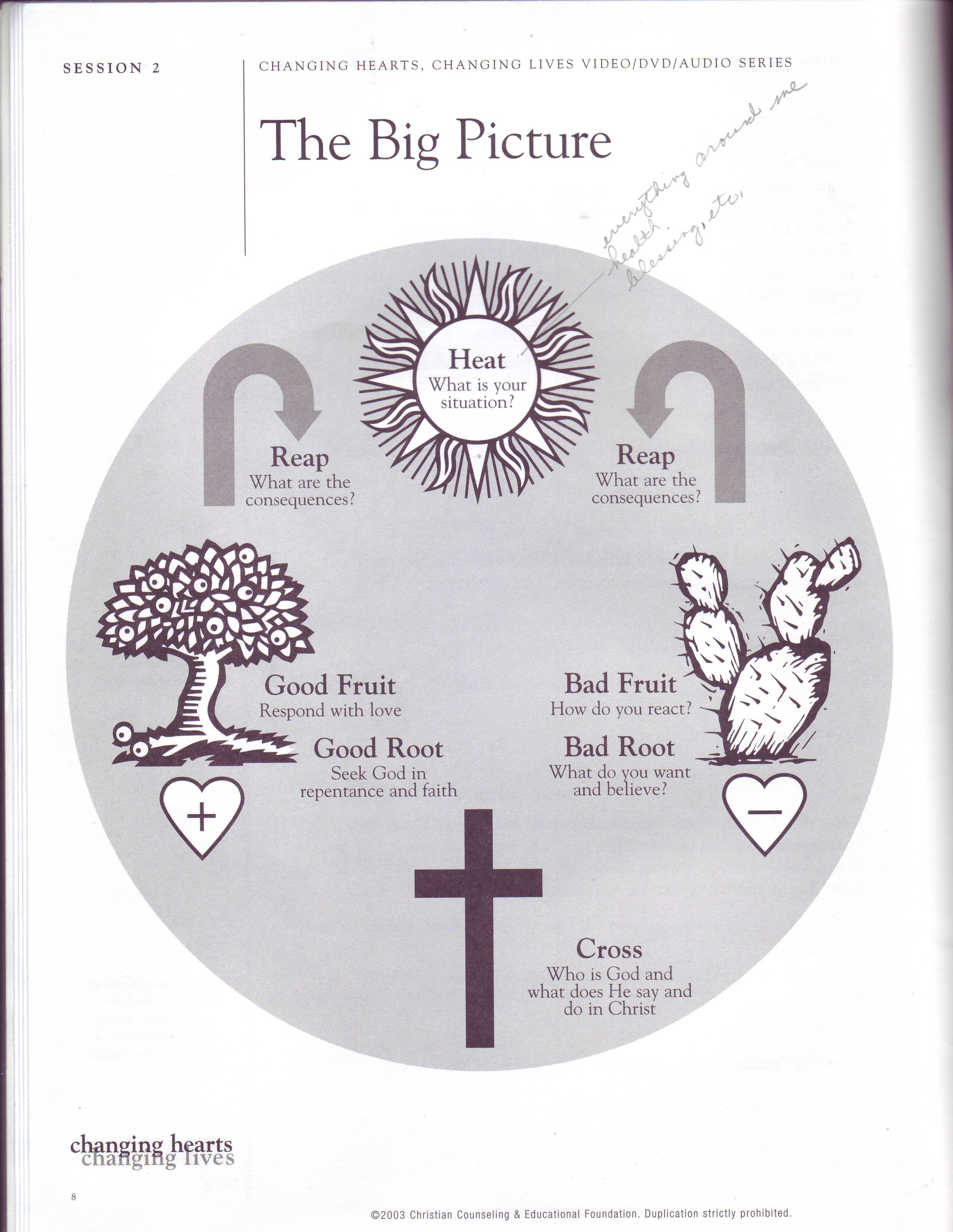
In the second model, the believer has the responsibility to learn and apply the word of God to their lives. But the first model, because it relies mostly on Platonist philosophy, also borrows the cybernetic loop for its “practical application.” Therefore, New Calvinists merge progressive justification into various cybernetic loops for “practical application.” Since the saints are supposedly unable to keep the law because they are still totally depraved, there has to be a way for the saints to continually partake in the same gospel that saved us. In order to come up with a way to do this, the New Calvinists went back to the basics: Plato. The first illustration of this is from CCEF’s The Journal of Biblical Counseling vol. 18, number 1, Fall 1999:
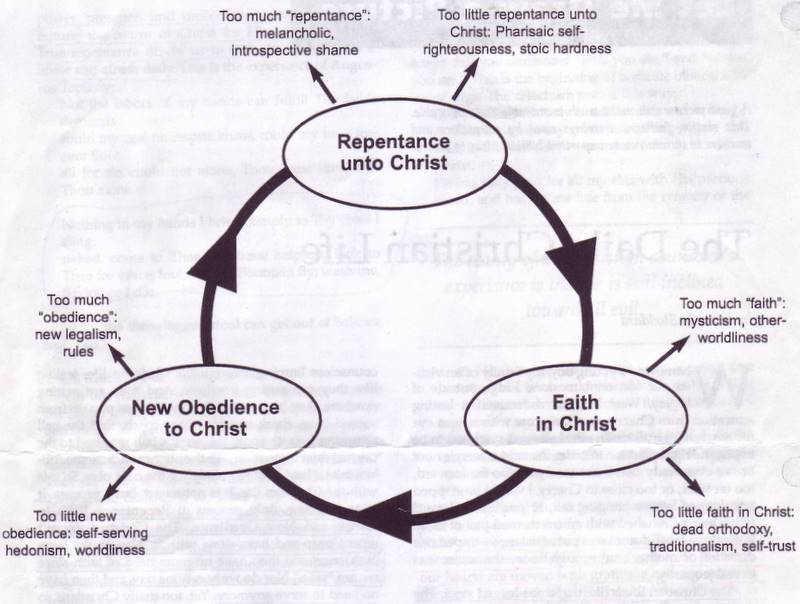
The following are illustrations from HPC and Powlison’s Dynamics of Biblical Change:

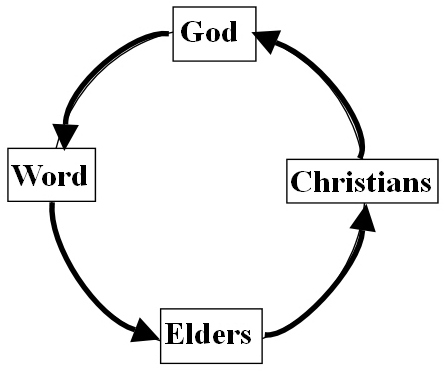
In the following excerpt from Dr. Devin Berry’s “How to Listen to a Sermon,” Berry uses a C-loop concept to explain the New Calvinist theory on how the saints receive the word of God. The illustration following the excerpt is mine:
Note this cycle: Paul, from the Word, delivers words. The Bereans, from Paul’s words, go to the Word. The Word cycles from God, through the preacher, to the people, back to the Word, and this, verse 12 tells us, produced belief in the God of the Word. An important thing to note is that this happened daily – suggesting a regular interaction between preaching, personal study, and the Word.
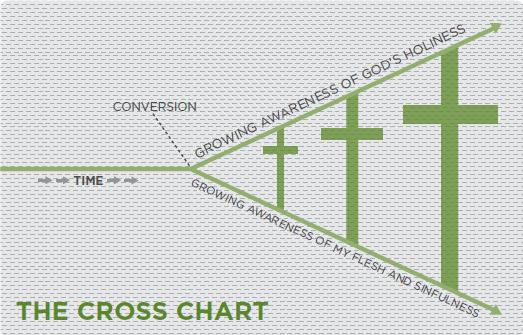
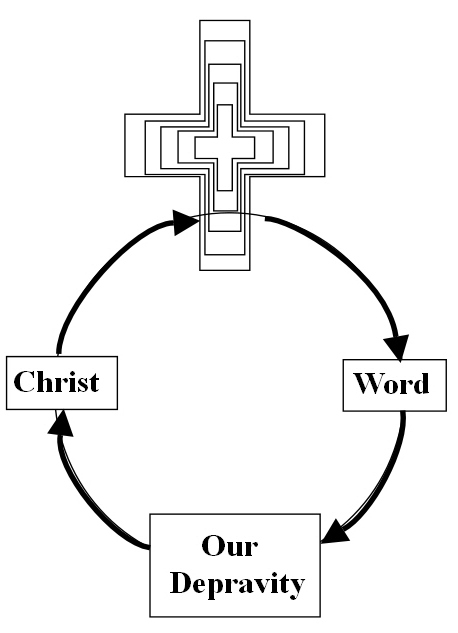
The goal of all of this is not change in the believer which is impossible anyway according to their theology because Christians are still totally depraved. The goal is to make the cross (or, the works of Christ) bigger by a deeper and deeper knowledge of how totally depraved we supposedly are. This is illustrated by the following chart produced by a New Calvinist organization:
 Below is a C-loop that can illustrate the above chart:
New Calvinism’s Objective Deception and Kinship With Mysticism
I have been watching the “Wide Is The Gate” video series by Caryl Productions. The series addresses “Christianized New Age Spirituality.” The series has many excellent observations. The following are the major ones:
- Eastern Mysticism that teaches creation is God, and that God is in every person, has been integrated into mainstream Christianity.
- Over the years, the integration has been fine tuned to appear orthodox.
- When one aspect of such a movement is exposed, they change the name.
- The Bible predicted that Christianity would be saturated with such false doctrines in the latter days.
There are two major movements right now that are being used by the kingdom of darkness to promote its major agenda: to get Christians as far away as possible from learning and doing God’s word. The folks at Caryl Productions are spot on; the New Age Movement never went away, it is alive and well under a different name, and in a local church near you. The video series addresses one of the major movements: the I am divinity crowd, and the practical application is various formulas for discovering one’s own inherit godhood. A mass of Christian thought, in various forms, falls under this category: “I am my own god.”
The host of the video makes a good point that in contrast, true evangelicals believe God to be outside of man, as opposed to mankind being inherently one with deity. Of course, the host is speaking in regard to the need for salvation. Now comes the evil sibling claiming, “the centrality of the objective gospel outside of us.” The contenders in the video make the point (and rightly so) that Christianized mysticism focuses on subjective “truth,” and the goodness within instead of God’s objective truth, and His goodness outside of us. But again, like they state well in the video, the movement continually retools in order to slip in unawares.
Enter New Calvinism. Their the centrality of the objective gospel outside of us (group A) would seem to be the perfect storm against the centrality of the subjective gospel inside of us (group B). This bunch are not amateur deceivers by any means. They introduce themselves as the extreme antithesis, while the goal is exactly the same. In fact, the practical application of both are identical: contemplationism. A primary theme in the video is the spiritual contemplationism of Christianized New Age Spirituality. And New Calvinism is no different.
I will now explain how both movements attain the exact same goal, but with different means. New Calvinists point to the means as a way to distinguish themselves from the other camp and to appear as contenders for a true gospel. New Calvinists believe that ALL reality is interpreted through “Christ” and His works. It isn’t about what Jesus SAYS to us, per se, it’s about who he is as a “person.” In the words of Paul David Tripp: “He comes as a person, not as a cognitive concept that we insert into a new formula for life” (How People Change, p.27). Tripp then proceeds (in the same book) to explain a complex Gnostic concept for replacing the learn and do “formula” propagated by Christ in Matthew 7:24-27.
Hence, rather than to say, “Truth is subjective and is found inside of us and we make truth whatever it is to us,” New Calvinists say, “Truth is found completely outside of us and is interpreted through a deeper and deeper knowledge of Christ and His works.” That’s supposedly an objective truth, but what does it mean? How do we gain a deeper and deeper knowledge of Christ as a person? By learning His word and doing it? No, because that’s not learning more and more about Christ, that’s doing what Christ commands, and since all objective truth is outside of us, we are still totally depraved and are unable to obey Him anyway.
Furthermore, New Calvinists believe that any doctrine indicating an infusion of Grace into the believer at salvation is a false gospel, and was the very crux of the Reformation; true spiritual life must remain outside of the believer. They concur with the new birth, but the new birth, to the New Calvinist, means that we are still spiritually dead and totally depraved; we have life in us (Christ), but we are still spiritually dead.
So, how do Christians change? According to New Calvinists, they don’t, but rather manifest the active obedience of Christ—the active obedience of Christ while He lived on Earth is imputed to us in this life as we “manifest” that obedience via Christ who indwells us by the Holy Spirit. How does that happen? It happens as we gain deeper and deeper knowledge of Christ through the Scriptures. To the New Calvinist, the Bible is an “objective” book about Christ only, a tool for gaining deeper knowledge about Christ. If we use it for that purpose only, the Spirit is involved, but if we use the Bible for the purpose of learning God’s imperatives for the purpose of obedience, that is using the Bible in the exact same way that the Pharisees used the Torah. Supposedly. According to New Calvinists, one is of the Spirit, the other is the “dead letter of the law.”
The final equation is simple: gospel contemplationism. Group A, and group B end up at the same place: seeking God through meditation and contemplationism. The only difference is the object of the meditation. And both are subjective. When New Calvinists have to see Jesus in every verse of the Bible, the results are bound to be subjective. Besides, New Calvinists believe we are still totally depraved, and anything that is inside of us is subjective; ie, we really can’t know anything—we are incapable of applying cognitive truth. What’s the difference between that and the new age idea that real truth is unknowable? Nothing. The New Calvinist way to spiritual life is meditation on Christ, and then sit back and watch what Christ might do. Paul David Tripp calls this, “New and surprising fruit.” Whatever we see in the Bible is imputed to us in the same way that righteousness was imputed to us when we were saved, resulting in “manifestations of Christ.”
The following exercise may lend some understanding on this. Find a passage in the Bible that has absolutely nothing to do with the gospel. For instance, God telling Adam to name all of the animals He created. Then, ask ten different Christians to draw a gospel meaning from the verse (ie, what does the passage say about Christ, His works, and the gospel). You can be sure that you will get ten different observations. But New Calvinists would say that all ten interpretations must be correct because they concern the gospel, and gospel interpretation is always attended by the Spirit. The subjective is therefore true because it came from a narrow, supposedly objective prism (even though a gospel result is always to be assumed). However, New Calvinists do recognize a structural aspect to the Scriptures that instructs them on how to organize church polity, but this is seen as a practical necessity for organization, not sanctification.
There is simply no difference between the two. They both seek to draw Christians away from the application of cognitive truth by replacing it with contemplationism.
paul
Why Al Mohler is a Heretic
 Listen friends, the gospel of progressive justification is a false gospel; it’s just that simple. I don’t care how educated Al is, how many followers he has, or anything else save the gospel he preaches. In the following video trailer from the 2011 Resolved Conference, Al Mohler states that the only purpose of the law in the life of a believer is to show us our ongoing need for salvation. Of course, he doesn’t word it that way. He states that believers have an ongoing need for Christ (which no Christian would refute), but note carefully: he is speaking in context of our initial salvation. So, instead of saying plainly that Christians need to be continually saved, or continually justified, he replaces that wording with “Christ.” However, again, the context is clearly salvation. He is saying that we need Christ in the same way that we needed Him for salvation.
Mohler is also saying that the law has the same relationship/purpose to unbelievers as it does believers: to show us our need for Christ. So, obviously, this is in contrast to any ability on the part of the believer to keep it. All the law can do is show NEED. Need for what? Well, what’s the context? Mohler also presents an either/or choice in regard to the law: it either shows us our need for Christ (again, what need specifically?), or we are using it to “rescue ourselves from sin.” Hmmm, what does it mean to “rescue ourselves from sin”? I believe Mohler deliberately uses the word “rescue” instead of “save” in order to add nuance to his point. “Rescue” is less direct, and could refer to a believer trying to overcome sin on his own. This is the same reason he replaces “salvation” with “Christ” in his prior point. It’s deliberate deception. Excluded is any mention that the law can be used by the believer to please God and glorify Him in all we do by “observing all that I have commanded.”
Mohler’s trailer starts at 1:35.
Storm Clouds Against New Calvinism Continue to Form



Southwood is Indicative of the Church’s Greatest Need in Our Day
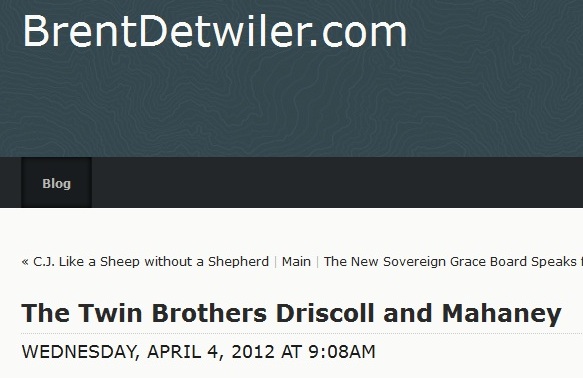
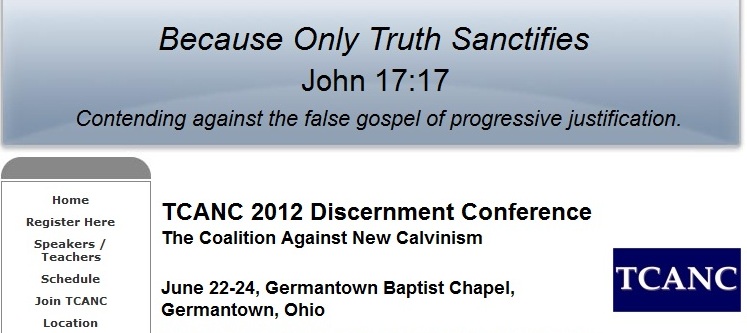
 I have been following the Southwood Presbyterian disaster for several months now. As in the ABWE missionary kids scandal—talk, lots of talk, more talk, and even more talk. As in the latter mentioned case, Southwood is talking about bringing in the Christian version of the United Nations: Peacekeeper Ministries. Whether PM, The Institute for Christian Conciliation™ (ICC), or G.R.A.C.E, these organizations are equal to the United Nations in their effectiveness. Stated plainly: they are worthless.
Why? Read all of their literature, and then add to it all of the endless statements from every type of committee trying to deal with these situations; there is one word missing in all of it. Read, read, read more, I just might be willing to give one, no, five dollars for every time you can find the concept: TRUTH.
There are a lot of battered/confused sheep among us because we are still naive enough to think that the vast majority of those who lead us care about Scriptural truth. If I am wrong, where is that word in anything they say? Strange, while on the one hand, the Scriptures make it clear that unity must be based on truth; on the other hand, PM and all the various committees called upon to bring peace to these situations never talk or write about truth. All they talk about is: finding sin within yourself; forgive the way Christ forgave you; recognize that we are all totally depraved, and therefore, stuff happens, que, sera, sera; and unity for the sake of unity.
Come now sheep; let us be completely honest with ourselves. The church, at least in this country, is being run by those who see themselves as the spiritual elite. The sheep are totally depraved, and must be saved from themselves. Yes, leaders believe they are totally depraved also, but also predestined for a certain enlightenment to lead. Therefore, they shouldn’t be questioned. This is one reason the “truth” word never appears in their vocabulary—truth is bound up in their authority.
Outrageous notion? Really? Let me demonstrate it from the Pastoral Care Committee of Providence Presbytery statement for the Southwood situation. Other than the fact that the word “truth” never appears in the document, the words for “heretic” does. In the Bible, unity is always linked to truth, and divisions are always linked to false doctrine. In the document, the biblical concept of heresy is exclusively leveled at the congregation and the leadership is completely excluded:
The Committee acknowledges that this report and these recommendations may meet resistance from any of the numerous factions currently at Southwood.
“Factions” is one of the English words for “heretic” in the Bible. The biblical definition of a heretic in the Bible is: a person who is part of a group or party that causes division through the use of false doctrine. I wrote a lengthy article on this subject here.
Elsewhere:
When Jean Larroux walked into Southwood for the first time as its Senior Pastor, we believe he entered into an environment that had the seeds for difficulty. Actions and reactions within that environment led the Church to where it is today. The SAHC sees four key factors in the decline of your church’s peace. These factors in our report were: Issues within the Session, Communication, Reaction to Conflict by all parties, and Theological Misunderstanding. The SAHC has communicated this in full to the Session.
Notice the fact that Larroux assumed the position without full disclosure (especially in regard to him thinking that he was bringing a “scandalous” gospel into Southwood) is nowhere on the committee’s radar screen. The committee again refers to the factions at Southwood as “parties,” another English word used to translate “heretic” from the Scriptures. I think this is by design. The “heresy” is not submitting to the leadership regardless of whether they are teaching truth or not. That’s because “truth” is bound up in their authority. This can be solidified with the fact that even after….
“We estimate that we have had hundreds of discussions, phone conversations, and email exchanges and have met regularly through the month of February.”
….charges of teaching false doctrine that was even called out by a thirteen-year-old visitor were summarily dismissed. And the existing leadership was given a sabbatical for the purpose of rest in anticipation of their future return to leadership. By the way, this is the exact same protocol being used by SGM to return serial sheep abuser CJ Mahaney to his presidency at SGM. The doctrinal concerns of the elders who resigned were also summarily dismissed in the document. Why? Because truth is bound up in the survival of the leadership. This is a serious problem that appears in Reformed theology from time to time in history: authority = truth.
Therefore, truth as perceived by the parishioners is irrelevant—because they don’t have the authority. Think my thesis is wrong? Note that there is no doctrinal error that even a thirteen-year-old (please, somebody send me her address so I can send her a bunch of stuff) can see, but only….
….Theological Misunderstanding
I have read many of Larroux’s messages; this is an outrageously offensive statement. Other than the fact that Christians are supposed to love the truth, and separate from those who don’t teach it (because a little Levin leavens the whole lump), I just don’t like the fact that we sheep ARE PAYING FOR ALL OF THIS! The message from the Presbytery, whether Baptist or otherwise, is:
Keep you damn mouth shut, put your money in the plate, buy our books, smile a lot, and bring other totally depraved sheep into our wonderful tyranny.
I close with a comment concerning this statement in the same document:
The Committee recommends that all concerned parties work toward forgiveness and not file any formal complaints or charges arising out of any events which have occurred up to the present time….
Christians are never to “file any formal complaints or charges arising out of any events”? I’m not so sure about that, and frankly, it’s the only hope I see in this document. The Scriptures are clear; we are only to follow those who follow Christ. And biblical imperatives to remove doctrinal error from local churches is most often directed at the whole congregation in the New Testament. I think that’s the greatest need of our day, for parishioners to stand up against error and any spiritual tyrant who seeks to protect error. If there is a course of action left for those at Southwood who love the truth—that’s what they need to do. Maybe it’s time for pastors to get the message: if you won’t stand for the truth, we will, and you can go get a real job!
paul

 Paul's Passing Thoughts
2 comments