A Response to Aaron O’Kelly, Part Two: Dr. O’Kelly is Only Totally Depraved When He Talks About It
Once again, pardon me for concluding from statements like this that Horton sees no difference between the spiritual condition of the saved /unsaved, and their equal need for the gospel of justification only.
As we continue our work concerning Aaron O’Kelly’s response to my open letter to Peter Lumpkin, it is difficult to know where to go next; the response is rich with post material. However, in this second part, we will focus on the following excerpt as we continue to evaluate New Calvinism with Dr. O’Kelly’s help:
“Dohse does make the claim that the NC denies the significance of the new birth. Such a claim is simply false. Some figures on the chart, such as Goldsworthy, have argued that the message of the gospel cannot be equated with the message of the new birth (and to what degree the new birth should be categorized as a component of the gospel or as an implication of the gospel is a point on which you would find disagreement within the NC), but such a denial does not entail that the new birth is insignificant.
Furthermore, the claim that the official teaching of the NC is that believers remain totally depraved after regeneration is likewise suspect. I myself am not aware of any uniformity among the theologians on the chart with regard to this question, nor have I ever heard any of them discuss it at length. I would imagine that different theologians on the chart would speak of it in different ways. It is certainly no pillar of NC orthodoxy, as Dohse implies. In my own practice, I often speak of myself as totally depraved, but what I mean by that is, considered apart from the grace of Christ, I am totally depraved in and of myself. It is a conceptual category that enables me to speak of myself from a certain perspective, not a theological statement about the inefficacy of regeneration to give me spiritual life. Again, this way of speaking likewise goes at least back to Luther.”
First, A-OK (Dr. Aaron O’Kelly) rightly words my claim: “Dohse does make the claim that the NC denies the significance of the new birth.” Then A-Ok follows with this: “Such a claim is simply false.” Really? I apologize that I got that idea from quotes such as this from New Calvinist Michael Horton:
“But to whom are we introducing people to, Christ or to ourselves? Is the ‘Good News’ no longer Christ’s doing and dying, but our own ‘Spirit-filled’ life?”
I further apologize that I got that idea because of the following: according to at least one author, much of Horton’s theological thinking and ministry philosophy was formed by the Australian Forum. In a particular article written by the Forum, Goeffrey Paxton states, “It [the new birth] robs Christ of His glory by putting the Spirit’s work in the believer above and therefore against what Christ has done for the believer in His doing and dying.” I found this comparison when one of my readers flippantly commented that he wondered if Horton got one of his favorite jingles, “Christ’s doing and dying” from the Forum. For giggles, I looked into it and was shocked to find the latter quote from the Forum. The quote comes from an article written by the Forum entitled “The False Gospel of the New Birth.” I suppose drawing any conclusions from such a title is presumptuous. Furthermore, Goldsworthy prefaced Paxton’s article with a footnote to make his point clear concerning this statement in Obituary for the Old Testament (G. Goldsworthy, PT vol.41 article2): “And the new-birth oriented ‘Jesus-in-my-heart’ gospel of evangelicals has destroyed the Old Testament just as effectively as has nineteenth-century liberalism.”
Notice, I repeat, notice how all three quotes frame any emphasis on the new birth as another gospel: “Is the ‘Good News’ no longer….but [rather] our….” “….by putting the Spirit’s work in the believer above and therefore against….” “And the new-birth oriented ‘Jesus-in-my-heart’ gospel [emphasis mine]….”
Moreover, Horton said this in Christless Christianity, page 62:
“Where we land on these issues is perhaps the most significant factor in how we approach our own faith and practice and communicate it to the world. If not only the unregenerate but the regenerate are always dependent at every moment on the free grace of God disclosed in the gospel, then nothing can raise those who are spiritually dead or continually give life to Christ’s flock but the Spirit working through the gospel. When this happens (not just once, but every time we encounter the gospel afresh), the Spirit progressively transforms us into Christ’s image. Start with Christ (that is, the gospel) and you get sanctification in the bargain; begin with Christ and move on to something else, and you lose both.”
Once again, pardon me for concluding from statements like this that Horton sees no difference between the spiritual condition of the saved /unsaved, and their equal need for the gospel of justification only. And even though the consequences of “move[ing] on to something else” is the loss of justification (ie., your lost), he doesn’t qualify what “something else” is. In my first part, if you observe my citation of Tullian Tchividjian, his “something else” is “deeper theological waters.” Am I the only one who has a problem with this? Also, spare me the Horton quotes where he appears to emphasize obedience. Horton believes, like many New Calvinist, that biblical imperatives are meant to “drive us to despair of self righteousness” so that we will gain a deeper understanding of our need for justification—in contrast to new creatures who find joy in obedience (though joy does not walk with obedience at every moment) as they are aided by the “Helper” (ESV John 14:15-17).
Throughout his post A-OK employs the New Calvinist protocol to deflect accountability for any particular belief; “One final observation to make before I close is that Dohse appears to be completely unaware of the fact that a very substantive discussion, including a good bit of back-and-forth disagreement, has been going on right in the center of the NC for some time now over the very question of sanctification and how the gospel and our own personal efforts are related to it. Justin Taylor provided a roundup of that discussion here. A quick perusal of that conversation will reveal quite clearly that there is no official New Calvinist position on the question, as Dohse implies. It is an ongoing conversation with significant areas of disagreement within the movement.”
In case, after case, after case, after case, those who confront elders about what is being taught in their churches, and trying to get to the bottom of it, hear this: “Well, all of the elders do not agree on that point.” This is a classic method implemented by cults to avoid coming clean about what they believe until the sheep are “ready to receive it.” And in fact, I will be discussing in one of the next parts how New Calvinism nurtures a cult-like atmosphere in churches since A-OK brought the “cult” angle into the discussion.
However, A-OK does clarify his own position; I think, anyway. After implementing the aforementioned deflection technique cited in another part of his post, He states:
“In my own practice, I often speak of myself as totally depraved, but what I mean by that is, considered apart from the grace of Christ, I am totally depraved in and of myself. It is a conceptual category that enables me to speak of myself from a certain perspective, not a theological statement about the inefficacy of regeneration to give me spiritual life. Again, this way of speaking likewise goes at least back to Luther.”
Here, we can see exactly what New Calvinist really believe about the new birth. First, why would it ever be necessary to speak of a Christian as totally depraved in any context? It goes without saying that if Christ does not indwell us we are not spiritually alive. So why frame anything that way unless you’re talking about BC/AC? And if that is what he is talking about in the above statement, he certainly doesn’t say so. I mean really: “Hey guys, did you know that if Christ didn’t indwell us we would be totally depraved?” Well, duh.
The key to understanding what A-OK is saying is the notation of these two phrases: “I am totally depraved in and of myself (present tense is assumed; ‘I am’)” and “….not a theological statement about the inefficacy of regeneration to give me spiritual life.” This concept was articulated by New Calvinist Paul David Tripp in How People Change. Throughout the book, Tripp refers to the “living Christ” over, and over again as if we didn’t know that Christ is alive. Then on pages 64, and 65 (2006 edition) he plainly states that Christians are spiritually dead, writing, “When you are dead you can’t do anything.” Simply stated, we are still spiritually dead and the living Christ within us obeys for us. This is also strongly implied by how many New Calvinists treat Galatians 2:20. We are not actually new creatures per se, but the only thing within us that is alive is Christ through the Holy Spirit. Before you reject this notion out of hand (though you must admit that it can be seen in Aaron’s careful wording), read Donn Arms’ book review on How People Change here: http://www.nouthetic.org/blog/?p=4793 Or here: http://wp.me/pmd7S-EC .
As Christians, if we are, as Dr. O’Kelly writes, “….totally depraved in and of myself,” how can the Holy Spirit be our “Helper.” What’s a helper? There is no helping the dead, the Holy Spirit would have to do all the work. And trust me, that’s what they really believe. Yet, not only did Christ say, “You must be born again,” the apostle Paul said, “Behold, all things are new.” New for whom? The Holy Spirit certainly doesn’t need anything new. The apostle also said to put off the old man (some translations, “former”) and put on the new creation. Does the Holy Spirit need to put anything new on Himself? I think not.
The implications here are profound. And frankly, I do not give a rat’s behind about disagreements between New Calvinist hacks. At the very least, their position is unclear—that’s on them. Moreover, again, where did Luther ever write: “We must preach the gospel to ourselves everyday”? And if he did, so what? The Bereans didn’t give the apostle Paul a pass on truth; and trust me, Luther was no apostle Paul.
paul
New Calvinism Further Exposed With Help From Aaron O’Kelly: Part One
This is a shocking statement that unwittingly reveals O’Kelly’s ignorance in regard to the short history of the doctrine he embraces. Dr. John Miller is the father of Sonship theology and coined the mantra that is a hallmark of New Calvinism: “We must preach the gospel to ourselves everyday.” Luther didn’t coin that phrase—Miller did.
A New Calvinist blogger by the name of Aaron O’Kelly has responded to my open letter to Peter Lumpkin. Among many other accomplishments, Aaron obtained a doctorate degree from Southern seminary which is of particular interest to me as a Southern Baptist.
I will address the title of Aaron’s post first. It exemplifies the New Calvinist motif: us against them; evangelical Catholicism against the children of Luther; the scandalous doctrine of freedom; and partaking with Paul the apostle in being called an antinomian, etc. Though I could cite a gazillion examples, one from New Calvinist guru Tullian Tchividjian should suffice:
“As I’ve said before, I once assumed (along with the vast majority of professing Christians) that the gospel was simply what non-Christians must believe in order to be saved, while afterward we advance to deeper theological waters.”
That’s the mentality—they are set apart from the “vast majority” of professing Christians. Let that sink in. Towards the end of his post, Aaron eludes to their kinship with the great apostle in being called antinomian because they have discovered the long lost gospel:
“Dohse’s open letter is one more indication of how scandalous the gospel really is. When we receive the unfathomable good news that God receives us into his favor on account of Christ alone, and not because of anything in us, we instinctively recoil in an attempt to protect this glorious message from the charge of antinomianism. The pure gospel is too strong for us, and we think we need to mix it with a good bit of law to keep it from becoming too dangerous.”
And:
“But the gospel of the New Testament is the good news of freedom from the law through union with the crucified and risen Christ (Romans 7:1-7). It is a message that Paul was slandered for proclaiming, as though he encouraged sin (Romans 3:8). And those who have proclaimed it faithfully have been slandered ever since.”
O’Kelly also mentions that he considers himself a “Luthero-Calvinistic Baptist, but that hasn’t caught on yet.” Give it time Aaron, I’m sure it will eventually. After all, like Luther, New Calvinists are set apart from the “vast majority” of professing Christians.
I might also mention that the we are like the apostle Paul because he was accused of antinomianism also was tried on Jason Hood when New Calvinist Dane Ortlund responded to his calling out of Tchividjian. I comment on the exchange in another post:
“Moreover, a new one that I hadn’t heard before was mentioned by Hood regarding Ortlund’s original challenge—the whole idea that today’s New Calvinists are being ‘falsely’ accused of antinomianism like the apostle Paul was during his ministry (Rom 3:8). Therefore, if they are being accused of antinomianism, they must be preaching just like Paul was. Oh brother!”
Hood’s theological trouncing of Ortland’s position can be observed here: http://goo.gl/wYTrV .
Much of Aaron O’Kelly’s (hereafter: “A-OK”) post addresses the genealogy chart. Perfect. After likening me to a government worker, he says the following:
“All kidding aside, charts like these have the effect of distorting the character of broad movements by implying that the adherents of the movement are members of a tightly knit group (cult?) who have conspired together to defend the novel teachings of their founder(s), to whom they are staunchly loyal.”
“Genealogy charts” and “family trees” (terms I use often to refer to the chart) in no way infer what A-OK is saying. Theological frameworks often leave behind a long history of people who never knew each other. Besides, the theological journal of the Australian Forum (hereafter: “AF”), Present Truth (hereafter “PT”), had a huge readership in Reformed Baptist circles and places like Westminster Seminary. In fact, Jon Zens was introduced to Brinsmead and the Forum through PT while he was a student at Westminster. To make my point, A-OK states the following concerning the top of the chart:
“I myself have never heard of the majority of names at the top of the list. I have heard of Graeme Goldsworthy, and I think he is an excellent Bible teacher. He is one influence among many (including some other names on the chart, but also including a large number of names that are not) who has played a role in my understanding of the Bible. Does that make me a card-carrying member of the group represented by this chart? If so, I must have missed the meeting where we learned the password and the secret handshake.”
So, A-OK seems to say that he has never heard of Zens or Brinsmead (he implies that Goldsworthy is the only one he knows of at the top of the chart), but it is well documented that Zens is the father of New Covenant Theology with considerable contributions by Brinsmead. Certainly, A-OK has heard of New Covenant Theology. He may even ascribe to it, but that doesn’t mean he’s a loyal follower of Jon Zens; or for that matter, even knew him or heard of him which seems to be the case.
Another indication that one does not need to know of the conceivers of a doctrine (or that my chart would imply a conspiracy) to embrace its elements passed on by various means, is the fact that A-OK parrots the AF’s position on the supposed subjective aspect of the gospel—even using their terminology. Here is what he writes:
“I am not sure why Dohse would consider it controversial to say ‘the gospel is something completely outside of us.’ To say otherwise would be to imply that salvation comes, at least in part, by gazing at our navels.”
Now consider what one of the AF3 wrote (Geoffrey Paxton, who I doubt he has heard of either) on the same wise:
“Such evangelical naval watching does nothing to commend Christianity….” (The False Gospel of the New Birth PT vol.37 article 4). The AF3 continually referred to “naval watching” when discussing the supposed subjective aspects of the gospel verses the objective gospel.
Another example would be Michael Horton who said this: “But to whom are we introducing people to, Christ or to ourselves? Is the ‘Good News’ no longer Christ’s doing and dying, but our own ‘Spirit-filled’ life?” Compared to G. Paxton who said this: “It robs Christ of His glory by putting the Spirit’s work in the believer above and therefore against what Christ has done for the believer in His doing and dying.”
Furthermore, A-OK prefaces the following statement in regard to the chart:
“By the way, I am speaking the language of Luther here; I am in no way indebted to the ‘Sonship theology’ that Dohse criticizes, nor have I ever heard of it prior to reading his letter.”
This is a shocking statement that unwittingly reveals O’Kelly’s ignorance in regard to the short history of the doctrine he embraces. Dr. John Miller is the father of Sonship theology and coined the mantra that is a hallmark of New Calvinism: “We must preach the gospel to ourselves everyday.” Luther didn’t coin that phrase—Miller did. Moreover, the present-day New Calvinist movement is replete with Miller’s spiritual children; namely, Tim Keller, David Powlison, Jerry Bridges, Darren Patrick, Mark Driscoll, and many others.
But now the most important points about the chart: First, it raises questions of integrity. Why does Keller and Powlison avoid the Sonship nomenclature among New Calvinist? You say, “They don’t” Then why do New Calvinist constantly espouse the phrase Miller invented, but yet they have never even heard of Sonship theology? O’Kelley said himself as one who is apparently qualified to write a response to the chart: “….nor have I ever heard of it prior to reading his letter.” I think this also adds to my aforementioned point as well—my chart hardly implies an accusation concerning a conspiracy.
Secondly, New Calvinists can no longer pretend that notable evangelicals have never had a problem with this doctrine. And to a more significant point, notable Calvinist themselves! And I don’t mean secondary disagreements, I mean, “This movement must be exposed and stopped.”
Thirdly, New Calvinist hacks can no longer go to conferences and pretend that all of the keynote speakers are parachuted in from Luther’s compound. Those days are over, and rightfully so.
Well, we have much more work to do on O’Kelly’s post. Lord willing, I will write part two tomorrow.
paul
But Peter, They’re Not Really Calvinist! An Open Letter To Peter Lumpkins
 Dear Peter,
I write to you as a fellow Southern Baptist.
I think real Calvinism has brought good things to Southern Baptists, but I just wanted to write you and mention that your present contention is not with real Calvinism.
They call themselves Calvinists, but that’s a lie. In fact, real Calvinists contend against them. Let me explain. The present movement you see in the SBC has a Calvinism label, but was really hatched by Jon Zens and a Seventh-day Adventist named Robert Brinsmead. Brinsmead created a project called the Australian Forum to promote the doctrine, and the two other primary contributors were Geoffrey Paxton and Graeme Goldsworthy. Their family tree, a work of mine with the help of others, can be seen in the following chart:

The basic frame of the doctrine they created is known as the centrality of the objective gospel (COG), and is what drives the present movement you see in the SBC. Apparently, the movement is now known as “New Calvinism,” and entails the T4G, The Gospel Coalition, and many, many other organizations that promote the movement.
Basically, it teaches that the gospel is something completely outside of us (objective), and that we are transformed by contemplating the depths of the gospel (or as John Piper states it: “Beholding as a way of becoming”). This outside, objective focus supposedly aids us in not being distracted by things that are subjective; for instance, even the belief that we are born again. In fact, the movement denies the significance of the new birth and teaches that Christians are still totally depraved. This can be illustrated by the video circulating on the Web called “John Piper is Bad” which doesn’t mean Piper is a cool guy, but rather that he is still a “T” in TULIP—totally depraved. Unlike real Calvinism, it projects TULIP onto sanctification as well. Piper acknowledged in an interview that he understood the video to mean exactly that and also agreed with it. Certainly, traditional Calvinism does not believe that Christians are still totally depraved.
In other words, the movement only recognizes justification (objective) and not the vital union or the new birth (subjective). We are supposedly transformed by focusing on the historical Christ event alone. This is why CJ Mahaney, one of the “core four” with Al Mohler in the T4G, always presents the gospel in the five-word epigram “Christ died for our sins.” In like manner, Piper presents a justification only gospel in “The gospel in 6 Minutes: “In a sentence….That’s the gospel.”
In 2008, one of the Australian 3, Graeme Goldsworthy, spoke at Southern Seminary (in the Australian Forum’s theological journal “Present Truth,” both Paxton and Goldsworthy declared the new birth a “false gospel”). John Piper reviewed Goldsworthy’s visit/lecture in an article posted on his Desiring God website (Piper is one of the keynote speakers at the 2012 T4G). In that article, Piper affirmed COG, and wrote the following:
“When the ground of justification moves from Christ outside of us to the work of Christ inside of us, the gospel (and the human soul) is imperiled. It is an upside down gospel [emphasis his, not mine].”
This is an interesting statement considering that Southern Baptists certainly change emphasis to our role as new creatures after we are saved. Piper is saying to do so is to put one’s soul in peril, and this is also exactly what the AF3 propagated. Furthermore, Piper seems to be saying that any emphasis on the work of Christ inside of us is a false gospel—also what the AF3 advocated. Peter, trust me, this problem is way bigger than Calvinism.
In addition, real Calvinist have fought this problem tooth and nail. As you can see from their family tree, the doctrine was repackaged by Dr. John Miller in the form of Sonship Theology while he was at Westminster Seminary. Pastors in the PCA (Calvin’s denomination) have been fighting the doctrine for years, especially Dr. Jay Adams who wrote a book against it in 1999. Tim Keller, a major figure in the New Calvinist movement, as well as David Powlison, were followers of John Miller. During a lecture at John Piper’s church, Powlison called Miller his mentor and chastised Adams for being critical of Dr. Miller for coining the phrase, “We must preach the gospel [justification] to ourselves everyday.” However, the fact that the criticism was in book form seemed to have slipped Powlison’s mind. Moreover, readers of my blog, one of which is taking the Sonship course presently, assure me that Sonship clearly teaches the total depravity of the saints, rejects the new birth, and holds to a New Covenant Theology view of the law. It is also common knowledge that Keller has taught Sonship Theology extensively.
It’s all the same doctrine. If the doctrine hadn’t found new life at Westminster, it wouldn’t have survived the brutal pushback by Reformed Baptist (more real Calvinist) such as Walter Chantry. Chantry and others adamantly called it out for what it is: “neo-antinomianism.” In the same way that COG plagued the Reformed Baptist by splitting churches and families, this doctrine continues to wreak havoc on God’s people.
Peter, worry about the real Calvinist later—these guys must go!
paul
Deja vu
 “I may be told, in reply, that no one of course means to disparage ‘works’ as an essential part of a holy life. It would be well, however, to make this more plain than many seem to make it in these days.”
~JC Ryle
The New Calvinist Anti-Apostle Paul Movement Comes With a T-Shirt
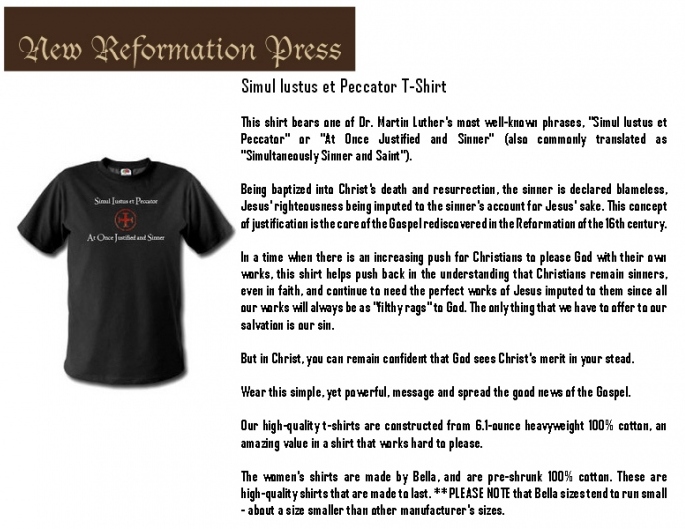
New Calvinist (like Al Mohler, John Piper, Jerry Bridges, John MacArthur, etc.) have a new t-shirt that can be proudly worn to protest what the apostle Paul wrote to the Corinthians:
“So we make it our goal to please him, whether we are at home in the body or away from it” (2Cor. 5:9).
New Calvinist will have no part of that! In Part, the ad reads as follows:
“In a time when there is an increasing push for Christians to please God with their own works, this shirt helps push back in the understanding that Christians remain sinners, even in faith, and continue to need the perfect works of Jesus imputed to them since all our works will always be as ‘filthy rags’ to God. The only thing that we have to offer to our salvation is our sin. But in Christ, you can remain confident that God sees Christ’s merit in your stead.”
Yes, that’s what the apostle Paul said. He said “we” (subjective personal pronoun) make (verb) it (direct object) “our” (possessive pronoun ) “goal” (predicate nominative) to please him (prepositional phrase). Yep, he said it’s our work in sanctification. Of course, any idiot should know that it must be either ALL the Spirit or ALL of us, it can’t be both; and surely, Christ must have misspoke when He called the Holy Spirit our “helper.”
The Sonship / New Calvinist / Gospel Sanctification crowd also apposes Paul’s idea that we don’t “remain sinners”:
“Therefore, if anyone is in Christ, he is a new creation; the old has gone, the new has come!” (2Cor. 5:17).
And then there is Paul’s stupid idea that Christ will judge the works of Christians when they are really all His to begin with, and some of our supposed works will be good works! (the good works Tim Keller says we should repent of):
“For we must all appear before the judgment seat of Christ, that each one may receive what is due him for the things done while in the body, whether good or bad” (2Cor. 5:10).
Here is a jpeg representation of the ad:

 Paul's Passing Thoughts
13 comments