My Detractor Stated it Well: Why John Calvin and His Followers are Heretics
 I have a detractor who has stated one of my positions against the Reformed false gospel very well. I want to capture his assessment in this post, and it will be used in two of my upcoming books; TTANC 2, and The Reformation Myth. Here is the statement:
“Paul Dohse takes exception with Calvinism not because its evil, not because of predestination, not because of its easy believism that rejects morality. Nope. He takes exception with it because it thinks that the Law is the standard of justification, and Paul (the so-called apostle, not Dohse) says that it’s impossible that any law could ever GIVE life. Here is Dohse quoting himself from the article at the top of the article:
‘Moreover, the Apostle Paul states with all certainty that there is NO law that can give life. If Christ kept/fulfilled/keeps the law for us in order to keep us justified, that is saying that there is a law that can give life.’
So Dohse’s problem with Calvinism is that he thinks it contradicts Paul’s heresy in Galatians 3:21
Is the law then against the promises of God? God forbid: for if there had been a law given which could have given life, verily righteousness should have been by the law. (Galatians 3:21 KJV)
The problem here is that Dohse has accepted Paul’s FALSE premise that we need to be GIVEN life” (James Jordan: Descriptive Grace blog; Paul Dohse’s pointless struggle against Calvinism while continuing to accept Paul’s Galatian heresy, Sept. 7, 2013).
Right he is, I have accepted that premise, and he states my position on NO law in justification very well. If the law has to be upheld perfectly to maintain our justification, as taught by the Reformers, the law is giving life. Who keeps it is beside the point.
That’s one reason among many why Calvinism is a false gospel.
paul
Inseparable: The Reformation’s Principles of Persecution and its Gospel, Part One
 You can’t separate the gospel of the Reformation from New Calvinism, and you can’t separate that gospel from its practice. Part and parcel with the Reformation gospel is the insistence that church and state be united for the purpose of purifying “the realm.” The church is over the spiritual and the sacraments, and the civil magistrate should enforce the edicts of the church. The civil authorities may have oversight of practical matters, but to not enforce the edicts of the church in spiritual matters is to override God’s “power of the keys.” Ultimately, the state is the servant of the church. Be sure of this: the present-day New Calvinist movement sees America as a rogue government unwilling to submit to the power of the keys. They will gravitate towards any party willing to get in bed with the church as opposed to a government that is contra principles of persecution. The Reformation was predicated on principles of persecution.
What we need to understand in situations like the SGM class action lawsuit is that Mahaney et al think they are being subjected to authority that God has not approved. They will improvise as much as possible in creating a persecuting sub-culture while working to bring America into the beginnings of a church/state government, and any kind of ugliness thereof would be better than what we have now. Also, the outright rejection of an idea that the New Calvinist tsunami is a segue to remarriage with Rome and the prophesied coming super church/state empire of the antichrist is a naïve out of hand dismissal.
The persecuting principles of the Reformers were its first cries coming forth from the womb; specifically, in Scotland where the Reformation first found formidable life. This series of posts are based on William Marshall’s The Principles of the Westminster Standards Persecuting (William Marshall, D.D., Coupar – Angus. Edinburgh: William Oliphant & Co. 1873).
The book’s inside cover quotes contemporaries of the Reformation to frame the thesis of the book:
Persecution is the deadly sin of the Reformed churches, that which cools every honest man’s zeal for their cause, in proportion as his reading becomes more extensive—Hallam.
In regard to this thesis, every holocaust has had its cowardly bystanders wearing the uniform of the prosecutors while raising a safe objection. The following statement by John Owen exemplifies such:
I know the usual pretenses for persecution. “Such a thing is blasphemy,” but search the Scriptures, look at the definitions of divines, and you will find heresy, in what head of religion soever be, and blasphemy very different. “To spread such errors will be destructive to souls.” So are many things which yet are not punishable with death. Let him who thinks so go kill Pagans and Mahometans. “Such a heresy is a canker,” but is a spiritual one, let it be prevented by spiritual means; cutting off men’s heads is no proper remedy for it. If state physicians think otherwise, I say no more, but I am not of that college—Owen.
So, I disagree, but if the state agrees with the church, well, then I have to bow to their authority, but I disagree. And such will be the commentary of some New Calvinists if they ever obtain force from the state which apparently makes the sin sanctified—the fact that there are some goodhearted souls within the movement. Good men should keep their peace while heads roll because to label the movement as tyranny would be a “generalization.” The ideology is not to blame, only the men who don’t see things exactly the way we see them. The persecuted should also understand this and shrug their shoulders in agreement while gladly placing the noose around their own neck voluntarily.
In regard to the Scottish Reformers, Marshall stated the following:
The Protestant Reformers in leaving Rome did not leave all Romanism behind them. In particular, they brought with them the prosecuting principles of Rome, and worked them freely and vigorously in support of the Reformed faith. They changed the Pope but not the popedom,
And….
Rightfully and nobly did the Protestant Reformers claim religious liberty for themselves; but they resolutely refused to concede it to others.
John Knox, the vaunted Scottish Reformer, though primarily concerned with Catholicism, made it clear that no aberration of Reformed doctrine should be tolerated by the state. According to Marshall:
Knox, the father of the Scottish Reformation, and the presiding genius of it, brought with him to his native country the Geneva theocracy; and it was copied as closely as the differences between the Swiss republic and the Scottish monarchy would permit….Such was the Church and State system of the Scottish Reformers in those days; and hence the melancholy selections from their history which I have now to offer.
The first Parliament, in which the Reformers became ascendant, was held in 1560. It adopted a Protestant Confession; a “summary of tenets constituting the essence of the Reformed religion;” one of the “tenets” being the theocratic one, “that to kings and rulers it belongs to reform and purify religion.”
Marshall continued to state that the same Confession prohibited the practice of Catholicism or any other aberration of the Reformed gospel, and such violations would entail confiscation of goods for the first offence, “suffering” and “banishment” for the second, and “death” for the third violation. Marshall then concludes:
Thus the very first legislation of the Scottish Reformers was deeply tainted with persecution.
Marshall continues:
The same year [1561] the First Book of Discipline was framed by a Committee of the Kirk, of which John Knox was a leading member….”Seeing that Christ Jesus is He whom God the Father hath commanded onely to be heard and followed of His sheepe, we judge it necessary that His gospell be truly and openly preached in every church and assembly of this realme; and that all doctrine repugnant to the same be utterly repressed, as damnable to men’s salvation….that the obstinate maintainers and teachers of such abominations ought not to escape the punishment of the civill magistrate….We dare not prescribe unto you what penalties shall be required of such, but this we fear not to affirm, that the one and the other deserve death.”
Apart from this committee, according to Marshall, Knox stated the following in a public sermon:
None provoking the people to idolatry ought to be exempted from the punishment of death.
I will conclude this first part with Marshall’s assessment of how the Scottish Reformers took control of the Scottish press:
Our early Reformers claimed like control over the press. “Immediately after the Reformation, the General Assembly took particular notice of the four printing presses then in Scotland, and they were careful that nothing should be published, at least by ministers, till it was communicated to the brethren, and revised by persons appointed by them.”
Marshall’s book is widely available and cites extensive sources. It should have its own place on every Christian’s bookshelf. In part two, we will look at Marshall’s assessment of persecuting principles found in the Westminster Confession.
paul

Free download: tancpublishing.com
The Book of Life: Another Lost Biblical Doctrine
 “Whether Protestants know it or not (that’s you), we all either believe this directly or we function that way. We are all good theologians of the cross. Luther would be proud of all of us. It’s a family tradition… Like Luther, we delight in the ‘simplicity of faith.’ Like Luther, we believe that thinking, reasoning, etc. is a filthy whore who should ‘have dung rubbed in her face to make her ugly’…. Hope of an objective future, and life wisdom, assumes that we are able to think through those things and apply them to our lives. To the Protestant, that is an ugly whore.”
Protestantism, which includes Baptists et al, is dumbed down by ecclesiastical design. On April 25, 1518, Martin Luther declared war on the priesthood of believers and sanctification via his declaration of Reformed theology in Heidelberg, Germany. The 95 Thesis was a moral treatise against Rome six months prior, but the Heidelberg Disputation was the very foundation of Reformed ideology. It called on theologians to interpret all of reality from a dual perspective: the glory story or the cross story.
True theology (the cross story) would look at man as worthless and empty with eyes of faith that can only see outward to the glory of God. This made all reality good as the sum equation of God’s goodness and man’s evil. So, tragedy only reflects man’s worthlessness and his deserved plight and the glorification of God following. The glory story was anything that recognized anything IN man at all. No goodness or grace is infused into man. True theology is a purely outward look, and only looks within to find reason for repentance that then glorifies God (“deep repentance”). Luther believed that man can experience the grace of God, but cannot participate in it. That would be works salvation. Man must empty himself to be saved and remain empty till the final judgment.
Hence, any notion that man could become good through salvation was deemed heretical, and a damning false gospel. In many ways, it was predicated on the Platonist idea that all matter is evil, and that would of course include man. The first sentence of the Calvin Institutes (CI 1.1.1) is based on Luther’s dual construct, and then the rest of the Institutes build a full metaphysical statement on the foundation of that first sentence. Pretty impressive. In that sentence, Calvin states that all wisdom is derived from a knowledge of us and knowledge of God. The two opposites define each other. Both Calvin and Luther were followers of Augustine who was the undisputed first and foremost integrationist in Western culture. Plato integrated Eastern mysticism with Western science, and Augustine integrated Platonism with the Bible. A cursory observation of world history makes this plain.
Therefore, the good Luther/Calvin cross theologian heartily agrees with, “study to show thyself approved, a workman that need not be ashamed.” But in the Protestant construct that redefines sanctification (and actually rejects it totally), what does “study” mean? What does “approved” mean? And what does “workman” mean? The Reformers did not believe anybody is approved. They believed work in sanctification (the Christian life) was equivalent to works salvation. Augustine, Luther, and Calvin believed baptism replaced circumcision, and sanctification replaced the Old Testament Sabbath Rest. Working on the Sabbath would bring death, and in the same way, working in sanctification also brings death (John King: The Complete Bible Commentary Collection of John Calvin; Genesis, Ch.2 sec.3, Ch.17 sec.13. Ibid: The Harmony of the Law, Due. 5:12-15, sec. 15).
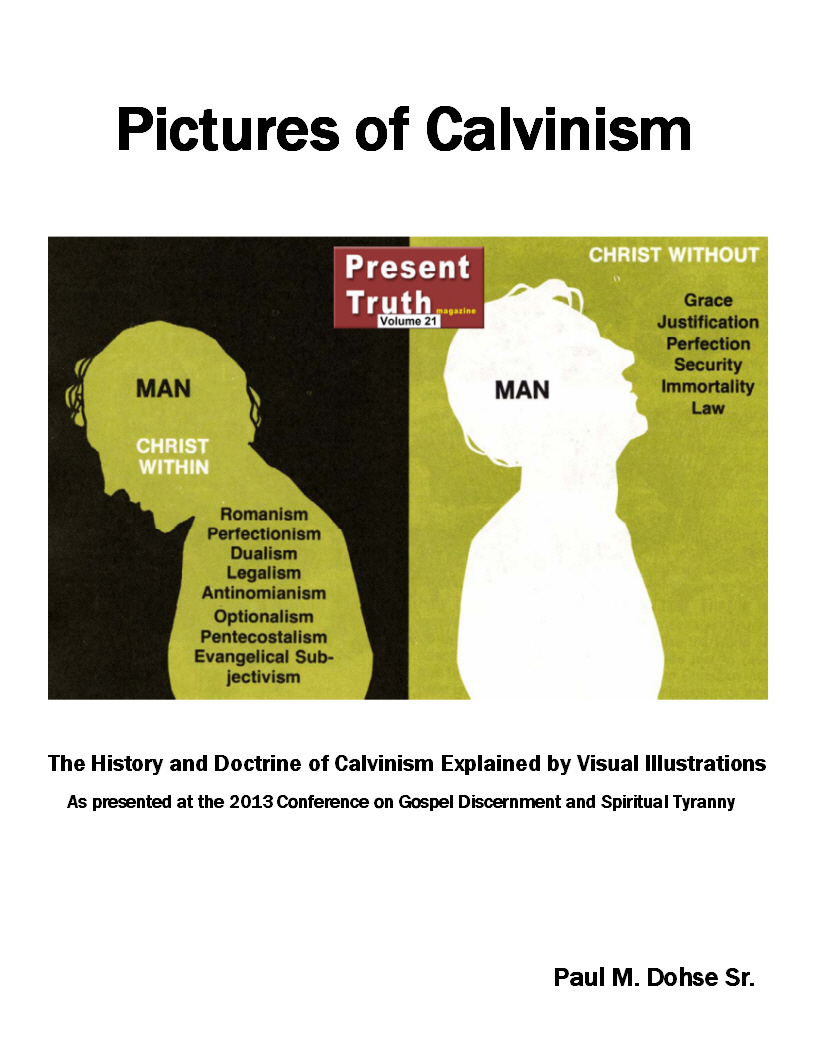
So, “study” is really a focus on what ANY Bible text says about mankind’s wretched, sinful existence as opposed to God’s holiness. When the equation is seen, a steady flow of Christ’s obedience is imputed to our account and we remain justified. These manifestations may, or may not be experienced, but if they are, it is in the realm of the subjective where even the experience cannot be somehow attributed to us. This selfless, daily bearing of the cross and dying to self will lead to joy, but we do not know if this joy is directly linked to a Christ manifestation. The gospel is objective and remains outside of us, but is experienced subjectively. Any inward focus leads to inward subjectivity and as John Piper stated it, “imperils the soul.” See post illustration. It is merely an application of Eastern Mysticism to make sanctification by justification possible.
This is why Luther despised reason and called it a prostitute that should have “dung” rubbed in her face to “make her ugly.” Reason is the glory story. Our ability to reason has to do with an inner ability apart from God. Our “study” is limited to seeing the cross more by a greater and greater realization of our God unlikeness. Our “work” is this study and contentment in the ruin that God has sovereignly placed us in. But of course, “Contentment with godliness is great gain.” That is knowing our own place in the caste system which is sovereignly determined by birth. Supposedly, working hard at being content in our own wretched station of life is not work—it’s faith. Problem is, Luther et al considered that to be saving faith as long as it is practiced in sanctification. You do the math. There is a standard for what isn’t work in sanctification and what is work in sanctification for the purpose of remaining justified.
That is why we argue That justification must be a finished work separate from our Christian life.
But this finally brings me to my point. Whether Protestants know it or not (that’s you), we all either believe this directly or we function that way. We are all good theologians of the cross. Luther would be proud of all of us. It’s a family tradition. Look around, that’s why few Christians know theology or doctrine. In fact, such ignorance in American church culture is a Lutheran badge of honor. Like Luther, we delight in the “simplicity of faith.” Like Luther, we believe that thinking, reasoning, etc. is a filthy whore who should “have dung rubbed in her face to make her ugly.”
Meanwhile, Christians do not know the difference between sanctification and justification, covenants, promises, prophecy, and things like “the book of life.” Why would they? If every verse in the Bible is about how wicked we are as set against God’s holiness, why would we know about those actual BIBLE WORDS. Those aren’t theological words; those are words that are in the Bible.
There is a kind of Christianity in our day that has become extinct. It presumes that if you want to have peace, you have to plan for it. They believe that plan is found in biblical wisdom. Gaining wisdom + planning + applying = peace/happiness. This is opposed to the traditional Christianity of our day that assumes the Bible is not for that purpose. The assumption is that the Bible is a tool for salvific contemplationism that results in subjective manifestations of happiness.
Hope of an objective future, and life wisdom, assumes that we are able to think through those things and apply them to our lives. To the Protestant, that is an ugly whore.
The Book of Life is a massive untapped biblical subject that is a major Segway to additional understanding. For you election buffs, you might be interested in knowing that a cursory study of the subject seems to indicate that EVERYONE born into the world is initially written in the book of life. If that is true, that has major theological implications.
One of the myths about the Reformation is that it made the printed Bible available to the masses. That’s true to a point, but along with increased availability came a distorted purpose in describing its use. This protestant tradition of keeping congregants dumbed down in our day with Lutheran epistemology is exemplified by projects like BibleMesh. These programs find their roots in the Lutheran tradition.
This is why after contemplating the counsel of many different people, I have decided to not screen comments on this blog while I realize that I need a moderator desperately. While the Potter’s House may be a different story, this blog does not seek to protect people from having to stand on their own two cranial hemispheres. People who come here challenge my readers to study new concepts for themselves. The Book of Life issue was in fact brought up by one of those visitors, a doctrine rarely heard of in the church. That’s what inspired this post.
Those who come to the Potter’s House are great thinkers, but yet, the Bible is clear that a local assembly is not an acropolis. There are some who come to PPT that offer strengths that Protestants lack by design: knowledge. It is then up to my readers to show themselves approved.
Moreover, I think the time is nearly upon us when the problem is clearly seen: anti-biblical sanctification. The formal institutionalized church is never going to deal with that because its construct was designed to serve that purpose to begin with. And I don’t think censorship on this blog is a solution by any stretch of the imagination. The solution is to come out from among them while not turning our backs on assembling and fellowshipping with other Christians. An environment where what we learn from the Scriptures is not dictated. A place where we are free to explore EVERYTHING that is in the Scriptures, not just what Luther thought we should know.
Blogs serve to fill that gap until Christians become solution oriented. Leaving church is not the issue, no longer letting control freaks dictate what church is—is the solution, and then acting on it for God’s glory.
paul

A Visual Eschatological Theory
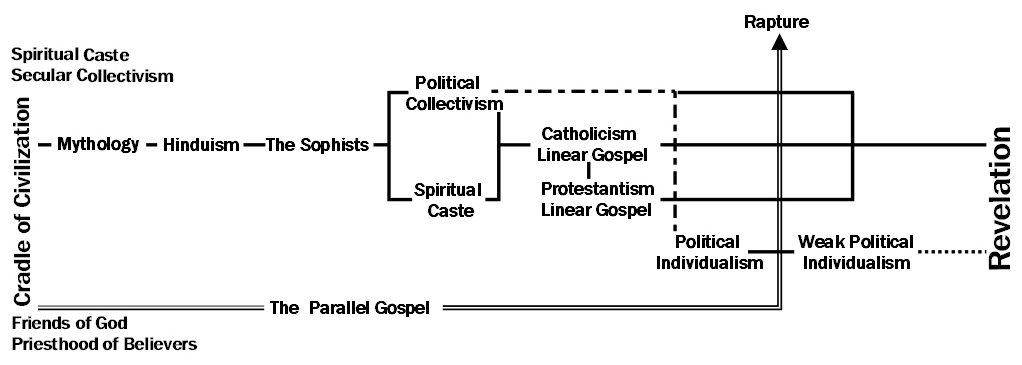
Spiritual Caste Hinduism: https://paulspassingthoughts.com/wp-content/uploads/2012/10/caste.jpg
Spiritual Caste: Protestantism: https://paulspassingthoughts.com/wp-content/uploads/2012/10/caste1.jpg
Catholicism/Protestantism: https://paulspassingthoughts.com/2013/08/13/susan-dohse-on-plato-augustine-calvin-and-the-reformation/
Collectivism/Sophists: https://paulspassingthoughts.com/2013/06/27/tanc-2013-john-immel-the-history-of-western-philosophy-and-its-societal-impact/
Political Individualism: Part 1; http://youtu.be/RcNwi1kMlNs Part 2; http://youtu.be/-aAvSTlbx3c Part 3; http://youtu.be/mzS7KOnyo9E
The Linear Gospel: https://paulspassingthoughts.com/wp-content/uploads/2013/06/linear-gospel-1.jpg
The Parallel Gospel: https://paulspassingthoughts.com/wp-content/uploads/2013/06/parallel-gospel-1.jpg
Protestant Gospel Metaphysics and Epistemology: https://paulspassingthoughts.com/wp-content/uploads/2013/06/pictures-of-calvinism.pdf

 Paul's Passing Thoughts


19 comments