The Potter’s House: Romans 14:1; Should We Invite Unbelievers to Church?

We come now to the first verse of chapter 14 in our Romans study. I want to begin by reminding us of a very important issue in regard to studying the Bible individually and understanding it. What I have found in the last few years is that most of what you need to understand the Bible is in the Bible itself. Yes, I am a big grammatical historical guy, and a study of history and culture is helpful in regard to Bible study, but the grammatical is most important. Just let the words say what they say. Take the words at face value.
Let me give you the prime example of that in my own life. I approached Romans with this principle: forget all of your presuppositions, and just let the words say what they say. I began to notice the use of the word “law” a lot in the book of Romans; the law of this, and the law of that, etc. What did Paul mean by the different references to law and was he speaking of the literal written law, or realms, or spiritual laws, or laws of nature?
Upon investigation, I discovered that the simple literal evaluation demanded these references to law to be a literal written law. In all cases, the word used was nomos while there are other Greek words for realm, a force of nature, etc. You don’t need to be a Greek scholar to determine that by any stretch of the imagination. This revelation has made the whole Bible fit together for me. Prior to that, presuppositions taught to me by others was an extreme hindrance to understanding the word of God.
Also, in our study of Romans, context is extremely important, so what is the context of Romans 14? Paul was the apostle of the Gentiles. His calling was the “mystery of the gospel.” What is that? Well, let’s see:
Ephesians 3:1 – For this reason I, Paul, a prisoner for Christ Jesus on behalf of you Gentiles— 2 assuming that you have heard of the stewardship of God’s grace that was given to me for you, 3 how the mystery was made known to me by revelation, as I have written briefly. 4 When you read this, you can perceive my insight into the mystery of Christ, 5 which was not made known to the sons of men in other generations as it has now been revealed to his holy apostles and prophets by the Spirit. 6 This mystery is that the Gentiles are fellow heirs, members of the same body, and partakers of the promise in Christ Jesus through the gospel.
The mystery of the gospel is God’s desire to bring Jew and Gentile together in one body to God’s glory. Think about what kind of power is displayed in a wisdom that brings two diverse cultures together in harmony? As we learned early on in our study, the Christians at Rome obviously understood the gospel of first order; i.e., the death, burial, and resurrection of Christ. Paul wanted to come to them and teach the full-orbed gospel or the full counsel of God to them face to face.
But, he was continually hindered in coming to them, so he decided to write them this treatise instead. Now, why did the Holy Spirit hinder him? It’s obvious; so that Christians in future generations would have this written treatise on the full orbed gospel. We also looked at Paul’s apology in the letter to the Christians at Rome for not being able to come. The Gentiles were deemed as second class citizens in the Judeo Assembly of Christ, and Paul feared that his tarrying in coming would feed this mentality. This is why the first chapters of Romans are a passionate body of doctrine that refutes it. However, by chapter 11, Paul senses that he has made his case very well, and warns the Gentiles against reverse discrimination.
Now listen, the verse we are addressing today may be what incited Paul to panic and the writing of this letter to the Romans. That’s right; we may find ourselves at the issue that sent him running for his quill. Apparently, the Romans had written Paul from time to time about certain issues, and the issue here is what to do about Jews coming into their fellowships. Because of their diversity in the recognition of dietary laws and laws concerning days, should they be allowed in their fellowships? This certainly panicked Paul because this is the crux of the what? Right, mystery of the gospel.
“But Paul, the verse says ‘weak in faith’ not ‘Jews.’” True, but Paul is referring to the Jews. Though the Jews have great advantage in being the overseers of God’s law and His chosen people, the transition from the Old Covenant to the New and its relationship to law has an inherent tendency towards weakness. Paul uses the nomenclature of “weak” in order to not label all Jews accordingly. Many Jews understood the proper relation of law to the New Covenant.
In fact, even though circumcision was no longer required under the New Covenant, Paul had Timothy circumcised in order to get an audience with Jews who still had the conviction that circumcision was required:
Acts 16:1 – Paul came also to Derbe and to Lystra. A disciple was there, named Timothy, the son of a Jewish woman who was a believer, but his father was a Greek. 2 He was well spoken of by the brothers at Lystra and Iconium. 3 Paul wanted Timothy to accompany him, and he took him and circumcised him because of the Jews who were in those places, for they all knew that his father was a Greek. 4 As they went on their way through the cities, they delivered to them for observance the decisions that had been reached by the apostles and elders who were in Jerusalem. 5 So the churches were strengthened in the faith, and they increased in numbers daily.
And what letter (“the decisions”) did they bring with them? The letter from the apostles in Jerusalem concerning the circumcision issue (Acts 15). I must say that Andy’s study in the book of Acts has helped me greatly in understanding what is going on in Romans 14 (see ttanc.com). The judgment of the Apostles was not to burden the Gentiles with being circumcised in order to get along with the weaker Jews, but did tell them to observe some Jewish dietary laws.
The weaker brother is to be “welcomed” and connects with Romans 15:
We who are strong have an obligation to bear with the failings of the weak, and not to please ourselves. 2 Let each of us please his neighbor for his good, to build him up. 3 For Christ did not please himself, but as it is written, “The reproaches of those who reproached you fell on me.” 4 For whatever was written in former days was written for our instruction, that through endurance and through the encouragement of the Scriptures we might have hope. 5 May the God of endurance and encouragement grant you to live in such harmony with one another, in accord with Christ Jesus, 6 that together you may with one voice glorify the God and Father of our Lord Jesus Christ. 7 Therefore welcome one another as Christ has welcomed you, for the glory of God. 8 For I tell you that Christ became a servant to the circumcised to show God’s truthfulness, in order to confirm the promises given to the patriarchs, 9 and in order that the Gentiles might glorify God for his mercy. As it is written,
“Therefore I will praise you among the Gentiles, and sing to your name.”
Who are the “you” in this text? It is the Gentiles that Paul is writing to in the letter. Clearly, Paul addresses the wisdom needed for Gentiles to WELCOME the weaker Jewish brothers into the assemblies WITHOUT quarreling about issues of liberty in accordance to the law. At issue is the very mystery of the gospel. AND, without a doubt, the same principles apply to a myriad of other contrary convictions that can come between people.
Just this week I read an article about a church split over the recognition of Christmas. Yes, it’s true, Christmas was founded on a pagan holiday and we are never commanded in the Bible to recognize Christ’s birthday. But is this an issue of separation? Granted, Halloween is a pagan holiday. Granted, I am not sure that Christian children should dress up like the Devil and werewolves. Nevertheless, should that be an issue of separation resulting in Christians not being welcome?
This has major implications for the home fellowship movement. If we want to see God glorified in the mystery of the gospel, one of the things we can emphasize is unity. Wisdom will be key to seeing the results God wants. Let’s start with another basic principle that can be derived from this text. Those welcome should be believers. Home fellowships should indeed be for the express purpose of fellowship between saved people including those who have a weak view of law.
The assembly of believers is not a place for evangelism. All evangelism should take place outside of home fellowships. The gathering of believers for fellowship and edification is never advocated as a place for evangelism in the New Testament. Where did the idea of invite people to church to get them saved come from? Where did the idea of church “revivals” and alter calls come from? It all came from the advent of the 4th century institutional church and the idea that salvation comes through church membership.
This approach has brought many difficulties into the institutional church. Many church leaders bemoan the fact that unsaved people populate the church in large numbers, but what does one expect when inviting lost people to church has been one of its institutional mandates for more than 500 years? I think the mindset that the assembling of believers together for encouragement and edification is exclusive would make a huge difference in Christianity in and of itself. This approach also removes a lot of, “What if…?” scenarios. When you start trying to apply matters of liberty in a group setting where the born again and unregenerate are meeting together—what you have is a mess!
Look at verses 2 and 3:
One person believes he may eat anything, while the weak person eats only vegetables. 3 Let not the one who eats despise the one who abstains, and let not the one who abstains pass judgment on the one who eats, for God has welcomed him.
Stop right there. Have you ever thought of who God welcomes as a standard for fellowship? The context of what Paul is writing about is Christian fellowships. The question posed to Paul previously was who should be welcome or not welcome. The standard is whoever God welcomes. Do you know what this tells me? God sees Christian fellowship as sacred and very important, and anybody and everybody is not necessarily welcome. This answers a lot of “What if…?” situations, no?
This speaks to a public purpose building in which anything but the kitchen sink can come walking in. It would seem that one of the primary purposes of a Christian assembly is unity along with encouragement and edification. The purpose of unity is at a distinct disadvantage with unbelievers present and defies the primary purpose of Christian assemblies.
This puts the rightful burden of evangelism on the individual Christian. This also necessitates the equipping for evangelism in the assemblies. The focus becomes what individual Christians do outside of Christian fellowship, not bringing people to church to get them saved by an expert evangelist. The focus of assemblies is strengthening and equipping each other for the work of the ministry.
That’s verse 1, next week we will further develop Paul’s prescription for unity in the assemblies regardless of varying convictions.

Romans 13:14B; Part 1, “Overcoming Sin and Living Righteously, a Righteous Life of Real and Lasting Change”

“I only have ONE comment concerning all of the drama that is part and parcel with the institutional church: ‘under law.’ That’s it. To be under law is to be cut off from bearing fruit for God. To be under law is to be cut off from its life and love.”
“This whole idea dominating the institutional church that Jesus keeps the law for us or, ‘Christ 100% for us,’ cuts off ‘life and peace’ from God’s people…The idea that we are still sinners and need to return to the cross daily to keep our sins covered is the blue chip of satanic gospels.”
“We are NOT sinners, we are saints. If we do not know this, sin will rein in our lives—it will be empowered by condemnation. The first step to living a life of change is to know that we are no longer condemned.”
As I reviewed Romans 13:14 in preparation to move on in our Romans study via 14:1, I noticed that the primary focus of our last study was the first part of 13:14 and we emphasized putting off sin and putting on Christ. In this study, I want to pause and focus on the second part of 13:14: Paul’s command to not “gratify” the “desires” of the “flesh.”
Let’s be clear and concise: what distinguishes the home fellowship movement from the institutional church follows: we believe that Christians are not only declared righteous, we are in fact personally righteous. We are perfect because there is no law to condemn us, and we possess the same desires of the Holy Spirit. The sin we commit in our Christian lives is sin against the fellowship of our heavenly family, and cannot remove us from our sonship. We only sin because we remain in these mortal bodies that tempt us with contrary desires which we sometimes “gratify.”
The institutional church, by and large does not believe this. Because Christians supposedly remain unrighteous, their sins need to be covered until the return of Christ, and the institutional church supplies that covering. Of course, there are varied doctrinal opinions regarding the “correct” process for keeping our sins covered, but it is usually referred to as “absolution.” The vast majority of institutional churches came from either Catholicism or Protestantism, and though most professing Christians assume that Protestantism is not predicated on absolution, this is NOT true at all. Both are clearly salvation by an institution given authority on earth by God to forgive sins. John Calvin and Martin Luther, the undisputed co-fathers of Protestantism state this fact throughout their writings in no uncertain terms.
Home fellowships believe our sins are ended, not merely covered. The institutional church believes that we need a continued covering because we are still sinners because we sin. This keeps Christians under [the] law which is the biblical definition of a lost person. Protestants think that is ok because Christ fulfilled/fulfills the law for us, but Christ didn’t come to uphold justification by law-keeping, He came to end the law and all of the sin that is imputed to it—justification is apart from the law.
This fact also clears up a lot of confusion about the Old Covenant versus the New Covenant. The Old Covenant, though passing away (Hebrews 8:13), still has a function: all sin that condemns is imputed to it. When someone believes in the death, burial, and resurrection of Christ; the law, its condemnation, and all of the sin imputed to it are ended for that individual. They are no longer under law, but under grace (Romans 6:14).
Another very important thing to know about being under law follows: it is where sin gets its power over people. Of course, if we believe Christians can overcome sin and live righteously, the belief that we are no longer under law is vital. The law’s ability to condemn is what gives sin its power:
1Corinthians 15:56 – The sting of death is sin, and the power of sin is the law. 57 But thanks be to God, who gives us the victory through our Lord Jesus Christ. 58 Therefore, my beloved brothers, be steadfast, immovable, always abounding in the work of the Lord, knowing that in the Lord your labor is not in vain.
Romans 7:4 – Likewise, my brothers, you also have died to the law through the body of Christ, so that you may belong to another, to him who has been raised from the dead, in order that we may bear fruit for God. 5 For while we were living in the flesh, our sinful passions, aroused by the law, were at work in our members to bear fruit for death. 6 But now we are released from the law, having died to that which held us captive, so that we serve in the new way of the Spirit and not in the old way of the written code.
7 What then shall we say? That the law is sin? By no means! Yet if it had not been for the law, I would not have known sin. For I would not have known what it is to covet if the law had not said, “You shall not covet.” 8 But sin, seizing an opportunity through the commandment, produced in me all kinds of covetousness. For apart from the law, sin lies dead. 9 I was once alive apart from the law, but when the commandment came, sin came alive and I died. 10 The very commandment that promised life proved to be death to me. 11 For sin, seizing an opportunity through the commandment, deceived me and through it killed me. 12 So the law is holy, and the commandment is holy and righteous and good.
What does it mean that the law “held us captive” before we were saved? That is answered from the book of Galatians:
Galatians 3:21 – Is the law then contrary to the promises of God? Certainly not! For if a law had been given that could give life, then righteousness would indeed be by the law. 22 But the Scripture imprisoned everything under sin, so that the promise by faith in Jesus Christ might be given to those who believe.
23 Now before faith came, we were held captive under the law, imprisoned until the coming faith would be revealed. 24 So then, the law was our guardian until Christ came, in order that we might be justified by faith. 25 But now that faith has come, we are no longer under a guardian, 26 for in Christ Jesus you are all sons of God, through faith. 27 For as many of you as were baptized into Christ have put on Christ.
So, the idea of being enslaved to the law is to be under its condemnation. Sin feeds on the ability to condemn. It is interesting to note that regardless of the fact that there is “now no condemnation” (Rom 8:1) for Christians, Satan is the “accuser of the brethren.”
Look, the issue of condemnation is a big deal. This is where sin gets its power. Watch out for condemnation. Gospels that keep people under the law will often be predicated by lots of condemnation. Do you now understand why, as a Protestant, primarily of the Baptist variety, that you go to church week after week and hear about what a bad person you are even as a Christian? That’s because you are still under the law.
Listen, it doesn’t matter if Jesus supposedly keeps the law for you, if you can’t keep it, you are still under it (See Romans 8, nothing is clearer). Any doctrine that indicates that all bets are off if you can’t keep the law perfectly, or that you can’t please God on any wise save obedience to the one idea that the former is true, is an under law/under condemnation very bad news gospel. In fact, many in the Reformed camp are often heard saying the following: the idea that you can please God by keeping the law is just, “more bad news,” “pretending,” and “trying to gain merit with God” etc.
But another bad angle on being under law and its condemnation is the fact that Christians are cut off from the life of the law. I only have ONE comment concerning all of the drama that is part and parcel with the institutional church: “under law.” That’s it. To be under law is to be cut off from bearing fruit for God. To be under law is to be cut off from its life and love. Please note the following:
Romans 7:7 – What then shall we say? That the law is sin? By no means! Yet if it had not been for the law, I would not have known sin. For I would not have known what it is to covet if the law had not said, “You shall not covet.” 8 But sin, seizing an opportunity through the commandment, produced in me all kinds of covetousness. For apart from the law, sin lies dead. 9 I was once alive apart from the law, but when the commandment came, sin came alive and I died. 10 The very commandment that promised life proved to be death to me. 11 For sin, seizing an opportunity through the commandment, deceived me and through it killed me. 12 So the law is holy, and the commandment is holy and righteous and good.
When Paul states, “The very commandment that promised life proved to be death to me,” that isn’t a hypothetical or the law promising a pipe dream, it is a statement of fact: the law does promise life, and in fact gives life to those who are not under it. When you are under grace, the law gives life, when are under law, the law only bears fruits of death. What is more obvious in the Scriptures?
Romans 7:4 – Likewise, my brothers, you also have died to the law through the body of Christ, so that you may belong to another, to him who has been raised from the dead, in order that we may bear fruit for God.
Romans 8:1 -There is therefore now no condemnation for those who are in Christ Jesus. 2 For the law of the Spirit of life has set you free in Christ Jesus from the law of sin and death. 3 For God has done what the law, weakened by the flesh, could not do. By sending his own Son in the likeness of sinful flesh and for sin, he condemned sin in the flesh, 4 in order that the righteous requirement of the law might be fulfilled in us, who walk not according to the flesh but according to the Spirit. 5 For those who live according to the flesh set their minds on the things of the flesh, but those who live according to the Spirit set their minds on the things of the Spirit. 6 For to set the mind on the flesh is death, but to set the mind on the Spirit is life and peace. 7 For the mind that is set on the flesh is hostile to God, for it does not submit to God’s law; indeed, it cannot. 8 Those who are in the flesh cannot please God.
This whole idea dominating the institutional church that Jesus keeps the law for us or, “Christ 100% for us,” cuts off “life and peace” from God’s people. This is why church is at worst boring, repressive, and depressing, and at best repetitious. You can dress it up with contemporary décor, programs, and praise music all you want to, but it will eventually go the way of Mark Driscoll’s Mars Hill dynasty. Why is it like this? Because you are under law and cut off from the law’s life and peace that comes from being under grace. Your sin is not ENDED, it is only covered by allegiance to the institutional church and its bogus authority.
Be sure of this: all of the rage about Joel Osteen is a pushback against 500 years of incessant condemnation. For the first time since anybody can remember, you can actually go to church without getting your weekly dose of deserved condemnation. Sure, he offers a cheap substitute for discipleship, and only time will tell where that will end up, but for now, this is what you are seeing. Susan and I went to an institutional church yesterday for a school project she is working on and we received our weekly dose of condemnation through the whole worn-out “forgive others as Christ forgave you” motif. It’s blank check forgiveness written on funds from the bank of moral equivalency. Basically, it teaches that all of humanity is equally evil; i.e., here we go again, “under law.” That’s where all of these ideas come from fundamentally. A transfer from death to life only regards a position in Christ and not a practical application in Christ other than the one obedience to the idea that we can’t keep the law perfectly so all bets are off.
There has been a lot of conversations recently on PPT regarding T-shirts, a lot of it is just pun, but seriously, let me recommend a T-shirt that will give you massive opportunities to present the gospel—especially to the Reformed. In big letters, “Yes, as a matter of fact, I AM PERFECT,” or simply, “I’m Perfect.” This will invoke comments from the Reformed like vultures are attracted to road kill. The conversations will go something like this:
Them: “That’s an interesting T-shirt you are wearing, what exactly do you mean by it?”
You: “Pretty much what it says, ‘I’m perfect.’”
Them: “Oh, you mean to say that you are ‘perfect in Christ.’”
You: “No, I am not only perfect in Christ, I am in fact perfect.”
Them: “Oh, so you didn’t sin today?”
You: “See, that statement right there tells me that you believe a false gospel.”
Them: “How so?”
You: “Because obviously, you believe perfection to the law is what justifies us when in reality we are justified apart from the law, and where there is no law there is no sin.”
Them: “No, I agree with you, there is no law in Christ.”
You: “No, you do not agree with me, you are saying that there is no law for us to keep because Jesus keeps it for us, but we are still under it; yet, it doesn’t matter who keeps it, we are either under law or under grace. Your very statement about sin indicates that you see sin against justification and sin against God’s family (or grieving the Holy Spirit; Eph 4:30) as the same thing—we are still under law in your mind. Sin for us is not ended, it is only covered by Christ’s obedience and not ours which also separates us from the life, peace, and fruits of the Spirit received as those under grace.
If Satan cannot hoodwink us into remaining under law, he will at least try to empower sin within us through condemnation. Be careful my friends, a critical spirit towards others is often the spirit of condemnation seeking to inflame sin within others. In the Old Testament, we have a very vivid picture of this:
Zechariah 3:1 – Then he showed me Joshua the high priest standing before the angel of the Lord, and Satan standing at his right hand to accuse him. 2 And the Lord said to Satan, “The Lord rebuke you, O Satan! The Lord who has chosen Jerusalem rebuke you! Is not this a brand plucked from the fire?” 3 Now Joshua was standing before the angel, clothed with filthy garments. 4 And the angel said to those who were standing before him, “Remove the filthy garments from him.” And to him he said, “Behold, I have taken your iniquity away from you, and I will clothe you with pure vestments.” 5 And I said, “Let them put a clean turban on his head.” So they put a clean turban on his head and clothed him with garments. And the angel of the Lord was standing by.
Presently, Satan is allowed access to heaven and he uses the privilege to condemn us. He is called the “accuser of the brethren.” The Bible states that Christ intercedes for us in regard to these accusations. Not only do we see this type of activity by Satan clearly in the book of Job, but we see Christ interceding for Peter while he was among the disciples (Luke 22:31,32). This is a ministry of intercession that Christ presently performs for us in heaven and is often confused with intercession concerning justification which is a finished work.
There is NOW no condemnation for us, and beware of spiritual bumper stickers that condemn us: “We are all just sinners saved by grace.” These are satanic ploys meant to condemn us and empower sin within us. Sin is empowered by the law’s condemnation.
We are NOT sinners, we are saints. If we do not know this, sin will reign in our lives—it will be empowered by condemnation. The first step to living a life of change is to know that we are no longer condemned. The idea that we are still sinners and need to return to the cross daily to keep our sins covered is the blue chip of satanic gospels.
Next week, we will look at the other concrete elements critical to the subject at hand. We have looked at “condemnation,” “perfection,” “life,” “love,” “peace,” and “law” this morning, we will also, Lord willing, look at “sin,” “flesh,” “weakness,’ “love,” and the primary crux, “desire.”
Jonathan Edwards: The Homeboy of Eastern Mysticism
A prerequisite for Gnostic Watch Weekly 10/31/2014:
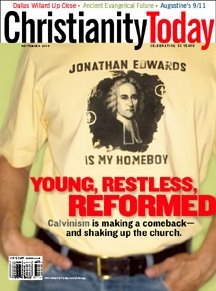
Materials for discussion:
http://en.wikipedia.org/wiki/Idealism
Comment thread: https://paulspassingthoughts.com/2014/10/24/tweet-tweet-authority/
The Potter’s House: The Three Exchanges of True Biblical Atonement
Originally posted March 9, 2014


We are inserting another interlude into our Romans series, the very important subject of atonement.
A clear definition of the word atonement, or at-onement, is critical to the discussion. The word primarily means to be reconciled as “onement” would imply. Unfortunately, atonement is often defined as “a covering” which is not the primary meaning of the word. “Covering” is not consistent with the idea of things separated becoming one. Mankind is at enmity with God and needs to be reconciled to Him.
It could be argued that covering is the result of reconciliation, but really, the result is an EXCHANGE. The exchange can be best summarized as an exchange of death for life. According to John J. Parsons, author of Hebrew 4 Christians .com, the English translation for the Jewish Day of Atonement is Yom Kippur which can mean “ransom,” “substitute,” or “redeem.” In Parson’s estimation, the overarching idea is an exchange of one life for another.
The idea of a covering for sin in the way you would cover something over to hide it is prevalent in the Old Testament. The word for covering something over appears in the Old Testament roughly 160 times, and about half of those pertain to a covering of sin. These are variations of kipur, kapar, kasa, and are usually translated in English as “cover” or “atonement.” The word atonement has a late etymology (16th century) and has religious implications. This shouldn’t surprise us because the Old Testament pointed to the eradication of sin on the cross while the Old Covenant covered, or held sin captive until Christ exchanged His life for ours:
Galatians 3:21 – Is the law then contrary to the promises of God? Certainly not! For if a law had been given that could give life, then righteousness would indeed be by the law. 22 But the Scripture imprisoned everything under sin, so that the promise by faith in Jesus Christ might be given to those who believe.
23 Now before faith came, we were held captive under the law, imprisoned until the coming faith would be revealed. 24 So then, the law was our guardian until Christ came, in order that we might be justified by faith. 25 But now that faith has come, we are no longer under a guardian, 26 for in Christ Jesus you are all sons of God, through faith.
In the New Testament, the word atonement doesn’t appear. The KJV translates katallage as atonement, but elsewhere in Romans 5:10,11, 11:15, 1Cor 5:18, 7:11, 2Cor 5:19,20, the only other places the word appears, it is translated “reconciliation” or to be reconciled.
The word for “cover” in the New Testament (kalypto) appears four times; once for the admonishment to not use our freedom as a covering for sin (1Pet 2:16); twice in regard to love covering sin among Christians (1Pet 4:8, James 5:20), and one Old Testament reference to Psalm 32:1,2 in Romans 4:7. But the real test is in the Old Testament narratives which exemplify EXCHANGE. The first is the account of Abraham and Isaac:
Genesis 22:1 – After these things God tested Abraham and said to him, “Abraham!” And he said, “Here I am.” 2 He said, “Take your son, your only son Isaac, whom you love, and go to the land of Moriah, and offer him there as a burnt offering on one of the mountains of which I shall tell you.” 3 So Abraham rose early in the morning, saddled his donkey, and took two of his young men with him, and his son Isaac. And he cut the wood for the burnt offering and arose and went to the place of which God had told him. 4 On the third day Abraham lifted up his eyes and saw the place from afar. 5 Then Abraham said to his young men, “Stay here with the donkey; I and the boy will go over there and worship and come again to you.” 6 And Abraham took the wood of the burnt offering and laid it on Isaac his son. And he took in his hand the fire and the knife. So they went both of them together. 7 And Isaac said to his father Abraham, “My father!” And he said, “Here I am, my son.” He said, “Behold, the fire and the wood, but where is the lamb for a burnt offering?” 8 Abraham said, “God will provide for himself the lamb for a burnt offering, my son.” So they went both of them together.
9 When they came to the place of which God had told him, Abraham built the altar there and laid the wood in order and bound Isaac his son and laid him on the altar, on top of the wood. 10 Then Abraham reached out his hand and took the knife to slaughter his son. 11 But the angel of the Lord called to him from heaven and said, “Abraham, Abraham!” And he said, “Here I am.” 12 He said, “Do not lay your hand on the boy or do anything to him, for now I know that you fear God, seeing you have not withheld your son, your only son, from me.” 13 And Abraham lifted up his eyes and looked, and behold, behind him was a ram, caught in a thicket by his horns. And Abraham went and took the ram and offered it up as a burnt offering instead of his son. 14 So Abraham called the name of that place, “The Lord will provide”; as it is said to this day, “On the mount of the Lord it shall be provided.”
15 And the angel of the Lord called to Abraham a second time from heaven 16 and said, “By myself I have sworn, declares the Lord, because you have done this and have not withheld your son, your only son, 17 I will surely bless you, and I will surely multiply your offspring as the stars of heaven and as the sand that is on the seashore. And your offspring shall possess the gate of his enemies, 18 and in your offspring shall all the nations of the earth be blessed, because you have obeyed my voice.” 19 So Abraham returned to his young men, and they arose and went together to Beersheba. And Abraham lived at Beersheba.
The angel of the Lord waited long enough to establish the fact that Isaac was as good as dead before stopping Abraham. The ram was then sacrificed in place of Isaac—this is an exchange of death for life. We learn from Hebrews that Abraham assumed God was going to raise Isaac from the dead, so Abraham may have understood far more about the coming Messiah than we would imagine (Heb 11:1-19).
The next example may be sanctified speculation, but I would like to enter it into the lesson:
Hebrews 11: 4 – By faith Abel offered to God a more acceptable sacrifice than Cain, through which he was commended as righteous, God commending him by accepting his gifts. And through his faith, though he died, he still speaks.
Hebrews 12:24 – and to Jesus, the mediator of a new covenant, and to the sprinkled blood that speaks a better word than the blood of Abel.
Genesis 4:1 – Now Adam knew Eve his wife, and she conceived and bore Cain, saying, “I have gotten a man with the help of the Lord.” 2 And again, she bore his brother Abel. Now Abel was a keeper of sheep, and Cain a worker of the ground. 3 In the course of time Cain brought to the Lord an offering of the fruit of the ground, 4 and Abel also brought of the firstborn of his flock and of their fat portions. And the Lord had regard for Abel and his offering, 5 but for Cain and his offering he had no regard. So Cain was very angry, and his face fell. 6 The Lord said to Cain, “Why are you angry, and why has your face fallen? 7 If you do well, will you not be accepted? And if you do not do well, sin is crouching at the door. Its desire is for you, but you must rule over it.”
8 Cain spoke to Abel his brother. And when they were in the field, Cain rose up against his brother Abel and killed him. 9 Then the Lord said to Cain, “Where is Abel your brother?” He said, “I do not know; am I my brother’s keeper?” 10 And the Lord said, “What have you done? The voice of your brother’s blood is crying to me from the ground. 11 And now you are cursed from the ground, which has opened its mouth to receive your brother’s blood from your hand. 12 When you work the ground, it shall no longer yield to you its strength. You shall be a fugitive and a wanderer on the earth.” 13 Cain said to the Lord, “My punishment is greater than I can bear. 14 Behold, you have driven me today away from the ground, and from your face I shall be hidden. I shall be a fugitive and a wanderer on the earth, and whoever finds me will kill me.” 15 Then the Lord said to him, “Not so! If anyone kills Cain, vengeance shall be taken on him sevenfold.” And the Lord put a mark on Cain, lest any who found him should attack him. 16 Then Cain went away from the presence of the Lord and settled in the land of Nod, east of Eden.
God set a mark on Cain to preserve his life. This is the death of a righteous one that results in the preservation of one undeserving of life. Again, this may be speculative, but I offer it up for your consideration. Less speculative is the sacrifices demanded under the Old Testament law, particularly the Day of Atonement:
Leviticus 16:6 – “Aaron shall offer the bull as a sin offering for himself and shall make atonement for himself and for his house. 7 Then he shall take the two goats and set them before the Lord at the entrance of the tent of meeting. 8 And Aaron shall cast lots over the two goats, one lot for the Lord and the other lot for Azazel [scapegoat/goat of departure]. 9 And Aaron shall present the goat on which the lot fell for the Lord and use it as a sin offering, 10 but the goat on which the lot fell for Azazel shall be presented alive before the Lord to make atonement over it, that it may be sent away into the wilderness to Azazel.
Leviticus 16:29 – “And it shall be a statute to you forever that in the seventh month, on the tenth day of the month, you shall afflict yourselves and shall do no work, either the native or the stranger who sojourns among you. 30 For on this day shall atonement be made for you to cleanse you. You shall be clean before the Lord from all your sins. 31 It is a Sabbath of solemn rest to you, and you shall afflict yourselves; it is a statute forever. 32 And the priest who is anointed and consecrated as priest in his father’s place shall make atonement, wearing the holy linen garments. 33 He shall make atonement for the holy sanctuary, and he shall make atonement for the tent of meeting and for the altar, and he shall make atonement for the priests and for all the people of the assembly. 34 And this shall be a statute forever for you, that atonement may be made for the people of Israel once in the year because of all their sins.” And Aaron did as the Lord commanded Moses.
Leviticus 14:49 – To purify the house he is to take two birds and some cedar wood, scarlet yarn and hyssop. 50 He shall kill one of the birds over fresh water in a clay pot. 51 Then he is to take the cedar wood, the hyssop, the scarlet yarn and the live bird, dip them into the blood of the dead bird and the fresh water, and sprinkle the house seven times. 52 He shall purify the house with the bird’s blood, the fresh water, the live bird, the cedar wood, the hyssop and the scarlet yarn. 53 Then he is to release the live bird in the open fields outside the town. In this way he will make atonement for the house, and it will be clean.”
In addition, these sacrifices, especially the Day of Atonement, signified the taking away of sin rather than a mere covering:
Leviticus 16:21 – And Aaron shall lay both his hands on the head of the live goat, and confess over it all the iniquities of the people of Israel, and all their transgressions, all their sins. And he shall put them on the head of the goat and send it away into the wilderness by the hand of a man who is in readiness.
John 1:29 – The next day he saw Jesus coming toward him, and said, “Behold, the Lamb of God, who takes away the sin of the world!
When we believe in Christ, we are persuaded that He laid down His life for ours. We are persuaded that He bore all of our sins and paid the penalty of death for them. He also was resurrected as well. His death and resurrection resulted in three exchanges that mark the true gospel. These are three exchanges that exhibit true atonement.
1. An exchange of the old us for the new us. When we believed on Christ, the old us literally died with Christ, and the new us was resurrected with Him. This is the meaning of baptism; it pictures that transaction:
Romans 6:1 – What shall we say then? Are we to continue in sin that grace may abound? 2 By no means! How can we who died to sin still live in it? 3 Do you not know that all of us who have been baptized into Christ Jesus were baptized into his death? 4 We were buried therefore with him by baptism into death, in order that, just as Christ was raised from the dead by the glory of the Father, we too might walk in newness of life.
5 For if we have been united with him in a death like his, we shall certainly be united with him in a resurrection like his.
The denial of a literal spiritual death and resurrection resulting in a new person is NOT tantamount to the true gospel.
2. There must be a transaction of law. There must be a transfer of jurisdiction in regard to law. There must be an exchange of “under law” for “under grace.” It is an exchange of the law of sin and death that condemns for the law of liberty/law of the Spirit:
Galatians 4:21 – Tell me, you who desire to be under the law, do you not listen to the law? 22 For it is written…
Romans 3:21 – 21 But now the righteousness of God has been manifested apart from the law, although the Law and the Prophets bear witness to it — 22 the righteousness of God through faith in Jesus Christ for all who believe.
We are justified apart from the law, but there is a law that bears witness to us. Unless we have a different relationship to the law than condemnation, there is no true gospel. A gospel that posits the idea that Christians are still under a law that can condemn us is a false one.
3. There must be a transaction of slavery. No unbeliever sins perfectly, and no believer obeys perfectly. Unbelievers are enslaved to unrighteousness and free to do good—believers are enslaved to righteousness and free to sin (Romans 6:20-23). Christ purchased us with His blood for service to His kingdom, and we were purchased from the slavery of the world (1Cor 7:23). Redemption is our resurrection when Christ takes full possession of us into His presence (Luke 21:28).
A true gospel must speak of these three transactions; you cannot have one without the other.
Love: Romans 12:9,10
Originally posted October 30, 2013

We now continue our study in the book of Romans, Chapter 12, and verse 9:
Let love be genuine. Abhor what is evil; hold fast to what is good.
Last week, we looked at some gifts that God has granted to those who call on His name. Christians have different gifts that function within the body of Christ. The apostle Paul used the human body and its anatomy to illustrate this point. If organs don’t function, the body is hindered (1Corinthians 12). Paul also stated that God assigns these gifts with different levels of ability.
Not only do we see this in the Parable of the Talents, but we also see in that same parable the danger of a mentality that likens the function of the body to works salvation (Matthew 25:14-30). Notice that immediately following the condemnation of the servant who hid his talents in the ground, giving back to God what had originally been given, verses 31-46 speak of what? Love. Take note: there is grave danger in seeing your function in the body of Christ as some kind of work possibly tied to salvation. It may point to a fundamental misunderstanding of the gospel. We are not under the law. Justification is a finished work accomplished by God only. Sanctification is the work of our love toward God and others.
I see the same kind of fear in contemporary Christians who think that functioning in the body of Christ can be works that are connected to justification if not done exactly right; ie., by faith alone. There isn’t a freedom to work diligently because of the fear that it can affect our original salvation. Tentative body parts—that’s a problem. If you have a tentative heart, they have to fix you up with all kinds of battery operated gizmos. And that’s what we have in today’s church: tentative body parts, parts that don’t know that they are parts, and others who want an excuse for not being a part; ie., it would be works salvation. This idea is either cause for undo fear or an excuse.
But most importantly, it’s not love. God has given us an array of gifts for the purpose of loving others; so, how important are those gifts? Your gifts—the gifts that came with your salvation. Chrsit died to give you those gifts. That makes them paramount, but this other immense privilege we have is to sanctify our works with love.
Yes, we have the privilege in this life to practice the one gift that is eternal: love. ALL the other gifts will pass away, only love will continue into eternity:
1Corithians 13:1 – If I speak in the tongues of men and of angels, but have not love, I am a noisy gong or a clanging cymbal. 2 And if I have prophetic powers, and understand all mysteries and all knowledge, and if I have all faith, so as to remove mountains, but have not love, I am nothing. 3 If I give away all I have, and if I deliver up my body to be burned, but have not love, I gain nothing.
4 Love is patient and kind; love does not envy or boast; it is not arrogant 5 or rude. It does not insist on its own way; it is not irritable or resentful; 6 it does not rejoice at wrongdoing, but rejoices with the truth. 7 Love bears all things, believes all things, hopes all things, endures all things.
8 Love never ends. As for prophecies, they will pass away; as for tongues, they will cease; as for knowledge, it will pass away. 9 For we know in part and we prophesy in part, 10 but when the perfect comes, the partial will pass away. 11 When I was a child, I spoke like a child, I thought like a child, I reasoned like a child. When I became a man, I gave up childish ways. 12 For now we see in a mirror dimly, but then face to face. Now I know in part; then I shall know fully, even as I have been fully known.
13 So now faith, hope, and love abide, these three; but the greatest of these is love.
We have to practice our gifts in order to love. Love is the only thing that continues after this life. Undoubtedly, love will function differently in eternity, but let us remember that love is defined in many different ways. Christ never partook in anything loveless. Every thought of His life and every action was in love. Think about that for a while. I fear that we have a very narrow view of love in our day.
As Christians, we love ourselves naturally (we discussed that last week), and as Christians, we are called on to love ourselves. Why? Because the best way to love ourselves is to die to self for the sake of others. Seeking self never leads to spiritual wellbeing. He who seeks his life will lose it, he who loses his life will find it (Matthew 10:39). Love is in part a selfish act. That was Paul’s point made to husbands in Ephesians 5. The idea is that not loving your wife is a metaphysical anomaly because not loving your wife is a stupid way of trying to love yourself. It’s curing a headache by smashing one of your fingers with a framing hammer—you’re not even thinking about your headache now because your finger hurts a lot more.
Of course, the world lies and states that the way to love yourself is, “If it feels good, do it.” There is this thing that Paul identifies called the “desires of the flesh.” As we have seen in our study of Romans, the unregenerate are enslaved to those desires, but free to do good. No unregenerate person is perfectly evil. But the direction of their lives is the desires of the flesh. So of course, it is no surprise that “if it feels good, do it” is the motto of their lives. Some boldly name it and claim it, others unwittingly function that way. Saved people are enslaved to righteousness, and free to do evil. Therefore, no saved person is perfectly righteous, but they seek spiritual wellbeing, and they know that is found in dying to self. It’s a matter of being selfish according to wisdom. Obviously, one who seeks to die to self has the goal of finding his/her own life in mind, right?
Argue for or against the intrinsic value of mankind all you want, God has wired us to value life, and that life includes our own self-awareness. To value life is to value yourself—this is inescapable, unless you’re not alive, then I agree that it is a dead issue.
So, the goal of love is to define love, and seek it as our primary motivation. The works of the flesh, or the old nature that was put to death (by the way, we only have ONE nature: the new one), cannot execute love, so we must put off its way of thinking and doing, and put on the ways of the Spirit which are always of love. The old nature is dead, but still has an influence on our mortality. This, I think is a mystery, but some like Dr. Jay E. Adams posit the idea that being habituated through the old ways of living is the key to understanding the Christian’s struggle with sin. That is at least part of it.
That brings us to verse 9. In this verse, Paul teaches us how to obtain genuine love. We are to cling to all that is good, and hate all that is evil. It is a matter of investment. Where your treasure is, your heart will be there also (Mathew 6:21). No doubt, without the inward change initiated by God, there would be no real change, but that doesn’t exclude the biblical fact that outward change also facilitates inward change. The maxim, “All change comes from the inside out” is patently false. Because we believe the truth of God’s word, we make choices to do things outwardly to strengthen the inner man. Falling into sin doesn’t strengthen the inner person, so we make a choice not to enter environments of temptation. The idea that practical outward obedience doesn’t strengthen us is a bad idea and usually rooted in mysticism.
So, the way to “genuine” love is to invest in good and shun evil in the way we think, and what we do. To only dwell on the bad elements of a person is first not true, and second, will certainly lead to hatred rather than love. Divorce is almost always the result of an untrue evaluation of one’s spouse. What you want to think about a person for whatever reason doesn’t make it true. We are to evaluate others and ourselves truthfully. Also, we can invest in others to strengthen them.
This coincides with some of the elements of love Paul pointed to in 1Corithians 13. Love doesn’t delight in evil. This is my primary beef with TV shows that make humor of things that God would disapprove of. That’s delighting in evil. That’s not love. You’re not loving God by laughing about something that is evil regardless of the context. Partaking in such will devalue your appreciation for the fact that God’s Son died to save us from such. Why do we laugh about things that nailed Christ to the cross?
We also need to take heed that we don’t delight when our enemies fall into sin. That’s delighting in evil. Republicans should not delight when a Democrat president gets caught up in some kind of scandal. Treating others the same way we would want to be treated applies to our enemies as well (Luke 6:21). How would you like to be treated by your enemy? If he stumbles upon your lost oxen in the wilderness, would you want him to return it? (Exodus 23:4,5). It was pointed out last week that self-love is a morally neutral metaphysical fact. We are wired to value life in general, including our own. This is assumed in the stated biblical goal to love others in the same we already love ourselves (Mark 12:31, Leviticus 19:18).
Be sure of this: any teaching that posits self-hatred in the vein of the whole total-depravity motif will lead to the devaluing of life in general. This is not only logical, but has been the witness of history. The idea that we can totally dismiss the value of our own lives while valuing life in general is a misnomer. In regard to the caliber of Jonathan and David’s friendship, it is said that Jonathan loved David as much as he loved himself (1Samuel 20:17). That standard seems to be the zenith for mortals. It’s neither bad nor good, it’s simply reality. Remember, Paul stated that no person has ever hated themselves (Ephesians 5:29). Often, self-destructive behavior comes from anger, enslavement to “desires,” or escape. People often follow their desires to the detriment of others without consideration of whether or not they would want to be treated that way.
I like some things about cable TV; specifically, those detective shows that document real-life cases. Those shows are a spectacular insight into human behavior. I have seen many of these shows that report the following motive for murder according to the confessions of the perpetrators: they simply wanted to know what it felt like to kill someone. That’s a “desire.” A desire to kill someone for the experience is an evil desire. How would they like it if someone killed them just because they wanted to know what it felt like? This is an extreme example, but it is a primary principle of this discussion and covers the whole spectrum down to the finest details of living by priorities.
And what is the priority? Love is the priority.
Verse 10 builds on this point:
Love one another with brotherly affection. Outdo one another in showing honor.
Let’s consider two of the words in this verse, first, “outdo” (proēgeomai):
To lead the way for others, i.e. show deference, prefer.
To go before and show the way, to go before and lead, to go before as a leader.
~Strong’s Dictionary.
This is a good example of how some have the gift of leadership, but everybody is to lead, or set the right examples. We call this “duty,” a word completely out of vogue in our day. In this particular case, the practice of our gift in context of love, or duty is “honor” (timē):
A value, i.e. money paid, or (concretely and collectively) valuables; by analogy, esteem (especially of the highest degree), or the dignity itself. Honor, precious, price, sum. A valuing by which the price is fixed. The price of a thing bought or sold. Honour which belongs or is shown to one of honour which one has by reason of rank and state of office which he holds. Deference, reverence.
~Strong’s Dictionary.
This is consistent with the rest of the New Testament: leading is setting the example, it has nothing to do with authority. If someone is practicing proper leadership, and you don’t follow them, you are not benefiting yourself (Hebrews 13:17). We are to be persuaded by the proper example.
Moreover, Paul is stating that we should aspire to be the best at showing the value of others. It is the same word used in 1Peter 3:7 for how husbands are to treat their wives—they are to be highly valued. This is also the same word used throughout the New Testament, nearly 40 times, to describe the high value of God’s people. Again, I can’t help to mention that this turns the whole total depravity gig upside down. Compare this to a Reformed funeral I attended just a few weeks ago. The deceased man’s own son stood up and “honored” him by proclaiming to the hundreds there that his father was a “wicked sinner.” Others testified that this was an honorable title because the former pastor was, “all about the grace of God and the gospel.” God help us. The way we love each other in the church today is to proudly proclaim ourselves sinners.
Is this not rejoicing in evil as well?
I will not relent in calling out this great evil in our day. We have indeed arrived there by the absence of tenacious and incessant complaint. Only the absence of a great outcry could result in a man honoring his dead father by calling him a “wicked sinner.”
Let me close with Matthew 24:11, 12 –
And many false prophets will arise and lead many astray. 12 And because lawlessness will be increased, the love of many will grow cold.
Certainly, a lot more could be taught here about love, but I want to close by making the point that love needs to be defined biblically. Christ, in speaking of the latter days, states that lawlessness will be increased by false teachers. The word “lawlessness” is anomia—it means to be contrary to the law of God in particular. The result of that will be the absence of love and a irreverence for life following.
And I believe we are in those days. Let us teach and practice a biblical love.

 Paul's Passing Thoughts
18 comments