
The False Protestant Gospel of “How Much?”
 “At any moment, any lost person can choose to have their sins ended. It is not a question of whether or not they are elected, it is a question of whether or not they are under the law—and they are.”
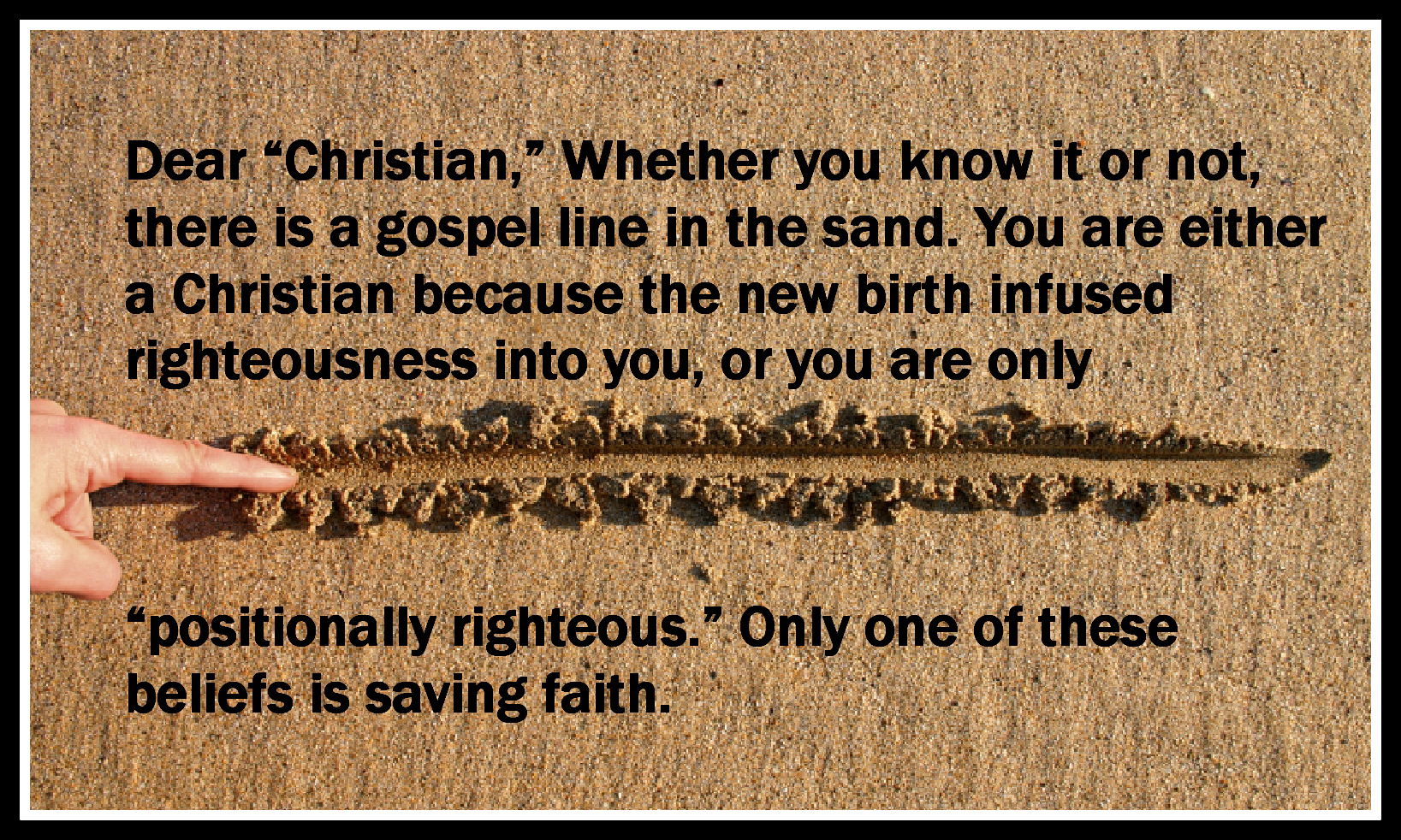
The Protestant gospel effectively denies the biblical interpretation of the new birth. Because of its Platonist metaphysical presuppositions, it denies the treasure of God’s seed dwelling in weak vessels. Hence, the new birth is redefined and confined to the ability to perceive realm manifestations apart from any ability to do a good work of any kind. As stated by some, “Sanctification is done TO you, not BY you.”
In the biblical good news schema, Christ does ONE act of obedience as His part in God’s reconciliation plan. There is no question of “how much?” because His death was all that was required.
Now enter the heinous “Reformation” gospel of confusion. A cursory observation of Reformation history reveals that the dust-up between Rome and the “Reformers” was over metaphysics first. The very first and foundational doctrinal statement of the Reformation contained 12 theses of philosophical metaphysics. Luther was miffed that Rome was moving away from its Augustinian/Platonist roots and coming under the spell of Thomism. This shift began in the 13th century via St. Thomas Aquinas and eventually incited the Reformation. The assertion that the Reformation was driven by sola scriptura is absurd.
Martin Luther introduced his metaphysical answer to Thomism and foisted his theses that supported it onto Scripture. The centerpiece eventually came to be known as double imputation. To Luther’s credit, he created a timeless soteriology based on metaphysics that continues to turn the world upside down. John Calvin articulated Luther’s foundation in the Institutes of the Christian Religion. Both were dedicated to returning the church to its Augustinian roots.
What is double imputation? Basically, it’s the idea that Christ’s role in the gospel of first importance (as set apart from God’s full counsel which is also good news) was twofold as opposed to ONE single act. This was necessary as a “biblical” doctrine that keeps the material being of man separate from Plato’s trinity: the good, true, and beautiful, ie., the invisible. The true gospel turned dualism philosophy completely on its head by infusing good into weakness and defining the true definitions of God’s creation and the state of being.
The idea that God infused His righteousness into the being of mankind is repugnant to the Reformed mindset. How repugnant? The colonial Puritans executed Quakers for even asserting an errant view of the idea.
Therefore, distorting Christ’s role in God’s elected plan of reconciliation was necessary. Christ’s redefined soteriological role removes all goodness from mankind proper and “Christians” in particular. Christ not only came to die for the sins of particular persons preselected by God, but He also came to live a perfect life in obedience to the law so that His obedience could be imputed to the “elect.”
Now the questions are begged: “How much suffering was necessary to pay the penalty for sins committed by the preselected, and how much obedience was necessary for righteousness to be imputed to the preselected as well. When a false doctrine is predicated on errant presuppositions, not only do these kinds of questions arise, but the attempted answers give rise to more questions.
And displays of nonsense. An example is the weird and embarrassing ad lib “Scream of the Damned” propagated by John Piper and CJ Mahaney at a conference hosted by John MacArthur Jr.’s Grace Community Church.* The sheer weirdness of it all even raised eyebrows within Reformed circles by the likes of Steve Camp. The premise was an adolescent-like attempt to explain how much? in regard to Christ’s death. Imagining the response from my older than dirt and probably dead father in the faith, Pastor Richard Peacock, put me on the floor rolling around while laughing uncontrollably. Only the thought of thousands of attending pastors supported by the hard work and sweat of the laity watching without a blink shocked me into the horror of reality and put an end to my shameless response.
When are people going to stop and say to themselves, “Wait a minute here; what drives this stuff? This kind of stuff just doesn’t happen for any or no reason.”
Likewise, in regard to how much?, how long did Christ have to live and how much of the law did He have to obey for the elect? Theories abound because the question itself flows from the false presuppositions of Platonism foisted on the Scriptures resulting in the doctrine of double imputation.
Christ did ONE thing to secure reconciliation for mankind: He died. How much? Answer: enough for ALL mankind. How? Answer: by ending the law. How is that possible? Answer: because all sin is against the law and imputed to the law, and Christ died to end it. Sin is not covered by Christ’s law–keeping; no, sin is not covered, it is ENDED. At any moment, any lost person can choose to have their sins ended. It is not a question of whether or not they are elected, it is a question of whether or not they are under the law—and they are.
What else did Christ do to secure our reconciliation? Answer: nothing. But wasn’t He resurrected? Answer: yes, but He didn’t do that, that was the Holy Spirit’s role in God’s plan of reconciliation. The fact that Christ would be resurrected was a promise made TO Christ and Abraham BY God. That surprises many Christians who don’t read their own Bibles for themselves, viz, most.
In other words, this is the gospel: Christ DIED to END sin. The Spirit resurrected Christ as the first fruits of those who would also be resurrected to new life and justification which is NOT merely a legal declaration, but a metaphysical fact. It does of course have a legal aspect, but it is adoption court where the Holy Spirt bears witness with us that we are the children of God. Christ was “resurrected” for our justification” by the Holy Spirit. “Forensic Justification” does have a legal aspect, but not only in the halls of criminal court, but just as much in the court of adoption with the Holy Spirit appearing as a witness.
Obedience to the law by Christ does not justify us, the new birth justifies us because we are in fact righteous. The resurrection justifies us, not law-keeping by anyone including Christ.
True resurrection with Christ is “under grace,” but that by no means states that we are no longer under a law. It means that we are no longer under a law that condemns us. This is what strips sin of its power. This is what strips death of its sting. We must remember that the law is the Spirit’s law. He will use it to convict the world of sin and warn of the judgment to come, or he will use it to sanctify God’s children. The law is a savor of death to those who do not believe, and a savor of life as we walk in it as God’s children.
The time has come to stop dwelling in the Protestant metaphysical narrative of death, and to follow Christ in our duty to write a narrative of life.
How much? That will depend on OUR obedience as children of God. The Spirit gave us life and opportunity to use His law to love God and others. “Do’s and don’ts” are not the issue, LOVE is the issue. We do not stay at the foot of the cross while Christ loves for us; we will be rewarded for the narrative of life that we write by using the gifts granted to us when Christ sat down beside the Father and rested from justifying all who will believe in Him.
We zealously write our narrative of life without fear of condemnation because of Christ’s love for us. And our love will never be enough because of the freedom we feel. The freedom purchased by His blood that freed us from the condemnation of the law and the Master empowered by it, and the freedom to love by obeying the law of the Spirit—the perfect law of liberty. When God looks at us, He sees more than Christ, he sees one that Christ is not ashamed to call a brother—He sees one of His children. Christ doesn’t cover us, He presents us.
He is not ashamed of us. His death was enough for our life.
paul
* “Apparently, they got the concept from RC Sproul, who used to be rock solid, but now it would appear that senility has opened his mind to the nonsensical theological acrobatics of our day. Likewise, the same consideration might apply to John MacArthur who spoke at the conference and also sponsored it; he is getting up in years as well. I offer this as a possible excuse for both of them though the vision of my heart longs to see them as the gray-haired stalwarts of the faith that I thought they were. Here is what Sproul said:
‘Once the sin of man was imputed to Him, He became the virtual incarnation of evil. The load He carried was repugnant to the Father. God is too holy to even look at iniquity. God the Father turned His back upon the Son, cursing Him to the pit of hell while on the cross. Here was the Son’s ‘descent into hell.’ Here the fury of God raged against Him. His scream was the scream of the damned. For us’ (Tabletalk magazine, My God, My God, Why Hast Thou Forsaken Me? April 1990, p. 6).
Steve Camp, on his blog, wrote a tame but thoroughly convincing argument against such a notion. But the fact that Camp thought such a significant expenditure of effort was needed is indicative of our day; surely, only ten years ago, such a thesis would have invoked a horrendous outcry among God’s people” (The New Calvinist License To Kill: And Did God Really Condemn Christ To Hell?, Paul’s Passing Thoughts blog, Paul Dohse, Sr., September 2, 2011).

What is the Gospel?
 Is the gospel a declaration about the death, burial, and resurrection of Christ? Are people saved because they believe those facts?
Granted, they have to believe those facts to be saved, but they must not only believe that Christ died for our sins and was resurrected three days later, they must also believe something else about those facts:
Salvation is a choice to follow Christ in that same death, burial, and resurrection. He accomplished such so that we can follow Him in it.
Salvation is an intellectual ascent AND a choice. The choice is also referred to as “repentance.” You are not only turning from an indifference to God’s truth, you are turning from who you are to whatever God wants to make you.
This is called the new birth, or the baptism of the Holy Spirit. You can do absolutely nothing to effect this new birth, you can only ask for it. It is the desire to turn from who you are to whatever God makes you. If you understand that, and want that, God has promised it to you if you ask for it.
Being saved encompasses the belief that you have passed from death to life. The Bible then commands us to proceed with life based on certain assumptions. First, we must know that we cannot be condemned for any sin. Secondly, we make it our goal to please God by putting off the former ways and learning the new ways of the Spirit. Spiritual growth is a true colaboring between ourselves and the Spirit. Our focus is putting off the old ways and putting on the new ways of the Spirit. This is the laser focus of discipleship.
A contrary focus on our supposed continued need for the same gospel that saved us, and a focus on how “sinful” we are is a denial that we have passed from death to life. Instead of our goal being love, our goal becomes a deeper and deeper appreciation of why Christ had to die for us. This is functioning on a completely different assumption:
It denies that we have passed from death to life, and makes our greatest sin that of not understanding how sinful we are resulting in a supposed lack of gratitude for Christ’s sacrifice. It assumes that the old us is still alive, and able to supply ample fodder for showing us why Christ had to die for us. Instead of the Bible showing us the new way of the Spirit, it supposedly shows us the old way of sin leading to a greater appreciation of the cross.
This is the theme we hear constantly in the institutional church, on Christian radio, and in contemporary praise music. And unfortunately, it tells us what we really believe about the gospel.
The new birth is redefined as a mere ability to see how sinful we are, and not an ability to be a transformed person—a true kingdom citizen—a true child of God. Transformation is redefined as an increased ability to see how sinful we are and plunge the depths of our total depravity. The idea that we can actually change and better learn Christ is declared to be arrogant, prideful, and… “having a righteousness of your own.”
This is a slick, deliberate play on words that subtly denies the new birth. It takes the reality that righteousness did not originate with us, and makes it tantamount to having NO righteousness that is a part of our true being. We remain unchanged except for an ability to SEE only, and the righteousness of God that comes part and parcel with being born of Him remains apart from us. We are merely vessels that “reflect” God’s righteousness, but it remains separate from our new identity.
In other words, we really don’t perform any love that pleases God, our only goal is to plunge the depths of our own sinfulness that results in God “reflecting” His love on us and others. This coincides with rhetoric we hear in the church constantly such as, “It wasn’t I who did it—it was the Spirit working through me.”
Passages like Galatians 2:20 are then twisted to make the case.
Consequently, instead of a proper dichotomy being drawn between GIFT and REWARD, salvation ends up as our reward for living a life of faith alone in… “what Jesus HAS done, not anything I do.”
Again, this not only denies the new birth, but makes “Christians” unwitting participants in a damning endeavor to keep ourselves saved by faith alone which is defined as a mere ability to see our need for a savior more and more. “Jumping directly from the commandment to obedience” is supposedly works salvation.
Jesus said, “You must be born again,” and this is exactly why He said it. Water baptism has nothing to do with a church membership found nowhere in the Bible, and it is not only about what Jesus did, it is a testimony that you have followed Christ in a literal death and resurrection.
Salvation is the abandonment of who you are, and trusting what God will do by recreating you into His own child. It is a matter of trust, because…
That which is born of the flesh is flesh, and that which is born of the Spirit is spirit. Do not marvel that I said to you, ‘You must be born again.’ The wind blows where it wishes, and you hear its sound, but you do not know where it comes from or where it goes. So it is with everyone who is born of the Spirit.
paul

 Paul's Passing Thoughts
leave a comment