“Grace” is NOT Salvation, and Why Justification is the Antithesis of Sanctification
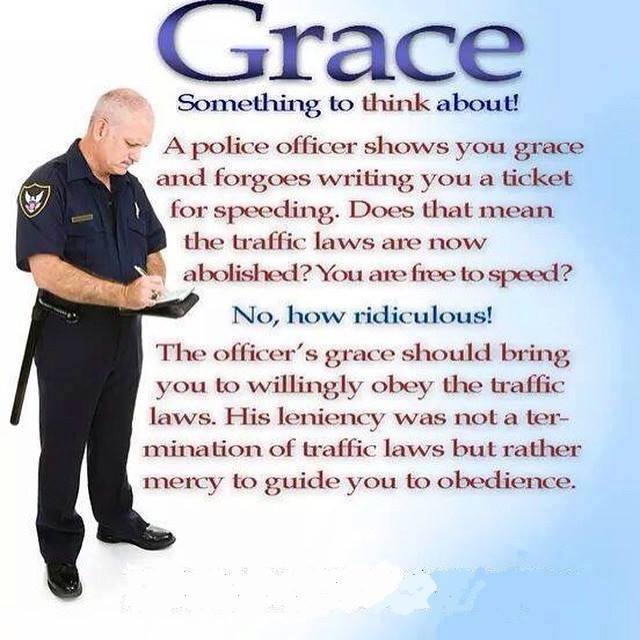 If every verse in the Bible is not about justification, but Protestants believe that, and they do, this will redefine the Bible from cover to cover, and it does. The result is a completely upside down gospel.
For example, the internet placard that inspired this post. How does it define “grace”? Obviously, it defines grace as Christians not getting the punishment they deserve from the “righteous demands of the law.” This “mercy” “guides” you to obedience. But what “obedience”? Well, let me quote the pastor of the person who posted the placard: “You don’t keep the law by keeping the law.”
“You don’t keep the law by keeping the law.” What does that mean in conjunction with “mercy” leading us to this “obedience.” And, do Christians still need “mercy”? According to Protestantism, “yes.” I understand that some Protestants understand this to mean that we are motivated by God’s mercy when we don’t get the punishment that we deserve, but that is a watered down version of the authentic Protestant gospel. And anyway, true Christians no longer need mercy because we are no longer under condemnation; there is “no condemnation” for Christians. But more on the significance of that later.
The crux of the placard and the idea that Christians still need grace is well defined by some comments that were posted in regard to the placard. It starts with the idea that “grace” is synonymous with biblical justification or salvation. And since we still need “mercy” from the law as Christians, we must know how to obtain this mercy leading to keeping the law by not keeping the law. The endeavor is twofold, and exemplified in the following aforementioned comments:
MERCY is when judgement is constrained, and hence is what is being illustrated in this story by the officer letting you off the hook. But GRACE is not that judgement was constrained, but that it was conferred! It’s the picture of the officer, though acknowledging that you were guilty of trespassing the speed limit, determines that he’ll let you go on the premise that he PAID the ticket for you!
And…
What if the police officer decided to jump in the car with you. So every time you drove he’s sitting next to you and just keeps saying don’t worry about speeding I have fulfilled that law. [Viz, I kept the law for you] I’ll whisper to your heart and let you know if you are heading towards the speed limit. I just want to sit and chat with you and get to know you so well that you never ever want to speed again. Because you are forgiven and I love you.
If you think these are armchair theologians, think again. What they are saying is a mirror image of how two heavyweight Protestant theologians stated it in the following video:
What’s the idea here? Since Christians still need mercy from the righteous demands of the law, they must continually receive it by returning to the same gospel that saved them. “Grace” is defined as justification/salvation, so obviously, we must continually return to the same gospel that saved us. To most professing Christians in our day, the idea that Christians still need grace and mercy is a no-brainer and is pontificated with the often-heard, “We must preach the gospel to ourselves every day.”
What is that gospel? It is twofold as exhibited by the two comments. Christ died for our sins which takes care of the penalty of sin (first comment), and then He kept the law perfectly so that His righteousness (perfect obedience) can be imputed to our Christian life. Therefore, as Christians, we continually go back to the salvation well for forgiveness and a righteousness that is not our own. That’s how we keep the law by not keeping the law: Jesus keeps it/kept it for us. The same gospel that saved you also sanctifies you.
Why is this an egregious false gospel? First, we are not under the law for justification. There is no law for Jesus to keep for us. Jesus didn’t come to keep the law for us, He came to end the law… for Justification (Romans 10:4). The fulfilling of the law by Christ does not refer to Him keeping the law perfectly so that His obedience can be imputed to our sanctification.
And “grace” is NOT justification or salvation. “Grace” defines why God saved man; it’s an act of love that expects nothing in return, and of course, we need this same kind of love in our Christian lives, but that doesn’t make our sanctification a progression or specific expression of justification. The love of God is not applied to justification in the exact same way it is applied to our Christian lives (sanctification). Grace, as the reason God justified us (His unmerited love) expects nothing in return because man is utterly unable to justify himself.
However, God also displays His love (“grace” also means “help”) in regard to the purpose for which he saved us: good works…that we actually do in order to please Him. God doesn’t love Himself through us—we are not mere conduits from which God loves Himself; we in fact love God or we do not belong to Him. God’s love towards man in justification has a different application in sanctification. In the former man is completely helpless, in the latter man needs help. Both expressions of love are “grace.”
This is demonstrated by Ephesians 2:8-10…
8 For by grace you have been saved through faith. And this is not your own doing; it is the gift of God, 9 not a result of works, so that no one may boast. 10 For we are his workmanship, created in Christ Jesus for good works, which God prepared beforehand, that we should walk in them.
Grace, or charis, is a Greek word that means “a joyful benevolence.” Actually, the word has a wide variance of applications including, “favor,” “love,” “help,” “dignity,” etc. To define “grace” as synonymous with salvation is inaccurate; grace is the reason God saves, but it is also the reason God does many other things as well. Grace is also the reason that God is our advocate, comforter, co-laborer, and helper in our Christian life. In regard to our Christian life (sanctification), these words are used interchangeably (Heb 13:6, Jn 14:16 Rom 8:26).
Note verse 8: grace is the reason God saved us (John 3:16), but salvation is “the gift.” It is not the result of “works” (v.9), but the result of grace. This is where we have a radical dichotomy between justification (gift) and sanctification (reward). The two are mutually exclusive, and “grace” does not bridge the two. Gift and reward are mutually exclusive. In fact, Hebrews 6:10 says that God would be “unjust” to forget our works in sanctification. Why? Because our works in sanctification is an earned reward that deserves to be recognized. There is no other conclusion that can be drawn from that passage.
The word for “works” in verse 9 is ergon which according to Greek scholar Spiros Zodhiates “stands in direct antithesis” to charis (grace) and the two words are “mutually exclusive” (The Complete Word Study Dictionary, AMG Int. 1992, p.1469). Yet, verse 10 indicates that good “ergon” or works is the purpose of salvation. Salvation is caused by grace, but works is the purpose of salvation. This is why justification and sanctification are mutually exclusive and not bridged by grace. One result of grace is the gift of salvation while the result of the other is reward. Gift and reward cannot be intermingled.
The type and kind of works were predetermined, but we are responsible to “walk” in them with God’s help. In justification, God is a savior; in sanctification, God is a “helper.”
Notice how the professing Christians of our day are obsessed with SIN. Because we are still supposedly under law and need the same “grace” that saved us, our Christianity is obsessed with failure and our dire need for more and more mercy. Life is lived under the cloud of the law, and the focus is how often the holy policemen in the sky does not write a ticket of condemnation.
A pity, because we are not under law and are rather under grace which means we seek to obey God’s law in love. The focus isn’t failure so that we can supposedly glorify God by returning to the foot of the cross, the focus is love which “covers a multitude of sin” (1Pet 4:8). We would sin a lot less if our focus was love, not the expectation of failure under the heavy burden of the law. We are not under the law of sin and death, we are under the law of the Spirit of life (Rom 8:2). We strive to obey that law in love as the primary focus of our life; we dwell on love, not sin.
Moreover, if we glory in more and more mercy that saves us from the law that we are supposedly still under, that will result in a relaxing (lyō) of the law in sanctification that Christ warned us about (Matt 5:19) because after all, we can’t keep it perfectly anyway.
As Christians, our sin is family sin against our Father and can bring chastisement, but it is not sin under the condemnation of the law that requires a return to the same “grace” that saved us. That’s a false gospel. That’s under law, NOT under grace.
So, you do in fact keep the law by keeping the law, because that’s love.
paul
Are Christians Truly Righteous? Yes, Because Jesus DID NOT Die for All of Our Sins
 The weak sanctification/kingdom living among Christians is due to a fundamental misunderstanding of the new birth. Once again, I was involved in a debate last week with several professing Christians who understand the new birth to be an idiom for our sins being covered rather than ended. Rather than being made, or recreated righteous, we still have sin that separates us from grace and requires an “imputation” of an “alien righteousness.” Our sins are only covered and we remain fundamentally unchanged.
Per the usual, the debate included Baptist pastors and missionaries which of course is completely terrifying. Wonder why your little Baptist church is dying a slow death? A false gospel perhaps?
Ask many professing Christians if Christ died for our present and future sins and they will look at you like it is the stupidest question they have ever heard in their whole life, but this is indicative of the overall ignorance concerning the true gospel among professing Protestants.
Christ came to end the law, and where there is no law there is no sin. Christ only died for sins that are under law. When you are saved you are no longer under law—there is no penalty to be paid for any sin that is not under law. That is the legal aspect, but it is also the reality of being.
The new birth puts the old person to death with Christ. A dead person is no longer under law. And where there is no law there is no sin. All sin is against the law; that is, the law of sin and death. That law no longer applies to the believer for two reasons: Christ ended it on the cross, and a dead man is no longer under the law. What happens when the Police find out a suspect is dead? Case closed. This is along the exact same line of argument Paul makes in Romans 7.
But there is also a resurrection. Even though the body of sin has been brought to nothing, and those who have died have ceased from sin, the soul of the believer is quickened (regeneration) and now is free to “serve another.” Who is the new person now free to serve? His/her new master, the law of the Spirit of life. The law is now our guide to love God and others—it cannot condemn us. We were indifferent to the law when we were under it and it was condemning us, but now we love it (see Psalms 119).
If Christ died for our present and future sins, we are still under the law of sin and death. The law of sin and death is not ended—we are still under it, and in fact, Christ’s death needs to be applied to any present or future sin we commit—we are therefore not under grace.
This denies the new birth. We have not ceased from sin because we never really died with Christ. The sin we presently commit is not merely family sin that can bring chastisement from our Father—that sin can actually condemn us. There is still condemnation for those who love God.
A verse often quoted to refute the literal new birth and the ending of the law of sin and death is 2Corinthians 5:21.
For he hath made him to be sin for us, who knew no sin; that we might be made the righteousness of God in him (KJV).
The idea in citing this verse is that the only righteousness we have is the righteousness of Christ imputed to us. Christ not only came to die for our sins, but instead of ending the law of sin and death, he came to obey it perfectly so that His obedience (righteousness) can be credited to our account because we are not literally righteous and fall short of obeying the law of sin and death perfectly. 1John 1:9 is often added to 2Corinthians 5:21 to make the case.
Moreover, this perfect obedience and His death must be reapplied to any new sin we commit against the still active law of sin and death. Hence, any obedience to the law done by us can only bring about death—we are not free to serve the law of the Spirit of life (Romans 8:2).
So, we have no righteousness of our own, and are not recreated righteous. We only have the righteousness of God, who is also Christ, so being interpreted: we are not righteous or recreated, but merely covered by the righteousness of Christ. “In Christ” means that the righteousness of God and the righteousness of Christ are the same thing.
This idea not only turns the true gospel completely on its head for a number of reasons, but 2Corithians 5:21 is saying the exact opposite.
“In Christ” means that Christ made it possible for God to recreate believers as truly righteous beings through the baptism of the Spirit. Christ died on the cross so that we could die with Him and no longer be under the law of sin and death. Christ died for us so that we could die with Him. Christ was then resurrected by the Spirit so that we could be resurrected with Him as new creatures that are truly righteous. This is what 2Corithians 5:21 is saying.
The two words translated “made” in said verse are two different Greek words. The first in regard to Christ being made sin is the word poieō which, for the most part is the idea of assignment or appointment. The meaning has a wide use and is ambiguous. Not so much with the word ginomai used in regard to us being made the righteousness of God. The word means to make something, or create something completely. For example, this is how the word is used in Matthew 4:3…
If you are the Son of God, command these stones to become loaves of bread.
“Become” is the same word, and how it is used is obvious. Satan wasn’t demanding that Christ declare the stones to be loaves of bread in some kind of forensic declaration, he was demanding that Christ recreate the stones as bread. Nor was this going to be a gradual process of transforming the stones into bread, but would have been a final complete act. Get the picture?
2Corinthians 5:21 is simply stating that Christ made it possible for God to recreate us to be the same righteousness that defines our Father because we are truly born of Him—that’s the gospel.
paul
The Imputation of Christ’s Righteousness Denies God as Father
 One of the most popular truisms in our day is the often-heard “righteousness of Christ” mantra. “We have the righteousness of Christ,” “The imputation of Christ’s righteousness,” etc. The mantra is indicative of the rampant last-day’s false gospel propagated by the institutional church.
The Bible never states that the righteousness of Christ is imputed to us or covers us, but rather states that we have the righteousness of God. Why is this seemingly technical difference all-important? Because the notion distorts the identity of the Trinity. God is no longer a father, and Christ is no longer our brother.
Have you ever wondered why God is called the Father? Because a father is able to give life—the same kind of life that makes up his own essence; in this case, righteousness. Because we are fathered by God through the Holy Spirit via the new birth, we are not merely declared righteous, we are MADE righteous. Therefore, the Reformation’s forensic justification gospel denies the Trinity and the new birth.
The idea that we can’t really be righteous and are only declared righteous further denies that God is a true father. How? It denies that we are truly born of God because we fall short of keeping the law perfectly. In his letter to the Galatians, Paul argues that this replaces the seed of God with the law and actually makes the law a life-giving seed. Paul states that only one seed was promised to Abraham and his offspring (Christ), not two, and “God is one.”
The primary point of Galatians 3:10-20 is that God the Father is the only one who gives life, He is the one seed. “The promise” spoken of is the promise of the new birth through the one seed. If you note the passage carefully, “the promise” was made to Abraham and Christ. No law can give life, nor can an “intermediary” (verse 20) which probably speaks to Moses or the angels or both.
Christ’s role was/is that of Brother.
“Both the one who makes people holy and those who are made holy are of the same family. So Jesus is not ashamed to call them brothers and sisters” (NIV).
“For he who sanctifies and those who are sanctified all have one source. That is why he is not ashamed to call them brothers” (ESV).
The “one source” is God the Father, and because of Him, Christ is not ashamed to call us brothers and sisters. Christ died for us, and God’s promise to Abraham and Christ was that many would be raised to glory with Christ. The impartation of righteousness was not Christ’s role in salvation—His role was to pay the penalty for our sins and establish the new birth through the power of the Holy Spirit.
Notice in the aforementioned citations from Hebrews 2:11 that we are “made” holy and “are” holy. If that is negated by an inability to keep the law perfectly, that makes the law a co-life-giver with God the Father. But there is only one God and only one seed.
What makes a believer holy is the regeneration of the heart through the new birth. The saved person is literally born of God’s seed (1John 3:9). Because of our mortal state, this results in a change of direction, not perfection. The Bible describes it as a reversal of slavery and freedom (Romans 6:20). But at any rate, Christ came to end the law for judging our holiness (Romans 10:4). If it wasn’t for the weakness of our mortal bodies, we would not sin and therefore we long for resurrection (Romans 7:23-25), viz, the redemption of the body.
The idea that Christ kept the law perfectly so His righteousness can be imputed to us makes the law a co-life-giver with God, makes Christ both father and brother, denies that the Holy Spirit raised Christ from the dead per “the promise,” and makes the law part of the Trinity.
It’s a really, really bad idea and an egregious false gospel. God is one, not many. There is only one life-giver, and that’s why we call Him “Father.”
paul
Pondering the Gospel
After counseling nearly all day with a longtime professing believer about his life and the gospel, I would like to share the thoughts I am pondering afterward:
You are not saved without your own death and resurrection after that of Christ. Believing on Christ unto salvation is not a mere mental ascent to the facts of the gospel; it is a decision to follow Christ in His death and resurrection. This means you have died to the law able to condemn you and now love the law of the Spirit. The law of the Spirit is the commandments of Christ that formally condemned you. You have passed from death to life, and from condemnation to loving God and others according to the law. Your motives are indeed pure for the law can no longer condemn you, the only motive that is left is love.
To love God is to love the law of the Spirit of life: “If you love me, keep my commandments.”
Salvation involves your own literal death and resurrection after Christ…
“You must be born again.”
paul


 Paul's Passing Thoughts
leave a comment