The Heidelberg Disputation Series Part 12, Theses 22 and 23: The Vital Union, Ritual, and Law
 Listen to the program or download audio file.
So, I was over at my mom’s house minding my own business watching a little Fox News when I noticed a little booklet on the table beside the easy chair. I picked it up and observed the title: Devotions and Prayers of Martin Luther. Of course, I thought that would be interesting. When I opened it, I observed that my dad bought it for mom in 1962. That would be when her three boys, of which I am one would have been 6, 4, and 2. That’s three boys, 6, 4, and 2 which means she would have been needing a lot of prayers during that time. So this gift makes perfect sense. Anyway, I just indiscriminately cracked the thing open roughly in the middle to see what was there. Here is the prayer that I read:
Almighty God, great that we and all Christians may receive the holy sacrament savingly by thy grace. Give us our daily bread that Christ may abide in us and we in him, and that we may worthily bear the name Christians which we have received from him. Amen.
Welcome truth lovers to Blog Talk radio .com/False Reformation, this is your host Paul Dohse. Tonight, part 12 of “The Magnum Opus of the Reformation: Martin Luther’s Heidelberg Disputation – Theses 22 and 23: The Vital Union, Ritual, and Law.”
Greetings from the Potters House and TANC ministries where we are always eager to serve all of your heterodox needs. Our teaching catalog can be found at tancpublishing.com.
If you would like to add to our lesson or ask a question, call (347) 855-8317. Remember to turn your PC volume down to prevent feedback over your cellphone. If you choose to use Skype to listen to the show, my advice is to just dial direct from your Skype account without using any of the Blogtalk links. 347-855-8317.
Per the usual, we will check in with Susan towards the end of the show and listen to her perspective.
Remember, you may remain anonymous. When I say, “This is your host; you are on the air, what’s your comment or question”—just start talking.
If you would like to comment on our subject tonight, you can also email me at paul@ttanc.com. That’s Paul @ Tom, Tony, Alice, Nancy, cat .com. I have my email monitor right here and can add your thoughts to the lesson without need for you to call in. You can post a question as well.
Tonight, we continue in our sentence by sentence evaluation of the HD with thesis 22. This is where we get into the true heart of the Protestant Reformation which concerned philosophy, or state of being.
Anything to do with justification or soteriology was grounded in philosophical or metaphysical presuppositions. I opened tonight with an example of that. Notice that Luther prayed that salvation would be imparted to believers through participation in the Lord’s Table. Whether Protestants know it or not, that’s why the Lord’s Table is such a solemn ceremony in the church—it’s imparting salvation. The solemn examination of self while droopy faced deacons or elders pass around the holy plastic thimbles filled with either grape juice or real wine depending on the outcome of the Baptist civil war in your neck of the woods is the mortification part of the ceremony, and one should expect a joyful demeanor following, ie., vivification.
The Lord’s Table is one of the big five that you do to run the Protestant race of faith alone on the way to the one big final “tribunal” where you find out if you lived by faith alone well enough to make it into heaven. The other four are church membership, sitting under elder preaching, prayer (primarily confession of “present sin”), and the baptism of the holy spirit through mortification and vilification. These all result in the vital union also mentioned in the same prayer: “that Christ may abide in us and we in him.” So, in regard to the initial baptism signified by water baptism which also initiates one into membership, this same baptism is lived out through self deprivation of some sort leading to resurrection experiences of one sort or another—usually incited by praise and worship music.
The Lord’s Table was never some solemn ceremony in the Christian assemblies, but rather an informal remembrance of Christ’s death during the fellowship meal. As Rome began to take over the home fellowships and assert authority over them, the paganization of Christian traditions took place; not least of which is this idea of perpetual union, or becoming one with some god through some sort of ritual. I would like you to observe the black chart on the slide show. Remember, this is not our chart, this is a visual illustration of the vital union, a formal Protestant doctrine.

Notice that in this case, the union takes place through the “deep repentance” process noted on the left. Obviously, if the process on the left is not a onetime event, nether is the right side of the chart. Notice the title of the chart: fundamentally, Protestantism is a returning to the same gospel that saved you in order to relive the baptism of the Spirit over and over again. In other words, the “new birth” is not a onetime event that makes you part of God’s family. The goal of the so-called Christian life is new birth experiences in which the works of Christ are manifested in our realm or through us (double imputation). The Reformers draw from a number of different metaphysical theories to explain this like Idealism philosophy. That is the idea that reality only exists in the perception of the mind, and God is in control of the perceptions. But that is only one angle among many.
But let’s take that example as a way to explain how this all works. Protestantism is about justification by faith…ALONE throughout the whole course of our life. So, it begs the question: how does one live, which assumes human activity prompted by cranium activity, by faith alone? How does one work meditatively? Well, if the work you are doing is really nothing more than perception placed there by God, you aren’t really doing the work, right? You are only EXPERIENCING what Christ accomplished when He was living on earth. He lived out a perfect life for us (double imputation) which is now experienced through the vital union (“I’m in him, He’s in me”). This is also known as Christ for us, or Christ 100% for us. But you say, “But look at the top part of the chart! It says “heart changed.” Ok, let’s go to another Reformed illustration.

What does the downward trajectory represent? Right, the left side of the other chart. What does the upward trajectory represent? Right, the right side of the chart. What does the cross represent? Right, the cross on the other chart. Now, what changes, you or the cross? Right, you don’t change, and in fact, if you fail to see how sinful you are the bottom trajectory goes up and the cross gets smaller. So, what is the authentic Protestant definition of “heart change”? Right, a mere perception or experience. I have at times likened this to standing in the rain. You experience the rain, you feel the rain, but you have no control over the rain. You are not doing the rain. Sanctification is being done to you, not by you. But you do something—you merely participate in the experience of salvation—it’s experiential only. This is how you supposedly live by faith alone.
This idea of being unified or becoming one with a god through some ritual is expressly pagan. Of course, what immediately comes to mind is the Aphrodite cults throughout history. This idea of union with a god through sexual intercourse with a temple prostitute even crept into the first century home assemblies:
1Corinthians 6:14 – And God raised the Lord and will also raise us up by his power.15 Do you not know that your bodies are members of Christ? Shall I then take the members of Christ and make them members of a prostitute? Never!16 Or do you not know that he who is joined to a prostitute becomes one body with her? For, as it is written, “The two will become one flesh.”17 But he who is joined to the Lord becomes one spirit with him. 18 Flee from sexual immorality. Every other sine a person commits is outside the body, but the sexually immoral person sins against his own body. 19Or do you not know that your body is a temple of the Holy Spirit within you, whom you have from God? You are not your own, 20 for you were bought with a price. So glorify God in your body.
From the historian Herodotus we learn:
The foulest Babylonian custom is that which compels every woman of the land to sit in the temple of Aphrodite and have intercourse with some stranger at least once in her life. Many women who are rich and proud and disdain to mingle with the rest, drive to the temple in covered carriages drawn by teams, and stand there with a great retinue of attendants. But most sit down in the sacred plot of Aphrodite, with crowns of cord on their heads; there is a great multitude of women coming and going; passages marked by line run every way through the crowd, by which the men pass and make their choice. Once a woman has taken her place there, she does not go away to her home before some stranger has cast money into her lap, and had intercourse with her outside the temple; but while he casts the money, he must say, “I invite you in the name of Mylitta” (that is the Assyrian name for Aphrodite). It does not matter what sum the money is; the woman will never refuse, for that would be a sin, the money being by this act made sacred. So she follows the first man who casts it and rejects no one. After their intercourse, having discharged her sacred duty to the goddess, she goes away to her home; and thereafter there is no bribe however great that will get her. So then the women that are fair and tall are soon free to depart, but the uncomely have long to wait because they cannot fulfil the law; for some of them remain for three years, or four. There is a custom like this in some parts of Cyprus (Herodotus, The Histories 1.199, tr A.D. Godley 1920).
What is our major concluding point here? That authentic Protestantism traded the biblical definition of the new birth, a onetime event that makes us a permanent part of God’s literal family, for the ongoing experience of so-called vital union, and that Protestantism’s way of obtaining that experience is just one among many not excluding the ritual of temple prostitution. It’s the same idea; temporary experiential union in contrast to a permanent new birth and onetime Spirit baptism.
Also, and more to the point regarding this area of the HD, is that these rituals necessarily take the place of knowledge because of the authentic Protestant worldview. More on that shortly, but let me now address a comment received this week on PPT.com because it’s a good example of the waters of confusion that Protestants swim in as a result of historical ignorance.
This honestly saddens me… I just finished reading Platt’s “Radical”, and I don’t feel that he deserves this. My understanding of his book is “if you truly love Jesus, it will change your life”. Platt is living out John 14:21 by obeying God’s commands to take care of the poor and needy, and living out Matthew 28:18-20 in bringing the gospel to all nations. This book (and Platt’s life) is designed to get the church on board with the mission of God, and is built on passages like 1 John 3:16-18. I’d much rather be like Platt, trying to get the church involved in the mission of God, instead of sitting in the pews screaming at anyone who doesn’t agree with what they think. Honestly, how can we call ourselves followers of a God (who IS love), and then unlovingly thrash another human being? Maybe we should read 1 John 4:21 before we start hating on a brother? Just a thought… lest we be condemned before God for not loving him.
More than likely, the individual who wrote this comment doesn’t understand how authentic Protestantism interprets the reality that Platt appears to be calling people to. More than likely, a more careful examination of the sentences in the book would paint a different picture. Platt is a Neo-Calvinist purist and would hold to almost everything in the HD, so let us consider thesis 24 in comparison to the reader’s comment:
He, however, who has emptied himself (cf. Phil. 2:7) through suffering no longer does works but knows that God works and does all things in him. For this reason, whether God does works or not, it is all the same to him. He neither boasts if he does good works, nor is he disturbed if God does not do good works through him. He knows that it is sufficient if he suffers and is brought low by the cross in order to be annihilated all the more. It is this that Christ says in John 3:7, »You must be born anew.« To be born anew, one must consequently first die and then be raised up with the Son of Man. To die, I say, means to feel death at hand.
Platt is therefore not “living out” anything nor is he calling others to do so. Platt isn’t really talking about good works in the book, but rather manifestations of Christ’s imputed righteousness. It is VERY unlikely that Platt does not hold to double imputation.
Again, this soteriology is necessarily the application of the Reformed world philosophy of choice integrated with Scripture.
Thesis 22: That wisdom which sees the invisible things of God in works as perceived by man is completely puffed up, blinded, and hardened.
This has already been said. Because men do not know the cross and hate it, they necessarily love the opposite, namely, wisdom, glory, power, and so on. Therefore they become increasingly blinded and hardened by such love, for desire cannot be satisfied by the acquisition of those things which it desires. Just as the love of money grows in proportion to the increase of the money itself, so the dropsy of the soul becomes thirstier the more it drinks, as the poet says: »The more water they drink, the more they thirst for it.«The same thought is expressed in Eccles. 1:8: »The eye is not satisfied with seeing, nor the ear filled with hearing.« This holds true of all desires.
Thus also the desire for knowledge is not satisfied by the acquisition of wisdom but is stimulated that much more. Likewise the desire for glory is not satisfied by the acquisition of glory, nor is the desire to rule satisfied by power and authority, nor is the desire for praise satisfied by praise, and so on, as Christ shows in John 4:13, where he says, »Every one who drinks of this water will thirst again.«
The remedy for curing desire does not lie in satisfying it, but in extinguishing it. In other words, he who wishes to become wise does not seek wisdom by progressing toward it but becomes a fool by retrogressing into seeking»folly«. Likewise he who wishes to have much power, honor, pleasure, satisfaction in all things must flee rather than seek power, honor, pleasure, and satisfaction in all things. This is the wisdom which is folly to the world.
Therefore, the Reformation called for the eradication of all knowledge as an evil lust that cannot be satisfied. Consequently, the Bible only has ONE use:
Thesis 23: The »law brings the wrath« of God (Rom. 4:15), kills, reviles, accuses, judges, and condemns everything that is not in Christ.
Thus Gal. 3:13 states, »Christ redeemed us from the curse of the law«; and:»For all who rely on works of the law are under the curse« (Gal. 3:10); and Rom. 4:15: »For the law brings wrath«; and Rom. 7:10: »The very commandment which promised life proved to be the death of me«; Rom. 2:12: »All who have sinned without the law will also perish without law.«Therefore he who boasts that he is wise and learned in the law boasts in his confusion, his damnation, the wrath of God, in death. As Rom. 2:23 puts it:»You who boast in the law.«
Hence, the Bible only aids us in self condemnation in regard to the downward trajectory on the cross chart and the process of vital union. The Bible is not to be used to gain any kind of knowledge, but is only a tool for self-condemnation, or “death at hand” in order to experience the vivification of what Reformed soteriology defines as the new birth. As seen in the summary of the 22nd thesis, any notion that objective conclusions can be drawn from that which is seen is utter wickedness according to this view.
That concludes tonight’s lesson, let’s go to the phones.
Hey Bristol, It’s Not About the Law—It’s About Love
 The present 20-40-something generation indoctrinated by the Protestant institutional church keeps on doin’ its thing. Yes, this is the “sinners saved by grace” generation. These are sinners that love on their own terms.
What brought all this up? My present midlife blogger crisis. In 2009 when I started blogging, a Protestant scandal only came along once a year or something like that. What made that blog worthy is that Protestants are supposed to be one-up on the Catholics as far as righteousness goes. Everybody knows Catholics do anything they want to and then go to confession afterwards. Protestants have always been deemed as above such religious wantonness.
Now blogging has become like children who get chocolate too often. It’s no longer a treat; it’s a common occurrence, and the chocolate just doesn’t melt in one’s mouth like it used to. I have watched trending Protestant scandals increase to bi-monthly, monthly, weekly, and now approaching daily. Yawn, we sit at the dinner table and ask the complaining rhetorical question to momma blogger: “Chocolate again?”
It’s hard medicine, but the only thing to blog about now is the why? The what has run its course. However, what most of us do not realize is that there is a new and exciting trail to blaze in our present day: the art of godly living. But first, we must examine why that is possible in the face of this impossible dream.
It’s possible because Protestant tradition has always made Christian living all about our original salvation. Jesus died on the cross to save us from this horrible world that can be fun at times; Jesus will get us through it, so eat and drink for tomorrow we die. After all, we are all just sinners saved by grace. So, eat, drink, and be merry, and when you get caught, or a bad choice actually yields cause and effect, merely pull out your Woe is me a lowly sinner membership card. Jesus is president of the club.
So what’s the why? The why is because Protestantism with all of its pulpit pounding about justification by faith alone is really about keeping people under the law. We remain under law, and keep it when the opportunity matches our desires or when it is convenient, but all in all, it’s impossible to keep the law perfectly so Jesus came to live on earth to fulfill it for us. When we keep the law, we didn’t do it, Jesus did it “through us.” When we get caught, or a bad a choice yields bad fruit, that’s “disappointing,” but thank goodness that’s why Jesus came to LIVE and DIE.
And that is a lie from the pit of hell. Christ came to end the law, not keep it for us. When we believe on Christ, our past sins are forgiven because Christ ended the law that we sinned against, and in regard to the future, there is no law to condemn us. The law of condemnation has been ended.
How? Because Christ died so that you can follow Him in death, and a dead person is no longer under the law of condemnation. Then, Christ was resurrected so that you can follow Him in resurrection as well. More accurately, when you follow Christ in death, the Spirit comes and resurrects you as He did Christ. That’s the new birth. Now you are free from the law in regard to condemnation, for the old you died and is no longer under the jurisdiction of the law’s condemnation. But…your resurrection to new life frees you to love according to the law of love, not condemnation. Same law—different use. Same law, different state of being.
Oops, I almost forgot, the new scandal. “Which one?” This one: Bristol Palin, Sarah Palin’s daughter, is once again pregnant out of wedlock. The family, members of the New Calvinist Wasilla Bible Church, survived the publicity of the first “disappointing” choice, but obviously nothing was learned from the first incident, the blessings of a child being brought into the world notwithstanding.
I am not going to bore you with what she said on her blog about the news; it is the same old Protestant song and dance. In essence, and for all practical purposes: Oops; me, a lowly sinner, once again has sinned. Per the usual, we all fall short of keeping the law perfectly, but praise God for Jesus—it’s not about what we do, but what he has done.
That misses the whole point. Jesus didn’t come to keep the law for us; He came to end the law, and set us free to love. Like all Protestants, Palin confuses law and love. Here is the huge problem: if Christ kept/keeps the law for us, He also loves for us. Like most Protestants, Palin dichotomizes law and love in Christian living because she remains under the law of condemnation and is not free to follow the law as love.
Hence, as she pontificated on her blog, she can dishonor her family while still loving them. As far as dishonoring her family and bringing shame upon them, Jesus died for that, but of course she still loves her family.
Listen, whenever love is something different than obedience to God’s law, whenever a failure to truly love is not called out for what it is, that means one thing and one thing only: that person is still under the condemnation of the law that Jesus supposedly keeps for us.
Listen “sister,” it’s not about the law, it’s about love. Google the following and find out who said it… “If you love me, keep my commandments.” One cannot change until the real problem is diagnosed. Palin failed to love God and her family.
Christ did not come to keep the law for us anymore than He came to love for us—we either love or we don’t love. If we truly understand salvation, “We love Him because He first loved us.” That means He loved us first by dying on the cross to end the law so that we are free to love him through obedience apart from being justified by the law. And as much as we love Him, we love others as well.
It’s not about the law—it’s about love. And that is the new frontier for recovering Protestants.
paul
________________
Visit “The Oligarchy White Paper” for additional perspective.
The Key to Revival: Stop Saying “Sins of the Flesh”. The Flesh is NOT Sinful
 Protestantism wasn’t born of Gnosticism; it was born of Neo-Platonism which became Gnosticism. Most Protestants would deny that they are Gnostics, but because the fruit doesn’t fall far from the tree, they often embrace ideology that is Gnostic. In other words, they are functioning Gnostics.
The prime example is the whole “sins of the flesh” Christian mantra. That’s not a biblical idea, and is essentially Gnostic.
A primary tenet of Gnosticism is Either/Or epistemology. If you pay attention to the words used in this Sunday’s sermon, more than likely, you will notice that everything is either/or with no middle ground. I realize that the Bible does contain sentences that refer to the “desires of the flesh” and “sins of the flesh,” but that refers to when the flesh, the bodily members, are used for sinful purposes. Please note that the Bible also states that we can use our members for holy purposes as well.
Furthermore, the Bible even states that as believers, our bodies are the temples of God. Moreover, a more careful examination reveals that the reference to “temple” in regard to our bodies actually refers to the Holy of Holies. If you think you can presently hear Calvin and Luther rolling and screaming in their graves in response to that assertion—the problem is not in your cranium set.
If you are actually free to present your body as a living sacrifice to God in the Holy of Holies, what do you need the vast Protestant industrial complex for? You don’t.
The flesh is NOT sinful, according to the Bible; it is “weak.” The idea that weakness is part and parcel with the evil material world is a Gnostic presupposition. For example, the holy angels are weaker than God, no?
Pastors, do you want revival? Stop telling your parishioners that they are “sinners saved by grace.” They are not sinners; they are literally a nation of holy priests.
“But we still sin.”
If you just said that, you are not fit for the ministry—you don’t even understand Biblical Law/Gospel 101.
Get with the program. You will never have revival with a bunch of sinners—that would seem evident. Grow up in Christ, and stop listening to men. You are like my adorable grandson, Blaine, who is 4 years old. He is a great listener and repeats everything he hears.
That’s just adorable, but when grown men who dare to call themselves pastors do the same thing—not so much.
paul
The Protestant Twisting of 1John: A Clarification, Part 5 – Law, Gospel, and Love
Listen to show audio or download audio file.
Welcome to Blogtalk Radio False Reformation this is your host Paul M. Dohse Sr. Tonight, part 5 of “The Protestant Twisting of 1John: A Clarification.” If you would like to add to our lesson or ask a question, call (347) 855-8317. Remember to turn your PC volume down to prevent feedback. Per the usual, we will check in with Susan towards the end of the show and listen to her perspective.
If you would like to comment on our subject tonight, you can also email me at paul@ttanc.com. That’s Tom, Tony, Alice, Nancy, cat, paul@ttanc.com. I have my email monitor right here and can add your thoughts to the lesson without need for you to call in.
This is our final segment on 1John, and next week we will be doing a book review on “How People Change” by Paul David Tripp. I will be doing an overview of each of the 16 chapters in the book according to the theses of each chapter, and then will explain how the different points of each chapter fit together to form a particular doctrine. All in all, the book represents a pretty impressive application of Reformed mysticism.
Then, the following week, starting on May 8th, I think the time has come to do an in-depth evaluation of the Heidelberg Disputation. Martin Luther’s 95 Theses launched the Reformation, but all Reformed doctrines flow from the Heidelberg Disputation. Though very subtle, our present church culture is saturated with a collectivist doctrine of death, and I want to show exactly where this culture of death came from. We will be evaluating the Heidelberg Disputation theses by theses. How many Baptists know anything about the Heidelberg Disputation? Few, if any, yet the foundation of evangelicalism flows from this document.
Last week, I got away from our Gnostic theme and showed a correlation between John’s theology and that of the apostle Paul. The focus was the new birth, which Gnosticism denies. The historical backdrop is John’s pushback against Gnosticism which denies that people change. The Gnostics of that day believed that the material realm is evil and the spiritual realm is pure.
The goal is wellbeing that comes from getting beyond the five senses in order to gain knowledge. The particular vein of Gnosticism that John was contending against believed that sin only occurs in the body, and man’s spirit has never sinned per se. As a result, God’s people were being taught that what they did in the body was insignificant, and man didn’t need to deal with sin. Gaining spiritual knowledge for their own wellbeing was the key to having a happy life.
They denied that Christ really came as a man and was God’s Son. They taught that there were two Christ’s; one born of men and a Christ that was a spiritual avatar of sorts.
At any rate, the doctrine denied Christ’s deity, that He came to die for sin, and that mankind needed forgiveness for sin. Consequently, it also denied the new birth. In the same way Protestantism obviously denies that people change, redefine the new birth as an ability to perceive realm manifestation, and have their own unique distortion of the Trinity. When it gets right down to it, authentic Protestantism posits the Father and the Spirit as shadows of Christ.
Therefore, in chapter 3, John focuses on the new birth and why it changes us. But the dominate theme of the book, especially chapters 4 and 5, concentrates on love. Why is that? Because love in action should be the primary focus of Christians. Instead, what is the primary focus of Protestantism? Right; sin, sin, sin, sin, sin. Yes, our focus must be keeping our sins covered by the perfect righteousness of Jesus. Every song you sing, every sermon you hear is about how glorious Jesus is as set against our wretched vile selves. It boils down to praising our ability to see how rotten we are in the name of Jesus.
Look, 1Corinthians 13:6 defines love as something that doesn’t rejoice in evil, but clearly, Protestants rejoice in “grace,” that is, seeing our evil as set against the holiness of God. Like the Gnosticism that John was dealing with, Protestantism turns love completely upside down. That’s the problem we want to solve tonight.
In the first parts of this series, we focused on the Gnostic backdrop, but last week, we brought in the teachings of Paul to better understand what John was writing, and that’s what we are going to do tonight.
Why does Protestantism, like Gnosticism, circumvent love, and what can we do about it? Let’s first consider what 1John states about love:
1John 4:7 – Beloved, let us love one another, for love is from God, and whoever loves has been born of God and knows God. 8 Anyone who does not love does not know God, because God is love.
1John 5:1 – Everyone who believes that Jesus is the Christ has been born of God, and everyone who loves the Father loves whoever has been born of him. 2 By this we know that we love the children of God, when we love God and obey his commandments. 3 For this is the love of God, that we keep his commandments.
Do you see the huge problem with focusing on sin and not love? And I don’t mean God’s love for us because we are such vile sinners, I mean our love towards God and others. Note what somebody sent the blog this week which is indicative of what we hear constantly in the church. They heard this on K-Love Christian radio:
Who am I, that the Lord of all the earth
Would care to know my name,
Would care to feel my hurt?
Who am I, that the Bright and Morning Star
Would choose to light the way
For my ever wandering heart?
Not because of who I am
But because of what You’ve done.
Not because of what I’ve done
But because of who You are.
I am a flower quickly fading,
Here today and gone tomorrow.
A wave tossed in the ocean.
A vapor in the wind.
Still You hear me when I’m calling.
Lord, You catch me when I’m falling.
And You’ve told me who I am.
I am Yours, I am Yours.
This is what we hear incessantly in the church. Where is the focus on our love towards others and God? In order to return to the right focus on love, we need the right theology, so let’s get to it.
Whatever form of Protestantism you are talking about, and Calvinism in particular, its Achilles’ heel is the law. Protestantism cannot pass the true gospel test because of its position on law, and this is not hard to understand.
Andy Young, an associate of TANC ministries, said something in last year’s 2014 conference that is probably true for the most part: “The law is for sanctification.” Right, because the law is in no wise for justification. We are justified apart from the law (Romans 3:21) and “apart” means exactly that. The fact that the law will judge people in the end is a separate issue altogether.
The apostle Paul makes all of this easy to understand in Galatians chapter 3. But first, let’s use that same chapter to establish what we mean by the word, “law.” The word is used interchangeably with many other words, including, “gospel” to refer to the Bible. So, Andy was merely saying that the Bible is for sanctification, or in other words, Christian living. Andy was talking in context of sanctification for the Bible has no stake in justification, and again, the fact that the Bible will judge people in the end is another issue. Yes, the Bible defines justification (Rom 3:21, Gal 4:21); yes, the Bible testifies to the truths regarding justification, but the law does not justify.
Note the following from Galatians 3:
21 Is the law then contrary to the promises of God? Certainly not! For if a law had been given that could give life, then righteousness would indeed be by the law. 22 But the Scripture imprisoned everything under sin, so that the promise by faith in Jesus Christ might be given to those who believe.
Notice that Paul uses the word “law” and “Scripture” interchangeably. The law, “holy writ,” “the word,” “the gospel,” “the Scriptures,” “the law and the prophets,” etc. are all terms that refer to the Bible which is a full orbed statement by God regarding Himself, mankind, and reality. Statements like this: “We are not bound by the law, or else we’d have to live under every aspect of the law including not wearing blended fabrics and not eating shrimp and bacon” reveal a fundamental ignorance in regard to what the law is.
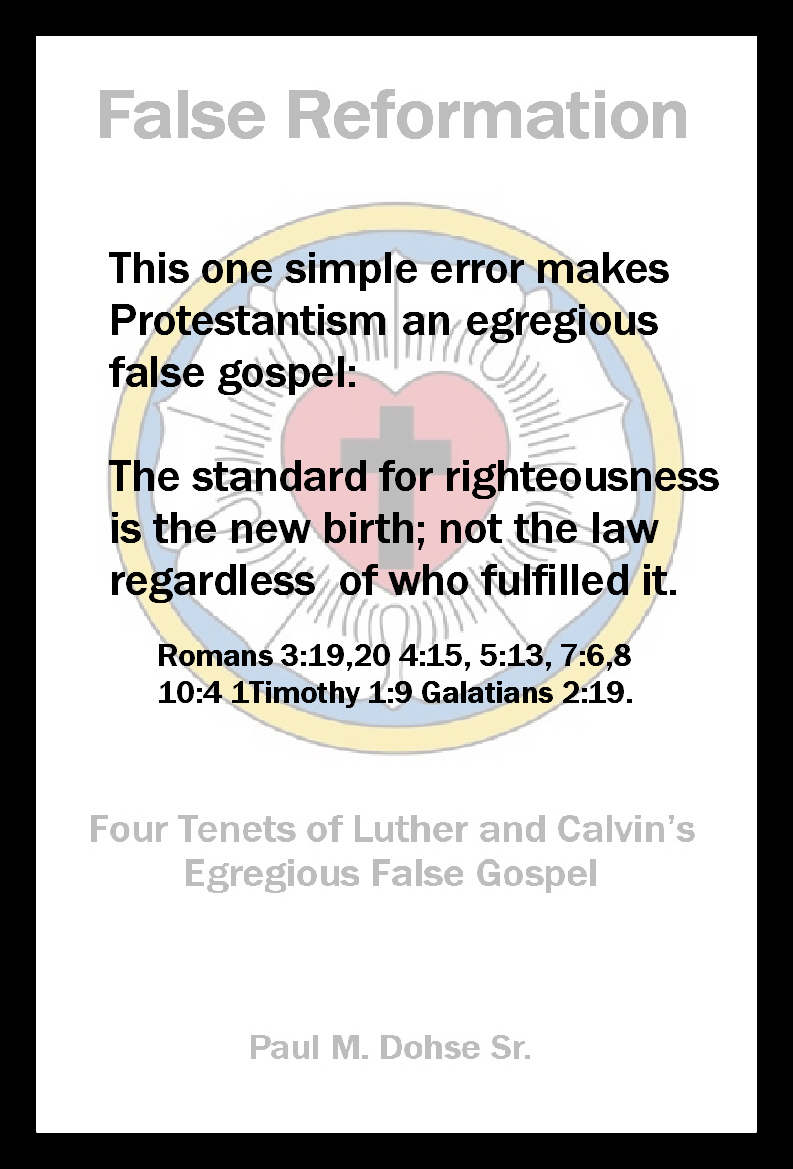
Protestantism falls on this one basic principle: law is the standard for righteousness. This makes the salvific work of Christ two-fold: He died to pay the penalty for our sins, and came to fulfill the law for us in order to make us righteous. That’s gross heresy. That’s an egregious false gospel. Hence, you have two kinds of Protestants: one camp that understands the position and professes it, and the other camp who also confesses it, but has not thought out the ramifications. This includes Baptists, Methodists, and many others. Baptists parted ways with the Reformers on baptism, but have never repented of making the law justification’s standard.
Yes, Jesus said that He came to fulfill the law and to not end it, but then we have the apostle Paul writing that Christ in fact did come to end the law, so does the Bible contradict itself? By no means.
Here is the problem: by design, Protestants don’t interpret the Bible in context of sanctification and justification, and again, that is by design. Why? Because Protestantism is founded on the idea that sanctification is merely the progression of justification. This also goes hand in glove with the idea that the law is justification’s standard. Hence, the law must continue to be fulfilled perfectly to keep the saints justified. This results in the confused theological train wreck we call Protestantism.
When the law must be continually fulfilled perfectly as a standard for justification, the law cannot be used for love because now you have fused love and justification together. This is why churches lack love; the maintaining of justification and love are confused. In the Bible, love is absolutely synonymous with obedience. Unfortunately, Protestantism makes obedience a justification issue. Obedience is not a justification issue—it’s a love issue. That’s why there is so much love-bombing in churches; true love is stifled because it is confused with justification. The vacuum is then filled with empty words and programs. People are in bondage to the law in Jesus’ name and their pain is medicated by praise bands, personality cults, and the splendor of institutional temples.
The fulfillment of the law in Jesus’ name is a huge problem—there is no law in justification regardless of who keeps it. Who keeps it is not the issue, the law is the issue. Here is the theses of Paul’s argument in Galatians 3: Only God can give life through faith alone in the promise. What is the promise? It was a promise made to Abraham and Christ that Israel and the Gentiles would be blessed with eternal life, and that Christ would be resurrected by the power of the Holy Spirit in order to make that possible:
Galatians 3:15 – To give a human example, brothers: even with a man-made covenant, no one annuls it or adds to it once it has been ratified. 16 Now the promises were made to Abraham and to his offspring. It does not say, “And to offsprings,” referring to many, but referring to one, “And to your offspring,” who is Christ. 17 This is what I mean: the law, which came 430 years afterward, does not annul a covenant previously ratified by God, so as to make the promise void. 18 For if the inheritance comes by the law, it no longer comes by promise; but God gave it to Abraham by a promise.
So in other words, if Christ came to also fulfill the law, the Promise is fulfilled by law, and not God’s promise made to Abraham. By the way, this term, “the promise” is a major biblical term referring to the gospel. In regard to justification, Christ came for one reason: to end the curse of the law:
Galatians 3:10 – For all who rely on works of the law are under a curse; for it is written, “Cursed be everyone who does not abide by all things written in the Book of the Law, and do them.” 11 Now it is evident that no one is justified before God by the law, for “The righteous shall live by faith.” 12 But the law is not of faith, rather “The one who does them shall live by them.” 13 Christ redeemed us from the curse of the law by becoming a curse for us—for it is written, “Cursed is everyone who is hanged on a tree”— 14 so that in Christ Jesus the blessing of Abraham might come to the Gentiles, so that we might receive the promised Spirit through faith.
If we still rely on the works of the law, we are under a curse; again, it doesn’t matter who keeps it. Paul spent most of his ministry trying to hammer this point home. Here, he makes it clear that the law was not part of the original promise, and once a covenant has been ratified, nothing can change it. If Christ fulfilled the law in our stead, that is clearly an addition to the original covenant of promise—that’s Paul’s specific point.
But now Protestants once again protest that the key is a perfect fulfillment of the law which only curses those who cannot keep it perfectly. Christ’s perfect obedience to the law is then imputed to us. In light of this chapter in Galatians, this position is fraught with problems. Clearly, it’s still an addition to the original covenant. Also, key is who the promise is made to; ie., the descendants of Abraham which include the Gentiles, and Christ Himself. Paul emphasizes that there is only ONE seed (verse 16). Why?
“Seed” is key. The Greek word refers to offspring. Christ was part of Abraham’s lineage, and is only ONE seed—there is not more than one seed. Christ died to end the curse of the law by dying to pay the penalty of sin, and then waited (in a manner of speaking) in the grave for the promise that was also made to Him: “the promised Spirit.” The Spirit raised Christ from the grave:
Romans 8:11 – If the Spirit of him who raised Jesus from the dead dwells in you, he who raised Christ Jesus from the dead will also give life to your mortal bodies through his Spirit who dwells in you.
Ephesians 1:19 – and what is the immeasurable greatness of his power toward us who believe, according to the working of his great might 20 that he worked in Christ when he raised him from the dead and seated him at his right hand in the heavenly places,
The promised Spirit is major here. This is the new birth. This promise of the Spirit accomplished three universe-shaking objectives: it enabled mankind to follow Christ in literal death and resurrection, baptized Jews and Gentiles into one body, or family of God, cancelled judgement and condemnation, and set God’s children free to aggressively love.
The idea that Christ fulfilled the law in order to satisfy justification usurps the Spirit’s role in the promise. God elected the means of salvation, Christ died, and the Spirit baptizes. God initiated salvation, Christ paid the penalty for sin, and the Spirit regenerates. We are not justified by the law, we are justified by the new birth:
Romans 4:20 – No distrust made him waver concerning the promise of God, but he grew strong in his faith as he gave glory to God, 21 fully convinced that God was able to do what he had promised. 22 That is why his faith was “counted to him as righteousness.” 23 But the words “it was counted to him” were not written for his sake alone, 24 but for ours also. It will be counted to us who believe in him who raised from the dead Jesus our Lord, 25 who was delivered up for our trespasses and raised for our justification. (ESV 2001).
Galatians 3:1 – O thoughtless Galatians, who did bewitch you, not to obey the truth — before whose eyes Jesus Christ was described before among you crucified? 2 this only do I wish to learn from you — by works of law the Spirit did ye receive, or by the hearing of faith? 3 so thoughtless are ye! having begun in the Spirit, now in the flesh do ye end? (YLT).
Notice the idea of completion reflected by the Greek and properly translated by the YLT. We don’t receive the Spirit and His work on the installment plan when we believe; the new birth is a complete work. Hence, the new birth, or the Spirit’s baptism is what makes us righteous or justified, not the law.
Again, God set forth the plan of salvation, Christ died to end the law, and the Spirit regenerates us and helps us in our progression of holiness. We are born of the Spirit and resurrected as holy babies born of God, and grow up in holiness (1Peter 2:2). The baptism of the Spirit is therefore twofold:
Romans 6:1 – What shall we say then? Are we to continue in sin that grace may abound? 2 By no means! How can we who died to sin still live in it? 3 Do you not know that all of us who have been baptized into Christ Jesus were baptized into his death? 4 We were buried therefore with him by baptism into death, in order that, just as Christ was raised from the dead by the glory of the Father, we too might walk in newness of life.
5 For if we have been united with him in a death like his, we shall certainly be united with him in a resurrection like his. 6 We know that our old self was crucified with him in order that the body of sin might be brought to nothing, so that we would no longer be enslaved to sin. 7 For one who has died has been set free from sin. 8 Now if we have died with Christ, we believe that we will also live with him. 9 We know that Christ, being raised from the dead, will never die again; death no longer has dominion over him. 10 For the death he died he died to sin, once for all, but the life he lives he lives to God. 11 So you also must consider yourselves dead to sin and alive to God in Christ Jesus.
Romans 7:1 – Or do you not know, brothers—for I am speaking to those who know the law—that the law is binding on a person only as long as he lives? 2 For a married woman is bound by law to her husband while he lives, but if her husband dies she is released from the law of marriage. 3 Accordingly, she will be called an adulteress if she lives with another man while her husband is alive. But if her husband dies, she is free from that law, and if she marries another man she is not an adulteress.
4 Likewise, my brothers, you also have died to the law through the body of Christ, so that you may belong to another, to him who has been raised from the dead, in order that we may bear fruit for God. 5 For while we were living in the flesh, our sinful passions, aroused by the law, were at work in our members to bear fruit for death. 6 But now we are released from the law, having died to that which held us captive, so that we serve in the new way of the Spirit and not in the old way of the written code.
Colossians 2:8 – See to it that no one takes you captive by philosophy and empty deceit, according to human tradition, according to the elemental spirits of the world, and not according to Christ. 9 For in him the whole fullness of deity dwells bodily, 10 and you have been filled in him, who is the head of all rule and authority. 11 In him also you were circumcised with a circumcision made without hands, by putting off the body of the flesh, by the circumcision of Christ, 12 having been buried with him in baptism, in which you were also raised with him through faith in the powerful working of God, who raised him from the dead. 13 And you, who were dead in your trespasses and the uncircumcision of your flesh, God made alive together with him, having forgiven us all our trespasses, 14 by canceling the record of debt that stood against us with its legal demands. This he set aside, nailing it to the cross. 15 He disarmed the rulers and authorities and put them to open shame, by triumphing over them in him.
Why would Christ fulfil the law and then die to end it? Why would Christ’s perfect obedience to law be imputed to us when it is no longer valid? Why would Christ fulfil the law for those who die with Him and are no longer under that law? Why would Christ fulfil a law that has nothing to say to us? (Romans 3:19). When Paul states, “For all who rely on works of the law are under a curse” (verse 10), that means any works of the law period, not just what we perform, but any works of the law period. The covenant of promise WAS NOT RATIFIED BY THE LAW THAT CAME 430 YEARS LATER. What could possibly be more evident? If Jesus kept the law perfectly as part of the gospel, that still ratifies the original covenant of promise.
But all of this is not even Paul’s primary argument. His primary argument is that only the Spirit can give life. His argument is that only the resurrection of the new birth gives life. If the law has any part in justification; the law can give life and there is more than one seed. Consequently, only God can give life and now there is a co-life-giver. That’s Paul’s argument exactly.
11 Now it is evident that no one is justified before God by the law, for “The righteous shall live by faith.” 12 But the law is not of faith, rather “The one who does them shall live by them.”
Life, justification, faith alone in the promise, and the new birth are all mutually inclusive while the law and justification are mutually exclusive—that’s exactly what the apostle Paul is saying.
Also, if law has anything to do with justification at all, we inherit eternal life by being born again into God’s family by the fulfillment of the law and NOT promise:
18 For if the inheritance comes by the law, it no longer comes by promise; but God gave it to Abraham by a promise.
Someone may argue, “But Jesus keeps the law perfectly!” So what of it? It’s still inheritance by the law and not promise. Again, and again; the original covenant was not ratified by Jesus’ perfect law-keeping. Here is what we must come to grips with: Protestantism is predicated on a juvenile perception of law and gospel.
16 Now the promises were made to Abraham and to his offspring. It does not say, “And to offsprings,” referring to many, but referring to one, “And to your offspring,” who is Christ.
20 Now an intermediary implies more than one, but God is one.
21 Is the law then contrary to the promises of God? Certainly not! For if a law had been given that could give life, then righteousness would indeed be by the law.
As an aside while on the subject of covenants: this whole idea of Jesus fulfilling the law plugs into the ever popular Covenant theology. This is the idea that Christ came to obey the law perfectly in order to restore the original and supposed covenant of works with Adam. But the Covenant of Promise was not made with Adam, it was made with Abraham. Compounding this glaring error is the citation of Genesis 3:15 to make a connection between Adam’s disobedience and Christ’s obedience to the law. But in that verse, it is the serpent that is being addressed and not Adam. Usually, when you make a covenant with someone, as with Abraham, it’s made with the person you are talking to. In essence, it claims that God made a covenant with the serpent.
Regardless of all of the splendor and glory affiliated with religious academia, it is found wanting in embarrassing proportions. The laity must stop listening to these people and start reading the Bible for themselves.
But with all of this said, “Why then the law?”(verse 19). However, which law is Paul referring to when he presents this anticipated question in verse 19? There are two laws: one known as, “the written code” (Colossians 2:14), “the law of sin and death” (Romans 8:2), “the law of sin” (Romans 7:23), simply “the law” in many places, “the letter” (2Cor 3:6), “ministry of death” (2Cor 3:7), “ministry of condemnation” (2Cor 3:9), “the record of debt” (Col 2:14), and “the first covenant” (Hebrews 8:13).
The second is known as: “the law of the Spirit of life” (Romans 8:2), “the law of my mind” (Romans 7:23), “the law of liberty” (James 1:25), “the law of Christ” (Galatians 6:2), and because love fulfills the whole law (Romans 13:8-10), it can be rightly called “the law of love.”
In verse 19, Paul is referring to the first law. It only condemns and judges, but that’s not its only function by far.
19 Why then the law? It was added because of transgressions, until the offspring should come to whom the promise had been made, and it was put in place through angels by an intermediary. 20 Now an intermediary implies more than one, but God is one.
21 Is the law then contrary to the promises of God? Certainly not! For if a law had been given that could give life, then righteousness would indeed be by the law. 22 But the Scripture imprisoned everything under sin, so that the promise by faith in Jesus Christ might be given to those who believe.
23 Now before faith came, we were held captive under the law, imprisoned until the coming faith would be revealed. 24 So then, the law was our guardian until Christ came, in order that we might be justified by faith. 25 But now that faith has come, we are no longer under a guardian, 26 for in Christ Jesus you are all sons of God, through faith. 27 For as many of you as were baptized into Christ have put on Christ. 28 There is neither Jew nor Greek, there is neither slave nor free, there is no male and female, for you are all one in Christ Jesus. 29 And if you are Christ’s, then you are Abraham’s offspring, heirs according to promise.
What’s this saying? First, it’s saying that the first law has no function for believers after Christ died on the cross to END the law. And Christ did come to end the law of sin and death. Christ didn’t come to merely cover sin with His own righteousness, He came to end sin by ending the law (Romans 3:19,20, 4:15, 5:13, 7:6,8, 10:4, 1Tim 1:9, Gal 2:19).
Secondly, the first law covered believers until Christ died on the cross. The first law was an atonement for sin; all of the sins of Old Testament believers were imputed to that law, and then it was ended by Christ. The person who believes on Christ dies in baptism, and is no longer under the law that he/she sinned against (Romans 7:1ff). This would also include believers who were deceased at the time.
In regard to Old Testament believers that were dead during the time of Christ’s ministry on earth, Old Testament believers were captive under the law until Christ died to end the law. Therefore, they were in Sheol/Abraham’s bosom/Paradise/Hades. When Christ died, He went there and preached to the captives and took the thief on the cross with Him. When the Spirit resurrected Him, He also resurrected those in Sheol and set the captives free. They and their sins were held captive by the law until Christ died to end it. Remember, King David said, “For you will not abandon my soul to Sheol, or let your holy one see corruption” (Psalm 16:10). As a testimony, Christ sent many of them to walk around Jerusalem. Texts that help sum up all of these points are Ephesians 4:7-10 which also references Psalm 68:18, Luke 16:22, Matthew 27:51-53, and Colossians 2:13-15.
Thirdly, the first law still has a function in the scheme of things. The old covenant of the law is passing away, but is not ended for the unbelieving. “Under grace” did not end “under law” (Romans 6:14). The first law still holds sin captive because all sin is against the law (1John 3:4). Yes, for those who don’t repent, the law will judge them in the end. To the degree that they violate the law, they will be punished eternally.
But there is a sense in which the first law also serves a purpose of covering as it formally did for those under grace. When a person is saved and born again, they die and are no longer culpable to the law—the law is also ended for them at that time. Their sins are taken away and cast as far as the east is from the west. Again, Christ did not come to cover sin, he came to take sin away. The first law is grace in waiting. All sin is imputed to it, and it stands ready to be ended for each and every person who chooses to follow Christ in death and resurrection.
Now, what about the other law—the law of the Spirit of life? Let there be no doubt, there is a law that is under grace. It is the law of love. We have been released from the condemnation of the first law, and are now free to aggressively serve the law of Christ:
Romans 7:4 – Likewise, my brothers, you also have died to the law through the body of Christ, so that you may belong to another, to him who has been raised from the dead, in order that we may bear fruit for God.
In the same way that one sin formally violated the whole law (James 2:10), one act of love fulfills the law of Christ (Gal 5:14, Rom 13:10). Love covers a multitude of sin (1Peter 4:8). We are sanctified with the word of truth (John 17:17). The Christian life is faith WORKING through the obedience of love (Gal 5:6), and love is synonymous with obedience (John 14:15).
If a professing Christian is not truly bearing fruit for God as an expression of true love for truth, God, and others, he/she has a flawed view of the law’s relationship to the gospel.
What is sapping the power of Christianity in our day is misguided fear. When the ending of sin is confused with the idea of covering, excessive introspection ensues for fear that we are not living by a convoluted Protestant system of faith-alone works so that the perfect obedience of Christ will continue to be imputed to our Christian life.
In contrast, there is no longer any condemnation for those in Christ and fear has to do with judgement (Rom 8:30, 1Jn 4:16-19). Those mature in love cast away fear. They are free from the condemnation of the law and free to serve Christ in aggressive love.
Who will deny that the overwhelming preoccupation of Protestants is sin and not love while any appearance of good works are held suspect? Where there is not freedom to love without fearful introspection, love will not thrive.
Let’s go to the phones.

 Paul's Passing Thoughts
leave a comment