This Says it All About New Calvinism
 An accusation against a ministry associate of mine after he asked, “What is my heresy against the church?”
The accuser’s answer: “Synergistic sanctification. Which underhandedly denies justification by faith alone.”
1. In the mind of a New Calvinist, the two are obviously fused.
2. Therefore, what we do in sanctification effects justification.
3. Whatever that would be, whether something, nothing, or otherwise, if we are involved, our justification is DOA.
4. New Calvinism is a false gospel on steroids.
Heresy Hunting is Good, but PPT is “Sect” Focused
“The more, the merrier. Information is the enemy of those leading God’s people astray.”
As the spiritual hirelings of our day are beginning to feel the heat from discernment ministries/blogs, more and more disparaging articles are being written about “heresy hunters.”
First, hirelings hate the internet. I can tell you this: without the internet, even if what I have uncovered about New Calvinism was possible, it would have been ten years of research rather than five.
Secondly, the internet also puts cults and cult-like movements at a huge disadvantage in their endeavor to control followers. When I first suspected something was wrong at my church, and the leaders were not forthcoming, I started googling phrases which led to additional information I could ask them about. When my questions caused alarm among the leadership, I knew I was on to something. Unfortunately, there wasn’t enough information on the net that I could obtain quickly enough to save my family. It goes without saying that PPT is out to solve that problem.
Thirdly, “heresy hunters” (HH) are beginning to network together and share information. The motives, agendas, and concerns are a huge melting pot, but much of the information overlaps. Discernment blogs of other concerns gave me information that made my good case in The Truth About New Calvinism an ironclad case. The more, the merrier. Information is the enemy of those leading God’s people astray.
And the progress/results are over the top. New Calvinism is now identified as a particular movement started at a particular time and processing a particular core/unifying doctrine. You cannot destroy an enemy that cannot be identified. New Calvinism has been greatly crippled in regard to slipping into churches unawares, and that crippling continues to escalate via blog networks and increased information. The movement is being identified according to its history, doctrine, character, and mode of operation.
Some HH ministries focus on various and sundry error. This appeals to the “collecting” instincts God created in us. Some like to collect and document stamps, some like to collect and document butterflies. We also have birdwatchers, and thank goodness, those who like to learn about and document biblical error. Amen. If you are going to have a hobby, that’s a good one. By the way, learning by antithesis is a great way to learn. Christ himself used it: “You have heard it said, but I tell you….” Often, studying error shows the cause and effect results to be avoided. Again, the Bible employs this technique:
1 Corinthians 10:6
Now these things took place as examples for us, that we might not desire evil as they did.
1 Corinthians 10:11
Now these things happened to them as an example, but they were written down for our instruction, on whom the end of the ages has come.
Then there are those who focus on warning others through information to prevent bondage and spiritual abuse. This is hard to argue with, and I wonder about those who assign disparaging nomenclature to those who educate Christians in regard to movements that propagate spanking their wives and locking them up in basements. Those who wax eloquent about so-called “heresy hunters” need to educate themselves in regard to the whole spectrum. Anti-spiritual abuse ministries offer biblical counseling as well.
Lastly on this internet subject, huge movements like New Calvinism can, and often do control education (seminaries), and dissimulation of information (Christian book publishers) among evangelical Christians. The internet gets around that. It’s truly a beautiful thing. A project that I am working on, “Berean Laity Publishers” will put publishing, support, and promotion into the hands and ability of the laity.
So, regardless of motives not always being pure among HH, the jury is in and the verdict is a good one. But PPT is not HH. And I also might mention that anti-spiritual abuse ministries are not HH either, not yet anyway, but that may change soon. Discernment ministries can be split up into three categories according to their focus: 1) error 2) prevention and healing 3) Sect. Number one is symptom focused and is important, but the lesser value of the three. Number two has strong biblical application in regard to counseling which is a biblical imperative for pastors and the laity alike. So, the answer to your question is “yes,” discernment ministries have biblical precedent in many ways, whether counseling, contending, warning, or looking out for one’s brother, and at the very least, teaching by antithesis. Number three is what PPT is; it is sect focused, and PPT only focuses on New Calvinism as a biblical sect.
What is a biblical “sect”? And why should New Calvinism be classified as such?
The Biblical Meaning of Heresy
Discernment ministries serve as a teaching tool by antithesis (finding error often leads to discovering more truth in the antithesis). And here, we have an excellent example for I would have never known the true meaning of the word “heresy” if not for this ministry. Like most folks, I assumed the word just referred to erroneous teachings by “heretics.” Such is not the case. The word refers to a group of people, or a movement that causes division and controversies by teaching error.
First, the foundation of what sects do is based on the biblical concept that truth unifies and error divides. A call for unity by the apostles is also a call to be of the “same” mind and judgment:
1 Corinthians 1:10
I appeal to you, brothers, by the name of our Lord Jesus Christ, that all of you agree, and that there be no divisions among you, but that you be united in the same mind and the same judgment.
1 Corinthians 9:8
Do I say these things on human authority? Does not the Law say the same?
Philippians 2:2
complete my joy by being of the same mind, having the same love, being in full accord and of one mind.
Secondly, the cause of division:
Romans 16:17
I appeal to you, brothers, to watch out for those who cause divisions and create obstacles contrary to the doctrine that you have been taught; avoid them.
1 Corinthians 1:10
I appeal to you, brothers, by the name of our Lord Jesus Christ, that all of you agree, and that there be no divisions among you, but that you be united in the same mind and the same judgment.
Jude 1:17
But you must remember, beloved, the predictions of the apostles of our Lord Jesus Christ. 18 They said to you, “In the last time there will be scoffers, following their own ungodly passions.” 19 It is these who cause divisions, worldly people, devoid of the Spirit.
Ephesians 4:13
Till we all come in the unity of the faith, and of the knowledge of the Son of God, unto a perfect man, unto the measure of the stature of the fulness of Christ:
14 That we henceforth be no more children, tossed to and fro, and carried about with every wind of doctrine, by the sleight of men, and cunning craftiness, whereby they lie in wait to deceive;
Truth unites, and error divides; therefore, a heretic is described in Titus 3:10:
“As for a person who stirs up division, after warning him once and then twice, have nothing more to do with him,
The actual word for “division” as translated in the ESV is the English word “heretic[k]” (KJV). It is translated that way because of the following note that is found in some English/Greek dictionaries: “From the same as G140; a schismatic. (“heretic” is the Greek word itself).”
Therefore, in the Bible, those who teach error and are divisive are synonymous.
Division With a Purpose
In the same way that heresy, heretics, and division cannot be separated, the idea that these are always sectarian is also the biblical maxim. In fact, Young’s Literal Translation uses the word “sectarian” in place of “divisive” or “heretic” in Titus 3:10. 1Corithians 11:19 states the following:
For there must be also heresies among you, that they which are approved may be made manifest among you.
The word in Titus 3:10 is “heretic,” and likewise, the English form of the word in 1Corinthians 11:19 is “heresies.” But most English translations use the word “faction.” The ESV is one example among many. It means “party,” “group,” or “sect.” In other words, these English words translated from the Greek are all used interchangeably in the biblical text, especially with “heresy” or “heretic.” This idea that sects, division, and doctrinal error go hand in hand is plainly stated in the Bible:
Acts 20:30
and from among your own selves will arise men speaking twisted things, to draw away the disciples after them.
Acts 24:5
For we have found this man a plague, one who stirs up riots among all the Jews throughout the world and is a ringleader of the sect of the Nazarenes.
In fact, Christianity was seen as a sect because of the divisions caused by sanctification:
Acts 24:14
But this I confess to you, that according to the Way, which they call a sect, I worship the God of our fathers, believing everything laid down by the Law and written in the Prophets, (refer back to 1Corinthians 11:19 as well).
Note that the word used in the ESV for “sect” is “heresy,” which is the same word used in Titus 3:10 to describe a heretic. Hence the following reference by others that I found helpful in regards to Titus 3:10:
Some say that in Titus 3:10 ‘a factious [sectarian] man’ should be translated ‘a man who teaches heresy’ and that this expression does not refer to a divisive person. But in Greek this expression denotes a person who holds an opinion or a different doctrine that tends toward division. Thus, the English versions translate this as (1) a factious man—American Standard Version, New American Standard Bible, Marshall’s Interlinear Greek-English New Testament; (2) a man who is factious—Revised Standard Version, Amplified Bible; (3) a heretical sectarian and cause of divisions—Amplified Bible; (4) a heretical person causing divisions—Wuest; (5) a sectarian—W. J. Conybeare; (6) a man who causes divisions—R. F. Weymouth; (7) a factious person—James Moffatt; (8) a sectarian man—Concordant Literal New Testament, Berry’s Interlinear Greek-English New Testament; (9) a factious person—Berkeley Version; (10) a heretical man, i.e., one given to ‘lift up’ opinions, sound or unsound, and an unstable, unsettled individual who wishes to form sects—Young’s Translation; (11) causing division by a party spirit, factious—Vine’s Expository Dictionary of New Testament Words; (12) a divisive person—New International Version.
To say that division over doctrine exemplifies New Calvinism would be the understatement of the century! Throughout the Bible, sectarians are also described as COVERT—another adjective describing New Calvinism that is an understatement on steroids. In fact, they themselves boast that they are divisive because they preach a “scandalous” gospel. Well, that’s exactly what the apostle Paul said sectarians do:
I appeal to you, brothers, to watch out for those who cause divisions and create obstacles contrary to the doctrine that you have been taught; avoid them.
The word for “obstacles” in this verse is, “scandalon” or “scandal.” So for all practical purposes, New Calvinists admit that they preach a divisive gospel. New Calvinism came forth from its Australian Forum womb drawing away disciples and causing divisions on personal levels and corporate levels to a degree that may be unprecedented in church history.
The Cure
New Calvinism is a super-sect that must be exposed and stopped, and only one cure will work: biblical separation. The apostles described sectarianism as a disease that would quickly spread and wreak havoc on God’s people (“gangrene”). They said that a little leaven will leaven the whole lump. Men who gather to “discuss” the symptoms of sectarianism with its proponents show that they do not understand what the Bible teaches about sectarianism. While they feast with these men and discuss “issues,” the gangrene does not wait.
paul
New Calvinism’s Replacement of the New Birth with Pagan Philosophy
We can rest assured that our Father doesn’t want us to be confused. He gave us a brain and is honored when we use it, but know this: He doesn’t want us to use it to vet every theory running amuck in the world regarding the meaning of life. His word to us is clear: we have His Spirit; we are not to be deceived; test every spirit; and we have all that is needed to be fully equipped for every good work. But according to New Calvinist David Powlison, the church forgets stuff. Therefore, it needs a research and development purpose to rediscover lost truth and apply it. Buyers beware; you only need to follow the money.
As stated in The Truth About new Calvinism, it all boils down to the enemy’s agenda: 1) keep people out of the kingdom 2) deceive kingdom citizens into living spiritually anemic lives 3) which leads to a lack of testimony and thereby facilitates purpose number one. If the kingdom of darkness couldn’t keep you out, it can at least use you to keep others out. And we only need to examine that in context of what worked so well: “Did God really say….” The apostle Paul warned us many times in regard to being led away from the truth by vain philosophies.
New Calvinism is a reductionist theology. Reductionism is two-fold. First, in an attempt to make much of God’s grace and little of man’s efforts, the role of man is reduced as much as possible in theological systems. Secondly, this entails diminishing the primary instrument for man’s participation in God’s work—the law. Therefore, something needs to be done about the new birth because it implies the ability to participate in upholding God’s law in sanctification. New Calvinists have several different ways of denying the new birth; this post is about what they replace it with.
The primary tenet of New Calvinism is the centrality of the objective gospel outside of us as developed by the Australian Forum, a think tank for the Progressive Adventist Movement. One reader commented in regard to part 5 of the New Calvinism for Dummies video series:
One of the things that popped into my mind when you were talking about “objective” and it occurring outside ourselves. It also seems like the NC is inviting the person to stepoutside themselves to be an observer of themselves. Like they are being invited to emotionally remove themselves from who they are, becoming the unemotional observer, which would also lead to some coldheartedness. With the emotions corralled, as such, it just sort of reminds me of Spock on Star Trek.
That’s a good assessment, and speaks to the fact that New Calvinists are very coldhearted and indifferent, also lacking in having a sense of justice about them. That’s one of the bad results of partaking in anti-word philosophies:
….and many false prophets will appear and deceive many people. Because of the increase of anomia, the love of most will grow cold (Matthew 24:11,12).
Their hearts are callous and unfeeling, but I delight in your law (Psalm 119:70).
The centrality of the objective gospel outside of us (COGOUS) is the mainframe that holds all of the various movements within New Calvinism together and gives it a hyper-ecumenical flare. The various groups within New Calvinism all have their own way of making this doctrine work with real life, but the overall goal of the doctrine is the same: gospel contemplationism leading to a passive manifestation of a realm. This is merely a device of the only primary goal of the kingdom of darkness from the beginning of redemptive history; specifically, “Has God really said.” It is meant to divert God’s people from Christ’s simple counsel:
Everyone then who hears these words of mine and does them will be like a wise man who built his house on the rock (Matthew 7:24).
If every verse in the Bible is about what Christ has done and not what he SAYS; ie, “these words of mine,” biblical wisdom for kingdom living is circumvented. Secondly, if our only “do[ing]es” is a passive yielding to a realm, the kind of intentional application of God’s word necessary for a life built on a rock is also circumvented. This will lead to the circumvention of Christ’s goal stated in Matthew chapter five:
14 You are the light of the world. A city set on a hill cannot be hidden. 15 Nor do people light a lamp and put it under a basket, but on a stand, and it gives light to all in the house. 16 In the same way, let your light shine before others, so that they may see your good works and give glory to your Father who is in heaven.
Therefore, the simple biblical approach of learn/hear>>>obey>>>God glorified, must be replaced with a more passive formula. Opponents of the biblical model would say they only want to exclude man’s efforts so God will get all of the glory, resulting in contemplation/meditation>>>_________>>>God’s works manifested, not ours. The blank is filled in by various and sundry techniques which New Calvinists point to. This often confuses the real issue. But getting back to the main point, the new birth must be refuted because it makes the contra formula possible. And because the latter formula is reductionist and narrow, it must be embellished. Hence, Christian Hedonism, Heart Theology, unbiblical forms of prayer, Neuro-Linguistic-Programming, reorientation of desires, etc, etc. This is vital in selling the product because we were created for work (you know, feet, hands, stuff like that), and passive theologies therefore contradict the conscience. So the blank between meditation and work must be filled in with some plausible stuff that sounds good. Please note: I am stating all of this in context of sanctification. COGOUS>>>life application>>>manifestation of works verses new birth>>>learn and apply>>>obedience.
Furthermore, the application must not only supply a feasible life application, but must also appeal to human desire. This brings us back to the astute comment by the aforementioned reader. This whole idea of COGOUS giving one the ability to step outside of themselves and be an observer of their own life. Some would call this Nature/Freedom philosophy; this is the freedom from the laws of nature, and in the case of New Calvinism, God’s written law as well. There is no better way to demonstrate this than by a quote from one of the most popular New Calvinist articles ever written:
What, then, is the subjective power of this message? Firstly, we find that there is real, objective freedom, the kind that, yes, can be experienced subjectively. We are freed from having to worry about the legitimacy of experiences; our claims of self-improvement are no longer seen as a basis of our witness or faith. In other words, we are freed from ourselves, from the tumultuous ebb and flow of our inner lives and the outward circumstances; anyone in Christ will be saved despite those things. We can observe our own turmoil without identifying with it. We might even find that we have compassion for others who function similarly. These fluctuations, violent as they might be, do not ultimately define us. If anything, they tell us about our need for a savior.
Secondly, this freedom gives us permission to confront and confess our pain. We can look our self-defeating and regressive tendencies in the eye for once. We no longer have to pretend to be anything other than what the Gospel tells us we are: hopeless sinners in need of mercy. Honesty and repentance go hand in hand – freedom puts us on our knees, where we belong. A subjective Gospel turns repentance into a frightening affair, evidence that God is far away from us. An objective Gospel provides the assurance that actually produces repentance, forging the pathway to the place where we find forgiveness and redemption. We can finally grasp hold of the truth that it is always better to be sorry than to be safe. The pastoral implications for marriage alone are staggering.
(David Zahl and Jacob Smith: Mockingbird blog, “The Subjective Power Of An Objective Gospel”).
I think this quotation says it all. It is a freedom from obedience to the law (because we are totally depraved sinners that can’t keep it anyway), freedom from consequences, and supplies a mentality that we can use to detach ourselves from the burdens of life. It is Nature Freedom philosophy to the max and could be accompanied by the song, “Don’t Worry Be Happy” by Bobby McFerrin:
Here is a little song I wrote
You might want to sing it note for note
Don’t worry be happy
In every life we have some trouble
When you worry you make it double
Don’t worry, be happy……
Ain’t got no place to lay your head
Somebody came and took your bed
Don’t worry, be happy
The land lord say your rent is late
He may have to litigate
Don’t worry, be happy
Look at me I am happy
Don’t worry, be happy
Here I give you my phone number
When you worry call me
I make you happy
Don’t worry, be happy
Ain’t got no cash, ain’t got no style
Ain’t got not girl to make you smile
But don’t worry be happy
Cause when you worry
Your face will frown
And that will bring everybody down
So don’t worry, be happy (now)…..
There is this little song I wrote
I hope you learn it note for note
Like good little children
Don’t worry, be happy
Listen to what I say
In your life expect some trouble
But when you worry
You make it double
Don’t worry, be happy……
Don’t worry don’t do it, be happy
Put a smile on your face
Don’t bring everybody down like this
Don’t worry, it will soon past
Whatever it is
Don’t worry, be happy
….because everything that matters is outside of you—the cross. Just sit back and let life make the cross bigger; stop trying to be the gospel instead of living the gospel by faith alone. That’s one of the many allurements of New Calvinism, but primarily, it’s a theological framework that allows us to fill in the practical application line in any way we would like to. And we like that.
paul
Another New Calvinist Lie via Chad Bresson: We Aren’t Postmodern and the Emergent Church is Bad and We are Good
I guess it goes along with being antinomian; New Calvinists constantly lie about many things. In fact, I wonder if they ever tell the truth about anything. New Calvinism dominates the present evangelical landscape because their theological framework invented by a Seventh-Day Adventist (who is now an atheist) is a powerful concept that sells. Robert Brinsmead claimed that he discovered the lost gospel of the Reformation and Reformed folks saw what the supposed finding was doing to the SDA: reforming it. Brinsmead’s Awakening movement via his centrality of the objective gospel (COGOUS) doctrine was turning the SDA upside down. The results were therefore evident, and it had a Reformed label, so the masses have been jumping on the new reformation bandwagon ever since. Many of the elements that make this doctrine attractive to our present culture will be discussed in the second volume of The Truth About New Calvinism.
New Calvinists avoid historical dots that could connect them back to Brinsmead like the Bubonic Plague, and one way of doing that is pretending like you oppose certain dots. Therefore, The dots that they disparage the most are New Covenant Theology (NCT) and the Emergent Church (EU). New Calvinists such as DA Carson stay aloof from NCT, but support it behind the scenes. Brinsmead was a close friend with the father of NCT, Jon Zens, and Brinsmead contributed significantly to the formation of the doctrine. Therefore, pigs will fly before any NCT guys will be invited to one of the big New Calvinist dances, but Carson regularly speaks at NCT conferences.
Likewise, Sonship Theology which was founded on Brinsmead’s COGOUS intermarried with the EC family, so the EC, like Jon Zens, is only one step removed from Brinsmead and his theological think tank that launched present-day New Calvinism: the Australian Form. The Forum may have also influenced the EC which originated in Australia/UK in 1992 and arrived in the US around 1998. Even though New Calvinists such as John Piper associate with EC proponents like Mark Driscoll on a continual basis, and both groups function by the same doctrine (COGOUS, also known as Gospel Sanctification), New Calvinists continually fustigate the EC. The Piper/Driscoll relationship is condoned because Driscoll is supposedly a different kind of Emergent species (http://wp.me/pmd7S-16r).
One New Calvinist “church” that partakes in this deception at every opportunity is Clearcreek Chapel in Springboro, Ohio. A staff elder, Chad Bresson, wrote an article on his blog (a blog dedicated to NCT ) entitled, “The Word of God is an objective, propositional revelation because the resurrection is of such” (Vossed World blog: archives; July 19, 2006). Bresson begins the post with the following:
A supporter of the emergent church posted over at Steve Camp’s blog the following comments:
1. Revelation does not refer to the Bible, it is rather God’s activity in history.
2. Revelation is dynamic and personal, not static propositional.
3. Scripture is a meta-narrative, and by this nature is not a propositional document for us
to pin down all the rules to obey and doctrines to believe.
4. Passages are not always easily discerned for God’s desired message for the Church.
5. Texts may simply indicate direction, not neat and orderly systematic doctrine.
All of these points are either outright false or are only partly true. They represent what is of major concern to many who have observed the development of the emerging church.
These five tenets of EC interpretation, for all practical purposes, are the like hermeneutics of New Calvinism despite Bresson’s disingenuous harpings. Bresson, usually accustomed to linguistic drones of ten-thousand words or more, writes a paragraph or two for each proposition that disputes propositional truth, and I will rebut his deceptive rebuttal of his theological kissing-cousin’s comment. Bresson begins by addressing the first tenet:
God[‘s] activity in history through Christ *resulted in* the Bible. The Bible is God’s *written* revelation to man, and thus the sixty six books of the Bible given to us by the Holy Spirit constitute the plenary (inspired equally in all parts) Word of God (1 Corinthians 2:7-14; 2 Peter 1:20-21). The Word of God is an objective, propositional revelation (1 Thessalonians 2:13; 1 Corinthians 2:13), verbally inspired in every word (2 Timothy 3:16), absolutely inerrant in the original documents, infallible, and God breathed. They are fully self-authenticating, not relying on any external proof for their claims. Since all of Scripture is spoken by God, all of Scripture must be “unlying,” just as God himself is: there can be no untruthfulness in Scripture (2 Sam. 7:28; Titus 1:2; Hebrews 6:18). Because God is the Bible’s author, we are to accept its authority and submit ourselves to it in faith (2 Pet. 1:19,21, 2 Tim. 3:16, 1 John 5:9, 1 Thess. 2:13).
As I will demonstrate, New Calvinists end up in the same place as the EC on this issue. And remember, the staple doctrine of New Calvinism and the EU is one and the same: Gospel Sanctification. This is plainly irrefutable. The EU is most prevalent in American church culture through Acts 29 and World Harvest Missions which were both spawned by the father of Sonship Theology, Dr. John “Jack” Miller. Dr. Miller originally coined the New Calvinist slogans, “We must preach the gospel to ourselves every day,” and its accompaniment, “The same gospel that saves you also sanctifies you.” The former understudies of Dr. Miller and the gatekeepers of Sonship theology after Miller’s passing, David Powlison and Tim Keller, are major figures in the New Calvinist clan.
Regardless of how orthodox Bresson’s opening statement is, his fingers are crossed behind his back with the first ten words: “God[‘s] activity in history through Christ *resulted in* the Bible.” Though the more fringe elements of the EC may think specific revelation can be found outside of the Bible, note that Bresson also states that the Bible is primarily a historical document about Christ. Specifically, a meta-narrative about the gospel, and the gospel only for meditation purposes. All of the rest affirming the accuracy of the Bible is regarding its accuracy for that purpose only. The pastor/teacher of Clearcreek states the following on this point:
May we be transformed by seeing the glory of Christ all through the Bible. The transforming power of beholding Christ emerges from the pages of the whole Bible. We are transformed from glory to glory as we see Him there. Want to grow and change? Want to reflect Christ to others? Gaze on Him in the pages of your Bible (Russ Kennedy: The Fading Glory, 2Corinthians 2:14-3:18).
Furthermore, Bresson posted an excerpt from Robert Brinsmead on his blog to make the point that the Holy Spirit only illumines when the Scriptures are seen through the prism of the gospel and used for that purpose alone (Vossed World blog: archives; July 17, 2008).
Bresson continues to use orthodoxy to deceive:
God’s Word is sufficient for all things pertaining to life and godliness, because Christ, THE WORD, is sufficient (Eph. 1:3, 23; Deut. 8:3/Matthew 4:4/John 6:48-51; John 1:14,16). Because THE WORD is life himself (John 11:25, 14:6; Colossians 1:15-20), The Word is living and active in discerning and judging the actions and thoughts of men (Hebrews 4:12). Christ, as THE WORD, is Wisdom from God (1 Corinthians 1:30), which is *why* the word is sufficient for all of life (Psalm 119:105; Proverbs 2:6, 3:18; Colossians 3:16). Christ’s sufficiency for all of life is best summed up by the covenantal promise/fulfillment: Christ is our God and we are His people (Revelation 21:3,7). As THE WORD, Christ himself is the grace that is sufficient for us (2 Cor. 12:7-10; John 1:14, 16, 17).
After all of the unarguable truth and citation of Scriptures, Bresson once again has his fingers crossed behind his back with the last thirteen words: “As THE WORD, Christ himself is the grace that is sufficient for us.” Hence, Bresson parrots the same EC hermeneutic he claims to be refuting. Note tenet number two: “Revelation is dynamic and personal, not static propositional.” In fact, on the aforementioned post where he cites a long excerpt from a Brinsmead article, Bresson made the following comment:
John 1:1 tells us that Christ incarnated the very Word of God. Thus, the text… the Word… is both witness to and emanates from THE WORD. I should add that John 1:1 is also telling us that Christ *was* the very Word of God from the beginning. So… to draw a distinction between text and Person is a false dichotomy.
Exactly, and the EC crowd agrees, stating that the word is a person and not for the reason of determining propositional truth. I like to state it a different way for clarification; it’s about who Jesus is (or his “personhood”), and not about what He SAYS. Christ warned against such a mentality in Luke 11:26, 27. Clearcreek’s close relationship with Paul David Tripp should also be weighed in this discussion as well. Tripp, who has close ties to Clearcreek and speaks there often, stated the following on page 27 of How people Changed (2006):
Jesus comes to transform our entire being, not just our mind. He comes as a person, not as a cognitive concept that we insert into a new formula for life.
As noted in another post (http://wp.me/pmd7S-hc) here on PPT, Dr. Carol K. Tharp accuses Tripp of having a kinship to the emergent church because of his teachings in Broken Down House:
In these assertions, Tripp reveals his kinship with the emergent church. A belief held in common by emergent church leaders is their “eschatology of hope.” For example, Tony Jones says, “God’s promised future is good, and it awaits us, beckoning us forward … in a tractor beam of redemption and recreation … so we might as well cooperate.” Emergents Stanley Grenz and John R. Franke declare, “As God’s image bearers, we have a divinely given mandate to participate in God’s work of constructing a world in the present that reflects God’s own eschatological will for creation.”‘ Elsewhere, emergent church advocate Doug Pagitt claims, “When we employ creativity to make this world better, we participate with God in the re-creation of the world.”
In regard to tenet number three, Bresson embarks on the following diatribe:
All the words in Scripture are God’s words. To disbelieve or disobey any word of Scripture is to disbelieve or disobey God. The essence of the authority of Scripture is its ability to compel us to believe and to obey it and to make such belief and obedience equivalent to believing and obeying God himself. The word of God contained in the Holy Scriptures is the only rule of knowledge, faith, and obedience, concerning the worship of God, and is the only rule in which is contained the whole duty of man. The Scriptures have plainly recorded whatever is needful for us to know, believe, and practice. God’s word is the only rule of holiness and obedience for all saints, at all times, in all places to be observed (Col. 2:23; Matt 15:6,9; John 5:39, 2 Tim. 3:15,16,17; Isa. 8:20; Gal. 1:8,9; Acts 3:22,23).
In Bresson’s supposed rebuttal, he admits that the Scriptures are a meta-narrative, but argues that the narrative yields objective truth to be obeyed: see above and following:
While the scriptures inherently contain meta-narrative, the various narrative forms, using various Jewish literary genre, are themselves propositional in nature and scope…. And, because there is a common meta-narrative inherent to the whole of scripture (the redemptive story pointing forward to and fulfilled in Christ), it necessarily follows that there is a logical analogy to the whole of scripture which is to be exegeted and preached.
In other words, the concept is objective (the narrative is true and objective), but obviously yields subjective results because one has to interpret every verse of Scripture in a way that shows forth the gospel. But New Calvinists think that this approach is acceptable as long as the point made is a valid gospel outcome. The EC believes that both the narrative and the outcomes are subjective; New Calvinists claim that objective truth is possible while torturing every verse for a gospel outcome, which is highly doubtful. In other words, the results from both camps are the same: subjective.
In addition, the “obedience” Bresson refers to is New Calvinist “new obedience” (Christ obeys for us or obedience is the mere yielding to the evil realm or the gospel realm) which teaches against what Bresson seems to be saying. Where would I even begin to document New Calvinist teachers in regard to their devaluing of obedience as stated by tenet three? “Scripture is a meta-narrative, and by this nature is not a propositional document for us to pin down all the rules to obey and doctrines to believe.” Consider what the New Calvinists themselves write along these same lines:
DA Carson: “In this broken world, it is not easy to promote holiness without succumbing to mere moralism; it is not easy to fight worldliness without giving in to a life that is constrained by mere rules.”
John Piper: “So the key to living the Christian life – the key to bearing fruit for God – the key to a Christ-exalting life of love and sacrifice – is to die to the law and be joined not to a list of rules, but to a Person, to the risen Christ. The pathway to love is the path of a personal, Spirit-dependent, all-satisfying relationship with the risen Christ, not the resolve to keep the commandments.”
Tullian Tchividjian: “A taste of wild grace is the best catalyst for real work in our lives: not guilt, not fear, not another list of rules.”
Lastly, Bresson mentions another New Calvinist substitution for orthodox obedience that I haven’t fully put my mind around—this whole idea of Christians putting ourselves in, or participating in the gospel narrative: “These historical contexts presume an original audience with whom we participate in the same redemptive story.” Again, postmodern emergents (EC) take the same approach with a slightly different application. Note what John MacArthur writes in The Truth War: Quoting Brian McLaren, another proponent of the Emerging Church:
Getting it right’ is beside the point: the point is ‘being and doing good’ as followers of Jesus in our unique time and place, fitting in with the ongoing story of God’s saving love for planet Earth.’ All of that is an exemplary statement of the typical postmodern perspective. But the thing to notice here is that in McLaren’s system, orthodoxy is really all about practice, not about true beliefs (page 36).
So, on the one hand (New Calvinism), we supposedly put ourselves in the gospel narrative in a passive endeavor to manifest a redeemed realm. On the other hand (EU), we put ourselves in the subjective narrative as a form of obedience. What’s the difference? The bottom line: New Calvinists use an objective means of interpretation that leads to subjective, if not mystical results, though they lamely argue that the results are objective because only objective results can come from seeing the gospel in every verse of the Bible. The emergents are at least honest about the means and the results being subjective.
And honesty in and of itself is a good thing; those who follow you at least know what they are following. But the New Calvinist cartel will continue in pretending to be orthodox while confusing the issue by contending against other camps that really believe the same things.
paul
Denial of the New Birth: John Piper and the Australian Forum, Sittin’ in a Tree
“The false gospel of the new birth” imagines that the new birth refers primarily to what happens in the believer and that this is the greatest news in the world. This is classical Roman Catholicism. It teaches that a good thing is the best thing, that the work of the Spirit is greater than that of the Son. It takes the fruit of the gospel and elevates it over the root, which is the gospel. It confuses the effect of the gospel with the gospel itself.
~Geoffrey Paxton: Present Truth; The false Gospel of the New Birth Volume Thirty-Seven — Article 4
How can my life, my doing, be fruit and not root? The fruit of the tree of justification and not the root of justification? The fruit of God being on my side rather than the root of making God be on my side? How can it be the fruit of the Holy Spirit so that I’m acting in the power of another and not in my own power?
~John Piper: http://marshill.com/media/guests/be-killing-sin-or-sin-will-be-killing-you
Bultmann’s existential gospel led him inevitably to a negative view of the Old Testament. And the new-birth oriented “Jesus-in-my-heart” gospel of evangelicals has destroyed the Old Testament just as effectively as has nineteenth-century liberalism.1 [Goldsworthy’s footnote #1] (1 See Geoffrey J. Paxton, “The False Gospel of the New Birth,” Present Truth Magazine 7, no.3 (June 1978): 17-22).
~Graeme Goldsworth: Present Truth; Obituary for the Old Testament Volume Forty-One — Article 2
This meant the reversal of the relationship of sanctification to justification. Infused grace, beginning with baptismal regeneration, internalized the Gospel and made sanctification the basis of justification. This is an upside down Gospel.
When the ground of justification moves from Christ outside of us to the work of Christ inside of us, the gospel (and the human soul) is imperiled. It is an upside down gospel.
In it [Goldsworthy’s lecture at Southern] it gave one of the clearest statements of why the Reformation was needed and what the problem was in the way the Roman Catholic church had conceived of the gospel….I would add that this ‘upside down’ gospel has not gone away—neither from Catholicism nor from Protestants.
~John Piper: Desiring God blog, June 25, 2009 Goldsworthy on Why the Reformation Was Necessary.
Visual illustration of how Piper and the Forum fuse justification and sanctification to exclude the New Birth because that enables the believer apart from justification:
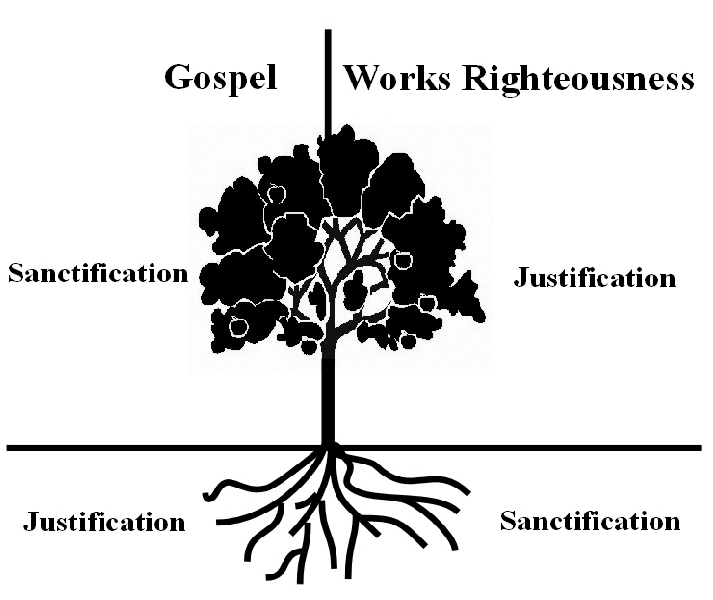
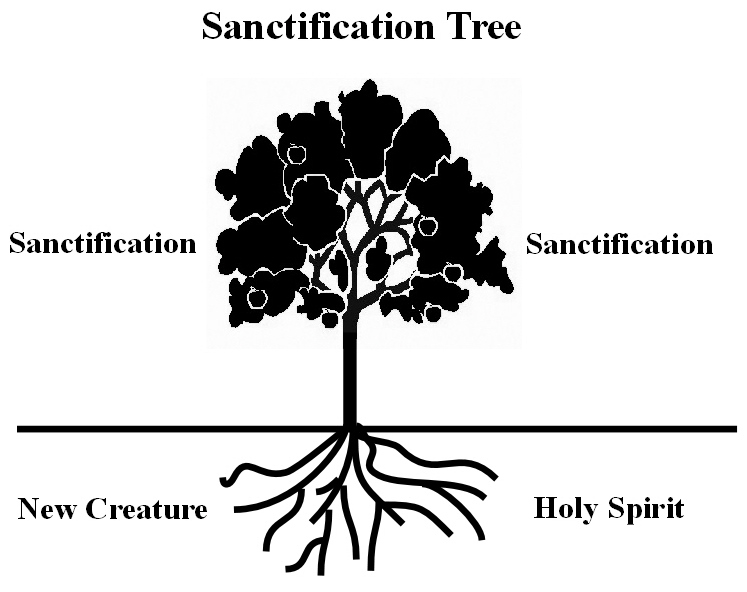
Orthodoxy: Sanctification is NOT “justification in action.” Justification is a finished work. Sanctification is powered by regeneration, not justification.
 Regeneration: New Birth enables the believer to work with the Holy Spirit. Justification is a finished work apart from sanctification.
Sanctification is cooperative. There are two partners involved in the work. I must work and God will work. If ever the extra-biblical maxim, “God helps those who help themselves,” had any truth, it is at this point. We are not called to sit back and let God do all the work. We are called to work, and to work hard. To work something out with fear and trembling is to work with devout and conscientious rigor. It is to work with care, with a profound concern with the end result.
~RC Sproul: Pleasing God p. 227
paul

 Paul's Passing Thoughts
leave a comment