Why Home Fellowships Can Help Abused Women and the Institutional Church Cannot

In our vision for a return to the way Judeo-Christian assemblies were done for about the first 300 years, let’s look at why home fellowships can help abused women and the institutional church cannot.
I would like to use this article as a catalyst for argumentation. The article was posted (author is not clearly stated) by Anna Wood who co-authored a book with Jeff Crippen, a Reformed pastor. The book can be found here.
The post is titled, What domestic abuse victims need from the church. My contention is that abused women cannot get what they need from “the church” as demonstrated over and over and over again. In fact, clearly, as also demonstrated over and over and over again as well, the institutional church adds to the abuse and becomes a co-abuser.
Why is this? The article offers a perspective from which to answer. This issue also speaks to the differences between home fellowships and the institutional church, hereafter “the church.” In an institution, it is easy to sign on the dotted line, give at the office, and pretend. Pastors can bark from Calvin’s Geneva pulpit all they want to; all folks have to say is, “Hey, I am a member in good standing, and as often heard, humble and incompetent—it’s not my gift and I am not qualified.” Likewise, in said article, the author’s call to “get involved” is going nowhere in the church in case anyone hasn’t noticed.
To the contrary, home fellowships are comprised of people who are sick of playing church, are weary of being mere spectators, and are not looking to walk into an arena with hungry lions, but know it could lead to that. They are also confident in the Spirit-filled laity and recognize where 500 years of academic popeism has brought us. In addition, they have a literal view of reality versus the functional dualism that drives orthodoxy. What am I saying? I am saying that home fellowships have a radically different worldview than orthodoxy and this will lead to aggressive participation in all kinds of needs.
Let me further this point by using the article at hand:
Statistics say that one out of four women in the United States experience domestic abuse of some form in their lifetime. Men can also be victims of domestic abuse. When those who have suffered are members of the Lord’s church, the faithful among them have an obligation to help them. And, if we know of someone in the community who is being abused, I also believe we have an obligation to help if we can. When, for whatever reason, we shy away from this obligation, either through ignorance or willful refusal to get involved, we lay waste to the Gospel we claim to believe. Christians are called to defend the oppressed yet when it comes to domestic violence, so few do.
What abuse victims need from their fellow Christians is pretty simple and straightforward. We need you to be Jesus to us. Do what He would do, say what He would say, were He the One ministering to us. Isn’t that what we all need from each other, anyway? Christians are called to stand in the place of Christ here on the earth and be His representative and do the works He would do. To fail in this is to fail in serving Christ.
Whoa, what a minute here! This is entirely unrealistic because of the message constantly drilled into the heads of Protestants. We are “all just sinners saved by grace.” We are, according to one prominent evangelical, “enemies of God.” According to yet another, “we hate God.” On the one hand, it is constantly drilled into the heads of those in the church that “when you are dead, you can do nothing,” but on the other hand we really think that parishioners shouldn’t think twice about getting involved in a domestic abuse situation?
First of all, getting involved in domestic violence is not “pretty simple.” Actually, it can get you killed by someone who doesn’t much appreciate your intervention. Moreover, getting the facts and evaluating the situation biblically is far from simple. Now couple that with the constant total depravity of the saints mantra heard in the church and it is little wonder that few will get involved in domestic abuse needs. The completely upside down worldview of the church makes laity involvement in domestic abuse nothing more than a pipe dream.
And, “Christians are called to defend the oppressed yet when it comes to domestic violence, so few do.” This complaint is not only a mere symptom, but is not even a symptom of the real problem. Congregants not only fail to defend the oppressed, they either turn a blind eye or defend the defender of the abusers—the church. Ever heard of SGM? Ever heard of ABWE? Ever heard of the SBC? In case you haven’t noticed, they are not only still in business, but business is booming! Why? Because regardless of what happens in the church, it is the only ticket to heaven. “What? so billions of people should go to hell because some bad things happen in the church that is made up of sinners? Well, get a grip—where there are people, there is sin!” That is in quotations because this is exactly what we hear in response to a “cry for justice.”
So far, if you are keeping notes, we have two reasons the church cannot help abused women: 1. The total depravity of the saints resulting in a few “experts” attempting to minister to a massive throng 2. Salvation is found in the institution, and therefore the institution will be defended at all cost. Better that a few suffer by themselves rather than all of humanity being sent to hell.
Before we move on to the next points, a little more clarification: why does the church defend abusers? It starts with its worldview. Without going into a lot of detail, we must first recognize that Calvin and Luther are the church’s heroes, and then recognize what their “theology of the cross” was all about. This is a philosophy that interprets all reality via the suffering of the cross. As Luther stated, “all wisdom is hidden in suffering.” Luther, as well as Calvin, split reality into two epistemologies: the cross story and the glory story. Only preordained leaders can lead the great unwashed masses in the cross story—only the preordained can save humanity from the story of man, or the glory story. As Al Mohler once said, “pastors are preordained to save God’s people from ignorance.”
 However, theologians of the cross and the spiritual peasantry have something in common: we are all just sinners saved by grace. So, everything going on in the material realm is fairly insignificant—it’s just the same old sin and dance anyway. But by the same token, theologians of the cross are preordained of God and invaluable. And besides, many are icons of the institution that keep the money rolling in. Sure, you can reject this theory and opt for another one, but in the process you will drive yourself nuts trying to figure out why ABWE defended and protected Donn Ketcham until the bitter end.
Need another example among myriads? What about Jack Hyles? The guy was a mafia don dressed in Bible verses and is still a spiritual hero among many Baptists. David Hyles, Jack’s son, was also a well-respected pastor in the church who had affairs with at least 19 women and is a suspect in an unsolved murder. Yet, to the best of my knowledge to date, David Hyles is still invited to speak at Baptist conferences/churches and receives robust ovations. Jack Hyles remained in the pulpit until his death in 2001 and was succeeded by his son in law Jack Schaap who is presently in prison for statutory rape. Jack Hyles is notorious for his quip, “If you didn’t see it, it didn’t happen” and is still revered among many Baptists as the best preacher since the apostle Paul.
The article continues with its list of things abuse victims need from “the church.” But the thesis of this article is that the church is not only unable to supply these things, but becomes a co-abuser. In contrast, the original Christian model for fellowship is well able to help and more likely to do just that.
First on the list is “The Pure Gospel.”
The church long ago got away from the pure gospel. We water it down, mix it up and serve it with a side of fun. No wonder it doesn’t save. It can’t save. It’s poison. We need preachers dedicated to the truth of God’s Word who are willing to stand up and preach that truth without changing it one iota. We need Christians who long after righteousness. When we have that–the pure Gospel preached and lived–we’ll see more Christians helping abuse victims and we’ll see less abusers masquerading as Christians.
Uh, ok, not sure how to add to this. It’s a stunning admission while calling on the same church to do something about the problem it has created. We don’t need “preachers” to do anything. Preachers have been preaching long and hard for thousands of years and the results are evident. We need God’s people to stand up and get back to the first works of home fellowship. The laity waiting on the experts is long traveled and worthless. More of what is beginning to happen needs to happen more and more. Ordinary Spirit-filled Christians are meeting together around the word and fellowship, and seeking God’s face in this whole matter about how church is traditionally practiced. And the fact that the church is grounded in a false gospel is something I addressed in another article posted today and Friday.
Without addressing every single point in the article other than those mentioned already, let me move on to this one:
Someone to care for their needs
Do you know what keeps a lot of abused women and children with their abusers? The lack of money to leave. If a woman is trying to get herself and her children to safety, don’t spend time telling her why she’s wrong, what you think about her decision or trying to talk her out of it. She knows what it’s like to live in abuse and you don’t. Even if she stays, chances are great that she and her children need something or maybe a lot of things. Financial abuse often accompanies other types of abuse. Instead of lecturing, get busy serving and help them.
According to the first-century model, a home fellowship network would be several small groups meeting in several homes in the same geographical area. And because of freedom from massive infrastructure cost and “tithing” versus New Testament giving based on NEED only funds and resources to help the abused would be ample. In fact, I could share an example from our very own home fellowship. We have a young lady living with us, and other people connected to our fellowship contribute financially to her needs. She is fully supported independently from anybody who might be a problem in her life. And when people live with you, trust me, you know the facts and you do a lot of listening. She will be completely self-reliant this month after living with us for about two years.
In regard to a different kind of abuse, a home fellowship network that I know of in Africa operates in the following way: the network assimilates street orphans from Nairobi into their fellowships. There is a leader from the network, equipped with the latest information about funds and availability that goes into Nairobi searching for orphans, and upon finding some, brings them back to the fellowship network where they will have a home, food, protection, and education. Let’s say that our home fellowships are connected with theirs; many of these children could be brought stateside and assimilated into fellowship here as well.
In addition to being freed from the bondage of infrastructure expense, the authority of the church’s clergy is suffocating. Clergy, more times than not, are control freaks obsessed with keeping the herd calm. They are spiritual cowboys constantly concerned with the herd being spooked. This speaks to the rest of the concerns in the post being considered here. More times than not, the laity are kept in the dark concerning the needs of those abused. There is a wall of confidentiality between the church’s “trained” counselors and the parishioners who fund the whole mess. When red flags are raised in regard to how certain situations are handled, we are told that “we should trust the elders who are closest to the situation and know all of the details.” This continually proves to be a recipe for disaster, and elders are granted NO such authority via the Scriptures.
Small groups in private homes offer intimate support and confidentiality from the other home fellowships. It is a perfect balance of intimate care and financial support if needed. All of the different gifts and experiences of Christ’s body are brought to bear on the situation.
Also, we must remember that the home fellowship movement is comprised of people from all walks of life: policemen, mental health professionals, etc., etc. These people or their areas of expertise are not separated from any situation by the professional clergy for inappropriate reasons.
paul
Here We Go Again: “The Church”
 In the video below which promotes a book on the subject, we have another example of this whole idea that God will bless America if “the church” is running the show. I wrote a post on this yesterday and defined what is meant by “the church.” In the video, this very term is used: “the church.” The key to America returning to greatness is “G-o-d, not G-o-v.,” via “the church.”
What is the assumptive presupposition? That, and this even coming from Rush Limbaugh of all people, some “concept of God” is key to strong leadership. What does this assume? It assumes what we swim in daily: God is not concerned with particulars. God is not concerned with the particulars of the Big T, truth.
Get out of bed, get dressed, put your hands over your eyes, walk a couple of steps into the day, and look, and there you will find an example. On Facebook the other day I saw a conversation among women who belong to “the church,” in this case Baptists and Methodists, clamoring about getting a group together to hear Beth Moore speak in Cincinnati, Ohio. Never mind that she flaunts her Eastern mysticism in broad daylight, she is a well-spoken, feel-good expositor that is part of “the church.” Her outfits are also to die for. ‘Nuff said.
This makes the case that mankind is helplessly enslaved to the concept of church state which is founded in the ancient doctrine of the knowledge of good and evil. It is the belief that creation is fundamentally evil and only the invisible is good. Moreover, the invisible is a subjective complex knowledge that takes a spiritual journey that should include everyone, and as many “gifted” teachers as possible. Faith in general, and “Christianity” in particular is a journey in pursuit of the gnosis. All who are on this journey are good and closest to the gnosis that brings wellbeing (utopia), those who are not part of “the church” are confused and cannot discern anything of the gnosis. They are not “spiritually discerning.” They are helplessly enslaved to material absolutes.
This is exactly how “the church” functions. It is an institutional church state wannabe. It is an institution that groans and weeps for the realization of Plato’s Republic. It moans and weeps for philosopher kings to save us from the abyss of people governing themselves.
It took mankind something like 10,000 years to break free from this tyranny and the historical demarcation was the American Revolution. The reason American ideology works so well when properly applied is because it has a biblical metaphysical premise: creation became weak, not inherently evil.
In addition, mankind in general can know things—mankind in general can know reality. Secondly, every person born into the world is responsible to God personally, and God speaks to every human being individually in a way that every person can understand. In other words, people are created free and culpable before God alone for the sum and substance of their own lives. The sole purpose of government is to insure that freedom for each and every person born into the world.
The framers of the American Constitution held that these principles were “self-evident.” Some were Christians, most were deists, some were agnostic if not outright atheist, the principle of individualism versus collectivism was the driving force—NOT where the principle came from! All of them agreed on the principle and the role of government and cared little about where the others thought the principle came from. What we see today is an emphasis on the source, not the principle. And this is the fly in the ointment: some “concept of God” can be interpreted in a variety of ways; in every case, enter tyranny.
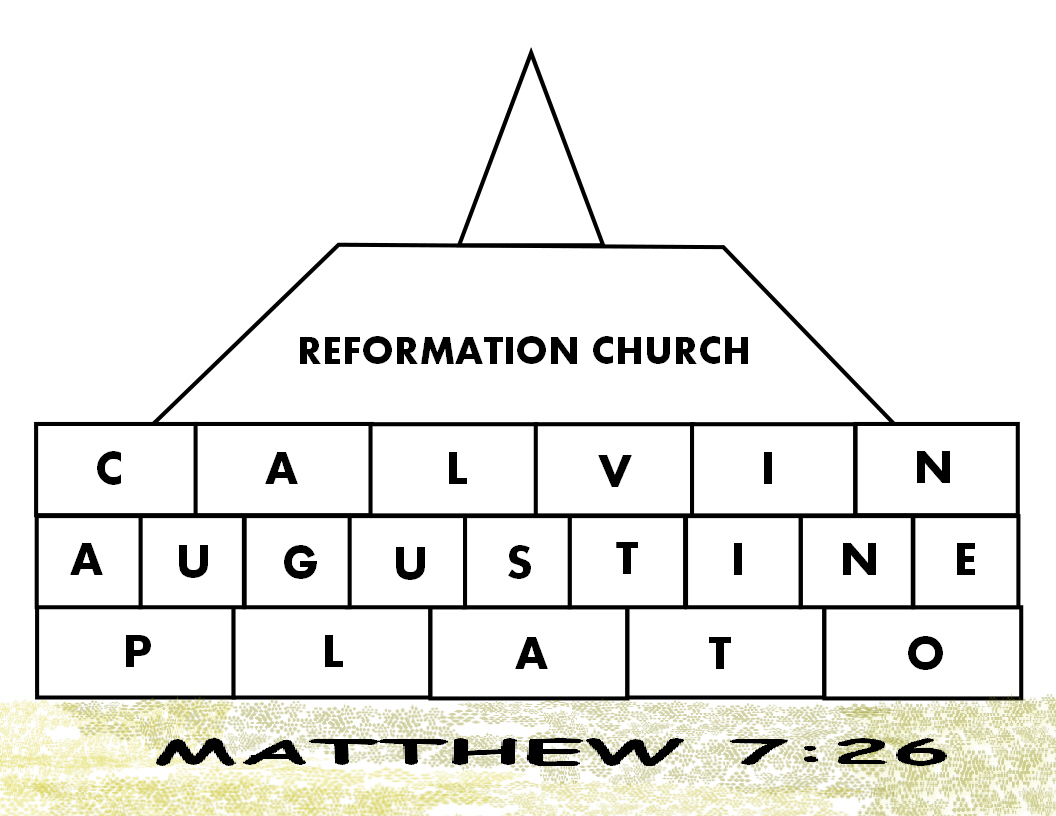
Hence, “the church” is a purely Platonist concept propagated by the big three of the Protestant Reformation: Augustine, Luther, and Calvin. A cursory observation of history reveals that all three were murdering despots. Most Christians, really all save a few, are helpless to know the difference because world philosophy is “worldly knowledge.” So, if the premise of what you really believe is unnecessary knowledge, the philosopher kings of “the church” can lead you around like a dog on a leash.
Want an example? Wherever you are, just remove your hands from over your eyes and look.
paul
What is “The Church”?
We hear it constantly, references to “the Church.” When discussing statistics, they are always in reference to “the church.” This is the term used constantly regardless of the fact that “church” can refer to Catholicism and an array of Protestant denominations including Charismatics and a myriad of Baptist stripes.
So, what is meant by “the church”? The concise definition is very obvious: the church is institutional theism. At least in Western culture, that is the starting point of accepted goodness that must prevail for the survival of humanity. In the same way that some parents send their children to Sunday school because “everybody needs some morals,” being a “Christian” is the minimal requirement for being unhazardous to humanity.
Hence, we have another definition: a “Christian” is someone who is identified with institutional theism, or “church.” And again, this is a societal Good Person Seal of Approval. For example, even President Obama claims to be a Christian and is a member of an institutional church. No Presidential candidate would have a prayer of being elected without some sort of religious affiliation whether Catholic or some breed of Protestantism. Quality of faith is far from being the issue, but the minimal requirement is a wink towards “the church.”
Being a Christian in America means you are a member of the institutional church which is anything theism. If you are a member of a theistic institution, you have good intentions and nobody has a right to judge your path to the pearly gates. Go to any Baptist church and start criticizing Catholics and you will quickly hear about all the Catholic friends they have who are saved and loved by God. Go to any of the National Day of Prayer gatherings and you will see that everything but the religious kitchen sink is there.
“The church” is the “Christian” club and means, not atheist, but rather any and all things theistic. Even the umber pragmatic Rush Limbaugh concurs. Just the other day on his radio program he stressed the importance of people, especially political candidates, having some “concept of God.” Bingo. A belief in some sort of deity: good; not believing in some sort of deity: bad. Limbaugh associated atheism (the Greek article “a” which means “anti” prefixed to “theism”) with being deceived about all sorts of things including global warming which he mentioned specifically.
Dr. Jay Adams, in a recent article, assumes that there are enough doctrinally sound churches in a given town or city to prevent “church tramping.” In my book, “church” and “tramp” are mutually inclusive.
When did “church” begin? The etymology of the word is German (kirche), and replaced the Greek word for “assembly” found in the Bible manuscripts (ecclesia). The word “synagogue” also means “assembly” or “congregation.”
The first complete English bible was the Tyndale bible in about 1524, and that bible did not use the word “church” anywhere in its pages, it used the word “congregation.” Sometime after this bible, they started replacing the word “congregation” with the word “church” (Christ’s Ekklesia and The Church Compared: Richard Anthony; http://www.ecclesia.org/truth/ekklesia.html).
However, the concept of church started much earlier in history after the deaths of the twelve apostles. The early church fathers, at least according to the English translations, used the word “church” often. Several of the early church fathers were disciples of the original twelve apostles and deemed authoritative theologians of that era.
Unfortunately, an apostolic succession controversy took place immediately following the passing of the twelve apostles. Regardless of the fact that the twelve established a home fellowship model led by elders and organized by deacons, and predicated by gifts rather than authority, many of the church fathers argued that chaos and doctrinal abyss would ensue unless the authority of the twelve was replaced with a like central authority.
However, even the apostles pointed to Christ as the only head and rarely implemented apostolic authority. The principle protocol was that of persuasion by apt teaching from the Word. Nevertheless, the church fathers insisted on a central hierarchy located in Rome that would rule over what they called “the church.” The first “ruling bishop” of Rome was Linus who was a disciple among the original twelve and an early church father, and for all practical purposes, the first pope. Later, Protestantism came out of the institutional church which originated in Rome.
The home fellowships established by the apostles contended against the institutional church for about 200 years until home fellowships finally began to give way in the 4th century. Unfortunately, the home fellowship model only continues in certain geographies because of necessity, usually economic or governments that prohibit organized religions that follow Christ.
Obviously, “the church” is little concerned with “sound doctrine” emphasized by the original twelve. The focus is some “concept of God” defined by “Christianity.” It is quite enough that the first Republican announcing his candidacy is calling himself a “Christian,” and has included video of his family praying before a meal in a TV ad—no one will ask for any particulars, the main concern is that he’s not an atheist and is a member of formal theism. The main concern is, does he have a “concept of God”?
This is where the home fellowship movement has opportunity. We are NOT “the church.” And by today’s definition, we are NOT “Christian.” And if nothing else, that will spark curiosity. But more than that, when the freedom to pursue sound doctrine is fully exploited, I wonder what the Spirit might do?
paul
Love Your Local Institutional Church
 One of the advantages of having Calvinist friends on my Facebook friend list is that little gems like this one appear in my news feed from time to time. The article is entitled “Do You Love the Church Like Jesus Does?” It was written by a young man named Mark Perry, Associate Pastor of Westerville Bible Church in Westerville, Ohio, a suburb of Columbus. Mr. Perry could be considered to be of the “young, restless, and reformed” variety.
The opening caption of the article asks the question, is it possible to love Jesus and not love His church? Obviously, a question such as this establishes the premise that such a thing is not possible. We are to assume that these two things are not compatible. If you don’t love the church then you must not love Jesus. The purpose of the article seeks to first define the “church” and then make the argument of why and how we are to love it. Again, you can read the entire article here, but I have reproduced the body of the article in this post so that I can offer a review of Mr. Perry’s arguments (in italics) and insert my comments to relevant sections that I want to point out to you.
Do You Love the Church Like Jesus Does?
What is the church?
We use the word “church” in many different ways. How can we pinpoint what that means? In Ephesians we are told that “Christ loved the church and gave himself up for her” (Eph 5:25). We can identify the church by asking for which “church” Jesus died.
The church is not the building in which believers assemble. We often use the word church to refer to the building: “What a lovely church!” or “The church could use a new coat of paint.” But surely this is not the church for which Jesus died. In fact, New Testament congregations met in members’ homes (e.g., Rom 16:5; 1 Cor 16:19; Col 4:15; Philemon 1:2). In many parts of the world today, our brothers and sisters in Christ meet in homes, parks, or public locations. It is not necessary to own property or have a physical building dedicated to the regular assembling of Jesus’ body.
So far so good. All very well stated. These are all things that Paul and I have both stated on regular occasions. I would agree with Mr. Perry on this point. Notice how he establishes that the church is not a building. In fact, he goes to some length to establish what the church is not, thereby framing his argument to follow. Reading on:
The church is not the meetings or ministry programming. Another way we use the word church is to refer to a worship service or ministry program: “Church was great this morning; I really enjoyed the sermon.” “My church has so many ministry opportunities available.” Many people see the church as the sum of services or ministries offered: children’s ministries, fellowship opportunities, teaching and preaching, or other benefits offered to members or adherents. But did Jesus die to secure singles’ ministries, Vacation Bible School, and youth groups? Did Jesus love a certain style of music or preaching so much that he left heaven to give his life? Every generation of believers since the book of Acts has had to work out how to obey Jesus’ command to make disciples in their culture.
Ok, here he starts to drift a little. First of all, we don’t have to “work out” how to obey Jesus’ commands. His commands are clear. We either do them or we don’t. The way we make disciples or “learners” is by teaching them exactly what Jesus said to do. The message of the Gospel of the Kingdom is not culture-specific. It is the same for all men everywhere. We don’t have to “figure it out.”
The other thing I notice in this statement is the implication that evangelism takes place within the confines of the institutional gathering or its ministries. This is patently false. Evangelism is an individual mandate. We don’t bring the unsaved to the church through the means of some “program” or “ministry” in order to get them saved. We as individuals go out to them and preach the gospel to them. When they hear and believe and become saved, we then invite them to fellowship with the assembly for the purpose of edification.
Moving on…
The church is the regular assembly of believers in Jesus. We often say, “The church is the people”
This is correct. Yay! The reason we often say it is because it’s true.
and we are right—almost.
Wait…Huh? What do you mean “almost?”
On one hand, the universal church includes all believers in Jesus from the Day of Pentecost until the Rapture. At the moment of Jesus’ return in the air, the universal church will be assembled for the first time: “those who have fallen asleep” and “we who are alive, who are left” (1 Thess 4:14, 17). But until that time, the church exists on earth in localized assemblies of believers who meet regularly for prayer, Scripture reading, teaching of apostolic doctrine, and fellowship (Acts 2:42). The Greek word translated “church” (ἐκκλησία) means assembly or gathering and sometimes in the New Testament it even refers to groups of unbelievers (e.g., Acts 19:32, 39, 41).
Ok, while I don’t see the NT making any distinction between “universal church” and “local church”, nevertheless his other points here are spot on. And he would have been better served stopping right there, but he didn’t. Read on…
The church is the church when it is assembled.
WHAT? Read that again. He said, “The church is the church when it is assembled”? The logical inverse of that statement would necessarily follow that the church is not the church when it is not assembled. But he just said the word “church” is the word “ekklesia” which means “assembly.” The reality of his statement indicates that the church does not exist when it is not assembled. That would mean the church only has relevance when it is assembled.
At the beginning this author made points about what a church is not. It is not a building, it is not a program. But please notice his emphasis is still on some group entity over the individual. And this is something that “Argo”, a blogger who frequently comments on Paul’s Passing Thoughts, has written on extensively over the past few weeks. In Reformed and Protestant orthodoxy, there is no relevance or meaning or existence outside of the group! To them, our relevance as believers only matters within the church. So, when we are not assembled, we don’t matter.
It is those believers who regularly gather in Jesus’ name. Therefore, the church that Jesus loves and for whom he died is the gathering of believers. These local assemblies or gatherings of believers are the only church we can know this side of heaven.
I would dare to ask Mr. Perry that if the church is the Body, and we are individual members of that Body, each with our own function, then do we cease to be a part of that Body when we are not assembled? Are we only part of the Body when we meet on Sundays (or Wednesday, or Saturday, or any other required meeting time/place)? I contend that our relevance as believers extends far beyond that which we do when we gather for fellowship. And our not being assembled together in fellowship at any given time does not preclude our identity as a member of the Body of Christ. He continues:
What does it mean to love the church?
We are commanded to “walk in love, as Christ loved us and gave himself up for us” (Eph 5:2). In other words, we are to love the church just as Jesus does. The command to love Jesus’ church is the same as the oft-repeated New Testament command to “love one another” (e.g., Rom 12:10; 13:8; 1 Thess 3:12; 4:9; 2 Thess 1:3; 1 Pet 1:22; 4:8; 1 John 3:11; 4:7, 11, 12; 2 John 1:5). So we love Jesus’ church when we love the brothers and sisters in our local assembly.
What about other brothers and sisters in other assemblies around the world who are not part of our cult group assembly, who don’t necessarily share all the same beliefs in matters of practice? Are they not a part of the body because they don’t assemble with us? Is our church somehow better/superior to their church because we don’t “worship” the same way they do, because we “do church” the “right way”? Are they any less part of the body of Christ? Are they part of the assembly because they are born-again believers in Christ or instead because they regularly assemble at our “church”?
And this is where it gets difficult. We may love our church’s beautiful building, we may be enraptured by our favorite preacher’s sermon series, or we may appreciate the array of ministries and opportunities our church offers, but loving these difficult, obnoxious, unkind, and sinful people is a different matter entirely! Jesus’ love for us is our example to love his church. What about the sinful people in my church? Jesus loved me while I was a sinner (Rom 5:6–8). What about the cantankerous or antagonistic people in my church? Jesus loved me while I was his enemy (Rom 5:10). What about the people who have weak consciences or unreasonable standards in my church? Jesus served others, not himself (Rom 15:3; Mark 10:45).
Mr. Perry must not think very much of the members in his church. Look at what he calls them: “difficult, obnoxious, unkind, and sinful people… cantankerous or antagonistic… people who have weak consciences or unreasonable standards”. Wow, I sure want to be a part of that church now that I know what the pastoral staff thinks of me! The view of the continued total depravity of the saints is clearly evident in this paragraph. The Bible does not call believers “sinners”. That is what we were in the past. Let us not forget the rest of 1 Corinthians 6:11, “…but ye are washed, but ye are sanctified, but ye are justified in the name of the Lord Jesus, and by the Spirit of our God…” Believers are righteous, Mr. Perry, because we have the righteousness of God the Father. We have His seed in us that cannot sin! (1 John 3:9)
As I continue to read these last points, the emphasis of the church as an institution (…our church’s beautiful building…preacher’s sermon series…array of ministries and opportunities…) vs. a body of individuals is apparent. The “church” is referred to in terms that place the emphasis on this “entity” that is something other than the body of Christ. It is very subtle, but the undertones are there.
How can we love the church?
How then can we “walk in love” and serve one another through love (Gal 5:13)? Here are four practical ways.
Meet regularly with Jesus’ church. Don’t turn your back on Jesus’ church because you don’t like the facilities or prefer a different ministry emphasis. Don’t abandon Jesus’ church for something that is not the church. Jesus has promised his presence with his church until the end of the age (Matt 28:20). Jesus meets with his church—do you?
There is a veiled threat in this point regarding abandoning the church. What happens to the one who abandons the church? What is the “something that is not the church”? Do you not see the equivocation here that if you are not part of the church then you are not a part of the Body, ergo, you are not saved? Whether or not it is stated plainly, reformed orthodoxy functions under the belief that salvation is found within the institution.
Pray for Jesus’ church. If you see problems [sic] When you see problems in your church, pray for your church.
Yes, by all means, we ought to pray for each others’ needs as we fellowship together. We ought to pray that our fellowship time is efficacious. We ought to pray that we would be on our guard for wolves who would do violence to the flock, and that we would be discerning regarding false teaching. But that is not what this author has in mind. His concern here is with the actual institution itself. Consider report after report of spiritual abuse and scandals that have rocked the religious word in the last few years. But yet it is these same institutions that must be preserved for the “cause of Christ”, regardless of the problems that exist. Look at this next paragraph:
Are you concerned about your church? Remember Jesus loves his church—he died for her—and he cares for your church more than you ever could (Rev 1:12, 20). We pray with confidence when we pray according to God’s will (1 John 5:14), and we know what God’s will is for the church—that she becomes like Jesus! This is what God is at work doing (Phil 1:6; 2:13). Pray the God-breathed prayers of the New Testament for your church (e.g., Eph 3:14–21; Phil 1:9–11; Rom 15:5–6; 1 Thess 5:23–24). Jesus prayed for his church (John 17:20–26) —do you?
Notice the collectivist emphasis in terms. The individuals are expendable. The “church” must become like Jesus, not individuals. We must pray for God’s will for the “church”, not the individuals. Jesus died for the “church”, not the individuals. Jesus prayed for the “church”, not the individuals. But consider that last reference in John 17 carefully. When Jesus prayed that night in the garden, he wasn’t praying for a church, he was praying for you and me! He was praying for the PEOPLE, the individuals that comprised His Body.
Follow the spiritual leaders Jesus has placed over his church. If you don’t like or don’t “click with” your church leadership, you might be tempted to turn your back on Jesus’ church. In fact, disagreement with the teaching or ministry direction of our leaders is a very spiritual-sounding reason for abandoning the group of brothers and sisters to whom we have committed ourselves
It’s more that just “spiritual-sounding”, it is commanded by Scripture! Come out from among them and be ye separate. Earnestly contend for the faith. Mark and avoid those who cause divisions because of contrary doctrine. But somehow this is abandonment?
But if Jesus was going to show us something new from his Word or to correct a misunderstanding we had about the Bible, how would he do that? Wouldn’t he use the leaders and teachers he has given to his church for that very purpose (Eph 4:11–14)? It seems the Chief Shepherd would use the shepherds he has set up over his church (1 Pet 5:4–5) to “keep watch over your soul” (Heb 13:17). Jesus, the Great Shepherd of the sheep, entrusted the church for which he died to your elders (Heb 13:20–21; Acts 20:28)—do you follow them?
First of all, there is nothing “new” in the Bible. We’ve had it for 2000 years or more. Are leaders and teachers giving us new revelation? Do they have some special dispensation or gifting that enables them to speak for God? Has God divinely appointed them (predetermination) to be in a place of authority, and so we must obey them? No because pastors and teachers are gifts given for the purpose of equipping and edifying the assembly, not for the purpose of authority or speaking for God. There is no mediator between God and man other than Jesus. We don’t need men to interpret God’s word for us. Shepherds guard and protect, they don’t rule. They see to the needs of the flock so that each believer can be effective in his own ministry. They don’t dictate to the flock how to think and act.
Put the spiritual needs of Jesus’ church above your own preferences. Often our opinions about how the building should be decorated or the way in which the meetings or programs should be set up are more important to us than the spiritual needs of our brothers and sisters.
Mr. Perry keeps bringing up these references to the building and ministries after he made it a point early on to emphasize that the church is not either of these. Why do these thoughts constantly permeate our thinking? Because it’s been ingrained into our mindset. This beast has created all of its own problems. Matters of preference or décor or carpet color or music choice or programs or how much to tithe all become moot when we simply get back to a Biblical model of fellowship.
If anyone could have lobbied for his own interests instead of giving himself for his church, it was Jesus (Phil 2:3–8). Jesus gave up his rights and reputation for his church—do you?
This is obviously a reference to Philippians 2:7, “But made himself of no reputation…”, but this same passage also states that Jesus gave up nothing, but instead constantly affirmed His equality with the Father.
Next Lord’s Day, as you gather in Jesus’ name with that group of believers you call your brothers and sisters in Christ, look around and ask yourself this question: “Do I love this church like Jesus does?”
Thankfully, that is the end of the article, because there is much more I could add, but I’d be writing forever. The bottom line here is that consistently the emphasis in the NT regarding the church is the assembly, or the individual members of the Body. We are to love the people, not this thing they call the “church”. Reformed and Protestant orthodoxy equivocate whenever it speaks of “church”, and that is by design. Their double-speak confuses and obfuscates the real matter- their belief of salvation being tied to the institution, and not the finished work of Christ. When you love the people you are loving the church because we are all members of it every moment, not just when we gather for fellowship. We are individual members of a Body, and no man ever hated his own body. We have got to be clear what we are talking about when we use the words we use!
Andy
An Answer for Lisa and Jane Doe
Noah’s wife must have been an interesting person. Imagine being married to one of the few men on earth who is right. If Noah wasn’t a compromiser, and I tend to think he wasn’t, Noah’s wife would have lived in isolation for the most part. I was surprised to find a significant amount of data on her. Though it is debatable, some think her name was Emzara, but that assertion is mostly tradition. Her major role in Noah’s ministry was behind the scenes, and apparently, she never did anything to rock the boat. Pun intended.
I will admit it, I have the best commenters here at PPT available on the internet. They are not many, but they are thinkers. They also love the truth. Some, like Lisa, are searching. Not for A truth, but for THE truth. That’s important. Lisa is an anti-type of the kind of “Christianity” that the apostles predicted would be prevalent in the last days. Here is her comment:
Hi, Paul-
I have been reading through your posts for a few months. I am on a truth quest, and have been awakening over the course of the last 15 months to the amazing amount if deception in the American church. I must say I am greatly dismayed–it seems that any teacher of note is a fraud of some sort. We spent years in the SBC, then went looking for something “real.”
After escaping the mindless crush of Stepford Christianity (seeker driven/church growth), and awakening to the underlying dogma (courtesy of Peter Drucker), I began looking into the various reformed denoms. Early on, we discarded the YRR/ Driscoll crowd. After some investigation and disappointment, Piper was out. Then, I began to look at the differences between Calvinism and Lutheranism.
That is about where I came across your blog. You make very compelling arguments against Luther, Calvin, Protestantism as a whole, and virtually every remaining pastor I hoped had something helpful to teach. I am not saying I think you are wrong, but I have a pretty good idea of what you DON’T believe, but no clue what you DO believe. What is left? Help!
Thanks!
Lisa
While writing this post, I received an email that echo’s Lisa’s concerns as well. The writer’s identity is protected by referring to her as “Jane Doe.”
Hi, I came across your blog while doing my own research on James MacDonald and his controversies. I have read through many of your past blogs and comments, in particular those relating to Calvinism.
Honestly, my head is spinning and my heart aching because I don’t know whether I am an even bigger fool than I thought for falling for MacDonald’s dog n pony show, or am I heading down another path of false teaching/opinions.
When I read your blog and others’ with your same opinions I realize that basically everything I listen to on Moody radio is essentially a farce. YIKES!.. I really thought I was headed down the right path but now I think I might be a Calvinist and I am alarmed by this.
I’m just a mom, raised in the [omitted] tradition. I attended a [omitted] university and over the last 20 years found myself clinging to Moody radio and my local congregation. I’m questioning Moody and am wary of most churches because they all seem to tout McArthur, Piper, Francis Chan, Rick Warren, Platt and guys lined up with JM.
I’m afraid I researched myself out of any affiliation with anyone. All I can hope for is to read my Bible with fresh eyes.
Sorry, you take the brunt of my sadness.
Jane Doe
Everybody just stop right now. Jane and Lisa are asking the same thing: “Where is THE truth???” When the truth is hard to find for truth-lovers, that’s a bad life. But Jane and Lisa are in a good place filled with hope. Jane and Lisa are experiencing what the apostles said would be taking place in the “latter part of the latter days.” This is twofold. First, “Christians” will be looking for A truth rather than THE truth:
2Timithy 4:3 – For the time is coming when people will not endure sound teaching, but having itching ears they will accumulate for themselves teachers to suit their own passions, 4 and will turn away from listening to the truth and wander off into myths.
Secondly, sound doctrine will not be tolerated.
Is this not descriptive of the day we are in?
As were the days of Noah, so will be the coming of the Son of Man.
This is in a manner of speaking, it won’t be technically as bad (the gates of hell will not prevail against the church), but why do thousands upon thousands of “Christians” pay 100-400 dollars each plus travel expenses to hear from mere men with a bunch of Plato Academy titles after their names? It’s insane. These men will not give an account for our lives before Christ, and Lisa-n-Jane know it. They are taking responsibility for the sum and substance of their own lives before God—the lives that bear their names. Good for them.
Salvation is NOT found in Augustine’s institutional church; Jane and Lisa know that also.
Now, we first address Lisa’s question:
…but I have a pretty good idea of what you DON’T believe, but no clue what you DO believe. What is left? Help!
What we do believe can be found here, here, here, here, and here. TANC is a research institute that is also offering alternatives to the false Protestant church. Like Lisa, we are on a “truth quest” as well. Welcome to the quest Lisa. Christ said that those who seek truth will find it. The quest’s end is assured. TANC is far from claiming to have all of the answers, but we are developing frameworks to help the priesthood of believers in their exodus away from the Augustinian church here, here. and here.
The alternative is the unpublicized massive home fellowship movement afoot in this country. Christians are figuring out that the authority of the church is found in the Scriptures, not an institution created by Platonists. TANC is trying to set the example with The Potter’s House Home Fellowship movement. This is not difficult. We meet every Sunday night at 6pm for a fellowship meal. At 7pm, we have a Bible lesson till 8pm, and then more fellowship.
“But where in the world would we start if we decided to do that?” Well, can you cook and talk? That takes care of the fellowship part. As far as the Bible study part, we have several key studies to help people get started. Our study through the book of Romans is very foundational in regard to a framework to start with. Some people merely print copies of our Romans series, read them, and have a group discussion. This is not a difficult start. Let the authority of God’s word guide you from there.
Have you been duped? I will only speak for my wife Susan and myself. Susan and I have 80 years of Christian experience between us, and we have learned more in the past year than we have in all of our Christian lives. Were we formally duped by the traditions of men?
Yes. Big time.
paul

 Paul's Passing Thoughts
3 comments