TGC Part 18: Michael Horton Drama, “The Wordless Gospel”
 In this clip, Horton explains his belief that the law and gospel are separate. Only problem is, the law isn’t just the Ten Commandments, it’s all of Scripture (Psalms 1:1-6 Matthew 4:4 among hundreds that could be cited). Therefore, the law informs us as to what the gospel is, so how can you separate them? Horton, in this clip, explains that the law can give us guidelines for purposes of which we will always fail to accomplish, but the gospel is a “promise” from God that will always be accomplished because it is of God. So the law doesn’t contain any promises? That’s just crazy, and obviously untrue. In usual GS doublespeak, Horton says we need “purposes” (ie., the law), but they can’t “drive” us. In other words, we need purposes, but they don’t do us any good. Huh?
“The ‘Gospel’ Coalition” Series, Part 10: How Can Something Be “New” if it’s Not Different?
Advocates of GS/Sonship that protest my writings must ask themselves the following: what is it, exactly, that the propagators of GS/Sonship say is so different? On the one hand, people write me and deny my representations. On the other hand, what then are the differences that the proponents themselves describe as “A radical departure” (Russ Kennedy, director of a NANC training center in Dayton OH), a “Modern ‘Reformation’” (the name of Horton’s magazine publication), different from the “vast majority” of “professing” Christians (Tullian T.), different from “hordes” of other Christians (Paul David Tripp), a “New” Calvinism? What’s “new” about it? If my proposed differences are incorrect–then what are they exactly? The former director of the aforementioned NANC counseling center in Dayton OH said that the GS (of course, he didn’t use that label) hermeneutic was “a whole new way of reading the Bible.”
Let me ask: how can someone choose a church to attend when they don’t even know how the pastor of that church “reads his Bible”? Sure, who is going to object to constantly hearing about who Christ is and what he did throughout the Old and New Testaments? Nobody, unless they stop and think about it. Christ was constantly annoyed by people who wanted to focus on other things besides his commands and instruction (Luke 11:27,28). There are two distinct ways of interpreting our Bibles in this day that will yield different results—the GS proponents themselves say they have a different way of interpreting the Bible. Is this not a major issue? How many Christians know the difference between the Redemptive-Historical hermeneutic and the Grammatical-Historical hermeneutic?—No Christian that I have ever asked; and moreover, how many attending this year’s TGC conference even know? However, have no fear; apparently, both sides are going to be presented. Ya, right.
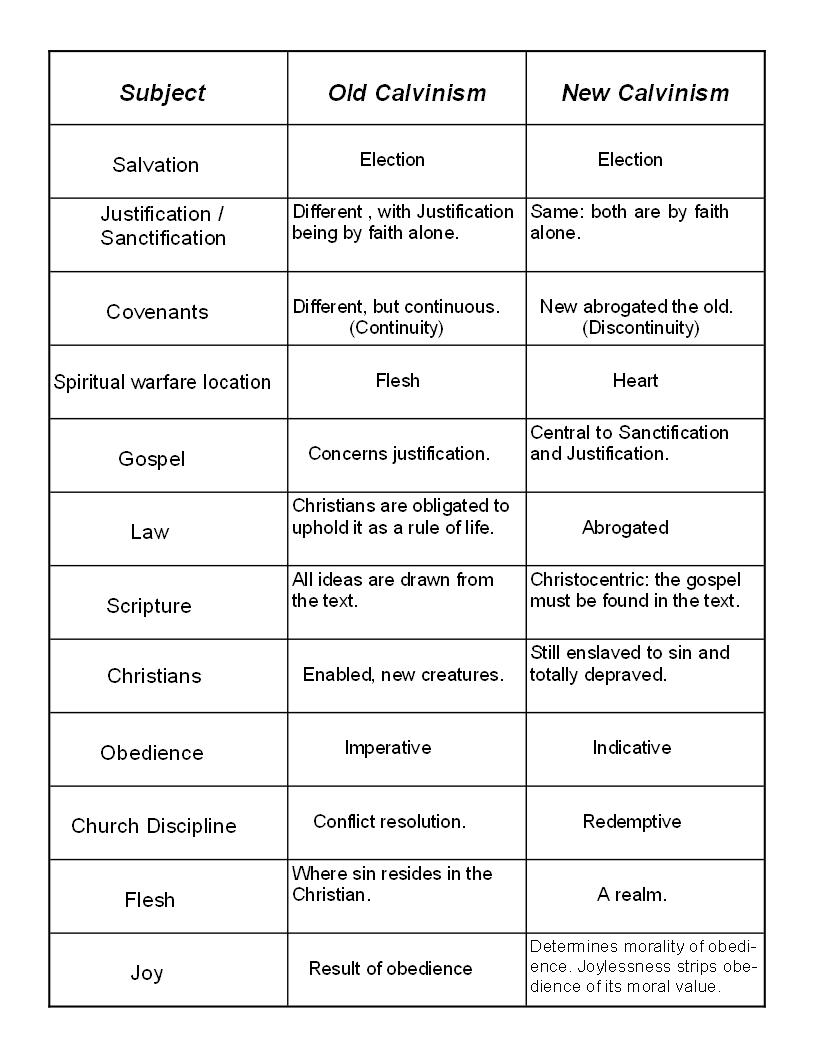
I have a better idea. One of the seventy teachers that are going to be there should make a chart with old Calvinism on the left, and New Calvinism on the right to help explain why it is “new.” List theological elements on the far left and the differences between the two can be noted in the short descriptions under each new/old heading. My proposed chart follows. Please feel free to print it and take it to the conference with you. It is not meant to be comprehensive or indicative of what ALL GS proponents believe, but merely an instrument to provoke discussion. However, the chart does indicate my conviction that the two are only similar on the election issue.
paul
“The ‘Gospel’ Coalition” Series, Part 9: The Five Points of New Calvinist Contradictions
Point One: The totally depraved preaching the gospel to themselves everyday. We gotta believe that they aren’t very good sermons (Jess—thanks for this one).
Point Two: Do what you know God wants you to do even if joy is not present, but it is sin. So, there are some situations where God would prefer that we sin (ebook: “Delight as Duty is Controversial,” John Piper, Desiring God website).
Point Three: New Calvinism encourages us to contemplate Christ in the Scriptures to make Him bigger and us smaller. The bigger the Jesus, the more humbled we are, and the more we realize how worthless and totally depraved we are as well. Yet, no Christian movement in all of redemptive history has invested more in IMAGE than the TGC and T4G. No “Christian” movement in redemptive history has been more image conscience than the leaders of TGC and T4G, sporting their super-yuppie sports wear and Sarah Palin like eyewear. No group of leaders has ever sought to draw attention to themselves via niche identity / personality / credentials like this group.
Point Four: Two different interpretive hermeneutics. When a text seems to confirm their doctrine literally (especially Gal 2:20), they want you to interpret it literally. But when not, they want you to view the text “in its gospel context,” ie., Christocentric hermeneutics.
Point Five: In my opinion, more deliberate deception than contradiction, is the TGC and T4G’s contentions against postmodernism and the Keswick movement, when they share many of the same elements. Note what Terry Johnson writes concerning Sonship theology (pdf available in right column):
“Many of us will have to be forgiven if we hear the quacks of the “higher life” movements from which we ostensibly escaped by coming to the PCA. We fled Keswick, the “Victorious Life,” the “Abundant Life,” and other perfectionists aberrations into the safe and sane arms of Westminster/ Puritan spirituality. Forgive us if we are nervous about losing the realism and balance of Reformed piety, where grace and law, love and duty, affection and fear, God’s power and our responsibility all stand in beautiful, biblically proportioned relation to one another. We liked the products of that spirituality: the Huguenot, the Puritan, the Covenanter; the modern missionary movement, the Protestant work ethic, precise morals, zeal for holiness, faithfulness amidst suffering, and what Packer calls “an ardor for order,” that orderliness that facilitates the fulfillment of all one’s duties. We will not quickly abandon this heritage for a reformulation that quacks suspiciously like the failed stepchildren of Wesleyanism.”
paul
“The ‘Gospel’ Coalition” Series, Part 8: A Note to the Misled Sheep
When you go to the 2011 TGC in Chicago, you will here a lot of GS / Sonship mantras that criticize “living by lists,” “living by do’s and don’ts,” “being God’s man, not a lawman,” “serving God out of duty,” “obeying in your own efforts [what they mean is any effort on your part at all is an attempt to obey God without depending on him],” etc., etc., etc. All the red herrings aside (no Christian advocates a grueling, joyless sanctification, but neither do we say it is always joyful), here is an article by Craig W. Booth that rightly divides the word: http://thefaithfulword.org/2006marchblogarchives.html#1a
A very edifying read—thanks to the reader who shared it.
paul
“The ‘Gospel’ Coalition” Series, Part 7: The 5 Points of Your New Calvinist Arrogance
Point One. Your Name: It insinuates that you’re the new and improved version of “old” Calvinism. Which is not only arrogant, but a lie as well.
Point Two. Your apologetics: You believe that you preach the only true gospel. One example would be what Michael Horton wrote on page 62 of “Christless Christianity” where he states that any separation of justification and sanctification results in the lose of BOTH. The synthesis of the two is the crux of the New Calvinist gospel.
Point Three. Your hermeneutic: One of your mantras plainly states how ALL people approach the Bible. The judgment is that NOBODY approaches the Bible with an open mind. One of your haughty teachers states it this way, “How we answer the question must be shaped and limited by the word of God. But we approach the word of God with assumptions, presuppositions, biases, historical understandings, and personal filters. None of us come to the word as empty slates; we have ‘tilts’ that may or may not be known to us.” And I will give you three wild guesses as to who can lead us in the right direction! Basically, New Calvinist leaders teach their followers that they have an inability to properly ascertain truth; or at the very least, should ALWAYS be in doubt of what they have read or studied. As I have said before and will say again, this shows New Calvinism’s kinship to postmodern thought which devalues the ability to know absolute truth absolutely. But more to the point, it dogmatically proclaims a restriction on the ability of others to understand the word of God on their own.
Point Four. Your Theology: Your view of law and gospel states that you are “free” from the law while EVERY other Christian who believes the law has a role in sanctification is still IN BONDAGE, ie., you are free and we are still in bondage. Gag, it’s not only arrogant, it’s also a lie.
Point Five: Your eschatology: You have informed Christ that He has low self-esteem, and you have fixed that for Him by making every verse in the Bible about Him and deemphasizing “an issue about a sliver of geography that eclipses Christ.” How dismayed you will be when he doesn’t thank you at the judgment.
paul

 Paul's Passing Thoughts
2 comments